

EN 16247-3:2022
(Main)Energy audits - Part 3: Processes
General Information
- Abstract
This document specifies the requirements, methodology and deliverables of an energy audit within a process. These consist of:
a) organizing and conducting an energy audit;
b) analysing the data from the energy audit;
c) reporting and documenting the energy audit findings.
This part of the standard applies to sites or parts of sites where a significant part of the energy use is due to processes. It is used in conjunction with and is supplementary to EN 16247-1, Energy audits - Part 1: General requirements. It provides additional requirements to EN 16247-1 and is applied simultaneously.
A process can include one or more production lines or services, offices, laboratories, research centres, packaging and warehouse sections with specific operational conditions and site transportation. An energy audit can include the whole site or part of a site.
If buildings are included in the scope of the energy audit, the energy auditor can choose to apply EN 16247-2, Energy Audits - Part 2: Buildings. If on-site transport on a site is included in the scope of the energy audit, the energy auditor can choose to apply EN 16247-4, Energy audits - Part 4: Transport.
NOTE The decision to apply Parts 2 and/or 4 is expected to be made during the preliminary contact, see 5.1.
- Status
- Published
- Publication Date
- 16-Aug-2022
- Technical Committee
- CEN/CLC/TC 14 - Energy management, energy audits, energy savings
- Drafting Committee
- CEN/CLC/TC 14 - Energy management, energy audits, energy savings
- Current Stage
- 6060 - Definitive text made available (DAV) - Publishing
- Start Date
- 17-Aug-2022
- Due Date
- 16-Oct-2021
- Completion Date
- 17-Aug-2022



Overview
EN 16247-3:2022 - Energy audits - Part 3: Processes is a CEN European Standard that defines requirements, methodology and deliverables for conducting energy audits where a significant share of energy use is driven by industrial or service processes. It supplements EN 16247-1:2022 (General requirements) and is intended to be used alongside other parts of the EN 16247 series. The standard covers organizing and conducting audits, analysing process energy data, and reporting/documenting findings for whole sites or parts of sites (production lines, utilities, laboratories, packaging, warehouses, on‑site transport, offices, etc.).
Key topics and technical requirements
- Scope and boundaries: Defines how to agree audit scope for processes and when to include buildings (EN 16247‑2) or on‑site transport (EN 16247‑4).
- Energy audit process: Steps from preliminary contact and start‑up meeting through data collection, measurement planning, field work, analysis and final reporting.
- Data collection & verification: Requirements to request site/process/utility data, verify plausibility, and obtain missing information.
- Measurement plan & sampling: Guidance for designing measurement plans and allowed use of representative sampling methods; Annex C addresses measurement-plan quality and Annex D provides a methodology example for multi‑site sampling.
- Analysis deliverables:
- Energy balance and breakdown by process and utility
- Energy Performance Indicators (EPIs)
- Identification and evaluation of Energy Performance Improvement Actions (EPIAs)
- Quality and competence: Audit quality depends on knowledge of processes and data; auditor competence is defined in EN 16247‑5.
- Documentation & reporting: Specifies required content of the final audit report and the need to clearly state whether Parts 2 or 4 were applied.
Applications and who uses it
EN 16247-3:2022 is used by:
- Energy managers and sustainability teams in manufacturing, chemical, food, pharmaceutical and process industries
- Energy audit consultants and certified energy auditors
- Facilities and operations managers seeking process‑focused energy savings
- Organizations implementing or integrating audits with energy management systems (e.g., ISO 50001) Practical applications include process energy benchmarking, prioritizing retrofit or operational measures, preparing business cases for efficiency projects, and supporting regulatory or voluntary energy audit obligations.
Related standards
- EN 16247‑1:2022 - General requirements for energy audits
- EN 16247‑2:2022 - Buildings (when buildings are in scope)
- EN 16247‑4:2022 - Transport (for on‑site transport)
- EN 16247‑5 - Competence of energy auditors
EN 16247‑3:2022 helps organizations perform robust, process‑oriented energy audits that produce actionable opportunities to improve energy performance across complex production and utility systems.
Relations
- Effective Date
- 08-May-2019
Get Certified
Connect with accredited certification bodies for this standard

DNV
DNV is an independent assurance and risk management provider.

BSI Group
BSI (British Standards Institution) is the business standards company that helps organizations make excellence a habit.

Bureau Veritas
Bureau Veritas is a world leader in laboratory testing, inspection and certification services.
Sponsored listings
Frequently Asked Questions
EN 16247-3:2022 is a standard published by the European Committee for Standardization (CEN). Its full title is "Energy audits - Part 3: Processes". This standard covers: This document specifies the requirements, methodology and deliverables of an energy audit within a process. These consist of: a) organizing and conducting an energy audit; b) analysing the data from the energy audit; c) reporting and documenting the energy audit findings. This part of the standard applies to sites or parts of sites where a significant part of the energy use is due to processes. It is used in conjunction with and is supplementary to EN 16247-1, Energy audits - Part 1: General requirements. It provides additional requirements to EN 16247-1 and is applied simultaneously. A process can include one or more production lines or services, offices, laboratories, research centres, packaging and warehouse sections with specific operational conditions and site transportation. An energy audit can include the whole site or part of a site. If buildings are included in the scope of the energy audit, the energy auditor can choose to apply EN 16247-2, Energy Audits - Part 2: Buildings. If on-site transport on a site is included in the scope of the energy audit, the energy auditor can choose to apply EN 16247-4, Energy audits - Part 4: Transport. NOTE The decision to apply Parts 2 and/or 4 is expected to be made during the preliminary contact, see 5.1.
This document specifies the requirements, methodology and deliverables of an energy audit within a process. These consist of: a) organizing and conducting an energy audit; b) analysing the data from the energy audit; c) reporting and documenting the energy audit findings. This part of the standard applies to sites or parts of sites where a significant part of the energy use is due to processes. It is used in conjunction with and is supplementary to EN 16247-1, Energy audits - Part 1: General requirements. It provides additional requirements to EN 16247-1 and is applied simultaneously. A process can include one or more production lines or services, offices, laboratories, research centres, packaging and warehouse sections with specific operational conditions and site transportation. An energy audit can include the whole site or part of a site. If buildings are included in the scope of the energy audit, the energy auditor can choose to apply EN 16247-2, Energy Audits - Part 2: Buildings. If on-site transport on a site is included in the scope of the energy audit, the energy auditor can choose to apply EN 16247-4, Energy audits - Part 4: Transport. NOTE The decision to apply Parts 2 and/or 4 is expected to be made during the preliminary contact, see 5.1.
EN 16247-3:2022 is classified under the following ICS (International Classification for Standards) categories: 03.120.10 - Quality management and quality assurance; 27.015 - Energy efficiency. Energy conservation in general. The ICS classification helps identify the subject area and facilitates finding related standards.
EN 16247-3:2022 has the following relationships with other standards: It is inter standard links to EN 16247-3:2014. Understanding these relationships helps ensure you are using the most current and applicable version of the standard.
EN 16247-3:2022 is associated with the following European legislation: Standardization Mandates: M/479. When a standard is cited in the Official Journal of the European Union, products manufactured in conformity with it benefit from a presumption of conformity with the essential requirements of the corresponding EU directive or regulation.
EN 16247-3:2022 is available in PDF format for immediate download after purchase. The document can be added to your cart and obtained through the secure checkout process. Digital delivery ensures instant access to the complete standard document.
Standards Content (Sample)
SLOVENSKI STANDARD
01-oktober-2022
Nadomešča:
SIST EN 16247-3:2014
Energetske presoje - 3. del: Procesi
Energy audits - Part 3: Processes
Energieaudits - Teil 3: Prozesse
Audits énergétiques - Partie 3 : Procédés
Ta slovenski standard je istoveten z: EN 16247-3:2022
ICS:
03.100.70 Sistemi vodenja Management systems
27.015 Energijska učinkovitost. Energy efficiency. Energy
Ohranjanje energije na conservation in general
splošno
2003-01.Slovenski inštitut za standardizacijo. Razmnoževanje celote ali delov tega standarda ni dovoljeno.
EUROPEAN STANDARD EN 16247-3
NORME EUROPÉENNE
EUROPÄISCHE NORM
August 2022
ICS 03.120.10; 27.015
Supersedes EN 16247-3:2014
English version
Energy audits - Part 3: Processes
Audits énergétiques - Partie 3 : Procédés Energieaudits - Teil 3: Prozesse
This European Standard was approved by CEN on 3 July 2022.
CEN and CENELEC members are bound to comply with the CEN/CENELEC Internal Regulations which stipulate the conditions for
giving this European Standard the status of a national standard without any alteration. Up-to-date lists and bibliographical
references concerning such national standards may be obtained on application to the CEN-CENELEC Management Centre or to
any CEN and CENELEC member.
This European Standard exists in three official versions (English, French, German). A version in any other language made by
translation under the responsibility of a CEN and CENELEC member into its own language and notified to the CEN-CENELEC
Management Centre has the same status as the official versions.
CEN and CENELEC members are the national standards bodies and national electrotechnical committees of Austria, Belgium,
Bulgaria, Croatia, Cyprus, Czech Republic, Denmark, Estonia, Finland, France, Germany, Greece, Hungary, Iceland, Ireland, Italy,
Latvia, Lithuania, Luxembourg, Malta, Netherlands, Norway, Poland, Portugal, Republic of North Macedonia, Romania, Serbia,
Slovakia, Slovenia, Spain, Sweden, Switzerland, Türkiye and United Kingdom.
CEN-CENELEC Management Centre:
Rue de la Science 23, B-1040 Brussels
© 2022 CEN/CENELEC All rights of exploitation in any form and by any means
Ref. No. EN 16247-3:2022 E
reserved worldwide for CEN national Members and for
CENELEC Members.
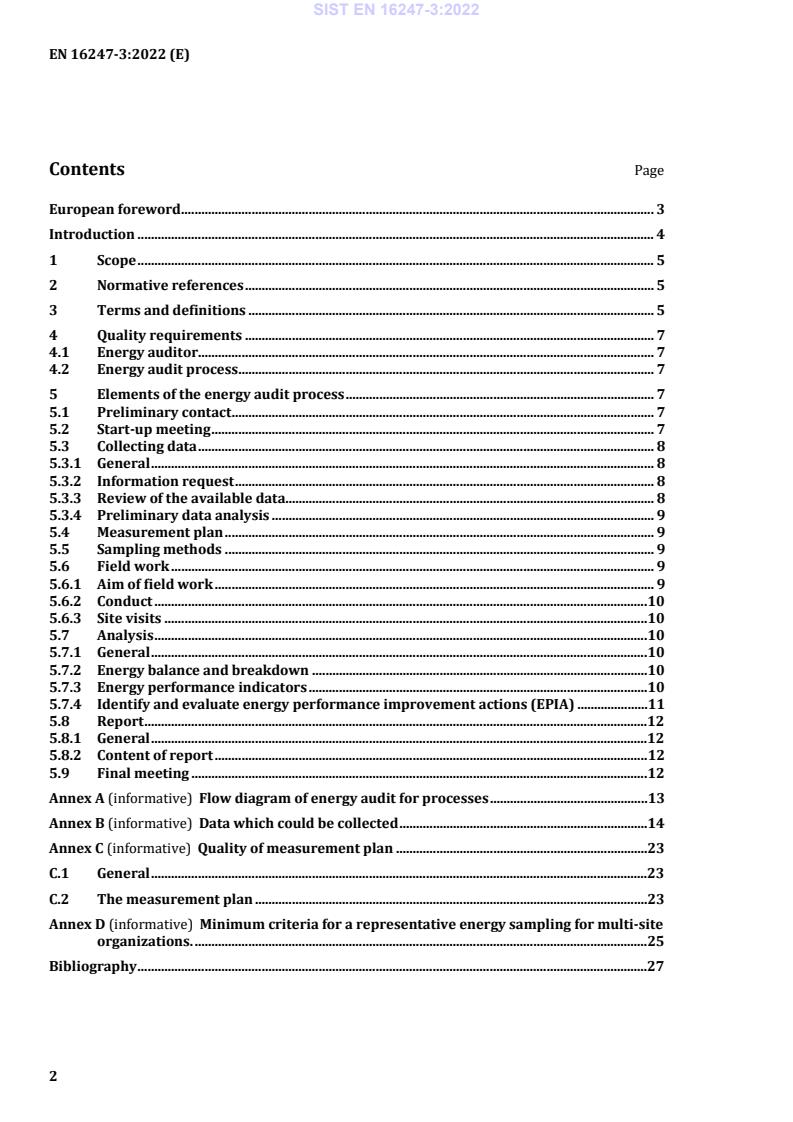
Contents Page
European foreword . 3
Introduction . 4
1 Scope . 5
2 Normative references . 5
3 Terms and definitions . 5
4 Quality requirements . 7
4.1 Energy auditor . 7
4.2 Energy audit process . 7
5 Elements of the energy audit process . 7
5.1 Preliminary contact . 7
5.2 Start-up meeting . 7
5.3 Collecting data . 8
5.3.1 General . 8
5.3.2 Information request . 8
5.3.3 Review of the available data. 8
5.3.4 Preliminary data analysis . 9
5.4 Measurement plan . 9
5.5 Sampling methods . 9
5.6 Field work . 9
5.6.1 Aim of field work . 9
5.6.2 Conduct .10
5.6.3 Site visits .10
5.7 Analysis .10
5.7.1 General .10
5.7.2 Energy balance and breakdown .10
5.7.3 Energy performance indicators .10
5.7.4 Identify and evaluate energy performance improvement actions (EPIA) .11
5.8 Report .12
5.8.1 General .12
5.8.2 Content of report .12
5.9 Final meeting .12
Annex A (informative) Flow diagram of energy audit for processes .13
Annex B (informative) Data which could be collected .14
Annex C (informative) Quality of measurement plan .23
C.1 General .23
C.2 The measurement plan .23
Annex D (informative) Minimum criteria for a representative energy sampling for multi-site
organizations. .25
Bibliography .27
European foreword
This document (EN 16247-3:2022) has been prepared by the Joint Technical Committee CEN-
CENELEC/JTC 14 “Energy management and energy efficiency in the framework of energy transition”, the
secretariat of which is held by UNI.
This European Standard shall be given the status of a national standard, either by publication of an
identical text or by endorsement, at the latest by February 2023, and conflicting national standards shall
be withdrawn at the latest by February 2023.
Attention is drawn to the possibility that some of the elements of this document may be the subject of
patent rights. CEN-CENELEC shall not be held responsible for identifying any or all such patent rights.
This document supersedes EN 16247-3:2014.
Significant changes compared to the previous edition are:
a) terms and definition updated;
b) structure aligned with EN 16247-1;
c) sampling method allowed as energy audit process;
d) new Annex D with an example of methodology for multi-sites audit sampling in industrial companies.
This document is part of series EN 16247 “Energy audits”, which comprises the following:
— Part 1: General requirements;
— Part 2: Buildings;
— Part 3: Processes;
— Part 4: Transport;
— Part 5: Competence of energy auditors.
This Part provides additional material to Part 1 for the Process sector and is intended to be used in
conjunction with Part 1.
This document has been prepared under a mandate given to CEN and CENELEC by the European
Commission and the European Free Trade Association.
Any feedback and questions on this document should be directed to the users’ national standards
body/national committee. A complete listing of these bodies can be found on the CEN and CENELEC
websites.
According to the CEN-CENELEC Internal Regulations, the national standards organisations of the
following countries are bound to implement this European Standard: Austria, Belgium, Bulgaria, Croatia,
Cyprus, Czech Republic, Denmark, Estonia, Finland, France, Germany, Greece, Hungary, Iceland, Ireland,
Italy, Latvia, Lithuania, Luxembourg, Malta, Netherlands, Norway, Poland, Portugal, Republic of North
Macedonia, Romania, Serbia, Slovakia, Slovenia, Spain, Sweden, Switzerland, Türkiye and the United
Kingdom.
Introduction
An energy audit can help an organization to identify opportunities to improve energy performance. It can
be part of a site wide energy management system.
There are various sectors with important differences in processes and utilities. It should be emphasized
that there are many types of processes in industry and commerce, with important differences in energy
use and energy consumption. In general, energy is used:
— directly by a process, e.g. furnaces, direct fired dryers, etc.;
— indirectly by a process (e.g. heat exchange, distillation, extrusion, etc.) including the specific
conditions of production (e.g. start-up, shut-down, product change over, cleaning, maintenance,
laboratory and product transfer);
— utility processes (e.g. motor driven systems such as fans, pumps, motors, compressors, etc., steam,
hot water), including on site power plants;
— other processes (e.g. sterilization in hospitals, fume cupboards, laboratories, etc.).
This document defines the attributes of an appropriate quality energy audit for processes in addition to
EN 16247-1, which gives the general requirements for energy audits.
1 Scope
This document specifies the requirements, methodology and deliverables of an energy audit within a
process. These consist of:
a) organizing and conducting an energy audit;
b) analysing the data from the energy audit;
c) reporting and documenting the energy audit findings.
This part of the standard applies to sites or parts of sites where a significant part of the energy use is due
to processes. It is used in conjunction with and is supplementary to EN 16247-1, Energy audits — Part 1:
General requirements. It provides additional requirements to EN 16247-1 and is applied simultaneously.
A process can include one or more production lines or services, offices, laboratories, research centres,
packaging and warehouse sections with specific operational conditions and site transportation. An
energy audit can include the whole site or part of a site.
If buildings are included in the scope of the energy audit, the energy auditor can choose to apply
EN 16247-2, Energy Audits — Part 2: Buildings. If on-site transport on a site is included in the scope of
the energy audit, the energy auditor can choose to apply EN 16247-4, Energy audits — Part 4: Transport.
NOTE The decision to apply Parts 2 and/or 4 is expected to be made during the preliminary contact, see 5.1.
2 Normative references
The following documents are referred to in the text in such a way that some or all of their content
constitutes requirements of this document. For dated references, only the edition cited applies. For
undated references, the latest edition of the referenced document (including any amendments) applies.
EN 16247-1:2022, Energy audits — Part 1: General requirements
EN 16247-2:2022, Energy audits — Part 2: Buildings
EN 16247-4:2022, Energy audits — Part 4: Transport
EN 16247-5, Energy audits — Part 5: Competence of energy auditors
3 Terms and definitions
For the purposes of this document, the terms and definitions given in EN 16247-1 and the following apply.
ISO and IEC maintain terminological databases for use in standardization at the following addresses:
— ISO Online browsing platform: available at https://www.iso.org/obp
— IEC Electropedia: available at https://www.electropedia.org/
3.1
production process
all the steps necessary to manufacture a product or to deliver a service
Note 1 to entry: Production process could include specific facilities for health, safety and environment pollution
control.
3.2
utility
energy carrier necessary for the process and auxiliary
Note 1 to entry: A utility could be generated on-site, off-site, or purchased from a third party.
EXAMPLE Steam, hot water, compressed air, etc.
3.3
utility process
set of utility equipment and distribution
Note 1 to entry: If the utility is purchased from a third party, utility process is only the utility distribution.
Note 2 to entry: All processes, not linked to one specific process or service, and whose purpose is limited to the
transformation, distribution or storage of energy.
3.4
site
processes within the boundary of the organization
Note 1 to entry: This may include pollution treatment processes and energy recovery, and waste product.
3.5
building
construction as a whole, including its envelope and all technical building systems, for which energy may
be used to condition the indoor climate, to provide domestic hot water and illumination and other
services related to the use of the building and the activities performed within the building
Note 1 to entry: The term can refer to the building as a whole or to parts thereof that have been designed or
altered to be used separately.
Note 2 to entry: The building could include its site location and related external environment.
[SOURCE: EN 16247-2:2022, 3.1]
3.6
energy
electricity, fuels, steam, heat, compressed air, and other similar media
Note 1 to entry: For the purposes of this document, energy refers to the various type of energy, including
renewable, which can be purchased, stored, treated, used in equipment or in a process, or recovered.
[SOURCE: EN ISO 50001:2018, 3.5]
3.7
energy performance improvement action
EPIA
action or measure or group of action or measures implemented or planned within an organization
intended to achieve energy performance improvement through technological, managerial or operational,
behavioural, economical, or other changes
[SOURCE: EN 16247-1:2022, 3.9]
4 Quality requirements
4.1 Energy auditor
The qualification of an energy auditor is defined in EN 16247-5.
4.2 Energy audit process
The quality of the energy audit depends on the knowledge of the processes, the site and available data
and information. Close collaboration between the energy auditor and the organization is essential. When
a sampling method is used, the selected samples shall be representative of the whole audited objects.
NOTE An example energy audit process is shown in Annex A.
5 Elements of the energy audit process
5.1 Preliminary contact
The energy auditor shall obtain a preliminary description of the site and the relevant processes from the
organization or from a site visit.
NOTE 1 The preliminary contact can be a physical meeting, by telephone, webinar or other remote interactive
discussions.
The energy auditor shall agree with the organization on the scope and boundary of the energy audit in
terms of:
a) processes included in the energy audit;
NOTE 2 A process can be defined as the whole process, part of a process, part of a system or a component.
b) whether or not outsourced utilities are included in the energy audit;
c) depending of the thoroughness of the energy audit, required by the organization, the energy auditor
shall design and carry out the energy audit taking into consideration the requirements of the relevant
standard (see bibliography).
For energy use not directly related to process (e.g. storing, packaging, logistics, offices, research centre,
laboratory and transport), the energy auditor shall agree with the organization the applicability of
EN 16247-2 and EN 16247-4. This choice and the agreed scope shall be clearly stated in the final energy
audit report (see 5.8).
For each audited process, the energy auditor and organization shall agree which members of staff, and
their roles, have a significant impact on energy consumption and energy performance, and propose a
preliminary list of data to be collected.
5.2 Start-up meeting
The energy auditor and organization shall agree energy performance indicators which can be used in the
energy audit.
5.3 Collecting data
5.3.1 General
The data collection could be carried out over several stages during an energy audit.
During data collection, the energy auditor shall:
a) verify the data and information provided by the organization (e.g. the indicated power rating or the
number of pieces of equipment);
b) obtain any missing data;
c) check the quality and plausibility of the data and ask for correction if significant mistakes or
inaccuracies are identified.
5.3.2 Information request
In addition to the information requested in EN 16247-1, the energy auditor shall request from the
organization the following:
a) site information including building, boundary and other relevant information;
b) utility processes information;
c) production processes information;
1) product specification;
2) main processes equipment involved in the process (drawings, other relevant technical data and
datasheets);
3) current operational conditions (set points) of utilities and production process;
4) specific condition and constraint for process and environment (security, pollution, health, etc.).
d) energy sources information.
NOTE 1 The collected data can be based on invoices, contracts, measurements, calculations from given operating
hours and installed capacity (technical characteristics), operation and maintenance documents, meeting with
operations and maintenance personnel, etc.
NOTE 2 See Annex B for examples of data to be collected.
5.3.3 Review of the available data
The energy auditor shall review the information collected for consistency and suitability.
The energy auditor shall assess whether the information provided is sufficient to achieve the agreed
objective.
If data requested is not available, or the provided data evaluated as unreliable, the energy auditor shall
define the method to obtain the necessary information (e.g. measurements, estimates, modelling, etc.).
5.3.4 Preliminary data analysis
The energy auditor shall carry out an analysis of the data collected in order to:
a) undertake a preliminary analysis of the site's energy balance on the basis of energy bills and output;
b) identify the relevant variables and static factors;
c) make a first identification of the significant energy uses;
d) establish the relevant energy performance indicator(s);
e) evaluate the distribution of energy consumption on the basis of sub-meter reading, installed capacity
and operating time;
f) evaluate the energy efficiency of the equipment and processes;
g) if there is sufficient information, to cover at least one complete operation cycle, establish an energy
baseline;
h) plan further data collection and measurements to be carried out during field works (5.4).
The energy auditor should develop preliminary EPIA.
The energy auditor shall agree with the organization about any measurement plan on:
1) objectives and parameters;
2) content;
3) required measurement conditions.
NOTE See Annex C for quality measurement plans.
5.4 Measurement plan
The general requirements for the measurement plan are defined in EN 16247-1:2022, 5.4.
5.5 Sampling methods
The general requirements for the sampling methods are defined in EN 16247-1:2022, 5.5.
5.6 Field work
5.6.1 Aim of field work
If necessary, the energy auditor shall carry out additional measurement to:
a) collect any missing data needed for analysis;
b) confirm the suitability of the baseline;
c) confirm the energy consumption, energy balance, relevant variables and static factors;
d) confirm the current operational conditions (set points) of utilities and production processes and the
impact with energy use and consumption;
e) collect all relevant information from identification plates, obtain the operation times of the relevant
processes, hold interviews with operators, etc.
5.6.2 Conduct
The conduct of energy auditor during field work is defined in EN 16247-1:2022, 5.6.2.
5.6.3 Site visits
The energy auditor shall visit the site and audited processes.
NOTE The schedule for site visits is planned during the start-up meeting (5.2).
5.7 Analysis
5.7.1 General
The energy auditor shall:
a) calculate the current energy performance of the relevant processes;
b) compare current energy performance against the best available technology benchmarks;
c) compare the energy needs with the sizing of the process and/or its components.
5.7.2 Energy balance and breakdown
The energy auditor shall provide:
a) a breakdown the energy consumption by energy type;
b) a breakdown the consumption of energy carriers into a company energy structure (for example main
activities, auxiliary services, general services) to cost effectiveness level;
c) a breakdown the energy consumption by processes in absolute number and in consistent energy
unit;
If the activity is time varying, it is recommended to establish the energy consumption at different
time periods in relation to the processes;
d) a demonstration of an energy balance between energy consumption and energy losses based on
appropriate me
...