

EN 1992-1-1:2023
(Main)Eurocode 2 - Design of concrete structures - Part 1-1: General rules and rules for buildings, bridges and civil engineering structures
General Information
- Abstract
1.1 Scope of FprEN 1992-1-1
(1) This document gives the general basis for the design of structures in plain, reinforced and prestressed concrete made with normal weight, lightweight and heavyweight aggregates. It gives specific rules for buildings, bridges and civil engineering structures, including temporary structures; additional requirements specific to bridges are given in Annex K. The rules are valid under temperature conditions between −40 °C and +100 °C generally. This document complies with the principles and requirements for the safety, serviceability, durability and robustness of structures, the basis of their design and verification that are given in EN 1990.
(2) This document is only concerned with the requirements for resistance, serviceability, durability, robustness and fire resistance of concrete structures. Other requirements, e.g. concerning thermal or sound insulation, are not considered.
(3) This document does not cover:
- resistance to fire (see EN 1992 1 2);
- fastenings in concrete (see EN 1992 4);
- seismic design (see EN 1998 (all parts));
- particular aspects of special types of civil engineering works (such as dams, pressure vessels);
- structures made with no-fines concrete, aerated or cellular concrete, lightweight aggregate concrete with open structure components;
- structures containing steel sections considered in design (see EN 1994 (all parts)) for composite steel and concrete structures;
- structural parts made of concrete with a smallest value of the upper sieve aggregate size Dlower < 8 mm (or if known Dmax < 8 mm) unless otherwise stated in this Eurocode.
1.2 Assumptions
(1) The assumptions of EN 1990 apply to FprEN 1992-1-1.
(2) It is assumed that the requirements for execution and workmanship given in EN 13670 are complied with.
- Status
- Published
- Publication Date
- 21-Nov-2023
- Technical Committee
- CEN/TC 250 - Structural Eurocodes
- Drafting Committee
- CEN/TC 250/SC 2 - Eurocode 2: Design of concrete structures
- Current Stage
- 6060 - Definitive text made available (DAV) - Publishing
- Start Date
- 22-Nov-2023
- Due Date
- 03-Feb-2023
- Completion Date
- 22-Nov-2023

Overview - EN 1992-1-1:2023 (Eurocode 2)
EN 1992-1-1:2023, part of Eurocode 2, sets the general basis and rules for the design of concrete structures in plain, reinforced and prestressed concrete. Published by CEN (approved 23 July 2023), the standard addresses buildings, bridges and civil engineering structures (including temporary works) made with normal-weight, lightweight and heavyweight aggregates and applies for ambient temperatures generally between −40 °C and +100 °C. It implements the safety, serviceability, durability and robustness principles established in EN 1990.
Key topics and technical requirements
- Scope and assumptions
- General design basis for plain, reinforced and prestressed concrete.
- Complies with EN 1990 assumptions; execution and workmanship are assumed to follow EN 13670.
- Materials
- Guidance on concrete, reinforcing and prestressing steels, material properties, creep, shrinkage and related design assumptions.
- Durability and concrete cover
- Environmental exposure classes, requirements for durability and rules for nominal/minimum concrete cover.
- Basis of design
- Structural reliability, design service life, partial factor methodology and verification principles.
- Structural analysis
- Modelling rules, linear/non-linear analysis, second‑order effects, lateral instability and prestressed member behavior.
- Limit states
- Requirements for Ultimate Limit States (ULS) and Serviceability Limit States (SLS) including bending, shear and robustness checks.
- Special provisions
- Rules for bridges included; additional bridge requirements are given in Annex K.
- Exclusions
- Does NOT cover resistance to fire (see EN 1992-1-2), seismic design (see EN 1998), fastenings in concrete (EN 1992-4), composite concrete/steel (see EN 1994) or certain special concretes and civil works (e.g., dams, pressure vessels, cellular or no‑fines concrete).
Practical applications and users
Who uses EN 1992-1-1:
- Structural and bridge engineers for design checks and specification of concrete element geometry, reinforcement and prestress.
- Designers preparing calculations for ULS/SLS, durability and service life estimation.
- Contractors, detailers and quality controllers to ensure compliance with material and workmanship assumptions.
- Regulators, approval bodies and inspectors verifying conformity to European design practice.
Typical uses:
- Building and bridge design (new and temporary structures)
- Selection of concrete cover and exposure class for durability
- Defining assumptions for creep, shrinkage and time-dependent effects
- Structural modelling and limit state verification
Related standards
- EN 1990 - Basis of structural design
- EN 1992-1-2 - Fire design of concrete structures
- EN 1992-4 - Fastenings in concrete
- EN 1994 - Composite steel and concrete structures
- EN 1998 - Seismic design
- EN 13670 - Execution of concrete structures
Keywords: EN 1992-1-1:2023, Eurocode 2, design of concrete structures, reinforced concrete, prestressed concrete, concrete durability, concrete cover, bridge design, structural analysis, CEN.
Relations
- Effective Date
- 29-Nov-2023
- Effective Date
- 29-Nov-2023
- Effective Date
- 29-Nov-2023
- Effective Date
- 29-Nov-2023
- Effective Date
- 25-Oct-2023
- Effective Date
- 19-Jan-2023
- Effective Date
- 25-Aug-2026
- Effective Date
- 25-Aug-2026
- Effective Date
- 25-Aug-2026
- Refers
EN 1991-3:2026 - Eurocode 1 - Actions on structures - Part 3: Actions induced by cranes and machines - Effective Date
- 25-Mar-2026
- Effective Date
- 25-Mar-2026
- Effective Date
- 25-Mar-2026
- Effective Date
- 25-Mar-2026
- Effective Date
- 25-Mar-2026
- Effective Date
- 11-Mar-2026
Get Certified
Connect with accredited certification bodies for this standard

DIBt (Deutsches Institut für Bautechnik)
German Institute for Building Technology.
DIN CERTCO
DIN Group product certification.

Aboma Certification B.V.
Specialized in construction, metal, and transport sectors.
Sponsored listings
Frequently Asked Questions
EN 1992-1-1:2023 is a standard published by the European Committee for Standardization (CEN). Its full title is "Eurocode 2 - Design of concrete structures - Part 1-1: General rules and rules for buildings, bridges and civil engineering structures". This standard covers: 1.1 Scope of FprEN 1992-1-1 (1) This document gives the general basis for the design of structures in plain, reinforced and prestressed concrete made with normal weight, lightweight and heavyweight aggregates. It gives specific rules for buildings, bridges and civil engineering structures, including temporary structures; additional requirements specific to bridges are given in Annex K. The rules are valid under temperature conditions between −40 °C and +100 °C generally. This document complies with the principles and requirements for the safety, serviceability, durability and robustness of structures, the basis of their design and verification that are given in EN 1990. (2) This document is only concerned with the requirements for resistance, serviceability, durability, robustness and fire resistance of concrete structures. Other requirements, e.g. concerning thermal or sound insulation, are not considered. (3) This document does not cover: - resistance to fire (see EN 1992 1 2); - fastenings in concrete (see EN 1992 4); - seismic design (see EN 1998 (all parts)); - particular aspects of special types of civil engineering works (such as dams, pressure vessels); - structures made with no-fines concrete, aerated or cellular concrete, lightweight aggregate concrete with open structure components; - structures containing steel sections considered in design (see EN 1994 (all parts)) for composite steel and concrete structures; - structural parts made of concrete with a smallest value of the upper sieve aggregate size Dlower < 8 mm (or if known Dmax < 8 mm) unless otherwise stated in this Eurocode. 1.2 Assumptions (1) The assumptions of EN 1990 apply to FprEN 1992-1-1. (2) It is assumed that the requirements for execution and workmanship given in EN 13670 are complied with.
1.1 Scope of FprEN 1992-1-1 (1) This document gives the general basis for the design of structures in plain, reinforced and prestressed concrete made with normal weight, lightweight and heavyweight aggregates. It gives specific rules for buildings, bridges and civil engineering structures, including temporary structures; additional requirements specific to bridges are given in Annex K. The rules are valid under temperature conditions between −40 °C and +100 °C generally. This document complies with the principles and requirements for the safety, serviceability, durability and robustness of structures, the basis of their design and verification that are given in EN 1990. (2) This document is only concerned with the requirements for resistance, serviceability, durability, robustness and fire resistance of concrete structures. Other requirements, e.g. concerning thermal or sound insulation, are not considered. (3) This document does not cover: - resistance to fire (see EN 1992 1 2); - fastenings in concrete (see EN 1992 4); - seismic design (see EN 1998 (all parts)); - particular aspects of special types of civil engineering works (such as dams, pressure vessels); - structures made with no-fines concrete, aerated or cellular concrete, lightweight aggregate concrete with open structure components; - structures containing steel sections considered in design (see EN 1994 (all parts)) for composite steel and concrete structures; - structural parts made of concrete with a smallest value of the upper sieve aggregate size Dlower < 8 mm (or if known Dmax < 8 mm) unless otherwise stated in this Eurocode. 1.2 Assumptions (1) The assumptions of EN 1990 apply to FprEN 1992-1-1. (2) It is assumed that the requirements for execution and workmanship given in EN 13670 are complied with.
EN 1992-1-1:2023 is classified under the following ICS (International Classification for Standards) categories: 91.010.30 - Technical aspects; 91.080.40 - Concrete structures. The ICS classification helps identify the subject area and facilitates finding related standards.
EN 1992-1-1:2023 has the following relationships with other standards: It is inter standard links to EN 1992-1-1:2004/AC:2010, EN 1992-1-1:2004/AC:2008, EN 1992-1-1:2004/A1:2014, EN 1992-2:2005/AC:2008, EN 1992-2:2005, EN 1992-1-1:2004, ISO 10406-2:2015, ISO 10406-1:2015, ISO 10406-3:2019, EN 1991-3:2026, EN 1991-1-8:2026, EN 1991-1-4:2026, EN 1991-4:2026, EN 1990-2:2026, EN 206-2:2026. Understanding these relationships helps ensure you are using the most current and applicable version of the standard.
EN 1992-1-1:2023 is associated with the following European legislation: Standardization Mandates: M/515. When a standard is cited in the Official Journal of the European Union, products manufactured in conformity with it benefit from a presumption of conformity with the essential requirements of the corresponding EU directive or regulation.
EN 1992-1-1:2023 is available in PDF format for immediate download after purchase. The document can be added to your cart and obtained through the secure checkout process. Digital delivery ensures instant access to the complete standard document.
Standards Content (Sample)
SLOVENSKI STANDARD
SIST EN 1992-1-1:2024
01-marec-2024
Nadomešča:
SIST EN 1992-1-1:2005
SIST EN 1992-1-1:2005/A1:2015
SIST EN 1992-1-1:2005/AC:2008
SIST EN 1992-1-1:2005/AC:2011
SIST EN 1992-2:2005
SIST EN 1992-2:2005/AC:2008
SIST EN 1992-3:2006
Evrokod 2 - Projektiranje betonskih konstrukcij - 1-1. del: Splošna pravila in
pravila za stavbe, mostove in gradbene konstrukcije
Eurocode 2 - Design of concrete structures - Part 1-1: General rules and rules for
buildings, bridges and civil engineering structures
Eurocode 2 - Bemessung und Konstruktion von Stahlbeton- und Spannbetontragwerken
- Teil 1-1: Allgemeine Regeln und Regeln für Hochbauten, Brücken und
Ingenieurbauwerke
Eurocode 2 : Calcul des structures en béton - Partie 1-1 : Règles générales - Règles
pour les bâtiments, les ponts et les ouvrages de génie civil
Ta slovenski standard je istoveten z: EN 1992-1-1:2023
ICS:
91.010.30 Tehnični vidiki Technical aspects
91.080.40 Betonske konstrukcije Concrete structures
SIST EN 1992-1-1:2024 en,fr,de
2003-01.Slovenski inštitut za standardizacijo. Razmnoževanje celote ali delov tega standarda ni dovoljeno.
SIST EN 1992-1-1:2024
SIST EN 1992-1-1:2024
EN 1992-1-1
EUROPEAN STANDARD
NORME EUROPÉENNE
November 2023
EUROPÄISCHE NORM
ICS 91.010.30; 91.080.40 Supersedes EN 1992-1-1:2004, EN 1992-2:2005, EN
1992-3:2006
English Version
Eurocode 2 - Design of concrete structures - Part 1-1:
General rules and rules for buildings, bridges and civil
engineering structures
Eurocode 2 : Calcul des structures en béton - Partie 1-1 Eurocode 2 - Bemessung und Konstruktion von
: Règles générales - Règles pour les bâtiments, les ponts Stahlbeton- und Spannbetontragwerken - Teil 1-1:
et les ouvrages de génie civil Allgemeine Regeln und Regeln für Hochbauten,
Brücken und Ingenieurbauwerke
This European Standard was approved by CEN on 23 July 2023.
CEN members are bound to comply with the CEN/CENELEC Internal Regulations which stipulate the conditions for giving this
European Standard the status of a national standard without any alteration. Up-to-date lists and bibliographical references
concerning such national standards may be obtained on application to the CEN-CENELEC Management Centre or to any CEN
member.
This European Standard exists in three official versions (English, French, German). A version in any other language made by
translation under the responsibility of a CEN member into its own language and notified to the CEN-CENELEC Management
Centre has the same status as the official versions.
CEN members are the national standards bodies of Austria, Belgium, Bulgaria, Croatia, Cyprus, Czech Republic, Denmark, Estonia,
Finland, France, Germany, Greece, Hungary, Iceland, Ireland, Italy, Latvia, Lithuania, Luxembourg, Malta, Netherlands, Norway,
Poland, Portugal, Republic of North Macedonia, Romania, Serbia, Slovakia, Slovenia, Spain, Sweden, Switzerland, Türkiye and
United Kingdom.
EUROPEAN COMMITTEE FOR STANDARDIZATION
COMITÉ EUROPÉEN DE NORMALISATION
EUROPÄISCHES KOMITEE FÜR NORMUNG
CEN-CENELEC Management Centre: Rue de la Science 23, B-1040 Brussels
© 2023 CEN All rights of exploitation in any form and by any means reserved Ref. No. EN 1992-1-1:2023 E
worldwide for CEN national Members.
SIST EN 1992-1-1:2024
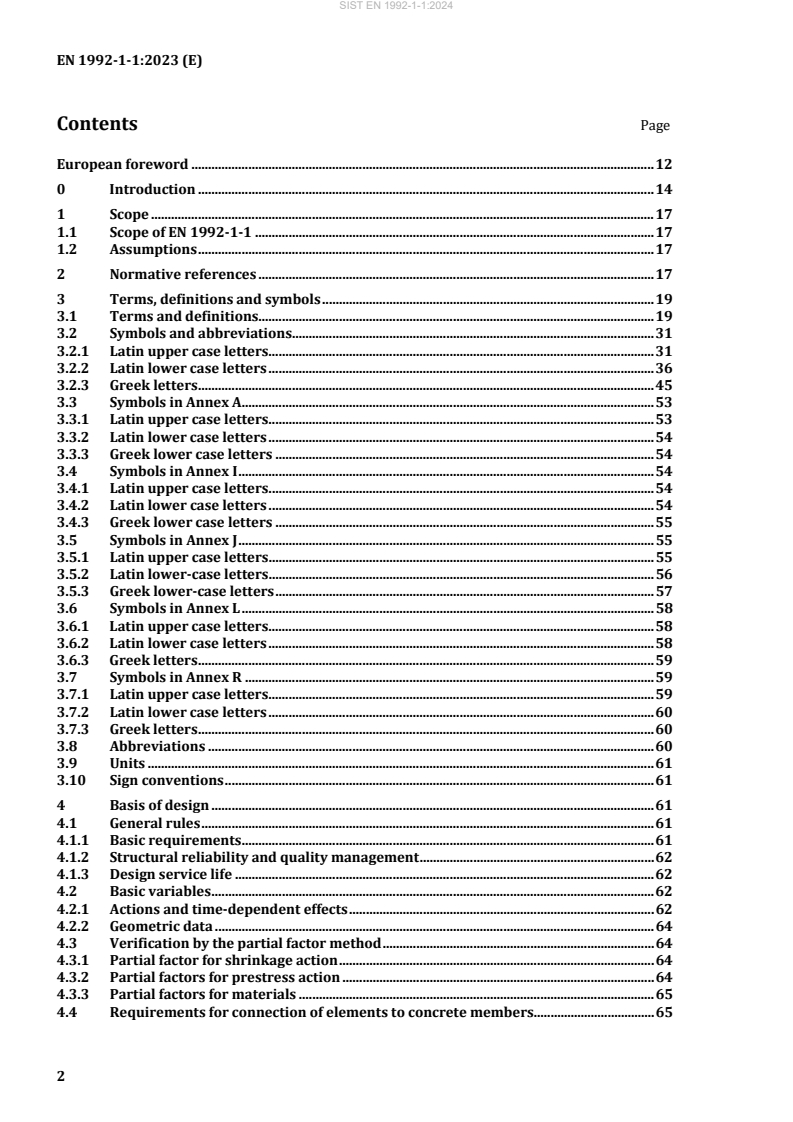
Contents Page
European foreword . 12
0 Introduction . 14
1 Scope . 17
1.1 Scope of EN 1992-1-1 . 17
1.2 Assumptions . 17
2 Normative references . 17
3 Terms, definitions and symbols . 19
3.1 Terms and definitions. 19
3.2 Symbols and abbreviations. 31
3.2.1 Latin upper case letters . 31
3.2.2 Latin lower case letters . 36
3.2.3 Greek letters . 45
3.3 Symbols in Annex A. 53
3.3.1 Latin upper case letters . 53
3.3.2 Latin lower case letters . 54
3.3.3 Greek lower case letters . 54
3.4 Symbols in Annex I . 54
3.4.1 Latin upper case letters . 54
3.4.2 Latin lower case letters . 54
3.4.3 Greek lower case letters . 55
3.5 Symbols in Annex J . 55
3.5.1 Latin upper case letters . 55
3.5.2 Latin lower-case letters . 56
3.5.3 Greek lower-case letters . 57
3.6 Symbols in Annex L . 58
3.6.1 Latin upper case letters . 58
3.6.2 Latin lower case letters . 58
3.6.3 Greek letters . 59
3.7 Symbols in Annex R . 59
3.7.1 Latin upper case letters . 59
3.7.2 Latin lower case letters . 60
3.7.3 Greek letters . 60
3.8 Abbreviations . 60
3.9 Units . 61
3.10 Sign conventions . 61
4 Basis of design . 61
4.1 General rules . 61
4.1.1 Basic requirements . 61
4.1.2 Structural reliability and quality management . 62
4.1.3 Design service life . 62
4.2 Basic variables . 62
4.2.1 Actions and time-dependent effects . 62
4.2.2 Geometric data . 64
4.3 Verification by the partial factor method . 64
4.3.1 Partial factor for shrinkage action . 64
4.3.2 Partial factors for prestress action . 64
4.3.3 Partial factors for materials . 65
4.4 Requirements for connection of elements to concrete members . 65
SIST EN 1992-1-1:2024
5 Materials . 66
5.1 Concrete . 66
5.1.1 General . 66
5.1.2 Properties and related conditions . 66
5.1.3 Strength . 67
5.1.4 Elastic deformation . 68
5.1.5 Creep and shrinkage . 68
5.1.6 Design assumptions . 70
5.2 Reinforcing steel . 72
5.2.1 General . 72
5.2.2 Properties . 72
5.2.3 Welding of reinforcing bars . 73
5.2.4 Design assumptions . 73
5.2.5 Reinforcement bar couplers . 74
5.2.6 Headed bars for reinforcement . 74
5.3 Prestressing steel . 74
5.3.1 General . 74
5.3.2 Properties . 75
5.3.3 Design assumptions . 76
5.4 Prestressing systems . 77
5.4.1 General . 77
5.4.2 Anchorage zones . 78
6 Durability and concrete cover . 78
6.1 General . 78
6.2 Requirements for durability . 78
6.3 Environmental exposure conditions . 79
6.4 Exposure resistance classes . 83
6.5 Concrete cover . 84
6.5.1 Nominal cover . 84
6.5.2 Minimum cover . 84
6.5.3 Allowance in design for deviation in cover . 88
7 Structural analysis . 89
7.1 General . 89
7.2 Structural modelling for analysis . 89
7.2.1 Geometric imperfections . 89
7.2.2 Idealisation of the structure . 93
7.2.3 Geometric data . 93
7.3 Methods of analysis . 95
7.3.1 Linear elastic analysis . 95
7.3.2 Linear elastic analysis with redistribution . 96
7.3.3 Plastic analysis . 98
7.3.4 Non-linear analysis . 98
7.4 Second order structural analysis of members and systems with axial force . 99
7.4.1 General . 99
7.4.2 Creep . 100
7.4.3 Methods of analysis . 100
7.4.4 Compression member with biaxial bending . 102
7.5 Lateral instability of slender beams . 103
7.6 Prestressed members and structures . 103
7.6.1 General . 103
7.6.2 Prestressing force . 104
7.6.3 Immediate losses of prestress . 104
SIST EN 1992-1-1:2024
7.6.4 Time dependent losses of prestress . 106
7.6.5 Effects of prestressing at ultimate limit state . 107
8 Ultimate Limit States (ULS) . 108
8.1 Bending with or without axial force . 108
8.1.1 General . 108
8.1.2 Stress distribution in the compression zones . 110
8.1.3 Bending in slabs . 110
8.1.4 Confined concrete . 111
8.2 Shear . 113
8.2.1 General verification procedure . 113
8.2.2 Detailed verification for members without shear reinforcement . 117
8.2.3 Members with shear reinforcement . 121
8.2.4 In-plane shear and transverse bending . 126
8.2.5 Shear between web and flanges . 127
8.2.6 Shear at interfaces . 129
8.3 Torsion and combined actions . 134
8.3.1 General considerations for torsion . 134
8.3.2 Internal forces due to torsion in compact or closed sections. 134
8.3.3 Internal forces due to torsion in open sections . 135
8.3.4 Torsional resistance of compact or closed sections . 135
8.3.5 Design procedure for combination of actions . 136
8.3.6 Interaction formula . 137
8.4 Punching . 137
8.4.1 General . 137
8.4.2 Shear-resisting effective depth, control perimeter and shear stress . 138
8.4.3 Punching shear resistance of slabs without shear reinforcement . 142
8.4.4 Punching shear resistance of slabs with shear reinforcement . 145
8.5 Design with strut-and-tie models and stress fields. 148
8.5.1 General . 148
8.5.2 Struts and compression fields . 150
8.5.3 Ties . 152
8.5.4 Nodes . 152
8.5.5 Transfer of concentrated forces into a member . 155
8.6 Partially loaded areas . 157
9 Serviceability Limit States (SLS) . 160
9.1 General . 160
9.2 Stress limitations and crack control . 161
9.2.1 General considerations . 161
9.2.2 Minimum reinforcement areas to avoid yielding . 163
9.2.3 Refined control of cracking . 165
9.3 Deflection control . 171
9.3.1 General consideration . 171
9.3.2 Simplified deflection control by span/depth-ratio for buildings . 171
9.3.3 Simplified calculation of deflections for reinforced concrete building structures 173
9.3.4 General method for deflection calculations. 174
9.4 Vibrations . 175
10 Fatigue . 176
10.1 General . 176
10.2 Combination of actions . 176
10.3 Internal forces and stresses for fatigue verification . 176
10.4 Simplified verification of reinforcing or prestressing steel. 178
SIST EN 1992-1-1:2024
10.5 Simplified verification of concrete under compression . 178
10.6 Simplified verification of concrete under shear . 179
10.7 Simplified verification of shear at interfaces . 179
11 Detailing of reinforcement and post-tensioning tendons . 180
11.1 General . 180
11.2 Spacing of bars . 180
11.3 Permissible mandrel diameters for bent bars . 181
11.4 Anchorage of reinforcing steel in tension and compression . 182
11.4.1 General . 182
11.4.2 Anchorage of straight bars . 183
11.4.3 Anchorage of bundles . 186
11.4.4 Anchorage of bars with bends and hooks. 187
11.4.5 Anchorage of bars with welded transverse reinforcement . 187
11.4.6 Anchorage of U-bar loops . 188
11.4.7 Anchorage of headed bars in tension . 188
11.4.8 Anchorage of bonded post-installed reinforcing steel . 190
11.5 Laps of reinforcing steel in tension and compression and mechanical couplers . 191
11.5.1 General . 191
11.5.2 All types of laps . 191
11.5.3 Laps of bundles . 195
11.5.4 Laps using U-bar loops . 196
11.5.5 Laps using headed bars . 198
11.5.6 Mechanical couplers . 200
11.5.7 Full penetration butt weld and fillet weld splices . 200
11.6 Post-tensioning tendons . 201
11.6.1 General . 201
11.6.2 Minimum spacing of ducts . 201
11.6.3 Minimum radius of curvature and straight length of tendons adjacent to anchorages
............................................................................................................................................................... 202
11.6.4 Anchorages, couplers and deviators of post-tensioning tendons . 203
11.7 Deviation forces due to curved tensile and compressive chords . 203
12 Detailing of members and particular rules . 204
12.1 General . 204
12.2 Minimum reinforcement rules . 204
12.3 Beams . 206
12.3.1 General . 206
12.3.2 Longitudinal reinforcement . 208
12.3.3 Shear and torsion reinforcement . 209
12.3.4 Suspension reinforcement for indirect support . 211
12.4 Slabs . 211
12.4.1 General . 211
12.4.2 Shear reinforcement . 213
12.5 Slab-column connections and column bases . 213
12.5.1 Punching shear reinforcement. 213
12.5.2 Integrity reinforcement against progressive collapse of flat slabs. 216
12.6 Columns . 217
12.7 Walls and deep beams . 218
12.8 Foundations . 219
12.9 Tying systems for robustness of buildings . 221
12.9.1 General . 221
12.9.2 Dimensioning of ties . 222
12.9.3 Required resistances for ties . 222
SIST EN 1992-1-1:2024
12.10 Supports, bearings and expansion joints . 223
13 Additional rules for precast concrete elements and structures . 226
13.1 General . 226
13.2 Specific requirements . 226
13.3 Concrete . 226
13.3.1 Strength for heat curing . 226
13.3.2 Creep and shrinkage . 226
13.4 Structural analysis . 227
13.4.1 General . 227
13.4.2 Losses of prestress during heat curing . 227
13.5 Design and detailing of pre-tensioning tendons . 228
13.5.1 Arrangement of tendons . 228
13.5.2 Anchorage zones . 229
13.5.3 Transfer of prestress . 229
13.5.4 Anchorage of tensile force at ULS . 230
13.5.5 Shear resistance of precast members without shear reinforcement . 231
13.6 Floor systems for buildings . 232
13.6.1 Distribution of loads. 232
13.6.2 Diaphragm action . 233
13.6.3 Tying systems for buildings . 233
13.7 Connections and supports . 234
13.7.1 Connections . 234
13.7.2 Supports . 236
13.8 Pocket foundations for buildings . 236
13.8.1 General . 236
13.8.2 Pocket foundations with keyed surface . 236
13.8.3 Pocket foundations with smooth or rough surfaces . 237
14 Plain and lightly reinforced concrete structures . 238
14.1 General . 238
14.2 Concrete . 238
14.3 Structural analysis . 238
14.4 Ultimate limit states . 239
14.4.1 General . 239
14.4.2 Design resistance to bending with axial force . 239
14.4.3 Shear . 239
14.4.4 Torsion . 240
14.4.5 Ultimate limit states induced by structural deformation (buckling) . 240
14.5 Serviceability limit states . 242
14.6 Detailing of members and particular rules . 243
14.6.1 Structural members . 243
14.6.2 Construction joints. 243
14.6.3 Strip and pad footings . 243
Annex A (informative) Adjustment of partial factors for materials . 244
A.1 Use of this annex . 244
A.2 Scope and fields of application . 244
A.3 General . 244
Annex B (normative) Time dependent behaviour of materials: strength, creep, shrinkage
and elastic strain of concrete and relaxation of prestressing steel . 251
B.1 Use of this annex . 251
SIST EN 1992-1-1:2024
B.2 Scope and field of application . 251
B.3 General . 251
B.4 Development of concrete strength and stiffness with time . 252
B.5 Basic formulae for determining the creep coefficient . 253
B.6 Basic formulae for determining the shrinkage strain . 256
B.7 Tests on elastic deformations, creep and shrinkage . 258
B.8 Detailed analysis for creep at variable loading . 259
B.9 Relaxation of prestressing steel. 260
Annex C (normative) Requirements for materials . 262
C.1 Use of this annex . 262
C.2 Scope and field of application . 262
C.3 Concrete . 262
C.4 Reinforcing steel . 262
C.5 Prestressing steel . 265
C.6 Couplers . 268
C.7 Headed bars . 269
C.8 Post-installed reinforcing steel systems . 269
Annex D (informative) Evaluation of early-age and long-term cracking due to restraint . 271
D.1 Use of this annex . 271
D.2 Scope and field of application . 271
D.3 General . 271
D.4 Assessment of temperature history . 272
D.5 Stress calculations . 274
D.6 Crack width calculations . 275
Annex E (normative) Additional rules for fatigue verification . 276
E.1 Use of this annex . 276
E.2 Scope and field of application . 276
E.3 General . 276
E.4 Verification using damage equivalent stress range. 276
E.5 Explicit verifications using Palmgren-Miner Rule . 278
Annex F (informative) Safety formats for non-linear analysis . 281
F.1 Use of this annex . 281
F.2 Scope and field of application . 281
F.3 General .
...