

EN 15346:2007
(Main)Plastics - Recycled plastics - Characterisation of poly(vinyl chloride) (PVC) recyclates
General Information
- Abstract
This European Standard defines a method of specifying delivery conditions for poly(vinyl chloride) (PVC) recyclates.
It gives the most important characteristics and associated test methods for assessing of PVC recyclates intended for use in the production of semi-finished/finished products.
It is intended to support parties involved in the use of recycled PVC to agree on specifications for specific and generic applications.
This Standard does not cover the characterisation of plastics wastes. See EN 15347.
This standard is applicable without prejudice to any existing legislation.
- Status
- Withdrawn
- Publication Date
- 04-Dec-2007
- Withdrawal Date
- 29-Sep-2026
- Technical Committee
- CEN/TC 249 - Plastics
- Drafting Committee
- CEN/TC 249/WG 11 - Plastics recycling
- Current Stage
- 9960 - Withdrawal effective - Withdrawal
- Start Date
- 05-Nov-2014
- Completion Date
- 30-Sep-2026

Relations
- Effective Date
- 16-Nov-2014
- Effective Date
- 25-Aug-2026
- Effective Date
- 25-Aug-2026
- Effective Date
- 25-Aug-2026
- Effective Date
- 25-Aug-2026
- Effective Date
- 25-Aug-2026
- Effective Date
- 25-Aug-2026
- Refers
EN ISO 3451-1:2026 - Plastics - Determination of ash - Part 1: General methods (ISO 3451-1:2026) - Effective Date
- 10-Jun-2026
- Effective Date
- 28-Jan-2026
- Refers
EN ISO 3451-1:2019 - Plastics - Determination of ash - Part 1: General methods (ISO 3451-1:2019) - Effective Date
- 28-Jan-2026
- Refers
EN 494:2004 - Fibre-cement profiled sheets and fittings - Product specification and test methods - Effective Date
- 28-Jan-2026
- Effective Date
- 28-Jan-2026
- Effective Date
- 28-Jan-2026
- Effective Date
- 28-Jan-2026
- Effective Date
- 28-Jan-2026
Get Certified
Connect with accredited certification bodies for this standard

DIN CERTCO
DIN Group product certification.
CIS Institut d.o.o.
Personal Protective Equipment (PPE) certification body. Notified Body NB-2890 for EU Regulation 2016/425 PPE.

Kiwa BDA Testing
Building and construction product certification.
Sponsored listings
Frequently Asked Questions
EN 15346:2007 is a standard published by the European Committee for Standardization (CEN). Its full title is "Plastics - Recycled plastics - Characterisation of poly(vinyl chloride) (PVC) recyclates". This standard covers: This European Standard defines a method of specifying delivery conditions for poly(vinyl chloride) (PVC) recyclates. It gives the most important characteristics and associated test methods for assessing of PVC recyclates intended for use in the production of semi-finished/finished products. It is intended to support parties involved in the use of recycled PVC to agree on specifications for specific and generic applications. This Standard does not cover the characterisation of plastics wastes. See EN 15347. This standard is applicable without prejudice to any existing legislation.
This European Standard defines a method of specifying delivery conditions for poly(vinyl chloride) (PVC) recyclates. It gives the most important characteristics and associated test methods for assessing of PVC recyclates intended for use in the production of semi-finished/finished products. It is intended to support parties involved in the use of recycled PVC to agree on specifications for specific and generic applications. This Standard does not cover the characterisation of plastics wastes. See EN 15347. This standard is applicable without prejudice to any existing legislation.
EN 15346:2007 is classified under the following ICS (International Classification for Standards) categories: 13.030.50 - Recycling; 83.080.20 - Thermoplastic materials. The ICS classification helps identify the subject area and facilitates finding related standards.
EN 15346:2007 has the following relationships with other standards: It is inter standard links to EN 15346:2014, ISO 182-2:1990, ISO 182-4:1993, ISO 182-3:1993, ISO 182-1:1990, ISO 565:1990, ISO 1269:2006, EN ISO 3451-1:2026, EN 12503-2:2001, EN ISO 3451-1:2019, EN 494:2004, EN ISO 1043-1:2001, EN 14437:2004, EN ISO 306:2022, EN 12099:1997. Understanding these relationships helps ensure you are using the most current and applicable version of the standard.
EN 15346:2007 is available in PDF format for immediate download after purchase. The document can be added to your cart and obtained through the secure checkout process. Digital delivery ensures instant access to the complete standard document.
Standards Content (Sample)
2003-01.Slovenski inštitut za standardizacijo. Razmnoževanje celote ali delov tega standarda ni dovoljeno.Plastics - Recycled plastics - Characterisation of poly(vinyl chloride) (PVC) recyclatesPolimerni materiali - Reciklirani polimerni materiali - Karakterizacija recikliranega polivinilklorida (PVC)Plastiques - Plastiques recyclés - Caractérisation des recyclats de poly(chlorure de vinyle) (PVC)Kunststoffe - Kunststoff-Rezyklate - Charakterisierung von Polyvinylchlorid (PVC)-RezyklatenTa slovenski standard je istoveten z:EN 15346:2007SIST EN 15346:2008en,fr,de83.080.2013.030.50ICS:SLOVENSKI
STANDARDSIST EN 15346:200801-februar-2008
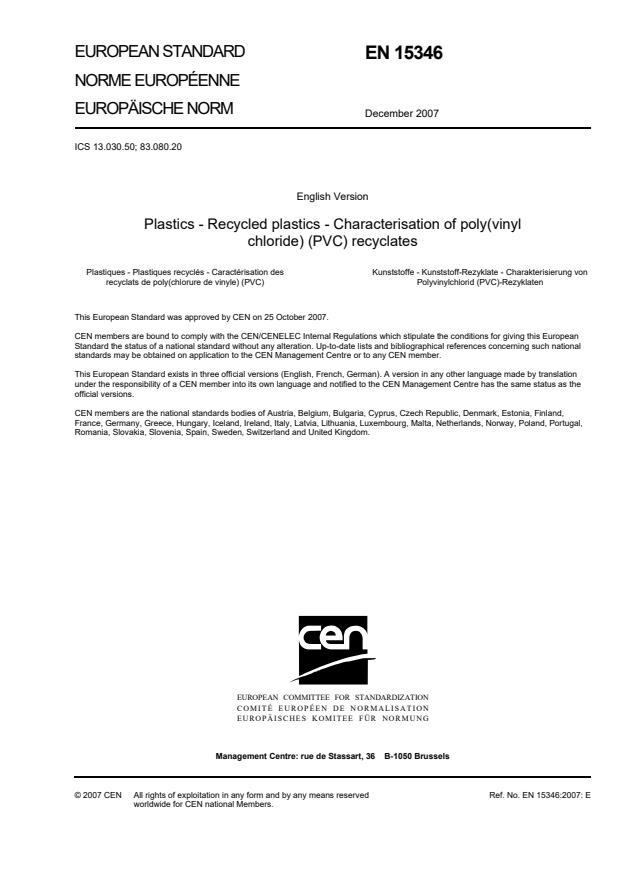
EUROPEAN STANDARDNORME EUROPÉENNEEUROPÄISCHE NORMEN 15346December 2007ICS 13.030.50; 83.080.20 English VersionPlastics - Recycled plastics - Characterisation of poly(vinylchloride) (PVC) recyclatesPlastiques - Plastiques recyclés - Caractérisation desrecyclats de poly(chlorure de vinyle) (PVC)Kunststoffe - Kunststoff-Rezyklate - Charakterisierung vonPolyvinylchlorid (PVC)-RezyklatenThis European Standard was approved by CEN on 25 October 2007.CEN members are bound to comply with the CEN/CENELEC Internal Regulations which stipulate the conditions for giving this EuropeanStandard the status of a national standard without any alteration. Up-to-date lists and bibliographical references concerning such nationalstandards may be obtained on application to the CEN Management Centre or to any CEN member.This European Standard exists in three official versions (English, French, German). A version in any other language made by translationunder the responsibility of a CEN member into its own language and notified to the CEN Management Centre has the same status as theofficial versions.CEN members are the national standards bodies of Austria, Belgium, Bulgaria, Cyprus, Czech Republic, Denmark, Estonia, Finland,France, Germany, Greece, Hungary, Iceland, Ireland, Italy, Latvia, Lithuania, Luxembourg, Malta, Netherlands, Norway, Poland, Portugal,Romania, Slovakia, Slovenia, Spain, Sweden, Switzerland and United Kingdom.EUROPEAN COMMITTEE FOR STANDARDIZATIONCOMITÉ EUROPÉEN DE NORMALISATIONEUROPÄISCHES KOMITEE FÜR NORMUNGManagement Centre: rue de Stassart, 36
B-1050 Brussels© 2007 CENAll rights of exploitation in any form and by any means reservedworldwide for CEN national Members.Ref. No. EN 15346:2007: E
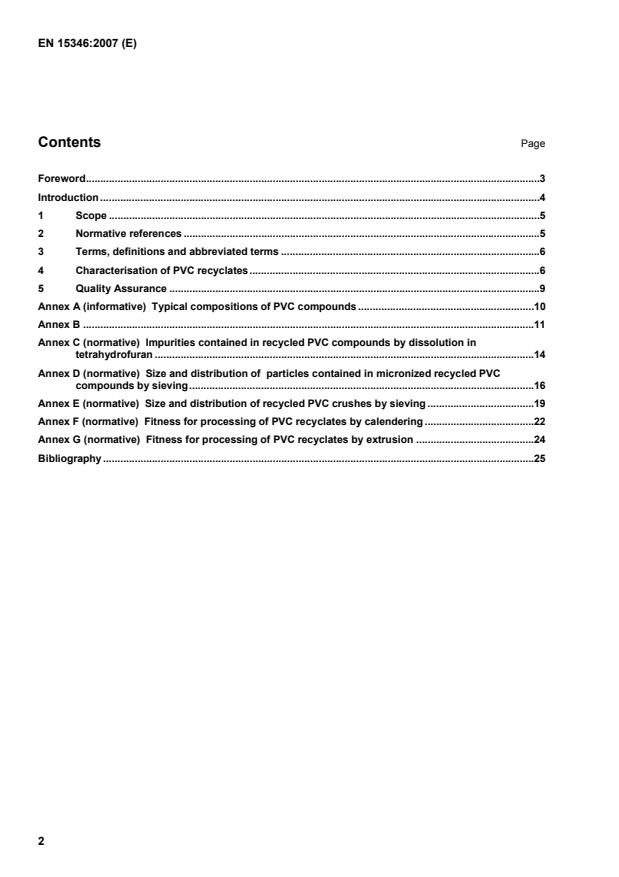
Typical compositions of PVC compounds.10 Annex B.11 Annex C (normative)
Impurities contained in recycled PVC compounds by dissolution in tetrahydrofuran.14 Annex D (normative)
Size and distribution of
particles contained in micronized recycled PVC compounds by sieving.16 Annex E (normative)
Size and distribution of recycled PVC crushes by sieving.19 Annex F (normative)
Fitness for processing of PVC recyclates by calendering.22 Annex G (normative)
Fitness for processing of PVC recyclates by extrusion.24 Bibliography.25
EN 15342 Plastics—Recycled Plastics—Characterization of polystyrene (PS) recyclates EN 15343 Plastics—Recycled Plastics—Plastics recycling traceability and assessment of conformity and recycled content EN 15344 Plastics—Recycled Plastics—Characterisation of Polyethylene (PE) recyclates EN 15345 Plastics—Recycled Plastics—Characterisation of Polypropylene (PP) recyclates EN 15346 Plastics—Recycled plastics—Characterisation of poly(vinyl chloride) (PVC) recyclates EN 15347 Plastics — Recycled Plastics — Characterisation of plastics wastes EN 15348 Plastics—Recycled plastics—Characterization of poly(ethylene terephthalate) (PET) recyclates CEN/TR 15353 Plastics — Recycled plastics — Guidelines for the development of standards for recycled plastics According to the CEN/CENELEC Internal Regulations, the national standards organizations of the following countries are bound to implement this European Standard: Austria, Belgium, Bulgaria, Cyprus, Czech Republic, Denmark, Estonia, Finland, France, Germany, Greece, Hungary, Iceland, Ireland, Italy, Latvia, Lithuania, Luxembourg, Malta, Netherlands, Norway, Poland, Portugal, Romania, Slovakia, Slovenia, Spain, Sweden, Switzerland and the United Kingdom.
Introduction Recycling of plastics waste is one type of material recovery process intended to save resources (virgin raw materials, water, and energy), while minimising harmful emissions into air, water and soil as well as any impacts on human health. The environmental impact of recycling has to be assessed over the whole life cycle of the recycling system (from the waste generation point to the disposal of final residues). To ensure that recycling constitutes the best environmental option for treating the available waste, some prerequisites should preferably be met: recycling scheme being contemplated should generate lower environmental impacts than alternative recovery options; existing or potential market outlets should be identified that will secure a sustainable industrial recycling operation; collection and sorting schemes should be properly designed to deliver recyclable plastics waste fractions fitting reasonably well with the available recycling technologies and with the (changing) needs of the identified market outlets, preferably at minimum costs to society. This standard has been produced in accordance with the guidance produced by CEN on Environmental Aspects and in accordance with CEN/TR 15353, Plastics—Recycled Plastics—Guidelines for the development of standards relating to recycled plastics. NOTE CEN/TR 15353 considers the general environmental aspects which are specific to the recycling process. It is often impossible to trace back each individual product at the end user stage and to check whether the product has been used correctly through its life.
Consequently products are out of industrial control for a period of time.
It is possible that during this period contamination with other materials may occur that could affect the product's suitability for recycling into the intended application.
3 Terms, definitions and abbreviated terms For the purposes of this European Standard, the terms and definitions given in EN ISO 472:2001 and CEN/TR 15353:2007 and the following apply.
3.1 sieve retention percentage, in mass, of the recycled test sample retained on a sieve at the end of the test
3.2 container retention percentage of recycled material retained in the container at the bottom of a stack of sieves, or under a simple sieve, at the end of the testing method compared to the mass of the sample tested 3.3 average particulate dimension single value of size, expressed to the nearest 0, 001 mm, representing the dominant mass size for the whole test sample 3.4 tetrahydrofuran THF
tetrahydrofuran 4 Characterisation of PVC recyclates A single batch is the quantity of recyclate that has homogeneous characteristics within the specified tolerances. The characteristics of PVC recyclates, given in Table 1, are divided into two types: Required characteristics needed to characterize PVC recyclates in general, and required for all recyclates.
Optional characteristics needed to characterize PVC recyclates according to customer specifications and applications. These characteristics shall be assessed by using the test methods given in Table 1.
Table 1 — Characterisation of PVC recyclates Characteristic Units Test method PVC-U PVC-P Comments Required Bulk density kg/m3 Annex B X X
Colour
Visual Inspection X X
e.g natural colour, single, mixed Hardness sh EN ISO 868
X For calendering stiffness can be evaluated instead of hardness. See Annex F. Impurities % Annex C
X X An alternative method agreed by both parties may also be used. Particle size and distribution
g, % Annex D a
Annex E b
X X Size distribution is needed for materials with
a low particle size. Shape
Visual X X e.g. micronized material, pellets,
particles Optional Ash content % EN ISO 3451-5 Method A O O Linked with filler and PVC content Dry flow rate s EN ISO 6186 O O Recommended for micronized materials or small particle size recyclates Density kg/m3 EN ISO 1183-1 Method A O O
Fitness of processing of PVC recyclates — by calendering
— by extrusion
Annex F
Annex G
O
O
O
O
Residual humidity % EN 12099c O O Weight loss, 105 °C Tensile stress at yield MPa EN ISO 527-1
EN ISO 527-2 O O
Tensile strain at break % EN ISO 527-1
EN ISO 527-2 O O Elongation Thermal stability min ISO 182-1 ISO 182-2 ISO 182-3 ISO 182-4 O O Linked to stabilizer content Specify which is used.
Vicat softening temperature °C EN ISO 306 Method B50 O
Volatile content % ISO 1269 O O Linked to moisture content X : required characteristics to be quantified. O : optional characteristics to be quantified. a Only applicable for micronized recycled PVC compounds. b Only applicable for recycled PVC crushes. c
Although the scope of EN 12099 is limited, it is considered relevant. NOTE Other tests may be carried out by an agreement between the purchaser and the supplier. The test results should be reported.
NOTE 1 A quality management system certified to EN ISO 9001 may be a suitable guarantee of consistent recyclate quality. The specification and the standard deviation or range of values within and between batches of material shall be agreed between the supplier and the purchaser. Where a statement of recycled content, or the previous history of the material, is requested, documentary evidence shall be provided, where there is no analytical method available to supply such information. These records should be available to the purchaser on request. Where a recyclate has been produced via a melt process, the supplier may choose to state the level of filtration applied during that process. This will determine the maximum size of any non-melting contaminants present in the recyclate. The statement of filtration level shall include details of the filter.
Recyclates which have not passed through a melt process cannot be quantified in the same way, and the supplier may state this.
NOTE 2 EN 15343 describes a qualified recycling process and gives details of traceability and the assessment of recycled content.
Typical compositions of PVC compounds
Resins of vinyl chloride are always converted as compounds that composition depends upon the application. Typical compositions of compounds are given in Table A.1. PVC recyclates are made from these compounds.
Table A.1 — Typical compositions of PVC compounds
Dimensions in phr (parts per hundred parts of resin) Application PVC Resin Plasticizer Filler range Other additives a Rigid packaging
100 0 0 5 to 20 Flexible packaging
100 20 to 40 0 1 to 20 Plastic piping components for pressure applications
100 0 2 to 5 4 Plastic piping components for non-pressure applications 100 0 0 to 20 3 to 5 Windows and doors 100 0 5 to 10 7 to 16 Other profiles 100 0 0 to 40 5 to 15 Cables 100 30 to 60 0 to 50 b 3 to 10 Flooring 100 25 to 50 - 0 to 300 2 to 5 Sheets 100 40 to 70 0 to 30 2 to 10 Coated fabrics 100 40 to 90 0 to 30 7 to 20 c
a Such as stabilizers, impact modifiers, lubricants, etc.
b
Bedding up to about 250 phr. c Synthetic textile fibres included.
Key 1 Volume of approximately 2 500 ml, diameter of hole at base 55 mm + 0,25mm 2 Inner height: 200 mm + 0,2mm, Inner diameter: 113 mm + 0,2mm, Volume: 2 000 ml 3 Angle approximately 65 ° 4 Diameter of hole approximately 60 mm 5 Distance of 100 mm + 0,5 mm Figure B.1 — Typical apparatus for determining bulk density
B.2 Material Powder or granular material. B.3 Apparatus B.3.1 Balance, accurate to 0,1 g. B.3.2 Measuring cylinder, smoothly finished inside, which shall be constructed of metal, of a capacity of
2 000 ml (Inner height 200 mm and inner diameter 113 mm). B.3.3 Conical funnel, of the form and dimensions shown in Figure B.1, of a capacity of 2 500 ml, internal diameter at base 55 mm, equipped with a metal trap plate for the lower orifice. Diameter of the orifice in trap plate 60 mm. B.4 Preparation of test sample Mix the sample well before the test.
B.5 Procedure B.5.1 Support the funnel (B.3.3) vertically with its lower orifice 100 mm above the measuring cylinder (B.3.2) and coaxial with it. Mix the sample of the powder or granular material well before testing. With the lower orifice of the funnel closed by means of the trap, place a quantity of 2 200 ml to 2 400 ml of the sample material in the funnel. B.5.2 Open the trap quickly and allow the sample to flow into the measuring cylinder. When the measuring cylinder is full, draw a straightedge blade across the top of the measuring cylinder to remove any excess of the sample. Weigh the contents of the measuring cylinder to the nearest 0,1 g, using the balance (B.3.1). B.5.3 Repeat procedure B.5.1 and B.5.2 to complete at least two determinations of the sample under test. B.6 Expression of results The bulk density of the material under test is given, in grams per millilitre, by the formula: m
(B.1) V where m is the mass, in grams, of the contents of the measuring cylinder; V is the volume, in millilitre, of the measuring cylinder. Take as the result the arithmetic mean of the results of the determinations obtained by following the procedure B.5.
...