

ASTM C1201/C1201M-20
(Test Method)Standard Test Method for Structural Performance of Exterior Dimension Stone Cladding Systems by Uniform Static Air Pressure Difference
General Information
- Abstract
SIGNIFICANCE AND USE
5.1 This test method gives a standard procedure for determining structural performance under uniform static air pressure difference. This typically is intended to represent the effects of wind loads on exterior building surface elements. The actual loading on building surfaces is quite complex, varying with wind direction, time, height above ground, building shape, terrain, surrounding structures, and other factors. These factors are discussed in the literature in 2.2 and 2.3 and Footnotes 4 and 5.
Note 1: In applying the results of tests by this test method, it should be borne in mind that the performance of a cladding system may be a function of fabrication, installation, and adjustment, and that the specimen may or may not truly represent the actual structure. In service, the performance will also depend on the rigidity of supporting construction and on the resistance of components to deterioration by various causes, to vibration, to thermal expansion and contraction, etc.
SCOPE
1.1 This test method covers the determination of the structural performance of dimension stone cladding systems under positive and negative uniform static air pressure differences, using a test chamber.
1.2 The proper use of this test method requires a knowledge of the principles of pressure and deflection measurement.
1.3 This test method describes the apparatus and the procedure to be used for applying either specific test loads or unknown ultimate values of uniformity distributed test loads to a specimen.
1.3.1 Procedure A (see 11.2) shall be used when deflections at maximum load only are required.
1.3.2 Procedure B (see 11.3) shall be used when a load-deflection curve is required.
1.4 The values stated in either SI units or inch-pound units are to be regarded separately as standard. The values stated in each system may not be exact equivalents; therefore, each system shall be used independently of the other. Combining values from the two systems may result in non-conformance with the standard.
1.5 This standard does not purport to address all of the safety concerns, if any, associated with its use. It is the responsibility of the user of this standard to establish appropriate safety, health, and environmental practices and determine the applicability of regulatory limitations prior to use. For specific hazard statements, see Section 7.
1.6 This international standard was developed in accordance with internationally recognized principles on standardization established in the Decision on Principles for the Development of International Standards, Guides and Recommendations issued by the World Trade Organization Technical Barriers to Trade (TBT) Committee.
- Status
- Published
- Publication Date
- 30-Sep-2020
- Technical Committee
- C18 - Dimension Stone
- Drafting Committee
- C18.01 - Test Methods
Buy Documents

ASTM C1201/C1201M-20 - Standard Test Method for Structural Performance of Exterior Dimension Stone Cladding Systems by Uniform Static Air Pressure Difference
REDLINE ASTM C1201/C1201M-20 - Standard Test Method for Structural Performance of Exterior Dimension Stone Cladding Systems by Uniform Static Air Pressure Difference
Overview
ASTM C1201/C1201M-20, established by ASTM International, defines the standard test method for evaluating the structural performance of exterior dimension stone cladding systems when subjected to uniform static air pressure differences. This rigorous method is designed to simulate the wind load effects encountered by cladding systems on building exteriors, taking into account both positive and negative pressure scenarios. The procedure is widely recognized in the construction and building materials industries as a benchmark for assessing the durability and strength of stone cladding systems under realistic service conditions.
Key Topics
- Purpose: The standard outlines procedures to determine how exterior stone cladding systems withstand uniformly distributed static air pressure, representing wind force conditions.
- Test Method: The test involves installing full-size specimens of the cladding system into a test chamber, applying controlled positive or negative air pressure, and measuring deflections and potential permanent deformation.
- Procedures:
- Procedure A measures deflection at the maximum applied load.
- Procedure B develops a load-deflection curve by applying incremental test loads.
- Measurement: Accurate recording of pressure differences and structural deflection is required, using calibrated instruments in either SI units or inch-pound units.
- Safety and Reliability: The process requires adherence to appropriate safety, health, and environmental practices, emphasizing user responsibility in risk assessment.
Applications
ASTM C1201/C1201M-20 is instrumental in several practical domains:
- Quality Assurance: Architects, engineers, and project managers use this standard to verify that stone cladding systems meet predetermined structural requirements before installation on new buildings.
- Performance Evaluation: Manufacturers and testing agencies rely on the method to assess new products and design configurations, ensuring compliance with building codes and safety standards.
- Structural Design: By identifying potential performance issues due to wind load, this test method aids in the optimization of cladding system design and selection of support components.
- Regulatory Compliance: This standard is often referenced in construction specifications and procurement documents to ensure that all materials and installations have been duly tested for structural adequacy under wind loads.
Related Standards
To further ensure comprehensive evaluation and integration with broader construction requirements, consider the following related standards:
- ASTM C1799 - Guide to Dimension Stone Test Specimen Sampling and Preparation: Ensures proper selection and preparation of test samples for reliable results.
- ANSI A58.1 - Building Code Requirements for Minimum Design Loads in Buildings and Other Structures: Provides foundational guidance on design loads relevant to exterior building components.
- AAMA TIR-A2 - Design Wind Loads for Aluminum Curtain Walls: Offers additional insights for systems integrating cladding with curtain wall assemblies.
Practical Value
Using ASTM C1201/C1201M-20 provides architects, engineers, manufacturers, and building owners with:
- Documented assurance of structural performance against wind loads.
- Objective, reproducible test results to compare different stone cladding products.
- Improved risk management through early identification of potential failures in cladding systems.
- Enhanced safety and durability in building façades, resulting in reduced maintenance and extended service life.
By following this standardized method, stakeholders in the building sector can achieve higher confidence in the long-term performance of exterior dimension stone cladding systems under real-world conditions.
Keywords: ASTM C1201/C1201M, stone cladding, structural performance, wind load testing, building façade, static air pressure, construction standards, façade durability, structural test methods.
Buy Documents
ASTM C1201/C1201M-20 - Standard Test Method for Structural Performance of Exterior Dimension Stone Cladding Systems by Uniform Static Air Pressure Difference
REDLINE ASTM C1201/C1201M-20 - Standard Test Method for Structural Performance of Exterior Dimension Stone Cladding Systems by Uniform Static Air Pressure Difference
Get Certified
Connect with accredited certification bodies for this standard

DIBt (Deutsches Institut für Bautechnik)
German Institute for Building Technology.
DIN CERTCO
DIN Group product certification.

Aboma Certification B.V.
Specialized in construction, metal, and transport sectors.
Sponsored listings
Frequently Asked Questions
ASTM C1201/C1201M-20 is a standard published by ASTM International. Its full title is "Standard Test Method for Structural Performance of Exterior Dimension Stone Cladding Systems by Uniform Static Air Pressure Difference". This standard covers: SIGNIFICANCE AND USE 5.1 This test method gives a standard procedure for determining structural performance under uniform static air pressure difference. This typically is intended to represent the effects of wind loads on exterior building surface elements. The actual loading on building surfaces is quite complex, varying with wind direction, time, height above ground, building shape, terrain, surrounding structures, and other factors. These factors are discussed in the literature in 2.2 and 2.3 and Footnotes 4 and 5. Note 1: In applying the results of tests by this test method, it should be borne in mind that the performance of a cladding system may be a function of fabrication, installation, and adjustment, and that the specimen may or may not truly represent the actual structure. In service, the performance will also depend on the rigidity of supporting construction and on the resistance of components to deterioration by various causes, to vibration, to thermal expansion and contraction, etc. SCOPE 1.1 This test method covers the determination of the structural performance of dimension stone cladding systems under positive and negative uniform static air pressure differences, using a test chamber. 1.2 The proper use of this test method requires a knowledge of the principles of pressure and deflection measurement. 1.3 This test method describes the apparatus and the procedure to be used for applying either specific test loads or unknown ultimate values of uniformity distributed test loads to a specimen. 1.3.1 Procedure A (see 11.2) shall be used when deflections at maximum load only are required. 1.3.2 Procedure B (see 11.3) shall be used when a load-deflection curve is required. 1.4 The values stated in either SI units or inch-pound units are to be regarded separately as standard. The values stated in each system may not be exact equivalents; therefore, each system shall be used independently of the other. Combining values from the two systems may result in non-conformance with the standard. 1.5 This standard does not purport to address all of the safety concerns, if any, associated with its use. It is the responsibility of the user of this standard to establish appropriate safety, health, and environmental practices and determine the applicability of regulatory limitations prior to use. For specific hazard statements, see Section 7. 1.6 This international standard was developed in accordance with internationally recognized principles on standardization established in the Decision on Principles for the Development of International Standards, Guides and Recommendations issued by the World Trade Organization Technical Barriers to Trade (TBT) Committee.
SIGNIFICANCE AND USE 5.1 This test method gives a standard procedure for determining structural performance under uniform static air pressure difference. This typically is intended to represent the effects of wind loads on exterior building surface elements. The actual loading on building surfaces is quite complex, varying with wind direction, time, height above ground, building shape, terrain, surrounding structures, and other factors. These factors are discussed in the literature in 2.2 and 2.3 and Footnotes 4 and 5. Note 1: In applying the results of tests by this test method, it should be borne in mind that the performance of a cladding system may be a function of fabrication, installation, and adjustment, and that the specimen may or may not truly represent the actual structure. In service, the performance will also depend on the rigidity of supporting construction and on the resistance of components to deterioration by various causes, to vibration, to thermal expansion and contraction, etc. SCOPE 1.1 This test method covers the determination of the structural performance of dimension stone cladding systems under positive and negative uniform static air pressure differences, using a test chamber. 1.2 The proper use of this test method requires a knowledge of the principles of pressure and deflection measurement. 1.3 This test method describes the apparatus and the procedure to be used for applying either specific test loads or unknown ultimate values of uniformity distributed test loads to a specimen. 1.3.1 Procedure A (see 11.2) shall be used when deflections at maximum load only are required. 1.3.2 Procedure B (see 11.3) shall be used when a load-deflection curve is required. 1.4 The values stated in either SI units or inch-pound units are to be regarded separately as standard. The values stated in each system may not be exact equivalents; therefore, each system shall be used independently of the other. Combining values from the two systems may result in non-conformance with the standard. 1.5 This standard does not purport to address all of the safety concerns, if any, associated with its use. It is the responsibility of the user of this standard to establish appropriate safety, health, and environmental practices and determine the applicability of regulatory limitations prior to use. For specific hazard statements, see Section 7. 1.6 This international standard was developed in accordance with internationally recognized principles on standardization established in the Decision on Principles for the Development of International Standards, Guides and Recommendations issued by the World Trade Organization Technical Barriers to Trade (TBT) Committee.
ASTM C1201/C1201M-20 is classified under the following ICS (International Classification for Standards) categories: 91.060.10 - Walls. Partitions. Facades. The ICS classification helps identify the subject area and facilitates finding related standards.
ASTM C1201/C1201M-20 is available in PDF format for immediate download after purchase. The document can be added to your cart and obtained through the secure checkout process. Digital delivery ensures instant access to the complete standard document.
Standards Content (Sample)
This international standard was developed in accordance with internationally recognized principles on standardization established in the Decision on Principles for the
Development of International Standards, Guides and Recommendations issued by the World Trade Organization Technical Barriers to Trade (TBT) Committee.
Designation: C1201/C1201M − 20
Standard Test Method for
Structural Performance of Exterior Dimension Stone
Cladding Systems by Uniform Static Air Pressure
Difference
This standard is issued under the fixed designation C1201/C1201M; the number immediately following the designation indicates the
year of original adoption or, in the case of revision, the year of last revision. A number in parentheses indicates the year of last
reapproval. A superscript epsilon (´) indicates an editorial change since the last revision or reapproval.
1. Scope 2. Referenced Documents
1.1 This test method covers the determination of the struc-
2.1 ASTM Standards:
tural performance of dimension stone cladding systems under C1799 Guide to Dimension Stone Test Specimen Sampling
positive and negative uniform static air pressure differences, and Preparation
using a test chamber.
2.2 ANSI Standard:
1.2 The proper use of this test method requires a knowledge ANSI A58.1 Building Code Requirements for Minimum
of the principles of pressure and deflection measurement. Design Loads in Buildings and Other Structures
1.3 This test method describes the apparatus and the proce- 2.3 AAMA Standard:
dure to be used for applying either specific test loads or AAMA TIR-A2 Design Wind Loads for Aluminum Curtain
unknown ultimate values of uniformity distributed test loads to Walls
a specimen.
1.3.1 ProcedureA(see 11.2) shall be used when deflections
3. Terminology
at maximum load only are required.
3.1 Definitions of Terms Specific to This Standard:
1.3.2 Procedure B (see 11.3) shall be used when a load-
3.1.1 permanent deformation—the permanent displacement
deflection curve is required.
from an original position that remains after an applied load has
1.4 The values stated in either SI units or inch-pound units
been removed.
are to be regarded separately as standard. The values stated in
3.1.2 specimen—theentireassembledunitsubmittedfortest
each system may not be exact equivalents; therefore, each
as described in Section 8.
system shall be used independently of the other. Combining
3.1.3 test load—thespecifieddifferenceinstaticairpressure
values from the two systems may result in non-conformance
(positive or negative) for which the specimen is to be tested,
with the standard.
expressed in pounds-force per square foot [Pascals].
1.5 This standard does not purport to address all of the
3.1.4 ultimate load—the difference in static air pressure
safety concerns, if any, associated with its use. It is the
(positive or negative) at which failure of the specimen occurs,
responsibility of the user of this standard to establish appro-
expressed in pounds-force per square foot [Pascals].
priate safety, health, and environmental practices and deter-
mine the applicability of regulatory limitations prior to use.
4. Summary of Test Method
For specific hazard statements, see Section 7.
1.6 This international standard was developed in accor- 4.1 This test method consists of sealing the test specimen
dance with internationally recognized principles on standard-
into or against one face of a test chamber; supplying air to, or
ization established in the Decision on Principles for the exhausting air from, the chamber at the rate required to
Development of International Standards, Guides and Recom- maintain the test-pressure difference across the specimen; and
mendations issued by the World Trade Organization Technical
Barriers to Trade (TBT) Committee.
For referenced ASTM standards, visit the ASTM website, www.astm.org, or
contact ASTM Customer Service at service@astm.org. For Annual Book of ASTM
This test method is under the jurisdiction of ASTM Committee C18 on Standards volume information, refer to the standard’s Document Summary page on
Dimension Stone and is the direct responsibility of Subcommittee C18.01 on Test the ASTM website.
Methods. Available from American National Standards Institute (ANSI), 25 W. 43rd St.,
Current edition approved Oct. 1, 2020. Published October 2020. Originally 4th Floor, New York, NY 10036, http://www.ansi.org.
approved in 1991. Last previous edition approved in 2015 as C1201–15. DOI: Available from American Architectural Manufacturers Association (AAMA),
10.1520/C1201_C1201M-20. 1827 Walden Office Square, Suite 550, Schaumburg, IL 60173-4268.
Copyright © ASTM International, 100 Barr Harbor Drive, PO Box C700, West Conshohocken, PA 19428-2959. United States
C1201/C1201M − 20
observing, measuring, and recording the deflection, being tested. At least one static pressure tap shall be provided
5,6
deformations, and nature of any failures. to measure the chamber pressure and shall be so located that
the reading is unaffected by the velocity of the air supply to or
5. Significance and Use
from the chamber, or any other air movement. The air supply
opening into the chamber shall be arranged so that the air does
5.1 This test method gives a standard procedure for deter-
miningstructuralperformanceunderuniformstaticairpressure not impinge directly on the test specimen. A means of access
into the chamber may be provided to facilitate adjustments and
difference. This typically is intended to represent the effects of
wind loads on exterior building surface elements. The actual observations after the specimen has been installed.
loading on building surfaces is quite complex, varying with
NOTE 3—The test chamber and the specimen mounting frame must not
wind direction, time, height above ground, building shape,
deflect under the test load in such a manner that the performance of the
terrain, surrounding structures, and other factors. These factors specimen will be affected.
are discussed in the literature in 2.2 and 2.3 and Footnotes 4
6.2.2 Air System—A controllable blower, a compressed-air
and 5.
supply, an exhaust system, or reversible controllable blower
designed to provide the required maximum air-pressure differ-
NOTE 1—In applying the results of tests by this test method, it should
be borne in mind that the performance of a cladding system may be a ence across the specimen. The system shall provide an essen-
function of fabrication, installation, and adjustment, and that the specimen
tially constant air-pressure difference for the required test
may or may not truly represent the actual structure. In service, the
period.
performance will also depend on the rigidity of supporting construction
and on the resistance of components to deterioration by various causes, to
NOTE 4—It is convenient to use a reversible blower or a separate
vibration, to thermal expansion and contraction, etc.
pressure and exhaust system to provide the required air-pressure differ-
ence so that the test specimen can be tested for the effect of positive
6. Apparatus
pressure and for the effect of negative pressure without removing,
reversing, and reinstalling the test specimen. If an adequate air supply is
6.1 The description of apparatus is general in nature; any
available, a completely airtight seal need not be provided around the
equipment capable of performing the test procedure within the
perimeter of the test specimen and the mounting panel, although it is
allowable tolerances is permitted.
preferable. However, substantial air leakage will require an air supply of
NOTE 2—Refer to Guide C1799 for additional information on selecting, much greater capacity to maintain the required pressure differences.
preparing, and conditioning test specimens.
6.2.3 Pressure-Measuring Apparatus—A device to measure
6.2 Major Components (see Fig. 1):
the test pressure difference within an accuracy of 62%.
6.2.1 Test Chamber—A test chamber or box with an
6.2.4 Deflection-Measuring System—Ameans of measuring
opening, a removable mounting panel, or one open side in
deflections with an accuracy of 60.001 in. [60.02 mm].
which, or against which, the specimen is installed. Care should
6.2.4.1 Stone deflections shall be measured perpendicular to
be taken when designing the chamber-to-specimen seal, to
the stone surface at anchorage locations and at the position of
avoidedgeconditionsnotrepresentativeofthecladdingsystem
maximum displacement. Additional locations for deflection
measurements, if required, shall be stated by the specifier.
6.2.4.2 Deflection gauges shall be supported independently
ASHRAE Handbook of Fundamentals, American Society of Heating,
of the cladding system being tested.
Refrigerating, and Air-Conditioning Engineers, Inc., Chapter 26, 1977.
“Wind Forces on Structures ,” Transactions of the American Society of Civil 6.2.4.3 For tests to determine the ultimate performance of a
Engineer, Vol 126, Part II, Paper 3269, 1961, pp. 1124–1198.
specimen, deflection-measuring de
...
This document is not an ASTM standard and is intended only to provide the user of an ASTM standard an indication of what changes have been made to the previous version. Because
it may not be technically possible to adequately depict all changes accurately, ASTM recommends that users consult prior editions as appropriate. In all cases only the current version
of the standard as published by ASTM is to be considered the official document.
Designation: C1201/C1201M − 15 C1201/C1201M − 20
Standard Test Method for
Structural Performance of Exterior Dimension Stone
Cladding Systems by Uniform Static Air Pressure
Difference
This standard is issued under the fixed designation C1201/C1201M; the number immediately following the designation indicates the
year of original adoption or, in the case of revision, the year of last revision. A number in parentheses indicates the year of last
reapproval. A superscript epsilon (´) indicates an editorial change since the last revision or reapproval.
1. Scope
1.1 This test method covers the determination of the structural performance of dimension stone cladding systems under positive
and negative uniform static air pressure differences, using a test chamber.
1.2 The proper use of this test method requires a knowledge of the principles of pressure and deflection measurement.
1.3 This test method describes the apparatus and the procedure to be used for applying either specific test loads or unknown
ultimate values of uniformity distributed test loads to a specimen.
1.3.1 Procedure A (see 11.2) shall be used when deflections at maximum load only are required.
1.3.2 Procedure B (see 11.3) shall be used when a load-deflection curve is required.
1.4 The values stated in either SI units or inch-pound units are to be regarded separately as standard. The values stated in each
system may not be exact equivalents; therefore, each system shall be used independently of the other. Combining values from the
two systems may result in non-conformance with the standard.
1.5 This standard does not purport to address all of the safety concerns, if any, associated with its use. It is the responsibility
of the user of this standard to establish appropriate safety safety, health, and healthenvironmental practices and determine the
applicability of regulatory limitations prior to use. For specific hazard statements, see Section 7.
1.6 This international standard was developed in accordance with internationally recognized principles on standardization
established in the Decision on Principles for the Development of International Standards, Guides and Recommendations issued
by the World Trade Organization Technical Barriers to Trade (TBT) Committee.
2. Referenced Documents
2.1 ASTM Standards:
C1799 Guide to Dimension Stone Test Specimen Sampling and Preparation
This test method is under the jurisdiction of ASTM Committee C18 on Dimension Stone and is the direct responsibility of Subcommittee C18.01 on Test Methods.
Current edition approved May 1, 2015Oct. 1, 2020. Published July 2015October 2020. Originally approved in 1991. Last previous edition approved in 20092015 as
C1201–09.–15. DOI: 10.1520/C1201_C1201M-15.10.1520/C1201_C1201M-20.
For referenced ASTM standards, visit the ASTM website, www.astm.org, or contact ASTM Customer Service at service@astm.org. For Annual Book of ASTM Standards
volume information, refer to the standard’s Document Summary page on the ASTM website.
Copyright © ASTM International, 100 Barr Harbor Drive, PO Box C700, West Conshohocken, PA 19428-2959. United States
C1201/C1201M − 20
2.2 ANSI Standard:
ANSI A58.1 Building Code Requirements for Minimum Design Loads in Buildings and Other Structures
2.3 AAMA Standard:
AAMA TIR-A2 Design Wind Loads for Aluminum Curtain Walls
3. Terminology
3.1 Definitions of Terms Specific to This Standard:
3.1.1 permanent deformation—the permanent displacement from an original position that remains after an applied load has been
removed.
3.1.2 specimen—the entire assembled unit submitted for test as described in Section 8.
3.1.3 test load—the specified difference in static air pressure (positive or negative) for which the specimen is to be tested,
expressed in pounds-force per square foot [Pascals].
3.1.4 ultimate load—the difference in static air pressure (positive or negative) at which failure of the specimen occurs, expressed
in pounds-force per square foot [Pascals].
4. Summary of Test Method
4.1 This test method consists of sealing the test specimen into or against one face of a test chamber; supplying air to, or exhausting
air from, the chamber at the rate required to maintain the test-pressure difference across the specimen; and observing, measuring,
5,6
and recording the deflection, deformations, and nature of any failures.
5. Significance and Use
5.1 This test method gives a standard procedure for determining structural performance under uniform static air pressure
difference. This typically is intended to represent the effects of wind loads on exterior building surface elements. The actual loading
on building surfaces is quite complex, varying with wind direction, time, height above ground, building shape, terrain, surrounding
structures, and other factors. These factors are discussed in the literature in 2.2 and 2.3 and Footnotes 4 and 5.
NOTE 1—In applying the results of tests by this test method, it should be borne in mind that the performance of a cladding system may be a function of
fabrication, installation, and adjustment, and that the specimen may or may not truly represent the actual structure. In service, the performance will also
depend on the rigidity of supporting construction and on the resistance of components to deterioration by various causes, to vibration, to thermal
expansion and contraction, etc.
6. Apparatus
6.1 The description of apparatus is general in nature; any equipment capable of performing the test procedure within the allowable
tolerances is permitted.
NOTE 2—Refer to Guide C1799 for additional information on selecting, preparing, and conditioning test specimens.
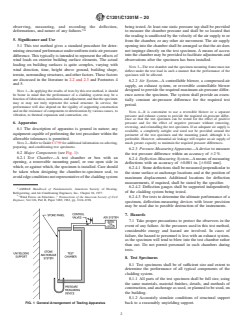
6.2 Major Components (see Fig. 1):
6.2.1 Test Chamber—A test chamber or box with an opening, a removable mounting panel, or one open side in which, or against
which, the specimen is installed. Care should be taken when designing the chamber-to-specimen seal, to avoid edge conditions not
representative of the cladding system being tested. At least one static pressure tap shall be provided to measure the chamber
pressure and shall be so located that the reading is unaffected by the velocity of the air supply to or from the chamber, or any other
air movement. The air supply opening into the chamber shall be arranged so that the air does not impinge directly on the test
specimen. A means of access into the chamber may be provided to facilitate adjustments and observations after the specimen has
been installed.
Available from American National Standards Institute (ANSI), 25 W. 43rd St., 4th Floor, New York, NY 10036, http://www.ansi.org.
Available from American Architectural Manufacturers Association (AAMA), 1827 Walden Office Square, Suite 550, Schaumburg, IL 60173-4268.
ASHRAE Handbook of Fundamentals, American Society of Heating, Refrigerating, and Air-Conditioning Engineers, Inc., Chapter 26, 1977.
“Wind Forces on Structures ,” Transactions of the American Society of Civil Engineer, Vol 126, Part II, Paper 3269, 1961, pp. 1124–1198.
C1201/C1201M − 20
FIG. 1 General Arrangement of Testing Apparatus
NOTE 3—The test chamber and the specimen mounting frame must not deflect under the test load in such a manner that the performance of the specimen
will be affected.
6.2.2 Air System—A controllable blower, a compressed-air supply, an exhaust system, or reversible controllable blower designed
to provide the required maximum air-pressure difference across the specimen. The system shall provide an essentially constant
air-pressure difference for the required test period.
NOTE 4—It is convenient to use a reversible blower or a separate pressure and exhaust system to provide the required air-pressure difference so that the
test specimen can be tested for the effect of positive pressure and for the effect of negative pressure without removing, reversing, and reinstalling the test
specimen. If an adequate air supply is available, a completely airtight seal need not be provided around the perimeter of the test specimen and the
mounting panel, although it is preferable. However, substantial air leakage will require an air supply of much greater capacity to maintain the required
pressure differences.
6.2.3 Pressure-Measuring Apparatus—A device to measure the test pressure difference within an accuracy of 62 %.
6.2.4 Deflection-Measuring System—A means of measuring deflections with an accuracy of 60.001 in. [60.02 mm].
6.2.4.1 Stone deflections shall be measured perpendicular to the stone surface at anchorage locations and at the position of
maximum displacement. Additional locations for deflection measurements, if required, shall be stated by the specifier.
6.2.4.2 Deflection gauges shall be supported independently of the cladding system being tested.
6.2.4.3 For tests to determine the ultimate performance of a specimen, deflection-measuring devices with lesser precision may be
used due to possible destruction of the instruments.
7. Hazards
7.1 Take proper precautions to protect the observers in the event of any failure. At the pressures used in this te
...