

ASTM C1301-22
(Test Method)Standard Test Method for Major and Trace Elements in Limestone and Lime by Inductively Coupled Plasma-Atomic Emission Spectroscopy (ICP) and Atomic Absorption (AA)
General Information
- Abstract
SIGNIFICANCE AND USE
5.1 The presence and concentration of elements in lime and limestone is important in determining product quality and its suitability for various uses. This test method provides a means of measuring the major and trace element concentration in lime and limestone.
SCOPE
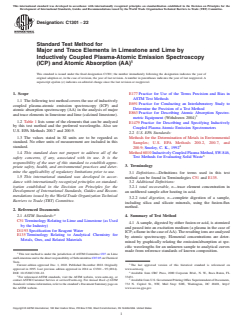
1.1 The following test method covers the use of inductively coupled plasma-atomic emission spectroscopy (ICP) and atomic absorption spectroscopy (AA) in the analysis of major and trace elements in limestone and lime (calcined limestone).
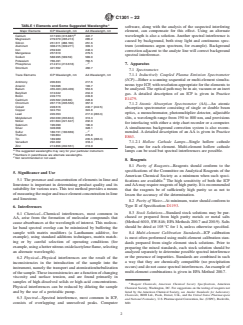
1.2 Table 1 lists some of the elements that can be analyzed by this test method and the preferred wavelengths. Also see U.S. EPA Methods 200.7 and 200.9.
1.3 The values stated in SI units are to be regarded as standard. No other units of measurement are included in this standard.
1.4 This standard does not purport to address all of the safety concerns, if any, associated with its use. It is the responsibility of the user of this standard to establish appropriate safety, health, and environmental practices and determine the applicability of regulatory limitations prior to use.
1.5 This international standard was developed in accordance with internationally recognized principles on standardization established in the Decision on Principles for the Development of International Standards, Guides and Recommendations issued by the World Trade Organization Technical Barriers to Trade (TBT) Committee.
- Status
- Published
- Publication Date
- 30-Nov-2022
- Technical Committee
- C07 - Lime and Limestone
- Drafting Committee
- C07.05 - Chemical Tests
Buy Documents
ASTM C1301-22 - Standard Test Method for Major and Trace Elements in Limestone and Lime by Inductively Coupled Plasma-Atomic Emission Spectroscopy (ICP) and Atomic Absorption (AA)
REDLINE ASTM C1301-22 - Standard Test Method for Major and Trace Elements in Limestone and Lime by Inductively Coupled Plasma-Atomic Emission Spectroscopy (ICP) and Atomic Absorption (AA)
Overview
ASTM C1301-22: Standard Test Method for Major and Trace Elements in Limestone and Lime by Inductively Coupled Plasma-Atomic Emission Spectroscopy (ICP) and Atomic Absorption (AA), provides a robust framework for the analysis of elemental composition in lime and limestone. The standard is developed and published by ASTM International, ensuring alignment with globally recognized principles.
This method enables precise identification and quantification of major and trace elements, supporting the evaluation of product quality and determining the material’s suitability for industrial, environmental, and construction applications. The test covers the use of ICP and AA spectroscopy to analyze a wide range of elements, following procedures and recommended instrument settings in compliance with international and U.S. EPA guidance.
Key Topics
Elemental Analysis in Lime and Limestone
The standard outlines detailed procedures to determine both major elements (e.g., calcium, magnesium, silicon, aluminum, iron, manganese, sodium, potassium, phosphorus, strontium) and trace elements (e.g., antimony, arsenic, lead, cadmium, chromium, copper, zinc, among others).Analytical Techniques
- Inductively Coupled Plasma-Atomic Emission Spectroscopy (ICP): Efficient for multi-element and trace-level analysis.
- Atomic Absorption Spectroscopy (AA): Reliable for routine quantification of key elements, with guidance on interference mitigation.
Sample Preparation and Quality Assurance
Instructions for sampling, digestion (total and acid-based), and calibration are provided to ensure accuracy and repeatability. The document emphasizes using high-purity reagents and standardized procedures to minimize interferences and errors.Precision, Repeatability, and Reproducibility
The standard defines measures for precision and bias, supporting the validation of results through interlaboratory comparison and adherence to ASTM statistical practices.
Applications
Industrial Quality Control
Manufacturers and processors of lime and limestone use this standard to ensure raw material consistency, optimize production processes, and fulfill quality certification requirements.Environmental Compliance
Accurate detection of trace elements is critical for adherence to regulatory limits on substances such as lead, arsenic, and cadmium in industrial products and waste, as referenced by the U.S. EPA methods.Construction and Infrastructure
Evaluating the composition of limestone and lime helps determine their suitability for use in construction materials, cement, and soil stabilization.Research and Development
Laboratories and research institutions apply these test methods in mineral analysis and materials science studies involving calcium-based materials.
Related Standards
- ASTM C51 - Terminology Relating to Lime and Limestone
- ASTM D1193 - Specification for Reagent Water
- ASTM E135 - Terminology Relating to Analytical Chemistry for Metals, Ores, and Related Materials
- ASTM E177 - Practice for Use of Precision and Bias in ASTM Test Methods
- ASTM E691 - Practice for Interlaboratory Study to Determine Precision of a Test Method
- ASTM E1479 - Practice for Describing and Specifying ICP Emission Spectrometers
- U.S. EPA Methods 200.7 and 200.9 - Determination of Metals in Environmental Samples
Keywords: ASTM C1301, limestone analysis, lime, ICP emission spectroscopy, atomic absorption, trace elements, major elements, industrial quality control, U.S. EPA methods, analytical chemistry, material testing, precision, reproducibility.
Relations
- Effective Date
- 01-Oct-2023
- Effective Date
- 01-Jan-2020
- Effective Date
- 15-May-2019
- Effective Date
- 01-Dec-2018
- Effective Date
- 01-Nov-2016
- Effective Date
- 15-May-2016
- Effective Date
- 01-Jul-2015
- Effective Date
- 15-May-2015
- Effective Date
- 15-Aug-2014
- Effective Date
- 01-May-2014
- Effective Date
- 01-Apr-2014
- Effective Date
- 15-Feb-2014
- Effective Date
- 01-Dec-2013
- Effective Date
- 01-May-2013
- Effective Date
- 01-May-2013
Buy Documents
ASTM C1301-22 - Standard Test Method for Major and Trace Elements in Limestone and Lime by Inductively Coupled Plasma-Atomic Emission Spectroscopy (ICP) and Atomic Absorption (AA)
REDLINE ASTM C1301-22 - Standard Test Method for Major and Trace Elements in Limestone and Lime by Inductively Coupled Plasma-Atomic Emission Spectroscopy (ICP) and Atomic Absorption (AA)
Get Certified
Connect with accredited certification bodies for this standard

ECOCERT
Organic and sustainability certification.

Eurofins Food Testing Global
Global leader in food, environment, and pharmaceutical product testing.

Intertek Bangladesh
Intertek certification and testing services in Bangladesh.
Sponsored listings
Frequently Asked Questions
ASTM C1301-22 is a standard published by ASTM International. Its full title is "Standard Test Method for Major and Trace Elements in Limestone and Lime by Inductively Coupled Plasma-Atomic Emission Spectroscopy (ICP) and Atomic Absorption (AA)". This standard covers: SIGNIFICANCE AND USE 5.1 The presence and concentration of elements in lime and limestone is important in determining product quality and its suitability for various uses. This test method provides a means of measuring the major and trace element concentration in lime and limestone. SCOPE 1.1 The following test method covers the use of inductively coupled plasma-atomic emission spectroscopy (ICP) and atomic absorption spectroscopy (AA) in the analysis of major and trace elements in limestone and lime (calcined limestone). 1.2 Table 1 lists some of the elements that can be analyzed by this test method and the preferred wavelengths. Also see U.S. EPA Methods 200.7 and 200.9. 1.3 The values stated in SI units are to be regarded as standard. No other units of measurement are included in this standard. 1.4 This standard does not purport to address all of the safety concerns, if any, associated with its use. It is the responsibility of the user of this standard to establish appropriate safety, health, and environmental practices and determine the applicability of regulatory limitations prior to use. 1.5 This international standard was developed in accordance with internationally recognized principles on standardization established in the Decision on Principles for the Development of International Standards, Guides and Recommendations issued by the World Trade Organization Technical Barriers to Trade (TBT) Committee.
SIGNIFICANCE AND USE 5.1 The presence and concentration of elements in lime and limestone is important in determining product quality and its suitability for various uses. This test method provides a means of measuring the major and trace element concentration in lime and limestone. SCOPE 1.1 The following test method covers the use of inductively coupled plasma-atomic emission spectroscopy (ICP) and atomic absorption spectroscopy (AA) in the analysis of major and trace elements in limestone and lime (calcined limestone). 1.2 Table 1 lists some of the elements that can be analyzed by this test method and the preferred wavelengths. Also see U.S. EPA Methods 200.7 and 200.9. 1.3 The values stated in SI units are to be regarded as standard. No other units of measurement are included in this standard. 1.4 This standard does not purport to address all of the safety concerns, if any, associated with its use. It is the responsibility of the user of this standard to establish appropriate safety, health, and environmental practices and determine the applicability of regulatory limitations prior to use. 1.5 This international standard was developed in accordance with internationally recognized principles on standardization established in the Decision on Principles for the Development of International Standards, Guides and Recommendations issued by the World Trade Organization Technical Barriers to Trade (TBT) Committee.
ASTM C1301-22 is classified under the following ICS (International Classification for Standards) categories: 71.040.50 - Physicochemical methods of analysis. The ICS classification helps identify the subject area and facilitates finding related standards.
ASTM C1301-22 has the following relationships with other standards: It is inter standard links to ASTM C51-23, ASTM E135-20, ASTM E135-19, ASTM C51-18, ASTM E1479-16, ASTM E135-16, ASTM E135-15a, ASTM E135-15, ASTM E135-14b, ASTM E177-14, ASTM E135-14a, ASTM E135-14, ASTM E135-13a, ASTM E177-13, ASTM E691-13. Understanding these relationships helps ensure you are using the most current and applicable version of the standard.
ASTM C1301-22 is available in PDF format for immediate download after purchase. The document can be added to your cart and obtained through the secure checkout process. Digital delivery ensures instant access to the complete standard document.
Standards Content (Sample)
This international standard was developed in accordance with internationally recognized principles on standardization established in the Decision on Principles for the
Development of International Standards, Guides and Recommendations issued by the World Trade Organization Technical Barriers to Trade (TBT) Committee.
Designation: C1301 − 22
Standard Test Method for
Major and Trace Elements in Limestone and Lime by
Inductively Coupled Plasma-Atomic Emission Spectroscopy
(ICP) and Atomic Absorption (AA)
This standard is issued under the fixed designation C1301; the number immediately following the designation indicates the year of
original adoption or, in the case of revision, the year of last revision. A number in parentheses indicates the year of last reapproval. A
superscript epsilon (´) indicates an editorial change since the last revision or reapproval.
1. Scope E177 Practice for Use of the Terms Precision and Bias in
ASTM Test Methods
1.1 The following test method covers the use of inductively
E691 Practice for Conducting an Interlaboratory Study to
coupled plasma-atomic emission spectroscopy (ICP) and
Determine the Precision of a Test Method
atomic absorption spectroscopy (AA) in the analysis of major
E863 Practice for Describing Atomic Absorption Spectro-
and trace elements in limestone and lime (calcined limestone).
metric Equipment (Withdrawn 2004)
1.2 Table 1 lists some of the elements that can be analyzed
E1479 Practice for Describing and Specifying Inductively
by this test method and the preferred wavelengths. Also see
Coupled Plasma Atomic Emission Spectrometers
U.S. EPA Methods 200.7 and 200.9.
2.2 U.S. EPA Standards:
1.3 The values stated in SI units are to be regarded as
Methods for the Determination of Metals in Environmental
standard. No other units of measurement are included in this
Samples; U.S. EPA Methods 200.2, 200.7, and
standard.
200.9; Smoley, C. K., 1992
Method 6010 InductivelyCoupledPlasmaMethod,SW-846,
1.4 This standard does not purport to address all of the
Test Methods for Evaluating Solid Waste
safety concerns, if any, associated with its use. It is the
responsibility of the user of this standard to establish appro-
3. Terminology
priate safety, health, and environmental practices and deter-
mine the applicability of regulatory limitations prior to use.
3.1 Definitions—Definitions for terms used in this test
1.5 This international standard was developed in accor-
method can be found in Terminologies C51 and E135.
dance with internationally recognized principles on standard-
3.2 Additional Definitions:
ization established in the Decision on Principles for the
3.2.1 total recoverable, n—trace element concentration in
Development of International Standards, Guides and Recom-
an unfiltered sample after heating in acid.
mendations issued by the World Trade Organization Technical
3.2.2 total digestion, n—complete digestion of a sample,
Barriers to Trade (TBT) Committee.
including silica and silicate minerals, using the fusion-flux
method.
2. Referenced Documents
2.1 ASTM Standards: 4. Summary of Test Method
C51 Terminology Relating to Lime and Limestone (as Used
4.1 Asample, digested by either fusion or acid, is atomized
by the Industry)
and passed into an excitation medium (a plasma in the case of
D1193 Specification for Reagent Water
ICP;aflameinthecaseofAA).Theresultingionsareanalyzed
E135 Terminology Relating to Analytical Chemistry for
by atomic spectroscopy. Elemental concentrations are deter-
Metals, Ores, and Related Materials
mined by graphically relating the emission/absorption at spe-
cific wavelengths for an unknown sample to analytical curves
made from reference standards of known composition.
This test method is under the jurisdiction of ASTM Committee C07 on Lime
andLimestoneandisthedirectresponsibilityofSubcommitteeC07.05onChemical
Tests.
Current edition approved Dec. 1, 2022. Published December 2022. Originally The last approved version of this historical standard is referenced on
approved in 1995. Last previous edition approved in 2014 as C1301 – 95 (2014). www.astm.org.
DOI: 10.1520/C1301-22. Available from CRC Press, 2000 Corporate Blvd., N. W., Boca Raton, FL
For referenced ASTM standards, visit the ASTM website, www.astm.org, or 33431.
contact ASTM Customer Service at service@astm.org. For Annual Book of ASTM AvailablefromU.S.GovernmentPrintingOfficeSuperintendentofDocuments,
Standards volume information, refer to the standard’s Document Summary page on 732 N. Capitol St., NW, Mail Stop: SDE, Washington, DC 20401, http://
the ASTM website. www.access.gpo.gov.
Copyright © ASTM International, 100 Barr Harbor Drive, PO Box C700, West Conshohocken, PA 19428-2959. United States
C1301 − 22
A
TABLE 1 Elements and Some Suggested Wavelengths
software, along with the analysis of the suspected interfering
Major Elements ICP Wavelength, nm AA Wavelength, nm
element, can compensate for this effect. Using an alternate
B
Calcium 317.933 (315.887) 422.7
wavelength is also a solution. Another spectral interference is
Magnesium 279.079 (285.213) 285.2
caused by background, both stray light and continuous spec-
Silicon 251.611 (288.160) 251.6
trum (continuous argon spectrum, for example). Background
Aluminum 308.215 (309.271) 309.3
Iron 259.940 248.3
correction adjacent to the analyte line will correct background
Manganese 257.610 279.5
spectral interference.
Sodium 588.995 (589.59) 589.0
Potassium 766.491 766.5
C
Phosphorus 214.914 (213.618) . 7. Apparatus
Strontium 421.552 460.7
7.1 Spectrometer.
Trace Elements ICP Wavelength, nm AA Wavelength, nm
7.1.1 Inductively Coupled Plasma Emission Spectrometer
(ICP)—Either a scanning sequential or multi-element simulta-
Antimony 206.833 217.6
neous type ICP, with resolution appropriate for the elements to
Arsenic 193.696 193.7
Barium 455.403 (493.409) 553.6
be analyzed.The optical path may be in air, vacuum or an inert
Beryllium 313.042 234.9
gas. A detailed description of an ICP is given in Practice
Boron 249.773 249.8
E1479.
Cadmium 226.502 (228.80) 228.8
Chromium 267.716 (205.552) 357.9 7.1.2 Atomic Absorption Spectrometer (AA)—An atomic
Cobalt 228.616 240.7 (242.5)
absorption spectrometer consisting of single or double beam
Copper 324.754 324.8
optics, a monochromator, photomultiplier detector, adjustable
Lead 220.353 217.0 (283.3)
Molybdenum 202.030 (203.844) 313.3
slits, a wavelength range from 190 to 800 nm, and provisions
Nickel 231.604 (221.647) 232.0
for interfacing with either a strip chart recorder or a computer.
Selenium 196.090 196.0
A simultaneous background correction system is also recom-
Silver 328.068 328.1
C
Sulfur 180.731 (180.669) .
mended. A detailed description of an AA is given in Practice
Thallium 190.864 276.8
E863.
Tin 189.989 235.5 (286.3)
7.1.2.1 Hollow Cathode Lamps—Single hollow cathode
Vanadium 292.402 318.4
Zinc 213.856 (202.551) 213.9
lamps, one for each element. Multi-element hollow cathode
A
The suggested wavelengths may vary for your particular instrument. lamps can be used but spectral interferences are possible.
B
Numbers in parentheses are alternate wavelengths.
C
Not recommended or not used.
8. Reagents
8.1 Purity of Reagents—Reagents should conform to the
specifications of the Committee on Analytical Reagents of the
5. Significance and Use
American Chemical Society as a minimum when such speci-
5.1 The presence and concentration of elements in lime and
fications are available. The high sensitivity of both the ICP
limestone is important in determining product quality and its
andAAmayrequirereagentsofhighpurity.Itisrecommended
suitability for various uses. This test method provides a means
that the reagents be of sufficiently high purity so as not to
ofmeasuringthemajorandtraceelementconcentrationinlime
lessen the accuracy of the determination.
and limestone.
8.2 Purity of Water—At minimum, water should conform to
Type II of Specification D1193.
6. Interferences
8.3 Stock Solutions—Standard stock solutions may be pur-
6.1 Chemical—Chemical interferences, most common in
chased or prepared from high purity metals or metal salts
AA, arise from the formation of molecular compounds that
(Method 6010, SW-846; EPAMethods 200.7 and 200.9). Salts
cause absorbances at the wavelength of interest. This molecu-
should be dried at 105 °C for 1 h, unless otherwise specified.
lar band spectral overlap can be minimized by buffering the
sample with matrix modifiers (a Lanthanum additive, for
8.4 Multi-element Calibration Standards—ICP calibration
example), using standard additions techniques, matrix match-
is most often performed using multi-element calibration stan-
ing or by careful selection of operating conditions (for
dards prepared from single element stock solutions. Prior to
example,usingahotternitrousoxide/acetyleneflame,selecting
preparing the mixed standards, each stock solution should be
an alternate wavelength).
analyzed separately to determine possible spectral interference
or the presence of impurities. Standards are combined in such
6.2 Physical—Physical interferences are the result of the
a way that they are chemically compatible (no precipitation
inconsistencies in the introduction of the sample into the
occurs) and do not cause spectral interferences.An example of
instrument, namely the transport and atomization/nebulization
multi-element combinations is given in EPA Method 200.7.
ofthesample.Theseinconsistenciesareafunctionofchanging
viscosity and surface tension, and are found primarily in
samples of high-dissolved solids or high-acid concentrations.
Reagent Chemicals, American Chemical Society Specifications, American
Physical interferences can be reduced by diluting the sample
Chemical Society, Washington, DC. For suggestions on the testing of reagents not
and by the use of a peristaltic pump. listed by the American Chemical Society, see Analar Standards for Laboratory
Chemicals, BDH Ltd., Poole, Dorset, U.K., and the United States Pharmacopeia
6.3 Spectral—Spectral interference, most common in ICP,
and National Formulary, U.S. Pharmacopeial Convention, Inc. (USPC), Rockville,
consists of overlapping and unresolved peaks. Computer MD.
C1301 − 22
8.5 Interference Check Sample—Interferencechecksamples lithium metaborate as a flux. Major elements include Calcium,
aremadefromsingleelementstocksolutionsataconcentration Magnesium,Silicon,Aluminum,Iron,Manganese,Sodiumand
level equal to that of the samples to be analyzed.
Potassium. Trace elements such as Lead, Arsenic, Selenium
andAntimony will partially volatilize using this fusion method
8.6 Calibration Blank—A calibration blank is prepared at
and it is therefore not recommended for trace element analysis.
the same acid strength as that of the samples to be analyzed;
usually 5 or 10 %. To prepare a 10 % nitric acid calibration 11.1.1 Take a representative minus 100 mesh sample split
and dry at 105 °C for 2 h.
blank, add one volume of nitric acid to nine volumes of water.
This same blank can be used as the rinse solution for flushing
11.1.2 Weigh 0.25 g of dried sample in a graphite or
the system between standards and samples.
platinum crucible. Then weigh 1.00 g of lithium metaborate in
the crucible. Add a few drops of non-wetting agent if needed.
8.7 Reagent Blank—The reagent blank contains all the
Mix the sample and lithium metaborate (the flux) well. Cover
reagents in the same concentrations (including nitric acid) as
the mixed sample-lithium metaborate with an additional 0.50 g
the samples to be analyzed. The reagent blank is carried
of lithium metaborate. This will give a total sample-flux ratio
through the same processes as a sample for analysis.
of 1:6.
8.8 Nitric Acid—High purity nitric acid is recommended.
11.1.3 Place a lid (optional) on the crucible prepared in
8.9 Lithium Tetraborate (Li2B4O7) Powder or Lithium
11.1.2 and place in a muffle furnace at 1000 °C for 30 min.
Metaborate (LiBO2)) Powder.
Gently agitate the molten contents of the crucible at least once
8.10 Non-Wetting Agent—Saturated solution of Hydrogen
during the 30° min heating.
Bromide(HBr),PotassiumBromide(KBr)orPotassiumIodide
11.1.4 Add 12.5 mL of concentrated nitric acid and 40 mL
(KI) as a non-wetting agent to prevent the flux from sticking to
of water to a clean 250 mL wide-mouth plastic bottle.
the crucible.
11.1.5 When the 30 min heating in 11.1.3 is complete,
8.11 Lanthanum Chloride (LaCl3) Powder—Lanthanum is
quickly pour molten contents of the crucible into the plastic
added to samples for AA analysis as a releasing agent (for
bottle described in 11.1.4. The water will bubble and sizzle.
Calcium) and ionization suppressant (for Aluminum). When
Quickly put the lid on the plastic bottle and shake. To aid in
added to the sample solution, Lanthanum will preferentially
digestion place the bottle in a warm ultrasonic bath.
react with potential interferents and “release” the analyte. In
11.1.6 The contents of the plastic bottle can either be
addition, the Lanthanum will preferentially ionize relative to
quantitatively transferred to a 250 mL volumetric flask and
Aluminum, aiding in the number of ground state Aluminum
diluted to volume or diluted to volume by weight (that is, 1
atoms.Atypical Lanthanum additive is prepared by dissolving
mL = 1 g) in the same 250 mLplastic bottle it was digested in.
175 g LaCl3 in 1 L of water (equivalent to 100 g/L Lantha-
Keep in mind, however, that the standards need to be made in
num).
the same manner as the samples. Add 10 mL Lanthanum
9. Preparation of Apparatus
additive to samples forAAanalysis (10 mL addition is part of
9.1 Prepareandoperatethespectrometerinaccordancewith the dilution to volume). Filtering is not necessary.
the manufacturer’s instructions. The present method assumes
11.2 Trace Elements—Samples for trace element analysis
that good operating procedures are followed. Design differ-
are prepared using hydrochloric acid (1:5 or 1+4) and nitric
ences between spectrometers make it impractical to specify the
acid (1:2 or 1+1). The trace elements concentrations deter-
required steps in detail here.
mined by this method are termed “total recoverable” (that is,
10. Calibration and Standardization
components not digested in hot acid are not recovered). Trace
elements include, but are not limited to, Antimony, Arsenic,
10.1 Allow a warm-up time of at least 30 min. Operate the
Barium, Beryllium, Boron, Cadmium, Chromium, Cobalt,
spectrometer according to the operation manual for the instru-
Copper, Lead, Molybdenum, Nickel, Selenium, Silver,
ment.
Strontium, Thallium, Tin, Vanadium, and Zinc.
10.2 Calibrate the instrument by aspirating the blank and
11.2.1 Take a representative minus 100 mesh sample split
stand
...
This document is not an ASTM standard and is intended only to provide the user of an ASTM standard an indication of what changes have been made to the previous version. Because
it may not be technically possible to adequately depict all changes accurately, ASTM recommends that users consult prior editions as appropriate. In all cases only the current version
of the standard as published by ASTM is to be considered the official document.
Designation: C1301 − 95 (Reapproved 2014) C1301 − 22
Standard Test Method for
Major and Trace Elements in Limestone and Lime by
Inductively Coupled Plasma-Atomic Emission Spectroscopy
(ICP) and Atomic Absorption (AA)
This standard is issued under the fixed designation C1301; the number immediately following the designation indicates the year of
original adoption or, in the case of revision, the year of last revision. A number in parentheses indicates the year of last reapproval. A
superscript epsilon (´) indicates an editorial change since the last revision or reapproval.
1. Scope
1.1 The following test method covers the use of inductively coupled plasma-atomic emission spectroscopy (ICP) and atomic
absorption spectroscopy (AA) in the analysis of major and trace elements in limestone and lime (calcined limestone).
1.2 Table 1 lists some of the elements that can be analyzed by this test method and the preferred wavelengths. Also see U.S. EPA
Methods 200.7 and 200.9.
1.3 The values stated in SI units are to be regarded as standard. No other units of measurement are included in this standard.
1.4 This standard does not purport to address all of the safety concerns, if any, associated with its use. It is the responsibility
of the user of this standard to establish appropriate safety safety, health, and healthenvironmental practices and determine the
applicability of regulatory limitations prior to use.
1.5 This international standard was developed in accordance with internationally recognized principles on standardization
established in the Decision on Principles for the Development of International Standards, Guides and Recommendations issued
by the World Trade Organization Technical Barriers to Trade (TBT) Committee.
2. Referenced Documents
2.1 ASTM Standards:
C51 Terminology Relating to Lime and Limestone (as Used by the Industry)
D1193 Specification for Reagent Water
E135 Terminology Relating to Analytical Chemistry for Metals, Ores, and Related Materials
E177 Practice for Use of the Terms Precision and Bias in ASTM Test Methods
E691 Practice for Conducting an Interlaboratory Study to Determine the Precision of a Test Method
E863 Practice for Describing Atomic Absorption Spectrometric Equipment (Withdrawn 2004)
E1479 Practice for Describing and Specifying Inductively Coupled Plasma Atomic Emission Spectrometers
2.2 U.S. EPA Standards:
Methods for the Determination of Metals in Environmental Samples; U.S. EPA Methods 200.2, 200.7, and 200.9; Smoley, C.
K., 1992
This test method is under the jurisdiction of ASTM Committee C07 on Lime and Limestone and is the direct responsibility of Subcommittee C07.05 on Chemical Tests.
Current edition approved July 1, 2014Dec. 1, 2022. Published July 2014December 2022. Originally approved in 1995. Last previous edition approved in 20092014 as
ε
C1301 – 95 (2014).(2009) . DOI: 10.1520/C1301-95R14.10.1520/C1301-22.
For referenced ASTM standards, visit the ASTM website, www.astm.org, or contact ASTM Customer Service at service@astm.org. For Annual Book of ASTM Standards
volume information, refer to the standard’s Document Summary page on the ASTM website.
The last approved version of this historical standard is referenced on www.astm.org.
Available from CRC Press, 2000 Corporate Blvd., N. W., Boca Raton, FL 33431.
Copyright © ASTM International, 100 Barr Harbor Drive, PO Box C700, West Conshohocken, PA 19428-2959. United States
C1301 − 22
A
TABLE 1 Elements and Some Suggested Wavelengths
Major Elements ICP Wavelength, nm AA Wavelength, nm
B
Calcium 317.933 (315.887) 422.7
Magnesium 279.079 (285.213) 285.2
Silicon 251.611 (288.160) 251.6
Aluminum 308.215 (309.271) 309.3
Iron 259.940 248.3
Manganese 257.610 279.5
Sodium 588.995 (589.59) 589.0
Potassium 766.491 766.5
C
Phosphorus 214.914 (213.618) .
Strontium 421.552 460.7
Trace Elements ICP Wavelength, nm AA Wavelength, nm
Antimony 206.833 217.6
Arsenic 193.696 193.7
Barium 455.403 (493.409) 553.6
Beryllium 313.042 234.9
Boron 249.773 249.8
Cadmium 226.502 (228.80) 228.8
Chromium 267.716 (205.552) 357.9
Cobalt 228.616 240.7 (242.5)
Copper 324.754 324.8
Lead 220.353 217.0 (283.3)
Molybdenum 202.030 (203.844) 313.3
Nickel 231.604 (221.647) 232.0
Selenium 196.090 196.0
Silver 328.068 328.1
C
Sulfur 180.731 (180.669) .
Thallium 190.864 276.8
Tin 189.989 235.5 (286.3)
Vanadium 292.402 318.4
Zinc 213.856 (202.551) 213.9
A
The suggested wavelengths may vary for your particular instrument.
B
Numbers in parentheses are alternate wavelengths.
C
Not recommended or not used.
Method 6010 Inductively Coupled Plasma Method, SW-846, Test Methods for Evaluating Solid Waste
3. Terminology
3.1 Definitions—Definitions for terms used in this test method can be found in Terminologies C51 and E135.
3.2 Additional Definitions:
3.2.1 total recoverable, n—trace element concentration in an unfiltered sample after heating in acid.
3.2.2 total digestion, n—complete digestion of a sample, including silica and silicate minerals, using the fusion-flux method.
4. Summary of Test Method
4.1 A sample, digested by either fusion or acid, is atomized and passed into an excitation medium (a plasma in the case of ICP;
a flame in the case of AA). The resulting ions are analyzed by atomic spectroscopy. Elemental concentrations are determined by
graphically relating the emission/absorption at specific wavelengths for an unknown sample to analytical curves made from
reference standards of known composition.
5. Significance and Use
5.1 The presence and concentration of elements in lime and limestone is important in determining product quality and its
suitability for various uses. This test method provides a means of measuring the major and trace element concentration in lime and
limestone.
Available from U.S. Government Printing Office Superintendent of Documents, 732 N. Capitol St., NW, Mail Stop: SDE, Washington, DC 20401, http://
www.access.gpo.gov.
C1301 − 22
6. Interferences
6.1 Chemical—Chemical interferences, most common in AA, arise from the formation of molecular compounds that cause
absorbances at the wavelength of interest. This molecular band spectral overlap can be minimized by buffering the sample with
matrix modifiers (a Lanthanum additive, for example), using standard additions techniques, matrix matching or by careful selection
of operating conditions (for example, using a hotter nitrous oxide/acetylene flame, selecting an alternate wavelength).
6.2 Physical—Physical interferences are the result of the inconsistencies in the introduction of the sample into the instrument,
namely the transport and atomization/nebulization of the sample. These inconsistencies are a function of changing viscosity and
surface tension, and are found primarily in samples of high-dissolved solids or high-acid concentrations. Physical interferences can
be reduced by diluting the sample and by the use of a peristaltic pump.
6.3 Spectral—Spectral interference, most common in ICP, consists of overlapping and unresolved peaks. Computer software,
along with the analysis of the suspected interfering element, can compensate for this effect. Using an alternate wavelength is also
a solution. Another spectral interference is caused by background, both stray light and continuous spectrum (continuous argon
spectrum, for example). Background correction adjacent to the analyte line will correct background spectral interference.
7. Apparatus
7.1 Spectrometer.
7.1.1 Inductively Coupled Plasma Emission Spectrometer (ICP)—Either a scanning sequential or multi-element simultaneous type
ICP, with resolution appropriate for the elements to be analyzed. The optical path may be in air, vacuum or an inert gas. A detailed
description of an ICP is given in Practice E1479.
7.1.2 Atomic Absorption Spectrometer (AA)—An atomic absorption spectrometer consisting of single or double beam optics, a
monochromator, photomultiplier detector, adjustable slits, a wavelength range from 190 to 800 nm, and provisions for interfacing
with either a strip chart recorder or a computer. A simultaneous background correction system is also recommended. A detailed
description of an AA is given in Practice E863.
7.1.2.1 Hollow Cathode Lamps—Single hollow cathode lamps, one for each element. Multi-element hollow cathode lamps can be
used but spectral interferences are possible.
8. Reagents
8.1 Purity of Reagents—Reagents should conform to the specifications of the Committee on Analytical Reagents of the American
Chemical Society as a minimum when such specifications are available. The high sensitivity of both the ICP and AA may require
reagents of high purity. It is recommended that the reagents be of sufficiently high purity so as not to lessen the accuracy of the
determination.
8.2 Purity of Water—At minimum, water should conform to Type II of Specification D1193.
8.3 Stock Solutions—Standard stock solutions may be purchased or prepared from high purity metals or metal salts (Method 6010,
SW-846; EPA Methods 200.7 and 200.9). Salts should be dried at 105°C105 °C for 1 h, unless otherwise specified.
8.4 Multi-element Calibration Standards—ICP calibration is most often performed using multi-element calibration standards
prepared from single element stock solutions. Prior to preparing the mixed standards, each stock solution should be analyzed
separately to determine possible spectral interference or the presence of impurities. Standards are combined in such a way that they
are chemically compatible (no precipitation occurs) and do not cause spectral interferences. An example of multi-element
combinations is given in EPA Method 200.7.
8.5 Interference Check Sample—Interference check samples are made from single element stock solutions at a concentration level
equal to that of the samples to be analyzed.
Reagent Chemicals, American Chemical Society Specifications, American Chemical Society, Washington, DC. For suggestions on the testing of reagents not listed by
the American Chemical Society, see Analar Standards for Laboratory Chemicals, BDH Ltd., Poole, Dorset, U.K., and the United States Pharmacopeia and National
Formulary, U.S. Pharmacopeial Convention, Inc. (USPC), Rockville, MD.
C1301 − 22
8.6 Calibration Blank—A calibration blank is prepared at the same acid strength as that of the samples to be analyzed; usually
5 or 10 %. To prepare a 10 % nitric acid calibration blank, add one volume of nitric acid to nine volumes of water. This same blank
can be used as the rinse solution for flushing the system between standards and samples.
8.7 Reagent Blank—The reagent blank contains all the reagents in the same concentrations (including nitric acid) as the samples
to be analyzed. The reagent blank is carried through the same processes as a sample for analysis.
8.8 Nitric Acid—High purity nitric acid is recommended.
8.9 Lithium Tetraborate (Li2B4O7) Powder or Lithium Metaborate (LiBO2)) Powder.
8.10 Non-Wetting Agent—Saturated solution of Hydrogen Bromide (HBr), Potassium Bromide (KBr) or Potassium Iodide (KI) as
a non-wetting agent to prevent the flux from sticking to the crucible.
8.11 Lanthanum Chloride (LaCl3) Powder—Lanthanum is added to samples for AA analysis as a releasing agent (for Calcium)
and ionization suppressant (for Aluminum). When added to the sample solution, Lanthanum will preferentially react with potential
interferents and “release” the analyte. In addition, the Lanthanum will preferentially ionize relative to Aluminum, aiding in the
number of ground state Aluminum atoms. A typical Lanthanum additive is prepared by dissolving 175 g LaCl3 in 1 L of water
(equivalent to 100 g/L Lanthanum).
9. Preparation of Apparatus
9.1 Prepare and operate the spectrometer in accordance with the manufacturer’s instructions. The present method assumes that
good operating procedures are followed. Design differences between spectrometers make it impractical to specify the required
steps in detail here.
10. Calibration and Standardization
10.1 Allow a warm-up time of at least 30 min. Operate the spectrometer according to the operation manual for the instrument.
10.2 Calibrate the instrument by aspirating the blank and standards. A10 % by volume HNO rinse solution is aspirated for a
minimum of 60 s between each standard. Most new systems are controlled by computer. The computer will establish the slope,
intercept and correlation coefficients for each element. Some suggested wavelengths are given in Table 1 and EPA Methods 200.2,
200.7, and 200.9.
10.3 A peristaltic pump is recommended for aspirating standards and samples. The peristaltic pump will reduce physical
interferences caused by changes in specimen viscosity and concentration (transport processes).
11. Sample Preparation
11.1 Major Elements—Samples for major element analysis are prepared for total digestion using lithium tetraborate or lithium
metaborate as a flux. Major elements include Calcium, Magnesium, Silicon, Aluminum, Iron, Manganese, Sodium and Potassium.
Trace elements such as Lead, Arsenic, Selenium and Antimony will partially volatilize using this fusion method and it is therefore
not recommended for trace element analysis.
11.1.1 Take a representative minus 100 mesh sample split and dry at 105°C105 °C for 2 h.
11.1.2 Weigh 0.25 g of dried sample in a graphite or platinum crucible. Then weigh 1.00 g of lithium metaborate in the crucible.
Add a few drops of non-wetting agent if needed. Mix the sample and lithium metaborate (the flux) well. Cover the mixed
sample-lithium metaborate with an additional 0.50 g of lithium metaborate. This will give a total sample-flux ratio of 1:6.
11.1.3 Place a lid (optional) on the crucible prepared in 11.1.2 and place in a muffle furnace at 1000°C1000 °C for 30 min. Gently
agitate the molten contents of the crucible at least once during the 30° min heating.
11.1.4 Add 12.5 mL of concentrated nitric acid and 40 mL of water to a clean 250 mL wide-mouth plastic bottle.
C1301 − 22
11.1.5 When the 30 min heating in 11.1.3 is complete, quickly pour molten contents of the crucible into the plastic bottle described
in 11.1.4. The water will bubble and sizzle. Quickly put the lid on the plastic bottle and shake. To aid in digestion place the bottle
in a warm ultrasonic bath.
11.1.6 The contents of the plastic bottle can either be quantitatively transferred to a 250 mL volumetric flask and diluted to volume
or diluted to volume by weight (th
...