

ASTM D4776/D4776M-18
(Test Method)Standard Test Method for Adhesion of Tire Cords and Other Reinforcing Cords to Rubber Compounds by H-Test Procedure
General Information
- Abstract
SIGNIFICANCE AND USE
5.1 Test Method D4776 for the determination of the H-test adhesion of reinforcing cords to rubber compounds may be used for the acceptance testing of commercial shipments of reinforcing cords but caution is advised since information about between-laboratory precision is incomplete. Comparative tests as directed in 5.1.1 may be advisable.
5.1.1 In cases of dispute arising from the differences in reported test results when using Test Method D4776 for acceptance testing of commercial shipments, the purchaser and the supplier should conduct comparative tests to determine if there is statistical bias between their laboratories. Competent statistical assistance is recommended for the investigation of bias. As a minimum, the two parties should take a group of test specimens which are as homogeneous as possible and which are from a lot of material of the type in question. The test specimens should then be randomly assigned in equal numbers to each laboratory for testing. The average results from the two laboratories should be compared using Student's t-test for unpaired data and an acceptable probability level chosen by the two parties before testing begins. If a bias is found, either its cause must be found and corrected or the purchaser and the supplier must agree to interpret future test results in light of the known bias.
5.2 This test method is used to measure the force required to extract the cord from a rubber compound test block.
5.3 This test method is designed to test the adhesion of textiles that are bonded to rubber compounds. Variables that may contribute to differences in results of this test method include adhesive type, adhesive application procedure, adhesive cure, fiber type, construction of cords, rubber type, rubber cure, and rubber thickness.
5.3.1 The deleterious effect of ozone in combination with atmospheric moisture on the ability of adhesives to bond with rubber requires assiduous protection of cords prior to embedment.
5.4 The expec...
SCOPE
1.1 This test method covers the measurement of adhesion of reinforcing cords that are bonded to rubber compounds. This test method is applicable to textile cord structures from both natural and manmade fibers, other than steel. For adhesion testing of steel tire cords, refer to Test Method D2229.
1.2 This test method is primarily used to evaluate tire cords, using a suitable tire cord adhesive and a suitable rubber compound. This test method is also used to evaluate (1) tire cord adhesives, and (2) the process of adhesive reaction on the cord using one consistent form of tire cord and one consistent rubber compound. This test method may be used to evaluate cords in industrial hose and belting products and other cord reinforced rubber products.
1.3 The values stated in either SI units or inch-pound units are to be regarded separately as standard. The values stated in each system may not be exact equivalents; therefore, each system shall be used independently of the other. Combining values from the two systems may result in non-conformance with the standard.
1.4 This standard does not purport to address all of the safety concerns, if any, associated with its use. It is the responsibility of the user of this standard to establish appropriate safety, health, and environmental practices and determine the applicability of regulatory limitations prior to use.
1.5 This international standard was developed in accordance with internationally recognized principles on standardization established in the Decision on Principles for the Development of International Standards, Guides and Recommendations issued by the World Trade Organization Technical Barriers to Trade (TBT) Committee.
- Status
- Published
- Publication Date
- 31-Dec-2017
- Technical Committee
- D13 - Textiles
- Drafting Committee
- D13.19 - Industrial Fibers and Metallic Reinforcements
Buy Documents
ASTM D4776/D4776M-18 - Standard Test Method for Adhesion of Tire Cords and Other Reinforcing Cords to Rubber Compounds by H-Test Procedure
REDLINE ASTM D4776/D4776M-18 - Standard Test Method for Adhesion of Tire Cords and Other Reinforcing Cords to Rubber Compounds by H-Test Procedure
Overview
ASTM D4776/D4776M-18 is the standard test method developed by ASTM International for assessing the adhesion of tire cords and other reinforcing cords to rubber compounds using the H-Test procedure. This method is critical for evaluating the performance of textile reinforcement in tires and other rubber products. It applies to cords made from natural and manmade fibers, but not to steel cords (for which ASTM D2229 should be used). The standard provides protocols for sampling, specimen preparation, test execution, and result reporting, ensuring consistency and comparability in quality testing across different laboratory environments.
Key Topics
- Adhesion Measurement: The H-Test procedure measures the force required to extract a reinforcing cord from a cured rubber compound block, simulating stresses experienced in end-use applications.
- Applicable Materials: The method targets textile cords used in tires, conveyor belts, industrial hoses, and other rubber-reinforced composites, excluding steel cords.
- Variables Influencing Test Results: Several factors can impact adhesion results, such as:
- Type and application of adhesives
- Cure conditions of both rubber and adhesive
- Fiber type and cord construction
- Rubber quality, thickness, and cure
- Proper handling to avoid moisture or ozone exposure prior to embedding
- Sampling and Homogeneity: Guidelines are provided for random selection of specimens to ensure sample representation and minimize variation, with special handling instructions for sensitive fibers such as rayon.
- Laboratory Testing and Dispute Resolution: Where differences arise between lab results, comparative testing with statistical analysis (e.g., Student’s t-test) is recommended to determine and correct bias.
Applications
- Quality Assurance and Acceptance Testing: Used for verifying the adhesion quality of commercial shipments of reinforcing cords for tires and rubber products.
- Material Development: Supports evaluation of new cord constructions or adhesive innovations for enhanced performance in rubber matrix composites.
- Product Performance Assessment: Validates manufacturing quality in the automotive, industrial hose, and rubber belting sectors by simulating operational stresses.
- Process Monitoring: Enables manufacturers and suppliers to monitor and optimize cord-rubber bonding processes according to industry requirements.
Related Standards
- ASTM D2229: Test Method for Adhesion Between Steel Tire Cords and Rubber, essential for steel reinforcement testing.
- ASTM D4393: Test Method for Strap Peel Adhesion, another widely used procedure for measuring cord or fabric adhesion to rubber.
- ASTM D76: Specification for Tensile Testing Machines for Textiles, relevant to test equipment requirements.
- ASTM D123: Standard Terminology Relating to Textiles, providing key definitions.
- ASTM D1566: Terminology Relating to Rubber for greater clarity on material properties.
- ASTM D6477: Terminology relating to tire cord, bead wire, and associated reinforcing materials.
Practical Value
Adhering to ASTM D4776/D4776M-18 ensures objective, repeatable assessment of cord-rubber adhesion in tire and rubber composite manufacturing. This fosters better quality control, product reliability, and improved safety in end-use scenarios. Proper use of this standard helps resolve laboratory discrepancies and supports consistent communication between purchasers and suppliers, ultimately strengthening global supply chain confidence in rubber-reinforced products.
Keywords: adhesion, tire cord, rubber compound, H-test, reinforcing cords, ASTM, textile cords, industrial hose, conveyor belt, quality control, standard test method, cord-rubber bonding, acceptance testing.
Relations
- Effective Date
- 01-Mar-2017
- Effective Date
- 15-Sep-2015
- Effective Date
- 01-Sep-2015
- Effective Date
- 01-Apr-2015
- Effective Date
- 15-Jun-2013
- Effective Date
- 15-Jun-2013
- Effective Date
- 15-May-2013
- Effective Date
- 01-Jan-2013
- Effective Date
- 01-Feb-2012
- Effective Date
- 01-Feb-2012
- Effective Date
- 01-Jan-2011
- Effective Date
- 01-Jan-2010
- Effective Date
- 15-Jan-2009
- Effective Date
- 15-Jan-2009
- Effective Date
- 15-Jan-2009
Buy Documents
ASTM D4776/D4776M-18 - Standard Test Method for Adhesion of Tire Cords and Other Reinforcing Cords to Rubber Compounds by H-Test Procedure
REDLINE ASTM D4776/D4776M-18 - Standard Test Method for Adhesion of Tire Cords and Other Reinforcing Cords to Rubber Compounds by H-Test Procedure
Get Certified
Connect with accredited certification bodies for this standard

DIN CERTCO
DIN Group product certification.

Smithers Quality Assessments
US management systems and product certification.
Sponsored listings
Frequently Asked Questions
ASTM D4776/D4776M-18 is a standard published by ASTM International. Its full title is "Standard Test Method for Adhesion of Tire Cords and Other Reinforcing Cords to Rubber Compounds by H-Test Procedure". This standard covers: SIGNIFICANCE AND USE 5.1 Test Method D4776 for the determination of the H-test adhesion of reinforcing cords to rubber compounds may be used for the acceptance testing of commercial shipments of reinforcing cords but caution is advised since information about between-laboratory precision is incomplete. Comparative tests as directed in 5.1.1 may be advisable. 5.1.1 In cases of dispute arising from the differences in reported test results when using Test Method D4776 for acceptance testing of commercial shipments, the purchaser and the supplier should conduct comparative tests to determine if there is statistical bias between their laboratories. Competent statistical assistance is recommended for the investigation of bias. As a minimum, the two parties should take a group of test specimens which are as homogeneous as possible and which are from a lot of material of the type in question. The test specimens should then be randomly assigned in equal numbers to each laboratory for testing. The average results from the two laboratories should be compared using Student's t-test for unpaired data and an acceptable probability level chosen by the two parties before testing begins. If a bias is found, either its cause must be found and corrected or the purchaser and the supplier must agree to interpret future test results in light of the known bias. 5.2 This test method is used to measure the force required to extract the cord from a rubber compound test block. 5.3 This test method is designed to test the adhesion of textiles that are bonded to rubber compounds. Variables that may contribute to differences in results of this test method include adhesive type, adhesive application procedure, adhesive cure, fiber type, construction of cords, rubber type, rubber cure, and rubber thickness. 5.3.1 The deleterious effect of ozone in combination with atmospheric moisture on the ability of adhesives to bond with rubber requires assiduous protection of cords prior to embedment. 5.4 The expec... SCOPE 1.1 This test method covers the measurement of adhesion of reinforcing cords that are bonded to rubber compounds. This test method is applicable to textile cord structures from both natural and manmade fibers, other than steel. For adhesion testing of steel tire cords, refer to Test Method D2229. 1.2 This test method is primarily used to evaluate tire cords, using a suitable tire cord adhesive and a suitable rubber compound. This test method is also used to evaluate (1) tire cord adhesives, and (2) the process of adhesive reaction on the cord using one consistent form of tire cord and one consistent rubber compound. This test method may be used to evaluate cords in industrial hose and belting products and other cord reinforced rubber products. 1.3 The values stated in either SI units or inch-pound units are to be regarded separately as standard. The values stated in each system may not be exact equivalents; therefore, each system shall be used independently of the other. Combining values from the two systems may result in non-conformance with the standard. 1.4 This standard does not purport to address all of the safety concerns, if any, associated with its use. It is the responsibility of the user of this standard to establish appropriate safety, health, and environmental practices and determine the applicability of regulatory limitations prior to use. 1.5 This international standard was developed in accordance with internationally recognized principles on standardization established in the Decision on Principles for the Development of International Standards, Guides and Recommendations issued by the World Trade Organization Technical Barriers to Trade (TBT) Committee.
SIGNIFICANCE AND USE 5.1 Test Method D4776 for the determination of the H-test adhesion of reinforcing cords to rubber compounds may be used for the acceptance testing of commercial shipments of reinforcing cords but caution is advised since information about between-laboratory precision is incomplete. Comparative tests as directed in 5.1.1 may be advisable. 5.1.1 In cases of dispute arising from the differences in reported test results when using Test Method D4776 for acceptance testing of commercial shipments, the purchaser and the supplier should conduct comparative tests to determine if there is statistical bias between their laboratories. Competent statistical assistance is recommended for the investigation of bias. As a minimum, the two parties should take a group of test specimens which are as homogeneous as possible and which are from a lot of material of the type in question. The test specimens should then be randomly assigned in equal numbers to each laboratory for testing. The average results from the two laboratories should be compared using Student's t-test for unpaired data and an acceptable probability level chosen by the two parties before testing begins. If a bias is found, either its cause must be found and corrected or the purchaser and the supplier must agree to interpret future test results in light of the known bias. 5.2 This test method is used to measure the force required to extract the cord from a rubber compound test block. 5.3 This test method is designed to test the adhesion of textiles that are bonded to rubber compounds. Variables that may contribute to differences in results of this test method include adhesive type, adhesive application procedure, adhesive cure, fiber type, construction of cords, rubber type, rubber cure, and rubber thickness. 5.3.1 The deleterious effect of ozone in combination with atmospheric moisture on the ability of adhesives to bond with rubber requires assiduous protection of cords prior to embedment. 5.4 The expec... SCOPE 1.1 This test method covers the measurement of adhesion of reinforcing cords that are bonded to rubber compounds. This test method is applicable to textile cord structures from both natural and manmade fibers, other than steel. For adhesion testing of steel tire cords, refer to Test Method D2229. 1.2 This test method is primarily used to evaluate tire cords, using a suitable tire cord adhesive and a suitable rubber compound. This test method is also used to evaluate (1) tire cord adhesives, and (2) the process of adhesive reaction on the cord using one consistent form of tire cord and one consistent rubber compound. This test method may be used to evaluate cords in industrial hose and belting products and other cord reinforced rubber products. 1.3 The values stated in either SI units or inch-pound units are to be regarded separately as standard. The values stated in each system may not be exact equivalents; therefore, each system shall be used independently of the other. Combining values from the two systems may result in non-conformance with the standard. 1.4 This standard does not purport to address all of the safety concerns, if any, associated with its use. It is the responsibility of the user of this standard to establish appropriate safety, health, and environmental practices and determine the applicability of regulatory limitations prior to use. 1.5 This international standard was developed in accordance with internationally recognized principles on standardization established in the Decision on Principles for the Development of International Standards, Guides and Recommendations issued by the World Trade Organization Technical Barriers to Trade (TBT) Committee.
ASTM D4776/D4776M-18 is classified under the following ICS (International Classification for Standards) categories: 83.160.01 - Tyres in general. The ICS classification helps identify the subject area and facilitates finding related standards.
ASTM D4776/D4776M-18 has the following relationships with other standards: It is inter standard links to ASTM D123-17, ASTM D123-15b, ASTM D123-15a, ASTM D123-15, ASTM D123-13a, ASTM D123-13ae1, ASTM D123-13, ASTM D6477-13, ASTM D123-12e1, ASTM D123-12, ASTM D6477-11, ASTM D2229-10, ASTM D123-09e1, ASTM D123-09, ASTM D123-09e2. Understanding these relationships helps ensure you are using the most current and applicable version of the standard.
ASTM D4776/D4776M-18 is available in PDF format for immediate download after purchase. The document can be added to your cart and obtained through the secure checkout process. Digital delivery ensures instant access to the complete standard document.
Standards Content (Sample)
This international standard was developed in accordance with internationally recognized principles on standardization established in the Decision on Principles for the
Development of International Standards, Guides and Recommendations issued by the World Trade Organization Technical Barriers to Trade (TBT) Committee.
Designation: D4776/D4776M − 18
Standard Test Method for
Adhesion of Tire Cords and Other Reinforcing Cords to
Rubber Compounds by H-Test Procedure
This standard is issued under the fixed designation D4776/D4776M; the number immediately following the designation indicates the
year of original adoption or, in the case of revision, the year of last revision. A number in parentheses indicates the year of last
reapproval. A superscript epsilon (´) indicates an editorial change since the last revision or reapproval.
1. Scope 2. Referenced Documents
1.1 This test method covers the measurement of adhesion of 2.1 ASTM Standards:
reinforcing cords that are bonded to rubber compounds. This D76 Specification for Tensile Testing Machines for Textiles
test method is applicable to textile cord structures from both D123 Terminology Relating to Textiles
natural and manmade fibers, other than steel. For adhesion D1566 Terminology Relating to Rubber
testing of steel tire cords, refer to Test Method D2229. D2229 Test Method for Adhesion Between Steel Tire Cords
and Rubber
1.2 This test method is primarily used to evaluate tire cords,
D6477 Terminology Relating to Tire Cord, Bead Wire, Hose
using a suitable tire cord adhesive and a suitable rubber
Reinforcing Wire, and Fabrics
compound. This test method is also used to evaluate (1) tire
cord adhesives, and (2) the process of adhesive reaction on the
3. Terminology
cord using one consistent form of tire cord and one consistent
3.1 Definitions:
rubber compound. This test method may be used to evaluate
3.1.1 Fordefinitionsoftermsrelatingtotirecord,beadwire,
cords in industrial hose and belting products and other cord
hose wire, and tire cord fabrics, refer to Terminology D6477.
reinforced rubber products.
3.1.1.1 The following terms are relevant to this standard:
1.3 The values stated in either SI units or inch-pound units
adhesion, adhesion, in tire fabrics, cord, curing, H-test
are to be regarded separately as standard. The values stated in
adhesion, industrial yarn, reinforcing cord, rubber, rubber
each system may not be exact equivalents; therefore, each
compound, as used in the manufacture of rubber articles,
system shall be used independently of the other. Combining
vulcanization.
values from the two systems may result in non-conformance
3.1.2 For definitions of other terms relating to rubber, refer
with the standard.
to Terminology D1566.
1.4 This standard does not purport to address all of the
3.1.3 For definitions of other textile terms related to textiles,
safety concerns, if any, associated with its use. It is the
refer to Terminology D123.
responsibility of the user of this standard to establish appro-
4. Summary of Test Method
priate safety, health, and environmental practices and deter-
mine the applicability of regulatory limitations prior to use.
4.1 A cord specimen is sandwiched between two layers of
1.5 This international standard was developed in accor-
rubber compound test stock in a form resembling an “H,”
dance with internationally recognized principles on standard-
placed in a heated mold, and cured at a specified temperature
ization established in the Decision on Principles for the
and pressure. The test specimen sandwich is then cut to create
Development of International Standards, Guides and Recom-
an H-test specimen consisting of a single cord with each end
mendations issued by the World Trade Organization Technical
embedded in the center of a tab end of the rubber test block
Barriers to Trade (TBT) Committee.
(Fig. 1). The test specimen is placed in the grips of the tensile
tester, and then the grips are separated. The maximum force
obtained is the H-test adhesion force.
This test method is under the jurisdiction ofASTM Committee D13 on Textiles
and is the direct responsibility of Subcommittee D13.19 on Industrial Fibers and
Metallic Reinforcements For referenced ASTM standards, visit the ASTM website, www.astm.org, or
Current edition approved Jan. 1, 2018. Published February 2018. Originally contact ASTM Customer Service at service@astm.org. For Annual Book of ASTM
approved in 1988. Last previous edition approved in 2010 as D4776 – 10. DOI: Standards volume information, refer to the standard’s Document Summary page on
10.1520/D4776-18. the ASTM website.
Copyright © ASTM International, 100 Barr Harbor Drive, PO Box C700, West Conshohocken, PA 19428-2959. United States
D4776/D4776M − 18
5.3 This test method is designed to test the adhesion of
textiles that are bonded to rubber compounds. Variables that
may contribute to differences in results of this test method
include adhesive type, adhesive application procedure, adhe-
sive cure, fiber type, construction of cords, rubber type, rubber
cure, and rubber thickness.
5.3.1 The deleterious effect of ozone in combination with
atmospheric moisture on the ability of adhesives to bond with
rubber requires assiduous protection of cords prior to embed-
ment.
5.4 Theexpectedrangeofvalueswhichcharacterizeaccept-
able adhesion can be determined in any cord-rubber combina-
tion with experience. For this reason, the purchaser normally
establishes a minimum level of adhesion to be obtained by the
supplier in either the supplier’s laboratory or the purchaser’s
laboratory using either the supplier’s standard rubber com-
pound or the purchaser’s rubber compound.
6. Apparatus and Materials
6.1 Tensile Testing Machine—Although a constant-rate-of-
extension (CRE) tensile testing machine is preferred, a
constant-rate-of-traverse (CRT type, pendulum type) may be
used. The specification and methods of calibration and verifi-
cation of these machines shall conform to Specification D76.
The testing machine shall be equipped with an autographic
recorder (rectilinear coordinates preferred) or an interface
computer. There is a distinct difference between the CRE and
CRT type testing machines. Consequently, they cannot be used
interchangeably unless a mathematical correlation has been
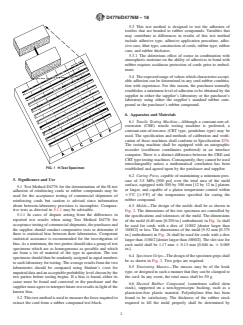
FIG. 1 H-Test Specimen
established and agreed upon by the purchaser and supplier.
6.2 Curing Press, capable of maintaining a minimum pres-
5. Significance and Use
sure of 3.5 MPa [500 psi] over the total area of the mold
surface, equipped with 300 by 300 mm [12 by 12 in.] platens
5.1 Test Method D4776 for the determination of the H-test
or larger, and capable of a platen temperature control within
adhesion of reinforcing cords to rubber compounds may be
63°C [65°F] of the temperature specified for curing the
used for the acceptance testing of commercial shipments of
rubber compound.
reinforcing cords but caution is advised since information
about between-laboratory precision is incomplete. Compara-
6.3 Molds—The design of the molds shall be as shown in
tive tests as directed in 5.1.1 may be advisable.
Fig. 2. The dimensions of the test specimen are controlled by
5.1.1 In cases of dispute arising from the differences in
the specifications and tolerances of the mold. The dimensions
reported test results when using Test Method D4776 for
of the mold (6.40 mm [0.250 in.] embedment) in Fig. 2a shall
acceptance testing of commercial shipments, the purchaser and
be used for cords with a dtex of 1100/2 [denier larger than
the supplier should conduct comparative tests to determine if
1000/2] or less. The dimensions of the mold (9.52 mm [0.375
there is statistical bias between their laboratories. Competent
in.] embedment) in Fig. 2b shall be used for cords with a dtex
statistical assistance is recommended for the investigation of
larger than 1100/2 [denier larger than 1000/2].The slot size for
bias.As a minimum, the two parties should take a group of test
each mold shall be 1.17 mm 6 0.13 mm [0.046 in. 6 0.005
specimens which are as homogeneous as possible and which
in.].
are from a lot of material of the type in question. The test
6.4 Specimen Grips—Thedesignofthespecimengripsshall
specimens should then be randomly assigned in equal numbers
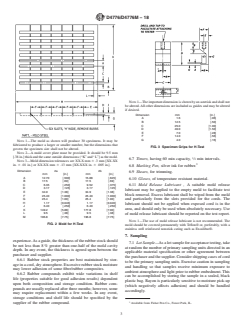
be as shown in Fig. 3. Two grips are required.
to each laboratory for testing.The average results from the two
6.5 Tensioning Masses—The masses may be of the hook
laboratories should be compared using Student’s t-test for
unpaireddataandanacceptableprobabilitylevelchosenbythe type, or designed in such a manner that they can be clamped to
the cord. In any event, the total mass shall be 50 g.
two parties before testing begins. If a bias is found, either its
cause must be found and corrected or the purchaser and the
6.6 Sheeted Rubber Compound, (sometimes called skim
supplier must agree to interpret future test results in light of the
stock), supported on a non-hygroscopic backing, such as a
known bias.
plasticizer-free plastic material. Polyethylene film has been
5.2 Thistestmethodisusedtomeasuretheforcerequiredto found to be satisfactory. The thickness of the rubber stock
extract the cord from a rubber compound test block. required to fill the mold properly shall be determined by
D4776/D4776M − 18
NOTE1—Theimportantdimensionisshownbyanasteriskandshallnot
be altered.All other dimensions are included as guides and may be altered
if desired.
Dimension mm [in.]
A 1.6 [.06]
B 12.5 [.50]
C 25.0 [1.00]
D 40.0 [1.50]
E 7.0 [.28]
F 14.0 [.56]
G 4.0 [.16]
NOTE 1—The mold as shown will produce 30 specimens. It may be
fabricated to produce a larger or smaller number, but the dimensions that
FIG. 3 Specimen Grips for H-Test
govern the specimen size shall not be altered.
NOTE 2—A mold cover plate must be provided. It should be 9.5 mm
[.38in.]thickandthesameoutsidedimensions(“K”and“L”]asthemold.
6.7 Timers, having 60 min ca
...
This document is not an ASTM standard and is intended only to provide the user of an ASTM standard an indication of what changes have been made to the previous version. Because
it may not be technically possible to adequately depict all changes accurately, ASTM recommends that users consult prior editions as appropriate. In all cases only the current version
of the standard as published by ASTM is to be considered the official document.
Designation: D4776/D4776M − 10 D4776/D4776M − 18
Standard Test Method for
Adhesion of Tire Cords and Other Reinforcing Cords to
Rubber Compounds by H-Test Procedure
This standard is issued under the fixed designation D4776/D4776M; the number immediately following the designation indicates the
year of original adoption or, in the case of revision, the year of last revision. A number in parentheses indicates the year of last
reapproval. A superscript epsilon (´) indicates an editorial change since the last revision or reapproval.
1. Scope
1.1 This test method covers the measurement of adhesion of reinforcing cords that are bonded to rubber compounds. This test
method is applicable to textile cord structures from both natural and manmade fibers, other than steel. For adhesion testing of steel
tire cords, refer to Test Method D2229.
1.2 This test method is primarily used to evaluate tire cords, using a suitable tire cord adhesive and a suitable rubber compound.
This test method is also used to evaluate (1) tire cord adhesives, and (2) the process of adhesive reaction on the cord using one
consistent form of tire cord and one consistent rubber compound. This test method may be used to evaluate cords in industrial hose
and belting products and other cord reinforced rubber products.
1.3 The values stated in either SI units or inch-pound units are to be regarded separately as standard. The values stated in each
system may not be exact equivalents; therefore, each system shall be used independently of the other. Combining values from the
two systems may result in non-conformance with the standard.
1.4 This standard does not purport to address all of the safety concerns, if any, associated with its use. It is the responsibility
of the user of this standard to establish appropriate safety safety, health, and healthenvironmental practices and determine the
applicability of regulatory limitations prior to use.
1.5 This international standard was developed in accordance with internationally recognized principles on standardization
established in the Decision on Principles for the Development of International Standards, Guides and Recommendations issued
by the World Trade Organization Technical Barriers to Trade (TBT) Committee.
2. Referenced Documents
2.1 ASTM Standards:
D76 Specification for Tensile Testing Machines for Textiles
D123 Terminology Relating to Textiles
D1566 Terminology Relating to Rubber
D2229 Test Method for Adhesion Between Steel Tire Cords and Rubber
D4393 Test Method for Strap Peel Adhesion of Reinforcing Cords or Fabrics to Rubber Compounds
D6477 Terminology Relating to Tire Cord, Bead Wire, Hose Reinforcing Wire, and Fabrics
3. Terminology
3.1 Definitions:
3.1.1 For defintionsdefinitions of terms relating to tire cord, bead wire, hose wire, and tire cord fabrics, refer to Terminology
D6477.
3.1.1.1 The following terms are relevant to this standard: adhesion, adhesion, in tire fabrics, cord, curing, H-test adhesion,
industrial yarn, reinforcing cord, rubber, rubber compound, as used in the manufacture of rubber articles, vulcanization.
3.1.2 For definitions of other terms relating to rubber, refer to Terminology D1566.
3.1.3 For definitions of other textile terms related to textiles, refer to Terminology D123.
This test method is under the jurisdiction of ASTM Committee D13 on Textiles and is the direct responsibility of Subcommittee D13.19 on Industrial Fibers and Metallic
Reinforcements
Current edition approved Jan. 1, 2010Jan. 1, 2018. Published January 2010February 2018. Originally approved in 1988. Last previous edition approved in 20042010 as
ε1
D4776 – 04D4776 – 10. . DOI: 10.1520/D4776-10.10.1520/D4776-18.
For referenced ASTM standards, visit the ASTM website, www.astm.org, or contact ASTM Customer Service at service@astm.org. For Annual Book of ASTM Standards
volume information, refer to the standard’s Document Summary page on the ASTM website.
Copyright © ASTM International, 100 Barr Harbor Drive, PO Box C700, West Conshohocken, PA 19428-2959. United States
D4776/D4776M − 18
4. Summary of Test Method
4.1 A cord specimen is sandwiched between two layers of rubber compound test stock in a form resembling an “H,” placed in
a heated mold, and cured at a specified temperature and pressure. The test specimen sandwich is then cut to create an H-test
specimen consisting of a single cord with each end embedded in the center of a tab end of the rubber test block (Fig. 1). The test
specimen is placed in the grips of the tensile tester, and then the grips are separated. The maximum force obtained is the H-test
adhesion force.
5. Significance and Use
5.1 Test Method D4776 for the determination of the H-test adhesion of reinforcing cords to rubber compounds may be used for
the acceptance testing of commercial shipments of reinforcing cords but caution is advised since information about
between-laboratory precision is incomplete. Comparative tests as directed in 5.1.1 may be advisable.
5.1.1 In cases of dispute arising from the differences in reported test results when using Test Method D4776 for acceptance
testing of commercial shipments, the purchaser and the supplier should conduct comparative tests to determine if there is statistical
bias between their laboratories. Competent statistical assistance is recommended for the investigation of bias. As a minimum, the
two parties should take a group of test specimens which are as homogeneous as possible and which are from a lot of material of
the type in question. The test specimens should then be randomly assigned in equal numbers to each laboratory for testing. The
average results from the two laboratories should be compared using Student’s t-test for unpaired data and an acceptable probability
level chosen by the two parties before testing begins. If a bias is found, either its cause must be found and corrected or the purchaser
and the supplier must agree to interpret future test results in light of the known bias.
5.2 This test method is used to measure the force required to extract the cord from a rubber compound test block.
5.3 This test method is designed to test the adhesion of textiles that are bonded to rubber compounds. Variables that may
contribute to differences in results of this test method include adhesive type, adhesive application procedure, adhesive cure, fiber
type, construction of cords, rubber type, rubber cure, and rubber thickness.
5.3.1 The deleterious effect of ozone in combination with atmospheric moisture on the ability of adhesives to bond with rubber
requires assiduous protection of cords prior to embedment.
FIG. 1 H-Test Specimen
D4776/D4776M − 18
5.4 The expected range of values which characterize acceptable adhesion can be determined in any cord-rubber combination
with experience. For this reason, the purchaser normally establishes a minimum level of adhesion to be obtained by the supplier
in either the supplier’s laboratory or the purchaser’s laboratory using either the supplier’s standard rubber compound or the
purchaser’s rubber compound.
5.5 Another procedure for testing adhesion of cords to rubber compounds is Test Methods D4393 . This procedure has been used
extensively in the trade for acceptance testing. Results obtained by this method cannot be used interchangeably since there is no
overall correlation between them.
6. Apparatus and Materials
6.1 Tensile Testing Machine—Although a constant-rate-of-extension (CRE) tensile testing machine is preferred, a constant-
rate-of-traverse (CRT type, pendulum type) may be used. The specification and methods of calibration and verification of these
machines shall conform to Specification D76. The testing machine shall be equipped with an autographic recorder (rectilinear
coordinates preferred) or an interface computer. There is a distinct difference between the CRE and CRT type testing machines.
Consequently, they cannot be used interchangeably unless a mathematical correlation has been established and agreed upon by the
purchaser and supplier.
6.2 Curing Press, capable of maintaining a minimum pressure of 3.5 MPa [500 psi] over the total area of the mold surface,
equipped with 300 by 300 mm [12 by 12 in.] platens or larger, and capable of a platen temperature control within 63°C [65°F]
of the temperature specified for curing the rubber compound.
6.3 Molds—The design of the molds shall be as shown in Fig. 2. The dimensions of the test specimen are controlled by the
specifications and tolerances of the mold. The dimensions of the mold (6.40 mm [0.250 in.] embedment) in Fig. 2a shall be used
for cords with a dtex of 1100/2 [denier larger than 1000/2] or less. The dimensions of the mold (9.52 mm [0.375 in.] embedment)
in Fig. 2b shall be used for cords with a dtex larger than 1100/2 [denier larger than 1000/2]. The slot size for each mold shall be
1.17 mm 6 0.13 mm [0.046 in. 6 0.005 in.].
6.4 Specimen Grips—The design of the specimen grips shall be as shown in Fig. 3. Two grips are required.
6.5 Tensioning Masses—The masses may be of the hook type, or designed in such a manner that they can be clamped to the
cord. In any event, the total mass shall be 50 g.
6.6 Sheeted Rubber Compound, (sometimes called skim stock), supported on a non hygroscopic non-hygroscopic backing, such
as a plasticizer-free plastic material. Polyethylene film has been found to be satisfactory. The thickness of the rubber stock required
to fill the mold properly shall be determined by experience. As a guide, the thickness of the rubber stock should be not less than
8 % greater than one-half of the mold cavity depth. In any event, the thickness is agreed upon between the purchaser and supplier.
NOTE 1—The important dimension is shown by an asterisk and shall not be altered. All other dimensions are included as guides and may be altered
if desired.
Dimension mm [in.]
A 1.6 [.06]
B 12.5 [.50]
C 25.0 [1.00]
D 40.0 [1.50]
E 7.0 [.28]
F 14.0 [.56]
G 4.0 [.16]
FIG. 3 Specimen Grips for H-Test
...