

ASTM D5234-92(2017)
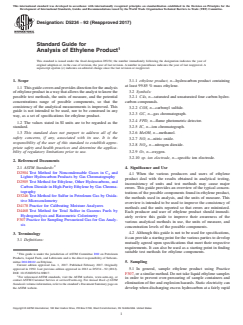
(Guide)Standard Guide for Analysis of Ethylene Product
General Information
- Abstract
SIGNIFICANCE AND USE
4.1 When the various producers and users of ethylene product deal with the results obtained in analytical testing, inconsistency of units and test methods may cause major errors. This guide provides an overview of the typical concentrations of the possible components found in ethylene product, the methods used in analysis, and the units of measure. This overview is intended to be used to improve the consistency of methods and the units reported so that errors are minimized. Each producer and user of ethylene product should immediately review this guide to improve their awareness of the various analytical methods in use, the units of measure, and concentration levels of the possible components.
4.2 Although this guide is not to be used for specifications, it can provide a starting point for the various parties to develop mutually agreed upon specifications that meet their respective requirements. It can also be used as a starting point in finding suitable test methods for ethylene components.
SCOPE
1.1 This guide covers and provides direction for the analysis of ethylene product in a way that allows the analyst to know the possible test methods, the units of measure, and the potential concentrations range of possible components, so that the consistency of the analytical measurements is improved. This guide is not intended to be used, nor to be construed in any way, as a set of specifications for ethylene product.
1.2 The values stated in SI units are to be regarded as the standard.
1.3 This standard does not purport to address all of the safety concerns, if any, associated with its use. It is the responsibility of the user of this standard to establish appropriate safety and health practices and determine the applicability of regulatory limitations prior to use.
- Status
- Published
- Publication Date
- 31-Dec-2016
- Technical Committee
- D02 - Petroleum Products, Liquid Fuels, and Lubricants
- Drafting Committee
- D02.D0.02 - Ethylene


Overview
ASTM D5234-92(2017): Standard Guide for Analysis of Ethylene Product provides essential direction for the analysis of ethylene product, a high-purity hydrocarbon containing at least 99.85% ethylene by mass. Published by ASTM International, this guide aims to improve consistency and reliability in analytical measurements by outlining commonly used test methods, appropriate units of measure, and expected concentration ranges for various components in ethylene. The guide is intended to assist producers, users, and laboratories in minimizing errors caused by inconsistencies in reporting and analytical techniques related to ethylene product analysis.
Key Topics
- Analytical Consistency: The guide emphasizes the importance of using consistent units and test methods to minimize errors when analyzing ethylene products. It encourages immediate review and adoption to improve awareness of current analytical practices.
- Component Analysis: Typical components found in ethylene products include ethane, methane, propylene, propane, hydrogen, acetylene, moisture, alcohols, sulfur compounds, nitrogen, oxygenates, carbon oxides, benzene, chlorides, C4 hydrocarbons, and ammonia.
- Test Methods: The standard references widely accepted analytical methods, such as gas chromatography (GC), flame photometric detection (FPD), ion chromatography (IC), and chemiluminescence for various impurities and components. Specific ASTM test methods referenced include:
- ASTM D2505 for hydrocarbon content
- ASTM D2504 for noncondensable gases
- ASTM D3246 and D4468 for sulfur content
- ASTM D4178 for calibrating moisture analyzers
- Sampling Procedures: Recommends sample collection in accordance with established practices such as ASTM F307 and highlights precautions, including avoidance of liquid ethylene sampling to prevent safety hazards.
- Units of Measure: SI units are specified as the standard for all measurements in ethylene analysis, supporting harmonization across global laboratories and stakeholders.
Applications
The ASTM D5234-92(2017) guide is broadly applicable across the ethylene production, quality control, and downstream user sectors. Its main practical values include:
- Quality Assurance: Ensures that both producers and consumers of ethylene are aligned in analytical expectations, reducing disputes and improving product quality.
- Development of Specifications: While not intended as a specification, the guide serves as a fundamental reference for stakeholders seeking to establish mutually agreed specifications and analytical requirements.
- Selection of Analytical Methods: Assists laboratories in choosing and justifying suitable test methods for the routine analysis of ethylene and its potential impurities.
- Safety and Compliance: Promotes safe sampling procedures and awareness of health and regulatory considerations in handling high-purity and potentially hazardous hydrocarbon products.
- Process Optimization: Facilitates benchmarking and performance evaluation in petrochemical manufacturing by specifying methods and component concentration ranges.
Related Standards
The standard references several key ASTM and non-ASTM methods relevant to ethylene analysis and sampling, enhancing its practical utility:
- ASTM D2504: Test Method for Noncondensable Gases in C₂ and Lighter Hydrocarbon Products by Gas Chromatography
- ASTM D2505: Test Method for Ethylene, Other Hydrocarbons, and Carbon Dioxide in High-Purity Ethylene by Gas Chromatography
- ASTM D3246: Test Method for Sulfur in Petroleum Gas by Oxidative Microcoulometry
- ASTM D4468: Test Method for Total Sulfur in Gaseous Fuels by Hydrogenolysis and Rateometric Colorimetry
- ASTM D4178: Practice for Calibrating Moisture Analyzers
- ASTM F307: Practice for Sampling Pressurized Gas for Gas Analysis
Adhering to the ASTM D5234-92(2017) standard guide improves consistency, efficiency, and quality in the analysis of ethylene products, supporting best practices across the petrochemical and laboratory testing sectors.
Relations
- Effective Date
- 01-Oct-2023
- Effective Date
- 01-Apr-2020
- Effective Date
- 01-Oct-2017
- Effective Date
- 01-Jun-2015
- Effective Date
- 01-Jun-2015
- Effective Date
- 01-Jan-2015
- Effective Date
- 01-May-2014
- Effective Date
- 01-Jun-2013
- Effective Date
- 01-Nov-2011
- Effective Date
- 01-Jun-2011
- Effective Date
- 01-May-2010
- Effective Date
- 01-May-2010
- Effective Date
- 01-Apr-2007
- Effective Date
- 01-Jun-2006
- Effective Date
- 01-Nov-2005
Get Certified
Connect with accredited certification bodies for this standard

ECOCERT
Organic and sustainability certification.

Eurofins Food Testing Global
Global leader in food, environment, and pharmaceutical product testing.

Intertek Bangladesh
Intertek certification and testing services in Bangladesh.
Sponsored listings
Frequently Asked Questions
ASTM D5234-92(2017) is a guide published by ASTM International. Its full title is "Standard Guide for Analysis of Ethylene Product". This standard covers: SIGNIFICANCE AND USE 4.1 When the various producers and users of ethylene product deal with the results obtained in analytical testing, inconsistency of units and test methods may cause major errors. This guide provides an overview of the typical concentrations of the possible components found in ethylene product, the methods used in analysis, and the units of measure. This overview is intended to be used to improve the consistency of methods and the units reported so that errors are minimized. Each producer and user of ethylene product should immediately review this guide to improve their awareness of the various analytical methods in use, the units of measure, and concentration levels of the possible components. 4.2 Although this guide is not to be used for specifications, it can provide a starting point for the various parties to develop mutually agreed upon specifications that meet their respective requirements. It can also be used as a starting point in finding suitable test methods for ethylene components. SCOPE 1.1 This guide covers and provides direction for the analysis of ethylene product in a way that allows the analyst to know the possible test methods, the units of measure, and the potential concentrations range of possible components, so that the consistency of the analytical measurements is improved. This guide is not intended to be used, nor to be construed in any way, as a set of specifications for ethylene product. 1.2 The values stated in SI units are to be regarded as the standard. 1.3 This standard does not purport to address all of the safety concerns, if any, associated with its use. It is the responsibility of the user of this standard to establish appropriate safety and health practices and determine the applicability of regulatory limitations prior to use.
SIGNIFICANCE AND USE 4.1 When the various producers and users of ethylene product deal with the results obtained in analytical testing, inconsistency of units and test methods may cause major errors. This guide provides an overview of the typical concentrations of the possible components found in ethylene product, the methods used in analysis, and the units of measure. This overview is intended to be used to improve the consistency of methods and the units reported so that errors are minimized. Each producer and user of ethylene product should immediately review this guide to improve their awareness of the various analytical methods in use, the units of measure, and concentration levels of the possible components. 4.2 Although this guide is not to be used for specifications, it can provide a starting point for the various parties to develop mutually agreed upon specifications that meet their respective requirements. It can also be used as a starting point in finding suitable test methods for ethylene components. SCOPE 1.1 This guide covers and provides direction for the analysis of ethylene product in a way that allows the analyst to know the possible test methods, the units of measure, and the potential concentrations range of possible components, so that the consistency of the analytical measurements is improved. This guide is not intended to be used, nor to be construed in any way, as a set of specifications for ethylene product. 1.2 The values stated in SI units are to be regarded as the standard. 1.3 This standard does not purport to address all of the safety concerns, if any, associated with its use. It is the responsibility of the user of this standard to establish appropriate safety and health practices and determine the applicability of regulatory limitations prior to use.
ASTM D5234-92(2017) is classified under the following ICS (International Classification for Standards) categories: 71.080.10 - Aliphatic hydrocarbons. The ICS classification helps identify the subject area and facilitates finding related standards.
ASTM D5234-92(2017) has the following relationships with other standards: It is inter standard links to ASTM D4178-23, ASTM F307-13(2020), ASTM D4178-82(2017), ASTM D2505-88(2015), ASTM D2504-88(2015), ASTM D3246-15, ASTM D3246-14, ASTM F307-13, ASTM D4468-85(2011), ASTM D3246-11, ASTM D2505-88(2010), ASTM D2504-88(2010), ASTM F307-02(2007), ASTM D4468-85(2006), ASTM D4178-82(2005). Understanding these relationships helps ensure you are using the most current and applicable version of the standard.
ASTM D5234-92(2017) is available in PDF format for immediate download after purchase. The document can be added to your cart and obtained through the secure checkout process. Digital delivery ensures instant access to the complete standard document.
Standards Content (Sample)
This international standard was developed in accordance with internationally recognized principles on standardization established in the Decision on Principles for the
Development of International Standards, Guides and Recommendations issued by the World Trade Organization Technical Barriers to Trade (TBT) Committee.
Designation: D5234 − 92 (Reapproved 2017)
Standard Guide for
Analysis of Ethylene Product
This standard is issued under the fixed designation D5234; the number immediately following the designation indicates the year of
original adoption or, in the case of revision, the year of last revision. A number in parentheses indicates the year of last reapproval. A
superscript epsilon (´) indicates an editorial change since the last revision or reapproval.
1. Scope 3.1.1 ethylene product, n—hydrocarbon product containing
at least 99.85 % mass ethylene.
1.1 Thisguidecoversandprovidesdirectionfortheanalysis
ofethyleneproductinawaythatallowstheanalysttoknowthe 3.2 Symbols:
possible test methods, the units of measure, and the potential
3.2.1 C4s, n—saturated and unsaturated four carbon hydro-
concentrations range of possible components, so that the carbon compounds.
consistency of the analytical measurements is improved. This
3.2.2 COS, n—carbonyl sulfide.
guide is not intended to be used, nor to be construed in any
3.2.3 GC, n—gas chromatograph.
way, as a set of specifications for ethylene product.
3.2.4 FPD, n—flame photometric detector.
1.2 The values stated in SI units are to be regarded as the
3.2.5 IC, n—ion chromatograph.
standard.
3.2.6 MeOH, n—methanol.
1.3 This standard does not purport to address all of the
safety concerns, if any, associated with its use. It is the
3.2.7 NO, n—nitric oxide.
responsibility of the user of this standard to establish appro-
3.2.8 NO,n—nitrogen dioxide.
priate safety and health practices and determine the applica-
3.2.9 O,n—oxygen.
bility of regulatory limitations prior to use. 2
3.2.10 sp. ion electrode, n—specific ion electrode.
2. Referenced Documents
4. Significance and Use
2.1 ASTM Standards:
D2504 Test Method for Noncondensable Gases in C and
4.1 When the various producers and users of ethylene
Lighter Hydrocarbon Products by Gas Chromatography
product deal with the results obtained in analytical testing,
D2505 Test Method for Ethylene, Other Hydrocarbons, and
inconsistency of units and test methods may cause major
Carbon Dioxide in High-Purity Ethylene by Gas Chroma-
errors. This guide provides an overview of the typical concen-
tography
trations of the possible components found in ethylene product,
D3246 Test Method for Sulfur in Petroleum Gas by Oxida-
the methods used in analysis, and the units of measure. This
tive Microcoulometry
overview is intended to be used to improve the consistency of
D4178 Practice for Calibrating Moisture Analyzers
methods and the units reported so that errors are minimized.
D4468 Test Method for Total Sulfur in Gaseous Fuels by
Each producer and user of ethylene product should immedi-
Hydrogenolysis and Rateometric Colorimetry
ately review this guide to improve their awareness of the
F307 Practice for Sampling Pressurized Gas for Gas Analy-
various analytical methods in use, the units of measure, and
sis
concentration levels of the possible components.
4.2 Although this guide is not to be used for specifications,
3. Terminology
it can provide a starting point for the various parties to develop
3.1 Definitions:
mutually agreed upon specifications that meet their respective
requirements. It can also be used as a starting point in finding
suitable test methods for ethylene components.
This guide is under the jurisdiction of ASTM Committee D02 on Petroleum
Products, Liquid Fuels, and Lubricants and is the direct responsibility of Subcom-
mittee D02.D0.02 on Ethylene.
5. Sampling
Current edition approved Jan. 1, 2017. Published February 2017. Originally
5.1 In general, sample ethylene product using Practice
approved in 1992. Last previous edition approved in 2012 as D5234 – 92 (2012).
DOI: 10.1520/D5234-92R17.
F307, or a similar method. Do not take liquid ethylene samples
For referenced ASTM standards, visit the ASTM website, www.astm.org, or
in order to prevent over-pressuring of sample containers and
contact ASTM Customer Service at service@astm.org. For Annual Book of ASTM
elimination of fire and explosion hazards. Static electricity can
Standards volume information, refer to the standard’s Document Summary page on
the ASTM website. develop when discharging excess hydrocarbon at a fairly rapid
Copyright © ASTM International, 100 Barr Harbor Drive, PO Box C700, West Conshohocken, PA 19428-2959. United States
D5234 − 92 (2017)
A
TABLE 2 Ethylene Test Methods (Non-ASTM)
rate from a sample cylinder to ambient conditions. Use a
Components Possible Test Methods
grounding system or strap.
Methane, ethane propane, pro- An adaptation of Test Method D2505 is
5.2 Reactive and Polar Components:
pylen
...