

ASTM D2042-22
(Test Method)Standard Test Method for Solubility of Asphalt Materials in Trichloroethylene or Toluene
General Information
- Abstract
SIGNIFICANCE AND USE
4.1 This test method is a measure of the solubility of asphalt in trichloroethylene or toluene solvent. The portion that is soluble in the solvent represents the active cementing constituents.
Note 2: The quality of the results produced by this standard are dependent on the competence of the personnel performing the procedure and the capability, calibration, and maintenance of the equipment used. Agencies that meet the criteria of Specification D3666 are generally considered capable of competent and objective testing, sampling, inspection, etc. Users of this standard are cautioned that compliance with Specification D3666 alone does not completely ensure reliable results. Reliable results depend on many factors; following the suggestions of Specification D3666 or some similar acceptable guideline provides a means of evaluating and controlling some of these factors.
SCOPE
1.1 This test method covers the determination of the degree of solubility in trichloroethylene or toluene of asphalt materials having little or no mineral matter.
Note 1: This method is not applicable to tars and their distillation residues or highly cracked petroleum products. For methods covering tars, pitches, and other highly cracked petroleum products, and the use of other solvents, see Test Methods D4, D2318, and D2764.
1.2 The values stated in SI units are to be regarded as standard. No other units of measurement are included in this standard.
1.3 The text of this standard references notes and footnotes which provide explanatory material. These notes and footnotes (excluding those in tables and figures) shall not be considered as requirements of the standard.
1.4 This standard does not purport to address all of the safety concerns, if any, associated with its use. It is the responsibility of the user of this standard to establish appropriate safety, health, and environmental practices and determine the applicability of regulatory limitations prior to use. Specific precaution statements are given in Section 7.
1.5 This international standard was developed in accordance with internationally recognized principles on standardization established in the Decision on Principles for the Development of International Standards, Guides and Recommendations issued by the World Trade Organization Technical Barriers to Trade (TBT) Committee.
- Status
- Published
- Publication Date
- 31-Dec-2021
- Technical Committee
- D04 - Road and Paving Materials
- Drafting Committee
- D04.47 - Miscellaneous Asphalt Tests
Buy Documents


ASTM D2042-22 - Standard Test Method for Solubility of Asphalt Materials in Trichloroethylene or Toluene
REDLINE ASTM D2042-22 - Standard Test Method for Solubility of Asphalt Materials in Trichloroethylene or Toluene
Overview
ASTM D2042-22: Standard Test Method for Solubility of Asphalt Materials in Trichloroethylene or Toluene specifies procedures for determining the degree of solubility of asphalt materials using trichloroethylene or toluene as solvents. The primary goal of this standard is to measure the portion of asphalt that is soluble, which represents the active cementing constituents vital for quality asphalt materials. This method is widely recognized in the construction and paving industries for assessing the purity and quality of asphalt used in road and infrastructure projects.
This standard is applicable to asphalt materials containing little or no mineral matter. It is not suitable for tars, their residues, or highly cracked petroleum products. For those materials, other ASTM standards, such as D4, D2318, and D2764, are recommended. The test offers a precise, objective means to evaluate asphalt solubility, ensuring consistent and reliable materials for construction applications.
Key Topics
- Test Scope and Applicability: Focused on asphalt materials with minimal mineral content, excluding tars and highly cracked petroleum products.
- Solubility Measurement: The method quantifies the percentage of asphalt material soluble in trichloroethylene or toluene, representing its active cementing potential.
- Equipment and Reagents: Specifies the use of Gooch crucibles, glass microfiber filter pads, filter flasks, and solvents (trichloroethylene or toluene).
- Precision Requirements: Stresses the importance of qualified personnel, properly calibrated and maintained equipment, and adherence to procedures for reliable results. Agencies meeting ASTM D3666 specification are typically deemed competent for such testing.
- Safety Considerations: Highlights the toxicity and flammability of both solvents, necessitating proper laboratory procedures, use of fume hoods, and reference to safety data sheets.
- Reporting Results: Specifies how to calculate and report soluble and insoluble fractions in accordance with the standard's guidelines.
Applications
ASTM D2042-22 is widely used in the following areas:
- Road Construction and Paving: Ensures that the asphalt binder contains enough active cementing material to provide durability and strength for highways, streets, and airport runways.
- Quality Control in Manufacturing: Used by asphalt producers and laboratories to maintain product consistency and meet contractual requirements for projects.
- Material Specification Compliance: Helps determine if asphalt materials meet industry and governmental specifications for purity and performance.
- Research and Development: Assists in developing new asphalt blends and verifying the efficacy of additives by determining the soluble fraction.
Adopting this test method contributes to the reliability and longevity of paved surfaces by verifying that only high-quality, effective asphalt binders are used.
Related Standards
Several standards complement and support the application of ASTM D2042-22:
- ASTM D4: Test Method for Bitumen Content, targeting different materials.
- ASTM D2318: Test Method for Quinoline-Insoluble Content of Tar and Pitch.
- ASTM D2764: Test Method for Dimethylformamide-Insoluble Content of Tar and Pitch.
- ASTM D3666: Specification for Minimum Requirements for Agencies Testing and Inspecting Road and Paving Materials.
- ASTM D4753: Guide for Evaluating, Selecting, and Specifying Balances and Standard Masses for Use in Construction Materials Testing.
- AASHTO T44: Solubility of Bituminous Materials in Organic Solvents, a closely related method recognized by highway authorities.
Keywords: solubility of asphalt, trichloroethylene, toluene, ASTM D2042, asphalt cement, road paving materials, asphalt quality testing, construction material standards, asphalt binder purity.
By following ASTM D2042-22, labs and agencies ensure consistent, reliable assessment of asphalt material quality, supporting infrastructure longevity and performance.
Relations
- Effective Date
- 03-Oct-2017
- Effective Date
- 01-Feb-2024
- Effective Date
- 01-Jun-2020
- Effective Date
- 01-Jun-2020
- Effective Date
- 01-May-2018
- Effective Date
- 01-Oct-2016
- Effective Date
- 01-Dec-2015
- Effective Date
- 01-May-2015
- Effective Date
- 01-Apr-2015
- Refers
ASTM D2318-14e1 - Standard Test Method for Quinoline-Insoluble (QI) Content of Tar and Pitch - Effective Date
- 01-May-2014
- Refers
ASTM D2318-14 - Standard Test Method for Quinoline-Insoluble (QI) Content of Tar and Pitch - Effective Date
- 01-May-2014
- Effective Date
- 01-Dec-2013
- Refers
ASTM D2318-98(2013) - Standard Test Method for Quinoline-Insoluble (QI) Content of Tar and Pitch - Effective Date
- 15-Jul-2013
- Effective Date
- 01-Dec-2011
- Effective Date
- 01-May-2010
Buy Documents
ASTM D2042-22 - Standard Test Method for Solubility of Asphalt Materials in Trichloroethylene or Toluene
REDLINE ASTM D2042-22 - Standard Test Method for Solubility of Asphalt Materials in Trichloroethylene or Toluene
Get Certified
Connect with accredited certification bodies for this standard

DIBt (Deutsches Institut für Bautechnik)
German Institute for Building Technology.
DIN CERTCO
DIN Group product certification.
Zavod za gradbeništvo Slovenije (ZAG) - Inšpekcija
ZAG inspection body for construction products, structures, and materials.
Sponsored listings
Frequently Asked Questions
ASTM D2042-22 is a standard published by ASTM International. Its full title is "Standard Test Method for Solubility of Asphalt Materials in Trichloroethylene or Toluene". This standard covers: SIGNIFICANCE AND USE 4.1 This test method is a measure of the solubility of asphalt in trichloroethylene or toluene solvent. The portion that is soluble in the solvent represents the active cementing constituents. Note 2: The quality of the results produced by this standard are dependent on the competence of the personnel performing the procedure and the capability, calibration, and maintenance of the equipment used. Agencies that meet the criteria of Specification D3666 are generally considered capable of competent and objective testing, sampling, inspection, etc. Users of this standard are cautioned that compliance with Specification D3666 alone does not completely ensure reliable results. Reliable results depend on many factors; following the suggestions of Specification D3666 or some similar acceptable guideline provides a means of evaluating and controlling some of these factors. SCOPE 1.1 This test method covers the determination of the degree of solubility in trichloroethylene or toluene of asphalt materials having little or no mineral matter. Note 1: This method is not applicable to tars and their distillation residues or highly cracked petroleum products. For methods covering tars, pitches, and other highly cracked petroleum products, and the use of other solvents, see Test Methods D4, D2318, and D2764. 1.2 The values stated in SI units are to be regarded as standard. No other units of measurement are included in this standard. 1.3 The text of this standard references notes and footnotes which provide explanatory material. These notes and footnotes (excluding those in tables and figures) shall not be considered as requirements of the standard. 1.4 This standard does not purport to address all of the safety concerns, if any, associated with its use. It is the responsibility of the user of this standard to establish appropriate safety, health, and environmental practices and determine the applicability of regulatory limitations prior to use. Specific precaution statements are given in Section 7. 1.5 This international standard was developed in accordance with internationally recognized principles on standardization established in the Decision on Principles for the Development of International Standards, Guides and Recommendations issued by the World Trade Organization Technical Barriers to Trade (TBT) Committee.
SIGNIFICANCE AND USE 4.1 This test method is a measure of the solubility of asphalt in trichloroethylene or toluene solvent. The portion that is soluble in the solvent represents the active cementing constituents. Note 2: The quality of the results produced by this standard are dependent on the competence of the personnel performing the procedure and the capability, calibration, and maintenance of the equipment used. Agencies that meet the criteria of Specification D3666 are generally considered capable of competent and objective testing, sampling, inspection, etc. Users of this standard are cautioned that compliance with Specification D3666 alone does not completely ensure reliable results. Reliable results depend on many factors; following the suggestions of Specification D3666 or some similar acceptable guideline provides a means of evaluating and controlling some of these factors. SCOPE 1.1 This test method covers the determination of the degree of solubility in trichloroethylene or toluene of asphalt materials having little or no mineral matter. Note 1: This method is not applicable to tars and their distillation residues or highly cracked petroleum products. For methods covering tars, pitches, and other highly cracked petroleum products, and the use of other solvents, see Test Methods D4, D2318, and D2764. 1.2 The values stated in SI units are to be regarded as standard. No other units of measurement are included in this standard. 1.3 The text of this standard references notes and footnotes which provide explanatory material. These notes and footnotes (excluding those in tables and figures) shall not be considered as requirements of the standard. 1.4 This standard does not purport to address all of the safety concerns, if any, associated with its use. It is the responsibility of the user of this standard to establish appropriate safety, health, and environmental practices and determine the applicability of regulatory limitations prior to use. Specific precaution statements are given in Section 7. 1.5 This international standard was developed in accordance with internationally recognized principles on standardization established in the Decision on Principles for the Development of International Standards, Guides and Recommendations issued by the World Trade Organization Technical Barriers to Trade (TBT) Committee.
ASTM D2042-22 is classified under the following ICS (International Classification for Standards) categories: 91.100.50 - Binders. Sealing materials; 93.080.20 - Road construction materials. The ICS classification helps identify the subject area and facilitates finding related standards.
ASTM D2042-22 has the following relationships with other standards: It is inter standard links to ASTM D5546-09, ASTM D4753-24, ASTM D2764-20, ASTM D2318-20, ASTM D4-86(2018), ASTM D3666-16, ASTM D2318-15, ASTM D4753-15, ASTM D2764-99(2015)e1, ASTM D2318-14e1, ASTM D2318-14, ASTM D3666-13, ASTM D2318-98(2013), ASTM D3666-11, ASTM D4-86(2010). Understanding these relationships helps ensure you are using the most current and applicable version of the standard.
ASTM D2042-22 is available in PDF format for immediate download after purchase. The document can be added to your cart and obtained through the secure checkout process. Digital delivery ensures instant access to the complete standard document.
Standards Content (Sample)
This international standard was developed in accordance with internationally recognized principles on standardization established in the Decision on Principles for the
Development of International Standards, Guides and Recommendations issued by the World Trade Organization Technical Barriers to Trade (TBT) Committee.
Designation: D2042 − 22
Standard Test Method for
Solubility of Asphalt Materials in Trichloroethylene or
Toluene
This standard is issued under the fixed designation D2042; the number immediately following the designation indicates the year of
original adoption or, in the case of revision, the year of last revision. A number in parentheses indicates the year of last reapproval. A
superscript epsilon (´) indicates an editorial change since the last revision or reapproval.
This standard has been approved for use by agencies of the U.S. Department of Defense.
1. Scope D2318 Test Method for Quinoline-Insoluble (QI) Content of
Tar and Pitch
1.1 This test method covers the determination of the degree
D2764 Test Method for Dimethylformamide-Insoluble
ofsolubilityintrichloroethyleneortolueneofasphaltmaterials
(DMF-I) Content of Tar and Pitch
having little or no mineral matter.
D3666 Specification for Minimum Requirements for Agen-
NOTE 1—This method is not applicable to tars and their distillation
cies Testing and Inspecting Road and Paving Materials
residues or highly cracked petroleum products. For methods covering tars,
D4753 Guide for Evaluating, Selecting, and Specifying Bal-
pitches, and other highly cracked petroleum products, and the use of other
ances and Standard Masses for Use in Soil, Rock, and
solvents, see Test Methods D4, D2318, and D2764.
Construction Materials Testing
1.2 The values stated in SI units are to be regarded as
2.2 AASHTO Standard:
standard. No other units of measurement are included in this
T44 Solubility of Bituminous Materials in Organic Solvents
standard.
1.3 The text of this standard references notes and footnotes
3. Summary of Method
which provide explanatory material. These notes and footnotes
3.1 The sample is dissolved in trichloroethylene or toluene
(excluding those in tables and figures) shall not be considered
solvent and filtered through a glass fiber pad. The insoluble
as requirements of the standard.
material is washed, dried, and weighed.
1.4 This standard does not purport to address all of the
4. Significance and Use
safety concerns, if any, associated with its use. It is the
responsibility of the user of this standard to establish appro-
4.1 This test method is a measure of the solubility of asphalt
priate safety, health, and environmental practices and deter-
in trichloroethylene or toluene solvent. The portion that is
mine the applicability of regulatory limitations prior to use.
soluble in the solvent represents the active cementing constitu-
Specific precaution statements are given in Section 7.
ents.
1.5 This international standard was developed in accor-
NOTE 2—The quality of the results produced by this standard are
dance with internationally recognized principles on standard-
dependent on the competence of the personnel performing the procedure
ization established in the Decision on Principles for the
and the capability, calibration, and maintenance of the equipment used.
Development of International Standards, Guides and Recom-
Agencies that meet the criteria of Specification D3666 are generally
mendations issued by the World Trade Organization Technical considered capable of competent and objective testing, sampling,
inspection, etc. Users of this standard are cautioned that compliance with
Barriers to Trade (TBT) Committee.
Specification D3666 alone does not completely ensure reliable results.
Reliable results depend on many factors; following the suggestions of
2. Referenced Documents
Specification D3666 or some similar acceptable guideline provides a
2.1 ASTM Standards:
means of evaluating and controlling some of these factors.
D4 Test Method for Bitumen Content
5. Apparatus and Materials
1 5.1 The assembly of a typical filtering apparatus is illus-
This test method is under the jurisdiction of ASTM Committee D04 on Road
and Paving Materials and is the direct responsibility of Subcommittee D04.47 on trated in Fig. 1. Details of the component parts are as follows:
Miscellaneous Asphalt Tests.
5.1.1 Asphalt Crucible or Gooch Crucible, glazed inside
Current edition approved Jan. 1, 2022. Published February 2022. Originally
and outside with the exception of outside bottom surface. The
approved in 1966. Last previous edition approved in 2015 as D2042 – 15. DOI:
10.1520/D2042-22.
For referenced ASTM standards, visit the ASTM website, www.astm.org, or
contact ASTM Customer Service at service@astm.org. For Annual Book of ASTM Available from American Association of State Highway and Transportation
Standards volume information, refer to the standard’s Document Summary page on Officials (AASHTO), 444 N. Capitol St., NW, Suite 249, Washington, DC 20001,
the ASTM website. http://www.transportation.org.
Copyright © ASTM International, 100 Barr Harbor Drive, PO Box C700, West Conshohocken, PA 19428-2959. United States
D2042 − 22
Trichloroethylene is a carcinogen. The safety data sheets for
either of these solvents should be reviewed prior to use.
8. Preparation of Crucible
8.1 Assemble the filtering apparatus as shown in Fig. 1.
Place filter pad into the Grooch crucible, moisten the pad with
solvent, and seat firmly in the bottom of the crucible with light
suction. Place the crucible plus one thickness of the filter pad
in an oven at 110 6 5 °C for 15 min, allow to cool in a
desiccator for 30 6 5 min, and then determine the mass to the
nearest 0.1 mg. Designate this mass as A. Store in the
desiccator until ready for use.
9. Sample Preparation
9.1 If the sample is not fluid, heat to any convenient
temperature, but in any case not more than 100 °C above the
softening point. Normally the temperature at which this test is
run is not critical, and it may be performed at the laboratory air
temperature. For referee tests, however, the flask and sample in
solution shall be placed in a water bath maintained at 38.0 6
0.3 °C for 1 h before filtering.
10. Procedure
10.1 Note safety precautions in Section 7. Transfer approxi-
mately2gofthe sample into a tared 125-mLErlenmeyer flask
or other suitable container. Smaller sample sizes may be
necessary if more than 0.5 % insolubl
...
This document is not an ASTM standard and is intended only to provide the user of an ASTM standard an indication of what changes have been made to the previous version. Because
it may not be technically possible to adequately depict all changes accurately, ASTM recommends that users consult prior editions as appropriate. In all cases only the current version
of the standard as published by ASTM is to be considered the official document.
Designation: D2042 − 15 D2042 − 22
Standard Test Method for
Solubility of Asphalt Materials in Trichloroethylene or
Toluene
This standard is issued under the fixed designation D2042; the number immediately following the designation indicates the year of
original adoption or, in the case of revision, the year of last revision. A number in parentheses indicates the year of last reapproval. A
superscript epsilon (´) indicates an editorial change since the last revision or reapproval.
This standard has been approved for use by agencies of the U.S. Department of Defense.
1. Scope
1.1 This test method covers the determination of the degree of solubility in trichloroethylene or toluene of asphalt materials having
little or no mineral matter.
NOTE 1—This method is not applicable to tars and their distillation residues or highly cracked petroleum products. For methods covering tars, pitches,
and other highly cracked petroleum products, and the use of other solvents, see Test Methods D4, D2318, and D2764.
1.2 The values stated in SI units are to be regarded as standard. No other units of measurement are included in this standard.
1.3 The text of this standard references notes and footnotes which provide explanatory material. These notes and footnotes
(excluding those in tables and figures) shall not be considered as requirements of the standard.
1.4 This standard does not purport to address all of the safety concerns, if any, associated with its use. It is the responsibility
of the user of this standard to establish appropriate safety safety, health, and healthenvironmental practices and determine the
applicability of regulatory limitations prior to use. Specific precaution statements are given in Section 7.
1.5 This international standard was developed in accordance with internationally recognized principles on standardization
established in the Decision on Principles for the Development of International Standards, Guides and Recommendations issued
by the World Trade Organization Technical Barriers to Trade (TBT) Committee.
2. Referenced Documents
2.1 ASTM Standards:
C670 Practice for Preparing Precision and Bias Statements for Test Methods for Construction Materials
D4 Test Method for Bitumen Content
D2318 Test Method for Quinoline-Insoluble (QI) Content of Tar and Pitch
D2764 Test Method for Dimethylformamide-Insoluble (DMF-I) Content of Tar and Pitch
D3666 Specification for Minimum Requirements for Agencies Testing and Inspecting Road and Paving Materials
D4753 Guide for Evaluating, Selecting, and Specifying Balances and Standard Masses for Use in Soil, Rock, and Construction
Materials Testing
This test method is under the jurisdiction of ASTM Committee D04 on Road and Paving Materials and is the direct responsibility of Subcommittee D04.47 on
Miscellaneous Asphalt Tests.
Current edition approved June 1, 2015Jan. 1, 2022. Published July 2015February 2022. Originally approved in 1966. Last previous edition approved in 20092015 as
D2042 – 09.D2042 – 15. DOI: 10.1520/D2042-15.10.1520/D2042-22.
For referenced ASTM standards, visit the ASTM website, www.astm.org, or contact ASTM Customer Service at service@astm.org. For Annual Book of ASTM Standards
volume information, refer to the standard’s Document Summary page on the ASTM website.
Copyright © ASTM International, 100 Barr Harbor Drive, PO Box C700, West Conshohocken, PA 19428-2959. United States
D2042 − 22
2.2 AASHTO Standard:
T44T 44 Solubility of Bituminous Materials in Organic Solvents
3. Summary of Method
3.1 The sample is dissolved in trichloroethylene or toluene solvent and filtered through a glass fiber pad. The insoluble material
is washed, dried, and weighed.
4. Significance and Use
4.1 This test method is a measure of the solubility of asphalt in trichloroethylene. trichloroethylene or toluene solvent. The portion
that is soluble in trichloroethylene the solvent represents the active cementing constituents.
NOTE 2—The quality of the results produced by this standard are dependent on the competence of the personnel performing the procedure and the
capability, calibration, and maintenance of the equipment used. Agencies that meet the criteria of Specification D3666 are generally considered capable
of competent and objective testing/sampling/inspection/etc. testing, sampling, inspection, etc. Users of this standard are cautioned that compliance with
Specification D3666 alone does not completely assureensure reliable results. Reliable results depend on many factors; following the suggestions of
Specification D3666 or some similar acceptable guideline provides a means of evaluating and controlling some of these factors.
5. Apparatus and Materials
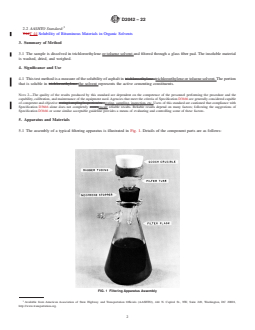
5.1 The assembly of a typical filtering apparatus is illustrated in Fig. 1. Details of the component parts are as follows:
FIG. 1 Filtering Apparatus Assembly
Available from American Association of State Highway and Transportation Officials (AASHTO), 444 N. Capitol St., NW, Suite 249, Washington, DC 20001,
http://www.transportation.org.
D2042 − 22
5.1.1 BitumenAsphalt Crucible or Gooch Crucible, glazed inside and outside with the exception of outside bottom surface. The
approximate dimensions shall be a diameter of 44 mm at the top, tapering to 36 mm at the bottom, and a depth of 20-30 mm.20
to 30 mm.
5.1.2 Glass Microfiber Filter Pad, 32–34 32 to 34 mm diameter, fine porosity, fast flow rate, 1.5 μm particle retention.
5.1.3 Filter Flask, heavy-wall, with side tube, 250-, 500-, or 1000-mL 250, 500, or 1000 mL capacity.
5.1.4 Filter Tube, 40-40 to 42-mm 42 mm inside diameter.
5.1.5 Rubber Tubing or Adapter, for holding the crucible on the filter tube.
NOTE 3—Other suitable assemblies permitting vacuum filtration with a crucible may be used.
5.1.6 Erlenmeyer Flask, 125 mL.
5.1.7 Oven, capable of maintaining a temperature of 110 6 5°C.5 °C.
5.1.8 Balance, Class GP2, conforming to the requirements of Guide D4753.
6. ReagentSolvent
6.1 Trichloroethylene, technical grade.
6.2 Toluene, technical grade.
7. Safety Precautions
7.1 Trichloroethylene is toxic, and good ventilation should be provided.Toluene and trichloroethylene are both toxic solvents and
should be used within a fume hood. Toluene is flammable. Trichloroethylene is a carcinogen. The safety data sheets for either of
these solvents should be reviewed prior to use.
8. Preparation of Crucible
8.1 Assemble the filtering apparatus as shown in Fig. 1Place the crucible . Place filter pad into the Grooch crucible, moisten the
pad with solvent, and seat firmly in the bottom of the crucible with light suction. Place the crucible plus one thickness of the filter
pad in an oven at 110 6 5°C5 °C for 15 min, allow to cool in a des
...