

ASTM D1461-17(2022)
(Test Method)Standard Test Method for Moisture or Volatile Distillates in Asphalt Mixtures
General Information
- Abstract
SIGNIFICANCE AND USE
3.1 This test method is used for determining either the amount of moisture or the amount of volatile petroleum distillates in asphalt mixtures.
3.2 Applicable standards are those in which measurements or calibrations are made, samples are procured, or products are selected.3
SCOPE
1.1 This test method covers the determination, by direct measurement, of moisture or volatile fractions of the asphalt in asphalt mixtures.
1.2 The values stated in SI units are to be regarded as the standard. No other units of measurement are included in this standard.
1.3 The text of this standard references notes and footnotes which provide explanatory material. These notes and footnotes (excluding those in tables and figures) shall not be considered as requirements of the standard.
1.4 This standard does not purport to address all of the safety concerns, if any, associated with its use. It is the responsibility of the user of this standard to establish appropriate safety, health, and environmental practices and determine the applicability of regulatory limitations prior to use.
1.5 This international standard was developed in accordance with internationally recognized principles on standardization established in the Decision on Principles for the Development of International Standards, Guides and Recommendations issued by the World Trade Organization Technical Barriers to Trade (TBT) Committee.
- Status
- Published
- Publication Date
- 31-Oct-2022
- Technical Committee
- D04 - Road and Paving Materials
- Drafting Committee
- D04.25 - Analysis of Asphalt Mixtures
Overview
ASTM D1461-17(2022): Standard Test Method for Moisture or Volatile Distillates in Asphalt Mixtures specifies a reliable procedure for determining the amount of moisture or volatile petroleum distillates present in asphalt mixtures. Developed by ASTM International, this test method is widely adopted for quality control in the construction and maintenance of asphalt pavements and related road infrastructure. This standard is integral to ensuring the performance, safety, and durability of asphalt-based materials by providing accurate measurement techniques for components that can significantly affect the properties of asphalt mixtures.
Key Topics
- Scope of the Test Method: Covers direct measurement of moisture content and volatile distillates in asphalt mixtures using calibrated apparatus and specific procedures.
- Applicability: Suitable for use wherever measurements or calibrations are required, including sample procurement and product selection for asphalt materials.
- Units of Measurement: Utilizes SI units exclusively as the standard of reference.
- Apparatus: Involves metal stills, water-cooled condensers, and precisely graduated glass traps.
- Sampling: Specifies that material samples must be representative and handled in accordance with ASTM guidelines (such as Practice D979/D979M).
- Procedure:
- Moisture determination involves adding a solvent to the sample, assembling test equipment, and distilling until readings stabilize.
- Volatile distillates determination uses water and sodium carbonate, then distillation and separation procedures are applied.
- Precision and Accuracy: Provides criteria for repeatability and reproducibility to ensure reliable results.
- Safety Practices: Emphasizes user responsibility for establishing appropriate safety, health, and environmental protocols.
Applications
ASTM D1461-17(2022) finds broad application in:
- Quality Assurance in Road Construction: Testing asphalt mixtures for the correct moisture and volatile content to prevent premature pavement failure.
- Materials Testing Laboratories: Routine assessment of asphalt samples during research, development, and production.
- Compliance and Regulatory Inspections: Ensuring asphalt materials meet regulatory and performance specifications.
- Contractor and Agency Verification: Used by contractors, governmental agencies, and third-party inspectors to verify material properties and compliance with project requirements.
- Forensic Analysis: Investigation of asphalt pavement performance issues due to inappropriate moisture or volatile content.
Implementing this standard enhances the reliability of asphalt mixture testing, helping to prevent costly structural failures and ensuring longevity of pavement surfaces.
Related Standards
Several other ASTM standards are referenced or commonly used alongside ASTM D1461-17(2022):
- ASTM D979/D979M: Practice for Sampling Bituminous Paving Mixtures, providing sampling procedures crucial for obtaining representative samples for testing.
- ASTM D3666: Specification for Minimum Requirements for Agencies Testing and Inspecting Road and Paving Materials, which ensures competent testing agencies and reliable laboratory practices.
- ASTM D6997: Test Method for Distillation of Emulsified Asphalt, offering procedures closely related to determining volatile content in bituminous products.
Additional standards and guidelines from ASTM and other organizations may complement this test method, particularly where specialized equipment or environmental conditions exist.
For laboratories, contractors, and agencies seeking to optimize asphalt mixture quality, ASTM D1461-17(2022) offers a trusted, internationally recognized method for assessing moisture and volatile distillate content. Adherence to this standard ensures material integrity, regulatory compliance, and long-term pavement performance.
Relations
- Effective Date
- 01-Oct-2016
- Effective Date
- 01-Dec-2013
- Effective Date
- 01-Feb-2012
- Effective Date
- 01-Dec-2011
- Effective Date
- 15-Jun-2011
- Effective Date
- 01-Dec-2009
- Effective Date
- 01-Aug-2007
- Effective Date
- 01-Aug-2007
- Effective Date
- 15-Jan-2007
- Effective Date
- 15-Jan-2007
- Effective Date
- 15-Jan-2007
- Effective Date
- 01-Jun-2006
- Effective Date
- 01-Jun-2005
- Effective Date
- 01-Feb-2005
- Effective Date
- 01-Aug-2004
Get Certified
Connect with accredited certification bodies for this standard

DIBt (Deutsches Institut für Bautechnik)
German Institute for Building Technology.
DIN CERTCO
DIN Group product certification.
Zavod za gradbeništvo Slovenije (ZAG) - Inšpekcija
ZAG inspection body for construction products, structures, and materials.
Sponsored listings
Frequently Asked Questions
ASTM D1461-17(2022) is a standard published by ASTM International. Its full title is "Standard Test Method for Moisture or Volatile Distillates in Asphalt Mixtures". This standard covers: SIGNIFICANCE AND USE 3.1 This test method is used for determining either the amount of moisture or the amount of volatile petroleum distillates in asphalt mixtures. 3.2 Applicable standards are those in which measurements or calibrations are made, samples are procured, or products are selected.3 SCOPE 1.1 This test method covers the determination, by direct measurement, of moisture or volatile fractions of the asphalt in asphalt mixtures. 1.2 The values stated in SI units are to be regarded as the standard. No other units of measurement are included in this standard. 1.3 The text of this standard references notes and footnotes which provide explanatory material. These notes and footnotes (excluding those in tables and figures) shall not be considered as requirements of the standard. 1.4 This standard does not purport to address all of the safety concerns, if any, associated with its use. It is the responsibility of the user of this standard to establish appropriate safety, health, and environmental practices and determine the applicability of regulatory limitations prior to use. 1.5 This international standard was developed in accordance with internationally recognized principles on standardization established in the Decision on Principles for the Development of International Standards, Guides and Recommendations issued by the World Trade Organization Technical Barriers to Trade (TBT) Committee.
SIGNIFICANCE AND USE 3.1 This test method is used for determining either the amount of moisture or the amount of volatile petroleum distillates in asphalt mixtures. 3.2 Applicable standards are those in which measurements or calibrations are made, samples are procured, or products are selected.3 SCOPE 1.1 This test method covers the determination, by direct measurement, of moisture or volatile fractions of the asphalt in asphalt mixtures. 1.2 The values stated in SI units are to be regarded as the standard. No other units of measurement are included in this standard. 1.3 The text of this standard references notes and footnotes which provide explanatory material. These notes and footnotes (excluding those in tables and figures) shall not be considered as requirements of the standard. 1.4 This standard does not purport to address all of the safety concerns, if any, associated with its use. It is the responsibility of the user of this standard to establish appropriate safety, health, and environmental practices and determine the applicability of regulatory limitations prior to use. 1.5 This international standard was developed in accordance with internationally recognized principles on standardization established in the Decision on Principles for the Development of International Standards, Guides and Recommendations issued by the World Trade Organization Technical Barriers to Trade (TBT) Committee.
ASTM D1461-17(2022) is classified under the following ICS (International Classification for Standards) categories: 91.100.50 - Binders. Sealing materials; 93.080.20 - Road construction materials. The ICS classification helps identify the subject area and facilitates finding related standards.
ASTM D1461-17(2022) has the following relationships with other standards: It is inter standard links to ASTM D3666-16, ASTM D3666-13, ASTM D979/D979M-12, ASTM D3666-11, ASTM D979/D979M-11, ASTM D3666-09a, ASTM D3666-07a, ASTM D3666-07ae1, ASTM D3666-07, ASTM D3666-07e2, ASTM D3666-07e1, ASTM D3666-06, ASTM D3666-05a, ASTM D3666-05, ASTM D3666-04. Understanding these relationships helps ensure you are using the most current and applicable version of the standard.
ASTM D1461-17(2022) is available in PDF format for immediate download after purchase. The document can be added to your cart and obtained through the secure checkout process. Digital delivery ensures instant access to the complete standard document.
Standards Content (Sample)
This international standard was developed in accordance with internationally recognized principles on standardization established in the Decision on Principles for the
Development of International Standards, Guides and Recommendations issued by the World Trade Organization Technical Barriers to Trade (TBT) Committee.
Designation: D1461 − 17 (Reapproved 2022)
Standard Test Method for
Moisture or Volatile Distillates in Asphalt Mixtures
This standard is issued under the fixed designation D1461; the number immediately following the designation indicates the year of
original adoption or, in the case of revision, the year of last revision. A number in parentheses indicates the year of last reapproval. A
superscript epsilon (´) indicates an editorial change since the last revision or reapproval.
This standard has been approved for use by agencies of the U.S. Department of Defense.
1. Scope 3. Significance and Use
3.1 This test method is used for determining either the
1.1 This test method covers the determination, by direct
amount of moisture or the amount of volatile petroleum
measurement, of moisture or volatile fractions of the asphalt in
distillates in asphalt mixtures.
asphalt mixtures.
3.2 Applicable standards are those in which measurements
1.2 The values stated in SI units are to be regarded as the
or calibrations are made, samples are procured, or products are
standard. No other units of measurement are included in this
selected.
standard.
1.3 The text of this standard references notes and footnotes
4. Apparatus
which provide explanatory material. These notes and footnotes
4.1 Metal Still—A vertical cylindrical still, similar to that
(excluding those in tables and figures) shall not be considered
used in Test Method D6997, having a faced flange at the top to
as requirements of the standard.
which the head is tightly attached by means of a clamp. The
1.4 This standard does not purport to address all of the
head shall be of metal, preferably of copper or brass, and shall
safety concerns, if any, associated with its use. It is the
have a tube opening of 25.4 mm of inside diameter to facilitate
responsibility of the user of this standard to establish appro-
attachment of the specified trap/condenser assembly.
priate safety, health, and environmental practices and deter-
4.2 Condenser, of the water-cooled reflux glass-tube type,
mine the applicability of regulatory limitations prior to use.
having a condenser jacket not less than 400 mm long with an
1.5 This international standard was developed in accor-
inner tube 9.5 to 12.7 mm in outside diameter. The end of the
dance with internationally recognized principles on standard-
condenser inserted in the trap shall be ground off at an angle of
ization established in the Decision on Principles for the
30° from the vertical axis of the condenser. For mixtures with
Development of International Standards, Guides and Recom-
very volatile solvents, it may be necessary to supplement this
mendations issued by the World Trade Organization Technical
water-cooled condenser with a second water-cooled condenser
Barriers to Trade (TBT) Committee.
of approximately the same dimensions.
4.3 Trap, of well-annealed glass, of one of the following
2. Referenced Documents
types depending upon the purpose of the test:
2.1 ASTM Standards:
4.3.1 For determination of water in asphalt mixtures, a glass
D979/D979M Practice for Sampling Bituminous Paving
trap of 10 or 25 mL capacity shall be used. The trap shall be
Mixtures
graduated in 0.1 mL divisions with 60.05 mL maximum error
D3666 Specification for Minimum Requirements for Agen-
below 1 mL, and in 0.2 mL divisions with a 60.1 mL
cies Testing and Inspecting Road and Paving Materials
maximum error above 1 mL, as specified in Table 1 and Figs.
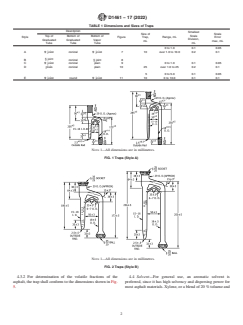
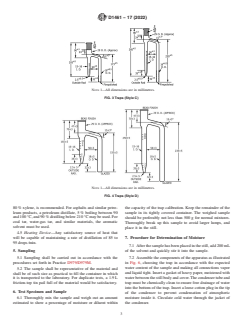
D6997 Test Method for Distillation of Emulsified Asphalt 1-4. Tapered ball traps require adaptors for connection to the
metal still.
This test method is under the jurisdiction of ASTM Committee D04 on Road
and Paving Materials and is the direct responsibility of Subcommittee D04.25 on The quality of the results produced by this standard are dependent on the
Analysis of Asphalt Mixtures. competence of the personnel performing the procedure and the capacity, calibration,
Current edition approved Nov. 1, 2022. Published November 2022. Originally and maintenance of the equipment used. Agencies that meet the criteria of
approved in 1956. Last previous edition approved in 2017 as D1461 – 17. DOI: Specification D3666 are generally considered capable of competent and objective
10.1520/D1461-17R22. testing, sampling, inspection, etc. Users of this standard are cautioned that
For referenced ASTM standards, visit the ASTM website, www.astm.org, or compliance with Specification D3666 alone does not completely ensure reliable
contact ASTM Customer Service at service@astm.org. For Annual Book of ASTM results. Reliable results depend on many factors; following the suggestions of
Standards volume information, refer to the standard’s Document Summary page on Specification D3666 or some similar acceptable guideline provides a means of
the ASTM website. evaluating and controlling some of those factors.
Copyright ©ASTM International, 100 Barr Harbor Drive, PO Box C700, West Conshohocken, PA19428-2959. United States
D1461 − 17 (2022)
TABLE 1 Dimensions and Sizes of Traps
Description
Smallest
Size of Scale
Scale
Top of Bottom of Bottom of
Style Figure Trap, Range, mL Error
Division,
Graduated Graduated Vapor
mL max, mL
mL
Tube Tube Tube
0to1.0 0.1 0.05
A$¯ joint conical $¯ joint 710 over 1.0 to 10.0 0.2 0.1
§ joint
B conical § joint 8
$¯ joint
C conical plain 9 0to1.0 0.1 0.05
D plain conical plain 10 25 over 1.0 to 25 0.2 0.1
5 0to5.0 0.1 0.05
E$¯ joint round $¯ joint 11 10 0to10.0 0.1 0.1
NOTE 1—All dimensions are in millimetres.
FIG. 1 Traps (Style A)
NOTE 1—All dimensions are in millimetres.
FIG. 2 Traps (Style B)
4.3.2 For determination of the volatile fractions of the 4.4 Solvent—For general use, an aromatic solvent is
asphalt, the trap shall conform to the dimensions shown in Fig. preferred, since it has high solvency and dispersing power for
5. most asphalt materials. Xylene, or a blend of 20 % toluene and
D1461 − 17 (2022)
NOTE 1—All dimensions are in millimetres.
FIG. 3 Traps (Style C)
NOTE 1—All dimensions are in millimetres.
FIG. 4 Traps (Style D)
80 % xylene, is recommended. For asphalts and similar petro- the capacity of the trap calibration. Keep the remainder of the
leum products, a petroleum distillate, 5 % boiling between 90
sample in its tightly covered container. The weighed sample
and100 °C,and90 %distillingbelow210 °Cmaybeused.For
should be preferably not less than 500 g for normal mixtures.
coal tar, water-gas tar, and similar materials, the aromatic
Thoroughly break up this sample to avoid larger lumps, and
solvent must be used.
place it in the still.
4.5 Heating Device—Any satisfactory source of heat
...