

ASTM D5303-20
(Test Method)Standard Test Method for Trace Carbonyl Sulfide in Propylene by Gas Chromatography
General Information
- Abstract
SIGNIFICANCE AND USE
5.1 In processes producing propylene, COS usually remains with the C3 hydrocarbons and must be removed, since it affects product quality. COS acts as a poison to commercial polymerization catalysts, resulting in deactivation and costly process downtime.
5.2 Accurate gas chromatographic determination of trace COS in propylene involves unique analytical problems because of the chemical nature of COS and idiosyncracies of trace level analyses. These problems result from the reactive and absorptive nature of COS, the low concentration levels being measured, the type of detector needed, and the interferences from the propylene sample matrix. This test method addresses these analytical problems and ways to properly handle them to assure accurate and precise analyses.
5.3 This test method provides a basis for agreement between two laboratories when the determination of trace COS in propylene is important. The test method permits several calibration techniques. For best agreement between two labs, it is recommended that they use the same calibration technique.
SCOPE
1.1 This test method covers the determination of traces of carbonyl sulfide (COS) in propylene. It is applicable to COS concentrations from 0.5 mg/kg to 4.0 mg/kg (parts per million by mass). See Note 1.
Note 1: The lower limit of this test method is believed to be below 0.1 mg/kg, depending on sample size and sensitivity of the instrumentation being used. However, the cooperative testing program was conducted in the 0.5 to 4.0 range due to limitations in preparing commercial test mixtures.
1.2 The values stated in SI units are to be regarded as standard. No other units of measurement are included in this standard.
1.3 This standard does not purport to address all of the safety concerns, if any, associated with its use. It is the responsibility of the user of this standard to establish appropriate safety, health, and environmental practices and determine the applicability of regulatory limitations prior to use. Specific hazards statements are given in Section 9.
1.4 This international standard was developed in accordance with internationally recognized principles on standardization established in the Decision on Principles for the Development of International Standards, Guides and Recommendations issued by the World Trade Organization Technical Barriers to Trade (TBT) Committee.
- Status
- Published
- Publication Date
- 30-Jun-2020
- Technical Committee
- D02 - Petroleum Products, Liquid Fuels, and Lubricants
- Drafting Committee
- D02.D0.03 - Propylene
Buy Documents
ASTM D5303-20 - Standard Test Method for Trace Carbonyl Sulfide in Propylene by Gas Chromatography
REDLINE ASTM D5303-20 - Standard Test Method for Trace Carbonyl Sulfide in Propylene by Gas Chromatography
Overview
ASTM D5303-20: Standard Test Method for Trace Carbonyl Sulfide in Propylene by Gas Chromatography establishes a reliable procedure for the quantitative determination of trace concentrations of carbonyl sulfide (COS) in propylene. Developed by ASTM International, this standard supports the petrochemical industry by addressing the unique analytical challenges of detecting extremely low levels of COS, ranging from 0.5 mg/kg to 4.0 mg/kg, within complex hydrocarbon matrices.
Carbonyl sulfide is a critical contaminant in propylene production-if not removed, COS can poison polymerization catalysts, leading to equipment downtime and compromised product quality. This test method provides robust guidelines to accurately detect and measure trace COS, facilitating high purity requirements essential for downstream applications.
Key Topics
Scope and Applicability
- Targets detection of trace levels of carbonyl sulfide (COS) in propylene using gas chromatography (GC)
- Suitable for COS concentrations from 0.5 mg/kg to 4.0 mg/kg (parts per million by mass)
- Utilizes SI units as standard measurements
Significance and Use
- Ensures product quality by verifying COS removal in propylene processing
- Protects catalyst function, minimizing process interruptions and operational costs
- Supports agreement and consistency in laboratory results, critical for quality assurance in international trade and supply chains
Technical Considerations
- Addresses special analytical challenges, including COS’s reactive and absorptive characteristics, interference from sample matrix, and low detection limits
- Recommends use of isothermal packed column gas chromatography with flame photometric detection (FPD) for specificity to sulfur compounds
- Guidance on calibration techniques for accurate trace-level quantitation, including standard sample, permeation tube, and blend preparation methods
Applications
Petrochemical Production
- Provides a standardized method for propylene producers and refiners to monitor and control COS contamination
- Supports the maintenance of high product quality needed for polymer-grade propylene
Catalyst Protection
- Enables manufacturers using propylene in downstream polymerization (such as polypropylene production) to safeguard sensitive catalysts against deactivation by trace sulfur species
Laboratory Quality Control
- Facilitates agreement between laboratories by recommending standardized calibration and testing procedures
- Supports compliance with internal and external product specifications, contributing to certification and regulatory requirements
Supply Chain Assurance
- Assists buyers and suppliers in verifying the purity of propylene during transportation, storage, and distribution, especially where consistency across international borders is essential
Related Standards
- ASTM D1835 - Specification for Liquefied Petroleum (LP) Gases; relates to quality control in LPG, which often includes propylene
- ASTM D3609 - Practice for Calibration Techniques Using Permeation Tubes; referenced for preparing calibration standards
- ASTM D4468 - Test Method for Total Sulfur in Gaseous Fuels by Hydrogenolysis and Colorimetry
- ASTM E355 - Practice for Gas Chromatography Terms and Relationships; provides terminology and definition standards
- ASTM E840 - Practice for Using Flame Photometric Detectors in Gas Chromatography
Practical Value
By following ASTM D5303-20, laboratories and petrochemical producers can ensure consistent, accurate measurement of trace carbonyl sulfide in propylene. This helps guarantee product quality, protect equipment, and maintain compliance with industry and regulatory standards. The adoption of this method enhances reliability in analytical results, facilitating quality management and supporting the continued development of high-performance propylene-based products.
Keywords: carbonyl sulfide, COS, gas chromatography, propylene, trace analysis, flame photometric detector, petrochemical quality control, ASTM standards, catalyst protection, sulfur analysis.
Relations
- Effective Date
- 01-May-2013
- Effective Date
- 01-Dec-2012
- Effective Date
- 01-Nov-2011
- Effective Date
- 01-May-2011
- Effective Date
- 01-Apr-2010
- Effective Date
- 01-Mar-2007
- Effective Date
- 01-Jun-2006
- Effective Date
- 01-Oct-2005
- Refers
ASTM E840-95(2005) - Standard Practice for Using Flame Photometric Detectors in Gas Chromatography - Effective Date
- 01-Sep-2005
- Effective Date
- 01-Apr-2005
- Effective Date
- 01-Nov-2003
- Effective Date
- 10-May-2003
- Effective Date
- 01-Jan-2001
- Effective Date
- 01-Jan-2001
- Effective Date
- 10-Sep-2000
Buy Documents
ASTM D5303-20 - Standard Test Method for Trace Carbonyl Sulfide in Propylene by Gas Chromatography
REDLINE ASTM D5303-20 - Standard Test Method for Trace Carbonyl Sulfide in Propylene by Gas Chromatography
Get Certified
Connect with accredited certification bodies for this standard

ECOCERT
Organic and sustainability certification.

Eurofins Food Testing Global
Global leader in food, environment, and pharmaceutical product testing.

Intertek Bangladesh
Intertek certification and testing services in Bangladesh.
Sponsored listings
Frequently Asked Questions
ASTM D5303-20 is a standard published by ASTM International. Its full title is "Standard Test Method for Trace Carbonyl Sulfide in Propylene by Gas Chromatography". This standard covers: SIGNIFICANCE AND USE 5.1 In processes producing propylene, COS usually remains with the C3 hydrocarbons and must be removed, since it affects product quality. COS acts as a poison to commercial polymerization catalysts, resulting in deactivation and costly process downtime. 5.2 Accurate gas chromatographic determination of trace COS in propylene involves unique analytical problems because of the chemical nature of COS and idiosyncracies of trace level analyses. These problems result from the reactive and absorptive nature of COS, the low concentration levels being measured, the type of detector needed, and the interferences from the propylene sample matrix. This test method addresses these analytical problems and ways to properly handle them to assure accurate and precise analyses. 5.3 This test method provides a basis for agreement between two laboratories when the determination of trace COS in propylene is important. The test method permits several calibration techniques. For best agreement between two labs, it is recommended that they use the same calibration technique. SCOPE 1.1 This test method covers the determination of traces of carbonyl sulfide (COS) in propylene. It is applicable to COS concentrations from 0.5 mg/kg to 4.0 mg/kg (parts per million by mass). See Note 1. Note 1: The lower limit of this test method is believed to be below 0.1 mg/kg, depending on sample size and sensitivity of the instrumentation being used. However, the cooperative testing program was conducted in the 0.5 to 4.0 range due to limitations in preparing commercial test mixtures. 1.2 The values stated in SI units are to be regarded as standard. No other units of measurement are included in this standard. 1.3 This standard does not purport to address all of the safety concerns, if any, associated with its use. It is the responsibility of the user of this standard to establish appropriate safety, health, and environmental practices and determine the applicability of regulatory limitations prior to use. Specific hazards statements are given in Section 9. 1.4 This international standard was developed in accordance with internationally recognized principles on standardization established in the Decision on Principles for the Development of International Standards, Guides and Recommendations issued by the World Trade Organization Technical Barriers to Trade (TBT) Committee.
SIGNIFICANCE AND USE 5.1 In processes producing propylene, COS usually remains with the C3 hydrocarbons and must be removed, since it affects product quality. COS acts as a poison to commercial polymerization catalysts, resulting in deactivation and costly process downtime. 5.2 Accurate gas chromatographic determination of trace COS in propylene involves unique analytical problems because of the chemical nature of COS and idiosyncracies of trace level analyses. These problems result from the reactive and absorptive nature of COS, the low concentration levels being measured, the type of detector needed, and the interferences from the propylene sample matrix. This test method addresses these analytical problems and ways to properly handle them to assure accurate and precise analyses. 5.3 This test method provides a basis for agreement between two laboratories when the determination of trace COS in propylene is important. The test method permits several calibration techniques. For best agreement between two labs, it is recommended that they use the same calibration technique. SCOPE 1.1 This test method covers the determination of traces of carbonyl sulfide (COS) in propylene. It is applicable to COS concentrations from 0.5 mg/kg to 4.0 mg/kg (parts per million by mass). See Note 1. Note 1: The lower limit of this test method is believed to be below 0.1 mg/kg, depending on sample size and sensitivity of the instrumentation being used. However, the cooperative testing program was conducted in the 0.5 to 4.0 range due to limitations in preparing commercial test mixtures. 1.2 The values stated in SI units are to be regarded as standard. No other units of measurement are included in this standard. 1.3 This standard does not purport to address all of the safety concerns, if any, associated with its use. It is the responsibility of the user of this standard to establish appropriate safety, health, and environmental practices and determine the applicability of regulatory limitations prior to use. Specific hazards statements are given in Section 9. 1.4 This international standard was developed in accordance with internationally recognized principles on standardization established in the Decision on Principles for the Development of International Standards, Guides and Recommendations issued by the World Trade Organization Technical Barriers to Trade (TBT) Committee.
ASTM D5303-20 is classified under the following ICS (International Classification for Standards) categories: 71.080.10 - Aliphatic hydrocarbons. The ICS classification helps identify the subject area and facilitates finding related standards.
ASTM D5303-20 has the following relationships with other standards: It is inter standard links to ASTM D1835-13, ASTM D1835-12, ASTM D4468-85(2011), ASTM D1835-11, ASTM D3609-00(2010), ASTM E355-96(2007), ASTM D4468-85(2006), ASTM D3609-00(2005), ASTM E840-95(2005), ASTM D1835-05, ASTM D1835-03a, ASTM D1835-03, ASTM E355-96(2001), ASTM E355-96, ASTM D3609-00. Understanding these relationships helps ensure you are using the most current and applicable version of the standard.
ASTM D5303-20 is available in PDF format for immediate download after purchase. The document can be added to your cart and obtained through the secure checkout process. Digital delivery ensures instant access to the complete standard document.
Standards Content (Sample)
This international standard was developed in accordance with internationally recognized principles on standardization established in the Decision on Principles for the
Development of International Standards, Guides and Recommendations issued by the World Trade Organization Technical Barriers to Trade (TBT) Committee.
Designation:D5303 −20
Standard Test Method for
Trace Carbonyl Sulfide in Propylene by Gas
Chromatography
This standard is issued under the fixed designation D5303; the number immediately following the designation indicates the year of
original adoption or, in the case of revision, the year of last revision.Anumber in parentheses indicates the year of last reapproval.A
superscript epsilon (´) indicates an editorial change since the last revision or reapproval.
1. Scope* Hydrogenolysis and Rateometric Colorimetry
E355PracticeforGasChromatographyTermsandRelation-
1.1 This test method covers the determination of traces of
ships
carbonyl sulfide (COS) in propylene. It is applicable to COS
E840PracticeforUsingFlamePhotometricDetectorsinGas
concentrations from 0.5mg⁄kg to 4.0mg⁄kg (parts per million
Chromatography
by mass). See Note 1.
NOTE 1—The lower limit of this test method is believed to be below
3. Terminology
0.1mg⁄kg, depending on sample size and sensitivity of the instrumenta-
tionbeingused.However,thecooperativetestingprogramwasconducted 3.1 Definitions:
in the 0.5 to 4.0 range due to limitations in preparing commercial test
3.1.1 Additional terminology related to the practice of gas
mixtures.
chromatography can be found in Practice E355.
1.2 The values stated in SI units are to be regarded as 3.1.2 liquefied petroleum gas (LPG), n—hydrocarbon gases
standard. No other units of measurement are included in this
that can be stored or handled in the liquid phase through
standard. compression or refrigeration, or both.
3.1.2.1 Discussion—LPG’s generally consist of C and C
1.3 This standard does not purport to address all of the 3 4
alkanes and alkenes or mixtures thereof and containing less
safety concerns, if any, associated with its use. It is the
than 10% by volume of higher carbon number material.Vapor
responsibility of the user of this standard to establish appro-
pressure does not normally exceed 2000kPa at 40ºC.
priate safety, health, and environmental practices and deter-
mine the applicability of regulatory limitations prior to use.
3.2 Definitions of Terms Specific to This Standard:
Specific hazards statements are given in Section 9.
3.2.1 propane/propene mixtures, n—mixtures primarily
1.4 This international standard was developed in accor-
composed of propane and propene where one of these compo-
dance with internationally recognized principles on standard-
nents is usually in the concentration range of 30% to 85% by
ization established in the Decision on Principles for the
mass with the other comprising the majority of the remainder.
Development of International Standards, Guides and Recom-
Commercial Propane in Specification D1835 is typically this
mendations issued by the World Trade Organization Technical
sort of product mixture.
Barriers to Trade (TBT) Committee.
3.2.1.1 Discussion—Other components may be present,
usually at less than 10% by mass.
2. Referenced Documents
4. Summary of Test Method
2.1 ASTM Standards:
D1835Specification for Liquefied Petroleum (LP) Gases
4.1 A procedure is given for removing a sample from the
D3609Practice for Calibration Techniques Using Perme-
sample cylinder, separating COS from propylene, detecting
ation Tubes
COS, calibrating the detector, quantitating COS content in the
D4468Test Method for Total Sulfur in Gaseous Fuels by
sample, and assaying the gas standard. General comments and
recommended techniques are given.
4.2 Arelativelylargevolumeofsampleisinjectedintoagas
This test method is under the jurisdiction of ASTM Committee D02 on
chromatograph having a single packed column, operated iso-
Petroleum Products, Liquid Fuels, and Lubricants and is the direct responsibility of
Subcommittee D02.D0.03 on Propylene.
thermally at 10°C to 50°C, that separates COS from propyl-
CurrenteditionapprovedJuly1,2020.PublishedJuly2020.Originallyapproved
ene. COS is detected with a flame photometric detector.
in 1992. Last previous edition approved in 2019 as D5303–19. DOI: 10.1520/
D5303-20.
4.3 Calibrationdata,basedonpeakareas,areobtainedusing
For referenced ASTM standards, visit the ASTM website, www.astm.org, or
a known gas standard blend of COS in the range expected for
contact ASTM Customer Service at service@astm.org. For Annual Book of ASTM
the sample. The COS peak area in the sample is measured and
Standards volume information, refer to the standard’s Document Summary page on
the ASTM website. the concentration of COS calculated.
*A Summary of Changes section appears at the end of this standard
Copyright © ASTM International, 100 Barr Harbor Drive, PO Box C700, West Conshohocken, PA 19428-2959. United States
D5303−20
A
TABLE 1 Suitable GC Columns and Temperatures
4.4 The COS gas standard blend is assayed prior to use for
Column Packing and Oven
calibration. B
Size, m × mm Tubing Type
Number Temperature, °C
1 0.9 × 3.78 SS Porapak R, 80/100 Mesh; 47
5. Significance and Use
C
2 1.4×3.78 TFE Carbopack BHT 100, 40/60
D
5.1 Inprocessesproducingpropylene,COSusuallyremains Mesh; 25,40
D
3 1.8 × 3.78 TFE Carbopack BHT 100; 25,30
withtheC hydrocarbonsandmustberemoved,sinceitaffects
4 1.8 × 3.78 TFE Porapak Q, AW, 50/80 Mesh
product quality. COS acts as a poison to commercial polym-
2.4 × 3.78 TFE (Above in Series); 74
erization catalysts, resulting in deactivation and costly process
5 2.4 × 3.78 SS Carbopack BHT 100; 47
6 2.8 × 3.78 TFE Carbopack BHT 100, 40/60
downtime.
Mesh; 50
7 3.6 × 3.78 TFE Carbopack BHT 100, 40/60
5.2 Accurate gas chromatographic determination of trace
Mesh; 50
COSinpropyleneinvolvesuniqueanalyticalproblemsbecause
E
8 4.3 × 3.78 TFE Chromosil 300; 50
ofthechemicalnatureofCOSandidiosyncraciesoftracelevel
9 6.1 × 3.78 TFE Hayes Sep Q, 80/100 Mesh; 65
analyses. These problems result from the reactive and absorp- A
These columns have been tested cooperatively and found suitable for use with
tive nature of COS, the low concentration levels being this test method.
B
316 SS Tubing for columns or connection of sample cylinder to sampling system
measured, the type of detector needed, and the interferences
can be TFE lined internally to improve on system stability. This tubing is
from the propylene sample matrix. This test method addresses
commercially available from chromatography vendors.
C
these analytical problems and ways to properly handle them to TFE—Homopolymer of tetrafluoroethylene.
D
Identical columns used by different labs at different temperatures.
assure accurate and precise analyses.
E
Propyne (methyl acetylene) can interfere with COS using this column.
5.3 Thistestmethodprovidesabasisforagreementbetween
two laboratories when the determination of trace COS in
propylene is important. The test method permits several
7.5 Recorder—Any strip chart recorder with a full scale
calibrationtechniques.Forbestagreementbetweentwolabs,it
range of 1mV, a maximum full scale balance time of 2s, and
is recommended that they use the same calibration technique.
a minimum chart speed of 0.5cm⁄s, may be used.
7.6 Data Handling System—Any commercially available
6. Interferences
GC integrator or GC computer system capable of accurately
6.1 Hydrogen sulfide (H S) or sulfur dioxide (SO ) can be
2 2
integratingthearea(uVs)oftheCOSpeakissatisfactory.Data
presentinthepropyleneandmustbeseparatedfromCOS.(See
systems that will linearize the logarithmic output of the FPD
Note 2.)
are also satisfactory.
NOTE 2—H S and SO are separated from COS with the Carbopack
2 2
7.7 Sample Cylinders, 300mLcapacity or larger, fluorocar-
BHT 100 columns or with the Chromosil 300 column.
bon lined stainless steel, Type DOT 3E, 12409kPa (1800psi)
7. Apparatus working pressure.
7.1 Gas Chromatograph—Any gas chromatograph (GC)
8. Reagents and Materials
equipped with a flame photometric detector/electrometer sys-
8.1 Air, zero grade.
tem (FPD), as described in 7.2, may be used. A GC/FPD
equipped with an output signal linearizer is also permitted. 8.2 Carbonyl sulfide (COS), lecture bottle, 97.5% min.
(Warning—Toxic! See Section 9, Hazards.)
7.2 Detector System, flame photometric detector, either
single or dual burner design. Noise level must be no more than 8.3 Gas Calibration Blends, 1mg⁄kg to 10mg⁄kg COS in
one recorder chart division (see 7.5). The signal for COS must eithernitrogen,argon,propyleneorapropylene/argonmixture.
be at least twice the noise level at the 0.1mg⁄kg level. A They can be obtained from any commercial supplier or
discussion of this detector is presented in Practice E840. The prepared as shown in Appendix X1 or Test Method D4468.
electrometer used with the detector must have a sensitivity of
8.4 Gas Sampling Syringe, 0.1mL, 1.0mL, and 5.0mL.
−12
10 A full scale on a 1mV recorder to achieve optimum
8.5 Gas Sampling Valve and Sample Loops, fluorocarbon or
detectability at lowest levels.
316 stainless steel. See Footnote B of Table 1.
NOTE3—Thesulfurdetectorbasedonthechemiluminescenceprinciple
8.6 Glass Vials, 125cm.
(GC_SCD) has shown good results for COS. However, no precision is
determinedforthisdetectorinthisapplication.Theachievablelowerlimit
8.7 Hydrogen, pure grade, 99.9%.
for COS in Propylene is 0.04mg⁄kg (30ppbMol).
8.8 Isooctane (2,2,4-trimethylpentane), sulfur free, mini-
7.3 Column—Any column that will effect the complete
mum purity 99 mol%. (Warning—Flammable! Health Haz-
separation of COS from propylene and other compounds
ard.)
normally present in propylene concentrates, and that is suffi-
8.9 Nitrogen or Helium, 99.999% min.
ciently inert to preclude the loss of COS, may be used.
Columns that meet these criteria, and that were used in the
8.10 TFE-fluorocarbon septa and aluminum seals for vials.
cooperative study for this test method, are listed in Table 1.
9. Hazards
7.4 Sample Inlet System—Any gas sampling valve or gas
tight syringe that will permit introduction of up to 5.0mL to 9.1 Carbonyl sulfide is toxic and narcotic in high
thecolumn,andthatwillnotcauseanylossofCOS,issuitable. concentrations, and upon decomposition can liberate hydrogen
D5303−20
sulfide. Exposure to dangerous concentrations of COS is most standard sample using either a gas syringe or different size
likely when handling the pure component for preparation of sample loops. For example, assume the normal sample size for
standardblendsforassayingtheCOScalibrationgasstandards. the analysis is 1.0mL and the calibration range to be estab-
lished is 0.5mg⁄kg to 5mg⁄kg of COS. Establish a calibration
10. Sampling
curve by injecting the volumes of a 10mg⁄kg standard sample
shown in the first column of the table below. The equivalent
10.1 Supply samples to the laboratory in high pressure
concentrationofCOSina1.0mLsamplewouldbethatshown
cylinders coated internally with TFE-fluorocarbon, or other-
in the second column:
wise specially treated to reduce or eliminate loss of COS due
to reaction with the cylinder walls.
Standard Sample Equivalent Concentration, COS mg/kg
0.05 0.5
10.2 The sample cylinder and contents should be at room
0.10 1.0
temperature prior to sampling to the chromatograph. Test 0.20 2.0
0.30 3.0
samples as soon as possible after receipt.
0.40 4.0
0.50 5.0
NOTE 4—Cooperative studies indicate that the measured value for COS
will decrease with time.
12.3 PermeationTubeMethod—RefertoPracticeD3609for
directions on using permeation tubes.
10.3 Placethesamplecylinderinaverticalpositionanduse
either of the following two techniques to obtain a vaporized
12.4 Blend Preparation Techniques—Techniques for the
sample from the container for introduction into the GC.
preparation and assay verification of calibration blends in the
10.3.1 Connect the sample cylinder to the sampling valve
laboratory are described in Appendix X1 and Appendix X2.
on the chromatograph, using a minimum length of 316 ss
Also, a technique using a moving pis
...
This document is not an ASTM standard and is intended only to provide the user of an ASTM standard an indication of what changes have been made to the previous version. Because
it may not be technically possible to adequately depict all changes accurately, ASTM recommends that users consult prior editions as appropriate. In all cases only the current version
of the standard as published by ASTM is to be considered the official document.
Designation: D5303 − 19 D5303 − 20
Standard Test Method for
Trace Carbonyl Sulfide in Propylene by Gas
Chromatography
This standard is issued under the fixed designation D5303; the number immediately following the designation indicates the year of
original adoption or, in the case of revision, the year of last revision. A number in parentheses indicates the year of last reapproval. A
superscript epsilon (´) indicates an editorial change since the last revision or reapproval.
1. Scope*
1.1 This test method covers the determination of traces of carbonyl sulfide (COS) in propylene. It is applicable to COS
concentrations from 0.5 mg ⁄kg to 4.0 mg ⁄kg (parts per million by mass). See Note 1.
NOTE 1—The lower limit of this test method is believed to be below 0.1 mg ⁄kg, depending on sample size and sensitivity of the instrumentation being
used. However, the cooperative testing program was conducted in the 0.5 to 4.0 range due to limitations in preparing commercial test mixtures.
1.2 The values stated in SI units are to be regarded as standard. No other units of measurement are included in this standard.
1.3 This standard does not purport to address all of the safety concerns, if any, associated with its use. It is the responsibility
of the user of this standard to establish appropriate safety, health, and environmental practices and determine the applicability of
regulatory limitations prior to use. Specific hazards statements are given in Section 89.
1.4 This international standard was developed in accordance with internationally recognized principles on standardization
established in the Decision on Principles for the Development of International Standards, Guides and Recommendations issued
by the World Trade Organization Technical Barriers to Trade (TBT) Committee.
2. Referenced Documents
2.1 ASTM Standards:
D1835 Specification for Liquefied Petroleum (LP) Gases
D3609 Practice for Calibration Techniques Using Permeation Tubes
D4468 Test Method for Total Sulfur in Gaseous Fuels by Hydrogenolysis and Rateometric Colorimetry
E355 Practice for Gas Chromatography Terms and Relationships
E840 Practice for Using Flame Photometric Detectors in Gas Chromatography
3. Terminology
3.1 Definitions:
3.1.1 Additional terminology related to the practice of gas chromatography can be found in Practice E355.
3.1.2 liquefied petroleum gas (LPG), n—hydrocarbon gases that can be stored or handled in the liquid phase through
compression or refrigeration, or both.
3.1.2.1 Discussion—
LPG’s generally consist of C and C alkanes and alkenes or mixtures thereof and containing less than 10 % by volume of higher
3 4
carbon number material. Vapor pressure does not normally exceed 2000 kPa at 40 ºC.
3.2 Definitions of Terms Specific to This Standard:
3.2.1 propane/propene mixtures, n—mixtures primarily composed of propane and propene where one of these components is
usually in the concentration range of 30 % to 85 % by mass with the other comprising the majority of the remainder. Commercial
Propane in Specification D1835 is typically this sort of product mixture.
This test method is under the jurisdiction of ASTM Committee D02 on Petroleum Products, Liquid Fuels, and Lubricants and is the direct responsibility of Subcommittee
D02.D0.03 on Propylene.
Current edition approved May 1, 2019July 1, 2020. Published June 2019July 2020. Originally approved in 1992. Last previous edition approved in 20122019 as
D5303 – 92 (2012).D5303 – 19. DOI: 10.1520/D5303-19.10.1520/D5303-20.
For referenced ASTM standards, visit the ASTM website, www.astm.org, or contact ASTM Customer Service at service@astm.org. For Annual Book of ASTM Standards
volume information, refer to the standard’s Document Summary page on the ASTM website.
*A Summary of Changes section appears at the end of this standard
Copyright © ASTM International, 100 Barr Harbor Drive, PO Box C700, West Conshohocken, PA 19428-2959. United States
D5303 − 20
3.2.1.1 Discussion—
Other components may be present, usually at less than 10 % by mass.
4. Summary of Test Method
4.1 A procedure is given for removing a sample from the sample cylinder, separating COS from propylene, detecting COS,
calibrating the detector, quantitating COS content in the sample, and assaying the gas standard. General comments and
recommended techniques are given.
4.2 A relatively large volume of sample is injected into a gas chromatograph having a single packed column, operated
isothermally at 10 °C to 50 °C, that separates COS from propylene. COS is detected with a flame photometric detector.
4.3 Calibration data, based on peak areas, are obtained using a known gas standard blend of COS in the range expected for the
sample. The COS peak area in the sample is measured and the concentration of COS calculated.
4.4 The COS gas standard blend is assayed prior to use for calibration.
5. Significance and Use
5.1 In processes producing propylene, COS usually remains with the C hydrocarbons and must be removed, since it affects
product quality. COS acts as a poison to commercial polymerization catalysts, resulting in deactivation and costly process
downtime.
5.2 Accurate gas chromatographic determination of trace COS in propylene involves unique analytical problems because of the
chemical nature of COS and idiosyncracies of trace level analyses. These problems result from the reactive and absorptive nature
of COS, the low concentration levels being measured, the type of detector needed, and the interferences from the propylene sample
matrix. This test method addresses these analytical problems and ways to properly handle them to assure accurate and precise
analyses.
5.3 This test method provides a basis for agreement between two laboratories when the determination of trace COS in propylene
is important. The test method permits several calibration techniques. For best agreement between two labs, it is recommended that
they use the same calibration technique.
6. Interferences
6.1 Hydrogen sulfide (H S) or sulfur dioxide (SO ) can be present in the propylene and must be separated from COS. (See Note
2 2
2.)
NOTE 2—H S and SO are separated from COS with the Carbopack BHT 100 columns or with the Chromosil 300 column.
2 2
7. Apparatus
7.1 Gas Chromatograph—Any gas chromatograph (GC) equipped with a flame photometric detector/electrometer system
(FPD), as described in 6.27.2, may be used. A GC/FPD equipped with an output signal linearizer is also permitted.
7.2 Detector System, flame photometric detector, either single or dual burner design. Noise level must be no more than one
recorder chart division (see 6.57.5). The signal for COS must be at least twice the noise level at the 0.1 mg ⁄kg level. A discussion
−12
of this detector is presented in Practice E840. The electrometer used with the detector must have a sensitivity of 10 A full scale
on a 1 mV recorder to achieve optimum detectability at lowest levels.
NOTE 3—The sulfur detector based on the chemiluminescence principle (GC_SCD) has shown good results for COS. However, no precision is
determined for this detector in this application. The achievable lower limit for COS in Propylene is 0.04 mg ⁄kg (30 ppbMol).
7.3 Column—Any column that will effect the complete separation of COS from propylene and other compounds normally
present in propylene concentrates, and that is sufficiently inert to preclude the loss of COS, may be used. Columns that meet these
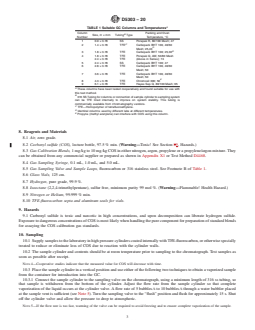
criteria, and that were used in the cooperative study for this test method, are listed in Table 1.
7.4 Sample Inlet System—Any gas sampling valve or gas tight syringe that will permit introduction of up to 5.0 mL to the
column, and that will not cause any loss of COS, is suitable.
7.5 Recorder—Any strip chart recorder with a full scale range of 1 mV, a maximum full scale balance time of 2 s, and a
minimum chart speed of 0.5 cm ⁄s, may be used.
7.6 Data Handling System—Any commercially available GC integrator or GC computer system capable of accurately
integrating the area (uVs) of the COS peak is satisfactory. Data systems that will linearize the logarithmic output of the FPD are
also satisfactory.
7.7 Sample Cylinders, 300 mL capacity or larger, fluorocarbon lined stainless steel, Type DOT 3E, 12409 kPa (1800 psi)
working pressure.
D5303 − 20
A
TABLE 1 Suitable GC Columns and Temperatures
Column Packing and Oven
B
Size, m × mm Tubing Type
Number Temperature, °C
1 0.9 × 3.78 SS Porapak R, 80/100 Mesh; 47
C
2 1.4 × 3.78 TFE Carbopack BHT 100, 40/60
D
Mesh; 25,40
D
3 1.8 × 3.78 TFE Carbopack BHT 100; 25,30
4 1.8 × 3.78 TFE Porapak Q, AW, 50/80 Mesh
2.4 × 3.78 TFE (Above in Series); 74
5 2.4 × 3.78 SS Carbopack BHT 100; 47
6 2.8 × 3.78 TFE Carbopack BHT 100, 40/60
Mesh; 50
7 3.6 × 3.78 TFE Carbopack BHT 100, 40/60
Mesh; 50
E
8 4.3 × 3.78 TFE Chromosil 300; 50
9 6.1 × 3.78 TFE Hayes Sep Q, 80/100 Mesh; 65
A
These columns have been tested cooperatively and found suitable for use with
this test method.
B
316 SS Tubing for columns or connection of sample cylinder to sampling system
can be TFE lined internally to improve on system stability. This tubing is
commercially available from chromatography vendors.
C
TFE—Homopolymer of tetrafluoroethylene.
D
Identical columns used by different labs at different temperatures.
E
Propyne (methyl acetylene) can interfere with COS using this column.
8. Reagents and Materials
8.1 Air, zero grade.
8.2 Carbonyl sulfide (COS), lecture bottle, 97.5 % min. (Warning—Toxic! See Section 89, Hazards.)
8.3 Gas Calibration Blends, 1 mg ⁄kg to 10 mg ⁄kg COS in either nitrogen, argon, propylene or a propylene/argon mixture. They
can be obtained from any commercial supplier or prepared as shown in Appendix X1 or Test Method D4468.
8.4 Gas Sampling Syringe, 0.1 mL, 1.0 mL, and 5.0 mL.
8.5 Gas Sampling Valve and Sample Loops, fluorocarbon or 316 stainless steel. See Footnote B of Table 1.
8.6 Glass Vials, 125 cm.
8.7 Hydrogen, pure grade, 99.9 %.
8.8 Isooctane (2,2,4-trimethylpentane), sulfur free, minimum purity 99 mol %. (Warning—Flammable! Health Hazard.)
8.9 Nitrogen or Helium, 99.999 % min.
8.10 TFE-fluorocarbon septa and aluminum seals for vials.
9. Hazards
9.1 Carbonyl sulfide is toxic and narcotic in high concentrations, and upon decomposition can liberate hydrogen sulfide.
Exposure to dangerous concentrations of COS is most likely when handling the pure component for preparation of standard blends
for assaying the COS calibration gas standards.
10. Sampling
10.1 Supply samples to the laboratory in high pressure cylinders coated internally with TFE-fluorocarbon, or otherwise specially
treated to reduce or eliminate loss of COS due to reaction with the cylinder walls.
10.2 The sample cylinder and contents should be at room temperature prior to sampling to the chromatograph. Test samples as
soon as possible after receipt.
NOTE 4—Cooperative studies indicate that the measured value for COS will decrease with time.
10.3 Place the sample cylinder in a vertical position and use either of the following two techniques to obtain a vaporized sample
from the container for introduction into the GC.
10.3.1 Connect the sample cylinder to the sampling valve on the chromatograph, using a minimum length of 316 ss tubing, so
that sample is withdrawn from the bottom of the cylinder. Adjust the flow rate from the sample cylinder so that complete
vaporization of the liquid occurs at the cylinder valve. A flow rate of 5 bubbles ⁄s to 10 bubbles ⁄s through a water bubbler placed
at the sample vent is sufficient (see Note 5). Turn the sampling valve to the “flush” position and flush for approximately 15 s. Shut
off the cylinder valve and allow the pressure to drop to atmospheric.
NOTE 5—If the flow rate is too fast, warming of the valve can be required to avoid freezing and to ensure complete vaporization of the sample.
D5303 − 20
10.3.2 Alternatively, obtain a sample with a gas tight syringe. A convenient way to do this is to use flexible plastic tubing to
connect the bottom of the sample cylinder to the water bubbler and then to pierce the tubing with the
...