

ASTM D5710/D5710M-22
(Specification)Standard Specification for Trinidad Lake Modified Asphalt
General Information
- Abstract
ABSTRACT
This specification covers Trinidad lake modified asphalt for use in the construction of pavements. The blended Trinidad lake modified asphalt shall be homogeneous as determined by appropriate sampling and testing. The penetration, flash point, thin-film oven, solubility in trichloroethylene, and ductility of the material shall be tested to meet the requirements prescribed. The inorganic material (ash), quantitative extraction of bitumen from bituminous paving mixtures, recovery of asphalt from solution by Abson method, and kinematic viscosity of asphalt shall be tested to meet the requirements prescribed.
SCOPE
1.1 This specification covers Trinidad Lake modified asphalt for use in the construction of pavements.
1.2 This specification covers the following penetration grades:
40–55
60–75
80–100
120–150
1.3 The values stated in either SI units or inch-pound units are to be regarded separately as standard. The values stated in each system are not necessarily exact equivalents; therefore, to ensure conformance with the standard, each system shall be used independently of the other, and values from the two systems shall not be combined.
1.4 This standard does not purport to address all of the safety concerns, if any, associated with its use. It is the responsibility of the user of this standard to establish appropriate safety, health, and environmental practices and determine the applicability of regulatory limitations prior to use.
1.5 This international standard was developed in accordance with internationally recognized principles on standardization established in the Decision on Principles for the Development of International Standards, Guides and Recommendations issued by the World Trade Organization Technical Barriers to Trade (TBT) Committee.
- Status
- Published
- Publication Date
- 30-Apr-2022
- Technical Committee
- D04 - Road and Paving Materials
- Drafting Committee
- D04.40 - Asphalt Specifications
Buy Documents
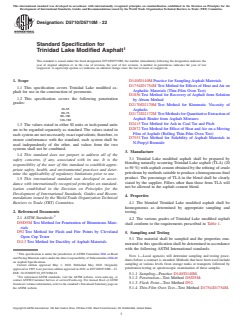


ASTM D5710/D5710M-22 - Standard Specification for Trinidad Lake Modified Asphalt
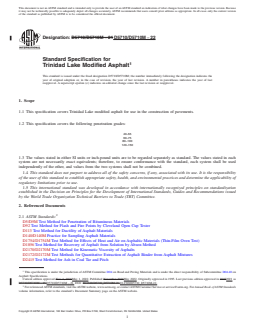
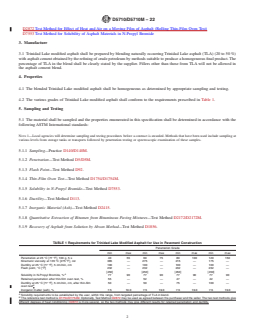


REDLINE ASTM D5710/D5710M-22 - Standard Specification for Trinidad Lake Modified Asphalt
Overview
ASTM D5710/D5710M-22, Standard Specification for Trinidad Lake Modified Asphalt, sets comprehensive requirements for the use of Trinidad Lake modified asphalt (TLA) in pavement construction. Developed by ASTM International, this standard ensures consistent material quality, performance, and global applicability in road and paving projects. The specification outlines penetration grades, testing methods, and criteria necessary for the safe and effective implementation of TLA-blended asphalt in infrastructure projects.
Key Topics
- Material Composition: Trinidad Lake modified asphalt must be produced by blending natural Trinidad Lake asphalt (20%-50%) with refined asphalt cement, ensuring a homogeneous final product. No additional fillers are permitted.
- Penetration Grades: The standard covers four specific penetration grades for TLA blends:
- 40–55
- 60–75
- 80–100
- 120–150
- Testing Requirements: The specification mandates rigorous laboratory tests to confirm quality and performance, including:
- Penetration (ASTM D5/D5M)
- Flash point (ASTM D92)
- Thin-film oven and rolling thin-film oven tests (ASTM D1754/D1754M, D2872)
- Solubility in N-Propyl Bromide (ASTM D7553)
- Ductility (ASTM D113)
- Inorganic material (ash content, ASTM D2415)
- Quantitative extraction of bituminous binder (ASTM D2172/D2172M)
- Kinematic viscosity (ASTM D2170/D2170M)
- Recovery of asphalt by Abson method (ASTM D1856)
- Homogeneity: Blended material must be uniform throughout as verified by standardized sampling and testing protocols.
- Unit Systems: Both SI units and inch-pound units are recognized; however, the two cannot be mixed within a single application.
Applications
- Pavement Construction: Trinidad Lake modified asphalt is primarily specified for road paving, offering improved durability, workability, and resistance to deformation. Its application benefits include:
- Enhanced rutting and cracking resistance
- Extended pavement life
- Suitability for a variety of climates and traffic conditions
- Quality Control and Procurement: Public agencies and private contractors rely on ASTM D5710/D5710M-22 to specify TLA-blended materials for consistent procurement and quality assurance during roadway construction projects.
- Material Correction: The standard provides guidance on adjusting fines in the asphalt mix due to the natural mineral content in Trinidad Lake asphalt, optimizing mixture performance.
Related Standards
Several other ASTM standards are integral to the implementation and verification of Trinidad Lake modified asphalt quality:
- ASTM D5/D5M: Test Method for Penetration of Bituminous Materials
- ASTM D92: Test Method for Flash and Fire Points by Cleveland Open Cup Tester
- ASTM D113: Test Method for Ductility of Asphalt Materials
- ASTM D140/D140M: Practice for Sampling Asphalt Materials
- ASTM D1754/D1754M: Test Method for Thin-Film Oven Test
- ASTM D1856: Recovery of Asphalt from Solution by Abson Method
- ASTM D2170/D2170M: Test Method for Kinematic Viscosity of Asphalts
- ASTM D2172/D2172M: Methods for Quantitative Extraction of Asphalt Binder
- ASTM D2415: Test Method for Ash in Coal Tar and Pitch
- ASTM D2872: Rolling Thin-Film Oven Test
- ASTM D7553: Solubility in N-Propyl Bromide
For global infrastructure projects, referencing ASTM standards like D5710/D5710M-22 helps ensure regulatory compliance, material performance, and consistent quality in roads and pavements using Trinidad Lake modified asphalt.
Relations
- Effective Date
- 01-Dec-2023
- Effective Date
- 01-Jun-2020
- Effective Date
- 15-Dec-2019
- Effective Date
- 01-Apr-2017
- Effective Date
- 01-Apr-2017
- Effective Date
- 01-Jun-2016
- Effective Date
- 01-Jun-2015
- Effective Date
- 01-Jun-2014
- Effective Date
- 01-Jan-2013
- Effective Date
- 01-Nov-2012
- Effective Date
- 01-Nov-2012
- Effective Date
- 01-Aug-2012
- Effective Date
- 01-Aug-2012
- Effective Date
- 01-Feb-2011
- Effective Date
- 01-Jul-2009
Buy Documents
ASTM D5710/D5710M-22 - Standard Specification for Trinidad Lake Modified Asphalt
REDLINE ASTM D5710/D5710M-22 - Standard Specification for Trinidad Lake Modified Asphalt
Get Certified
Connect with accredited certification bodies for this standard

DIBt (Deutsches Institut für Bautechnik)
German Institute for Building Technology.
DIN CERTCO
DIN Group product certification.
Zavod za gradbeništvo Slovenije (ZAG) - Inšpekcija
ZAG inspection body for construction products, structures, and materials.
Sponsored listings
Frequently Asked Questions
ASTM D5710/D5710M-22 is a technical specification published by ASTM International. Its full title is "Standard Specification for Trinidad Lake Modified Asphalt". This standard covers: ABSTRACT This specification covers Trinidad lake modified asphalt for use in the construction of pavements. The blended Trinidad lake modified asphalt shall be homogeneous as determined by appropriate sampling and testing. The penetration, flash point, thin-film oven, solubility in trichloroethylene, and ductility of the material shall be tested to meet the requirements prescribed. The inorganic material (ash), quantitative extraction of bitumen from bituminous paving mixtures, recovery of asphalt from solution by Abson method, and kinematic viscosity of asphalt shall be tested to meet the requirements prescribed. SCOPE 1.1 This specification covers Trinidad Lake modified asphalt for use in the construction of pavements. 1.2 This specification covers the following penetration grades: 40–55 60–75 80–100 120–150 1.3 The values stated in either SI units or inch-pound units are to be regarded separately as standard. The values stated in each system are not necessarily exact equivalents; therefore, to ensure conformance with the standard, each system shall be used independently of the other, and values from the two systems shall not be combined. 1.4 This standard does not purport to address all of the safety concerns, if any, associated with its use. It is the responsibility of the user of this standard to establish appropriate safety, health, and environmental practices and determine the applicability of regulatory limitations prior to use. 1.5 This international standard was developed in accordance with internationally recognized principles on standardization established in the Decision on Principles for the Development of International Standards, Guides and Recommendations issued by the World Trade Organization Technical Barriers to Trade (TBT) Committee.
ABSTRACT This specification covers Trinidad lake modified asphalt for use in the construction of pavements. The blended Trinidad lake modified asphalt shall be homogeneous as determined by appropriate sampling and testing. The penetration, flash point, thin-film oven, solubility in trichloroethylene, and ductility of the material shall be tested to meet the requirements prescribed. The inorganic material (ash), quantitative extraction of bitumen from bituminous paving mixtures, recovery of asphalt from solution by Abson method, and kinematic viscosity of asphalt shall be tested to meet the requirements prescribed. SCOPE 1.1 This specification covers Trinidad Lake modified asphalt for use in the construction of pavements. 1.2 This specification covers the following penetration grades: 40–55 60–75 80–100 120–150 1.3 The values stated in either SI units or inch-pound units are to be regarded separately as standard. The values stated in each system are not necessarily exact equivalents; therefore, to ensure conformance with the standard, each system shall be used independently of the other, and values from the two systems shall not be combined. 1.4 This standard does not purport to address all of the safety concerns, if any, associated with its use. It is the responsibility of the user of this standard to establish appropriate safety, health, and environmental practices and determine the applicability of regulatory limitations prior to use. 1.5 This international standard was developed in accordance with internationally recognized principles on standardization established in the Decision on Principles for the Development of International Standards, Guides and Recommendations issued by the World Trade Organization Technical Barriers to Trade (TBT) Committee.
ASTM D5710/D5710M-22 is classified under the following ICS (International Classification for Standards) categories: 91.100.50 - Binders. Sealing materials; 93.080.20 - Road construction materials. The ICS classification helps identify the subject area and facilitates finding related standards.
ASTM D5710/D5710M-22 has the following relationships with other standards: It is inter standard links to ASTM D140/D140M-16(2023), ASTM D2415-20, ASTM D5/D5M-19a, ASTM D2172/D2172M-17e1, ASTM D2172/D2172M-17, ASTM D140/D140M-16, ASTM D140/D140M-15, ASTM D140/D140M-14, ASTM D5/D5M-13, ASTM D92-12a, ASTM D2415-98(2012), ASTM D2872-12, ASTM D2872-12e1, ASTM D2172/D2172M-11, ASTM D1856-09. Understanding these relationships helps ensure you are using the most current and applicable version of the standard.
ASTM D5710/D5710M-22 is available in PDF format for immediate download after purchase. The document can be added to your cart and obtained through the secure checkout process. Digital delivery ensures instant access to the complete standard document.
Standards Content (Sample)
This international standard was developed in accordance with internationally recognized principles on standardization established in the Decision on Principles for the
Development of International Standards, Guides and Recommendations issued by the World Trade Organization Technical Barriers to Trade (TBT) Committee.
Designation:D5710/D5710M −22
Standard Specification for
Trinidad Lake Modified Asphalt
This standard is issued under the fixed designation D5710/D5710M; the number immediately following the designation indicates the
year of original adoption or, in the case of revision, the year of last revision. A number in parentheses indicates the year of last
reapproval. A superscript epsilon (´) indicates an editorial change since the last revision or reapproval.
1. Scope D140/D140M Practice for Sampling Asphalt Materials
D1754/D1754M Test Method for Effects of Heat andAir on
1.1 This specification covers Trinidad Lake modified as-
Asphaltic Materials (Thin-Film Oven Test)
phalt for use in the construction of pavements.
D1856 Test Method for Recovery of Asphalt from Solution
1.2 This specification covers the following penetration
by Abson Method
grades:
D2170/D2170M Test Method for Kinematic Viscosity of
40–55
Asphalts
60–75
D2172/D2172M TestMethodsforQuantitativeExtractionof
80–100
Asphalt Binder from Asphalt Mixtures
120–150
D2415 Test Method for Ash in Coal Tar and Pitch
1.3 The values stated in either SI units or inch-pound units
D2872 Test Method for Effect of Heat andAir on a Moving
are to be regarded separately as standard. The values stated in
Film of Asphalt (Rolling Thin-Film Oven Test)
each system are not necessarily exact equivalents; therefore, to
D7553 Test Method for Solubility of Asphalt Materials in
ensure conformance with the standard, each system shall be
N-Propyl Bromide
used independently of the other, and values from the two
systems shall not be combined.
3. Manufacture
1.4 This standard does not purport to address all of the
3.1 Trinidad Lake modified asphalt shall be prepared by
safety concerns, if any, associated with its use. It is the
blending naturally occurring Trinidad Lake asphalt (TLA) (20
responsibility of the user of this standard to establish appro-
to 50 %) with asphalt cement obtained by the refining of crude
priate safety, health, and environmental practices and deter-
petroleumbymethodssuitabletoproduceahomogeneousfinal
mine the applicability of regulatory limitations prior to use.
product. The percentage of TLA in the blend shall be clearly
1.5 This international standard was developed in accor-
stated by the supplier. Fillers other than those from TLA will
dance with internationally recognized principles on standard-
not be allowed in the asphalt cement blend.
ization established in the Decision on Principles for the
Development of International Standards, Guides and Recom-
4. Properties
mendations issued by the World Trade Organization Technical
Barriers to Trade (TBT) Committee. 4.1 The blended Trinidad Lake modified asphalt shall be
homogeneous as determined by appropriate sampling and
2. Referenced Documents
testing.
2.1 ASTM Standards:
4.2 The various grades of Trinidad Lake modified asphalt
D5/D5M Test Method for Penetration of Bituminous Mate-
shall conform to the requirements prescribed in Table 1.
rials
D92 Test Method for Flash and Fire Points by Cleveland
5. Sampling and Testing
Open Cup Tester
5.1 The material shall be sampled and the properties enu-
D113 Test Method for Ductility of Asphalt Materials
merated in this specification shall be determined in accordance
with the following ASTM International standards:
This specification is under the jurisdiction of ASTM Committee D04 on Road
NOTE 1—Local agencies will determine sampling and testing proce-
and Paving Materials and is under the direct responsibility of Subcommittee D04.40
dures before a contract is awarded. Methods that have been used include
on Asphalt Specifications.
sampling at various levels from storage tanks or transports followed by
Current edition approved May 1, 2022. Published May 2022. Originally
penetration testing or spectroscopic examination of these samples.
approved in 1995. Last previous edition approved in 2021 as D5710/D5710M – 21.
DOI: 10.1520/D5710_D5710M-22.
5.1.1 Sampling—Practice D140/D140M.
For referenced ASTM standards, visit the ASTM website, www.astm.org, or
5.1.2 Penetrati
...
This document is not an ASTM standard and is intended only to provide the user of an ASTM standard an indication of what changes have been made to the previous version. Because
it may not be technically possible to adequately depict all changes accurately, ASTM recommends that users consult prior editions as appropriate. In all cases only the current version
of the standard as published by ASTM is to be considered the official document.
Designation: D5710/D5710M − 21 D5710/D5710M − 22
Standard Specification for
Trinidad Lake Modified Asphalt
This standard is issued under the fixed designation D5710/D5710M; the number immediately following the designation indicates the
year of original adoption or, in the case of revision, the year of last revision. A number in parentheses indicates the year of last
reapproval. A superscript epsilon (´) indicates an editorial change since the last revision or reapproval.
1. Scope
1.1 This specification covers Trinidad Lake modified asphalt for use in the construction of pavements.
1.2 This specification covers the following penetration grades:
40–55
60–75
80–100
120–150
1.3 The values stated in either SI units or inch-pound units are to be regarded separately as standard. The values stated in each
system are not necessarily exact equivalents; therefore, to ensure conformance with the standard, each system shall be used
independently of the other, and values from the two systems shall not be combined.
1.4 This standard does not purport to address all of the safety concerns, if any, associated with its use. It is the responsibility
of the user of this standard to establish appropriate safety, health, and environmental practices and determine the applicability of
regulatory limitations prior to use.
1.5 This international standard was developed in accordance with internationally recognized principles on standardization
established in the Decision on Principles for the Development of International Standards, Guides and Recommendations issued
by the World Trade Organization Technical Barriers to Trade (TBT) Committee.
2. Referenced Documents
2.1 ASTM Standards:
D5/D5M Test Method for Penetration of Bituminous Materials
D92 Test Method for Flash and Fire Points by Cleveland Open Cup Tester
D113 Test Method for Ductility of Asphalt Materials
D140/D140M Practice for Sampling Asphalt Materials
D1754/D1754M Test Method for Effects of Heat and Air on Asphaltic Materials (Thin-Film Oven Test)
D1856 Test Method for Recovery of Asphalt from Solution by Abson Method
D2170/D2170M Test Method for Kinematic Viscosity of Asphalts
D2172/D2172M Test Methods for Quantitative Extraction of Asphalt Binder from Asphalt Mixtures
D2415 Test Method for Ash in Coal Tar and Pitch
This specification is under the jurisdiction of ASTM Committee D04 on Road and Paving Materials and is under the direct responsibility of Subcommittee D04.40 on
Asphalt Specifications.
Current edition approved Nov. 1, 2021May 1, 2022. Published November 2021May 2022. Originally approved in 1995. Last previous edition approved in 20152021 as
D5710/D5710M – 15.D5710/D5710M – 21. DOI: 10.1520/D5710_D5710M-21.10.1520/D5710_D5710M-22.
For referenced ASTM standards, visit the ASTM website, www.astm.org, or contact ASTM Customer Service at service@astm.org. For Annual Book of ASTM Standards
volume information, refer to the standard’s Document Summary page on the ASTM website.
Copyright © ASTM International, 100 Barr Harbor Drive, PO Box C700, West Conshohocken, PA 19428-2959. United States
D5710/D5710M − 22
D2872 Test Method for Effect of Heat and Air on a Moving Film of Asphalt (Rolling Thin-Film Oven Test)
D7553 Test Method for Solubility of Asphalt Materials in N-Propyl Bromide
3. Manufacture
3.1 Trinidad Lake modified asphalt shall be prepared by blending naturally occurring Trinidad Lake asphalt (TLA) (20 to 50 %)
with asphalt cement obtained by the refining of crude petroleum by methods suitable to produce a homogeneous final product. The
percentage of TLA in the blend shall be clearly stated by the supplier. Fillers other than those from TLA will not be allowed in
the asphalt cement blend.
4. Properties
4.1 The blended Trinidad Lake modified asphalt shall be homogeneous as determined by appropriate sampling and testing.
4.2 The various grades of Trinidad Lake modified asphalt shall conform to the requirements prescribed in Table 1.
5. Sampling and Testing
5.1 The material shall be sampled and the properties enumerated in this specific
...