

ASTM D6588/D6588M-11(2016)
(Test Method)Standard Test Method for Fatigue of Tire Cords (Disc Fatigue Test)
General Information
- Abstract
SIGNIFICANCE AND USE
5.1 This test method is not recommended for acceptance testing of commercial shipments in the absence of reliable information on between-laboratory precision.
5.1.1 If there are differences of practical significance between the reported test results for two laboratories (or more), a comparative test should be performed to determine if there is a statistical bias between them, using competent statistical assistance. As a minimum, test samples should be used that are as homogeneous as possible, that are drawn from a material from which the disparate test results were obtained, and that are randomly assigned in equal numbers to each laboratory for testing. Other fabrics with established test values may be used for this purpose. The test results from the two laboratories should be compared using a statistical test for unpaired data, at a probability level chosen prior to the testing series. If a bias is found, either its cause must be found and corrected, or future test results must be adjusted in consideration of the known bias.
SCOPE
1.1 This test method covers the determination of fatigue of tire cords in rubber due to compression or extension, or both, using a disc fatigue tester. The fatigue is measured as a loss in strength.
1.2 The values stated in either SI units or inch-pound units are to be regarded separately as standard. The values stated in each system may not be exact equivalents; therefore, each system shall be used independently of the other. Combining values from the two systems may result in nonconformance with the standard.
1.3 This standard does not purport to address all of the safety concerns, if any, associated with its use. It is the responsibility of the user of this standard to establish appropriate safety and health practices to determine the applicability of regulatory limitations prior to use.
- Status
- Published
- Publication Date
- 30-Jun-2016
- Technical Committee
- D13 - Textiles
- Drafting Committee
- D13.19 - Industrial Fibers and Metallic Reinforcements
Overview
ASTM D6588/D6588M-11(2016), issued by ASTM International, establishes a standard test method to determine the fatigue of tire cords embedded in rubber using the disc fatigue test. Evaluating tire cord fatigue is essential for understanding the durability and strength loss of cords as they are subjected to repeated compression and extension, simulating real-world stress in tire applications. This standard offers a reproducible method to assess the mechanical degradation of tire cords, supporting quality control, product development, and comparative performance assessments in the tire industry.
Key Topics
- Test Scope: The method measures fatigue in tire cords as a percent strength loss after cyclic loading in rubber compounds using a disc fatigue tester.
- Materials Tested: Applies to tire cords made from a range of fibers, including nylon, polyester, rayon, aramid, and twisted yarns.
- Sample Preparation: Outlines protocols for selecting, conditioning, and preparing cord and fabric specimens, emphasizing homogeneity and random assignment for multi-laboratory testing.
- Testing Procedure: Tire cords, embedded in rubber blocks, are repeatedly flexed or compressed between rotating discs, then removed and tested for residual tensile strength.
- Precision and Repeatability: Provides recommendations for addressing inter-laboratory variation, emphasizing statistical evaluation and sample homogeneity.
- Reporting Requirements: Specifies information to be included in test reports, such as materials, sampling method, fatigue conditions, and breaking forces.
Applications
- Tire Industry Quality Assurance: Enables manufacturers to assess the fatigue resistance of different tire cords, ensuring compliance with internal and customer-specific durability requirements.
- Material Comparison: Facilitates direct comparison of fatigue performance between different cord materials or treatments in research and development.
- Design and Development: Assists engineering teams in selecting tire reinforcement materials based on fatigue performance for improved product longevity.
- Regulatory and Compliance Support: Provides a standardized method necessary for certification and specification compliance in international markets.
- Inter-Laboratory Comparisons: Useful for round robin or reference sample studies to benchmark laboratory performance and maintain test consistency across production sites.
Related Standards
To ensure the proper execution of ASTM D6588/D6588M-11(2016), the following referenced ASTM standards are commonly used in conjunction:
- ASTM D76: Specification for Tensile Testing Machines for Textiles
- ASTM D123: Terminology Relating to Textiles
- ASTM D885: Test Methods for Tire Cords, Tire Cord Fabrics, and Industrial Filament Yarns
- ASTM D1776: Practice for Conditioning and Testing Textiles
- ASTM D6477: Terminology Relating to Tire Cord, Bead Wire, Hose Reinforcing Wire, and Fabrics
- ASTM D7269: Test Methods for Tensile Testing of Aramid Yarns
Practical Value
Adopting ASTM D6588/D6588M-11(2016) Standard Test Method for Fatigue of Tire Cords (Disc Fatigue Test) ensures that tire cord manufacturers and tire producers can rigorously and consistently evaluate fatigue performance of reinforcement materials under controlled, repeatable laboratory conditions. This standard is essential for material selection, product development, and ongoing quality control in the global tire industry, supporting robust tire performance and user safety.
Relations
- Effective Date
- 01-Jul-2016
- Effective Date
- 01-Mar-2017
- Effective Date
- 15-Sep-2015
- Effective Date
- 01-Sep-2015
- Effective Date
- 01-Apr-2015
- Effective Date
- 15-Jun-2013
- Effective Date
- 15-Jun-2013
- Effective Date
- 15-May-2013
- Effective Date
- 01-Jan-2013
- Effective Date
- 01-Feb-2012
- Effective Date
- 01-Feb-2012
- Effective Date
- 01-Jan-2011
- Effective Date
- 15-Jan-2009
- Effective Date
- 15-Jan-2009
- Effective Date
- 15-Jan-2009
Get Certified
Connect with accredited certification bodies for this standard

DIN CERTCO
DIN Group product certification.

Smithers Quality Assessments
US management systems and product certification.
Sponsored listings
Frequently Asked Questions
ASTM D6588/D6588M-11(2016) is a standard published by ASTM International. Its full title is "Standard Test Method for Fatigue of Tire Cords (Disc Fatigue Test)". This standard covers: SIGNIFICANCE AND USE 5.1 This test method is not recommended for acceptance testing of commercial shipments in the absence of reliable information on between-laboratory precision. 5.1.1 If there are differences of practical significance between the reported test results for two laboratories (or more), a comparative test should be performed to determine if there is a statistical bias between them, using competent statistical assistance. As a minimum, test samples should be used that are as homogeneous as possible, that are drawn from a material from which the disparate test results were obtained, and that are randomly assigned in equal numbers to each laboratory for testing. Other fabrics with established test values may be used for this purpose. The test results from the two laboratories should be compared using a statistical test for unpaired data, at a probability level chosen prior to the testing series. If a bias is found, either its cause must be found and corrected, or future test results must be adjusted in consideration of the known bias. SCOPE 1.1 This test method covers the determination of fatigue of tire cords in rubber due to compression or extension, or both, using a disc fatigue tester. The fatigue is measured as a loss in strength. 1.2 The values stated in either SI units or inch-pound units are to be regarded separately as standard. The values stated in each system may not be exact equivalents; therefore, each system shall be used independently of the other. Combining values from the two systems may result in nonconformance with the standard. 1.3 This standard does not purport to address all of the safety concerns, if any, associated with its use. It is the responsibility of the user of this standard to establish appropriate safety and health practices to determine the applicability of regulatory limitations prior to use.
SIGNIFICANCE AND USE 5.1 This test method is not recommended for acceptance testing of commercial shipments in the absence of reliable information on between-laboratory precision. 5.1.1 If there are differences of practical significance between the reported test results for two laboratories (or more), a comparative test should be performed to determine if there is a statistical bias between them, using competent statistical assistance. As a minimum, test samples should be used that are as homogeneous as possible, that are drawn from a material from which the disparate test results were obtained, and that are randomly assigned in equal numbers to each laboratory for testing. Other fabrics with established test values may be used for this purpose. The test results from the two laboratories should be compared using a statistical test for unpaired data, at a probability level chosen prior to the testing series. If a bias is found, either its cause must be found and corrected, or future test results must be adjusted in consideration of the known bias. SCOPE 1.1 This test method covers the determination of fatigue of tire cords in rubber due to compression or extension, or both, using a disc fatigue tester. The fatigue is measured as a loss in strength. 1.2 The values stated in either SI units or inch-pound units are to be regarded separately as standard. The values stated in each system may not be exact equivalents; therefore, each system shall be used independently of the other. Combining values from the two systems may result in nonconformance with the standard. 1.3 This standard does not purport to address all of the safety concerns, if any, associated with its use. It is the responsibility of the user of this standard to establish appropriate safety and health practices to determine the applicability of regulatory limitations prior to use.
ASTM D6588/D6588M-11(2016) is classified under the following ICS (International Classification for Standards) categories: 83.160.01 - Tyres in general. The ICS classification helps identify the subject area and facilitates finding related standards.
ASTM D6588/D6588M-11(2016) has the following relationships with other standards: It is inter standard links to ASTM D6588/D6588M-11, ASTM D123-17, ASTM D123-15b, ASTM D123-15a, ASTM D123-15, ASTM D123-13ae1, ASTM D123-13a, ASTM D123-13, ASTM D6477-13, ASTM D123-12e1, ASTM D123-12, ASTM D6477-11, ASTM D123-09, ASTM D123-09e2, ASTM D123-09e1. Understanding these relationships helps ensure you are using the most current and applicable version of the standard.
ASTM D6588/D6588M-11(2016) is available in PDF format for immediate download after purchase. The document can be added to your cart and obtained through the secure checkout process. Digital delivery ensures instant access to the complete standard document.
Standards Content (Sample)
This international standard was developed in accordance with internationally recognized principles on standardization established in the Decision on Principles for the
Development of International Standards, Guides and Recommendations issued by the World Trade Organization Technical Barriers to Trade (TBT) Committee.
Designation: D6588/D6588M − 11 (Reapproved 2016)
Standard Test Method for
Fatigue of Tire Cords (Disc Fatigue Test)
This standard is issued under the fixed designation D6588/D6588M; the number immediately following the designation indicates the
year of original adoption or, in the case of revision, the year of last revision. A number in parentheses indicates the year of last
reapproval. A superscript epsilon (´) indicates an editorial change since the last revision or reapproval.
1. Scope 3.1.1 For definitions of terms relating to tire cord and
fabrics, see Terminology D6477.
1.1 This test method covers the determination of fatigue of
3.1.2 For definitions of other terms related to textiles, see
tire cords in rubber due to compression or extension, or both,
Terminology D123.
using a disc fatigue tester. The fatigue is measured as a loss in
strength.
4. Summary of Test Method
1.2 The values stated in either SI units or inch-pound units
4.1 disc fatigue is a measure of the strength loss of a tire
are to be regarded separately as standard. The values stated in
cord, which is subjected to repeated stresses. The stresses are
each system may not be exact equivalents; therefore, each
accomplished by subjecting the tire cords, after being cured in
system shall be used independently of the other. Combining
rubber, to repeated cycles of compression and extension.
values from the two systems may result in nonconformance
4.2 The specimen of interest is the cord after it has been
with the standard.
stressed and later removed from the rubber in which it was
1.3 This standard does not purport to address all of the
imbedded. Cord specimens are placed between strips of rubber
safety concerns, if any, associated with its use. It is the
compound and molded into blocks.The specimen block is then
responsibility of the user of this standard to establish appro-
mounted between two rotating discs that are positioned in such
priatesafetyandhealthpracticestodeterminetheapplicability
a way that the specimen will undergo compression or
of regulatory limitations prior to use.
extension, or both, as the discs rotate.After a specified number
of cycles, the cords are removed from the blocks and their
2. Referenced Documents
breaking force measured on a tensile testing machine. The
2.1 ASTM Standards:
fatigue, based on the unfatigued specimen strength, is ex-
D76 Specification for Tensile Testing Machines for Textiles
pressed as a percent strength loss in fatigued specimens.
D123 Terminology Relating to Textiles
D885 Test Methods for Tire Cords, Tire Cord Fabrics, and
5. Significance and Use
Industrial Filament Yarns Made from Manufactured
5.1 This test method is not recommended for acceptance
Organic-Base Fibers
testing of commercial shipments in the absence of reliable
D1776 Practice for Conditioning and Testing Textiles
information on between-laboratory precision.
D6477 Terminology Relating to Tire Cord, Bead Wire, Hose
5.1.1 If there are differences of practical significance be-
Reinforcing Wire, and Fabrics
tween the reported test results for two laboratories (or more), a
D7269 Test Methods for Tensile Testing of Aramid Yarns
comparative test should be performed to determine if there is a
statistical bias between them, using competent statistical assis-
3. Terminology
tance. As a minimum, test samples should be used that are as
3.1 Definitions:
homogeneous as possible, that are drawn from a material from
which the disparate test results were obtained, and that are
This test method is under the jurisdiction ofASTM Committee D13 on Textiles
randomly assigned in equal numbers to each laboratory for
and is the direct responsibility of Subcommittee D13.19 on Industrial Fibers and
testing. Other fabrics with established test values may be used
Metallic Reinforcements
for this purpose. The test results from the two laboratories
Current edition approved July 1, 2016. Published August 2016. Originally
should be compared using a statistical test for unpaired data, at
approved in 2000. Last previous edition approved in 2011 as D6588–11. DOI:
10.1520/D6588_D6588M-11R16.
a probability level chosen prior to the testing series. If a bias is
For referenced ASTM standards, visit the ASTM website, www.astm.org, or
found, either its cause must be found and corrected, or future
contact ASTM Customer Service at service@astm.org. For Annual Book of ASTM
test results must be adjusted in consideration of the known
Standards volume information, refer to the standard’s Document Summary page on
the ASTM website. bias.
Copyright © ASTM International, 100 Barr Harbor Drive, PO Box C700, West Conshohocken, PA 19428-2959. United States
D6588/D6588M − 11 (2016)
6. Apparatus, Materials, and Reagents 6.11 Solvent, 1.1.2.2 tetrachloroethylene, CHCl CHCl or
2 2
1.1.1 trichloroethane CCl CH ) for removing cords from
3 3
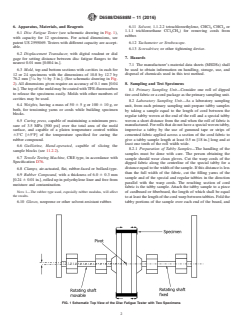
6.1 Disc Fatigue Tester (see schematic drawing in Fig. 1),
rubber.
with capacity for 12 specimens. For actual dimensions, see
patent US 2595069. Testers with different capacity are accept- 6.12 Tachometer or Stroboscope.
able.
6.13 Screwdriver, or other tightening device.
6.2 Displacement Transducer, with digital readout or dial
gage for setting distance between disc fatigue flanges to the 7. Hazards
nearest 0.01 mm [0.004 in.].
7.1 The manufacturer’s material data sheets (MSDSs) shall
6.3 Mold, top and bottom sections with cavities in each for be used to obtain information on handling, storage, use, and
disposal of chemicals used in this test method.
12 or 24 specimens with the dimensions of 10.8 by 12.7 by
7 1
76.2 mm [ ⁄16 by ⁄2 by 3 in.]. (See schematic drawing in Fig.
8. Sampling and Test Specimens
2). All dimensions given require an accuracy of 0.1 mm [0.04
in.].The top of the mold may be coated withTFE-fluorocarbon
8.1 Primary Sampling Unit—Consider one roll of dipped
to release the specimens easily. Molds with other numbers of
tire cord fabric or a cord package as the primary sampling unit.
cavities may be used.
8.2 Laboratory Sampling Unit—As a laboratory sampling
6.4 Weights, having a mass of 50 65gor100 6 10 g, or
unit, from each primary sampling unit prepare tabby samples
both, for tensioning yarns or cords while building specimen
by taking a sample equal to the length of cord between the
blocks.
regular tabby woven at the end of the roll and a special tabby
woven a short distance from the end when the roll of fabric is
6.5 Curing press, capable of maintaining a minimum pres-
manufactured.Forrollsthatdonothaveaspecialwoventabby,
sure of 3.5 MPa [500 psi] over the total area of the mold
improvise a tabby by the use of gummed tape or strips of
surface, and capable of a platen temperature control within
cemented fabric applied across a section of the cord fabric to
63°C [65°F] of the temperature specified for curing the
give a tabby sample length at least 0.5 m [18 in.] long and at
rubber compound.
least one tenth of the roll width wide.
6.6 Guillotine, Hand-operated, capable of slicing the
8.2.1 Preparation of Tabby Samples—The handling of the
sample blocks (see 11.2.2).
samples must be done with care. The person obtaining the
6.7 Tensile Testing Machine, CRE type, in accordance with
sample should wear clean gloves. Cut the warp cords of the
Specification D76.
dipped fabric along the centerline of the special tabby for a
distanceequaltothewidthofthesample.Ifthisdistanceisless
6.8 Clamps, air-actuated, flat, rubber-faced or bollard-type.
than the full width of the fabric, cut the filling yarns of the
6.9 Rubber Compound, with a thickness of 6.0 6 0.3 mm
sample and of the special and regular tabbies in the direction
[0.24 6 0.01 in.], rolled up in polyethylene liner and free from
parallel with the warp cords. The resulting section of cord
moisture and contamination.
fabric is the tabby sample. Attach the tabby sample to a piece
NOTE 1—The rubber type used, especially rubber modulus, will affect
of cardboard or fiberboard, the length of which shall be equal
the results.
toatleastthelengthofthecordwarpbetweentabbies.Foldthe
6.10 Gloves, neoprene or other solvent-resistant rubber. tabby portions of the sample over each end of the board, and
FIG. 1 Schematic Top View of the Disc Fatigue Tester with Two Specimens
D6588/D6588M − 11 (2016)
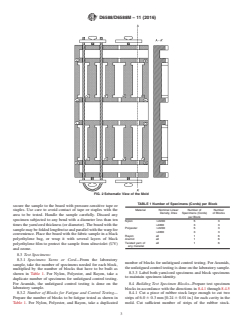
FIG. 2 Schematic View of the Mold
TABLE 1 Number of Specimens (Cords) per Block
secure the sample to the board with pressure-sensitive tape or
Material Nominal Linear Number of Number
staples. Use care to avoid contact of tape or staples with the
Density, Dtex Specimens (Cords) of Blocks
area to be tested. Handle the sample carefully. Discard any
per Block
specimen subjected to any bend with a diameter less than ten
Nylon #2200 5 3
times the yarn/cord thickness (or diameter).The board with the
>2200 3 3
Polyester #2200 5 3
samplemaybefoldedlengthwiseandparallelwiththewarpfor
>2200 3 3
convenience. Place the board with the fabric sample in a black
Rayon all 1 6
polyethylene bag, or wrap it with several layers of black Aramid all 1 6
Twisted yarn of all 1 6
polyethylene film to protect the sample from ultraviolet (UV)
any material
and ozone.
8.3 Test Specimens:
8.3.1 Specimens Yarns or Cord—From the laboratory
number of blocks for unfatigued control testing. For Aramids,
sample, take the number of specimens needed for each block,
the unfatigued control testing is done on the laboratory sample.
multiplied by the number of blocks that have to be built as
8.3.3 Label both yarn/cord specimens and block specimens
shown in Table 1. For Nylon, Polyester, and Rayon, take a
to maintain specimen identity.
duplicate number of specimens for unfatigued control testing.
For Aramids, the unfatigued control testing is done on the 8.4 Building Test Specimen Blocks—Prepare test specimen
laboratory sample. blocks in accordance with the directions in 8.4.1 through 8.4.5
8.3.2 Number of Blocks for Fatigue and Control Testing— 8.4.1 Cut a piece of rubber stock large enough to cut two
Prepare the number of blocks to be fatigue tested as shown in strips of 6.0 6 0.3 mm [0.24 6 0.01 in.] for each cavity in the
Table 1. For Nylon, Polyester, and Rayon, take a duplicated mold. Cut sufficient number of strips of the rubber stock.
D6588/D6588M − 11 (2016)
Remove polyethylene backing from one side of rubber strips where:
just prior to using. Place a strip in each of the cavities of the
M = change of the original distance, mm [in.], if M is
two halves of the mold with the polyethylene side up. Press the
negative, the distance is decreased by that amount and
rubber firmly into the cavities. A cold press may be used.
if M is positive, the distance is increased,
Remove the polyethylene backing from the top of the rubber, D = original distance, (25.4 mm) [1 in.],
O
D = parallel testing distance of the discs,
leaving the rubber surface free of contamination and finger-
t
E = percent elongation/100, and
prints.
C = percent compression/100.
8.4.2 For packages, discard the outer layer of cord. Cut
9.1.3 Make the appropriate M change in the distance be-
approximately1m[1yd]of dipped cord. Simultaneously load
tween each pair of discs by moving the left disc in a straight
two adjacent cavities in the bottom mold by one end of a single
line toward, or away from, the right disc until the specified
cordatthefirstclamp.Positionthecordinthecenterofthefirst
parallel distance between the two discs has been achieved.
cavity, loop it through the second clamp at the end of the mold
9.1.4 Next, set the left disc to the required compression and
(hangatensioningmassontheloopt
...