

SIST EN IEC 60539-1:2023/kFprA1:2026
(Amendment)Amendment 1 - Directly heated negative temperature coefficient thermistors - Part 1: Generic specification
- Status
- Not Published
- Public Enquiry End Date
- 28-May-2026
- Technical Committee
- I11 - Imaginarni 11
- Current Stage
- 5020 - Formal vote (FV) (Adopted Project)
- Start Date
- 17-Nov-2026
- Due Date
- 05-Jan-2027
- Completion Date
- 17-Nov-2026

SIST EN IEC 60539-1:2023/kFprA1:2026 is the Slovenian amendment to the generic specification for directly heated negative temperature coefficient thermistors. It updates the Part 1 document used to specify, test, and qualify these components, especially where soldering practice, thermal definitions, and environmental test methods are concerned. The Slovenian text is identical to EN IEC 60539-1:2023/prA1:2026.
What does SIST EN IEC 60539-1:2023/kFprA1:2026 specify?
SIST EN IEC 60539-1:2023/kFprA1:2026 specifies amendments to the base Part 1 generic specification rather than a standalone product requirement. It revises clause text in the definition, mounting, measurement, and test sections so that manufacturers and test labs use the same wording and acceptance approach.
The document is organized as an amendment to the foreword and to selected clauses in the base standard. The affected areas are clause 3.36, clause 5.4.3.2, clause 6.8.2, and the test clauses in section 8, ending with clause 8.9.4.
What are the key requirements of SIST EN IEC 60539-1:2023/kFprA1:2026?
SIST EN IEC 60539-1:2023/kFprA1:2026 mainly tightens how several measurements and tests are described, and it makes the repeated test sequence clearer across the environmental and endurance clauses. In practice, this helps laboratories run the same recovery, intermediate measurement, and final inspection pattern each time.
Definitions and mounting
- Clause 3.36 revises the definition of thermal time constant by cooling after self-heating. It defines the time for a thermistor to cool by 63.2 % of its self-heating temperature excess in a defined medium. This matters because it fixes how cooling performance is interpreted and reported.
- Clause 5.4.3.2 changes the wave soldering instruction to use silver-bearing eutectic Sn/Pb solder with non-activated flux. This matters for production because the soldering materials are part of the mounting condition and can affect component stress and repeatability.
Measurement and test flow
- Clause 6.8.2 replaces the formula used for the initial measurement. The amendment keeps the 0.632 factor in the calculation, so the initial measurement point is handled consistently in the test method.
- Clauses 8.1, 8.2, 8.3, 8.4 and 8.5 standardize the general structure of the environmental tests - rapid change of temperature, thermal shock, cold, dry heat, and damp heat, steady state. Each test now follows the same pattern: general method, intermediate measurement if required, recovery, and final inspection.
- In those clauses, any intermediate measurement requires the load to be removed and the thermistors to recover under standard atmospheric conditions for 1 h to 2 h. The measured parameter(s) are then checked against the initial values and the detail specification limit. This matters because it controls how much drift is acceptable during a test.
- The same clauses also limit the time away from test conditions to 12 h for any thermistor. That keeps test history consistent when measurements are interrupted.
Endurance and special checks
- Clause 8.6.2 covers endurance at room temperature with applied continuous maximum current (Imax x 25) for inrush current-limiting thermistors only. It adds intermediate checks after 168 h and 500 h, and a final recovery after 1 000 h ± 48 h.
- Clause 8.6.3 covers endurance at room temperature with applied cyclic maximum current (Imax25) for inrush current-limiting thermistors only. It uses the same style of intermediate measurement and recovery, but the progress is counted in cycles rather than hours.
- Clause 8.6.6 covers maximum permissible capacitance for inrush current-limiting thermistors only. The amendment aligns its intermediate measurement and recovery sequence with the other endurance clauses.
- Clause 8.9.4 adds a final inspection rule for insulated types: insulation resistance is measured in accordance with 6.3 and must meet the detail specification. This matters because insulation performance is part of the accept/reject decision for insulated parts.
What terms does SIST EN IEC 60539-1:2023/kFprA1:2026 define?
- Thermal time constant by cooling after self-heating - the time for a thermistor to lose 63.2 % of the temperature rise created by self-heating in a defined medium.
- Negative temperature coefficient (NTC) thermistor - a thermistor whose resistance falls as temperature rises; the document uses NTC throughout the test clauses.
- Detail specification - the product-specific specification that gives the measured parameters, limits, and acceptance criteria for a particular thermistor type.
- Standard atmospheric conditions of testing - the recovery environment used after removing load or completing a test step.
- Inrush current-limiting thermistors - the thermistors for which the endurance and capacitance clauses 8.6.2, 8.6.3 and 8.6.6 apply.
- Insulation resistance - the electrical resistance of an insulated type, measured in 8.9.4 according to 6.3 and compared with the detail specification.
Who uses SIST EN IEC 60539-1:2023/kFprA1:2026?
SIST EN IEC 60539-1:2023/kFprA1:2026 is used by thermistor manufacturers, test laboratories, quality teams, and product engineers working with electronic equipment. They use it to agree soldering practice, define test plans, run qualification and endurance tests, and check whether results meet the detail specification.
It is also relevant to buyers and component approvers who need a common technical basis for comparing thermistor offerings and reviewing test evidence.
What changed in SIST EN IEC 60539-1:2023/kFprA1:2026 from the previous edition?
SIST EN IEC 60539-1:2023/kFprA1:2026 is Amendment 1 to IEC 60539-1 Part 1. The amendment states these changes:
- clause 3.36 revises the definition of thermal time constant by cooling after self-heating;
- clause 5.4.3.2 changes the wave soldering solder and flux requirement;
- clause 6.8.2 replaces the initial measurement formula;
- clauses 8.1 to 8.5 rewrite the general, intermediate measurement, recovery, and final inspection wording for several environmental tests;
- clauses 8.6.2, 8.6.3 and 8.6.6 update endurance and capacitance procedures for inrush current-limiting thermistors only;
- clause 8.9.4 adds the insulation resistance requirement for insulated types.
What does the SIST EN IEC 60539-1:2023/kFprA1:2026 document contain?
SIST EN IEC 60539-1:2023/kFprA1:2026 contains clause-by-clause replacement text for the base generic specification. The amendment focuses on a definition, one mounting method, one calculation, and several test sequences rather than on product tables or worked examples.
Its practical content is the sequence of test steps used in design verification and qualification: load removal, recovery, intermediate measurement, final inspection, and comparison with detail-specification limits. It also gives the exact wording needed for the thermal, endurance, and insulation-related checks that labs and manufacturers must align in their reports.
Relations
- Effective Date
- 03-Jun-2025
Frequently Asked Questions
SIST EN IEC 60539-1:2023/kFprA1:2026 is a draft published by the Slovenian Institute for Standardization (SIST). Its full title is "Amendment 1 - Directly heated negative temperature coefficient thermistors - Part 1: Generic specification". This standard covers: Amendment 1 - Directly heated negative temperature coefficient thermistors - Part 1: Generic specification
Amendment 1 - Directly heated negative temperature coefficient thermistors - Part 1: Generic specification
SIST EN IEC 60539-1:2023/kFprA1:2026 is classified under the following ICS (International Classification for Standards) categories: 31.040.30 - Thermistors. The ICS classification helps identify the subject area and facilitates finding related standards.
SIST EN IEC 60539-1:2023/kFprA1:2026 has the following relationships with other standards: It is inter standard links to SIST EN IEC 60539-1:2023. Understanding these relationships helps ensure you are using the most current and applicable version of the standard.
SIST EN IEC 60539-1:2023/kFprA1:2026 is available in PDF format for immediate download after purchase. The document can be added to your cart and obtained through the secure checkout process. Digital delivery ensures instant access to the complete standard document.
Standards Content (Sample)
SLOVENSKI STANDARD
SIST EN IEC 60539-1:2023/oprA1:2026
01-maj-2026
Neposredno ogrevani termistorji z negativnim temperaturnim koeficientom - 1. del:
Splošna specifikacija - Dopolnilo A1
Amendment 1 - Directly heated negative temperature coefficient thermistors - Part 1:
Generic specification
Direkt geheizte temperaturabhängige Widerstände mit negativem
Temperaturkoeffizienten - Teil 1: Fachgrundspezifikation
Thermistances à coefficient de température négatif à chauffage direct - Partie 1:
Spécification générique
Ta slovenski standard je istoveten z: EN IEC 60539-1:2023/prA1:2026
ICS:
31.040.30 Termistorji Thermistors
SIST EN IEC 60539-1:2023/oprA1:2026 en
2003-01.Slovenski inštitut za standardizacijo. Razmnoževanje celote ali delov tega standarda ni dovoljeno.
SIST EN IEC 60539-1:2023/oprA1:2026
SIST EN IEC 60539-1:2023/oprA1:2026
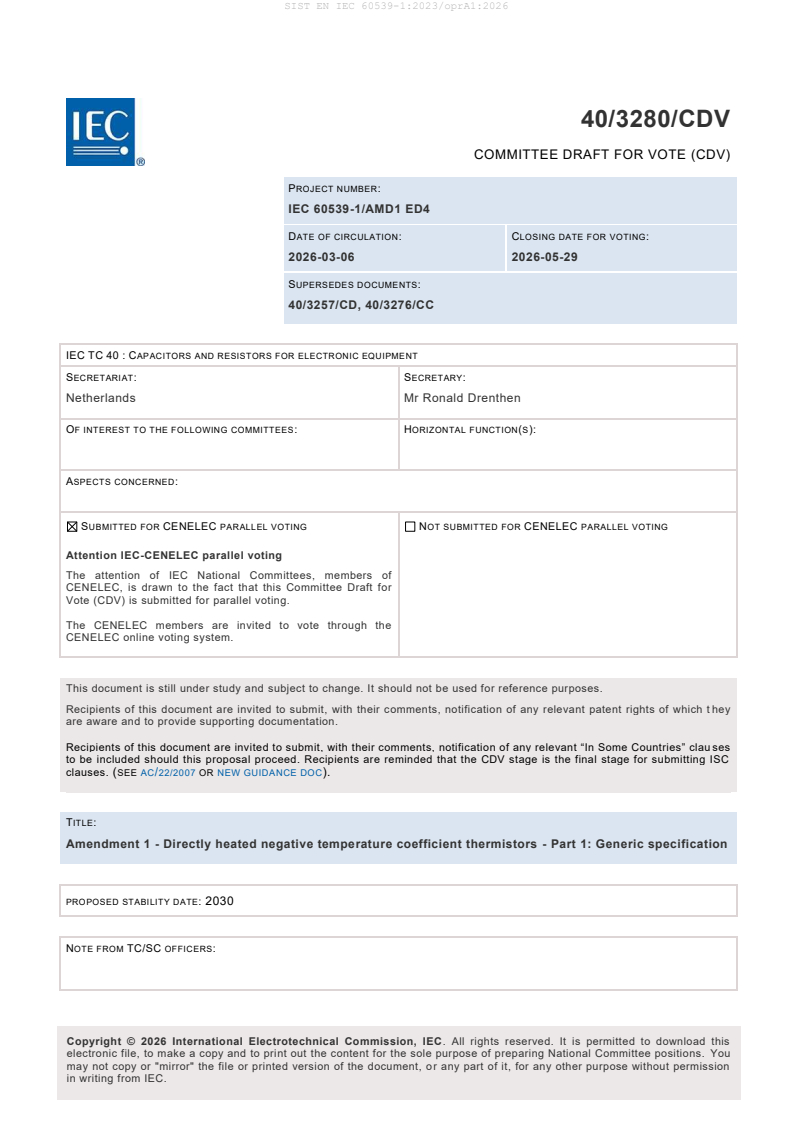
40/3280/CDV
COMMITTEE DRAFT FOR VOTE (CDV)
PROJECT NUMBER:
IEC 60539-1/AMD1 ED4
DATE OF CIRCULATION: CLOSING DATE FOR VOTING:
2026-03-06 2026-05-29
SUPERSEDES DOCUMENTS:
40/3257/CD, 40/3276/CC
IEC TC 40 : CAPACITORS AND RESISTORS FOR ELECTRONIC EQUIPMENT
SECRETARIAT: SECRETARY:
Netherlands Mr Ronald Drenthen
OF INTEREST TO THE FOLLOWING COMMITTEES: HORIZONTAL FUNCTION(S):
ASPECTS CONCERNED:
SUBMITTED FOR CENELEC PARALLEL VOTING NOT SUBMITTED FOR CENELEC PARALLEL VOTING
Attention IEC-CENELEC parallel voting
The attention of IEC National Committees, members of
CENELEC, is drawn to the fact that this Committee Draft for
Vote (CDV) is submitted for parallel voting.
The CENELEC members are invited to vote through the
CENELEC online voting system.
This document is still under study and subject to change. It should not be used for reference purposes.
Recipients of this document are invited to submit, with their comments, notification of any relevant patent rights of which t hey
are aware and to provide supporting documentation.
Recipients of this document are invited to submit, with their comments, notification of any relevant “In Some Countries” clau ses
to be included should this proposal proceed. Recipients are reminded that the CDV stage is the final stage for submitting ISC
clauses. (SEE AC/22/2007 OR NEW GUIDANCE DOC).
TITLE:
Amendment 1 - Directly heated negative temperature coefficient thermistors - Part 1: Generic specification
PROPOSED STABILITY DATE: 2030
NOTE FROM TC/SC OFFICERS:
electronic file, to make a copy and to print out the content for the sole purpose of preparing National Committee positions. You
may not copy or "mirror" the file or printed version of the document, or any part of it, for any other purpose without permission
in writing from IEC.
SIST EN IEC 60539-1:2023/oprA1:2026
IEC CDV 60539-1 ED4.1 AMD1 © IEC 2026
1 INTERNATIONAL ELECTROTECHNICAL COMMISSION
2 ____________
4 DIRECTLY HEATED NEGATIVE TEMPERATURE
5 COEFFICIENT THERMISTORS – Part 1: Generic specification
7 AMENDMENT 1
9 FOREWORD
10 1) The International Electrotechnical Commission (IEC) is a worldwide organization for standardization comprising all national
11 electrotechnical committees (IEC National Committees). The object of IEC is to promote international co -operation on all
12 questions concerning standardization in the electrical and electronic fields. To this end and in addition to other activities , IEC
13 publishes International Standards, Technical Specifications, Technical Reports, Publicly Available Specifications (PAS) and G uides
14 (hereafter referred to as “IEC Publication(s)”). Their preparation is entrusted to technical committees; any IEC National Com mittee
15 interested in the subject dealt with may participate in this preparatory work. International, governmental and non -governmental
16 organizations liaising with the IEC also participate in this preparation. IEC collaborates closely with the International Org anization
17 for Standardization (ISO) in accordance with conditions determined by agreement between the two organizations.
18 2) The formal decisions or agreements of IEC on technical matters express, as nearly as possible, an international consensus of
19 opinion on the relevant subjects since each technical committee has representation from all interested IEC National Committee s.
20 3) IEC Publications have the form of recommendations for international use and are accepted by IEC National Committees in that
21 sense. While all reasonable efforts are made to ensure that the technical content of IEC Publications is accurate, IEC cannot be
22 held responsible for the way in which they are used or for any misinterpretation by any end user.
23 4) In order to promote international uniformity, IEC National Committees undertake to apply IEC Publications transparently to th e
24 maximum extent possible in their national and regional publications. Any divergence between any IEC Publication and the
25 corresponding national or regional publication shall be clearly indicated in the latter.
26 5) IEC itself does not provide any attestation of conformity. Independent certification bodies provide conformity assessment ser vices
27 and, in some areas, access to IEC marks of conformity. IEC is not responsible for any services carried out by independent
28 certification bodies.
29 6) All users should ensure that they have the latest edition of this publication.
30 7) No liability shall attach to IEC or its directors, employees, servants or agents including individual experts and members of its
31 technical committees and IEC National Committees for any personal injury, property damage or other damage of any nature
32 whatsoever, whether direct or indirect, or for costs (including legal fees) and expenses arising out of the publication, use of, or
33 reliance upon, this IEC Publication or any other IEC Publications.
34 8) Attention is drawn to the Normative references cited in this publication. Use of the referenced publications is indispensable for
35 the correct application of this publication.
36 9) Attention is drawn to the possibility that some of the elements of this IEC Publication may be the subject of patent rights. IEC shall
37 not be held responsible for identifying any or all such patent rights.
39 This amendment to IEC 60539-1 has been prepared by IEC technical committee 40: Capacitors and
40 resistors for electronic equipment.
41 The text of this Amendment is based on the following documents:
Draft Report on voting
XX/XX/FDIS XX/XX/RVD
43 Full information on the voting for its approval can be found in the report on voting indicated in the above
44 table.
45 The language used for the development of this International Standard is English.
SIST EN IEC 60539-1:2023/oprA1:2026
IEC CDV 60539-1 ED4.1 AMD1 © IEC 2026
46 This document was drafted in accordance with ISO/IEC Directives, Part 2, and developed in accordance
47 with ISO/IEC Directives, Part 1 and ISO/IEC Directives, IEC Supplement, available at
48 www.iec.ch/members_experts/refdocs. The main document types developed by IEC are described in
49 greater detail at www.iec.ch/publications.
50 The committee has decided that the contents of this document will remain unchanged until the stability
51 date indicated on the IEC website under webstore.iec.ch in the data related to the specific document. At
52 this date, the document will be
53 • reconfirmed,
54 • withdrawn,
55 • replaced by a revised edition, or
56 • amended.
SIST EN IEC 60539-1:2023/oprA1:2026
IEC CDV 60539-1 ED4.1 AMD1 © IEC 2026
60 DIRECTLY HEATED NEGATIVE TEMPERATURE
61 COEFFICIENT THERMISTORS – Part 1: Generic specification
63 AMENDMENT 1
67 3.36 thermal time constant by cooling after self-heating
69 Change in the first paragraph sentence to be
71 time required for a thermistor to cool by 63,2 % of its temperature excess induced by self-heating, in a
72 defined medium when the current passing through an NTC thermistor in a specified medium is
73 suddenly changed from a non-zero load state to a zero load state.
75 5.4.3 Mounting on board / 5.4.3.2 Wave soldering method
77 Change the sentence in 5.4.3.2 a), first line, to be
79 The solder used shall be silver bearing (1.8 to 2.2 %) eutectic Sn/Pb solder together with non-activated
80 flux,…
82 6.8.2 Initial measurement
84 Replace the formula with this formula
86 T = T – (T – T ) × 0.632
i b b a
88 8.1 Rapid change of temperature
90 Change the sentence and item number to be
92 8.1.1 General
SIST EN IEC 60539-1:2023/oprA1:2026
IEC CDV 60539-1 ED4.1 AMD1 © IEC 2026
93 The method of test shall be conducted as specified in 8.1.2 to 8.1.6.
94 ----------------------------------------------------------------------------------------------------
95 8.1.4 Intermediate measurement
96 If an intermediate measurement is to be carried out, the load shall be removed and the NTC
97 thermistors allowed to recover under standard atmospheric conditions of testing for not less than 1
98 h and not more than 2 h.
99 The appropriate parameter(s) given in the detail specification shall then be measured using
100 the method specified. The change compared with the value(s) measured in 8.1.2 shall not
101 exceed the limit specified in the relevant detail specification.
102 After intermediate measurements, the thermistors shall be returned to the conditions of
103 test. The interval between the removal from, and the return to the conditions of test for any
104 NTC thermistor shall not exceed 12 h.
105 8.1.5 Recovery
106 After completion of the test, the thermistors shall be removed and allowed to recover under
107 standard atmospheric conditions for a period of 1 h to 2 h.
109 8.1.6 Final inspection, measurements and requirements.
112 8.2 Thermal shock
...