

SIST EN 1264-3:2021
(Main)Water based surface embedded heating and cooling systems - Part 3: Dimensioning
General Information
- Abstract
The EN 1264 series gives guidelines for surface embedded heating and cooling systems installed in buildings, residential and non-residential (e.g. office, public, commercial and industrial buildings) and focuses on systems installed for the purpose of thermal comfort.
The EN 1264 series gives guidelines for water based heating and cooling systems embedded into the enclosure surfaces of the room to be heated or to be cooled. It also specifies the use of other heating media instead of water, as appropriate.
The EN 1264 series specifies standardized product characteristics by calculation and testing the thermal output of heating for technical specifications and certification. For the design, construction and operation of these systems, see EN 1264-3 and EN 1264-4 for the types A, B, C, D, H, I and J. For the types E, F and G, see the EN ISO 11855 series.
The systems specified in the EN 1264 series are adjoined to the structural base of the enclosure surfaces of the building, mounted directly or with fixing supports. The EN 1264 series does not specify ceiling systems mounted in a suspended ceiling with a designed open air gap between the system and the building structure which allows the thermally induced circulation of the air. The thermal output of these systems can be determined according to EN 14037 series and EN 14240.
EN 1264-3 specifies the use in practical engineering of the results coming from EN 1264-2 and EN 1264-5.
For heating systems, physiological limitations are taken into account when specifying the surface temperatures. In the case of floor heating systems the limitations are realized by a design based on the characteristic curves and limit curves determined in accordance with EN 1264-2.
For cooling systems, only a limitation with respect to the dew point is taken into account. In predominating practice, this means that physiological limitations are included as well.
- Status
- Published
- Public Enquiry End Date
- 02-Feb-2020
- Publication Date
- 14-Jun-2021
- Technical Committee
- OGS - Heating for buildings
- Current Stage
- 6060 - National Implementation/Publication (Adopted Project)
- Start Date
- 07-Jun-2021
- Due Date
- 12-Aug-2021
- Completion Date
- 15-Jun-2021



Overview
EN 1264-3:2021 (CEN) - "Water based surface embedded heating and cooling systems - Part 3: Dimensioning" provides practical engineering rules for dimensioning water-based heating and cooling systems embedded in building surfaces (floors, walls, ceilings). It applies to residential and non-residential buildings and uses the calculation/test results from EN 1264-2 and EN 1264-5 to derive design values such as flow temperatures, specific thermal output and required insulation. The standard covers types A, B, C, D, H, I and J (systems E, F, G are covered by EN ISO 11855) and excludes ceiling systems installed in suspended ceilings with designed air gaps.
Key topics and technical requirements
- Dimensioning principles: Use outputs from EN 1264-2 and EN 1264-5 to determine design specific thermal output, inlet (flow) temperature and design water flow rates. Characteristic curves (q vs. Δθ) are used to relate specific thermal output to heating/cooling water–room temperature difference.
- Characteristic and limit curves: Provide fields for different thermal resistances (Rλ,B = 0, 0.05, 0.10, 0.15 m²K/W). Limit curves set maximum permissible flow temperatures based on physiological surface temperature limits (e.g., floor occupied area typically 29 °C, peripheral area 35 °C; bathroom examples noted).
- Thermal insulation: Minimum insulating layer resistance is required to limit downward heat loss. Insulation resistance is calculated as R = s / λ_ins where s is effective thickness and λ_ins is thermal conductivity. Profiling of insulation panels has a specified method for determining effective thickness.
- Cooling constraints: Cooling design considers the dew point to avoid condensation; the standard limits cooling operation primarily via dew-point criteria (physiological limits often included in practice).
- Hydraulic and thermal design details: Includes pressure loss considerations, determination of design cooling water flow rate, and treatment of peripheral areas and service pipe heat gains. Thermal inertia for floor systems is generally negligible for design.
- Formulas and calculation rules: EN 1264-3 references formulae for Δθ and the proportional relationship q = K · Δθ (K = equivalent heat transmission coefficient from EN 1264-2).
Applications and users
Who uses EN 1264-3:2021:
- HVAC / building services engineers and designers (dimensioning and specifying embedded heating/cooling)
- Manufacturers and product certifiers (thermal output characterization)
- Installers and contractors (system layout, insulation requirements)
- Architects and energy modelers (integrating low-temperature surface systems into building design)
- Facility managers and consultants (retrofit and system performance assessment)
Practical use cases:
- Designing floor heating in offices and residential buildings with compliant surface temperature limits
- Specifying insulation and pipe spacing to meet required thermal outputs
- Determining cooling water temperatures/flow rates while avoiding condensation risk
Related standards
- EN 1264-1, EN 1264-2, EN 1264-4, EN 1264-5 (EN 1264 series)
- EN ISO 11855 (types E, F, G)
- EN 12831 (design heat load), EN 14037 / EN 14240 (alternative thermal output determination for suspended ceiling systems)
Relations
- Effective Date
- 01-Jul-2021
- Effective Date
- 28-Jan-2026
- Effective Date
- 28-Jan-2026
- Effective Date
- 28-Jan-2026
- Effective Date
- 28-Jan-2026
- Effective Date
- 28-Jan-2026
- Effective Date
- 28-Jan-2026
- Effective Date
- 28-Jan-2026
- Effective Date
- 28-Jan-2026
- Effective Date
- 28-Jan-2026
- Effective Date
- 28-Jan-2026
- Effective Date
- 28-Jan-2026
- Referred By
SIST EN 12828:2013 - Heating systems in buildings - Design for water-based heating systems - Effective Date
- 28-Jan-2026
- Effective Date
- 28-Jan-2026
- Effective Date
- 28-Jan-2026
Get Certified
Connect with accredited certification bodies for this standard

DIBt (Deutsches Institut für Bautechnik)
German Institute for Building Technology.
DIN CERTCO
DIN Group product certification.

Aboma Certification B.V.
Specialized in construction, metal, and transport sectors.
Sponsored listings
Frequently Asked Questions
SIST EN 1264-3:2021 is a standard published by the Slovenian Institute for Standardization (SIST). Its full title is "Water based surface embedded heating and cooling systems - Part 3: Dimensioning". This standard covers: The EN 1264 series gives guidelines for surface embedded heating and cooling systems installed in buildings, residential and non-residential (e.g. office, public, commercial and industrial buildings) and focuses on systems installed for the purpose of thermal comfort. The EN 1264 series gives guidelines for water based heating and cooling systems embedded into the enclosure surfaces of the room to be heated or to be cooled. It also specifies the use of other heating media instead of water, as appropriate. The EN 1264 series specifies standardized product characteristics by calculation and testing the thermal output of heating for technical specifications and certification. For the design, construction and operation of these systems, see EN 1264-3 and EN 1264-4 for the types A, B, C, D, H, I and J. For the types E, F and G, see the EN ISO 11855 series. The systems specified in the EN 1264 series are adjoined to the structural base of the enclosure surfaces of the building, mounted directly or with fixing supports. The EN 1264 series does not specify ceiling systems mounted in a suspended ceiling with a designed open air gap between the system and the building structure which allows the thermally induced circulation of the air. The thermal output of these systems can be determined according to EN 14037 series and EN 14240. EN 1264-3 specifies the use in practical engineering of the results coming from EN 1264-2 and EN 1264-5. For heating systems, physiological limitations are taken into account when specifying the surface temperatures. In the case of floor heating systems the limitations are realized by a design based on the characteristic curves and limit curves determined in accordance with EN 1264-2. For cooling systems, only a limitation with respect to the dew point is taken into account. In predominating practice, this means that physiological limitations are included as well.
The EN 1264 series gives guidelines for surface embedded heating and cooling systems installed in buildings, residential and non-residential (e.g. office, public, commercial and industrial buildings) and focuses on systems installed for the purpose of thermal comfort. The EN 1264 series gives guidelines for water based heating and cooling systems embedded into the enclosure surfaces of the room to be heated or to be cooled. It also specifies the use of other heating media instead of water, as appropriate. The EN 1264 series specifies standardized product characteristics by calculation and testing the thermal output of heating for technical specifications and certification. For the design, construction and operation of these systems, see EN 1264-3 and EN 1264-4 for the types A, B, C, D, H, I and J. For the types E, F and G, see the EN ISO 11855 series. The systems specified in the EN 1264 series are adjoined to the structural base of the enclosure surfaces of the building, mounted directly or with fixing supports. The EN 1264 series does not specify ceiling systems mounted in a suspended ceiling with a designed open air gap between the system and the building structure which allows the thermally induced circulation of the air. The thermal output of these systems can be determined according to EN 14037 series and EN 14240. EN 1264-3 specifies the use in practical engineering of the results coming from EN 1264-2 and EN 1264-5. For heating systems, physiological limitations are taken into account when specifying the surface temperatures. In the case of floor heating systems the limitations are realized by a design based on the characteristic curves and limit curves determined in accordance with EN 1264-2. For cooling systems, only a limitation with respect to the dew point is taken into account. In predominating practice, this means that physiological limitations are included as well.
SIST EN 1264-3:2021 is classified under the following ICS (International Classification for Standards) categories: 91.140.10 - Central heating systems. The ICS classification helps identify the subject area and facilitates finding related standards.
SIST EN 1264-3:2021 has the following relationships with other standards: It is inter standard links to SIST EN 1264-3:2009, SIST EN 12831-1:2018, SIST EN 1264-2:2021, SIST EN 1264-1:2021, SIST EN 1264-5:2021, SIST EN 12831-3:2018, SIST-TP CEN/TR 16798-14:2018, SIST EN 16798-13:2018, SIST EN 16798-9:2018, SIST EN 1264-4:2021, SIST EN 16904:2025, SIST EN 16354:2019, SIST EN 12828:2013, SIST-TP CEN/TR 15316-6-2:2018, SIST EN 15377-1:2008. Understanding these relationships helps ensure you are using the most current and applicable version of the standard.
SIST EN 1264-3:2021 is available in PDF format for immediate download after purchase. The document can be added to your cart and obtained through the secure checkout process. Digital delivery ensures instant access to the complete standard document.
Standards Content (Sample)
SLOVENSKI STANDARD
01-julij-2021
Nadomešča:
SIST EN 1264-3:2009
Ploskovni sistemi za ogrevanje in hlajenje z vodo - 3. del: Dimenzioniranje
Water based surface embedded heating and cooling systems - Part 3: Dimensioning
Raumflächenintegrierte Heiz- und Kühlsysteme mit Wasserdurchströmung - Teil 3:
Auslegung
Systèmes de surfaces chauffantes et rafraîchissantes hydrauliques intégrées - Partie 3 :
Dimensionnement
Ta slovenski standard je istoveten z: EN 1264-3:2021
ICS:
91.140.10 Sistemi centralnega Central heating systems
ogrevanja
2003-01.Slovenski inštitut za standardizacijo. Razmnoževanje celote ali delov tega standarda ni dovoljeno.
EN 1264-3
EUROPEAN STANDARD
NORME EUROPÉENNE
May 2021
EUROPÄISCHE NORM
ICS 91.140.10 Supersedes EN 1264-3:2009
English Version
Water based surface embedded heating and cooling
systems - Part 3: Dimensioning
Systèmes de surfaces chauffantes et rafraîchissantes Raumflächenintegrierte Heiz- und Kühlsysteme mit
hydrauliques intégrées - Partie 3 : Dimensionnement Wasserdurchströmung - Teil 3: Auslegung
This European Standard was approved by CEN on 12 April 2021.
CEN members are bound to comply with the CEN/CENELEC Internal Regulations which stipulate the conditions for giving this
European Standard the status of a national standard without any alteration. Up-to-date lists and bibliographical references
concerning such national standards may be obtained on application to the CEN-CENELEC Management Centre or to any CEN
member.
This European Standard exists in three official versions (English, French, German). A version in any other language made by
translation under the responsibility of a CEN member into its own language and notified to the CEN-CENELEC Management
Centre has the same status as the official versions.
CEN members are the national standards bodies of Austria, Belgium, Bulgaria, Croatia, Cyprus, Czech Republic, Denmark, Estonia,
Finland, France, Germany, Greece, Hungary, Iceland, Ireland, Italy, Latvia, Lithuania, Luxembourg, Malta, Netherlands, Norway,
Poland, Portugal, Republic of North Macedonia, Romania, Serbia, Slovakia, Slovenia, Spain, Sweden, Switzerland, Turkey and
United Kingdom.
EUROPEAN COMMITTEE FOR STANDARDIZATION
COMITÉ EUROPÉEN DE NORMALISATION
EUROPÄISCHES KOMITEE FÜR NORMUNG
CEN-CENELEC Management Centre: Rue de la Science 23, B-1040 Brussels
© 2021 CEN All rights of exploitation in any form and by any means reserved Ref. No. EN 1264-3:2021 E
worldwide for CEN national Members.
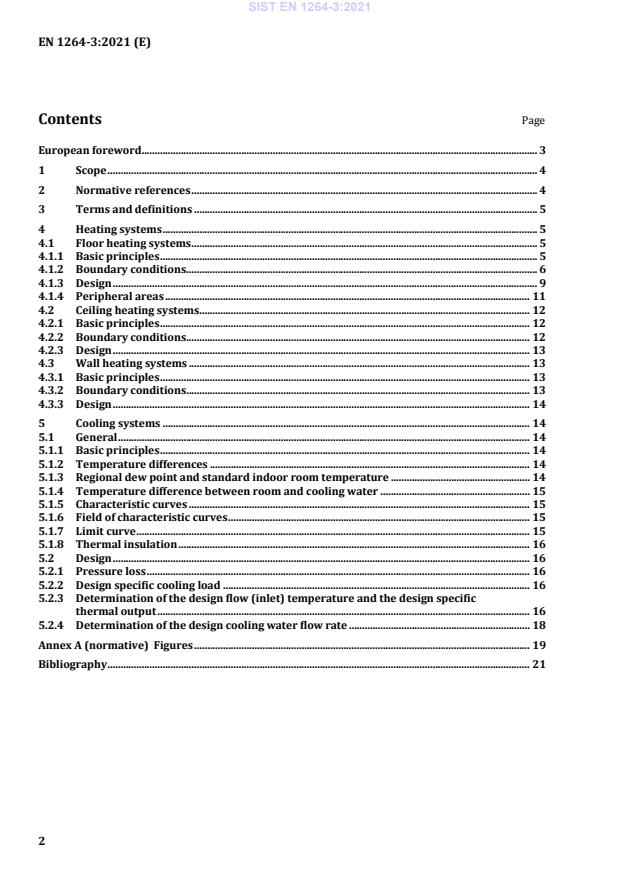
Contents Page
European foreword . 3
1 Scope . 4
2 Normative references . 4
3 Terms and definitions . 5
4 Heating systems . 5
4.1 Floor heating systems . 5
4.1.1 Basic principles . 5
4.1.2 Boundary conditions . 6
4.1.3 Design . 9
4.1.4 Peripheral areas . 11
4.2 Ceiling heating systems . 12
4.2.1 Basic principles . 12
4.2.2 Boundary conditions . 12
4.2.3 Design . 13
4.3 Wall heating systems . 13
4.3.1 Basic principles . 13
4.3.2 Boundary conditions . 13
4.3.3 Design . 14
5 Cooling systems . 14
5.1 General . 14
5.1.1 Basic principles . 14
5.1.2 Temperature differences . 14
5.1.3 Regional dew point and standard indoor room temperature . 14
5.1.4 Temperature difference between room and cooling water . 15
5.1.5 Characteristic curves . 15
5.1.6 Field of characteristic curves . 15
5.1.7 Limit curve . 15
5.1.8 Thermal insulation . 16
5.2 Design . 16
5.2.1 Pressure loss . 16
5.2.2 Design specific cooling load . 16
5.2.3 Determination of the design flow (inlet) temperature and the design specific
thermal output . 16
5.2.4 Determination of the design cooling water flow rate . 18
Annex A (normative) Figures . 19
Bibliography . 21
European foreword
This document (EN 1264-3:2021) has been prepared by Technical Committee CEN/TC 130 “Space
heating appliances without integral heat sources”, the secretariat of which is held by UNI.
This European Standard shall be given the status of a national standard, either by publication of an
identical text or by endorsement, at the latest by November 2021, and conflicting national standards
shall be withdrawn at the latest by November 2021.
Attention is drawn to the possibility that some of the elements of this document may be the subject of
patent rights. CEN shall not be held responsible for identifying any or all such patent rights.
This document supersedes EN 1264-3:2009.
The main changes compared to the previous edition are listed below:
a) Clarification of the Scope;
b) Improved wording, especially the term “prove method”;
c) Deletion of the Note in 4.1.2.2;
d) Addition of new subclauses 4.1.3.1, 4.2.3.1, 4.3.3.1 and 5.2.1.1 Pressure loss;
e) Modification of the maximum average surface temperature for ceiling heating systems in 4.2.1.4;
f) Figures 1 and 3 replaced with Figures A.2 and A.3;
2 2
g) Correction of Formula (15) from 1/α = 0,009 3 (m ∙K)/W to 1/α = 0,092 6 (m ∙K)/W.
EN 1264, Water based surface embedded heating and cooling systems, consists of the following parts:
— Part 1: Definitions and symbols;
— Part 2: Floor heating: Methods for the determination of the thermal output using calculations and
experimental tests;
— Part 3: Dimensioning;
— Part 4: Installation;
— Part 5: Determination of the thermal output for wall and ceiling heating and for floor, wall and ceiling
cooling.
According to the CEN-CENELEC Internal Regulations, the national standards organisations of the
following countries are bound to implement this European Standard: Austria, Belgium, Bulgaria,
Croatia, Cyprus, Czech Republic, Denmark, Estonia, Finland, France, Germany, Greece, Hungary, Iceland,
Ireland, Italy, Latvia, Lithuania, Luxembourg, Malta, Netherlands, Norway, Poland, Portugal, Republic of
North Macedonia, Romania, Serbia, Slovakia, Slovenia, Spain, Sweden, Switzerland, Turkey and the
United Kingdom.
1 Scope
The EN 1264 series gives guidelines for surface embedded heating and cooling systems installed in
buildings, residential and non-residential (e.g. office, public, commercial and industrial buildings) and
focuses on systems installed for the purpose of thermal comfort.
The EN 1264 series gives guidelines for water based heating and cooling systems embedded into the
enclosure surfaces of the room to be heated or to be cooled. It also specifies the use of other heating
media instead of water, as appropriate.
The EN 1264 series specifies standardized product characteristics by calculation and testing the
thermal output of heating for technical specifications and certification. For the design, construction and
operation of these systems, see EN 1264-3 and EN 1264-4 for the types A, B, C, D, H, I and J. For the
types E, F and G, see the EN ISO 11855 series.
The systems specified in the EN 1264 series are adjoined to the structural base of the enclosure
surfaces of the building, mounted directly or with fixing supports. The EN 1264 series does not specify
ceiling systems mounted in a suspended ceiling with a designed open air gap between the system and
the building structure which allows the thermally induced circulation of the air. The thermal output of
these systems can be determined according to EN 14037 series and EN 14240.
EN 1264-3 specifies the use in practical engineering of the results coming from EN 1264-2 and
EN 1264-5.
For heating systems, physiological limitations are taken into account when specifying the surface
temperatures. In the case of floor heating systems the limitations are realized by a design based on the
characteristic curves and limit curves determined in accordance with EN 1264-2.
For cooling systems, only a limitation with respect to the dew point is taken into account. In
predominating practice, this means that physiological limitations are included as well.
2 Normative references
The following documents are referred to in the text in such a way that some or all of their content
constitutes requirements of this document. For dated references, only the edition cited applies. For
undated references, the latest edition of the referenced document (including any amendments) applies.
EN 1264-1:2021, Water based surface embedded heating and cooling systems — Part 1: Definitions and
symbols
EN 1264-2:2021, Water based surface embedded heating and cooling systems — Part 2: Floor heating:
Methods for the determination of the thermal output using calculations and experimental tests
EN 1264-4:2021, Water based surface embedded heating and cooling systems — Part 4: Installation
EN 1264-5:2021, Water based surface embedded heating and cooling systems — Part 5: Heating and
cooling surfaces embedded in floors, ceilings and walls — Determination of the thermal output
EN 12831 (all parts), Heating systems in buildings — Method for calculation of the design heat load
EN 15243, Ventilation for buildings — Calculation of room temperatures and of load and energy for
buildings with room conditioning systems
3 Terms and definitions
For the purposes of this document, the terms and definitions given in EN 1264-1:2021 apply.
ISO and IEC maintain terminological databases for use in standardization at the following addresses:
— ISO Online browsing platform: available at https://www.iso.org/obp
— IEC Electropedia: available at https://www.electropedia.org/
4 Heating systems
4.1 Floor heating systems
4.1.1 Basic principles
4.1.1.1 Temperature difference between heating water and room
The temperature difference between the heating water and the room is calculated using Formula (1),
see also EN 1264-2. In this Formula, the effect of the temperature drop of the heating water is taken into
account.
ϑ −ϑ
V R
∆ϑ = (1)
H
ϑ −ϑ
V i
ln
ϑϑ−
Ri
4.1.1.2 Characteristic curve
The characteristic curve describes the relationship between the specific thermal output q of a system
and the required temperature difference between heating water and room Δϑ . For a simplification, the
H
specific thermal output is taken directly proportional to the temperature difference, see Formula (2):
qK= ⋅∆ϑ
H H
(2)
where the gradient is the equivalent heat transmission coefficient determined according to EN 1264-2.
4.1.1.3 Field of characteristic curves
The field of characteristic curves of a floor heating system with a specific pipe spacing T shall at least
contain the characteristic curves for values of the thermal resistance R = 0 (m ∙K)/W,
λ,B
2 2 2
R = 0,05 (m ∙K)/W, R = 0,10 (m ∙K)/W and R = 0,15 (m ∙K)/W in accordance with EN 1264-2
λ,B λ,B λ,B
(see Figure A.1, in Annex A). Values of R > 0,15 (m ∙K)/W shall not be used if possible.
λ,B
4.1.1.4 Limit curves
The limit curves in the field of characteristic curves describe in accordance with EN 1264-2 the
relationship between the specific thermal output q and the temperature difference Δϑ between the
H
heating water and the room in the case where the physiologically agreed limit values of surface
temperatures ϑ = 29 °C (occupied area) or ϑ = 35 °C (peripheral area) are reached . For
F,max F,max
bathrooms (ϑ = 24 °C) the limit curve for (ϑ − ϑ ) = 9 K also applies. For design purposes, i.e. the
I F,max i
determination of design values of the specific thermal output and the associated temperature difference
between heating water and room, the limit curves are valid for the temperature drop σ of the heating
water in a range of:
0 K < σ ≤ 5 K
The limit curves are used to specify the maximum permissible flow temperature (see 4.1.3.2 and
Figure A.2).
4.1.1.5 Thermal inertia
The difference between the minimum and the maximum surface temperature of a floor heating system
is low. This means for design purposes that no consideration of thermal inertia is required.
4.1.2 Boundary conditions
4.1.2.1 Flow pipes to adjacent rooms
The heat output of service pipes, not serving rooms through which they pass, shall be limited by careful
design, or by use of thermal insulation coverings, so that any room temperature should not be increased
substantially. The heat output of service pipes passing through the room in question to adjacent rooms
is taken into account if the same type of room usage can be assumed.
4.1.2.2 Thermal insulation
To limit the heat flow through the floor to rooms below, the required thermal resistance of the
insulating layer R (see Figure A.3) shall be at minimum in accordance with of EN 1264-4 , Table 1. It
λ,ins
is calculated according to Formula (3).
s
ins
R = (3)
λ,ins
λ
ins
where
s is the thickness of the insulating layer in m;
ins
λ is the thermal conductivity of the insulating layer in W/(m∙K).
ins
Depending on the construction of the floor heating system, the effective thickness of the insulating layer
s is determined differently.
ins
For floor heating systems with flat thermal insulating panels (see Figure 1), s is identical with the
ins
thickness of the thermal insulating panel.
National regulations may limit these temperatures to lower values.
National regulations may vary the requirements given in Table 1 of EN 1264-4.
For floor heating systems with profiled thermal insulating panels (see Figure 3), a surface-related
weighted calculation is made for the effective thickness of the insulating layer s :
ins
s ⋅ T− D + s ⋅ D
( )
hl
s =
ins
T
(4)
For profiled thermal insulating panels shaped differently from that shown in Figure 3, the average
effective thickness of the insulating layer shall be calculated with an accordant application of
Formula (4).
The thermal resistance R of the insulating layers of the heating/cooling system shall be calculated as
λ,ins
reported in EN 1264-4:2021, Table 1.
This calculation can be done with the assumption that the thermal insulation is continuous parallel to
the pipes. For floor heating systems with thermal insulation panels with studs according to Figure 2
(Type A and Type C systems), only the flat part of the panel (without studs) shall be considered in
calculation of s .
ins
Figure 1 — Average thickness of insulating layer flat insulating panels
Key
1 floor covering
2 weight bearing and thermal diffusion layer
3 thermal insulation with studs
4 acoustic insulation (if present)
5 structural base
6 pipes
Figure 2 — Type A and Type C System with studs
Key
1 floor covering
2 weight bearing and thermal diffusion layer
3 thermal insulation
4 heat diffusion device
5 structural base
Figure 3 — Average thickness of insulating for layer for profiled insulating panels
4.1.3 Design
4.1.3.1 Pressure loss
The maximum pressure loss per heating circuit should be minimized in order to limit the electrical
power consumption of the pump, e.g. by hydronic balancing (see EN 1264-4:2021, 4.1). It should not
exceed 350 mbar.
4.1.3.2 Design specific thermal output
The design value q to design a floor heating system for a room is equal to the standard heat load Q
des N,f
(see EN 1264-1) divided by the heating surface A :
F
Q
Nf,
q =
des
A
F
(5)
The standard heat load Q shall be calculated in accordance with EN 12831 (all parts). Normally, the
N,f
heat output Q of the floor heating system shall be equivalent to the standard heat load Q . If this is not
F N,f
possible, additional heating surfaces shall be used, see Formula (12).
The design thermal output Q of the entire heating surface A is calculated using Formula (6):
F F
Q q⋅ A
FF
(6)
Where peripheral area is used, q shall be distributed between the peripheral area A and the occupied
R
area A according to a surface weighted calculation, see Formula (7) (see also 4.1.4):
A
AA
RA
qq= ⋅ + ⋅ q
RA
AA
FF
(7)
where
q is the specific thermal output of the occupied area;
A
q is the specific thermal output of the peripheral area.
R
4.1.3.3 Determination of the design flow temperature
The design flow temperature is determined for the room (or the rooms respectively) with the maximum
specific thermal output q = q (excluding bathrooms). In the rooms being heated, it is assumed that
max des
floor coverings with a uniform thermal conduction resistance are used. Generally for the design of floor
heating systems in residential rooms, uniform floor coverings with R = 0,10 (m ⋅K)/W are assumed.
λ,B
In the case of using higher values R , these values shall be taken.
λ,B
For the room used for design, the temperature drop of the heating water is specified to σ ≤ 5 K. If
necessary, a subdivision of this room into heating circuits should be performed. Under these conditions,
the maximum value q may reach until the limit value q of the specific thermal output (see
max G
Figure A.2) .
...