

SIST EN 60835-2-4:2002/A1:2002
(Amendment)Methods of measurement for equipment used in digital microwave radio transmission systems -- Part 2: Measurements on terrestrial radio-relay systems -- Section 4: Transmitter/receiver including modulator/demodulator
General Information
- Abstract
EN following parallel vote
- Status
- Published
- Publication Date
- 30-Sep-2002
- Technical Committee
- OMS - Equipment used in mobile services and satelite comunication systems
- Current Stage
- 6060 - National Implementation/Publication (Adopted Project)
- Start Date
- 01-Oct-2002
- Due Date
- 01-Oct-2002
- Completion Date
- 01-Oct-2002

Overview
SIST EN 60835-2-4:2002/A1:2002 provides standardized methods of measurement for equipment used in digital microwave radio transmission systems, specifically focusing on terrestrial radio-relay systems. This standard covers critical procedures for measuring the performance of transmitters, receivers, modulators, and demodulators within these systems. The amendment (A1) aligns with the parallel vote in the EN process and incorporates updates from the corresponding IEC standard.
Reliable and reproducible measurement methods are essential for ensuring performance, interoperability, and regulatory compliance in radio-relay communication equipment. This standard is vital for manufacturers, engineers, and testing professionals involved in the design, development, and validation of digital microwave radio transmission systems.
Key Topics
Transmitter and Receiver Measurement:
- Performance evaluation of transmitters and receivers in digital microwave systems.
- Specific focus on the role and testing of modulators and demodulators.
Selective Fading Signature Measurement:
- Methods to analyze the impact of multipath propagation, commonly found in terrestrial microwave links.
- Utilization of two-ray fading simulators to replicate selective fading scenarios.
Bit Error Rate (BER) Testing:
- Assessment techniques to determine how various fading conditions affect BER.
- Procedures for setting notch depth and measuring offset frequencies in fading simulators.
System Sensitivity Assessments:
- Comparing system performance and adaptive equalizer sensitivity to multipath effects.
- Supporting the prediction of outage times caused by selective fading in operational environments.
Applications
SIST EN 60835-2-4:2002/A1:2002 plays a fundamental role in various practical scenarios, including:
Product Development & Validation:
- Used by manufacturers of digital microwave radio equipment to verify transmitter and receiver performance under standardized measurement conditions.
- Ensures equipment meets industry requirements for reliability and robustness in multipath-prone terrestrial settings.
Type Approval & Acceptance Testing:
- Laboratories employ these measurement methods for type tests, acceptance tests, and compliance certification.
- Enables uniformity in testing, supporting regulatory compliance and market approval processes.
System Optimization & Comparison:
- Network engineers and designers use measurement data to optimize radio-relay system configurations and compare equipment from multiple vendors.
- Helps identify suitable equalization and error correction strategies to mitigate selective fading effects.
Predictive Maintenance & Field Analysis:
- Results from these measurements guide predictive maintenance plans and the analysis of downtime causes, ultimately improving network uptime and service reliability.
Related Standards
Professionals dealing with digital microwave radio-relay systems should also be aware of the following related standards:
- EN 60835-2-8: Addresses measurement methods for BER in radio-relay equipment and is cited within this standard for test arrangement reference.
- IEC 60835 Series: Comprises a suite of standards covering broader methods for measurement and specification within digital microwave transmission systems.
- EN 302 217: Focused on characteristics and requirements for fixed radio systems, often relevant for harmonization with European requirements.
- IEC 60834: Provides requirements and performance criteria for analog and digital communication systems, complementing the scope of EN 60835-2-4.
Practical Value
Implementing SIST EN 60835-2-4:2002/A1:2002 ensures consistent, repeatable, and internationally recognized approaches for measuring vital parameters in digital microwave radio equipment. By following these standardized measurement methods, organizations can not only achieve regulatory compliance but also enhance the overall quality, resilience, and performance of terrestrial radio-relay systems in demanding communication environments.
Keywords: digital microwave radio, terrestrial radio-relay, transmitter measurement, receiver testing, selective fading, bit error rate, multipath propagation, modulators, demodulators, performance validation, SIST standard, IEC 60835-2-4.
Relations
- Effective Date
- 21-Sep-2010
Get Certified
Connect with accredited certification bodies for this standard

ANCE
Mexican certification and testing association.

Intertek Slovenia
Intertek testing, inspection, and certification services in Slovenia.

LNE (Laboratoire National de Métrologie et d'Essais)
French national laboratory for metrology and testing.
Sponsored listings
Frequently Asked Questions
SIST EN 60835-2-4:2002/A1:2002 is a amendment published by the Slovenian Institute for Standardization (SIST). Its full title is "Methods of measurement for equipment used in digital microwave radio transmission systems -- Part 2: Measurements on terrestrial radio-relay systems -- Section 4: Transmitter/receiver including modulator/demodulator". This standard covers: EN following parallel vote
EN following parallel vote
SIST EN 60835-2-4:2002/A1:2002 is classified under the following ICS (International Classification for Standards) categories: 33.060.30 - Radio relay and fixed satellite communications systems. The ICS classification helps identify the subject area and facilitates finding related standards.
SIST EN 60835-2-4:2002/A1:2002 has the following relationships with other standards: It is inter standard links to SIST EN 60835-2-4:2002. Understanding these relationships helps ensure you are using the most current and applicable version of the standard.
SIST EN 60835-2-4:2002/A1:2002 is available in PDF format for immediate download after purchase. The document can be added to your cart and obtained through the secure checkout process. Digital delivery ensures instant access to the complete standard document.
Standards Content (Sample)
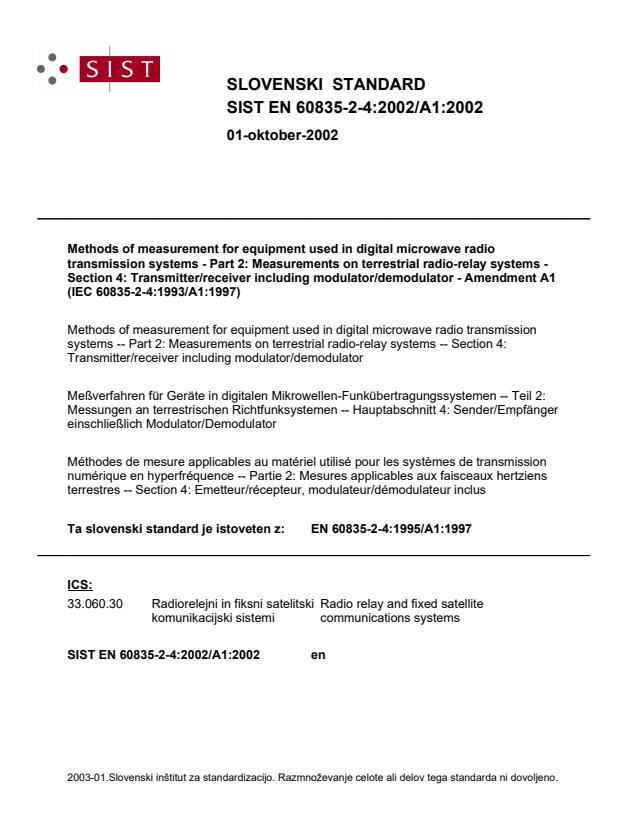
SLOVENSKI STANDARD
01-oktober-2002
Methods of measurement for equipment used in digital microwave radio
transmission systems - Part 2: Measurements on terrestrial radio-relay systems -
Section 4: Transmitter/receiver including modulator/demodulator - Amendment A1
(IEC 60835-2-4:1993/A1:1997)
Methods of measurement for equipment used in digital microwave radio transmission
systems -- Part 2: Measurements on terrestrial radio-relay systems -- Section 4:
Transmitter/receiver including modulator/demodulator
Meßverfahren für Geräte in digitalen Mikrowellen-Funkübertragungssystemen -- Teil 2:
Messungen an terrestrischen Richtfunksystemen -- Hauptabschnitt 4: Sender/Empfänger
einschließlich Modulator/Demodulator
Méthodes de mesure applicables au matériel utilisé pour les systèmes de transmission
numérique en hyperfréquence -- Partie 2: Mesures applicables aux faisceaux hertziens
terrestres -- Section 4: Emetteur/récepteur, modulateur/démodulateur inclus
Ta slovenski standard je istoveten z: EN 60835-2-4:1995/A1:1997
ICS:
33.060.30 Radiorelejni in fiksni satelitski Radio relay and fixed satellite
komunikacijski sistemi communications systems
2003-01.Slovenski inštitut za standardizacijo. Razmnoževanje celote ali delov tega standarda ni dovoljeno.
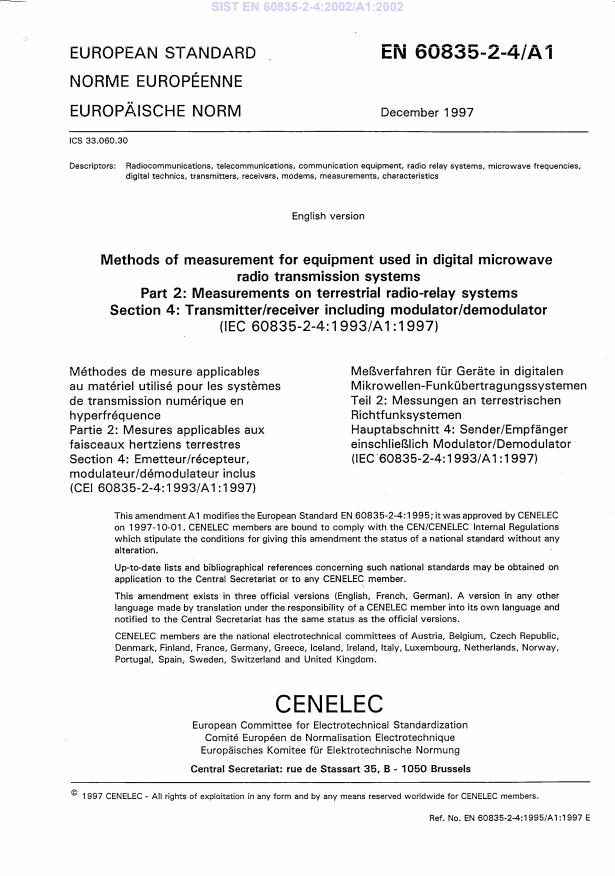
NORME
CEI
INTERNATIONALE
IEC
60835-2-4
INTERNATIONAL
STANDARD
AMENDEMENT 1
AMENDMENT 1
1997-11
Amendement 1
Méthodes de mesure applicables au matériel
utilisé pour les systèmes de transmission
numérique en hyperfréquence –
Partie 2:
Mesures applicables aux faisceaux
hertziens terrestres –
Section 4: Emetteur/récepteur,
modulateur/démodulateur inclus
Amendment 1
Methods of measurement for equipment used
in digital microwave radio transmission systems –
Part 2:
Measurements on terrestrial radio-relay systems –
Section 4: Transmitter/receiver including
modulator/demodulator
IEC 1997 Droits de reproduction réservés Copyright - all rights reserved
International Electrotechnical Commission 3, rue de Varembé Geneva, Switzerland
Telefax: +41 22 919 0300 e-mail: inmail@iec.ch IEC web site http: //www.iec.ch
CODE PRIX
Commission Electrotechnique Internationale
PRICE CODE F
International Electrotechnical Commission
Pour prix, voir catalogue en vigueur
For price, see current catalogue
60835-2-4 Amend. 1 IEC:1997 – 3 –
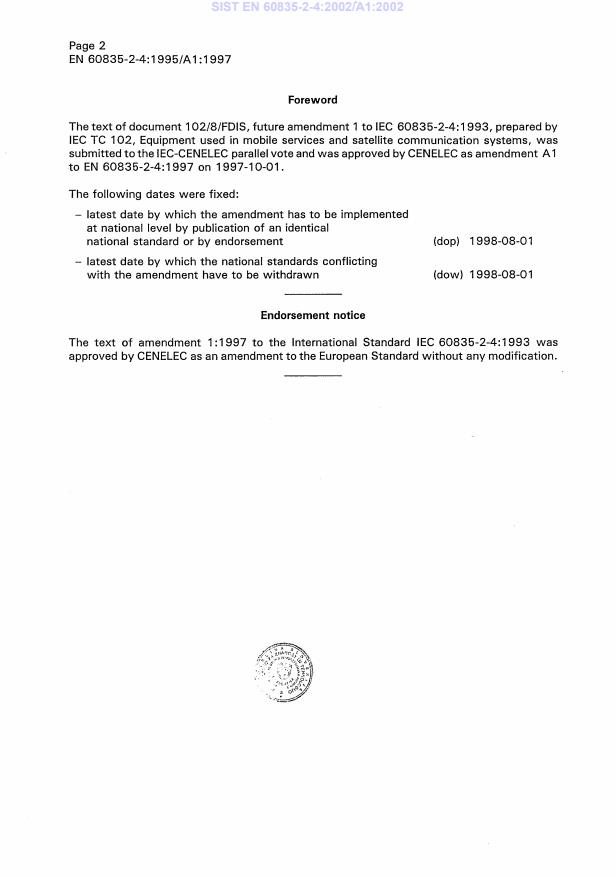
FOREWORD
This amendment has been prepared by IEC technical committee 102: Equipment used in
mobile sevices and satellite communication systems.
The text of this amendment is based on the following documents:
FDIS Report on voting
102/8/FDIS 102/18/RVD
Full information on the voting for the approval of this amendment can be found in the report on
voting indicated in the above table.
___________
Page 3
CONTENTS
Add, on page 5, the following items:
5.3 Selective fading signature .
5.3.1 General considerations .
5.3.2 Method of measurement.
5.3.3 Presentation of results .
5.3.4 Details to be specified .
Figures
5 Functional arrangement of the fading simulator .
6 Wideband frequency characteristic of the two-ray i.f. fading simulator .
7 Example of minimum / non-minimum phase signature .
Page 29
5.3 Selective fading signature
Add the following new text:
5.3.1 General considerations
Digital radio-relay systems designed for the transmission of high bit rates are susceptible to
selective fading due to multipath propagation. This results in a BER which is higher than that
which would be caused by flat fading of the same mean value.
60835-2-4 Amend. 1 IEC:1997 – 5 –
In order to assess the sensitivity of the radio-relay system to the effects of multipath
propagation during acceptance or type test, a "two-ray fading simulator" can be used in the i.f.
or r.f. path of the receiver. Signatures measured with this simulator, as explained in the next
subclause, are suitable for the comparison of different digital radio-relay systems and adaptive
equalizers in their sensitivity to multipath fading, and also for predicting outage time due to
selective fading in the field.
In the simplified block diagram of the two-ray fading simulator shown in figure 5, the i.f. or r.f.
input signal is split into a direct p
...