

SIST EN ISO 25745-1:2023
(Main)Energy performance of lifts, escalators and moving walks - Part 1: Energy measurement and verification (ISO 25745-1:2023)
General Information
- Abstract
This document specifies:
a) methods of measuring actual energy consumption of lifts, escalators and moving walks on a single unit basis;
b) methods of carrying out periodic energy verification checks on lifts, escalators and moving walks in operation.
This document only considers the energy performance during the operational portion of the life cycle of the lifts, escalators or moving walks.
For lifts, this document does not cover energy aspects, such as:
a) hoistway lighting;
b) heating and cooling equipment, including fans in the lift car;
c) machine room lighting;
d) machine room heating, ventilation and air conditioning;
e) non-lift, display systems, closed circuit television security cameras, etc.;
f) non-lift, monitoring systems (building management systems, etc.);
g) the effect of lift group dispatching on energy consumption;
h) non-lift equipment consumption through the power sockets;
i) energy storage systems if used as an alternative energy source for operation.
For escalators and moving walks, this document does not cover energy aspects of the ancillary equipment, such as:
a) lighting with the exception of comb plate lighting and step gap lighting and traffic light;
b) cooling and heating;
c) alarm devices and emergency battery supplies equipment, etc.
- Status
- Published
- Public Enquiry End Date
- 30-Oct-2022
- Publication Date
- 19-Nov-2023
- Technical Committee
- DTN - Lift and transport appliances
- Current Stage
- 6060 - National Implementation/Publication (Adopted Project)
- Start Date
- 02-Aug-2023
- Due Date
- 07-Oct-2023
- Completion Date
- 20-Nov-2023

Overview
EN ISO 25745-1:2023 - Energy performance of lifts, escalators and moving walks - Part 1: Energy measurement and verification (ISO 25745-1:2023) defines standardized methods to measure and verify the actual energy use of individual lifts, escalators and moving walks during normal operation. Published by CEN and identical to ISO 25745-1:2023, this standard focuses on in-service energy measurement, periodic verification checks and reporting - enabling consistent, comparable energy performance data for equipment installed in buildings and public transport hubs.
Key topics and requirements
- Scope and focus
- Measurement and verification of operational energy consumption for single-unit lifts, escalators and moving walks.
- Explicit exclusions for lifts (e.g., hoistway lighting, HVAC in machine rooms, building management systems, effect of group dispatching, energy storage systems) and for escalators/moving walks (e.g., general lighting except comb plate/step gap lighting, HVAC, alarm/emergency battery equipment).
- Measurement procedures
- Requirements for instrumentation, accuracy and test setup for lifts and for escalators/moving walks.
- Distinction between main energy/power (drive consumption during running, idle and standby) and ancillary energy (auxiliary systems during running, idle and standby).
- Specific procedures for lift energy measurements (main energy - running, idle/standby; ancillary energy) and escalator/moving walk power measurements (running, standby, autostart, slow speed, no-load).
- Verification checks
- Methods for periodic on-site verification using current or power checks to confirm measured or expected energy performance.
- Reporting
- Standardized reporting structure including general information, measured values for main and ancillary energy/power, and verification check results to ensure transparency and repeatability.
- Instrumentation coupling points
- Guidance on where to couple meters and measurement devices for accurate capture of energy flows.
Applications and who uses it
- Building owners and facility managers seeking reliable, comparable data for energy management and decarbonization programs.
- Lift, escalator and moving-walk manufacturers and installers for product validation and warranty verification.
- Energy auditors, commissioning teams and testing laboratories performing on-site energy measurements and periodic verification.
- Asset managers and sustainability officers benchmarking equipment performance, prioritizing retrofits, or demonstrating compliance with energy regulations.
Related standards
- Part of the ISO 25745 series on energy performance for vertical and horizontal transport. Use EN ISO 25745-1:2023 alongside other parts of the series and applicable national/regional energy codes when establishing energy labeling, benchmarking or compliance programs.
Keywords: EN ISO 25745-1:2023, energy measurement, energy verification, lifts, escalators, moving walks, energy performance, energy reporting, measurement procedures.
Relations
- Effective Date
- 28-Jan-2026
- Effective Date
- 28-Jan-2026
- Referred By
SIST EN ISO 10088:2023 - Small craft - Permanently installed fuel systems (ISO 10088:2022) - Effective Date
- 28-Jan-2026
- Effective Date
- 03-Aug-2022
Get Certified
Connect with accredited certification bodies for this standard

DIBt (Deutsches Institut für Bautechnik)
German Institute for Building Technology.
DIN CERTCO
DIN Group product certification.

Aboma Certification B.V.
Specialized in construction, metal, and transport sectors.
Sponsored listings
Frequently Asked Questions
SIST EN ISO 25745-1:2023 is a standard published by the Slovenian Institute for Standardization (SIST). Its full title is "Energy performance of lifts, escalators and moving walks - Part 1: Energy measurement and verification (ISO 25745-1:2023)". This standard covers: This document specifies: a) methods of measuring actual energy consumption of lifts, escalators and moving walks on a single unit basis; b) methods of carrying out periodic energy verification checks on lifts, escalators and moving walks in operation. This document only considers the energy performance during the operational portion of the life cycle of the lifts, escalators or moving walks. For lifts, this document does not cover energy aspects, such as: a) hoistway lighting; b) heating and cooling equipment, including fans in the lift car; c) machine room lighting; d) machine room heating, ventilation and air conditioning; e) non-lift, display systems, closed circuit television security cameras, etc.; f) non-lift, monitoring systems (building management systems, etc.); g) the effect of lift group dispatching on energy consumption; h) non-lift equipment consumption through the power sockets; i) energy storage systems if used as an alternative energy source for operation. For escalators and moving walks, this document does not cover energy aspects of the ancillary equipment, such as: a) lighting with the exception of comb plate lighting and step gap lighting and traffic light; b) cooling and heating; c) alarm devices and emergency battery supplies equipment, etc.
This document specifies: a) methods of measuring actual energy consumption of lifts, escalators and moving walks on a single unit basis; b) methods of carrying out periodic energy verification checks on lifts, escalators and moving walks in operation. This document only considers the energy performance during the operational portion of the life cycle of the lifts, escalators or moving walks. For lifts, this document does not cover energy aspects, such as: a) hoistway lighting; b) heating and cooling equipment, including fans in the lift car; c) machine room lighting; d) machine room heating, ventilation and air conditioning; e) non-lift, display systems, closed circuit television security cameras, etc.; f) non-lift, monitoring systems (building management systems, etc.); g) the effect of lift group dispatching on energy consumption; h) non-lift equipment consumption through the power sockets; i) energy storage systems if used as an alternative energy source for operation. For escalators and moving walks, this document does not cover energy aspects of the ancillary equipment, such as: a) lighting with the exception of comb plate lighting and step gap lighting and traffic light; b) cooling and heating; c) alarm devices and emergency battery supplies equipment, etc.
SIST EN ISO 25745-1:2023 is classified under the following ICS (International Classification for Standards) categories: 91.140.90 - Lifts. Escalators. The ICS classification helps identify the subject area and facilitates finding related standards.
SIST EN ISO 25745-1:2023 has the following relationships with other standards: It is inter standard links to SIST EN ISO 6185-3:2024, SIST EN ISO 9094:2023, SIST EN ISO 10088:2023, SIST EN ISO 25745-1:2013. Understanding these relationships helps ensure you are using the most current and applicable version of the standard.
SIST EN ISO 25745-1:2023 is available in PDF format for immediate download after purchase. The document can be added to your cart and obtained through the secure checkout process. Digital delivery ensures instant access to the complete standard document.
Standards Content (Sample)
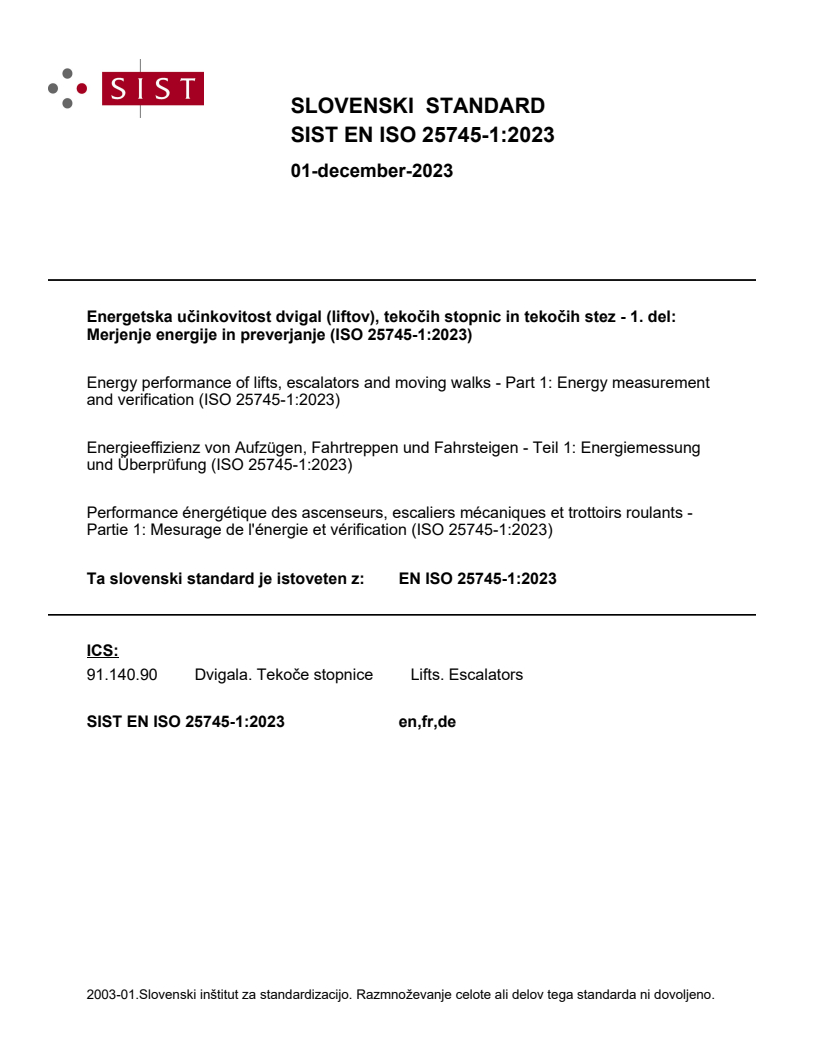
SLOVENSKI STANDARD
01-december-2023
Energetska učinkovitost dvigal (liftov), tekočih stopnic in tekočih stez - 1. del:
Merjenje energije in preverjanje (ISO 25745-1:2023)
Energy performance of lifts, escalators and moving walks - Part 1: Energy measurement
and verification (ISO 25745-1:2023)
Energieeffizienz von Aufzügen, Fahrtreppen und Fahrsteigen - Teil 1: Energiemessung
und Überprüfung (ISO 25745-1:2023)
Performance énergétique des ascenseurs, escaliers mécaniques et trottoirs roulants -
Partie 1: Mesurage de l'énergie et vérification (ISO 25745-1:2023)
Ta slovenski standard je istoveten z: EN ISO 25745-1:2023
ICS:
91.140.90 Dvigala. Tekoče stopnice Lifts. Escalators
2003-01.Slovenski inštitut za standardizacijo. Razmnoževanje celote ali delov tega standarda ni dovoljeno.
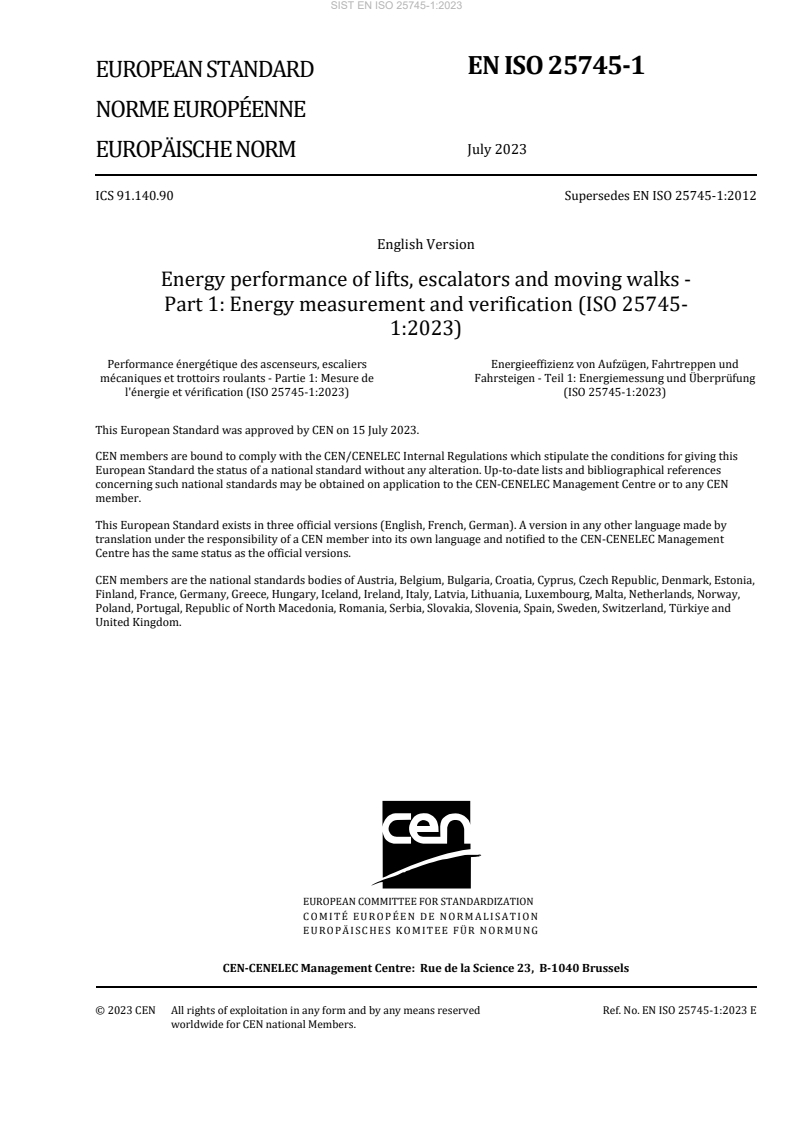
EN ISO 25745-1
EUROPEAN STANDARD
NORME EUROPÉENNE
July 2023
EUROPÄISCHE NORM
ICS 91.140.90 Supersedes EN ISO 25745-1:2012
English Version
Energy performance of lifts, escalators and moving walks -
Part 1: Energy measurement and verification (ISO 25745-
1:2023)
Performance énergétique des ascenseurs, escaliers Energieeffizienz von Aufzügen, Fahrtreppen und
mécaniques et trottoirs roulants - Partie 1: Mesure de Fahrsteigen - Teil 1: Energiemessung und Überprüfung
l'énergie et vérification (ISO 25745-1:2023) (ISO 25745-1:2023)
This European Standard was approved by CEN on 15 July 2023.
CEN members are bound to comply with the CEN/CENELEC Internal Regulations which stipulate the conditions for giving this
European Standard the status of a national standard without any alteration. Up-to-date lists and bibliographical references
concerning such national standards may be obtained on application to the CEN-CENELEC Management Centre or to any CEN
member.
This European Standard exists in three official versions (English, French, German). A version in any other language made by
translation under the responsibility of a CEN member into its own language and notified to the CEN-CENELEC Management
Centre has the same status as the official versions.
CEN members are the national standards bodies of Austria, Belgium, Bulgaria, Croatia, Cyprus, Czech Republic, Denmark, Estonia,
Finland, France, Germany, Greece, Hungary, Iceland, Ireland, Italy, Latvia, Lithuania, Luxembourg, Malta, Netherlands, Norway,
Poland, Portugal, Republic of North Macedonia, Romania, Serbia, Slovakia, Slovenia, Spain, Sweden, Switzerland, Türkiye and
United Kingdom.
EUROPEAN COMMITTEE FOR STANDARDIZATION
COMITÉ EUROPÉEN DE NORMALISATION
EUROPÄISCHES KOMITEE FÜR NORMUNG
CEN-CENELEC Management Centre: Rue de la Science 23, B-1040 Brussels
© 2023 CEN All rights of exploitation in any form and by any means reserved Ref. No. EN ISO 25745-1:2023 E
worldwide for CEN national Members.
Contents Page
European foreword . 3
European foreword
This document (EN ISO 25745-1:2023) has been prepared by Technical Committee ISO/TC 178 "Lifts,
escalators and moving walks" in collaboration with Technical Committee CEN/TC 10 “Lifts, escalators
and moving walks” the secretariat of which is held by AFNOR.
This European Standard shall be given the status of a national standard, either by publication of an
identical text or by endorsement, at the latest by January 2024, and conflicting national standards shall
be withdrawn at the latest by January 2024.
Attention is drawn to the possibility that some of the elements of this document may be the subject of
patent rights. CEN shall not be held responsible for identifying any or all such patent rights.
This document supersedes EN ISO 25745-1:2012.
Any feedback and questions on this document should be directed to the users’ national standards
body/national committee. A complete listing of these bodies can be found on the CEN website.
According to the CEN-CENELEC Internal Regulations, the national standards organizations of the
following countries are bound to implement this European Standard: Austria, Belgium, Bulgaria,
Croatia, Cyprus, Czech Republic, Denmark, Estonia, Finland, France, Germany, Greece, Hungary, Iceland,
Ireland, Italy, Latvia, Lithuania, Luxembourg, Malta, Netherlands, Norway, Poland, Portugal, Republic of
North Macedonia, Romania, Serbia, Slovakia, Slovenia, Spain, Sweden, Switzerland, Türkiye and the
United Kingdom.
Endorsement notice
The text of ISO 25745-1:2023 has been approved by CEN as EN ISO 25745-1:2023 without any
modification.
INTERNATIONAL ISO
STANDARD 25745-1
Second edition
2023-07
Energy performance of lifts, escalators
and moving walks —
Part 1:
Energy measurement and verification
Performance énergétique des ascenseurs, escaliers mécaniques et
trottoirs roulants —
Partie 1: Mesure de l'énergie et vérification
Reference number
ISO 25745-1:2023(E)
ISO 25745-1:2023(E)
© ISO 2023
All rights reserved. Unless otherwise specified, or required in the context of its implementation, no part of this publication may
be reproduced or utilized otherwise in any form or by any means, electronic or mechanical, including photocopying, or posting on
the internet or an intranet, without prior written permission. Permission can be requested from either ISO at the address below
or ISO’s member body in the country of the requester.
ISO copyright office
CP 401 • Ch. de Blandonnet 8
CH-1214 Vernier, Geneva
Phone: +41 22 749 01 11
Email: copyright@iso.org
Website: www.iso.org
Published in Switzerland
ii
ISO 25745-1:2023(E)
Contents Page
Foreword .v
Introduction . vi
1 Scope . 1
1.1 General . 1
1.2 Lifts . 1
1.3 Escalators and moving walks . 1
2 Normative references . 2
3 Terms and definitions . 2
4 Measurement and verification of lift, escalator and moving walk energy usage .4
4.1 General . 4
4.2 Lift energy measurements or escalator and moving walk power measurements . 5
4.3 Lift, escalator and moving walk energy verification check . 5
4.3.1 General . 5
4.3.2 Lift . 5
4.3.3 Escalator and moving walk . 5
4.4 Multiple lift, escalator and moving walk installations . 5
5 Measurement procedures for a lift installation . 6
5.1 Preliminaries . 6
5.1.1 Instrumentation. 6
5.1.2 Accuracy . 6
5.1.3 Test setup . 6
5.1.4 Coupling points . 6
5.2 Procedures for the energy measurements . 6
5.2.1 General . 6
5.2.2 Main energy — running . 7
5.2.3 Main energy — idle and standby . 7
5.2.4 Ancillary energy — running . 7
5.2.5 Ancillary energy — idle and standby . 8
5.3 Procedures for the energy verification check . 8
5.3.1 General . 8
5.3.2 Main current — running . 8
5.3.3 Main current — idle and standby . 9
5.3.4 Ancillary current — running . 9
5.3.5 Ancillary current — idle and standby . 9
6 Measurement procedures for an escalator or moving walk installation .10
6.1 Preliminaries . 10
6.1.1 Instrumentation. 10
6.1.2 Accuracy . 10
6.1.3 Test setup . 10
6.2 Procedures for power measurement . 10
6.2.1 General . 10
6.2.2 Main power — running . 11
6.2.3 Power measured in standby condition . 11
6.2.4 Power measured in autostart condition (if available) . 11
6.2.5 Power measured in slow speed condition (if available) . 11
6.2.6 Power measured in no load condition . 11
6.2.7 Power measured in ancillary equipment . 11
6.3 Procedures for the power verification check . 11
7 Reporting .11
7.1 General information. 11
7.2 Lift reporting .12
7.2.1 General .12
iii
ISO 25745-1:2023(E)
7.2.2 Main energy — running: .12
7.2.3 Main energy — Idle and standby: .12
7.2.4 Ancillary energy — running: .12
7.2.5 Ancillary energy — idle and standby: .12
7.3 Lift energy usage verification check .12
7.3.1 General .12
7.3.2 Main current — running: .12
7.3.3 Main current — idle and standby: . 13
7.3.4 Ancillary current — running: . 13
7.3.5 Ancillary current —idle and standby: . 13
7.4 Escalator and moving walk energy reporting . 13
7.5 Escalator and moving walk energy verification check reporting .13
Annex A (informative) Measuring instrument coupling points .14
Bibliography .16
iv
ISO 25745-1:2023(E)
Foreword
ISO (the International Organization for Standardization) is a worldwide federation of national standards
bodies (ISO member bodies). The work of preparing International Standards is normally carried out
through ISO technical committees. Each member body interested in a subject for which a technical
committee has been established has the right to be represented on that committee. International
organizations, governmental and non-governmental, in liaison with ISO, also take part in the work.
ISO collaborates closely with the International Electrotechnical Commission (IEC) on all matters of
electrotechnical standardization.
The procedures used to develop this document and those intended for its further maintenance are
described in the ISO/IEC Directives, Part 1. In particular, the different approval criteria needed for the
different types of ISO document should be noted. This document was drafted in accordance with the
editorial rules of the ISO/IEC Directives, Part 2 (see www.iso.org/directives).
ISO draws attention to the possibility that the implementation of this document may involve the use
of (a) patent(s). ISO takes no position concerning the evidence, validity or applicability of any claimed
patent rights in respect thereof. As of the date of publication of this document, ISO had not received
notice of (a) patent(s) which may be required to implement this document. However, implementers are
cautioned that this may not represent the latest information, which may be obtained from the patent
database available at www.iso.org/patents. ISO shall not be held responsible for identifying any or all
such patent rights.
Any trade name used in this document is information given for the convenience of users and does not
constitute an endorsement.
For an explanation of the voluntary nature of standards, the meaning of ISO specific terms and
expressions related to conformity assessment, as well as information about ISO's adherence to
the World Trade Organization (WTO) principles in the Technical Barriers to Trade (TBT), see
www.iso.org/iso/foreword.html.
This document was prepared by Technical Committee ISO/TC 178, Lifts, escalators and moving walks,
in collaboration with the European Committee for Standardization (CEN) Technical Committee CEN/
TC 10, Lifts, escalators and moving walks, in accordance with the Agreement on technical cooperation
between ISO and CEN (Vienna Agreement).
This second edition cancels and replaces the first edition (ISO 25745-1:2012), which has been technically
revised.
The main changes are as follows:
— updated scope for lifts regarding energy storage systems and fan.
A list of all parts in the ISO 25745 series can be found on the ISO website.
Any feedback or questions on this document should be directed to the user’s national standards body. A
complete listing of these bodies can be found at www.iso.org/members.html.
v
ISO 25745-1:2023(E)
Introduction
This document has been prepared in response to the rapidly increasing need to ensure and to support
the efficient and effective use of energy.
This document is intended to be a reference for the following parties:
— building developers or owners determining and confirming the energy consumption of a building;
— building owners and service companies for performing regulatory periodic energy verification;
— manufacturers, installers and maintenance providers of lifts, escalators and moving walks;
— consultants and architects involved in specification of lifts, escalators and moving walks.
The total energy consumption over the entire life cycle of lifts, escalators and moving walks consists
of the energy to manufacture, install, operate, and the disposal of lifts, escalators and moving walks.
However, for the purpose of this document, only the power consumption of the lift, escalator or
moving walk required for its operation is considered in the assessment of energy consumption and its
verification.
This document is suitable for national or regional jurisdictional energy performance purposes.
vi
INTERNATIONAL STANDARD ISO 25745-1:2023(E)
Energy performance of lifts, escalators and moving
walks —
Part 1:
Energy measurement and verification
1 Scope
1.1 General
This document specifies:
a) methods of measuring actual energy consumption of lifts, escalators and moving walks on a single
unit basis;
b) methods of carrying out periodic energy verification checks on lifts, escalators and moving walks
in operation.
This document only considers the energy performance during the operational portion of the life cycle of
the lifts, escalators or moving walks.
1.2 Lifts
For lifts, this document does not cover energy aspects, such as:
a) hoistway lighting;
b) heating and cooling equipment, including fans in the lift car;
c) machine room lighting;
d) machine room heating, ventilation and air conditioning;
e) non-lift, display systems, closed circuit television security cameras, etc.;
f) non-lift, monitoring systems (building management systems, etc.);
g) the effect of lift group dispatching on energy consumption;
h) non-lift equipment consumption through the power sockets;
i) energy storage systems if used as an alternative energy source for operation.
1.3 Escalators and moving walks
For escalators and moving walks, this document does not cover energy aspects of the ancillary
equipment, such as:
a) lighting with the exception of comb plate lighting and step gap lighting and traffic light;
b) cooling and heating;
c) alarm devices and emergency battery supplies equipment, etc.
SIST
...