

SIST EN 12594:2025
(Main)Bitumen and bituminous binders - Preparation of test samples
General Information
- Abstract
This document specifies methods for preparing test samples of bitumens and bituminous binders in order to test their properties.
WARNING - The use of this document can involve hazardous materials, operations and equipment. This document does not purport to address all of the safety problems associated with its use. It is the responsibility of the user of this document to establish appropriate safety and health practices and to determine the applicability of regulatory limitations prior to use.
- Status
- Published
- Public Enquiry End Date
- 29-Jun-2023
- Publication Date
- 09-Dec-2024
- Technical Committee
- VLA - Water proofing
- Current Stage
- 6060 - National Implementation/Publication (Adopted Project)
- Start Date
- 07-Nov-2024
- Due Date
- 12-Jan-2025
- Completion Date
- 10-Dec-2024

Overview
SIST EN 12594:2025 - Bitumens and Bituminous Binders: Preparation of Test Samples is a European Standard developed by CEN. It establishes standardized procedures for preparing test samples of bitumens and bituminous binders to evaluate their properties. Accurate sample preparation is crucial for the reliability of laboratory tests, ultimately influencing the quality assessment and specification of construction materials such as asphalt and road surfacing binders.
Scope:
This document specifies the methodologies for handling, conditioning, and preparing laboratory and test samples from bituminous materials. The processes are designed to preserve material integrity and ensure test results are representative and reproducible.
Warning: The procedures involve hazardous materials and operations. Users must establish appropriate safety practices and comply with relevant safety regulations.
Key Topics
Standardized Sample Preparation:
EN 12594 defines the step-by-step preparation of bitumens and bituminous binders, including solid, semi-solid, and liquid (emulsion) forms, to maintain consistency across tests.Types of Samples:
- Laboratory sample: The primary sample received for testing, taken in conformity with EN 58.
- Test sample: A smaller sub-sample or treated portion intended for individual property testing.
- Test specimen: Material taken from the test sample specifically for a given test method.
Procedures for Different Forms:
- Solid and semi-solid samples: Guided melting, homogenization, and division based on sample size.
- Soft paving and fluxed bitumens: Controlled heating to avoid volatile loss.
- Bituminous emulsions: Conditioning and gentle mixing to ensure uniformity and minimize sediment.
Equipment and Materials:
Specification for laboratory ovens, indirect heating devices, containers, sieves, and stirrers to avoid contamination and ensure test reliability.Reporting and Traceability:
Detailed requirements for test reports, including identification, preparation conditions, storage, deviations, and observations.
Applications
SIST EN 12594:2025 is essential in settings where accurate testing of bitumens and bituminous binders is required, including:
Construction Materials Testing:
Ensures representative sampling and preparation for the development, quality control, and specification compliance of asphalt mixes and bituminous products.Research and Development Laboratories:
Enables comparative analysis of different bitumen formulations by ensuring consistency in sample preparation across tests and between laboratories.Regulatory and Certification Processes:
Provides recognized procedures used by certifying bodies, paving the way for international acceptance and trade.Quality Assurance:
Supports road construction, repair, and surfacing projects by reducing variability in test results, ensuring product performance meets standards and contract requirements.
Related Standards
SIST EN 12594:2025 is used in conjunction with several other standards within the field of bituminous materials, including:
- EN 58 - Sampling of bituminous binders
- EN 1425 - Characterization of perceptible properties
- EN 1427 - Softening point determination (Ring and Ball method)
- EN 1429 / EN 12847 - Tests for bituminous emulsions (residue on sieving, settling tendency)
- EN 12591 - Specifications for paving grade bitumens
- EN 14023 - Specification framework for polymer modified bitumens
- EN 12607 Series - Hardening resistance by heat and air
- EN 12697 Series - Bituminous mixtures test methods
- EN 13074 Series, EN 1431 - Recovery and stabilization processes
- EN ISO 3696 - Water for analytical laboratory use
- ISO 3310-1 - Test sieves technical requirements
Keywords: bitumen sample preparation, bituminous binder test, EN 12594, laboratory testing, sample homogenization, construction materials standards, CEN bitumen standards, quality control, test sample handling, asphalt binder testing.
By adhering to SIST EN 12594:2025, laboratories and construction professionals can ensure reliable, high-quality data for bitumen analysis, supporting durable and safe infrastructure development.
Relations
- Effective Date
- 01-Jan-2025
- Effective Date
- 27-May-2026
- Effective Date
- 28-Jan-2026
- Effective Date
- 28-Jan-2026
- Refers
SIST EN 1425:2012 - Bitumen and bituminous binders - Characterization of perceptible properties - Effective Date
- 28-Jan-2026
- Effective Date
- 28-Jan-2026
- Effective Date
- 28-Jan-2026
- Effective Date
- 28-Jan-2026
- Effective Date
- 28-Jan-2026
- Effective Date
- 08-Apr-2026
- Effective Date
- 28-Jan-2026
- Effective Date
- 28-Jan-2026
- Effective Date
- 28-Jan-2026
- Effective Date
- 28-Jan-2026
- Effective Date
- 28-Jan-2026
Get Certified
Connect with accredited certification bodies for this standard

DIBt (Deutsches Institut für Bautechnik)
German Institute for Building Technology.
DIN CERTCO
DIN Group product certification.

Element Materials Technology
Materials testing and product certification.
Sponsored listings
Frequently Asked Questions
SIST EN 12594:2025 is a standard published by the Slovenian Institute for Standardization (SIST). Its full title is "Bitumen and bituminous binders - Preparation of test samples". This standard covers: This document specifies methods for preparing test samples of bitumens and bituminous binders in order to test their properties. WARNING - The use of this document can involve hazardous materials, operations and equipment. This document does not purport to address all of the safety problems associated with its use. It is the responsibility of the user of this document to establish appropriate safety and health practices and to determine the applicability of regulatory limitations prior to use.
This document specifies methods for preparing test samples of bitumens and bituminous binders in order to test their properties. WARNING - The use of this document can involve hazardous materials, operations and equipment. This document does not purport to address all of the safety problems associated with its use. It is the responsibility of the user of this document to establish appropriate safety and health practices and to determine the applicability of regulatory limitations prior to use.
SIST EN 12594:2025 is classified under the following ICS (International Classification for Standards) categories: 75.140 - Waxes, bituminous materials and other petroleum products; 91.100.50 - Binders. Sealing materials. The ICS classification helps identify the subject area and facilitates finding related standards.
SIST EN 12594:2025 has the following relationships with other standards: It is inter standard links to SIST EN 12594:2014, SIST EN 1427:2026, SIST EN 1429:2013, SIST EN 12847:2022, SIST EN 1425:2012, SIST EN ISO 3696:1998, SIST EN 58:2012, SIST EN 1427:2015, SIST EN 12597:2025, SIST EN 16659:2026, SIST EN 13632:2010, SIST EN 12607-1:2025, SIST EN 13399:2018, SIST EN 13358:2019, SIST-TS CEN/TS 15325:2008. Understanding these relationships helps ensure you are using the most current and applicable version of the standard.
SIST EN 12594:2025 is available in PDF format for immediate download after purchase. The document can be added to your cart and obtained through the secure checkout process. Digital delivery ensures instant access to the complete standard document.
Standards Content (Sample)
SLOVENSKI STANDARD
01-januar-2025
Nadomešča:
SIST EN 12594:2014
Bitumen in bitumenska veziva - Priprava preskusnih vzorcev
Bitumen and bituminous binders - Preparation of test samples
Bitumen und bitumenhaltige Bindemittel - Vorbereitung von Untersuchungsproben
Bitumes et liants bitumineux - Préparation des échantillons d'essai
Ta slovenski standard je istoveten z: EN 12594:2024
ICS:
75.140 Voski, bitumni in drugi naftni Waxes, bituminous materials
proizvodi and other petroleum products
91.100.50 Veziva. Tesnilni materiali Binders. Sealing materials
2003-01.Slovenski inštitut za standardizacijo. Razmnoževanje celote ali delov tega standarda ni dovoljeno.
EN 12594
EUROPEAN STANDARD
NORME EUROPÉENNE
October 2024
EUROPÄISCHE NORM
ICS 75.140; 91.100.50 Supersedes EN 12594:2014
English Version
Bitumens and bituminous binders - Preparation of test
samples
Bitumes et liants bitumineux - Préparation des Bitumen und bitumenhaltige Bindemittel -
échantillons d'essai Vorbereitung von Untersuchungsproben
This European Standard was approved by CEN on 26 August 2024.
CEN members are bound to comply with the CEN/CENELEC Internal Regulations which stipulate the conditions for giving this
European Standard the status of a national standard without any alteration. Up-to-date lists and bibliographical references
concerning such national standards may be obtained on application to the CEN-CENELEC Management Centre or to any CEN
member.
This European Standard exists in three official versions (English, French, German). A version in any other language made by
translation under the responsibility of a CEN member into its own language and notified to the CEN-CENELEC Management
Centre has the same status as the official versions.
CEN members are the national standards bodies of Austria, Belgium, Bulgaria, Croatia, Cyprus, Czech Republic, Denmark, Estonia,
Finland, France, Germany, Greece, Hungary, Iceland, Ireland, Italy, Latvia, Lithuania, Luxembourg, Malta, Netherlands, Norway,
Poland, Portugal, Republic of North Macedonia, Romania, Serbia, Slovakia, Slovenia, Spain, Sweden, Switzerland, Türkiye and
United Kingdom.
EUROPEAN COMMITTEE FOR STANDARDIZATION
COMITÉ EUROPÉEN DE NORMALISATION
EUROPÄISCHES KOMITEE FÜR NORMUNG
CEN-CENELEC Management Centre: Rue de la Science 23, B-1040 Brussels
© 2024 CEN All rights of exploitation in any form and by any means reserved Ref. No. EN 12594:2024 E
worldwide for CEN national Members.
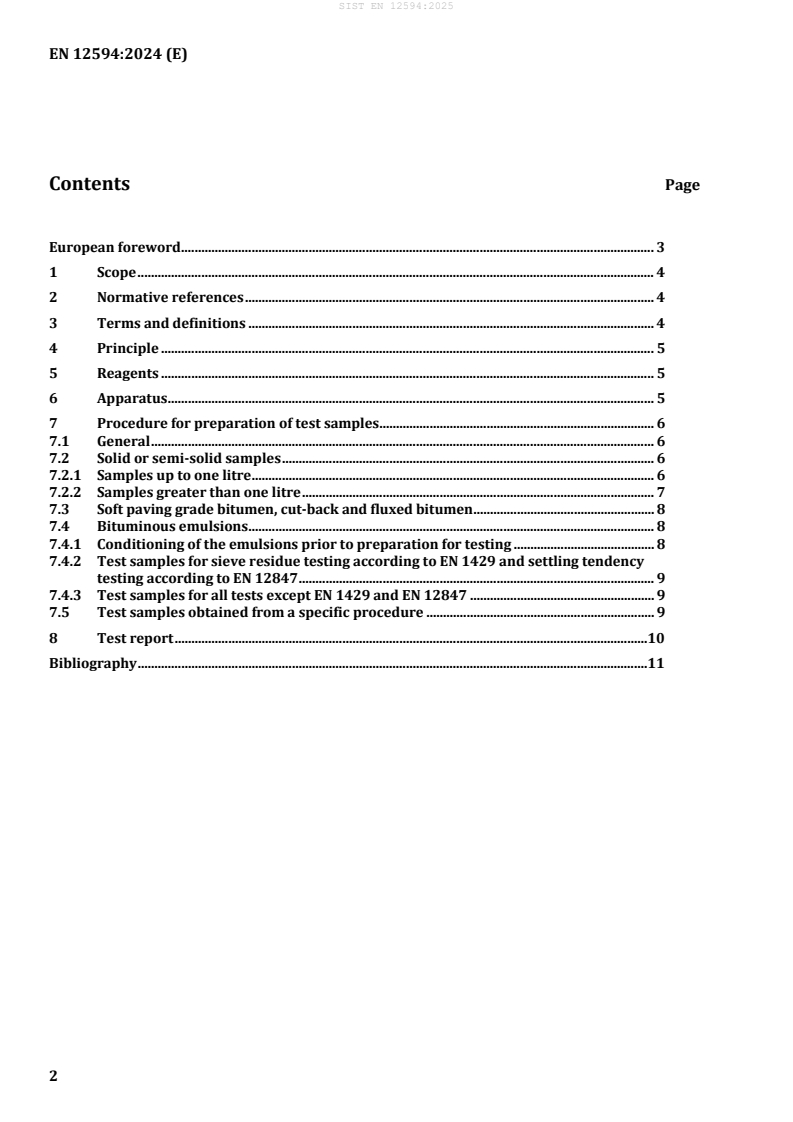
Contents Page
European foreword . 3
1 Scope . 4
2 Normative references . 4
3 Terms and definitions . 4
4 Principle . 5
5 Reagents . 5
6 Apparatus . 5
7 Procedure for preparation of test samples . 6
7.1 General . 6
7.2 Solid or semi-solid samples . 6
7.2.1 Samples up to one litre . 6
7.2.2 Samples greater than one litre . 7
7.3 Soft paving grade bitumen, cut-back and fluxed bitumen . 8
7.4 Bituminous emulsions . 8
7.4.1 Conditioning of the emulsions prior to preparation for testing . 8
7.4.2 Test samples for sieve residue testing according to EN 1429 and settling tendency
testing according to EN 12847 . 9
7.4.3 Test samples for all tests except EN 1429 and EN 12847 . 9
7.5 Test samples obtained from a specific procedure . 9
8 Test report .10
Bibliography .11
European foreword
This document (EN 12594:2024) has been prepared by Technical Committee CEN/TC 336 “Bitumens and
bituminous binders”, the secretariat of which is held by AFNOR.
This European Standard shall be given the status of a national standard, either by publication of an
identical text or by endorsement, at the latest by April 2025, and conflicting national standards shall be
withdrawn at the latest by April 2025.
Attention is drawn to the possibility that some of the elements of this document may be the subject of
patent rights. CEN shall not be held responsible for identifying any or all such patent rights.
This document supersedes EN 12594:2014.
— definitions of laboratory sample and test sample have been reviewed;
— definitions of test specimen and melting have been added;
— reference to most reageants and materials have been deleted as already covered in other standards;
— description of apparatus has been completed;
— procedure in Clause 7 has been modified to ensure consistency with test standards and to better
precise conditions, in particular heating time and heating temperatures;
— structure of 7.4 has been modified to facilitate its reading;
— recommendations on the storage of emulsions have been added.
Any feedback and questions on this document should be directed to the users’ national standards body.
A complete listing of these bodies can be found on the CEN website.
According to the CEN-CENELEC Internal Regulations, the national standards organisations of the
following countries are bound to implement this European Standard: Austria, Belgium, Bulgaria, Croatia,
Cyprus, Czech Republic, Denmark, Estonia, Finland, France, Germany, Greece, Hungary, Iceland, Ireland,
Italy, Latvia, Lithuania, Luxembourg, Malta, Netherlands, Norway, Poland, Portugal, Republic of North
Macedonia, Romania, Serbia, Slovakia, Slovenia, Spain, Sweden, Switzerland, Türkiye and the United
Kingdom.
1 Scope
This document specifies methods for preparing test samples of bitumens and bituminous binders in order
to test their properties.
WARNING — The use of this document can involve hazardous materials, operations and equipment. This
document does not purport to address all of the safety problems associated with its use. It is the
responsibility of the user of this document to establish appropriate safety and health practices and to
determine the applicability of regulatory limitations prior to use.
2 Normative references
The following documents are referred to in the text in such a way that some or all of their content
constitutes requirements of this document. For dated references, only the edition cited applies. For
undated references, the latest edition of the referenced document (including any amendments) applies.
EN 58, Bitumen and bituminous binders — Sampling bituminous binders
EN 1425, Bitumen and bituminous binders — Characterization of perceptible properties
EN 1427, Bitumen and bituminous binders — Determination of the softening point — Ring and Ball method
EN 1429:2013, Bitumen and bituminous binders — Determination of residue on sieving of bituminous
emulsions, and determination of storage stability by sieving
EN 12597, Bitumen and bituminous binders — Terminology
EN 12847, Bitumen and bituminous binders — Determination of settling tendency of bituminous emulsions
EN ISO 3696:1995, Water for analytical laboratory use — Specification and test methods (ISO 3696:1987)
ISO 3310-1:2016, Test sieves — Technical requirements and testing — Part 1: Test sieves of metal wire
cloth
3 Terms and definitions
For the purposes of this document, the terms and definitions given in EN 12597 and the following apply.
ISO and IEC maintain terminology databases for use in standardization at the following addresses:
— ISO Online browsing platform: available at https://www.iso.org/obp
— IEC Electropedia: available at https://www.electropedia.org
3.1
laboratory sample
sample of bitumen or bituminous binder taken in accordance with EN 58 and incoming into laboratory
for tests
Note 1 to entry: The term “laboratory sample” does not apply to samples from material containing bitumen and
bituminous binders, e.g. asphalt mixtures or cores, as they are sampled differently from those described in EN 58.
Note 2 to entry: The laboratory sample may be a spot sample, a composite sample, or a part thereof (a divided
sample).
3.2
test sample
sample produced by treatment or subdivision of a laboratory sample (3.1) for individual testing
Note 1 to entry: The same test sample can be treated to prepare various tests in parallel; some test methods need
preparation of test specimen, while for others a portion of the test sample will be used directly.
3.3
test specimen
specimen for specific tests prepared from a test sample (3.2)
Note 1 to entry: In principle, details on the test specimen preparation are described in the respective test
standards, where applicable, and are not within the scope of EN 12594. However, EN 12594 is covering common
areas like temperatures or duration of preparation.
3.4
melting
heating the sample to lower its viscosity and ensure homogeneity while preparing test samples (3.2) and
test specimens (3.3)
4 Principle
Incoming laboratory samples are prepared for testing depending on their type and their size. This
includes preparation of test specimens noting that more detailed information on their preparation may
also be given in test standards.
5 Reagents
Only reagents of recognized standard analytical grade and water conforming to grade 3 of
EN ISO 3696:1995 shall be used.
6 Apparatus
The usual laboratory apparatus and glassware, together with the following shall be used.
6.1 Ventilated laboratory oven with a maximum permissible measurement error of ±5 °C, checked in
working space at suitable intervals.
6.2 Indirect heating apparatus, e.g. heating jacket, oil bath with thermometer or equivalent.
6.3 Container of appropriate material (i.e. heat resistant and not interacting with the sample) to heat
the sample.
6.4 Lid or aluminium foil for container (6.3).
6.5 Any appropriate stirrer, e.g. manual (such as spatula), mechanical equipped with a propeller or
magnetic.
6.6 Metal sieve, mesh size 0,500 mm, in accordance with ISO 3310-1:2016.
6.7 Test sample container of appropriate material with a lid or other closure.
NOTE Test sample container can be the one originally used to sample the bituminous binder in accordance
with EN 58.
6.8 Test containers or moulds for test specimen preparation, as described in the respective test
standards, into which the test sample is transferred prior to testing. It may be that the test sample is not
stored in a test sample container (6.7) but directly transferred into moulds or test containers.
6.9 Cooling chamber, if necessary, allowing to condition the samples between 18 °C and 28 °C.
7 Procedure for preparation of test samples
7.1 General
In order to produce the laboratory sample, the material shall have been sampled in accordance with
EN 58.
Perceptible properties of the laboratory sample shall be checked in accordance with EN 1425, prior to
sample preparation according to this document.
7.2 Solid or semi-solid samples
7.2.1 Samples up to one litre
Ease the lid (6.4) or other closure of the container (6.3) and place the container with the lid loose in the
oven (6.1). The temperature of the oven shall be set at not more than (85 ± 5) °C above the expected
softening point measured in accordance with EN 1427; this includes the maximum permissible
measurement error described in 6.1.
For modified bitumen, use the procedure provided by the supplier. If no guidance is provided, for polymer
modified bitumen complying with EN 14023 [11], the temperature of the oven shall be set at (190 ± 5) °C,
irrespective from t
...