

SIST EN 1997-1:2024/oprA1:2026
(Amendment)Eurocode 7 - Geotechnical design - Part 1: General rules
General Information
- Abstract
1.1 Scope of EN 1997 1
(1) This document provides general rules for the design and verification of geotechnical structures.
(2) This document is applicable for the design and verification of geotechnical structures outside the scope of EN 1997 3.
NOTE In this case, additional or amended provisions can be necessary.
1.2 Assumptions
(1) In addition to the assumptions given in EN 1990, the provisions of EN 1997 (all parts) assume that:
— ground investigations are planned by individuals or organisations with knowledge of potential ground and groundwater conditions;
— ground investigations are executed by individuals with appropriate skills and experience;
— the evaluation of test results and derivation of ground properties from the ground investigation are carried out by individuals with appropriate geotechnical experience and qualifications;
— the data required for design are collected, recorded, and interpreted by appropriately qualified and experienced individuals;
— geotechnical structures are designed and verified by individuals with appropriate qualifications and experience in geotechnical design;
— adequate continuity and communication exist between the individuals involved in data collection, design, verification and execution.
(2) This document is intended to be used in conjunction with EN 1990, which establishes principles and requirements for the safety, serviceability, robustness, and durability of structures, including geotechnical structures, and other construction works.
NOTE Additional or amended provisions can be necessary for assessment of existing structures, see EN 1990 2.
(3) This document is intended to be used in conjunction with EN 1997 2, which gives provisions for determining ground properties from ground investigations.
(4) This document is intended to be used in conjunction with EN 1997 3, which gives specific rules for the design and verification of certain types of geotechnical structures.
(5) This document is intended to be used in conjunction with other Eurocodes for the design of geotechnical structures, including temporary geotechnical structures.
- Status
- Not Published
- Public Enquiry End Date
- 29-Jul-2026
- Technical Committee
- KON - Structures
- Current Stage
- 4020 - Public enquire (PE) (Adopted Project)
- Start Date
- 17-Jun-2026
- Due Date
- 04-Nov-2026

Overview
SIST EN 1997-1:2024/oprA1:2026 – Eurocode 7: Geotechnical Design – Part 1: General Rules sets out the general requirements for the design and verification of geotechnical structures. As a foundational European standard, it specifies the minimum principles and practices for ensuring the safety, serviceability, and durability of earthworks, excavations, foundation works, and all related underground construction. The 2026 draft amendment updates and clarifies several clauses in response to evolving engineering practices and regulatory frameworks.
This Eurocode is a key reference for geotechnical engineers, civil engineers, designers, and regulators working across Europe. Compliance helps ensure that geotechnical structures perform reliably throughout their operational life, meeting both local and EU construction standards.
Key Topics
- Design and Verification: Provides consistent rules for the design and checking of geotechnical structures outside the scope of EN 1997-3.
- Assumptions and Qualifications: Stipulates that ground investigations, data collection, and evaluations are carried out by qualified, experienced professionals, ensuring reliable determination of soil and material properties.
- Inter-disciplinary Coordination: Emphasizes the need for close coordination between site investigators, designers, and constructors for robust geotechnical design processes.
- Limit States and Safety: Aligns with the principles of EN 1990 and other Eurocodes in considering ultimate and serviceability limit states, robustness, and structural durability.
- Amendments and Updates: The 2026 draft introduces editorial improvements, updates references (e.g., to EN 1990 and EN 1991-1-1), and clarifies terminology for greater consistency and easier national adoption.
- Groundwater and Material Considerations: Includes guidance on the influence of groundwater, soil properties, and site-specific conditions on geotechnical performance.
- Quality Assurance: Focuses on minimizing the probability of human error and monitoring construction activities to ensure design intent is realized in practice.
Applications
SIST EN 1997-1:2024/oprA1:2026 applies to a broad range of geotechnical engineering projects within Europe, including:
- Earthworks and Excavations: Design of slopes, temporary and permanent excavations, embankments, and cuttings.
- Foundation Construction: Applicable to shallow and deep foundations for buildings, bridges, and industrial structures.
- Underground Works: Tunnels, shafts, retaining structures, and other sub-surface works benefit from the standard’s comprehensive approach to risk and performance.
- Dams and Water Retaining Structures: Offers criteria for critical structures where geotechnical failure could have widespread consequences, such as earth dams connected to energy plants or aqueducts.
- Verification of Existing Structures: Supports assessment and upgrading of existing geotechnical assets, in conjunction with EN 1990-2 and related standards.
- Temporary Works: Ensures that temporary geotechnical structures also meet core safety and functionality requirements during construction phases.
Implementation of this standard leads to:
- Improved structural safety and resilience against ground movements and water pressure.
- Greater reliability in foundation performance and earth retention.
- Enhanced compliance with regulatory and insurance requirements.
- Streamlined collaboration among industry professionals.
Related Standards
Projects designed under SIST EN 1997-1:2024/oprA1:2026 often reference additional documents to address broader aspects of geotechnical engineering:
- EN 1990-1:2023+A1:2026 – Basis of structural and geotechnical design.
- EN 1997-2:2024+A1:2026 – Ground investigations and determination of geotechnical properties.
- EN 1997-3:2025+A1:2026 – Specific rules for special geotechnical structures.
- EN 1991-1-1:2025 – Actions on structures including geotechnical actions.
- Other relevant Eurocodes governing structural, material, and product standards.
SIST EN 1997-1:2024/oprA1:2026 is an integral part of the Eurocode suite that ensures geotechnical design across Europe meets the highest standards of safety, quality, and performance.
Relations
- Effective Date
- 19-Nov-2025
Get Certified
Connect with accredited certification bodies for this standard

DIBt (Deutsches Institut für Bautechnik)
German Institute for Building Technology.
DIN CERTCO
DIN Group product certification.
Zavod za gradbeništvo Slovenije (ZAG) - Inšpekcija
ZAG inspection body for construction products, structures, and materials.
Sponsored listings
Frequently Asked Questions
SIST EN 1997-1:2024/oprA1:2026 is a draft published by the Slovenian Institute for Standardization (SIST). Its full title is "Eurocode 7 - Geotechnical design - Part 1: General rules". This standard covers: 1.1 Scope of EN 1997 1 (1) This document provides general rules for the design and verification of geotechnical structures. (2) This document is applicable for the design and verification of geotechnical structures outside the scope of EN 1997 3. NOTE In this case, additional or amended provisions can be necessary. 1.2 Assumptions (1) In addition to the assumptions given in EN 1990, the provisions of EN 1997 (all parts) assume that: — ground investigations are planned by individuals or organisations with knowledge of potential ground and groundwater conditions; — ground investigations are executed by individuals with appropriate skills and experience; — the evaluation of test results and derivation of ground properties from the ground investigation are carried out by individuals with appropriate geotechnical experience and qualifications; — the data required for design are collected, recorded, and interpreted by appropriately qualified and experienced individuals; — geotechnical structures are designed and verified by individuals with appropriate qualifications and experience in geotechnical design; — adequate continuity and communication exist between the individuals involved in data collection, design, verification and execution. (2) This document is intended to be used in conjunction with EN 1990, which establishes principles and requirements for the safety, serviceability, robustness, and durability of structures, including geotechnical structures, and other construction works. NOTE Additional or amended provisions can be necessary for assessment of existing structures, see EN 1990 2. (3) This document is intended to be used in conjunction with EN 1997 2, which gives provisions for determining ground properties from ground investigations. (4) This document is intended to be used in conjunction with EN 1997 3, which gives specific rules for the design and verification of certain types of geotechnical structures. (5) This document is intended to be used in conjunction with other Eurocodes for the design of geotechnical structures, including temporary geotechnical structures.
1.1 Scope of EN 1997 1 (1) This document provides general rules for the design and verification of geotechnical structures. (2) This document is applicable for the design and verification of geotechnical structures outside the scope of EN 1997 3. NOTE In this case, additional or amended provisions can be necessary. 1.2 Assumptions (1) In addition to the assumptions given in EN 1990, the provisions of EN 1997 (all parts) assume that: — ground investigations are planned by individuals or organisations with knowledge of potential ground and groundwater conditions; — ground investigations are executed by individuals with appropriate skills and experience; — the evaluation of test results and derivation of ground properties from the ground investigation are carried out by individuals with appropriate geotechnical experience and qualifications; — the data required for design are collected, recorded, and interpreted by appropriately qualified and experienced individuals; — geotechnical structures are designed and verified by individuals with appropriate qualifications and experience in geotechnical design; — adequate continuity and communication exist between the individuals involved in data collection, design, verification and execution. (2) This document is intended to be used in conjunction with EN 1990, which establishes principles and requirements for the safety, serviceability, robustness, and durability of structures, including geotechnical structures, and other construction works. NOTE Additional or amended provisions can be necessary for assessment of existing structures, see EN 1990 2. (3) This document is intended to be used in conjunction with EN 1997 2, which gives provisions for determining ground properties from ground investigations. (4) This document is intended to be used in conjunction with EN 1997 3, which gives specific rules for the design and verification of certain types of geotechnical structures. (5) This document is intended to be used in conjunction with other Eurocodes for the design of geotechnical structures, including temporary geotechnical structures.
SIST EN 1997-1:2024/oprA1:2026 is classified under the following ICS (International Classification for Standards) categories: 91.010.30 - Technical aspects; 93.020 - Earthworks. Excavations. Foundation construction. Underground works. The ICS classification helps identify the subject area and facilitates finding related standards.
SIST EN 1997-1:2024/oprA1:2026 has the following relationships with other standards: It is inter standard links to kSIST FprEN 1997-1:2024. Understanding these relationships helps ensure you are using the most current and applicable version of the standard.
SIST EN 1997-1:2024/oprA1:2026 is available in PDF format for immediate download after purchase. The document can be added to your cart and obtained through the secure checkout process. Digital delivery ensures instant access to the complete standard document.
Standards Content (Sample)
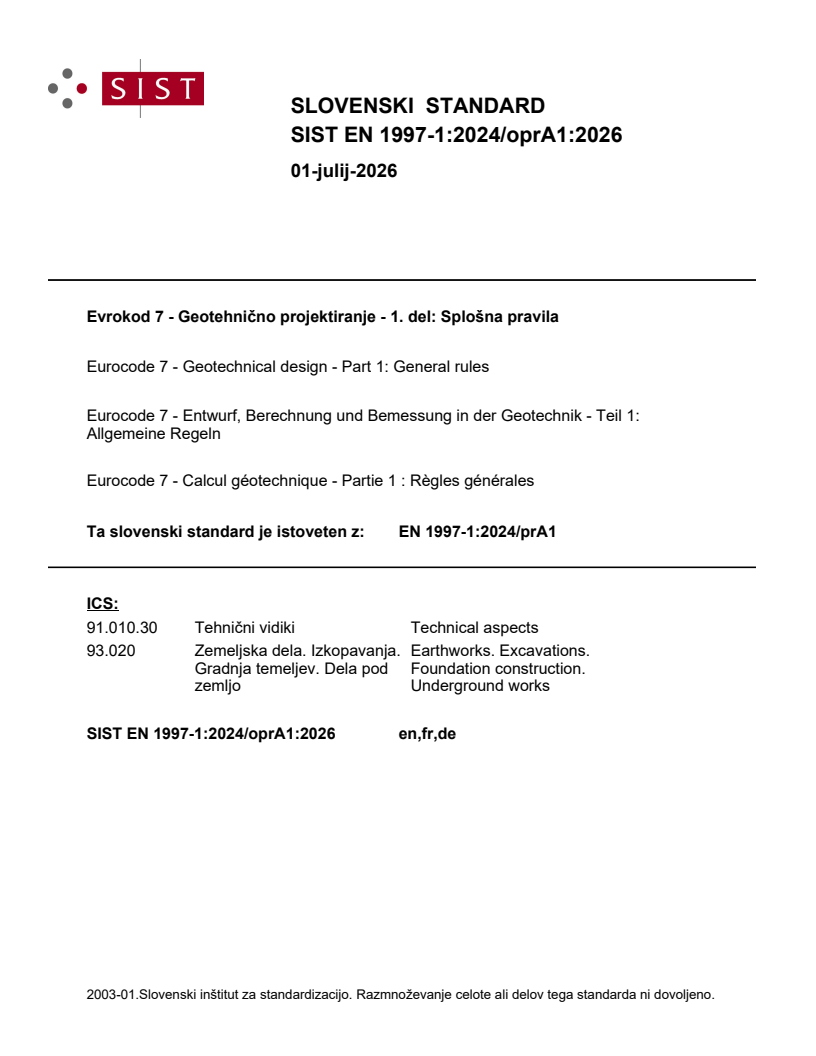
SLOVENSKI STANDARD
01-julij-2026
Evrokod 7 - Geotehnično projektiranje - 1. del: Splošna pravila
Eurocode 7 - Geotechnical design - Part 1: General rules
Eurocode 7 - Entwurf, Berechnung und Bemessung in der Geotechnik - Teil 1:
Allgemeine Regeln
Eurocode 7 - Calcul géotechnique - Partie 1 : Règles générales
Ta slovenski standard je istoveten z: EN 1997-1:2024/prA1
ICS:
91.010.30 Tehnični vidiki Technical aspects
93.020 Zemeljska dela. Izkopavanja. Earthworks. Excavations.
Gradnja temeljev. Dela pod Foundation construction.
zemljo Underground works
2003-01.Slovenski inštitut za standardizacijo. Razmnoževanje celote ali delov tega standarda ni dovoljeno.
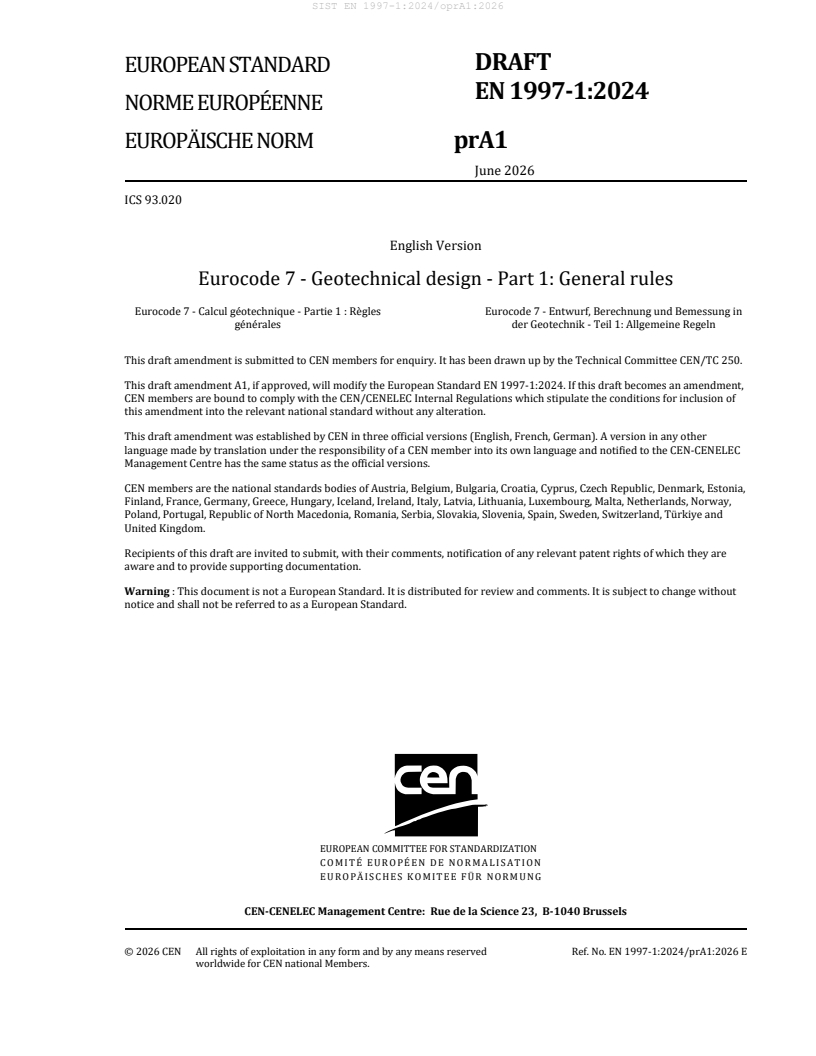
DRAFT
EUROPEAN STANDARD
EN 1997-1:2024
NORME EUROPÉENNE
EUROPÄISCHE NORM
prA1
June 2026
ICS 93.020
English Version
Eurocode 7 - Geotechnical design - Part 1: General rules
Eurocode 7 - Calcul géotechnique - Partie 1 : Règles Eurocode 7 - Entwurf, Berechnung und Bemessung in
générales der Geotechnik - Teil 1: Allgemeine Regeln
This draft amendment is submitted to CEN members for enquiry. It has been drawn up by the Technical Committee CEN/TC 250.
This draft amendment A1, if approved, will modify the European Standard EN 1997-1:2024. If this draft becomes an amendment,
CEN members are bound to comply with the CEN/CENELEC Internal Regulations which stipulate the conditions for inclusion of
this amendment into the relevant national standard without any alteration.
This draft amendment was established by CEN in three official versions (English, French, German). A version in any other
language made by translation under the responsibility of a CEN member into its own language and notified to the CEN-CENELEC
Management Centre has the same status as the official versions.
CEN members are the national standards bodies of Austria, Belgium, Bulgaria, Croatia, Cyprus, Czech Republic, Denmark, Estonia,
Finland, France, Germany, Greece, Hungary, Iceland, Ireland, Italy, Latvia, Lithuania, Luxembourg, Malta, Netherlands, Norway,
Poland, Portugal, Republic of North Macedonia, Romania, Serbia, Slovakia, Slovenia, Spain, Sweden, Switzerland, Türkiye and
United Kingdom.
Recipients of this draft are invited to submit, with their comments, notification of any relevant patent rights of which they are
aware and to provide supporting documentation.
Warning : This document is not a European Standard. It is distributed for review and comments. It is subject to change without
notice and shall not be referred to as a European Standard.
EUROPEAN COMMITTEE FOR STANDARDIZATION
COMITÉ EUROPÉEN DE NORMALISATION
EUROPÄISCHES KOMITEE FÜR NORMUNG
CEN-CENELEC Management Centre: Rue de la Science 23, B-1040 Brussels
© 2026 CEN All rights of exploitation in any form and by any means reserved Ref. No. EN 1997-1:2024/prA1:2026 E
worldwide for CEN national Members.
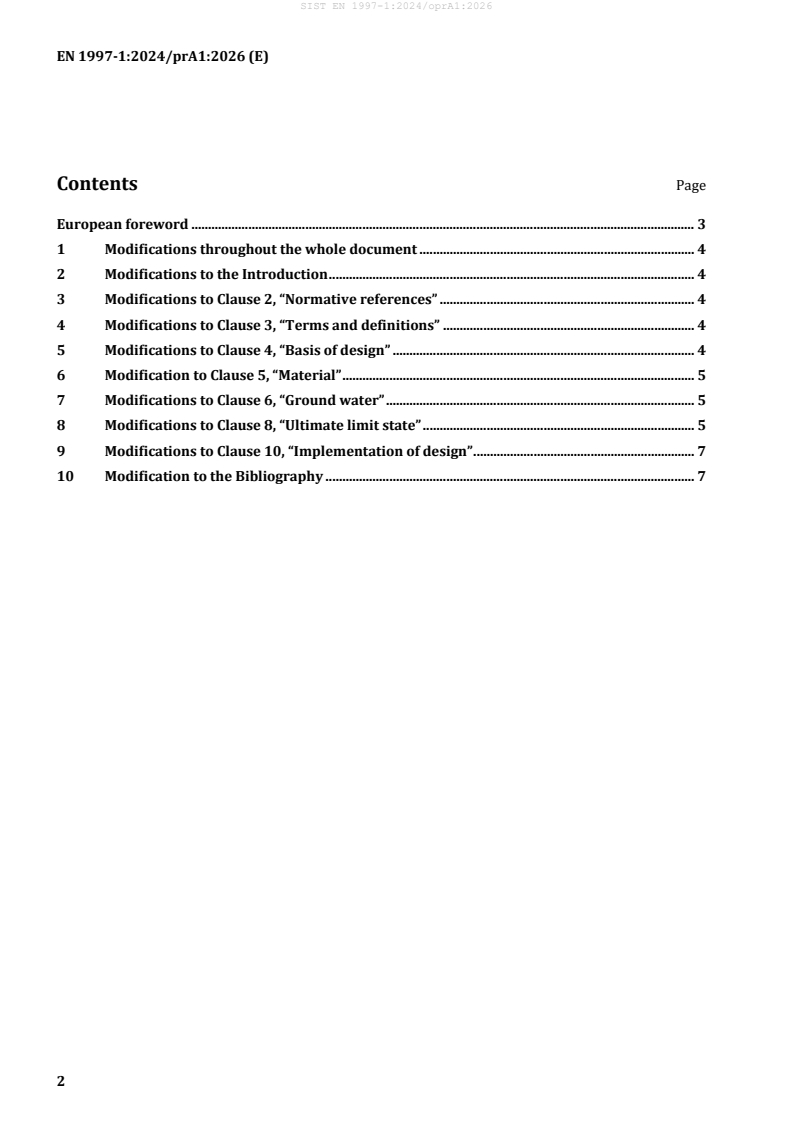
Contents Page
European foreword . 3
1 Modifications throughout the whole document . 4
2 Modifications to the Introduction . 4
3 Modifications to Clause 2, “Normative references” . 4
4 Modifications to Clause 3, “Terms and definitions” . 4
5 Modifications to Clause 4, “Basis of design” . 4
6 Modification to Clause 5, “Material” . 5
7 Modifications to Clause 6, “Ground water” . 5
8 Modifications to Clause 8, “Ultimate limit state” . 5
9 Modifications to Clause 10, “Implementation of design” . 7
10 Modification to the Bibliography . 7
European foreword
This document (EN 1997-1:2024/prA1:2026) has been prepared by Technical Committee CEN/TC 250
“Structural Eurocodes”, the secretariat of which is held by BSI. CEN/TC 250 is responsible for all
Structural Eurocodes and has been assigned responsibility for structural and geotechnical design matters
by CEN.
This document is currently submitted to the CEN Enquiry.
This document will amend EN 1997-1:2024.
NOTE Some modifications are purely editorial corrections to improve
...