

SIST EN 17192:2026
(Main)Ventilation for buildings - Ductwork - Non-metallic ductwork - Requirements and test methods
General Information
- Abstract
This document specifies the requirements and test methods for rigid or semi-rigid non-metallic ductwork which are used for ventilation and air conditioning in buildings and excludes flexible ducts and ductwork made from insulation duct board.
The specified test methods are under laboratory conditions and exclude on-site tests.
- Status
- Published
- Public Enquiry End Date
- 31-Oct-2024
- Publication Date
- 15-Mar-2026
- Technical Committee
- OGS - Heating for buildings
- Current Stage
- 6060 - National Implementation/Publication (Adopted Project)
- Start Date
- 04-Mar-2026
- Due Date
- 09-May-2026
- Completion Date
- 16-Mar-2026

Overview
SIST EN 17192:2026 is a European Standard developed by CEN, specifying the requirements and test methods for rigid or semi-rigid non-metallic ductwork used in building ventilation and air conditioning systems. This standard excludes flexible ducts and ductwork fabricated from insulation duct board. The document defines laboratory-based criteria and testing procedures for key ductwork properties to ensure safety, durability, and operational efficiency. As non-metallic ductwork gains prominence in modern HVAC systems, compliance with SIST EN 17192:2026 is essential for manufacturers, designers, and contractors across Europe to meet regulatory and performance requirements.
Key Topics
SIST EN 17192:2026 addresses several critical aspects of non-metallic ductwork for ventilation and air conditioning, including:
- Air Tightness: Outlines classes (ATC 1–7) and limits for leakage rates to control energy efficiency and indoor air quality.
- Pressure Loss: Sets the requirement for manufacturers to declare pressure losses for ducts and components, essential for sizing and system design.
- Operating Temperature: Specifies required ranges for minimum and maximum temperatures (STL/ STH) for safe operation of ductwork.
- Reaction to Fire: Requires testing and classification according to EN 13501-1 and EN ISO 11925-2, aligning with European fire safety standards.
- Resistance to External Pressure: Establishes methods to measure a duct’s resistance to deformation when subjected to external forces.
- Microbial Resistance: Calls for evaluation of resistance to microbial growth per EN ISO 846 or ISO 22196 to maintain hygiene standards.
- Dimensional Tolerances: Requires manufacturers to specify dimensions, minimum bending radius (for semi-rigid types), and permissible tolerances.
- Product Documentation and Marking: Mandates comprehensive installation/maintenance manuals and clear labelling on products or packaging.
Applications
SIST EN 17192:2026 is crucial wherever rigid or semi-rigid non-metallic ductwork is used for building ventilation or air conditioning:
- Commercial Buildings: Offices, retail centers, and public facilities benefit from high-performance, non-corrosive ductwork complying with air tightness and fire safety requirements.
- Residential Buildings: Ensures safe, efficient, and hygienic air distribution in homes and apartment complexes.
- Healthcare and Cleanrooms: Provides a foundation for clean air delivery systems where microbial resistance is critical.
- Industrial Facilities: Supports durable and efficient HVAC ducting in industrial environments, where material non-reactivity is beneficial.
- Sustainability and Retrofits: Non-metallic ductwork compliant with SIST EN 17192:2026 supports energy-efficient renovations and sustainable construction.
Related Standards
Several European and international standards complement and enrich the scope of SIST EN 17192:2026:
- EN 16798-3: Performance requirements for ventilation and room-conditioning systems in non-residential buildings.
- EN 13501-1: Fire classification of construction products and building elements.
- EN ISO 11925-2: Fire tests - Ignitability of products by direct flame.
- EN ISO 846 / ISO 22196: Evaluation of resistance to micro-organisms.
- EN 1507 / EN 12237: Requirements for metallic ducts, particularly for strength and air leakage.
- EN 12792 / EN 14239: Symbols, terminology, and measurement of duct surface area.
- EN 13180: Specifications for flexible ducts (outside scope of SIST EN 17192:2026 but relevant for system integration).
- EN 13403: Ductwork made from insulation ductboards (explicitly excluded in scope, but may be referenced in project documentation).
By adopting SIST EN 17192:2026, organizations support high standards for performance, safety, and environmental responsibility in modern building ventilation systems. Compliance also facilitates trade and regulatory approval across the European market for non-metallic ductwork components.
Relations
- Effective Date
- 01-May-2026
- Effective Date
- 15-Jul-2026
- Effective Date
- 15-Jul-2026
- Effective Date
- 15-Jul-2026
- Effective Date
- 15-Jul-2026
- Effective Date
- 15-Jul-2026
- Effective Date
- 15-Jul-2026
- Effective Date
- 15-Jul-2026
- Effective Date
- 01-Jul-2026
- Effective Date
- 11-Mar-2026
Get Certified
Connect with accredited certification bodies for this standard

DIBt (Deutsches Institut für Bautechnik)
German Institute for Building Technology.
DIN CERTCO
DIN Group product certification.

Aboma Certification B.V.
Specialized in construction, metal, and transport sectors.
Sponsored listings
Frequently Asked Questions
SIST EN 17192:2026 is a standard published by the Slovenian Institute for Standardization (SIST). Its full title is "Ventilation for buildings - Ductwork - Non-metallic ductwork - Requirements and test methods". This standard covers: This document specifies the requirements and test methods for rigid or semi-rigid non-metallic ductwork which are used for ventilation and air conditioning in buildings and excludes flexible ducts and ductwork made from insulation duct board. The specified test methods are under laboratory conditions and exclude on-site tests.
This document specifies the requirements and test methods for rigid or semi-rigid non-metallic ductwork which are used for ventilation and air conditioning in buildings and excludes flexible ducts and ductwork made from insulation duct board. The specified test methods are under laboratory conditions and exclude on-site tests.
SIST EN 17192:2026 is classified under the following ICS (International Classification for Standards) categories: 91.140.30 - Ventilation and air-conditioning systems. The ICS classification helps identify the subject area and facilitates finding related standards.
SIST EN 17192:2026 has the following relationships with other standards: It is inter standard links to SIST EN 17192:2019, SIST EN ISO 11925-2:2026, SIST EN 12792:2004, SIST EN ISO 1182:2020, SIST EN 1507:2006, SIST EN 12237:2004, SIST EN ISO 846:2019, SIST EN ISO 1716:2018, SIST EN 13823:2020+A1:2022, SIST EN 13501-1:2019. Understanding these relationships helps ensure you are using the most current and applicable version of the standard.
SIST EN 17192:2026 is available in PDF format for immediate download after purchase. The document can be added to your cart and obtained through the secure checkout process. Digital delivery ensures instant access to the complete standard document.
Standards Content (Sample)
SLOVENSKI STANDARD
01-maj-2026
Nadomešča:
SIST EN 17192:2019
Prezračevanje stavb - Kanali - Nekovinski kanali - Zahteve in preskusne metode
Ventilation for buildings - Ductwork - Non-metallic ductwork - Requirements and test
methods
Lüftung von Gebäuden - Nichtmetallische Kanäle - Anforderungen und Prüfmethoden
Ventilation des bâtiments - Réseau de conduits - Réseau de conduits non métalliques -
Exigences et méthodes d'essai
Ta slovenski standard je istoveten z: EN 17192:2026
ICS:
91.140.30 Prezračevalni in klimatski Ventilation and air-
sistemi conditioning systems
2003-01.Slovenski inštitut za standardizacijo. Razmnoževanje celote ali delov tega standarda ni dovoljeno.
EN 17192
EUROPEAN STANDARD
NORME EUROPÉENNE
February 2026
EUROPÄISCHE NORM
ICS 91.140.30 Supersedes EN 17192:2018
English Version
Ventilation for buildings - Ductwork - Non-metallic
ductwork - Requirements and test methods
Ventilation des bâtiments - Réseau de conduits - Lüftung von Gebäuden - Nichtmetallische Kanäle -
Réseau de conduits non métalliques - Exigences et Anforderungen und Prüfmethoden
méthodes d'essai
This European Standard was approved by CEN on 12 January 2026.
CEN members are bound to comply with the CEN/CENELEC Internal Regulations which stipulate the conditions for giving this
European Standard the status of a national standard without any alteration. Up-to-date lists and bibliographical references
concerning such national standards may be obtained on application to the CEN-CENELEC Management Centre or to any CEN
member.
This European Standard exists in three official versions (English, French, German). A version in any other language made by
translation under the responsibility of a CEN member into its own language and notified to the CEN-CENELEC Management
Centre has the same status as the official versions.
CEN members are the national standards bodies of Austria, Belgium, Bulgaria, Croatia, Cyprus, Czech Republic, Denmark, Estonia,
Finland, France, Germany, Greece, Hungary, Iceland, Ireland, Italy, Latvia, Lithuania, Luxembourg, Malta, Netherlands, Norway,
Poland, Portugal, Republic of North Macedonia, Romania, Serbia, Slovakia, Slovenia, Spain, Sweden, Switzerland, Türkiye and
United Kingdom.
EUROPEAN COMMITTEE FOR STANDARDIZATION
COMITÉ EUROPÉEN DE NORMALISATION
EUROPÄISCHES KOMITEE FÜR NORMUNG
CEN-CENELEC Management Centre: Rue de la Science 23, B-1040 Brussels
© 2026 CEN All rights of exploitation in any form and by any means reserved Ref. No. EN 17192:2026 E
worldwide for CEN national Members.
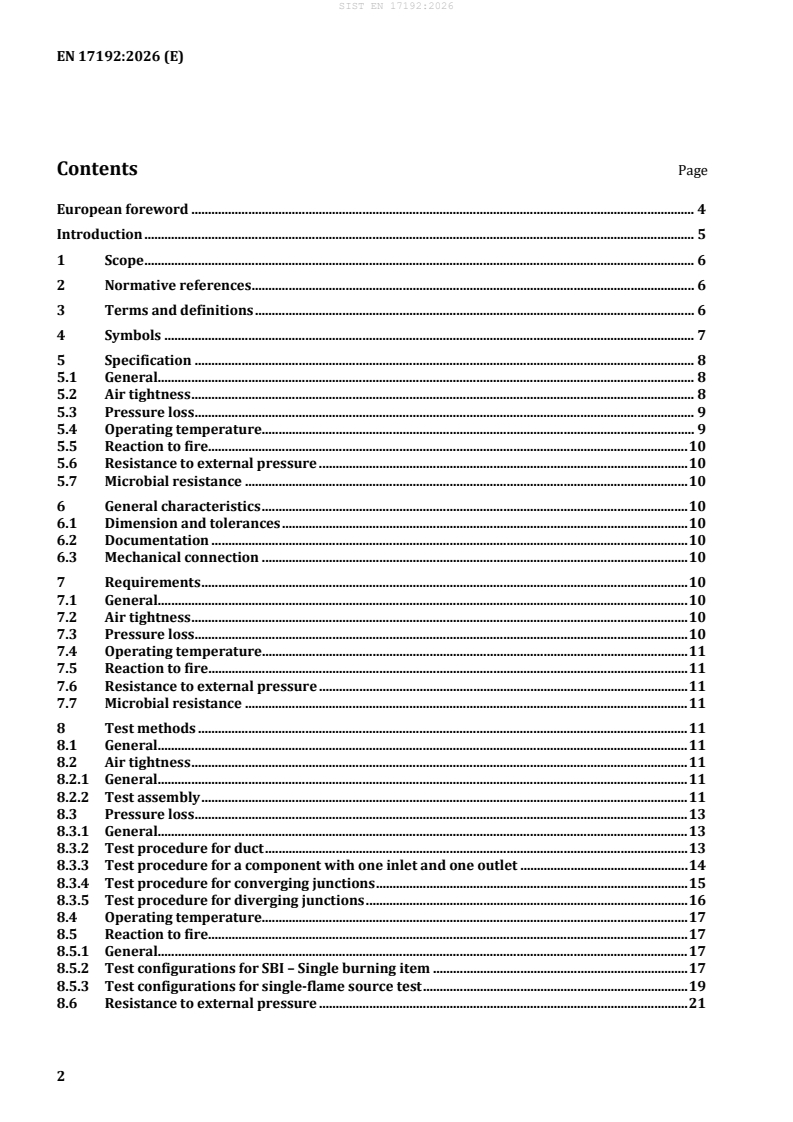
Contents Page
European foreword . 4
Introduction . 5
1 Scope . 6
2 Normative references . 6
3 Terms and definitions . 6
4 Symbols . 7
5 Specification . 8
5.1 General. 8
5.2 Air tightness . 8
5.3 Pressure loss . 9
5.4 Operating temperature . 9
5.5 Reaction to fire. 10
5.6 Resistance to external pressure . 10
5.7 Microbial resistance . 10
6 General characteristics . 10
6.1 Dimension and tolerances . 10
6.2 Documentation . 10
6.3 Mechanical connection . 10
7 Requirements . 10
7.1 General. 10
7.2 Air tightness . 10
7.3 Pressure loss . 10
7.4 Operating temperature . 11
7.5 Reaction to fire. 11
7.6 Resistance to external pressure . 11
7.7 Microbial resistance . 11
8 Test methods . 11
8.1 General. 11
8.2 Air tightness . 11
8.2.1 General. 11
8.2.2 Test assembly . 11
8.3 Pressure loss . 13
8.3.1 General. 13
8.3.2 Test procedure for duct . 13
8.3.3 Test procedure for a component with one inlet and one outlet . 14
8.3.4 Test procedure for converging junctions . 15
8.3.5 Test procedure for diverging junctions . 16
8.4 Operating temperature . 17
8.5 Reaction to fire. 17
8.5.1 General. 17
8.5.2 Test configurations for SBI – Single burning item . 17
8.5.3 Test configurations for single-flame source test . 19
8.6 Resistance to external pressure . 21
8.6.1 General . 21
8.6.2 Test rig . 22
8.6.3 Measurement of deformation force F . 22
8.7 Microbial resistance . 23
9 Product information . 23
9.1 Documentation . 23
9.2 Marking and labelling . 24
Bibliography . 25
European foreword
This document (EN 17192:2026) has been prepared by Technical Committee CEN/TC 156 “Ventilation
of buildings”, the secretariat of which is held by BSI.
This European Standard shall be given the status of a national standard, either by publication of an
identical text or by endorsement, at the latest by August 2026, and conflicting national standards shall be
withdrawn at the latest by August 2026.
Attention is drawn to the possibility that some of the elements of this document may be the subject of
patent rights. CEN shall not be held responsible for identifying any or all such patent rights.
This document supersedes EN 17192:2019.
— Reaction to fire tests have been updated with classifications D and E, the tests are in accordance with
the single-flame source test, according to EN ISO 11925-2.
— The thermal resistance test has been removed because it is not possible to perform this test on other
than flat materials. A thermal resistance test for non-metallic ducts can be added if a suitable method
is developed.
— Overarching requirements for the air tightness classes of the ventilation system for non-residential
buildings are given in EN 16798-3.
Any feedback and questions on this document should be directed to the users’ national standards body.
A complete listing of these bodies can be found on the CEN website.
According to the CEN-CENELEC Internal Regulations, the national standards organisations of the
following countries are bound to implement this European Standard: Austria, Belgium, Bulgaria, Croatia,
Cyprus, Czech Republic, Denmark, Estonia, Finland, France, Germany, Greece, Hungary, Iceland, Ireland,
Italy, Latvia, Lithuania, Luxembourg, Malta, Netherlands, Norway, Poland, Portugal, Republic of North
Macedonia, Romania, Serbia, Slovakia, Slovenia, Spain, Sweden, Switzerland, Türkiye and the United
Kingdom.
Introduction
This document specifies the requirements and test methods for non-metallic ductwork and has been
developed after the standards for metallic ductwork, flexible ducts and ductwork made from insulation
duct board.
1 Scope
This document specifies the requirements and test methods for rigid or semi-rigid non-metallic ductwork
which are used for ventilation and air conditioning in buildings and excludes flexible ducts and ductwork
made from insulation duct board.
The specified test methods are under laboratory conditions and exclude on-site tests.
2 Normative references
The following documents are referred to in the text in such a way that some or all of their content
constitutes requirements of this document. For dated references, only the edition cited applies. For
undated references, the latest edition of the referenced document (including any amendments) applies.
EN 1507, Ventilation for buildings — Sheet metal air ducts with rectangular section — Requirements for
strength and leakage
EN 12237, Ventilation for buildings — Ductwork — Strength and leakage of circular sheet metal ducts
EN 12792, Ventilation for buildings — Symbols, terminology and graphical symbols
EN 13501-1, Fire classification of construction products and building elements — Part 1: Classification
using data from reaction to fire tests
EN 13823, Reaction to fire tests for building products — Building products excluding floorings exposed to
the thermal attack by a single burning item
EN ISO 846, Plastics — Evaluation of the action of microorganisms (ISO 846)
EN ISO 1182, Reaction to fire tests for products — Non-combustibility test (ISO 1182)
EN ISO 1716, Reaction to fire tests for products — Determination of the gross heat of combustion (calorific
value) (ISO 1716)
ISO 22196, Measurement of antibacterial activity on plastics and other non-porous surfaces
EN ISO 11925-2, Reaction to fire tests — Ignitability of products subjected to direct impingement of flame
— Part 2: Single-flame source test (ISO 11925-2)
3 Terms and definitions
For the purposes of this document, the terms and definitions given in EN 12792 and the following apply.
ISO and IEC maintain terminology databases for use in standardization at the following addresses:
— ISO Online browsing platform: available at https://www.iso.org/obp/
— IEC Electropedia: available at https://www.electropedia.org/
3.1
ductwork
system of ducts and their components for the transport of air
3.2
rigid duct
duct which cannot be longitudinally compressed or decompressed and cannot be flexed in any direction
without permanently damaging the cross sectional area
3.3
semi-rigid ductwork
duct which cannot be longitudinally compressed or decompressed but can be flexed in at least one
direction without permanently damaging the cross sectional area
3.4
bending radius
centreline radius after bending a duct
3.5
sealed connection length
length of the perimeter where a duct or component is connected with another duct or component
3.6
maximum operating temperature
STH
highest temperature at which the ductwork can be used
3.7
minimum operating temperature
STL
lowest temperature at which the ductwork can be used
3.8
pressure loss
difference between total pressure upstream and downstream of component or duct
3.9
purpose-designed sealing solution
sealing solution engineered and supplied by the manufacturer
3.10
purpose-designed connection solution
connection solution of the ductwork engineered and supplied by the manufacturer
3.11
manufacturer
any natural or legal person who manufactures a construction product or who has such a product designed
or manufactured and markets that product under his name or trademark
4 Symbols
Nomenclature shown in Table 1 is used throughout this document.
Table 1 — Symbols
Symbol Quantity Units
A Product surface area m
p
d Hydraulic diameter m
h
Lsc Sealed connection length m
A Internal surface area m
s
3 -1 -2
f Air leakage factor m ·s ·m
c
3 -1 -2
f Limits leakage rate m ·s ·m
max
p Atmospheric pressure Pa
a
p Static gauge pressure Pa
s
p Static test pressure Pa
t
3 -1
q Measured air leakage volume rate m ·s
vl measured
3 -1
q Leakage volume rate of air flow m ·s
vl
t Air temperature °C
5 Specification
5.1 General
The following characteristics are specified in this document:
— air tightness;
— pressure loss;
— operating temperature;
— reaction to fire;
— resistance to external pressure;
— microbial resistance.
5.2 Air tightness
The air tightness classes and the limits for the leakage rate are specified in Table 2.
Table 2 — Air tightness classes
Air tightness class Air leakage limit
f
max
3 -1 -2
EN 16798-3:2017 m ·s ·m
ATC 7 Not classified
0,65 −3
ATC 6 0,067 5 · p · 10
t
0,65 −3
ATC 5 0,027 · p · 10
t
0,65 −3
ATC 4 0,009 · p · 10
t
0,65 −3
ATC 3 0,003 · p · 10
t
0,65 −3
ATC 2 0,001 · p · 10
t
0,65 −3
ATC 1 0,000 33 · pt · 10
NOTE The default value is ATC 7 if no leakage is measured.
The operating pressure range of the ductwork is defined by negative and positive pressures.
The air tightness class shall be declared together with the operating pressure range. The declared air
tightness class shall be valid for the specified operating pressure range.
The operating pressure range shall be declared in increments of 10 Pa together with the air tightness
class.
EXAMPLE
Example declaration:
Operating pressure range Air tightness class declared
−20 Pa to +50 Pa ATC 2
−60 Pa to +260 Pa ATC 4
−40 Pa to +110 Pa ATC 3
Example explanation:
At an operating pressure of 40 Pa, air tightness class is ATC 2.
At an operating pressure of 125 Pa, air tightness class is ATC 4.
At an operating pressure of 90 Pa, air tightness class is ATC 3.
5.3 Pressure loss
The pressure loss shall be declared for every duct and component of the ductwork.
5.4 Operating temperature
The temperature class defines the range of the operating temperature for the use of the ventilation
ductwork. The designation for the lowest operating temperature is STL and for the highest operating
temperature STH.
The designation is followed by the operating temperature.
...