

SIST EN 13141-5:2021
(Main)Ventilation for buildings - Performance testing of components/products for residential ventilation - Part 5: Cowls, assisted cowls and roof outlet terminal devices
General Information
- Abstract
This document specifies methods for measuring:
- the aerodynamic characteristics of cowls, fan assisted cowls and roof outlets;
- the electrical and acoustic characteristics of fan assisted cowls.
This document is applicable to cowls, assisted cowls and roof outlets used in natural, hybrid or mechanical ventilation and that are meant to be fitted onto ducts which project above the roof surface.
This document does not apply to:
- assisted cowls assisted by a device other than a fan (e.g. injection assisted cowls);
- roof exhaust fans (see EN 13141-4).
- Status
- Published
- Public Enquiry End Date
- 03-Jul-2019
- Publication Date
- 06-Dec-2020
- Technical Committee
- OGS - Heating for buildings
- Current Stage
- 6060 - National Implementation/Publication (Adopted Project)
- Start Date
- 06-Nov-2020
- Due Date
- 11-Jan-2021
- Completion Date
- 07-Dec-2020



Overview
EN 13141-5:2020 - published by CEN - specifies laboratory methods for performance testing of cowls, fan assisted cowls and roof outlet terminal devices used in residential ventilation. The standard defines procedures to measure the aerodynamic characteristics of cowls and roof outlets, and the electrical and acoustic characteristics of fan assisted cowls. It applies to devices fitted on ducts that project above the roof surface and is intended for natural, hybrid or mechanical ventilation systems. Exclusions: assisted cowls that use non-fan devices (e.g. injection-assisted) and roof exhaust fans (covered by EN 13141-4).
Key topics and technical requirements
- Aerodynamic testing (Clause 5): Test installation layout, flow stabilization, test duct sizing and minimum lengths, pressure drop measurement and characterization, and evaluation of the cowl’s suction effect under different wind conditions. Wind tunnel use is covered where applicable.
- Electrical testing (Clause 6): Measurement of electrical power input for fan assisted cowls with defined test installations and uncertainty requirements.
- Acoustic testing (Clause 7): Procedures to determine radiated outdoor sound power and in-duct sound power levels for assisted cowls, referencing standardized acoustic methods.
- Test reporting (Clause 8): Required content for aerodynamic, electrical and acoustic test results so manufacturers and test labs can deliver consistent, auditable reports.
- Normative references: EN 12792 (terminology), EN ISO 5801 (fan testing), EN ISO 5136 (in-duct acoustics), EN ISO 7235 and ISO 13347 series for acoustic measurement methods, and EN ISO/IEC 17025 for laboratory competence.
- Updates vs previous edition: Addition of assisted cowls, refined wind and suction test methods, modified pressure-drop correction, and new combined wind+fan testing methods.
Applications and users
- Manufacturers of cowls and roof outlet devices - to verify product performance and compliance.
- Independent testing laboratories - implementing standardized aerodynamic, electrical and acoustic test setups.
- HVAC designers and consultants - to select and specify terminal devices for residential natural, hybrid or mechanical ventilation systems.
- Regulators and certification bodies - for product evaluation, labeling and conformity assessment.
- Installers and building owners - to understand performance implications of roof-mounted terminals under wind and fan operation.
Related standards
- EN 13141 series (other parts for air terminal devices, fans, units)
- EN 13141-4 (roof exhaust fans)
- EN ISO 5801, EN ISO 5136, EN ISO 7235, EN 12792, EN ISO/IEC 17025
Keywords: EN 13141-5:2020, cowls, assisted cowls, fan assisted cowls, roof outlet terminal devices, ventilation performance testing, aerodynamic characteristics, acoustic testing, electrical testing, residential ventilation, CEN.
Relations
- Effective Date
- 01-Jan-2021
- Effective Date
- 28-Jan-2026
- Effective Date
- 28-Jan-2026
- Effective Date
- 28-Jan-2026
- Effective Date
- 28-Jan-2026
- Effective Date
- 28-Jan-2026
- Effective Date
- 28-Jan-2026
- Effective Date
- 28-Jan-2026
- Effective Date
- 28-Jan-2026
- Effective Date
- 09-Feb-2026
- Effective Date
- 28-Jan-2026
- Effective Date
- 28-Jan-2026
- Effective Date
- 28-Jan-2026
- Effective Date
- 28-Jan-2026
- Effective Date
- 28-Jan-2026
Get Certified
Connect with accredited certification bodies for this standard

DIBt (Deutsches Institut für Bautechnik)
German Institute for Building Technology.
DIN CERTCO
DIN Group product certification.

Aboma Certification B.V.
Specialized in construction, metal, and transport sectors.
Sponsored listings
Frequently Asked Questions
SIST EN 13141-5:2021 is a standard published by the Slovenian Institute for Standardization (SIST). Its full title is "Ventilation for buildings - Performance testing of components/products for residential ventilation - Part 5: Cowls, assisted cowls and roof outlet terminal devices". This standard covers: This document specifies methods for measuring: - the aerodynamic characteristics of cowls, fan assisted cowls and roof outlets; - the electrical and acoustic characteristics of fan assisted cowls. This document is applicable to cowls, assisted cowls and roof outlets used in natural, hybrid or mechanical ventilation and that are meant to be fitted onto ducts which project above the roof surface. This document does not apply to: - assisted cowls assisted by a device other than a fan (e.g. injection assisted cowls); - roof exhaust fans (see EN 13141-4).
This document specifies methods for measuring: - the aerodynamic characteristics of cowls, fan assisted cowls and roof outlets; - the electrical and acoustic characteristics of fan assisted cowls. This document is applicable to cowls, assisted cowls and roof outlets used in natural, hybrid or mechanical ventilation and that are meant to be fitted onto ducts which project above the roof surface. This document does not apply to: - assisted cowls assisted by a device other than a fan (e.g. injection assisted cowls); - roof exhaust fans (see EN 13141-4).
SIST EN 13141-5:2021 is classified under the following ICS (International Classification for Standards) categories: 91.140.30 - Ventilation and air-conditioning systems. The ICS classification helps identify the subject area and facilitates finding related standards.
SIST EN 13141-5:2021 has the following relationships with other standards: It is inter standard links to SIST EN 13141-5:2005, SIST EN 15895:2011, SIST EN ISO/IEC 17025:2017, SIST EN ISO 3449:2008, oSIST prEN 16282-8:2011, SIST EN ISO 7235:2009, SIST EN ISO 5801:2018, SIST EN ISO 5136:2009, SIST EN 12792:2004, SIST EN IEC 63403-2:2024, SIST EN ISO 28399:2021, SIST EN 15242:2007, SIST EN 13142:2013, SIST EN 16798-7:2018, SIST EN 13142:2021. Understanding these relationships helps ensure you are using the most current and applicable version of the standard.
SIST EN 13141-5:2021 is associated with the following European legislation: EU Directives/Regulations: 2002-01-2013, 305/2011. When a standard is cited in the Official Journal of the European Union, products manufactured in conformity with it benefit from a presumption of conformity with the essential requirements of the corresponding EU directive or regulation.
SIST EN 13141-5:2021 is available in PDF format for immediate download after purchase. The document can be added to your cart and obtained through the secure checkout process. Digital delivery ensures instant access to the complete standard document.
Standards Content (Sample)
SLOVENSKI STANDARD
01-januar-2021
Nadomešča:
SIST EN 13141-5:2005
Prezračevanje stavb - Preskušanje lastnosti sestavnih delov/izdelkov za
prezračevanje stanovanjskih stavb - 5. del: Prezračevalne kape in odvodniki na
strehah
Ventilation for buildings - Performance testing of components/products for residential
ventilation - Part 5: Cowls, assisted cowls and roof outlet terminal devices
Lüftung von Gebäuden - Leistungsprüfung von Bauteilen/Produkten für die Lüftung von
Wohnungen - Teil 5: Hauben und Dach-Fortluftdurchlässe
Ventilation des bâtiments - Essais de performance des composants/produits pour la
ventilation des logements - Partie 5 : Extracteurs statiques, extracteurs statiques
assistés et dispositifs de sortie en toiture
Ta slovenski standard je istoveten z: EN 13141-5:2020
ICS:
91.140.30 Prezračevalni in klimatski Ventilation and air-
sistemi conditioning systems
2003-01.Slovenski inštitut za standardizacijo. Razmnoževanje celote ali delov tega standarda ni dovoljeno.
EN 13141-5
EUROPEAN STANDARD
NORME EUROPÉENNE
October 2020
EUROPÄISCHE NORM
ICS 91.140.30 Supersedes EN 13141-5:2004
English Version
Ventilation for buildings - Performance testing of
components/products for residential ventilation - Part 5:
Cowls, assisted cowls and roof outlet terminal devices
Ventilation des bâtiments - Essais de performance des Lüftung von Gebäuden - Leistungsprüfung von
composants/produits pour la ventilation des Bauteilen/Produkten für die Lüftung von Wohnungen -
logements - Partie 5 : Extracteurs statiques, extracteurs Teil 5: Hauben und Dach-Fortluftdurchlässe
statiques assistés et dispositifs de sortie en toiture
This European Standard was approved by CEN on 8 June 2020.
CEN members are bound to comply with the CEN/CENELEC Internal Regulations which stipulate the conditions for giving this
European Standard the status of a national standard without any alteration. Up-to-date lists and bibliographical references
concerning such national standards may be obtained on application to the CEN-CENELEC Management Centre or to any CEN
member.
This European Standard exists in three official versions (English, French, German). A version in any other language made by
translation under the responsibility of a CEN member into its own language and notified to the CEN-CENELEC Management
Centre has the same status as the official versions.
CEN members are the national standards bodies of Austria, Belgium, Bulgaria, Croatia, Cyprus, Czech Republic, Denmark, Estonia,
Finland, France, Germany, Greece, Hungary, Iceland, Ireland, Italy, Latvia, Lithuania, Luxembourg, Malta, Netherlands, Norway,
Poland, Portugal, Republic of North Macedonia, Romania, Serbia, Slovakia, Slovenia, Spain, Sweden, Switzerland, Turkey and
United Kingdom.
EUROPEAN COMMITTEE FOR STANDARDIZATION
COMITÉ EUROPÉEN DE NORMALISATION
EUROPÄISCHES KOMITEE FÜR NORMUNG
CEN-CENELEC Management Centre: Rue de la Science 23, B-1040 Brussels
© 2020 CEN All rights of exploitation in any form and by any means reserved Ref. No. EN 13141-5:2020 E
worldwide for CEN national Members.
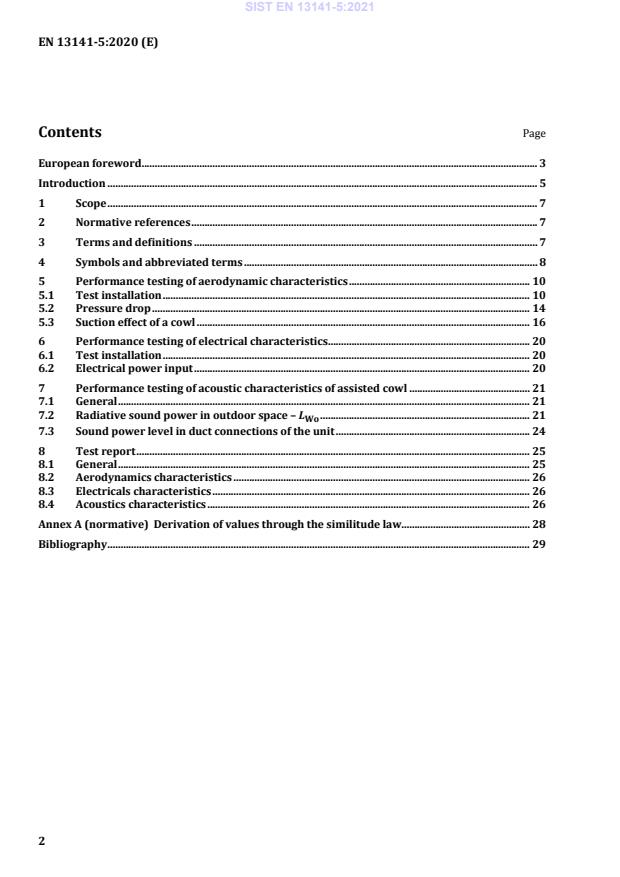
Contents Page
European foreword . 3
Introduction . 5
1 Scope . 7
2 Normative references . 7
3 Terms and definitions . 7
4 Symbols and abbreviated terms . 8
5 Performance testing of aerodynamic characteristics . 10
5.1 Test installation . 10
5.2 Pressure drop . 14
5.3 Suction effect of a cowl . 16
6 Performance testing of electrical characteristics. 20
6.1 Test installation . 20
6.2 Electrical power input . 20
7 Performance testing of acoustic characteristics of assisted cowl . 21
7.1 General . 21
7.2 Radiative sound power in outdoor space – L . 21
Wo
7.3 Sound power level in duct connections of the unit . 24
8 Test report . 25
8.1 General . 25
8.2 Aerodynamics characteristics . 26
8.3 Electricals characteristics . 26
8.4 Acoustics characteristics . 26
Annex A (normative) Derivation of values through the similitude law. 28
Bibliography . 29
European foreword
This document (EN 13141-5:2020) has been prepared by Technical Committee CEN/TC 156 “Ventilation
for buildings”, the secretariat of which is held by BSI.
This European Standard shall be given the status of a national standard, either by publication of an
identical text or by endorsement, at the latest by April 2021, and conflicting national standards shall be
withdrawn at the latest by April 2021.
Attention is drawn to the possibility that some of the elements of this document may be the subject of
patent rights. CEN shall not be held responsible for identifying any or all such patent rights.
This document supersedes EN 13141-5:2004.
In addition to a number of editorial revisions, the following main changes have been made with respect
to EN 13141-5:2004:
— modification of the title and scope to add assisted cowls;
— exclusion from the scope of roof exhaust fans which are tested according to EN 13141-4;
— reorganization of the clause concerning the performance testing of aerodynamic characteristics
(now Clause 5) in order to have a more homogeneous organization and modification of all the figures
to make them more understandable;
— modification of the subclause concerning test installation for aerodynamic characteristics (now 5.1),
which includes the modification of all tests installation requirements as well as the distinction
between requirements that apply to all the tests and those that apply only to the wind tunnel use;
— modification of the volume flow rate correction (see 5.2 concerning pressure drop);
— modification of the formula used to characterize the suction effect of a cowl (see 5.3.2 concerning the
measurements and calculations);
— renaming of “Preliminary test” as “Least favourable horizontal wind approach angle for the suction
effect” (see 5.3.3.1);
— replacement of “a wind of sufficient speed to give easily measurable pressure differences” by “a wind
of 8 m/s” (see 5.3.3.1);
— removal of the two following measurements points: V = 0,5 m/s and 1,5 m/s (see 5.3.3.2);
— more precise definition of the three series of measurements to carry out (i.e. v = 0m/s,
duct
v = 4m/s and 0 m/s < v < 4 m/s) (see 5.3.3.3);
duct duct
— for additional testing (e.g. acoustics and aerodynamic) for fan assisted cowls, reference to
EN 13141-4 is replaced by reference to EN ISO 5801 and more developed information are given;
— addition of a test method for measuring the combined effect of natural wind and wind from the fan
assisted cowl;
— addition of a detailed clause concerning the test report;
— review of the entire document in order to make it more accessible regarding the changes made.
A list of all parts in the EN 13141 series, published under the general title Ventilation for buildings —
Performance testing of components/products for residential ventilation can be found on the CEN website.
According to the CEN-CENELEC Internal Regulations, the national standards organisations of the
following countries are bound to implement this European Standard: Austria, Belgium, Bulgaria, Croatia,
Cyprus, Czech Republic, Denmark, Estonia, Finland, France, Germany, Greece, Hungary, Iceland, Ireland,
Italy, Latvia, Lithuania, Luxembourg, Malta, Netherlands, Norway, Poland, Portugal, Republic of North
Macedonia, Romania, Serbia, Slovakia, Slovenia, Spain, Sweden, Switzerland, Turkey and the United
Kingdom.
Introduction
The position of this document in the field of standards for the mechanical building services is shown in
Figure 1.
Mechanical Building Services
Ventilation and air conditioning
Control systems Heating systems
systems
Mechanical and Design criteria for
Air terminal Air handling System
Ductwork natural residential the indoor Installation
devices units performance
ventilation environment
Components/product
s for residential Performance testing of Design and Performance testing
Simplified calculation
ventilation Required components/products dimensioning for and installation
methods for residential
and optional for residential residential ventilation checks for residential
ventilation systems
performance ventilation systems ventilation systems
characteristics
Part 1: Externally and internally mounted air transfer devices
Part 2: Exhaust and supply air terminal devices
Part 3: Range hoods for residential use without fan
Part 4: Fans used in residential ventilation systems
Part 5: Cowls, assisted cowls and roof outlet terminal devices
Part 6: Exhaust ventilation system packages used in a single dwelling
Part 7: Performance testing of a mechanical supply and exhaust
ventilation units (including heat recovery) for mechanical ventilation
systems intended for single family dwellings
Part 8: Performance testing of un-ducted mechanical supply and exhaust
ventilation units (including heat recovery) for mechanical ventilation
systems intended for a single room
Part 9: Externally mounted humidity controlled air transfer device
Part 10: Humidity controlled extract air terminal device
Part 11: Supply ventilation units
Figure 1 — Position of EN 13141-5 in the field of the mechanical building services
1 Scope
This document specifies methods for measuring:
— the aerodynamic characteristics of cowls, fan assisted cowls and roof outlets;
— the electrical and acoustic characteristics of fan assisted cowls.
This document is applicable to cowls, assisted cowls and roof outlets used in natural, hybrid or
mechanical ventilation and that are meant to be fitted onto ducts which project above the roof surface.
This document does not apply to:
— assisted cowls assisted by a device other than a fan (e.g. injection assisted cowls);
— roof exhaust fans (see EN 13141-4).
2 Normative references
The following documents are referred to in the text in such a way that some or all of their content
constitutes requirements of this document. For dated references, only the edition cited applies. For
undated references, the latest edition of the referenced document (including any amendments) applies.
EN 12792, Ventilation for buildings — Symbols, terminology and graphical symbols
EN ISO 5136, Acoustics — Determination of sound power radiated into a duct by fans and other air-moving
devices — In-duct method (ISO 5136)
EN ISO 5801:2017, Fans — Performance testing using standardized airways (ISO 5801:2017)
EN ISO 7235, Acoustics — Laboratory measurement procedures for ducted silencers and air-terminal
units — Insertion loss, flow noise and total pressure loss (ISO 7235)
EN ISO/IEC 17025:2017, General requirements for the competence of testing and calibration laboratories
(ISO/IEC 17025:2017)
ISO 13347-2, Industrial fans — Determination of fan sound power levels under standardized laboratory
conditions — Part 2: Reverberant room method
ISO 13347-3, Industrial fans — Determination of fan sound power levels under standardized laboratory
conditions — Part 3: Enveloping surface methods
ISO 13347-4, Industrial fans — Determination of fan sound power levels under standardized laboratory
conditions — Part 4: Sound intensity method
3 Terms and definitions
For the purposes of this document, the terms and definitions given in EN 12792 and the following apply.
ISO and IEC maintain terminological databases for the use in standardization at the following addresses:
• IEC Electropedia: available at http://www.electropedia.org/
• ISO online browsing platform: available at https://www.iso.org/obp
3.1
cowl
exhaust air terminal device with or without moving component, intended to be fitted on top of a duct,
with aim, by creating negative pressure depending on the wind speed, to avoid reverse flow and to
increase the exhaust air flow rate in presence of wind
[SOURCE: EN 12792:2003, 92, modified – reformulation of the definition in a single sentence]
3.2
assisted cowl
cowl fitted with an auxiliary device using an energy source other than wind to compensate for lack of
suction effect
[SOURCE: EN 12792:2003, 46, modified – removal of “such as a fan and” and replacement of “pressure
difference” by “suction effect”]
3.3
fan assisted cowl
assisted cowl where the auxiliary device is a fan
3.4
roof outlet
exhaust air terminal device without moving component, intended to be fitted on top of a duct
4 Symbols and abbreviated terms
For the purposes of this document, the symbols listed in Table 1 apply.
No abbreviated terms are listed in this document.
Table 1 — Symbols
Symbol Quantity Unit
C(α,v ,v )
pressure factor —
tunnel duct
D duct diameter m
L duct length m
L sound power level dB
W
L A-weighted sound power level dB(A)
WA
L
radiated sound power in the outdoor space (including casing) dB
wo
p atmospheric pressure Pa
a
p dynamic pressure in the test duct Pa
d,duct
p
dynamic pressure in the wind tunnel Pa
d,tunnel
p static gauge pressure in the test duct Pa
s,duct
Symbol Quantity Unit
p average static gauge pressure in the wind tunnel Pa
s,tunnel
P electrical power input W
E
q corrected volume flow rate m /s
v,cor
q
measured volume flow rate m /s
v,meas
r coefficient of determination of the regression line —
v mean air speed in the test duct m/s
duct
v air speed in the wind tunnel (wind speed) m/s
tunnel
α vertical wind approach angle degree
β horizontal wind approach angle degree
∆p pressure drop Pa
∆p difference between the total pressure in the test duct Pa
cowl
approaching the cowl under test and the static pressure in the
tunnel
∆p pressure drop due to friction in the test duct between the Pa
f,duct
pressure tapping and the bottom of the cowl
ζ pressure drop coefficient —
θ temperature of the air in the test duct °C
a
3 3
ρ
density of 1 204 kg/m corresponding to the air under kg/m
ref
standard conditions (20 °C, 101 325 Pa)
ρ
air density in the wind tunnel kg/m
tunnel
5 Performance testing of aerodynamic characteristics
5.1 Test installation
5.1.1 General
The aerodynamic characteristics of the air terminal device shall be tested in a test installation as shown
in Figure 2. For pressure drop (see 5.2) and mechanical tests without wind (see 5.3.3.4), the wind tunnel
is not necessary. The test installation shall comprise the following:
— an adjustable air supply incorporating a flow rate measuring device with an uncertainty in
accordance with 5.1.3 (e.g. orifice plate or venturi tube conforming with EN ISO 5167-1, or other flow
meter, such as a rotameter). The air supply passes via an airtight duct;
— means to stabilize the flow and pressure upstream the test duct, e.g. airtight plenum chamber (with
a side length at least 4 times the diameter of the test duct) containing flow settling screens at the air
entry zone and a smooth outlet;
— an airtight test circular duct (test duct) to carry the air terminal device under test, of diameter D
chosen according to EN 1506:2007, Table 1 to suit the air terminal device, and with a minimum
length as given by Formula (1).
LD6⋅
(1)
In case of assisted cowl, the test installation shown in Figure 2 shall be in accordance with Category C
installation as defined in EN ISO 5801:2017, 11.5, ducted inlet and free outlet.
The test shall be performed according to the intended use of the air terminal device.
The pressure measurement point in the test duct (Figure 2, Key 6) shall be located 3D upstream of the air
terminal device (D being the diameter of the test duct).
In order to reach high pressure values, a device to increase the pressure drop in the test duct (e.g. iris)
may be used (Figure 2, Key 15). In order to reach low pressure values, a fan with flow rate adjusted device
may be used (Figure 2, Key 12).
5.1.2 Wind tunnel
Static pressure shall be measured using two pressure probes (or more) located in the working section
(see Figure 2, section A-A). The pressure probes should be situated far enough from the cowl to avoid
side effects, at each side of the wind cross section. The reference pressure is the average of the two (or
more) static pressures.
The wind speed measurement shall be made at 1 m upstream from the air terminal device and in front of
it.
During the suction effect tests, the volume flow rate in the test duct shall not exceed 2 % of the volume
flow rate from the wind tunnel.
If the tests are carried out in a confined working section as shown in Figure 2, then the cross-section area
of the working section (in projection along the axis of the wind tunnel) shall be at least 20 times the cross
section area of the cowl and duct in the wind.
If the tests are carried out using an open jet type wind tunnel, then the cross section area of the jet shall
be at least 10 times the cross-section area (in projection along the axis of the wind tunnel) of the cowl
and duct in the wind.
In order to avoid side effects from the wind tunnel, the test duct part located in the working section (see
Figure 2, section A-A) of the wind tunnel (i.e. the duct part blown by the wind) shall be at least 5 times
the duct diameter.
=
The turbulence intensity of the air inside the wind tunnel upwards from the air terminal device shall be
less than 5 %.
To simulate varying vertical wind approach angles, it shall be possible to rotate the cowl and test duct
about an axis perpendicular to the wind tunnel axis and test duct axis, the cowl remaining near the same
test point located at the wind tunnel axis to remain in the homogenous wind stream (see Figure 3).
NOTE 1 The test point represents the position of the cowl during the test.
In addition, where the test duct axis is perpendicular to the wind tunnel axis, it shall be possible to rotate
the cowl about the test duct axis to simulate varying horizontal wind approach angles (see Figure 4).
When the mounting parts which support the duct and the cowl are in the wind, they should have limited
influence from an aerodynamic point of view.
NOTE 2 No practical rules can be formulated in this document on how to limit the influence of mounting parts.
Key
1 wind tunnel 9 plenum chamber
2 location for wind speed measurement 10 air flow measuring device
3 air terminal device 11 flow straightener
4 location for static pressure measurement 12 fan with flow rate adjusting device
5 test duct 13 air supply
6 location for static pressure measurement 14 location for static pressure measurement at the
bottom of the device
7 location of sealing for preliminary suction test 15 pressure regulation device
8 flow setting screens
Figure 2 — Typical example of a test installation
Key
1 axis of wind tunnel 5 test duct
2 wind tunnel 6 axis of test duct
3 location for wind speed measurement 7 axis of rotation
4 homogeneous part of the wind flow
Figure 3 — Rotation to simulate varying vertical wind approach
Key
1 axis of wind tunnel 4 axis of test duct (axis of rotation)
2 wind tunnel 5 test duct
3 location for wind speed measurement
Figure 4 — Rotation to simulate varying horizontal wind approach
5.1.3 Maximum permissible measurement error
The maximum permissible measurement error is given in Table 2 for each quantity.
Table 2 — Maximum permissible measurement error
Quantity Maximum permissible Unit
measurement error
Wind speed ≤ 0,05 m/s
Air flow ≤ 0,000 3 + 0,03 × measured value m /s
Pressure ≤ 0,5 + 0,03 × measured value Pa
5.2 Pressure drop
5.2.1 General
When testing a fan assisted cowl, the auxiliary fan shall be switched-off and its blades shall not be blocked.
5.2.2 Measurements and calculations
The parameters to be measured are:
— the volume flow rate in the test duct;
— the static pressure difference between the test duct (Figure 2, key 6) and the room in which the test
is carried out (static gauge pressure);
— the atmospheric pressure;
— the temperature of the air in the test duct.
The measured volume flow rate shall be corrected if the temperature or barometric pressure are different
from the standard conditions (20 °C and 101 325 Pa), using Formula (2).
0,5 0,5
p
293,15
a
qq= ⋅⋅ (2)
v,cor v,meas
101 325 273,15 + θ
a
where
q is the corrected volume flow rate, in m /s;
v,cor
q is the measured volume flow rate, in m /s;
v,meas
p is the atmospheric pressure, in Pa;
a
θ is the temperature of the air in the test duct, in °C.
a
For each measurement, the dynamic pressure in the test duct, p , shall be calculated using
d,duct
Formula (3).
----------------------
...