

SIST EN ISO 8100-1:2026
(Main)Lifts for the transport of persons and goods - Part 1: Safety rules for the construction and installation of passenger and goods passenger lifts (ISO 8100-1:2026, including corrected version 2026-05)
- Abstract
This document specifies the safety rules for lifts permanently serving buildings and constructions and intended for the transport of persons or persons and goods. It applies to traction lifts, positive drive lifts and hydraulic lifts that:
serve specific levels; and
have a rated speed exceeding 0,15 m/s; and
have an enclosed car; and
move along guide rails inclined not more than 15° to the vertical; and
are indoor or weather-protected.
This document also applies to the electrical equipment of these lifts including the lighting and socket outlets in the well.
This document specifies safety rules related to:
persons to be safeguarded:
users, including passengers, maintenance and inspection personnel;
persons at the landings and outside of the well, or any machinery space and pulley room, who can be affected by the lift.
property to be safeguarded:
loads in the car;
components of the lift installation;
building in which the lift is installed.
This document does not specify additional requirements for:
lifts serving buildings with requirements for seismic conditions;
lifts serving buildings with requirements for accessibility;
lifts exposed to vandalism;
lifts which can be used for firefighting and evacuation purposes under firefighters control;
lifts which can be used to support faster evacuation of persons with disabilities;
the behaviour of the lift when the control system of the lift receives a recall signal(s) in the event of fire in a building.
This document is not applicable to passenger and goods passenger lifts, which are installed before the date of its publication.
- Status
- Published
- Public Enquiry End Date
- 30-Jan-2024
- Publication Date
- 17-Nov-2026
- Technical Committee
- DTN - Lift and transport appliances
- Current Stage
- 6060 - National Implementation/Publication (Adopted Project)
- Start Date
- 24-Jun-2026
- Due Date
- 29-Aug-2026
- Completion Date
- 18-Nov-2026

SIST EN ISO 8100-1:2026 is the Slovenian standard published by SIST for passenger and goods passenger lifts in buildings. It specifies safety rules for the construction and installation of traction lifts, positive drive lifts and hydraulic lifts, including their electrical equipment and the lighting and socket outlets in the well. It is aimed at designers, manufacturers, installers, inspectors and maintenance teams who need a common safety basis for new lift installations.
What does SIST EN ISO 8100-1:2026 specify?
SIST EN ISO 8100-1:2026 covers lifts permanently serving buildings and constructions and intended for the transport of persons or persons and goods. It applies to enclosed lifts with a rated speed above 0.15 m/s, moving on guide rails inclined not more than 15° to the vertical, and installed indoors or in weather-protected locations.
The document is organized into clauses 1 to 7 and annexes A to D.
| Annex | What it covers |
|---|---|
| Annex A | List of the electric safety devices and the minimum SIL linked to each check |
| Annex B | Technical interfaces between the building or construction and the lift |
| Annex C | Types of pit access ladder and their general provisions |
| Annex D | Relationship between this document and ISO 8100-20 |
The scope also excludes several special applications, such as lifts for seismic conditions, accessibility-specific lifts, vandal-prone lifts, firefighting lifts, lifts used to support faster evacuation of persons with disabilities, and fire-recall behaviour. It is also not intended for passenger and goods passenger lifts installed before its publication.
What are the key requirements of SIST EN ISO 8100-1:2026?
Building interfaces, well and access spaces
Clause 4.2 sets the physical envelope around the lift - the well, pit, headroom, machinery spaces and pulley rooms. SIST EN ISO 8100-1:2026 requires safe access to the pit, notices, lighting, enclosure strength, emergency release arrangements and refuge spaces on the car roof and in the pit.
In practice, this is the part that tells the project team how much space the building must leave for installation, inspection and rescue. Annex B supports this by defining the building data that must be exchanged, such as type and purpose of the lift, layout and access, environmental conditions, forces and building execution.
Doors, entrances and protection at the landing
Clause 4.3 makes landing doors and car doors the main barrier between users and the moving lift. SIST EN ISO 8100-1:2026 requires doors to be imperforate, properly locked, and fitted with protection that prevents closing injuries, shearing and accidental access to the well.
The document gives special attention to horizontally sliding, vertically sliding, folding and hinged doors, including glass panels and vision panels. It also links door safety to impact testing, emergency unlocking, proving the locked condition, and electric safety devices for checking that the car doors are closed. For the reader, this means door choice, clearances, closing behaviour and release functions must all be verified together, not treated as separate details.
Car, rated load, roof and passenger protection
Clause 4.4 covers the car itself, including enclosure, available area, rated load, number of passengers, apron, ventilation, lighting and the roof. Table 6 links rated load to maximum available car area, so the cabin size must match the intended load and passenger capacity.
The car has to be fully enclosed, fitted with an apron at each sill, and provided with emergency lighting and ventilation openings arranged so that a person cannot pass through them. The roof also needs fall protection and, where glass is used, laminated safety glass. In practice, this is the section that determines the usable car space, the protection at the entrance edge, and the safe conditions for maintenance work on the roof.
Suspension means and their monitoring
Clause 4.5 deals with ropes, belts, chains, compensation means, sheaves, drums, sprockets and terminations. SIST EN ISO 8100-1:2026 requires independent suspension means, load distribution measures, protection around rotating parts and marking so the installed parts can be identified and traced.
A major feature of this clause is discard monitoring for suspension means. The document allows a bending fatigue counter or physical strength monitoring, and it treats the related data as critical. In practice, this means the lift must be taken out of automatic service when the monitored condition reaches its discard limit, and the maintenance team must be able to reset the monitoring only after replacement of the suspension means.
Protection against free fall, overspeed and unintended movement
Clause 4.6 addresses the main motion hazards: free fall, excessive speed, unintended car movement and creeping. SIST EN ISO 8100-1:2026 uses safety gear and tripping means for traction and positive drive lifts, and rupture valves, restrictors and pawl devices for hydraulic lifts.
The same clause also requires ascending car overspeed protection and protection against unintended car movement with open doors. These systems must stop the car, keep it stopped, and return to a safe state without needing access to the well. For procurement and commissioning, this is the section that defines the lift’s emergency stopping philosophy and the hardware that must be present to support it.
Guide rails, buffers and machinery
Clauses 4.7 to 4.9 cover guide rails, buffers, and the lift machine. Guide rails must carry the car, counterweight or balancing weight under defined load cases and deflection limits, while buffers must be fitted at the end of travel.
SIST EN ISO 8100-1:2026 also requires each lift to have its own lift machine and protection for accessible rotating parts. For a project team, this means the rail support, buffer arrangement and drive machinery are not optional details - they are core safety elements that must be designed and checked as a system.
Electrical installation, controls and safety-related functions
Clauses 4.10 to 4.12 cover electrical installation, electric safety devices and controls. The document deals with the main switch, wiring, earthing, lighting and socket outlets, contactors, safety circuits, load control, limit switches, emergency alarm, intercom and rescue operation.
Annex A ties several functions to a minimum safety integrity level (SIL), which tells the reader that the control and detection functions are safety-related and must be treated accordingly. In practice, this affects component selection, wiring, software or electronics used in safety functions, and the checks needed before the lift is accepted for service.
Verification and tests
Clause 5 links the requirements to verification by examination, calculation, testing or a combination of these. For installed lifts, it includes checks for braking, traction, safety gear, buffers, rupture valves, restrictors, levelling accuracy, door behaviour and unintended car movement.
This matters because the standard is not only a design document. It also tells the installer or inspector what has to be witnessed, measured or tested before the lift can be handed over.
What terms does SIST EN ISO 8100-1:2026 define?
- Automatic rescue operation - a device or function that moves the lift car automatically to a landing after loss of power or another failure.
- Balancing weight - a mass used to save energy by balancing all or part of the car mass.
- Car - the part of the lift that carries the loads.
- Electric safety device - a safety contact, safety circuit or SIL-rated circuit with the required reliability of operation.
- Lift machine - the unit that drives and stops the lift, including the drive elements for traction or positive drive lifts, or the pump and valves for hydraulic lifts.
- Rated load - the load intended to be carried in automatic operation, which can include handling devices.
- Rated speed - the car speed for which the equipment has been built.
- Unintended car movement - non-commanded movement of the car with doors open within the door zone away from the landing.
Who uses SIST EN ISO 8100-1:2026?
Lift manufacturers and installation contractors use SIST EN ISO 8100-1:2026 to design the car, doors, suspension, drive system and safety devices. Design engineers and building designers use it to define the well, pit, headroom, access and interface conditions that the building must provide.
Inspectors, conformity assessors and commissioning teams use it to verify tests and checks on the installed lift. Maintenance and inspection personnel use it for access, emergency operation, logbook entries and replacement planning. Buyers and specification writers in construction use it to compare lift offers against the same safety baseline.
What changed in SIST EN ISO 8100-1:2026 from the previous edition?
SIST EN ISO 8100-1:2026 replaces SIST EN 81-20:2020.
Which standards are used with SIST EN ISO 8100-1:2026?
| Standard | What it contributes |
|---|---|
| ISO 12100:2010 | General principles for risk assessment and risk reduction |
| ISO 3008-2:2017 | Fire-resistance tests for lift landing door assemblies |
| ISO 4344:2022 | Minimum requirements for steel wire ropes used for lifts |
| ISO 4190-5:2006 | Control devices, signals and additional fittings |
| ISO 4413:2010 | Safety rules for hydraulic systems and components |
| ISO 6743-4:2015 | Classification of hydraulic lubricants |
| ISO 7010:2019 | Registered safety signs and symbols |
| ISO 8100-2:2023 | Design rules, calculations, examinations and tests of lift components |
| ISO 8102-1:2020 | EMC emission requirements for lift electrical equipment |
| ISO 8102-2:2021 | EMC immunity requirements for lift electrical equipment |
| ISO 8102-20:2022 | Cybersecurity requirements for lift electrical equipment |
| ISO/TS 8100-3:2019 | Additional requirements to use when applicable in combination with this document |
| ISO 12543-2:2021 | Laminated safety glass for car roofs |
| ISO 12543-3:2021 | Laminated glass and laminated safety glass for doors and panels |
| ISO 13857:2019 | Safety distances to prevent reaching hazard zones |
| ISO 14122-3:2016 | Permanent means of access - stairs, stepladders and guard-rails |
| ISO 14122-4:2016 | Permanent means of access - fixed ladders |
| ISO 29584:2015 | Pendulum impact testing and classification of safety glass |
| IEC 60204-1:2016 + A1:2021 | Electrical equipment of machines |
| IEC 60227-6:2001 | Lift cables and flexible connections |
| IEC 60332-1-2:2004 + A1:2015 | Vertical flame propagation test for a single cable |
| IEC 60332-3-24:2018 | Vertical flame spread test for bunched cables |
| IEC 60364-4-41:2005 + A1:2017 | Protection against electric shock |
| IEC 60364-6:2016 | Verification of low-voltage electrical installations |
| IEC 60417:2002 | Graphical symbols for equipment |
| IEC 60529:1989 + A1:1999 | IP code for enclosure protection |
| IEC 60598-1:2020 | Luminaires for car and machinery-space lighting |
| IEC 60617:2012 | Graphical symbols for diagrams |
| IEC 60664-1:2020 | Insulation coordination for low-voltage equipment |
| IEC 60754-2:2011 + A1:2019 | Acidity and conductivity of gases from cables |
| IEC 60947-4-1:2018 | Contactors and motor starters |
| IEC 60947-5-1:2016 | Control circuit devices and switching elements |
| IEC 60947-5-5:1997 + A1:2005 | Emergency stop device with mechanical latching |
| IEC 61034-2:2005 + A1:2013 | Smoke density of cable burning |
| IEC 61310-3:2007 | Location and operation of actuators |
| IEC 61508-1:2010 | Functional safety of electrical/electronic/programmable electronic systems |
| IEC 61800-5-2:2016 | Functional safety for adjustable speed drives |
| IEC 61810-1:2015 + A1:2019 | Electromechanical elementary relays |
| IEC 61810-3:2015 | Relays with forcibly guided contacts |
| EN 81-28:2022 | Remote alarm for passenger and goods passenger lifts |
| EN 81-58:2022 | Landing door fire resistance test |
| EN 81-71:2022 | Vandal resistant lifts |
| EN 1993-1-1:2006 + A1:2014 | Design of steel structures |
| EN 12385-1:2002 + A1:2008 | General safety requirements for steel wire ropes |
| EN 12385-5:2021 | Stranded ropes for lifts |
| EN 13411-3:2022 | Ferrules and ferrule-securing terminations |
| EN 13411-6:2004 + A1:2008 | Asymmetric wedge socket terminations |
| EN 13411-7:2021 | Symmetric wedge socket terminations |
| EN 13411-8:2011 | Swage terminals and swaging |
| EN 13501-1:2018 | Fire classification of construction products and building elements |
| EN 13501-6:2018 + A1:2022 | Fire classification of electric cables |
| EN 50214:2006 | Flat PVC sheathed flexible cables |
What does the SIST EN ISO 8100-1:2026 document contain?
SIST EN ISO 8100-1:2026 contains detailed requirements, figures, tables and formulas for lift safety features, clearances and testing. It includes table-based sizing for car area and load, test set-ups for door impact resistance, and calculation methods for guide rail forces, sill loads and suspension fatigue.
Clause 5 turns those requirements into verification actions, including checks and tests on a built and installed lift. Annex A provides the list of electric safety devices and their SIL levels, Annex B defines the building interface data, and Annex C describes pit access ladders and their placement. Annex D links the document to ISO 8100-20 and the related essential health and safety requirements.
Relations
- Effective Date
- 06-Jul-2022
- Effective Date
- 01-Jul-2026
- Effective Date
- 01-Jul-2026
- Effective Date
- 01-Jul-2026
- Effective Date
- 01-Jul-2026
- Effective Date
- 01-Jul-2026
- Effective Date
- 01-Jul-2026
- Effective Date
- 01-Jul-2026
- Effective Date
- 01-Jul-2026
- Effective Date
- 01-Jul-2026
- Effective Date
- 01-Jul-2026
- Refers
SIST EN 13411-7:2021 - Terminations for steel wire ropes - Safety - Part 7: Symmetric wedge socket - Effective Date
- 01-Jul-2026
- Effective Date
- 24-Jun-2026
- Effective Date
- 24-Jun-2026
- Effective Date
- 24-Jun-2026
Get Certified
Connect with accredited certification bodies for this standard

DIBt (Deutsches Institut für Bautechnik)
German Institute for Building Technology.

DIN CERTCO
DIN Group product certification.

Aboma Certification B.V.
Specialized in construction, metal, and transport sectors.
Sponsored listings
Frequently Asked Questions
SIST EN ISO 8100-1:2026 is a standard published by the Slovenian Institute for Standardization (SIST). Its full title is "Lifts for the transport of persons and goods - Part 1: Safety rules for the construction and installation of passenger and goods passenger lifts (ISO 8100-1:2026, including corrected version 2026-05)". This standard covers: This document specifies the safety rules for lifts permanently serving buildings and constructions and intended for the transport of persons or persons and goods. It applies to traction lifts, positive drive lifts and hydraulic lifts that: serve specific levels; and have a rated speed exceeding 0,15 m/s; and have an enclosed car; and move along guide rails inclined not more than 15° to the vertical; and are indoor or weather-protected. This document also applies to the electrical equipment of these lifts including the lighting and socket outlets in the well. This document specifies safety rules related to: persons to be safeguarded: users, including passengers, maintenance and inspection personnel; persons at the landings and outside of the well, or any machinery space and pulley room, who can be affected by the lift. property to be safeguarded: loads in the car; components of the lift installation; building in which the lift is installed. This document does not specify additional requirements for: lifts serving buildings with requirements for seismic conditions; lifts serving buildings with requirements for accessibility; lifts exposed to vandalism; lifts which can be used for firefighting and evacuation purposes under firefighters control; lifts which can be used to support faster evacuation of persons with disabilities; the behaviour of the lift when the control system of the lift receives a recall signal(s) in the event of fire in a building. This document is not applicable to passenger and goods passenger lifts, which are installed before the date of its publication.
This document specifies the safety rules for lifts permanently serving buildings and constructions and intended for the transport of persons or persons and goods. It applies to traction lifts, positive drive lifts and hydraulic lifts that: serve specific levels; and have a rated speed exceeding 0,15 m/s; and have an enclosed car; and move along guide rails inclined not more than 15° to the vertical; and are indoor or weather-protected. This document also applies to the electrical equipment of these lifts including the lighting and socket outlets in the well. This document specifies safety rules related to: persons to be safeguarded: users, including passengers, maintenance and inspection personnel; persons at the landings and outside of the well, or any machinery space and pulley room, who can be affected by the lift. property to be safeguarded: loads in the car; components of the lift installation; building in which the lift is installed. This document does not specify additional requirements for: lifts serving buildings with requirements for seismic conditions; lifts serving buildings with requirements for accessibility; lifts exposed to vandalism; lifts which can be used for firefighting and evacuation purposes under firefighters control; lifts which can be used to support faster evacuation of persons with disabilities; the behaviour of the lift when the control system of the lift receives a recall signal(s) in the event of fire in a building. This document is not applicable to passenger and goods passenger lifts, which are installed before the date of its publication.
SIST EN ISO 8100-1:2026 is classified under the following ICS (International Classification for Standards) categories: 91.140.90 - Lifts. Escalators. The ICS classification helps identify the subject area and facilitates finding related standards.
SIST EN ISO 8100-1:2026 has the following relationships with other standards: It is inter standard links to SIST EN 81-20:2020, SIST ISO 1219-1:2014, SIST EN 50214:2024, SIST ISO 7000:2020, SIST EN 13411-8:2012, SIST EN 13411-6:2004+A1:2008, SIST EN 13501-1:2019, SIST EN 81-28:2022, SIST ISO 4190-5:2012, SIST EN 13501-6:2019+A1:2023, SIST EN 13411-3:2023, SIST EN 13411-7:2021, SIST EN 12015:2005, SIST EN 81-80:2019, SIST EN 50600-2-1:2021. Understanding these relationships helps ensure you are using the most current and applicable version of the standard.
SIST EN ISO 8100-1:2026 is associated with the following European legislation: EU Directives/Regulations: 2014/33/EU; Standardization Mandates: M/549, M/599. When a standard is cited in the Official Journal of the European Union, products manufactured in conformity with it benefit from a presumption of conformity with the essential requirements of the corresponding EU directive or regulation.
SIST EN ISO 8100-1:2026 is available in PDF format for immediate download after purchase. The document can be added to your cart and obtained through the secure checkout process. Digital delivery ensures instant access to the complete standard document.
Standards Content (Sample)
SLOVENSKI STANDARD
01-december-2026
Nadomešča:
SIST EN 81-20:2020
Dvigala za prevoz oseb in blaga - 1. del: Varnostna pravila za konstruiranje in
vgradnjo dvigal (liftov) za osebna in tovorno-osebna dvigala (ISO 8100-1:2026,
vključuje popravljeno različico 2026-05)
Lifts for the transport of persons and goods - Part 1: Safety rules for the construction and
installation of passenger and goods passenger lifts (ISO 8100-1:2026, including
corrected version 2026-05)
Aufzüge für den Personen- und Gütertransport - Teil 1: Sicherheitsregeln für die
Konstruktion und den Einbau von Personen- und Lastenaufzügen (ISO 8100-1:2026,
einschließlich korrigierte Fassung 2026-05)
Ascenseurs pour le transport de personnes et d'objets - Partie 1: Règles de sécurité pour
la construction et l'installation d'ascenseurs et d'ascenseurs de charge (ISO 8100-
1:2026, y compris version corrigée 2026-05)
Ta slovenski standard je istoveten z: EN ISO 8100-1:2026
ICS:
91.140.90 Dvigala. Tekoče stopnice Lifts. Escalators
2003-01.Slovenski inštitut za standardizacijo. Razmnoževanje celote ali delov tega standarda ni dovoljeno.
EN ISO 8100-1
EUROPEAN STANDARD
NORME EUROPÉENNE
June 2026
EUROPÄISCHE NORM
ICS 91.140.90 Supersedes EN 81-20:2020
English Version
Lifts for the transport of persons and goods - Part 1: Safety
rules for the construction and installation of passenger
and goods passenger lifts (ISO 8100-1:2026, including
corrected version 2026-05)
Ascenseurs pour le transport de personnes et d'objets - Aufzüge für den Personen- und Gütertransport - Teil 1:
Partie 1: Règles de sécurité pour la construction et Sicherheitsregeln für die Konstruktion und den Einbau
l'installation d'ascenseurs et d'ascenseurs de charge von Personen- und Lastenaufzügen (ISO 8100-1:2026,
(ISO 8100-1:2026, y compris version corrigée 2026- einschließlich korrigierte Fassung 2026-05)
05)
This European Standard was approved by CEN on 1 March 2026.
CEN members are bound to comply with the CEN/CENELEC Internal Regulations which stipulate the conditions for giving this
European Standard the status of a national standard without any alteration. Up-to-date lists and bibliographical references
concerning such national standards may be obtained on application to the CEN-CENELEC Management Centre or to any CEN
member.
This European Standard exists in three official versions (English, French, German). A version in any other language made by
translation under the responsibility of a CEN member into its own language and notified to the CEN-CENELEC Management
Centre has the same status as the official versions.
CEN members are the national standards bodies of Austria, Belgium, Bulgaria, Croatia, Cyprus, Czech Republic, Denmark, Estonia,
Finland, France, Germany, Greece, Hungary, Iceland, Ireland, Italy, Latvia, Lithuania, Luxembourg, Malta, Netherlands, Norway,
Poland, Portugal, Republic of North Macedonia, Romania, Serbia, Slovakia, Slovenia, Spain, Sweden, Switzerland, Türkiye and
United Kingdom.
EUROPEAN COMMITTEE FOR STANDARDIZATION
COMITÉ EUROPÉEN DE NORMALISATION
EUROPÄISCHES KOMITEE FÜR NORMUNG
CEN-CENELEC Management Centre: Rue de la Science 23, B-1040 Brussels
© 2026 CEN All rights of exploitation in any form and by any means reserved Ref. No. EN ISO 8100-1:2026 E
worldwide for CEN national Members.
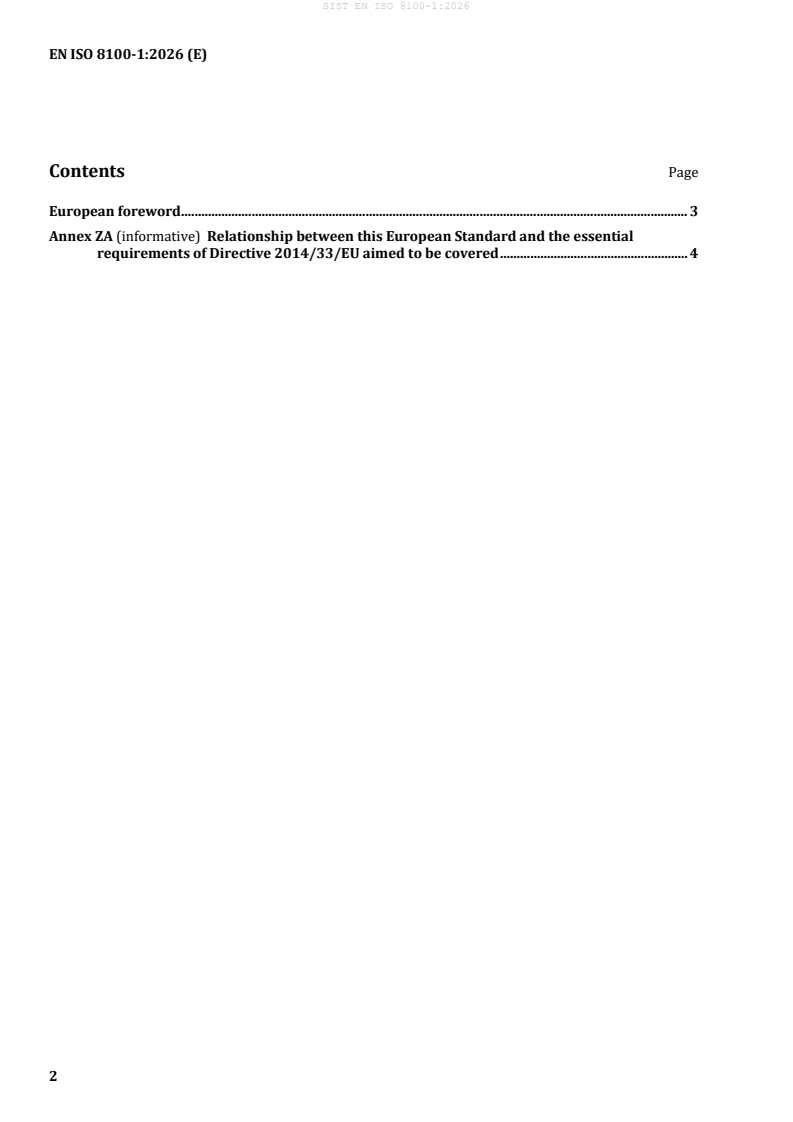
Contents Page
European foreword . 3
Annex ZA (informative) Relationship between this European Standard and the essential
requirements of Directive 2014/33/EU aimed to be covered . 4
European foreword
This document (EN ISO 8100-1:2026) has been prepared by Technical Committee ISO/TC 178 "Lifts,
escalators and moving walks" in collaboration with Technical Committee CEN/TC 10 “Lifts, escalators
and moving walks” the secretariat of which is held by AFNOR.
This European Standard shall be given the status of a national standard, either by publication of an
identical text or by endorsement, at the latest by December 2026, and conflicting national standards
shall be withdrawn at the latest by June 2029.
Attention is drawn to the possibility that some of the elements of this document may be the subject of
patent rights. CEN shall not be held responsible for identifying any or all such patent rights.
This document supersedes EN 81-20:2020.
This document has been prepared under a standardization request addressed to CEN by the European
Commission. The Standing Committee of the EFTA States subsequently approves these requests for its
Member States.
For the relationship with EU Legislation, see informative Annex ZA, which is an integral part of this
document.
Any feedback and questions on this document should be directed to the users’ national standards
body/national committee. A complete listing of these bodies can be found on the CEN website.
According to the CEN-CENELEC Internal Regulations, the national standards organizations of the
following countries are bound to implement this European Standard: Austria, Belgium, Bulgaria,
Croatia, Cyprus, Czech Republic, Denmark, Estonia, Finland, France, Germany, Greece, Hungary, Iceland,
Ireland, Italy, Latvia, Lithuania, Luxembourg, Malta, Netherlands, Norway, Poland, Portugal, Republic of
North Macedonia, Romania, Serbia, Slovakia, Slovenia, Spain, Sweden, Switzerland, Türkiye and the
United Kingdom.
Endorsement notice
The text of ISO 8100-1:2026, including corrected version 2026-05 has been approved by CEN as
Annex ZA
(informative)
Relationship between this European Standard and the essential
requirements of Directive 2014/33/EU aimed to be covered
This European Standard has been prepared under a Commission’s standardization request C(2023)
3)
6588 final (‘M/599’) to provide one voluntary means of conforming to requirements of
Directive 2014/33/EU of the European Parliament and of the Council of 26 February 2014 as regards
lifts and safety components for lifts (OJ L 96, 29.3.2014).
Once this standard is cited in the Official Journal of the European Union under that Directive,
compliance with the normative clauses of this standard given in Table ZA.1.1, Table ZA.1.2 and Table
ZA.1.3 confers, within the limits of the scope of this standard, a presumption of conformity with the
corresponding essential requirements of that Directive and associated EFTA regulations.
Table ZA.1.1 — Correspondence between this European Standard and Annex I of
Directive 2014/33/EU
The relevant essential
health and safety
requirements of Clause(s)/sub-clause(s) of this EN Remarks/Notes
Annex I to
Directive 2014/33/EU
1.1 See below Table ZA.1.2 and Table ZA.1.3
1.2 first paragraph 4.2.6.4.3.2 f), 4.3.3.1, 4.3.3.2, 4.3.5.1,
4.3.5.2, 4.3.5.4, 4.3.5.5, 4.3.5.6,
4.4.1, 4.4.2.1.1, 4.4.2.1.2, 4.4.2.1.3,
4.4.2.2, 4.4.2.3.1, 4.4.3.2, 4.4.3.4
1.2 second paragraph Not covered
1.3 4.5.1, 4.5.2, 4.5.4, 4.5.5,
1.4.1 4.4.2.1.4, 4.12.1.2
1.4.2 4.6.1.1, 4.6.1.2, 4.6.2.2.1.1, 4.6.2.2.5.5,
4.6.3.1, 4.6.4.1
1.4.3 4.8.2.2.1 b), 4.6.2.2.1.6 a) 4.6.2.2.5.4 a) 4.12.1.3
2), 2),
1.4.4 4.5.3, 4.5.6, 4.5.7.2
1.5.1 4.9.1.1
1.5.2 4.2.1.1.1, 4.2.3.3 b), 4.2.5.2.1, 4.2.5.2.2,
3)
C(2023) 6588, COMMISSION IMPLEMENTING DECISION of 5.10.2023 on a standardisation request to the European
Committee for Standardization as regards lifts and safety components for lifts in support of Directive 2014/33/EU of the
European Parliament and of the Council
The relevant essential
health and safety
requirements of Clause(s)/sub-clause(s) of this EN Remarks/Notes
Annex I to
Directive 2014/33/EU
4.2.6.4.3.2 d), 4.2.6.5.1.2, 4.2.6.5.1.3 b), 4.2.6.6.1 b),
4.3.9.1.1, 4.3.9.3
1.6.1 Not covered
1.6.2 4.3.6.2.3.4 c), 4.12.1.1.1, 4.12.1.1.2
1.6.3 4.10.5.3
1.6.4 4.2.1.1.2, 4.9.2.5, 4.9.3.4,
4.10.1.1.2, 4.10.1.1.3, 4.10.1.2, 4.10.1.3,
4.10.2, 4.10.3, 4.10.4, 4.10.5,
4.10.6, 4.10.7, 4.10.8.3,
4.10.9, 4.10.10, 4.11
2.1 4.2.1.3.1 a), 4.2.3.3, 4.2.5.2, 4.2.5.5.2,
4.2.6.4.4.1 d), 4.3.1, 4.3.4, 4.3.5.2,
4.3.8, 4.3.9, 4.3.10, 4.4.8 a)
2.2 4.2.5.6, 4.2.5.7, 4.2.5.8,
4.5.3.3, 4.8.1.2, 4.9.3.2.6.2
2.3 4.3.1.1, 4.3.1.2, 4.3.3,
4.3.5.1, 4.3.5.2, 4.3.5.3, 4.3.5.4,
4.3.5.5, 4.3.5.6, 4.3.5.8,
4.3.8, 4.3.9.1, 4.3.9.3, 4.3.9.4,
4.3.10, 4.3.11, 4.12.1.4, 4.12.1.8
3.1 4.2.5.3.1 c), 4.2.6.4.3.2, 4.3.1, 4.3.9.2,
4.3.13, 4.3.14, 4.3.15.2,
4.4.3.1, 4.4.9.3
3.2 4.6.1, 4.6.2, 4.6.3.1, 4.6.3.8,
4.6.4.1, 4.6.4.6, 4.6.6, 4.6.7,
4.7
3.3 4.2.5.6.1,
4.8.1.1, 4.8.1.3, 4.8.1.4, 4.8.2.1.1.1,
4.8.2.1.2.2, 4.8.2.2.1
3.4 4.6.2.1.5, 4.6.2.2.1.6 b), 4.6.2.2.1.6 c), 4.6.2.2.3 e),
4.6.2.2.5.4 b), 4.6.2.2.5.4 c), 4.6.2.2.5.6,
The relevant essential
health and safety
requirements of Clause(s)/sub-clause(s) of this EN Remarks/Notes
Annex I to
Directive 2014/33/EU
4.6.6.5, 4.6.7.8
4.1 4.3.6.2, 4.12.1.1.4
4.2 not covered
4.3 4.2.5.5.3, 4.4.11.2, 4.4.11.3 a), 4.7.5.2
4.4 4.2.3.1, 4.2.6.2.2, 4.2.6.6.1
1st paragraph
,
4.2.6.6.2 a), 4.2.6.6.2 c), 4.3.9.3.1, 4.3.9.3.2,
4.3.9.3.7, 4.3.15.1, 4.3.15.3, 4.4.6.2,
4.9.2.3.1, 4.9.2.3.3, 4.9.2.3.4, 4.9.2.3.5,
4.9.2.3.6, 4.9.2.3.7, 4.9.2.3.9, 4.9.3.9.1.1,
4.9.3.9.1.2, 4.9.3.9.1.3, 4.9.3.9.1.4, 4.9.3.9.1.5,
4.9.3.9.2.1, 4.9.3.9.2.2, 4.9.3.9.2.3, 4.9.3.9.3,
4.10.11, 4.12.1.6, 4.12.3.2
4.5 not covered
4.6 4.9.3.11, 4.10.4.3, 4.10.4.4
4.7 4.4.9
4.8 4.4.10.1, 4.4.10.2, 4.4.10.3, 4.4.10.4 b)
4.9 4.10.11.1 a), 4.10.11.2
4.10 not covered
5.1 4.4.2.3.2 d), 4.4.2.3.2 e)
5.2 not covered
6.1 not covered
6.2 6.2, 6.3
Table ZA.1.2 — Correspondence between this European Standard and Annex I of
Directive 2006/42/EC
The relevant essential
health and safety
requirements of Clause(s)/sub-clause(s) of this EN Remarks/Notes
Annex I to
Directive 2006/42/EC
1.1.2 (a) 4, 5, 6
1.1.2 (c) 4, 5, 6
1.1.2 (e) 4, 5, 6
1.1.3 4.4.4,
4.9.3.1.4, 4.9.3.2.5.1, 4.9.3.7, 4.9.3.11
1.1.4 4.2.1.2, 4.2.6.6.3, 4.4.10,
4.10.5.1.1 a), 4.10.5.1.1 c), 4.10.5.1.1 e),
4.10.7.1, 4.10.8
1.1.5 C.4 a)
1.1.6 4.2.3.2, 4.2.6.3.2.1, 4.2.6.3.2.2, 4.2.6.4.1.1,
4.2.6.4.2, 4.4.6.1 a), 4.12.1.5.1.2, C.3,
C.4, C.5
1.2.1 4.9.2.2.2.3, 4.9.2.3.1, 4.9.2.5, 4.9.2.6,
4.9.2.7, 4.9.3.4, 4.9.3.10,
4.10.3, 4.11, 4.12, Annex A
1.2.2 4.2.1.3.1 a), 4.2.1.3.1 b),
4.4.8 a), 4.4.8 b), 4.10.1.1.2,
4.12.1.5, 4.12.1.6, 4.12.1.7, 4.12.1.8
1.2.3 4.2.6.4.4.1 g), 4.3.9.1.12 f), 4.4.6.1 b) 3), 4.4.6.2 b) 3),
4.5.3.3 a) 2), 4.5.3.3 b),
4.6.2.1.4.3, 4.6.2.2.1.6 b), 4.6.2.2.5.4 b), 4.6.5.10,
4.6.6.7, 4.6.6.2, 4.6.7.3, 4.6.7.9,
4.9.2.7.3, 4.9.3.10.3, 4.11.1.5, 4.12.1.3.2,
4.12.1.5, 4.12.1.6, 4.12.1.11.2, 4.12.2.3.2
1.2.4.1 4.2.1.3.1 d), 4.12.1.11.1, 4.12.1.11.2
1.2.4.4 4.4.6.2 b) 3), 4.12.1.11.1
1.2.5 4.12.1.5, 4.12.1.6, 4.12.1.8
1.2.6 4.6.2.1.4.3, 4.6.2.2.5.6, 4.6.5.10, 4.6.6.7,
4.6.7.9, 4.9.2.2.2.3 g), 4.9.2.2.2.8, 4.11.1.1,
The relevant essential
health and safety
requirements of Clause(s)/sub-clause(s) of this EN Remarks/Notes
Annex I to
Directive 2006/42/EC
4.11.2.4.2.2, 4.11.2.4.3.2, 4.12.1.3.2, 4.12.2.3.2
1.3.1 4.2.1.5, 4.9.3.2.6.3
1.3.2 4.3.3.3, 4.3.5.2, 4.4.3.2, 4.4.11.2,
4.5.2, 4.5.6.3, 4.5.8 a), 4.6.2.2.1.3,
4.6.3.3, 4.6.4.3, 4.7, 4.9.3.2.1,
4.9.3.2.2, 4.9.3.2.3, 4.9.3.2.6.1, 4.9.3.2.6.4,
4.9.3.2.6.5, 4.9.3.2.6.6, 4.9.3.3.1, 4.9.3.5.3,
6.2.4
1.3.3 4.2.2.2 f), 4.2.2.2 g), 4.2.5.4, 4.2.6.3.3,
4.2.6.7.2, 4.4.7.2 a), 4.4.11.3
1.3.4 4.2.5.3.2 c), 4.2.5.3.2 d), 4.3.6.1, 4.3.6.2.2.1 f),
4.3.6.2.2.1 g), 4.3.6.2.2.1 i), 4.3.6.2.2.1 j), 4.3.6.2.2.1 k),
4.4.5.1
1.3.7 4.2.5.5, 4.4.7.4 d),
4.5.6.2 e), 4.5.7, 4.6.2.1.6.3, 4.6.2.2.3 g),
4.9.1.2, 4.9.2.3.4 a) 1), 4.9.2.3.4 a) 3), 4.9.3.2.6.6 b)
1.3.8.1 4.2.5.5, 4.5.7.1, 4.9.1.2
1.3.9 4.2.6.4.3.1, 4.2.6.4.4.1
1.4.1 4.1.2, 4.2.3.4, 4.2.5.5.1, 4.2.5.5.2,
4.2.6.4.3.2 d), 4.2.6.4.3.2 e), 4.2.6.4.3.2 f), 4.3.9.1.8,
4.4.5, 4.4.6.1 b), 4.4.7.4, 4.5.7
1.4.2.1 4.1.2, 4.3.9.1.9 4.5.7
1.4.2.2 4.2.3.3 b), 4.2.3.3 d), 4.2.6.4.3.2 d), 4.2.6.4.3.2 e),
4.4.6.1 b) 3), 4.4.6.2 b) 3)
1.5.1 4.10.1.1.4, 4.10.1.2, 4.10.1.3,
4.10.2, 4.10.3, 4.10.4, 4.10.5,
4.10.6, 4.10.9, 4.10.10
1.5.3 4.9.3.1
1.5.4 4.3.5.2, 4.6.2.2.1.1 c), 4.9.2.3.8, 4.10.6.4
1.5.5 4.10.1.1.4
1.5.6 4.9.3.11, 4.9.2.2.2.6, 4.10.4.1, 4.10.4.2
The relevant essential
health and safety
requirements of Clause(s)/sub-clause(s) of this EN Remarks/Notes
Annex I to
Directive 2006/42/EC
1.5.7 Not covered
1.5.8 Not covered
1.5.11 Not covered
1.5.14 4.2.1.4, 4.2.3.3 c), 4.2.6.4.3.1 c), 4.2.6.4.4.2,
4.3.9.3.5, 4.12.1.11.3, 4.12.3.1
1.5.15 4.2.2.2 e), 4.2.2.2 k), 4.2.6.4.5.3 b), 4.2.6.4.5.3 d),
4.3.4.3, 4.4.7.1 b), 4.4.7.2 b), 4.4.7.2 c),
4.4.7.2 d), 4.4.7.3, 4.4.7.4, 4.12.1.1.3,
C.3.3 d)
1.6.1 4.6.3.6, 4.6.3.7, 4.6.4.5, 4.12.1.5,
4.12.1.7, 4.12.1.8, 4.12.1.11.1, 6.2.4
1.6.2 4.2.2.1, 4.2.3.2, 4.2.3.3, 4.2.3.4,
4.2.6.3.2, 4.2.6.4.1.1, 4.2.6.4.2, 4.2.6.4.3.1 c),
4.2.6.4.3.2, 4.2.6.4.4.2, 4.2.6.4.5, 4.2.6.4.6,
4.2.6.6.4, 4.2.6.7.1, 4.6.3.2, 4.6.4.2,
C.1, C.2
1.6.3 4.10.1.2.4, 4.10.5, 4.10.8.1
1.7.1 4.1.3, 4.2.2.2 j), 4.2.5.7.1, 4.2.5.8.1,
4.2.6.4.5.7, 4.3.7, 4.4.2.2.1 g), 4.9.2.3.2,
4.9.2.3.8, 4.9.3.3.3.3, 4.9.3.7, 4.10.1.2.5,
4.10.5.6, 4.12.1.5.1.2 b 4.12.1.5.4, 4.12.1.8.4
),
1.7.2 4.2.2.2 j), 4.2.4, 4.2.6.2, 4.2.6.4.5.7,
4.2.5.7.1, 4.2.5.8.1, 4.2.6.4.1.2, 4.3.6.2.2.1 b)
3),
4.3.6.2.3.1 d), 4.3.9.3.9, 4.9.2.3.2, 4.10.1.2.5,
4.10.5.6, 4.12.1.1.5, 4.12.1.2.3 a), 4.12.1.2.3 b),
4.12.1.5.3, 4.12.1.8.3 c), 4.12.1.10 b), 4.12.1.10 c)
1.7.3 4.2.6.4.5.7, 4.3.9.1.11, 4.4.2.2.1 g), 4.4.2.3.2 a),
4.4.2.3.2 b), 4.4.2.3.2 c), 4.4.2.3.2 e), 4.4.2.3.2 f),
4.4.2.3.3, 4.6.2.1.1.3, 4.6.2.2.1.8,
The relevant essential
health and safety
requirements of Clause(s)/sub-clause(s) of this EN Remarks/Notes
Annex I to
Directive 2006/42/EC
4.6.3.9, 4.6.4.7, 4.6.6.12, 4.6.7.14,
4.8.1.8, 4.9.3.3.3.3, 4.9.3.9.1.6, 4.9.3.9.2.4,
4.11.2.3.5
4.1.2.3 4.5.3, 4.6.3.5, 4.6.4.4, 4.7.2.3.1,
4.9.2.2.2.1, 4.9.3.3.2, 4.9.3.3.3.1, 4.9.3.3.3.2,
5.2.4, 5.2.5, 5.2.7, 5.2.9,
5.2.10,
4.1.2.4 4.5.1, 4.5.2, 4.5.4, 4.5.6
4.1.2.8.2 4.4.2.2.1 d), 4.12.1.1.3, 4.12.1.2.1, 4.12.1.12.4
4.2.1 4.9.2.3.1, 4.9.3.9.1.3, 4.12.1.5.2.1 f), 4.12.1.5.2.3,
4.12.1.6.1.2 b 4.12.1.6.2.1 c)
),
4.3.1 4.5.9
6.3.1 4.2.6.4.4.1 a), 4.5.3.2, 4.6.2.1.2.1, 4.6.2.1.3,
4.6.3.1, 4.6.6.3, 4.6.7.6, 4.8.1.5,
4.8.1.7, 4.8.2.1.1, 4.8.2.1.2.1 a), 4.8.2.1.2.1 b),
4.8.2.1.2.1 e), 4.8.2.2.2 a), 4.8.2.2.2 b),
4.9.2.2.2.1 4.9.3.2.3.2, 4.9.3.2.4.2
st
1 paragraph,
6.3.2 4.2.6.4.3.2, 4.4.3.2.1, 4.4.6, 4.4.7.2 b),
4.4.7.2 c), 4.4.7.3, 4.6.3.4
Table ZA.1.3 — Correspondence between this European Standard and Annex III of
Regulation (EU) 2023/1230
The relevant essential
health and safety
requirements of Annex Clause(s)/sub-clause(s) of this EN Remarks/Notes
III to Regulation (EU)
2023/1230
1.1.2 (a) 4, 5, 6
1.1.2 (c) 4, 5, 6
1.1.2 (e) 4, 5, 6
1.1.3 4.4.4,
4.9.3.1.4, 4.9.3.2.5.1, 4.9.3.7, 4.9.3.11
1.1.4 4.2.1.2, 4.2.1.3.1 a), 4.2.6.6.3, 4.4.10,
4.10.5.1.1 a), 4.10.5.1.1 c), 4.10.5.1.1 e),
4.10.7.1, 4.10.8
1.1.5 C.4 a)
1.1.6 4.2.3.2, 4.2.6.3.2.1, 4.2.6.3.2.2, 4.2.6.4.1.1,
4.2.6.4.2, 4.4.6.1 a), 4.12.1.5.1.2, C.3,
C.4, C.5
1.1.9 4.10.1.1.5, 4.10.1.1.6, 4.12.4, 6.2.4 k) 7),
6.2.4 v)
1.2.1 4.9.2.2.2.3, 4.9.2.3.1, 4.9.2.5, 4.9.2.6,
4.9.2.7, 4.9.3.4, 4.9.3.10,
4.10.1.1.5 4.10.1.1.6,
4.10.3, 4.11, 4.12, Annex A
1.2.2 4.2.1.3.1 a), 4.2.1.3.1 b),
4.4.8 a), 4.4.8 b), 4.10.1.1.2,
4.12.1.5, 4.12.1.6, 4.12.1.7, 4.12.1.8
1.2.3 4.2.6.4.4.1 g), 4.3.9.1.12 f), 4.4.6.1 b) 3), 4.4.6.2 b) 3),
4.5.3.3 a) 2), 4.5.3.3 b),
4.6.2.1.4.3, 4.6.2.2.1.6 b), 4.6.2.2.5.4 b), 4.6.5.10,
4.6.6.7, 4.6.6.2, 4.6.7.3, 4.6.7.9,
4.9.2.7.3, 4.9.3.10.3, 4.11.1.5, 4.12.1.3.2,
4.12.1.5, 4.12.1.6, 4.12.1.11.2, 4.12.2.3.2
1.2.4.1 4.2.1.3.1 d), 4.12.1.11.1, 4.12.1.11.2
1.2.4.4 4.4.6.2 b) 3), 4.12.1.11.1
The relevant essential
health and safety
requirements of Annex Clause(s)/sub-clause(s) of this EN Remarks/Notes
III to Regulation (EU)
2023/1230
1.2.5 4.12.1.5, 4.12.1.6, 4.12.1.8
1.2.6 4.6.2.1.4.3, 4.6.2.2.5.6, 4.6.5.10, 4.6.6.7,
4.6.7.9, 4.9.2.2.2.3 g), 4.9.2.2.2.8, 4.11.1.1,
4.11.2.4.2.2, 4.11.2.4.3.2, 4.12.1.3.2, 4.12.2.3.2
1.3.1 4.2.1.5, 4.9.3.2.6.3
1.3.2 4.3.3.3, 4.3.5.2, 4.4.3.2, 4.4.11.2,
4.5.2, 4.5.6.3, 4.5.8 a), 4.6.2.2.1.3,
4.6.3.3, 4.6.4.3, 4.7, 4.9.3.2.1,
4.9.3.2.2, 4.9.3.2.3, 4.9.3.2.6.1, 4.9.3.2.6.4,
4.9.3.2.6.5, 4.9.3.2.6.6, 4.9.3.3.1, 4.9.3.5.3,
6.2.4
1.3.3 4.2.2.2 f), 4.2.2.2 g), 4.2.5.4, 4.2.6.3.3,
4.2.6.7.2, 4.4.7.2 a), 4.4.11.3
1.3.4 4.2.5.3.2 c), 4.2.5.3.2 d), 4.3.6.1, 4.3.6.2.2.1 f),
4.3.6.2.2.1 g), 4.3.6.2.2.1 i), 4.3.6.2.2.1 j), 4.3.6.2.2.1 k),
4.4.5.1
1.3.7 4.2.5.5, 4.4.7.4 d),
4.5.6.2 e), 4.5.7, 4.6.2.1.6.3, 4.6.2.2.3 g),
4.9.1.2, 4.9.2.3.4 a) 1), 4.9.2.3.4 a) 3), 4.9.3.2.6.6 b)
1.3.8.1 4.2.5.5, 4.5.7.1, 4.9.1.2
1.3.9 4.2.6.4.3.1, 4.2.6.4.4.1
1.4.1 4.1.2, 4.2.3.4, 4.2.5.5.1, 4.2.5.5.2,
4.2.6.4.3.2 d), 4.2.6.4.3.2 e), 4.2.6.4.3.2 f), 4.3.9.1.8,
4.4.5, 4.4.6.1 b), 4.4.7.4, 4.5.7
1.4.2.1 4.1.2, 4.3.9.1.9 4.5.7
1.4.2.2 4.2.3.3 b), 4.2.3.3 d), 4.2.6.4.3.2 d), 4.2.6.4.3.2 e),
4.4.6.1 b) 3), 4.4.6.2 b) 3),
1.5.1 4.10.1.1.4, 4.10.1.2, 4.10.1.3,
4.10.2, 4.10.3, 4.10.4, 4.10.5,
4.10.6, 4.10.9, 4.10.10
1.5.3 4.9.3.1
The relevant essential
health and safety
requirements of Annex Clause(s)/sub-clause(s) of this EN Remarks/Notes
III to Regulation (EU)
2023/1230
1.5.4 4.3.5.2, 4.6.2.2.1.1 c), 4.9.2.3.8, 4.10.6.4
1.5.5 4.10.1.1.4
1.5.6 4.9.3.11, 4.9.2.2.2.6, 4.10.4.1, 4.10.4.2
1.5.7 Not covered
1.5.8 Not covered
1.5.11 Not covered
1.5.14 4.2.1.4, 4.2.3.3 c), 4.2.6.4.3.1 c), 4.2.6.4.4.2,
4.3.9.3.5, 4.12.1.11.3, 4.12.3.1
1.5.15 4.2.2.2 e), 4.2.2.2 k), 4.2.6.4.5.3 b), 4.2.6.4.5.3 d),
4.3.4.3, 4.4.7.1 b), 4.4.7.2 b), 4.4.7.2 c),
4.4.7.2 d), 4.4.7.3, 4.4.7.4, 4.12.1.1.3,
C.3.3 d)
1.6.1 4.6.3.6, 4.6.3.7, 4.6.4.5, 4.12.1.5,
4.12.1.7, 4.12.1.8, 4.12.1.11.1, 6.2.4
1.6.2 4.2.2.1, 4.2.3.2, 4.2.3.3, 4.2.3.4,
4.2.6.3.2, 4.2.6.4.1.1, 4.2.6.4.2, 4.2.6.4.3.1 c),
4.2.6.4.3.2, 4.2.6.4.4.2, 4.2.6.4.5, 4.2.6.4.6,
4.2.6.6.4, 4.2.6.7.1, 4.6.3.2, 4.6.4.2,
C.1, C.2
1.6.3 4.10.1.2.4, 4.10.5, 4.10.8.1
1.7.1 4.1.3, 4.2.2.2 j), 4.2.5.7.1, 4.2.5.8.1,
4.2.6.4.5.7, 4.3.7, 4.4.2.2.1 g), 4.9.2.3.2,
4.9.2.3.8, 4.9.3.3.3.3, 4.9.3.7, 4.10.1.2.5,
4.10.5.6, 4.12.1.5.1.2 b 4.12.1.5.4, 4.12.1.8.4
),
1.7.2 4.2.2.2 j), 4.2.4, 4.2.6.2, 4.2.6.4.5.7,
4.2.5.7.1, 4.2.5.8.1, 4.2.6.4.1.2, 4.3.6.2.2.1 b)
3),
4.3.6.2.3.1 d), 4.3.9.3.9, 4.9.2.3.2, 4.10.1.2.5,
4.10.5.6, 4.12.1.1.5, 4.12.1.2.3 a), 4.12.1.2.3 b),
4.12.1.5.3, 4.12.1.8.3 c), 4.12.1.10 b), 4.12.1.10 c)
The relevant essential
health and safety
requirements of Annex Clause(s)/sub-clause(s) of this EN Remarks/Notes
III to Regulation (EU)
2023/1230
1.7.3 4.2.6.4.5.7, 4.3.9.1.11, 4.4.2.2.1 g), 4.4.2.3.2 a),
4.4.2.3.2 b), 4.4.2.3.2 c), 4.4.2.3.2 e), 4.4.2.3.2 f),
4.4.2.3.3, 4.6.2.1.1.3, 4.6.2.2.1.8,
4.6.3.9, 4.6.4.7, 4.6.6.12, 4.6.7.14,
4.8.1.8, 4.9.3.3.3.3, 4.9.3.9.1.6, 4.9.3.9.2.4,
4.11.2.3.5
4.1.2.3 4.5.3, 4.6.3.5, 4.6.4.4, 4.7.2.3.1,
4.9.2.2.2.1, 4.9.3.3.2, 4.9.3.3.3.1, 4.9.3.3.3.2,
5.2.4, 5.2.5, 5.2.7, 5.2.9,
5.2.10,
4.1.2.4 4.5.1, 4.5.2, 4.5.4, 4.5.6
4.1.2.8.2 4.4.2.2.1 d), 4.12.1.1.3, 4.12.1.2.1, 4.12.1.12.4
4.2.1 4.9.2.3.1, 4.9.3.9.1.3, 4.12.1.5.2.1 f), 4.12.1.5.2.3,
4.12.1.6.1.2 b 4.12.1.6.2.1 c)
),
4.3.1 4.5.9
6.3.1 4.2.6.4.4.1 a), 4.5.3.2, 4.6.2.1.2.1, 4.6.2.1.3,
4.6.3.1, 4.6.6.3, 4.6.7.6, 4.8.1.5,
4.8.2.1.1, 4.8.2.1.2.1 a), 4.8.2.1.2.1 b),
4.8.2.1.2.1 e), 4.8.2.2.2 a), 4.8.2.2.2 b),
4.9.2.2.2.1 4.9.3.2.3.2, 4.9.3.2.4.2
st
1 paragraph,
6.3.2 4.2.6.4.3.2, 4.4.3.2.1, 4.4.6, 4.4.7.2 b),
4.4.7.2 c), 4.4.7.3, 4.6.3.4
WARNING 1 Presumption of conformity stays valid only as long as a reference to this European
Standard is maintained in the list published in the Official Journal of the European Union. Users of this
standard should consult frequently the latest list published in the Official Journal of the European
Union.
WARNING 2 Other Union legislation may be applicable to the product(s) falling within the scope of
this standard.
International
Standard
ISO 8100-1
Second edition
Lifts for the transport of persons
2026-03
and goods —
Corrected version
Part 1:
2026-05
Safety rules for the construction
and installation of passenger and
goods passenger lifts
Ascenseurs pour le transport de personnes et d'objets —
Partie 1: Règles de sécurité pour la construction et l'installation
d'ascenseurs et d'ascenseurs de charge
Reference number
ISO 8100-1:2026(en) © ISO 2026
ISO 8100-1:2026(en)
© ISO 2026
All rights reserved. Unless otherwise specified, or required in the context of its implementation, no part of this publication may
be reproduced or utilized otherwise in any form or by any means, electronic or mechanical, including photocopying, or posting on
the internet or an intranet, without prior written permission. Permission can be requested from either ISO at the address below
or ISO’s member body in the country of the requester.
ISO copyright office
CP 401 • Ch. de Blandonnet 8
CH-1214 Vernier, Geneva
Phone: +41 22 749 01 11
Email: copyright@iso.org
Website: www.iso.org
Published in Switzerland
ii
ISO 8100-1:2026(en)
Contents Page
Foreword .vi
Introduction .viii
1 Scope . 1
2 Normative references . 2
3 Terms and definitions . 4
4 Safety requirements and/or protective measures . 9
4.1 General .9
4.2 Well, machinery spaces and pulley rooms .10
4.2.1 General provisions .10
4.2.2 Access to the pit . 13
4.2.3 Access doors, emergency doors, access trap doors and inspection doors .16
4.2.4 Notices .17
4.2.5 Well .17
4.2.6 Machinery spaces and pulley rooms . 30
4.3 Landing and car doors . 36
4.3.1 General provisions . 36
4.3.2 Height and width of entrances .37
4.3.3 Sills, guides, door suspension .37
4.3.4 Horizontal door clearances . 38
4.3.5 Strength of landing and car doors .42
4.3.6 Protection in relation to door operation . 48
4.3.7 “Car here” indication .57
4.3.8 Locking and closed landing door check . 58
4.3.9 Locking and emergency unlocking of landing and car doors . 58
4.3.10 Requirements common to devices for proving the locked condition and the
closed condition of the landing door .62
4.3.11 Sliding landing doors with multiple, mechanically linked panels .62
4.3.12 Closing of automatically operated landing doors . 63
4.3.13 Electric safety device for proving the car door closed . 63
4.3.14 Sliding or folding car door with multiple, mechanically linked panels . 63
4.3.15 Opening the car door . 64
4.4 Car, counterweight and balancing weight . 64
4.4.1 Height of car . . . 64
4.4.2 Available car area, rated load, number of passengers. 64
4.4.3 Walls, floor and roof of the car .70
4.4.4 Car door(s), floor, walls, ceiling and decorative materials . 72
4.4.5 Apron . 72
4.4.6 Emergency trap doors and emergency doors . 73
4.4.7 Car roof .74
4.4.8 Equipment on top of the car . 78
4.4.9 Ventilation . 78
4.4.10 Lighting . 78
4.4.11 Counterweight and balancing weight . 79
4.5 Suspension means, compensation means and related protection means . 79
4.5.1 Suspension means and related sheaves/drums/sprockets . 79
4.5.2 Minimum diameter ratio, safety factor, fatigue lifetime and suspension means
terminations . 82
4.5.3 Suspension means traction/transmission . 90
4.5.4 Winding up of ropes for positive drive lifts . 90
4.5.5 Distribution of load between the suspension means.91
4.5.6 Compensation means .91
4.5.7 Protection for sheaves, pulleys and sprockets . 92
4.5.8 Traction sheaves, pulleys and sprockets . 95
4.5.9 Marking of suspension means and compensation means . 95
iii
ISO 8100-1:2026(en)
4.6 Precautions against free fall, excessive speed, unintended car movement and creeping
of the car . . 96
4.6.1 Application of protections means . 96
4.6.2 Safety gear and its tripping means . 97
4.6.3 Rupture valve . 105
4.6.4 Restrictors . 106
4.6.5 Pawl device . 107
4.6.6 Ascending car overspeed protection means . 108
4.6.7 Protection against unintended car movement .110
4.7 Guide rails . 112
4.7.1 Guiding of the car, counterweight or balancing weight . 112
4.7.2 Forces and load cases . 113
4.7.3 Combination of masses and forces .116
4.7.4 Impact factors .116
4.7.5 Permissible stresses and deflections .117
4.8 Buffers . 118
4.8.1 General provisions . 118
4.8.2 Stroke of buffers .119
4.9 Lift machinery and associated equipment. 120
4.9.1 General provision . 120
4.9.2 Lift machine for traction lifts and positive drive lifts . 120
4.9.3 Lift machine for hydraulic lifts . 126
4.10 Electric installations and appliances .134
4.10.1 General provisions .134
4.10.2 Incoming supply conductor terminations . . 137
4.10.3 Contactors, contactor relays, components of safety circuits . 137
4.10.4 Protection of electrical equipment . 138
4.10.5 Main switch, supply disconnecting devices and isolating devices .138
4.10.6 Electric wiring . 140
4.10.7 Lighting and socket outlets .141
4.10.8 Control of the supply for lighting and socket outlets .141
4.10.9 Protective earthing .142
4.10.10 Identification of electrical components .142
4.10.11 Emergency supply .142
4.11 Protection against electric faults; failure analysis; electric safety devices .142
4.11.1 Protection against electric faults; failure analysis .142
4.11.2 Electric safety devices .143
4.12 Electrical Controls . 149
4.12.1 Control of lift operations . 149
4.12.2 Final limit switches .158
4.12.3 Alert initiation and intercom system . 159
4.12.4 Identification of the software . 159
5 Verification of the safety requirements and/or protective measures .159
5.1 Verification methods . 159
5.2 Specific examinations and tests on installed lift . 163
5.2.1 General . 163
5.2.2 Braking system (4.9.2.2) . 163
5.2.3 Electric installation . 164
5.2.4 Checking of the traction (4.5.3) . 164
5.2.5 Car safety gear (4.6.2). 165
5.2.6 Counterweight or balancing weight safety gear (4.6.2) . 165
5.2.7 Pawl device (4.6.5) . . 165
5.2.8 Buffers (4.8) . 166
5.2.9 Rupture valve (4.6.3) . 166
5.2.10 Restrictor/one-way restrictor (4.6.4) . 166
5.2.11 Pressure test .167
5.2.12 Ascending car overspeed protection means (4.6.6) .167
5.2.13 Stopping of the car at landings and levelling accuracy (4.12.1.1.3) .167
iv
ISO 8100-1:2026(en)
5.2.14 Protection against unintended car movement (4.6.7) .167
5.2.15 Protection against falling/shearing (4.3.9.3.4) .167
5.2.16 Balancing of vertically sliding door (4.3.3.3.5) .167
5.2.17 Counterweight balance (4.5.3) .167
5.2.18 Balancing weight balance (4.5.3) . 168
6 Information for use .168
6.1 General .
...