

SIST EN 12944-3:2026
(Main)Fertilizers, liming materials and inhibitors - Vocabulary - Part 3: Terms relating to liming materials
General Information
- Abstract
This document defines terms relating to liming materials.
An index of all terms defined in this part of the EN 12944 series is given in Annex A in English, French and German.
- Status
- Published
- Public Enquiry End Date
- 02-Feb-2024
- Publication Date
- 15-Mar-2026
- Technical Committee
- KAT - Soil quality
- Current Stage
- 6060 - National Implementation/Publication (Adopted Project)
- Start Date
- 08-Jan-2026
- Due Date
- 15-Mar-2026
- Completion Date
- 16-Mar-2026
Overview
EN 12944-3:2025 - Fertilizers, liming materials and inhibitors - Vocabulary - Part 3: Terms relating to liming materials is a CEN vocabulary standard that defines and harmonizes terminology used for liming materials, their production, properties and agronomic/environmental uses. Part 3 is one of three parts of EN 12944 and provides an indexed list of terms (Annex A) in English, French and German to support clear communication across industry, laboratories and regulatory bodies.
Key topics and technical scope
This vocabulary standard does not set performance limits or test methods; instead it provides precise definitions for terms commonly used in the liming and fertilizer sector:
- Products and production: calcination, carbonation, kiln types (rotary, shaft), wet/dry slaking, filter lime, burnt lime, slaked (hydrated) lime, burnt dolomite, lime-burnt dolomite, limestone, magnesian limestone, dolomitic limestone, marl, chalk, magnesite, slags (blast furnace, converter), sludge liming material, sugar factory lime.
- Physical and physico‑chemical properties: pH, alkaline/acid solutions, alkalinity, buffer capacity, acid insoluble residue (AIR), loss on ignition (LOI), carbon dioxide residue, neutralizing value (NV), basicity, reactivity (referencing ISO 8157).
- Agricultural and environmental uses: liming for preservation, rehabilitation and soil protection; lime requirement and liming effect (total liming effect).
- Soil interaction: free lime effect in soil and base saturation rate (exchangeable Ca, Mg, K, Na as % of CEC).
The 2024/2025 revision aligns certain mineral definitions (limestone, magnesian and dolomitic limestone) with EN 14069 magnesium oxide content ranges, recognizes slag terms as preferred, and updates cross‑references such as ISO 8157.
Practical applications and users
EN 12944-3 is essential for anyone needing consistent terminology in the production, specification, testing and use of liming materials:
- Manufacturers and suppliers - to label and describe products (e.g., burnt lime, slaked lime, slag lime) consistently.
- Laboratories and testing bodies - to report properties (NV, LOI, reactivity, AIR) with standardized terms.
- Agronomists, soil scientists and environmental managers - to describe liming objectives (preservation, rehabilitation, soil protection) and effects on soil pH and cation exchange.
- Regulators, procurement and standards committees - to harmonize national legislation, procurement specifications and technical documentation.
- Industry stakeholders involved in fertilizer classification and safety data sheets.
Related standards
- EN 12944 (Parts 1 & 2) - General terms and terms for fertilizers
- EN 13535 - Classification scheme for fertilizers and liming materials
- EN 14069 - Definitions and MgO content references for carbonate rocks
- ISO 8157 - Test methods and terminology for liming material reactivity
This standardized vocabulary improves clarity in specifications, testing, regulatory compliance and cross‑border trade for liming materials and related fertilizer products.
Relations
- Effective Date
- 01-Apr-2026
- Effective Date
- 28-Jan-2026
- Effective Date
- 28-Jan-2026
- Effective Date
- 28-Jan-2026
- Effective Date
- 28-Jan-2026
- Effective Date
- 28-Jan-2026
- Effective Date
- 28-Jan-2026
- Effective Date
- 28-Jan-2026
- Effective Date
- 28-Jan-2026
- Effective Date
- 28-Jan-2026
Get Certified
Connect with accredited certification bodies for this standard

Control Union Certifications
Global certification for agriculture and sustainability.

ECOCERT
Organic and sustainability certification.

FSC International
Forest Stewardship Council certification.
Sponsored listings
Frequently Asked Questions
SIST EN 12944-3:2026 is a standard published by the Slovenian Institute for Standardization (SIST). Its full title is "Fertilizers, liming materials and inhibitors - Vocabulary - Part 3: Terms relating to liming materials". This standard covers: This document defines terms relating to liming materials. An index of all terms defined in this part of the EN 12944 series is given in Annex A in English, French and German.
This document defines terms relating to liming materials. An index of all terms defined in this part of the EN 12944 series is given in Annex A in English, French and German.
SIST EN 12944-3:2026 is classified under the following ICS (International Classification for Standards) categories: 01.040.65 - Agriculture (Vocabularies); 65.080 - Fertilizers. The ICS classification helps identify the subject area and facilitates finding related standards.
SIST EN 12944-3:2026 has the following relationships with other standards: It is inter standard links to SIST EN 12944-3:2019, SIST EN 13535:2002, SIST-TS CEN/TS 17758:2023, SIST EN 13971:2020, SIST-TS CEN/TS 17338:2019, SIST EN 14069:2026, SIST EN 12946:2024, SIST-TP CR 12949:2004, SIST EN 14069:2018, SIST EN 14069:2004. Understanding these relationships helps ensure you are using the most current and applicable version of the standard.
SIST EN 12944-3:2026 is available in PDF format for immediate download after purchase. The document can be added to your cart and obtained through the secure checkout process. Digital delivery ensures instant access to the complete standard document.
Standards Content (Sample)
SLOVENSKI STANDARD
01-april-2026
Nadomešča:
SIST EN 12944-3:2019
Gnojila, sredstva za apnjenje in inhibitorji - Slovar - 3. del: Izrazi v zvezi s sredstvi
za apnjenje
Fertilizers, liming materials and inhibitors - Vocabulary - Part 3: Terms relating to liming
materials
Düngemittel, Kalkdünger und Inhibitoren - Vokabular - Teil 3: Begriffe für Kalkdünger
Engrais, amendements minéraux basiques et inhibiteurs - Vocabulaire - Partie 3 :
Termes relatifs aux amendements minéraux basiques
Ta slovenski standard je istoveten z: EN 12944-3:2025
ICS:
01.040.65 Kmetijstvo (Slovarji) Agriculture (Vocabularies)
65.080 Gnojila Fertilizers
2003-01.Slovenski inštitut za standardizacijo. Razmnoževanje celote ali delov tega standarda ni dovoljeno.
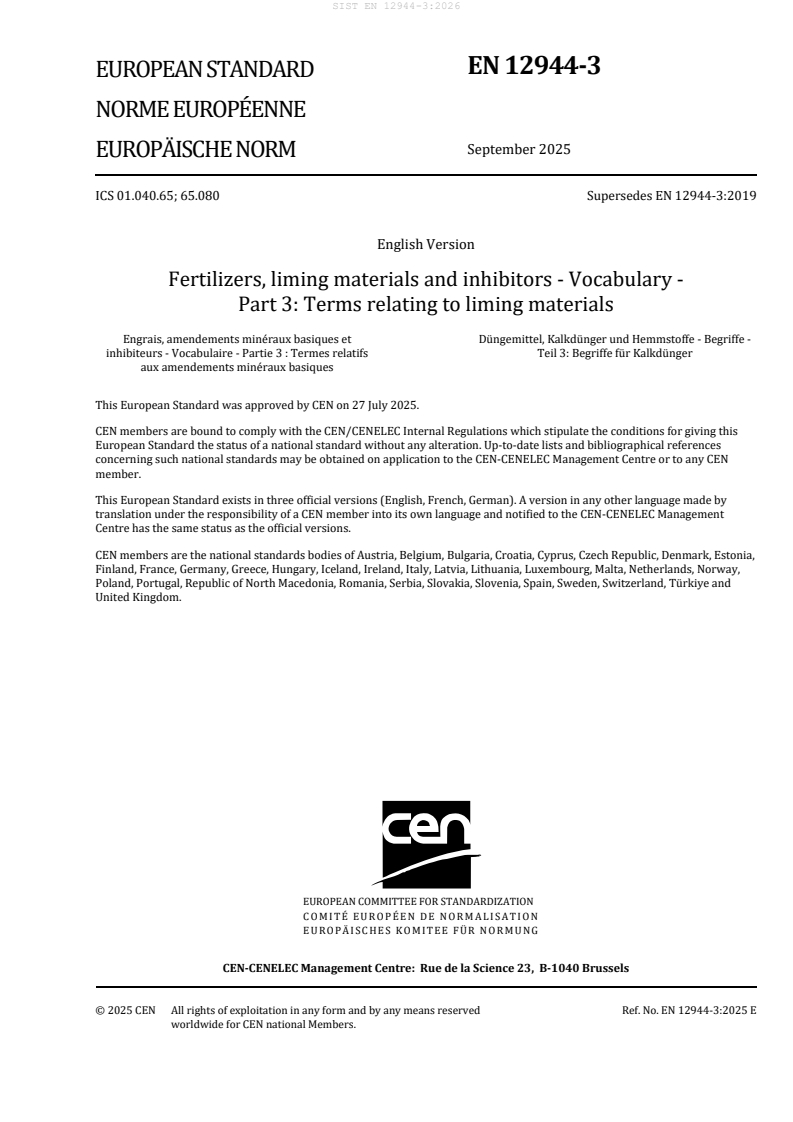
EN 12944-3
EUROPEAN STANDARD
NORME EUROPÉENNE
September 2025
EUROPÄISCHE NORM
ICS 01.040.65; 65.080 Supersedes EN 12944-3:2019
English Version
Fertilizers, liming materials and inhibitors - Vocabulary -
Part 3: Terms relating to liming materials
Engrais, amendements minéraux basiques et Düngemittel, Kalkdünger und Hemmstoffe - Begriffe -
inhibiteurs - Vocabulaire - Partie 3 : Termes relatifs Teil 3: Begriffe für Kalkdünger
aux amendements minéraux basiques
This European Standard was approved by CEN on 27 July 2025.
CEN members are bound to comply with the CEN/CENELEC Internal Regulations which stipulate the conditions for giving this
European Standard the status of a national standard without any alteration. Up-to-date lists and bibliographical references
concerning such national standards may be obtained on application to the CEN-CENELEC Management Centre or to any CEN
member.
This European Standard exists in three official versions (English, French, German). A version in any other language made by
translation under the responsibility of a CEN member into its own language and notified to the CEN-CENELEC Management
Centre has the same status as the official versions.
CEN members are the national standards bodies of Austria, Belgium, Bulgaria, Croatia, Cyprus, Czech Republic, Denmark, Estonia,
Finland, France, Germany, Greece, Hungary, Iceland, Ireland, Italy, Latvia, Lithuania, Luxembourg, Malta, Netherlands, Norway,
Poland, Portugal, Republic of North Macedonia, Romania, Serbia, Slovakia, Slovenia, Spain, Sweden, Switzerland, Türkiye and
United Kingdom.
EUROPEAN COMMITTEE FOR STANDARDIZATION
COMITÉ EUROPÉEN DE NORMALISATION
EUROPÄISCHES KOMITEE FÜR NORMUNG
CEN-CENELEC Management Centre: Rue de la Science 23, B-1040 Brussels
© 2025 CEN All rights of exploitation in any form and by any means reserved Ref. No. EN 12944-3:2025 E
worldwide for CEN national Members.
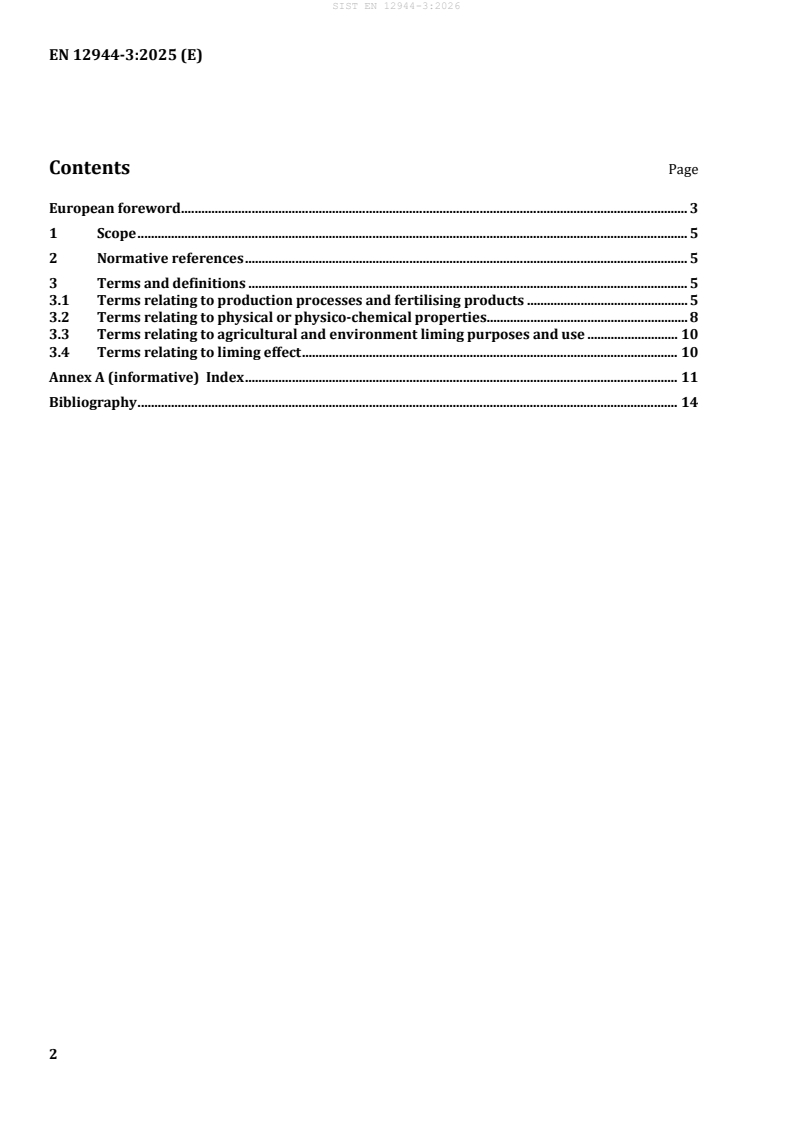
Contents Page
European foreword . 3
1 Scope . 5
2 Normative references . 5
3 Terms and definitions . 5
3.1 Terms relating to production processes and fertilising products . 5
3.2 Terms relating to physical or physico-chemical properties . 8
3.3 Terms relating to agricultural and environment liming purposes and use . 10
3.4 Terms relating to liming effect . 10
Annex A (informative) Index . 11
Bibliography . 14
European foreword
This document (EN 12944-3:2025) has been prepared by Technical Committee CEN/TC 260 “Fertilizers and
liming materials”, the secretariat of which is held by DIN.
This European Standard shall be given the status of a national standard, either by publication of an identical
text or by endorsement, at the latest by March 2026, and conflicting national standards shall be withdrawn
at the latest by March 2026.
Attention is drawn to the possibility that some of the elements of this document may be the subject of patent
rights. CEN shall not be held responsible for identifying any or all such patent rights.
This document supersedes EN 12944-3:2019.
a) the definitions of 3.1.17 “limestone”, 3.1.18 “magnesian limestone” and 3.1.19 “dolomitic limestone” have
been revised to be in line with minimum and maximum magnesium oxide (MgO) contents of EN 14069;
b) blast furnace lime and blast furnace slag (see 3.1.22) have both been recognized as preferred terms;
c) converter lime and converter slag (see 3.1.23) have both been recognized as preferred terms;
d) the term “free lime” was modified to “free lime effect in soil” (see 3.4.4);
e) the terms “alkaline solution”, “acid solution” and “pH value” have been removed as these are common
terms;
f) informative annex including a general index to all parts of the EN 12944 series has been removed;
g) addition of EN 14069 in the bibliography;
h) addition of EN 17816 in the bibliography;
i) update of the reference to ISO 8157 in the bibliography.
The EN 12944 series, under the general title Fertilizers, liming materials and inhibitors — Vocabulary, is
currently composed of the following parts:
— Part 1: General terms.
— Part 2: Terms relating to fertilizers.
— Part 3: Terms relating to liming materials.
These definitions do not necessarily correspond to those used in national legislation.
NOTE A classification scheme for fertilizers and liming materials is given in EN 13535.
Any feedback and questions on this document should be directed to the users’ national standards body. A
complete listing of these bodies can be found on the CEN website.
According to the CEN-CENELEC Internal Regulations, the national standards organisations of the following
countries are bound to implement this European Standard: Austria, Belgium, Bulgaria, Croatia, Cyprus, Czech
Republic, Denmark, Estonia, Finland, France, Germany, Greece, Hungary, Iceland, Ireland, Italy, Latvia,
Lithuania, Luxembourg, Malta, Netherlands, Norway, Poland, Portugal, Republic of North Macedonia,
Romania, Serbia, Slovakia, Slovenia, Spain, Sweden, Switzerland, Türkiye and the United Kingdom.
1 Scope
This document defines terms relating to liming materials.
An index of all terms defined in this part of the EN 12944 series is given in Annex A in English, French and
German.
2 Normative references
There are no normative references in this document.
3 Terms and definitions
For the purposes of this document, the following terms and definitions apply.
ISO and IEC maintain terminology databases for use in standardization at the following addresses:
— ISO Online browsing platform: available at https://www.iso.org/obp
— IEC Electropedia: available at https://www.electropedia.org/
3.1 Terms relating to production processes and fertilising products
3.1.1
calcination
burning or heating of a material, usually in order to remove volatile components or in order to change the
crystal structure
3.1.2
carbonation
conversion of slaked lime to carbonate by uptake of carbon dioxide
3.1.3
chalk
form of calcium carbonate derived from the skeletons of microscopic marine organisms
3.1.4
wet grinding
grinding of material in the presence of water
3.1.5
degree of burning
degree to which carbon dioxide has been removed during the production of quicklime or burnt dolomite
3.1.6
lime-burnt dolomite
dolomitic limestone calcined to the same carbon dioxide level as normally burnt limestone
3.1.7
burnt dolomite
liming material mainly consisting of calcium oxide and magnesium oxide obtained by calcination of
dolomitic limestone
3.1.8
burnt magnesium lime
liming material mainly consisting of calcium oxide and magnesium oxide obtained by calcination of
magnesian limestone
3.1.9
free lime
calcium or magnesium oxides and/or hydroxides which have not reacted with the liming material they are
included in
3.1.10
kiln
equipment used for lime burning
3.1.11
rotary kiln
rotary tubular counter-current kiln
3.1.12
shaft kiln
kiln constructed as a vertical combustion shaft
3.1.13
lime
burnt lime and slacked lime
3.1.14
burnt lime
quick lime
liming material consisting mainly of calcium oxide, or a mixture of calcium oxide and possibly magnesium
oxide, produced by the calcination of limestone, magnesian limestone or dolomitic limestone
3.1.15
filter lime
liming material in the form of dust, obtained from flue gases during lime burning
3.1.16
slaked lime
hydrated lime
liming material consisting mainly of calcium hydroxide, or a mixture of calcium hydroxide and possibly
magnesium hydroxide, produced by a controlled reaction between burnt lime and water
Note 1 to entry: The reaction between burnt lime and water is referred to as “slaking”.
3.1.17
limestone
natural rock consisting mainly of varying amounts of calcium carbonate and magnesium carbonate,
containing less than a mass fraction of 3 % of magnesium oxide (MgO)
Note 1 to entry: To convert magnesium oxide (MgO) to elemental magnesium (Mg) multiply by 0,603.
3.1.18
magnesian limestone
natural rock consisting mainly of varying amounts of calcium carbonate and magnesium carbonat
...