

SIST ETS 300 019-1-5 E1:2006
(Main)Equipment Engineering (EE); Environmental conditions and environmental tests for telecommunications equipment; Part 1-5: Classification of environmental conditions; Ground vehicle installations
General Information
- Abstract
The purpose of this sub-part of this standard is to define the classes of environmental conditions and their severities to which equipment may be exposed in ground vehicles. Only severe conditions, which may be harmful to the equipment, are included. The severities specified are those which will have a low probability of being exceeded; generally less than 1 . This sub-part applies to equipment when in use and permanently or temporarily installed in ground vehicles.
- Status
- Published
- Publication Date
- 31-Jan-2006
- Withdrawal Date
- 30-Sep-2003
- Technical Committee
- RES - Radio equipment and systems
- Current Stage
- 6060 - National Implementation/Publication (Adopted Project)
- Start Date
- 01-Feb-2006
- Due Date
- 01-Feb-2006
- Completion Date
- 01-Feb-2006


Overview
SIST ETS 300 019-1-5 E1:2006 is a key Slovenian standard adopted from the European Telecommunications Standards Institute (ETSI), detailing environmental conditions and classification for telecommunications equipment installed in ground vehicles. Focusing on severe environmental factors, this standard defines classes of environmental conditions and their severities, ensuring the reliability and operational safety of equipment subjected to various stresses during installation and use in ground vehicles. The standard is applicable for both temporary and permanent installations and supports the broader aim of consistent equipment engineering (EE) practices across the telecommunications sector.
Key Topics
Classification of Environmental Conditions:
The standard specifies Classes 5.1 (Protected installation) and 5.2 (Partly protected installation), covering the typical conditions encountered by telecommunications equipment installed in ground vehicles, from passenger cars to specialized outdoor vehicles.Severe Environmental Stresses:
It addresses only the most significant environmental factors that could potentially damage or impair the function of telecommunications equipment, such as extreme temperatures, vibration, humidity, salt mist, dust, and mechanical shock.Climatic, Mechanical, and Chemical Conditions:
- Climatic: Temperature extremes, humidity, solar and heat radiation, precipitation, and air pressure.
- Mechanical: Stresses from vibration, shock, and impact (e.g., from flying stones in road environments).
- Chemical and Biological: Presence of corrosive substances, road salts, sulphur dioxide, and biological threats such as fungi and rodents.
Equipment Placement:
Covers internally and externally mounted equipment in vehicles, accounting for differences in protection afforded by location (e.g., ventilated compartments vs. exposed mounts).
Applications
SIST ETS 300 019-1-5 E1:2006 serves a wide variety of practical applications where telecommunications equipment is used in challenging environments:
Telecommunications Infrastructure for Vehicles:
Ensures that radio, data, and communication terminals installed in transportation vehicles can withstand harsh conditions encountered during daily operation.Design and Installation Guidance:
Provides manufacturers and system integrators with clear criteria for selecting appropriate environmental protection measures based on the expected vehicle use case and installation type.Quality and Safety Assurance:
Assists operators and maintenance teams in verifying that equipment maintains functionality and compliance with environmental thresholds throughout its lifecycle.Logistics and Transportation Systems:
Useful for deployment planning and risk assessment, particularly in diverse climate zones from cold to warm and dry to damp, as defined by international standards.
Related Standards
- ETS 300 019-1 (General): Covers broader classification of environmental conditions for telecommunications equipment, beyond just vehicle installations.
- ETS 300 019-2: Specifies test procedures corresponding to the environmental classes defined in Part 1.
- ETR 035: Offers guidance and terminology for environmental engineering in telecommunications equipment.
- IEC 721-3-5: International reference for classifying ground vehicle installations.
- IEC 721-2-1: Defines global climatic conditions, supporting risk evaluation in various geographic regions.
- IEC 68-2-27: Specifies tests related to shock and vibration for equipment evaluation.
Implementing SIST ETS 300 019-1-5 E1:2006 is crucial for telecommunication equipment providers seeking durable and reliable solutions for ground vehicle applications. Adhering to this standard helps anticipate operational challenges, reduce failures, and maintain performance in line with international best practices for environmental testing and classification.
Get Certified
Connect with accredited certification bodies for this standard

ANCE
Mexican certification and testing association.

IMP NDT d.o.o.
Non-destructive testing services. Radiography, ultrasonic, magnetic particle, penetrant, visual inspection.
Inštitut za kovinske materiale in tehnologije
Institute of Metals and Technology. Materials testing, metallurgical analysis, NDT.
Sponsored listings
Frequently Asked Questions
SIST ETS 300 019-1-5 E1:2006 is a standard published by the Slovenian Institute for Standardization (SIST). Its full title is "Equipment Engineering (EE); Environmental conditions and environmental tests for telecommunications equipment; Part 1-5: Classification of environmental conditions; Ground vehicle installations". This standard covers: The purpose of this sub-part of this standard is to define the classes of environmental conditions and their severities to which equipment may be exposed in ground vehicles. Only severe conditions, which may be harmful to the equipment, are included. The severities specified are those which will have a low probability of being exceeded; generally less than 1 . This sub-part applies to equipment when in use and permanently or temporarily installed in ground vehicles.
The purpose of this sub-part of this standard is to define the classes of environmental conditions and their severities to which equipment may be exposed in ground vehicles. Only severe conditions, which may be harmful to the equipment, are included. The severities specified are those which will have a low probability of being exceeded; generally less than 1 . This sub-part applies to equipment when in use and permanently or temporarily installed in ground vehicles.
SIST ETS 300 019-1-5 E1:2006 is classified under the following ICS (International Classification for Standards) categories: 19.040 - Environmental testing; 33.050.01 - Telecommunication terminal equipment in general. The ICS classification helps identify the subject area and facilitates finding related standards.
SIST ETS 300 019-1-5 E1:2006 is available in PDF format for immediate download after purchase. The document can be added to your cart and obtained through the secure checkout process. Digital delivery ensures instant access to the complete standard document.
Standards Content (Sample)
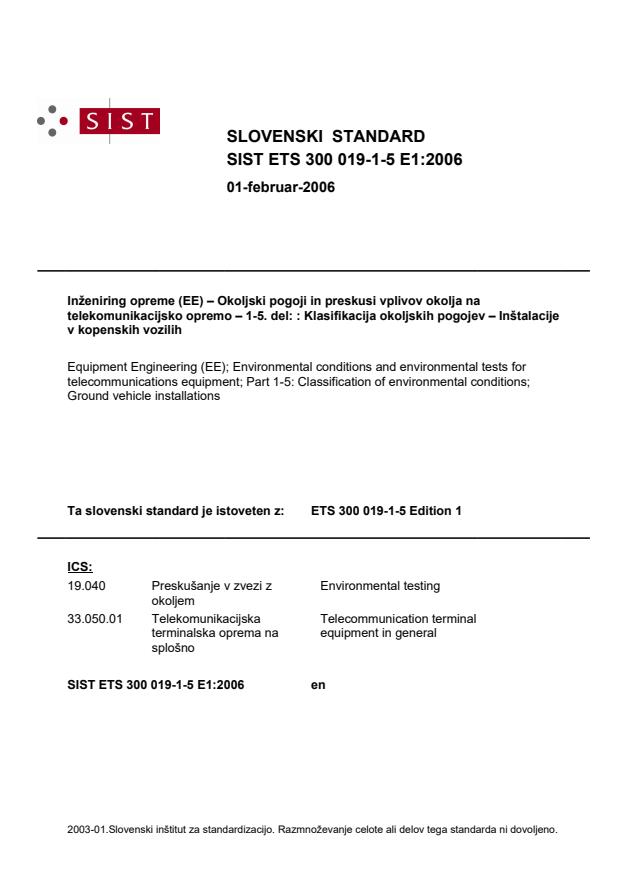
SLOVENSKI STANDARD
01-februar-2006
Inženiring opreme (EE) – Okoljski pogoji in preskusi vplivov okolja na
telekomunikacijsko opremo – 1-5. del: : Klasifikacija okoljskih pogojev – Inštalacije
v kopenskih vozilih
Equipment Engineering (EE); Environmental conditions and environmental tests for
telecommunications equipment; Part 1-5: Classification of environmental conditions;
Ground vehicle installations
Ta slovenski standard je istoveten z: ETS 300 019-1-5 Edition 1
ICS:
19.040 Preskušanje v zvezi z Environmental testing
okoljem
33.050.01 Telekomunikacijska Telecommunication terminal
terminalska oprema na equipment in general
splošno
2003-01.Slovenski inštitut za standardizacijo. Razmnoževanje celote ali delov tega standarda ni dovoljeno.
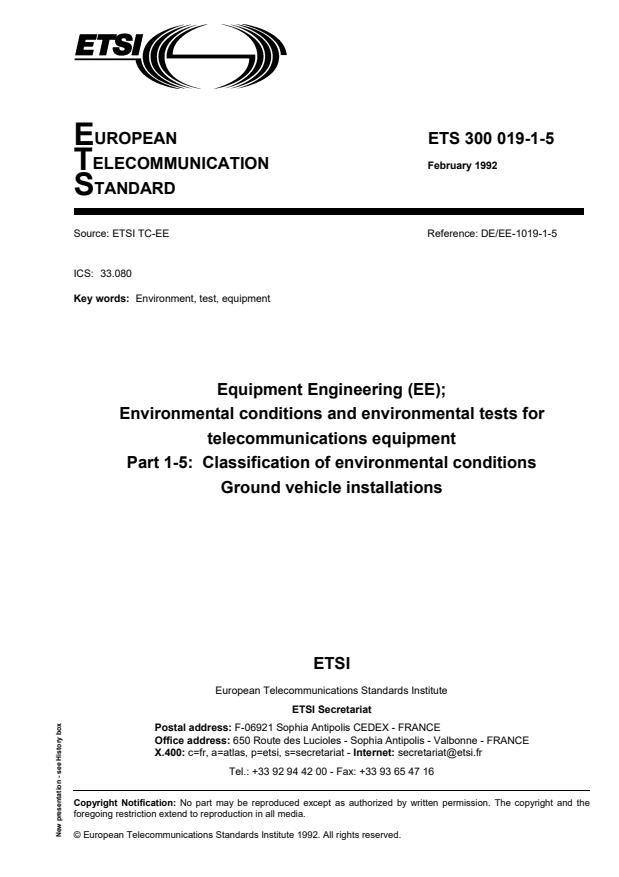
EUROPEAN ETS 300 019-1-5
TELECOMMUNICATION February 1992
STANDARD
Source: ETSI TC-EE Reference: DE/EE-1019-1-5
ICS: 33.080
Environment, test, equipment
Key words:
Equipment Engineering (EE);
Environmental conditions and environmental tests for
telecommunications equipment
Part 1-5: Classification of environmental conditions
Ground vehicle installations
ETSI
European Telecommunications Standards Institute
ETSI Secretariat
F-06921 Sophia Antipolis CEDEX - FRANCE
Postal address:
650 Route des Lucioles - Sophia Antipolis - Valbonne - FRANCE
Office address:
c=fr, a=atlas, p=etsi, s=secretariat - secretariat@etsi.fr
X.400: Internet:
Tel.: +33 92 94 42 00 - Fax: +33 93 65 47 16
Copyright Notification: No part may be reproduced except as authorized by written permission. The copyright and the
foregoing restriction extend to reproduction in all media.
© European Telecommunications Standards Institute 1992. All rights reserved.
New presentation - see History box
Page 2
ETS 300 019-1-5: February 1992
Whilst every care has been taken in the preparation and publication of this document, errors in content,
typographical or otherwise, may occur. If you have comments concerning its accuracy, please write to
"ETSI Editing and Committee Support Dept." at the address shown on the title page.
Page 3
ETS 300 019-1-5: February 1992
Contents
Foreword.5
1 Scope .7
2 Normative references .7
3 Definitions. 7
4 Environmental classes .7
4.1 Class 5.1: Protected installation .7
4.2 Class 5.2: Partly protected installation.8
5 Environmental conditions. 10
5.1 Climatic conditions. 10
5.2 Biological conditions . 11
5.3 Chemical active substances . 11
5.4 Contaminating fluids . 12
5.5 Mechanically active substances. 12
5.6 Mechanical conditions. 12
Annex A (normative): Summary of applications of classes 5.1 and 5.2 in different climates. 14
History. 15
Page 4
ETS 300 019-1-5: February 1992
Blank page
Page 5
ETS 300 019-1-5: February 1992
Foreword
This multi-part European Telecommunication Standard (ETS) has been produced by the Equipment
Engineering (EE) Technical Committee of the European Telecommunications Standards Institute (ETSI).
This standard is concerned with environmental conditions and environmental tests for telecommunications
equipment and comprises two main parts, each with subdivisions:
- ETS 300 019-1: "Classification of environmental conditions".
This part of the standard, Part 1, specifies different standardised environmental classes covering
climatic and biological conditions, chemically and mechanically active substances and mechanical
conditions during storage, transportation and in use.
- ETS 300 019-2: "Specification of environmental tests".
This part of the standard will specify the test requirements for the different environmental classes.
Each part of the standard is divided into sub-parts. Sub-part 1-0 will form a general overview of Part 1.
This sub-part, Sub-part 1-5, deals with ground vehicle installations.
This part of the standard (Part 1) was submitted to Public Enquiry as prETS 300 019 Part B. The original
Part A is to be published as ETSI Technical Report ETR 035 entitled: "Equipment Engineering (EE);
Environmental engineering Guidance and terminology".
Annex A to this sub-part is normative.
Page 6
ETS 300 019-1-5: February 1992
Blank page
Page 7
ETS 300 019-1-5: February 1992
1 Scope
The purpose of this sub-part of this standard is to define the classes of environmental conditions and their
severities to which equipment may be exposed in ground vehicles. Only severe conditions, which may be
harmful to the equipment, are included. The severities specified are those which will have a low probability
of being exceeded; generally less than 1 .
This sub-part applies to equipment when in use and permanently or temporarily installed in ground vehicles.
2 Normative references
This ETS contains, by dated or undated reference, provisions from other publications. These normative
references are cited at the appropriate places in the text and the publications listed hereafter. For dated
references, subsequent amendments to, or revisions of any of these publications apply to this ETS only
when incorporated in it by amendment or revision. For undated references the latest edition of the
publication referred to applies.
[1] ETR 035: "Equipment Engineering (EE); Environmental engineering Guidance
and terminology".
[2] IEC Publication 721-3-5: "Ground vehicle installations".
[3] IEC Publication 721-2-1: "Temperature and humidity".
[4] IEC Publication 68-2-27: "Test Ea : Shock".
3 Definitions
In this sub-part the following definitions apply:
Internally mounted: The equipment is mounted internally in the vehicle in a compartment which affords
some protection from the environment. The protection ranges from complete isolation from external
influences to protection only from precipitation when the vehicle is not moving.
Externally mounted: The equipment is mounted on the outside of the vehicle. It is not protected from any
external influences.
Weatherprotected location: A location at which the vehicle is protected from direct weather influences.
The locality is assumed to be reasonably ventilated (at least natural flow).
4 Environmental classes
The classes shown in parentheses, e.g. (5S1), may be selected for special applications.
4.1 Class 5.1: Protected installation
This class is a combination of classes 5K2/5B2/5C2(5C3)/5F1(5F2)/5S2(5S1)/5M2 or 5M3 in IEC
Publication 721-3-5 [2].
This class applies to equipment in vehicles used at weatherprotected and heated locations covered by
world-wide open-air climates excluding extremely warm dry climates.
At non-weatherprotected locations this class applies to equipment in ventilated compartments and in the
engine compartments of vehicles powered by electric motors in climatic conditions with normal rain
intensities but excluding extremely cold, cold, cold temperate and extremely warm dry climates.
NOTE 1: For some environmental parameters (low air temperature, high air temperature) this
class also covers externally mounted equipment.
Page 8
ETS 300 019-1-5: February 1992
NOTE 2: A survey of applications in different climates is given in Annex A. Climatic conditions for
different areas are defined in IEC publication 721-2-1 [3].
This class applies to:
- equipment subjected to heat from heating elements and solar radiation through windows. The vehicle
may be moved between cold, non-weatherprotected and warm, weatherprotected conditions. The
equipment may also be subjected to dripping water and conditions of wet mounting surfaces. Engine
compartments may be subjected to the ingress of water and snow;
- areas and conditions where mould growth and attacks by animals, except termites, may occur;
- equipment internally mounted in partly open compartments and in engine compartments which may
be subjected to the ingress of road salts;
- locations with normal levels of contaminants experienced in urban areas with industrial activities
scattered over the whole area and/or with heavy traffic;
NOTE 3: In areas with industrial sources emitting high quantities of chemical pollutants either
special precautions must be taken or the special IEC chemical class 5C3 must be
chosen.
- compartments where contaminating fluids are not expected;
NOTE 4: If the equipment is exposed to contaminating fluids either the special precautions must
be taken or the special IEC class 5F2 must be chosen.
- equipment not protected from sand and dust on vehicles not used in desert areas;
NOTE 5: In a vehicle cab which is mainly protected from sand the special IEC class 5S1 may be
chosen.
Class 5.1 also includes one of the following mechanical conditions as appropriate:
- Class 5M2: All types of road vehicles used in areas with well-developed road systems except
tracked vehicles, motorcycles, scooters and other vehicles with low mass. The equipment can be
mounted on surfaces which may be subjected to flying stones. The equipment may be mounted on
passenger car instrument panels to which high frequency vibrations from the engine, or from other
parts connected to the engine, may be transmitted. This class also applies to fork lift trucks and to
trains with soft suspension and shock reducing buffers;
- Class 5M3: All types of road vehicles in areas without well-developed road system; tracked
vehicles, self-propelled machines, overland vehicles, motorcycles, scooters and other vehicles with
low mass. The equipment may be mounted on instrument panels to which high frequency vibrations
from the engine, or from other parts connected to the engine, may be transmitted. This class also
applies to trains with hard suspension. Externally mounted equipment may be directly hit by flying
stones.
NOTE 6: The proper IEC class, 5M2 or 5M3, shall be chosen according to the expected
installation and use of the equipment.
4.2 Class 5.2: Partly protected installation
This class is a combination of classes 5K3/5B2/5C2(5C3)/5F1(5F2)/5S2(5S1)/5M2 or 5M3 in IEC
Publication 721-3-5 [2].
In addition to conditions in class 5.1, class 5.2 applies to equipment in vehicles used at non-
weatherprotected locations in climatic conditions with normal rain intensities but excluding extremely cold,
cold and extremely warm dry climates. This class also applies to internally mounted equipment in heated
Page 9
ETS 300 019-1-5: February 1992
compartments, after a warm-up period, and to equipment in engine compartments of vehicles powered by
electric motors in general open-air climates.
NOTE 1: A survey of applications in different climatic conditions is shown in Annex A. Climatic
conditions for different areas are defined in IEC publication 721-2-1 [3].
This class applies to:
- equipment in compartments with wet surfaces and subjected to solar radiation. The equipment may
also be subjected to direct solar radiation and rain;
- areas and conditions where mould growth, attacks by animals but except termites, may occur;
- equipment either externally mounted or internally mounted in partly-open compartments. The
equipment may be subjected to the ingress of road salt or splashing water;
- locations with normal levels of contaminants experienced in urban areas with industrial activities
scattered over the whole area and/or with heavy traffic;
NOTE 2: In areas with industrial sources emitting high quantities of chemical pollutants either
special precautions shall be taken or the special IEC class 5C3 shall be chosen.
- compartments where contaminating fluids are not expected;
NOTE 3: If the equipment is exposed to contaminating fluids either special precautions shall be
taken or the special IEC class 5F2 shall be chosen.
- equipment is not protected from sand and dust on vehicles not used in desert areas.
NOTE 4: In a vehicle cab which is mainly protected from sand the special IEC class 5S1 may be
chosen.
Class 5.2 also includes one of the following mechanical conditions as appropriate:
- Class 5M2: All types of road vehicles used in areas with a well-developed road system, except
tracked vehicles, motorcycles, scooters and other vehicles with low mass. The equipment can be
mounted on surfaces which may be subjected to flying stones. The equipment may be mounted on
passenger car instrument panels to which high frequency vibrations from the engine, or from other
parts connected to the engine, may be transmitted. This class also applies to fork lift trucks and
trains with soft suspension and shock reducing buffers;
- Class 5M3: All types of road vehicles in areas without a well-developed road system, tracked
vehicles and self-propelled machines, overland vehicles, motorcycles, scooters and other vehicles
with low mass. The equipment may be mounted on instrument panels to which high-frequency
vibrations from the engine, or from other parts connected to the engine, may be transmitted. This
class also applies to trains with hard suspension. Externally mounted equipment may be directly hit
by flying stones.
NOTE 5: The proper mechanical IEC class, 5M2 or 5M3, shall be chosen according to the
expected installation and use of the equipment.
Page 10
ETS 300 019-1-5: February 1992
5 Environmental conditions
5.1 Climatic conditions
Table 1: Climatic conditions for environmental classes 5.1 and 5.2
Class
Environmental parameter Unit 5.1 5.2
a) Low temperature, air C - 25 -40
b) High temperature, air, in ventilated compartments C +40 +40
(except engine compartments) or outdoor (NOTE 1)
c) High temperature, air, in unventilated compartments, C +70 +70
except engine compartments (NOTE 2)
d) High temperature, air, in engine compartments C +70 +70
e) Change of temperature, air/air (NOTE 3) C -25/+30 -40/+30
f) Gradual change of temperature, air/air, except C -25/+30 -40/+30
in engine compartments C/minute 5 5
g) Gradual change of temperature, air/air, in C -25/+60 -40/+70
engine compartments C 10 10
h) Change of temperature, air/water, except in engine C no +40/+5
compartments (NOTES 3,4)
i) Change of temperature, air/water, in engine C +60/+5 +70/+5
compartments (NOTES 3,4)
j) Change
...