

oSIST prEN ISO 6338-4:2026
(Main)Calculations of greenhouse gas (GHG) emissions throughout the liquefied natural gas (LNG) chain - Part 4: Shipping (ISO/DIS 6338-4:2026)
General Information
- Abstract
This document provides the part of the method to calculate the GHG emissions throughout the
LNG chain specific to shipping.
The general requirements are covered in ISO 6338-1.
- Status
- Not Published
- Public Enquiry End Date
- 01-May-2026
- Technical Committee
- DPL - Gas supply
- Current Stage
- 4020 - Public enquire (PE) (Adopted Project)
- Start Date
- 20-Feb-2026
- Due Date
- 10-Jul-2026
- Completion Date
- 29-Apr-2026

Overview
oSIST prEN ISO 6338-4:2026:2026 provides a standardized methodology for calculating greenhouse gas (GHG) emissions associated specifically with the shipping stage in the liquefied natural gas (LNG) supply chain. Developed by CEN in cooperation with ISO/TC 67, this draft international standard addresses a critical focus for the LNG industry: ensuring consistency, transparency, and comparability in reporting GHG emissions for maritime LNG transport. While the requirements and methodologies for the entire LNG chain are detailed in ISO 6338-1, Part 4 narrows the scope to shipping, supporting stakeholders in regulatory compliance, voluntary disclosures, and climate strategies.
Key Topics
Scope and Boundaries
- Clear definition of GHG inventory boundaries specific to LNG shipping.
- Guidance for including emissions from combustion, fuel cells, venting, and fugitive leaks.
Identification and Quantification of GHG Sources
- Step-by-step approaches for quantifying emissions from ship engine combustion, onboard fuel cells, venting processes, and leaks from pipes or equipment.
- Preference for primary measurement data (e.g., fuel consumption, emission sensors), with secondary data and factors as alternatives.
- Inclusion of methane slip and unburned hydrocarbons.
Emissions Allocation
- Methodologies for allocating emissions from maintenance, gas freeing, and ballast legs among shipped cargoes, ensuring fair and transparent reporting.
Reporting and Quality Management
- Emphasis on accurate, auditable GHG inventories conforming to ISO 6338-1 requirements.
- Requirements for data management, quality control, and independent review.
Exclusions
- Activities not directly related to shipping, such as LNG loading/unloading and FSRU operations, are addressed in other parts of ISO 6338.
Applications
oSIST prEN ISO 6338-4:2026 is applicable for a range of organizations and industry professionals concerned with LNG shipping emissions, including:
LNG Ship Operators and Owners
- Supporting regulatory GHG reporting, fleet management, and sustainability initiatives.
- Helps in benchmarking and improving environmental performance.
Energy Producers and Traders
- Enables transparent communication of carbon intensity along the LNG value chain.
- Assists in meeting increasing commercial requirements for carbon footprint data from customers and stakeholders.
Regulators and Policymakers
- Provides a harmonized framework for assessing compliance with environmental and climate-related regulations in maritime LNG transport.
Third-Party Auditors and Verifiers
- Serves as a reference for conducting independent reviews and verification of reported GHG data.
Sustainability and ESG Reporting
- Supports alignment with broader corporate social responsibility, sustainability, and Environmental, Social, and Governance (ESG) frameworks.
Related Standards
- ISO 6338-1: General principles and methodology for GHG emissions calculations throughout the LNG chain.
- ISO 14044: Life cycle assessment - Environmental management requirements and guidelines.
- ISO 14064-1: Quantification and reporting of GHG emissions and removals at the organizational level.
- ISO 14064-2, ISO 14064-3: GHG project-level quantification and verification guidelines.
- ISO 14065, ISO 14066: Principles and competence requirements for validation and verification of environmental information.
- ISO 14067: Guidance on carbon footprint quantification.
- CEN/TS 17874: Methodology for methane emissions quantification in gas systems and LNG terminals.
- API GHG Methodology for LNG Operations: Industry reference for consistent LNG GHG estimation.
Implementing oSIST prEN ISO 6338-4:2026 in LNG shipping operations supports robust GHG emissions measurement, reporting, and management, helping organizations respond to evolving regulatory expectations and contribute to global climate targets in the LNG sector.
Get Certified
Connect with accredited certification bodies for this standard

BSI Group
BSI (British Standards Institution) is the business standards company that helps organizations make excellence a habit.

Bureau Veritas
Bureau Veritas is a world leader in laboratory testing, inspection and certification services.

DNV
DNV is an independent assurance and risk management provider.
Sponsored listings
Frequently Asked Questions
oSIST prEN ISO 6338-4:2026 is a draft published by the Slovenian Institute for Standardization (SIST). Its full title is "Calculations of greenhouse gas (GHG) emissions throughout the liquefied natural gas (LNG) chain - Part 4: Shipping (ISO/DIS 6338-4:2026)". This standard covers: This document provides the part of the method to calculate the GHG emissions throughout the LNG chain specific to shipping. The general requirements are covered in ISO 6338-1.
This document provides the part of the method to calculate the GHG emissions throughout the LNG chain specific to shipping. The general requirements are covered in ISO 6338-1.
oSIST prEN ISO 6338-4:2026 is classified under the following ICS (International Classification for Standards) categories: 13.020.40 - Pollution, pollution control and conservation; 75.020 - Extraction and processing of petroleum and natural gas. The ICS classification helps identify the subject area and facilitates finding related standards.
oSIST prEN ISO 6338-4:2026 is available in PDF format for immediate download after purchase. The document can be added to your cart and obtained through the secure checkout process. Digital delivery ensures instant access to the complete standard document.
Standards Content (Sample)
SLOVENSKI STANDARD
01-april-2026
Izračuni emisij toplogrednih plinov v oskrbovalni verigi z utekočinjenim
zemeljskim plinom (LNG) - 4. del: Transport (ISO/DIS 6338-4:2026)
Calculations of greenhouse gas (GHG) emissions throughout the liquefied natural gas
(LNG) chain - Part 4: Shipping (ISO/DIS 6338-4:2026)
Berechnungsverfahren der Treibhausgasemissionen (THG) in der gesamten
Flüssigerdgas-(LNG-)Kette - Teil 4: Transport (ISO/DIS 6338-4:2026)
Calcul des émissions de gaz à effet de serre (GES) dans la chaîne gaz naturel liquéfié
(GNL) - Partie 4: Transport maritime (ISO/DIS 6338-4:2026)
Ta slovenski standard je istoveten z: prEN ISO 6338-4
ICS:
13.020.40 Onesnaževanje, nadzor nad Pollution, pollution control
onesnaževanjem in and conservation
ohranjanje
75.020 Pridobivanje in predelava Extraction and processing of
nafte in zemeljskega plina petroleum and natural gas
2003-01.Slovenski inštitut za standardizacijo. Razmnoževanje celote ali delov tega standarda ni dovoljeno.
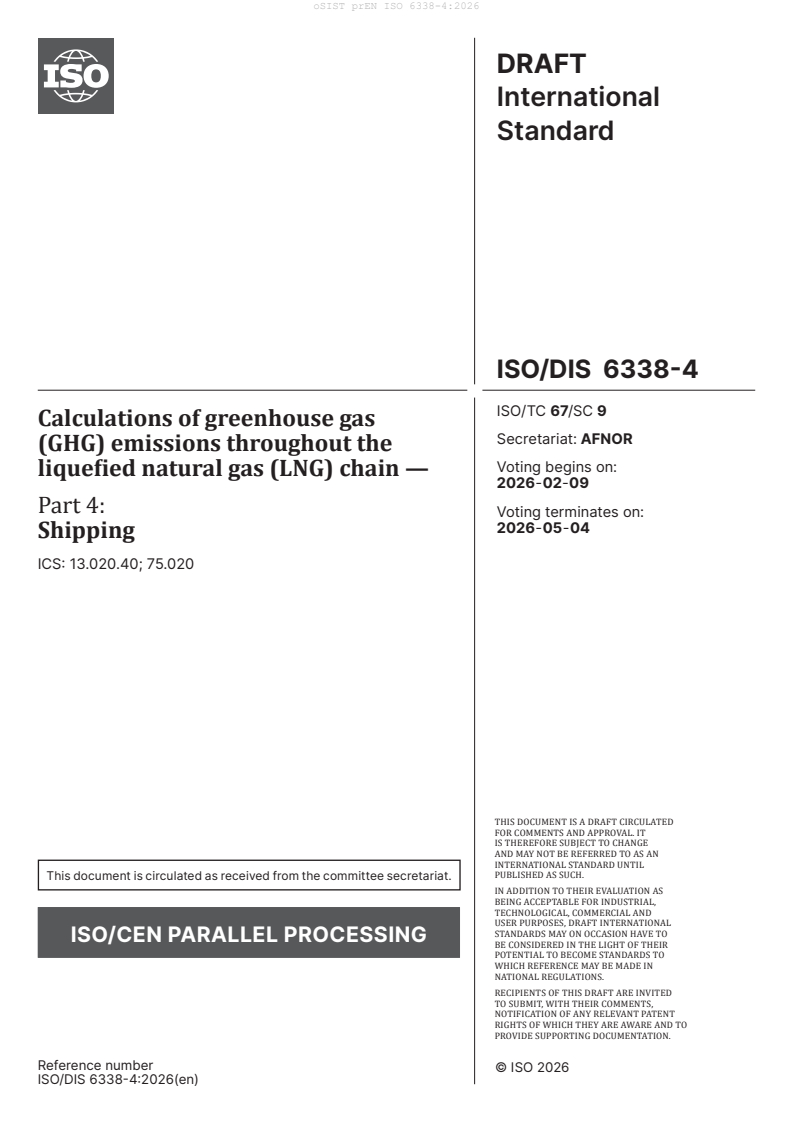
DRAFT
International
Standard
ISO/DIS 6338-4
ISO/TC 67/SC 9
Calculations of greenhouse gas
Secretariat: AFNOR
(GHG) emissions throughout the
Voting begins on:
liquefied natural gas (LNG) chain —
2026-02-09
Part 4:
Voting terminates on:
2026-05-04
Shipping
ICS: 13.020.40; 75.020
THIS DOCUMENT IS A DRAFT CIRCULATED
FOR COMMENTS AND APPROVAL. IT
IS THEREFORE SUBJECT TO CHANGE
AND MAY NOT BE REFERRED TO AS AN
INTERNATIONAL STANDARD UNTIL
PUBLISHED AS SUCH.
This document is circulated as received from the committee secretariat.
IN ADDITION TO THEIR EVALUATION AS
BEING ACCEPTABLE FOR INDUSTRIAL,
TECHNOLOGICAL, COMMERCIAL AND
USER PURPOSES, DRAFT INTERNATIONAL
STANDARDS MAY ON OCCASION HAVE TO
ISO/CEN PARALLEL PROCESSING
BE CONSIDERED IN THE LIGHT OF THEIR
POTENTIAL TO BECOME STANDARDS TO
WHICH REFERENCE MAY BE MADE IN
NATIONAL REGULATIONS.
RECIPIENTS OF THIS DRAFT ARE INVITED
TO SUBMIT, WITH THEIR COMMENTS,
NOTIFICATION OF ANY RELEVANT PATENT
RIGHTS OF WHICH THEY ARE AWARE AND TO
PROVIDE SUPPORTING DOCUMENTATION.
Reference number
ISO/DIS 6338-4:2026(en)
DRAFT
ISO/DIS 6338-4:2026(en)
International
Standard
ISO/DIS 6338-4
ISO/TC 67/SC 9
Calculations of greenhouse gas
Secretariat: AFNOR
(GHG) emissions throughout the
Voting begins on:
liquefied natural gas (LNG) chain —
Part 4:
Voting terminates on:
Shipping
ICS: 13.020.40; 75.020
THIS DOCUMENT IS A DRAFT CIRCULATED
FOR COMMENTS AND APPROVAL. IT
IS THEREFORE SUBJECT TO CHANGE
AND MAY NOT BE REFERRED TO AS AN
INTERNATIONAL STANDARD UNTIL
PUBLISHED AS SUCH.
This document is circulated as received from the committee secretariat.
IN ADDITION TO THEIR EVALUATION AS
BEING ACCEPTABLE FOR INDUSTRIAL,
© ISO 2026
TECHNOLOGICAL, COMMERCIAL AND
USER PURPOSES, DRAFT INTERNATIONAL
All rights reserved. Unless otherwise specified, or required in the context of its implementation, no part of this publication may
STANDARDS MAY ON OCCASION HAVE TO
ISO/CEN PARALLEL PROCESSING
be reproduced or utilized otherwise in any form or by any means, electronic or mechanical, including photocopying, or posting on
BE CONSIDERED IN THE LIGHT OF THEIR
the internet or an intranet, without prior written permission. Permission can be requested from either ISO at the address below
POTENTIAL TO BECOME STANDARDS TO
WHICH REFERENCE MAY BE MADE IN
or ISO’s member body in the country of the requester.
NATIONAL REGULATIONS.
ISO copyright office
RECIPIENTS OF THIS DRAFT ARE INVITED
CP 401 • Ch. de Blandonnet 8
TO SUBMIT, WITH THEIR COMMENTS,
CH-1214 Vernier, Geneva
NOTIFICATION OF ANY RELEVANT PATENT
Phone: +41 22 749 01 11
RIGHTS OF WHICH THEY ARE AWARE AND TO
PROVIDE SUPPORTING DOCUMENTATION.
Email: copyright@iso.org
Website: www.iso.org
Published in Switzerland Reference number
ISO/DIS 6338-4:2026(en)
ii
ISO/DIS 6338-4:2026(en)
Contents Page
Foreword .iv
Introduction .v
1 Scope . 1
2 Normative references . 1
3 Terms and definitions . 1
4 Principles . 1
5 GHG inventory boundaries . 1
6 Quantification of GHG emissions . 2
6.1 Identification of GHG sources and quantification approach .2
6.1.1 General .2
6.1.2 Emissions from combustion .2
6.1.3 Emissions from fuel cells .3
6.1.4 Emissions from venting.3
6.1.5 Fugitive emissions .4
6.1.6 Emissions associated with imported energy, utilities, and consumables .4
6.2 Calculation of GHG emissions .4
6.3 Preferred units .4
6.4 Allocation .4
6.5 Carbon capture .4
7 GHG inventory quality management . 4
8 GHG reporting . 4
9 Independent review . . 5
Bibliography . 6
iii
ISO/DIS 6338-4:2026(en)
Foreword
ISO (the International Organization for Standardization) is a worldwide federation of national standards
bodies (ISO member bodies). The work of preparing International Standards is normally carried out through
ISO technical committees. Each member body interested in a subject for which a technical committee
has been established has the right to be represented on that committee. International organizations,
governmental and non-governmental, in liaison with ISO, also take part in the work. ISO collaborates closely
with the International Electrotechnical Commission (IEC) on all matters of electrotechnical standardization.
The procedures used to develop this document and those intended for its further maintenance are described
in the ISO/IEC Directives, Part 1. In particular, the different approval criteria needed for the different types
of ISO document should be noted. This document was drafted in accordance with the editorial rules of the
ISO/IEC Directives, Part 2 (see www.iso.org/directives).
ISO draws attention to the possibility that the implementation of this document may involve the use of (a)
patent(s). ISO takes no position concerning the evidence, validity or applicability of any claimed patent
rights in respect thereof. As of the date of publication of this document, ISO had not received notice of (a)
patent(s) which may be required to implement this document. However, implementers are cautioned that
this may not represent the latest information, which may be obtained from the patent database available at
www.iso.org/patents. ISO shall not be held responsible for identifying any or all such patent rights.
Any trade name used in this document is information given for the convenience of users and does not
constitute an endorsement.
For an explanation of the voluntary nature of standards, the meaning of ISO specific terms and expressions
related to conformity assessment, as well as information about ISO's adherence to the World Trade
Organization (WTO) principles in the Technical Barriers to Trade (TBT), see www.iso.org/iso/foreword.html.
This document was prepared by Technical Committee ISO/TC 67, Oil and gas industries including lower carbon
energy, Subcommittee SC 9, Production, transport and storage facilities for cryogenic liquefied gases.
A list of all parts in the ISO 6338 series can be found on the ISO website.
Any feedback or questions on this document should be directed to the user’s national standards body. A
complete listing of these bodies can be found at www.iso.org/members.html.
iv
ISO/DIS 6338-4:2026(en)
Introduction
Natural gas will play a key role in the energy transition (e.g. by replacing coal to produce electricity) and the
use of liquefied natural gas (LNG) to transport natural gas is expected to increase. The process of liquefying
natural gas is energy-intensive. Gas producers are increasingly accountable for their greenhouse gas (GHG)
emissions and the ambition to reduce them. Furthermore, there is an emerging marketing demand for GHG
data to enable commercial mechanisms such as offsetting to be utilized.
There is no standardized and auditable methodology to calculate the carbon footprint of the whole LNG
...