

SIST EN 17692:2025
(Main)Central heating boilers - Specification for indirectly heated unvented (closed) pressurized buffer tanks - Requirements, testing and marking
General Information
- Abstract
This document specifies the essential terms, constructional requirements, tests, energy assessment and marking of indirectly heated water storage tanks for primary water (buffer tanks), with a capacity not exceeding 2,000 l, an operating temperature not exceeding 95 °C, and an operating pressure not exceeding 1,0 MPa (10 bar).
This document covers metallic and plastic made buffer tanks.
Although this document does not consider any buffer tanks mainly intended for direct firing, it allows for the provision of electric heating elements for auxiliary purposes.
NOTE The energy assessment is performed by EN 15332 or EN 12897.
- Status
- Published
- Public Enquiry End Date
- 03-Aug-2021
- Publication Date
- 19-Aug-2025
- Technical Committee
- PLN - Gas appliances for domestic use
- Current Stage
- 6060 - National Implementation/Publication (Adopted Project)
- Start Date
- 21-Jul-2025
- Due Date
- 25-Sep-2025
- Completion Date
- 20-Aug-2025

Overview
EN 17692:2025 - "Central heating boilers - Specification for indirectly heated unvented (closed) pressurized buffer tanks" is a CEN standard specifying requirements, tests, energy assessment and marking for indirectly heated buffer tanks used in central heating systems. The standard covers metallic and plastic buffer tanks with a rated capacity up to 2 000 l, an operating temperature up to 95 °C, and an operating pressure up to 1,0 MPa (10 bar). It excludes tanks mainly intended for direct firing but permits auxiliary electric heating elements. Energy assessment is performed according to EN 15332 or EN 12897.
Key topics and technical requirements
- Scope & definitions - Clarifies terms such as primary water, buffer tank, combined buffer tank, primary/secondary systems and actual storage volumes (Vp, Vd, Ve).
- Design and construction requirements - Hydraulic connections, venting, draining, insulation, mounting, and temperature control measures for safe operation of closed pressurized buffer tanks.
- Safety devices - Requirements for pressure safety valves, temperature safety devices and energy shut-off mechanisms.
- Initial type testing - Mandatory tests including pressure resistance (shell, secondary system, heat exchanger), leak tightness, durability testing and standing loss measurements.
- Energy assessment - Procedures for measuring standing losses and overall energy performance (referencing EN 15332 / EN 12897 test methods).
- Operational control & expansion - Measures for temperature control, expansion accommodation and long-term durability.
- Production quality control - Requirements for factory production control and on‑going testing during production.
- Marking, labelling & documentation - Mandatory marking, installation instructions, packaging and technical documentation for compliance and safe installation.
- Combined buffer tanks - Specific provisions for tank-in-tank designs, internal drinking-water heat exchangers and external plate heat exchanger arrangements.
Practical applications and users
Who benefits from EN 17692:2025:
- Manufacturers of buffer tanks and central heating components - to design, test and document products that meet European requirements.
- Test laboratories - to carry out initial type tests, standing loss and leak/durability testing referenced in the standard.
- System designers & installers - to select compliant buffer tanks and follow installation and safety requirements.
- Specifiers, procurement officers & regulatory bodies - to set performance and safety criteria for product selection, ecodesign and energy labelling compliance.
- Quality managers - to implement factory production control and ensure consistent product quality and marking.
Practical uses:
- Product design validation, CE/market compliance, energy performance reporting, selection of buffer tanks for hydronic heating systems, and integration with drinking-water heating arrangements (combined tanks).
Related standards
- EN 15332 - Heating boilers: energy assessment of hot water storage tanks
- EN 12897 - Specification for indirectly heated unvented storage water heaters
- EN 1490 - Combined temperature and pressure relief valves
- EN IEC 60730-2-9 and EN IEC 60335-2-102 - Relevant electrical control and appliance safety requirements
Keywords: EN 17692:2025, central heating boilers, buffer tanks, indirectly heated, unvented closed pressurized, testing, marking, energy assessment, EN 15332, EN 12897.
Relations
- Effective Date
- 09-Feb-2026
- Effective Date
- 09-Feb-2026
- Effective Date
- 09-Feb-2026
- Effective Date
- 09-Feb-2026
- Effective Date
- 09-Feb-2026
- Effective Date
- 28-Jan-2026
- Effective Date
- 28-Jan-2026
- Effective Date
- 28-Jan-2026
Get Certified
Connect with accredited certification bodies for this standard

DNV
DNV is an independent assurance and risk management provider.

Lloyd's Register
Lloyd's Register is a global professional services organisation specialising in engineering and technology.

DIBt (Deutsches Institut für Bautechnik)
German Institute for Building Technology.
Sponsored listings
Frequently Asked Questions
SIST EN 17692:2025 is a standard published by the Slovenian Institute for Standardization (SIST). Its full title is "Central heating boilers - Specification for indirectly heated unvented (closed) pressurized buffer tanks - Requirements, testing and marking". This standard covers: This document specifies the essential terms, constructional requirements, tests, energy assessment and marking of indirectly heated water storage tanks for primary water (buffer tanks), with a capacity not exceeding 2,000 l, an operating temperature not exceeding 95 °C, and an operating pressure not exceeding 1,0 MPa (10 bar). This document covers metallic and plastic made buffer tanks. Although this document does not consider any buffer tanks mainly intended for direct firing, it allows for the provision of electric heating elements for auxiliary purposes. NOTE The energy assessment is performed by EN 15332 or EN 12897.
This document specifies the essential terms, constructional requirements, tests, energy assessment and marking of indirectly heated water storage tanks for primary water (buffer tanks), with a capacity not exceeding 2,000 l, an operating temperature not exceeding 95 °C, and an operating pressure not exceeding 1,0 MPa (10 bar). This document covers metallic and plastic made buffer tanks. Although this document does not consider any buffer tanks mainly intended for direct firing, it allows for the provision of electric heating elements for auxiliary purposes. NOTE The energy assessment is performed by EN 15332 or EN 12897.
SIST EN 17692:2025 is classified under the following ICS (International Classification for Standards) categories: 27.060.30 - Boilers and heat exchangers; 91.140.10 - Central heating systems. The ICS classification helps identify the subject area and facilitates finding related standards.
SIST EN 17692:2025 has the following relationships with other standards: It is inter standard links to SIST EN IEC 60730-2-9:2019, SIST EN IEC 60730-2-9:2019/A1:2019, SIST EN IEC 60730-2-9:2019/A2:2020, SIST EN IEC 60335-2-102:2025/A11:2025, SIST EN IEC 60335-2-102:2025, SIST EN 12897:2016+A1:2020, SIST EN 15332:2020, SIST EN 1490:2000. Understanding these relationships helps ensure you are using the most current and applicable version of the standard.
SIST EN 17692:2025 is associated with the following European legislation: EU Directives/Regulations: 812/2013, 813/2013, 814/2013; Standardization Mandates: M/534. When a standard is cited in the Official Journal of the European Union, products manufactured in conformity with it benefit from a presumption of conformity with the essential requirements of the corresponding EU directive or regulation.
SIST EN 17692:2025 is available in PDF format for immediate download after purchase. The document can be added to your cart and obtained through the secure checkout process. Digital delivery ensures instant access to the complete standard document.
Standards Content (Sample)
SLOVENSKI STANDARD
01-september-2025
Kotli za centralno ogrevanje - Specifikacija za posredno ogrevane, neprezračevane
(zaprte) rezervoarje pod tlakom - Zahteve, preskušanje in označevanje
Central heating boilers - Specification for indirectly heated unvented (closed) pressurized
buffer tanks - Requirements, testing and marking
Zentralheizungskessel - Beschreibungen für indirekt beheizte, unbelüftete
(geschlossene), unter Druck stehende Pufferspeicher - Anforderungen, Prüfung und
Kennzeichnung
Chaudières de chauffage central - Spécification principale pour ballons tampons
pressurisés métalliques non ouverts à l'air libre (fermés) - Exigences, essais et
marquage
Ta slovenski standard je istoveten z: EN 17692:2025
ICS:
27.060.30 Grelniki vode in prenosniki Boilers and heat exchangers
toplote
91.140.10 Sistemi centralnega Central heating systems
ogrevanja
2003-01.Slovenski inštitut za standardizacijo. Razmnoževanje celote ali delov tega standarda ni dovoljeno.
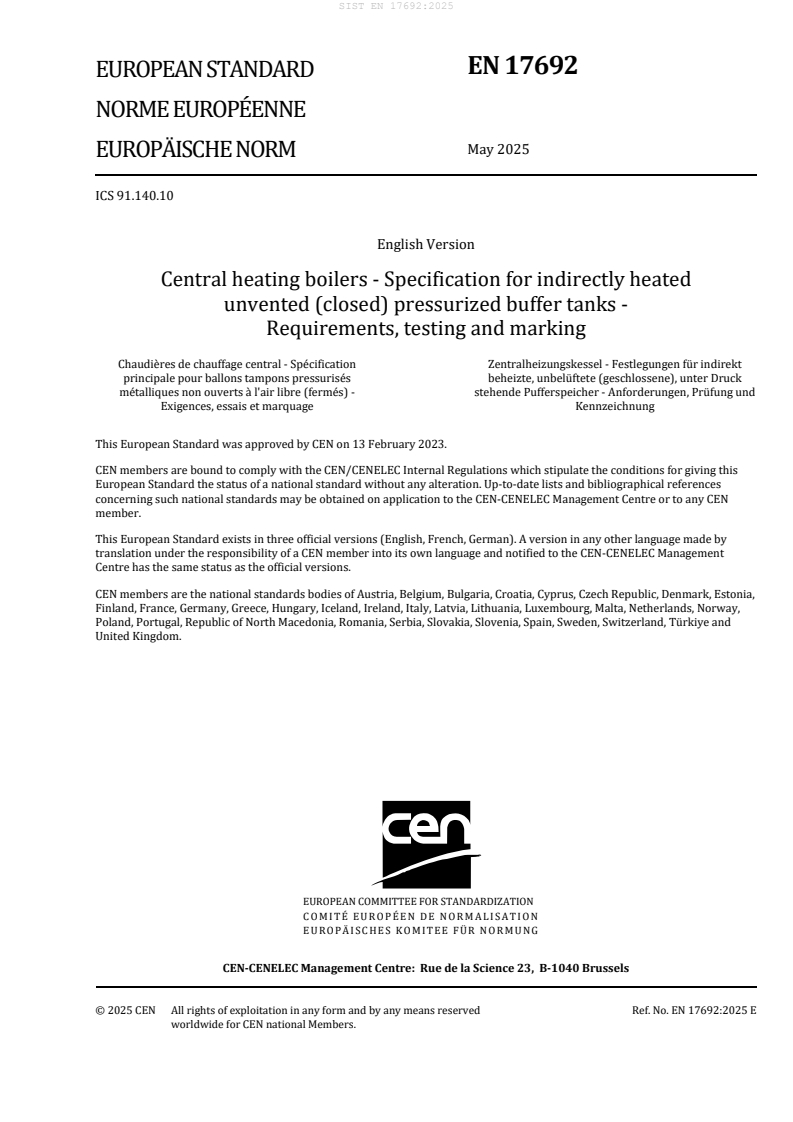
EN 17692
EUROPEAN STANDARD
NORME EUROPÉENNE
May 2025
EUROPÄISCHE NORM
ICS 91.140.10
English Version
Central heating boilers - Specification for indirectly heated
unvented (closed) pressurized buffer tanks -
Requirements, testing and marking
Chaudières de chauffage central - Spécification Zentralheizungskessel - Festlegungen für indirekt
principale pour ballons tampons pressurisés beheizte, unbelüftete (geschlossene), unter Druck
métalliques non ouverts à l'air libre (fermés) - stehende Pufferspeicher - Anforderungen, Prüfung und
Exigences, essais et marquage Kennzeichnung
This European Standard was approved by CEN on 13 February 2023.
CEN members are bound to comply with the CEN/CENELEC Internal Regulations which stipulate the conditions for giving this
European Standard the status of a national standard without any alteration. Up-to-date lists and bibliographical references
concerning such national standards may be obtained on application to the CEN-CENELEC Management Centre or to any CEN
member.
This European Standard exists in three official versions (English, French, German). A version in any other language made by
translation under the responsibility of a CEN member into its own language and notified to the CEN-CENELEC Management
Centre has the same status as the official versions.
CEN members are the national standards bodies of Austria, Belgium, Bulgaria, Croatia, Cyprus, Czech Republic, Denmark, Estonia,
Finland, France, Germany, Greece, Hungary, Iceland, Ireland, Italy, Latvia, Lithuania, Luxembourg, Malta, Netherlands, Norway,
Poland, Portugal, Republic of North Macedonia, Romania, Serbia, Slovakia, Slovenia, Spain, Sweden, Switzerland, Türkiye and
United Kingdom.
EUROPEAN COMMITTEE FOR STANDARDIZATION
COMITÉ EUROPÉEN DE NORMALISATION
EUROPÄISCHES KOMITEE FÜR NORMUNG
CEN-CENELEC Management Centre: Rue de la Science 23, B-1040 Brussels
© 2025 CEN All rights of exploitation in any form and by any means reserved Ref. No. EN 17692:2025 E
worldwide for CEN national Members.
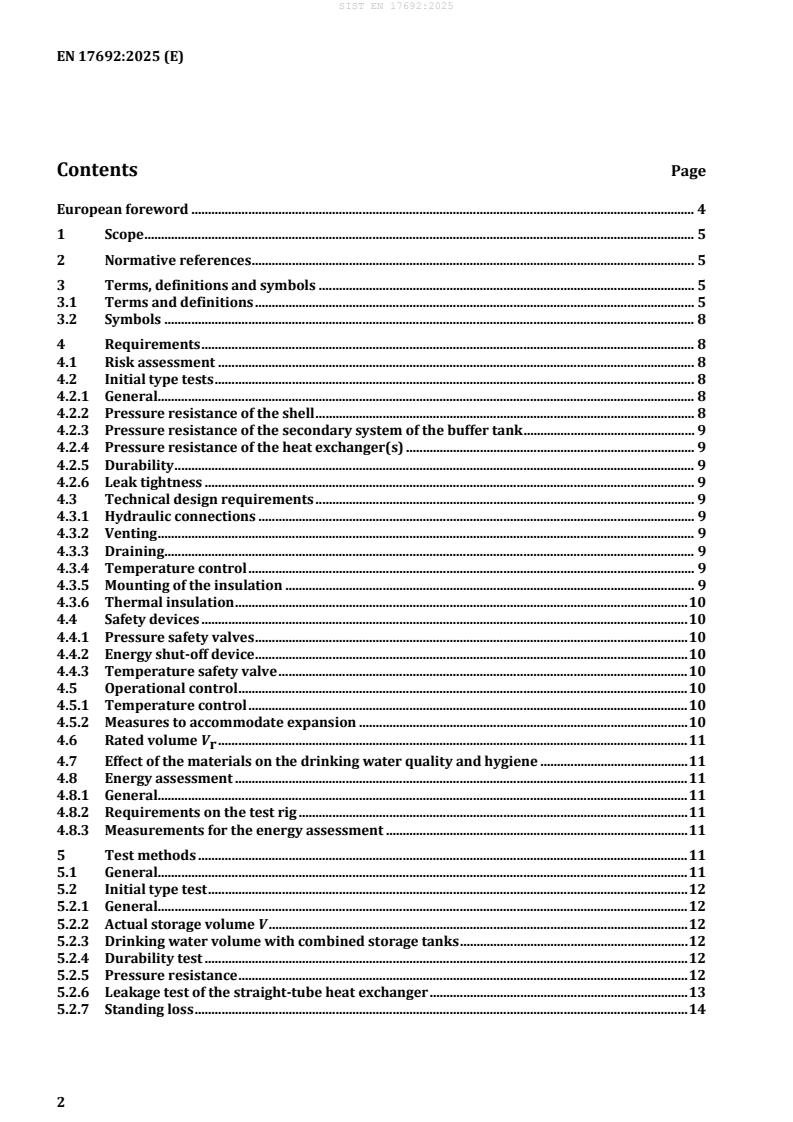
Contents Page
European foreword . 4
1 Scope . 5
2 Normative references . 5
3 Terms, definitions and symbols . 5
3.1 Terms and definitions . 5
3.2 Symbols . 8
4 Requirements . 8
4.1 Risk assessment . 8
4.2 Initial type tests . 8
4.2.1 General. 8
4.2.2 Pressure resistance of the shell . 8
4.2.3 Pressure resistance of the secondary system of the buffer tank . 9
4.2.4 Pressure resistance of the heat exchanger(s) . 9
4.2.5 Durability . 9
4.2.6 Leak tightness . 9
4.3 Technical design requirements . 9
4.3.1 Hydraulic connections . 9
4.3.2 Venting . 9
4.3.3 Draining . 9
4.3.4 Temperature control . 9
4.3.5 Mounting of the insulation . 9
4.3.6 Thermal insulation . 10
4.4 Safety devices . 10
4.4.1 Pressure safety valves . 10
4.4.2 Energy shut-off device . 10
4.4.3 Temperature safety valve . 10
4.5 Operational control . 10
4.5.1 Temperature control . 10
4.5.2 Measures to accommodate expansion . 10
4.6 Rated volume V . 11
r
4.7 Effect of the materials on the drinking water quality and hygiene . 11
4.8 Energy assessment . 11
4.8.1 General. 11
4.8.2 Requirements on the test rig . 11
4.8.3 Measurements for the energy assessment . 11
5 Test methods . 11
5.1 General. 11
5.2 Initial type test . 12
5.2.1 General. 12
5.2.2 Actual storage volume V . 12
5.2.3 Drinking water volume with combined storage tanks . 12
5.2.4 Durability test . 12
5.2.5 Pressure resistance . 12
5.2.6 Leakage test of the straight-tube heat exchanger . 13
5.2.7 Standing loss . 14
5.2.8 V . 14
mix40
5.2.9 Temperature control devices . 14
5.3 Testing during production . 15
5.3.1 General . 15
5.3.2 Leakage resistance . 15
5.4 Internal factory production control (quality assurance system/QA system) . 16
6 Marking, labelling and packaging . 16
7 Technical documentation . 17
7.1 General . 17
7.2 Installation instructions . 17
7.3 Additional instructions . 17
Annex A (informative) Buffer tank types . 18
Annex ZA (informative) Relationship between this European Standard and the ecodesign
requirements of Commission Regulation (EU) No [814/2013] [OJ L 239, 6.9.2013] aimed to
be covered . 20
Annex ZB (informative) Relationship between this European Standard and the energy labelling
requirements of Commission Regulation (EU) No [812/2013] [OJ L 239, 6.9.2013] aimed to
be covered . 21
Bibliography . 22
European foreword
This document (EN 17692:2025) has been prepared by Technical Committee CEN/TC 57 “Central heating
boilers”, the secretariat of which is held by DIN.
This European Standard shall be given the status of a national standard, either by publication of an
identical text or by endorsement, at the latest by November 2025, and conflicting national standards shall
be withdrawn at the latest by November 2025.
Attention is drawn to the possibility that some of the elements of this document may be the subject of
patent rights. CEN shall not be held responsible for identifying any or all such patent rights.
This document has been prepared under a standardization request addressed to CEN by the European
Commission. The Standing Committee of the EFTA States subsequently approves these requests for its
Member States.
For the relationship with EU Legislation, see informative Annexes ZA and ZB, which is an integral part of
this document.
Any feedback and questions on this document should be directed to the users’ national standards body.
A complete listing of these bodies can be found on the CEN website.
According to the CEN-CENELEC Internal Regulations, the national standards organisations of the
following countries are bound to implement this European Standard: Austria, Belgium, Bulgaria, Croatia,
Cyprus, Czech Republic, Denmark, Estonia, Finland, France, Germany, Greece, Hungary, Iceland, Ireland,
Italy, Latvia, Lithuania, Luxembourg, Malta, Netherlands, Norway, Poland, Portugal, Republic of North
Macedonia, Romania, Serbia, Slovakia, Slovenia, Spain, Sweden, Switzerland, Türkiye and the United
Kingdom.
1 Scope
This document specifies the essential terms, constructional requirements, tests, energy assessment and
marking of indirectly heated water storage tanks for primary water (buffer tanks), with a capacity not
exceeding 2,000 l, an operating temperature not exceeding 95 °C, and an operating pressure not
exceeding 1,0 MPa (10 bar).
This document covers metallic and plastic made buffer tanks.
Although this document does not consider any buffer tanks mainly intended for direct firing, it allows for
the provision of electric heating elements for auxiliary purposes.
NOTE The energy assessment is performed by EN 15332 or EN 12897.
2 Normative references
The following documents are referred to in the text in such a way that some or all of their content
constitutes requirements of this document. For dated references, only the edition cited applies. For
undated references, the latest edition of the referenced document (including any amendments) applies.
EN 1490:2000, Building valves — Combined temperature and pressure relief valves — Tests and
requirements
EN 12897:2016+A1:2020, Water supply — Specification for indirectly heated unvented (closed) storage
water heaters
EN 15332:2019, Heating boilers — Energy assessment of hot water storage tanks
EN IEC 60730-2-9:2019, Automatic electrical controls for household and similar use — Part 2-9:
Particular requirements for temperature sensing controls (IEC 60730-2-9:2015)
EN IEC 60335-2-102:2024, Household and similar electrical appliances — Safety — Part 2-102: Particular
requirements for gas, oil and solid-fuel burning appliances having electrical connections
(IEC 60335-2-102:2017)
3 Terms, definitions and symbols
3.1 Terms and definitions
For the purposes of this document, the following terms and definitions apply.
ISO and IEC maintain terminology databases for use in standardization at the following addresses:
— ISO Online browsing platform: available at https://www.iso.org/obp
— IEC Electropedia: available at https://www.electropedia.org/
3.1
primary water
water intended to use in central heating systems produced by any space heating appliance
As impacted by EN IEC 60730-2-9:2019/A1:2019 and EN IEC 60730-2-9:2019/A2:2020.
As impacted by EN IEC 60335-2-102:2024/A11:2024.
3.2
buffer tank
[water storage tank for primary water]
heat store filled with primary water, in which the contents do not come into contact with the atmosphere
Note 1 to entry: It can collect energy from various sources, store it, and deliver it at a later point in time.
Note 2 to entry: Examples of various buffer tanks can be found in Annex A.
3.3
combined buffer tank
specific type of buffer tank used for both heating water energy storage and provisions for drinking water
heating to be achieved within a single appliance
Combined buffer tanks have 3 main types of drinking water heating:
3.3.1
tank-in-tank
using a second tank for drinking water located inside the buffer tank containing the heating water
Note 1 to entry: Examples for tank in tank can be found in Figure A.1 f).
3.3.2
internal drinking water heat exchanger
using an integrated heat exchanger (for example a stainless-steel, corrugated-pipe heat exchanger) for
instantaneous heating drinking water
Note 1 to entry: Examples for tank in tank can be found in Figure A.1 a) and b).
3.3.3
external plate heat exchanger
using an external heat exchanger working on the through-flow principle for heating drinking water
Note 1 to entry: Examples for tank in tank can be found in Figure A.1 d) and e).
3.4
primary system
part of the system that only contains the heating water
Note 1 to entry: See also Annex A (types of buffer tanks) for more details.
3.5
secondary system
part of the system that only contains the drinking water
Note 1 to entry: See also Annex A (types of buffer tanks) for more details.
3.6
actual storage volume
V
storage volume V of the buffer tank is the total in litres of the actual volumes of the heating water V , the
p
secondary system V and the internal heat exchanger(s) V
d e
3.7
actual volume of the primary water
V
p
volume of the heating water circuit inside the tank in litres
3.8
actual volume of the drinking water circuit
V
d
volume of the drinking water circuit inside the tank in litres
3.9
actual volume of each heat exchanger
V
e
volume of each internal heat exchanger in litres
3.10
rated volume
V
r
volume of the water storage shell in litres as specified on the data plate
3.11
drinking water side
parts of the buffer tank that are in direct contact with the drinking water
3.12
rated volume of drinking water at 40 °C
V
mix40
amount of drinking water at an average temperature of 40 °C
3.13
maximum design pressure (rated pressure)
p
n
maximum pressure to which the buffer tank is subjected to in MPa (bar)
3.14
maximum operating temperature
T
n
maximum temperature for which the buffer tank is designed to operate in °C
3.15
standing loss
S
energy loss from the buffer tank in W
3.16
shell
outer vessel of the buffer tank on which the insulation is mounted
EXAMPLE made of metal or plastic
3.17
internal heat exchanger
heat exchanger situated inside the tank
3.18
external heat exchanger
heat exchanger situated outside the tank
3.2 Symbols
For the purposes of this document, the following symbols apply.
Symbol Unit Description
p Pa Rated pressure
n
V [l] Actual storage volume
V [l] Actual volume of the primary water
p
V [l] Actual volume of the drinking water circuit
d
V [l] volume of the drinking water side
d
V [l] Rated volume
r
V [l] Actual volume of each heat exchanger
e
V [l] Volume of hot water at 40 °C
mix40
T [°C] Maximum operating temperature
n
S / Standing loss
4 Requirements
4.1 Risk assessment
Risk assessment based on the design in accordance with the relevant guidelines shall be performed and
documented.
4.2 Initial type tests
4.2.1 General
The following tests are performed for initial type tests only.
Tests shall be performed after the manufacture of the buffer tank has been completed, but before the
insulation is applied.
4.2.2 Pressure resistance of the shell
In the test according to 5.2.5, the shell shall withstand, for at least 600 seconds, a pressure that is twice
the maximum design pressure (specified by the technical instructions) without suffering any leaks or
material damage (for example cracks or permanent distortion).
4.2.3 Pressure resistance of the secondary system of the buffer tank
In the test according to 5.2.5, the secondary system of the buffer tank shall withstand, for at least
600 seconds, a pressure that is twice the maximum design pressure (specified by the technical
instructions on the secondary system) on secondary system without suffering any leaks or material
damage (for example cracks or permanent distortion).
4.2.4 Pressure resistance of the heat exchanger(s)
In the test according to 5.2.5, the internal heat exchanger shall withstand, for at least 600 seconds, a
pressure that is twice the maximum design pressure of the heat exchanger(s) specified by technical
instructions without suffering any leaks or material damage (for example cracks or permanent
distortion).
4.2.5 Durability
4.2.5.1 Durability of the shell
When the buffer tank shell is tested according to 5.2.4, neither leaks nor material damage (for example
cracks or permanent distortion) shall occur.
4.2.5.2 Durability of the drinking water circuit
When the drinking water side is tested according to 5.2.4, neither leaks nor material damage (for example
cracks or permanent distortion) shall occur.
4.2.6 Leak tightness
For internal heat exchanger the tightness of the system shall be assessed separately. This is done using
one of the tests in 5.2.6.
4.3 Technical design requirements
4.3.1 Hydraulic connections
The hydraulic connections to the heating circuit and the secondary system of the buffer tank shall be
designed so that they can be disconnected whenever necessary.
4.3.2 Venting
The heating circuit and the secondary system of the buffer tank shall be designed so that they can be
vented.
4.3.3 Draining
The buffer tank shall permit in situ draining. The method of draining shall be given in the technical
instructions of the appliance.
4.3.4 Temperature control
Every energy source suppling the buffer tank shall be controlled in order not to exceed the maximum
operating temperature of the buffer tank.
4.3.5 Mounting of the insulation
...