


oSIST prEN IEC 60749-7:2025
(Main)Semiconductor devices - Mechanical and climatic test methods - Part 7: Internal moisture content measurement and the analysis of other residual gases
Semiconductor devices - Mechanical and climatic test methods - Part 7: Internal moisture content measurement and the analysis of other residual gases
IEC 60749-7:2025 specifies the testing and measurement of water vapour and other gas content of the atmosphere inside a metal or ceramic hermetically sealed device. The test is used as a measure of the quality of the sealing process and to provide information about the long-term chemical stability of the atmosphere inside the package. It is applicable to semiconductor devices sealed in such a manner but generally only used for high reliability applications such as military or aerospace.
Of particular interest is the measurement of the primary sealing gases (or lack thereof), the moisture content, the presence of bombing gases that are indicative of non-hermeticity (e.g. helium), oxygen to argon ratio indicative of room air ~ 20 to 1 (± 10 %), dissimilar concentration of internally sealed gases (e.g. nitrogen, helium) than originally sealed in the device package, the presence of leak test fluid (i.e. fluorocarbon, helium, air), and all other gases to determine if the device meets the specified moisture, hermeticity and other criteria. Also of interest is the measurement of all the other gases since they reflect upon the quality of the sealing process and provide information about the long-term chemical stability of the atmosphere inside the device. The presence of leak test fluorocarbon vapour in the internal gas analysis (IGA) is an indication of failure to meet leak test requirements of IEC 60749‑8.
This test is destructive.
This edition includes the following significant technical changes with respect to the previous edition:
a) This document has been re-written and rearranged to align with the text of MIL-STD-883, Method 1018.10.
b) Additional detail has been provided in the calibration requirements.
Halbleiterbauelemente - Mechanische und klimatische Prüfverfahren - Teil 7: Messung des inneren Feuchtegehaltes und Analyse von anderen Restgasen
Dispositifs à semiconducteurs - Méthodes d'essais mécaniques et climatiques - Partie 7: Mesure de la teneur en humidité interne et analyse des autres gaz résiduels
L’IEC 60749-7:2025 spécifie les essais et les mesures de la teneur en vapeur d'eau et en autres gaz de l'atmosphère à l'intérieur d'un dispositif métallique ou céramique scellé hermétiquement. L'essai vise à mesurer la qualité du procédé de scellement et à donner des informations relatives à la stabilité chimique à long terme de l'atmosphère à l'intérieur du boîtier. Il est applicable à tous les dispositifs à semiconducteurs scellés de cette manière, mais généralement réservés pour les applications à haute fiabilité comme dans les domaines militaire et spatial.
Le mesurage des principaux gaz d'étanchéité (ou de leur absence), de la teneur en humidité, de la présence de gaz de bombardement révélatrice de l'absence d'herméticité (l'hélium, par exemple), du rapport oxygène/argon révélateur d'un air ambiant d'environ 20:1 (± 10 %), de la concentration différente de gaz scellé en interne (l'azote ou l'hélium, par exemple) par rapport à celui d'origine scellé dans le boîtier du dispositif, de la présence d'une fuite de liquide d'essai (c'est-à-dire le fluorocarbure, l'hélium, l'air) et de tous les autres gaz permettant de déterminer si le dispositif satisfait aux critères spécifiés en matière d'humidité, d'herméticité, etc., présente un intérêt particulier. Le mesurage de tous les autres gaz reflétant la qualité du procédé de scellement et donnant des informations relatives à la stabilité chimique à long terme de l'atmosphère à l'intérieur du dispositif présente également un intérêt. La présence d'une fuite de vapeur de fluorocarbure d'essai dans l'analyse des gaz internes (IGA, Internal Gas Analysis) est révélatrice d'une défaillance à satisfaire aux exigences d'essai de fuite de l'IEC 60749‑8.
Cet essai est destructif.
Cette édition inclut les modifications techniques majeures suivantes par rapport à l'édition précédente:
a) Le présent document a été remanié et réorganisé de manière à l'aligner sur le texte de la MIL-STD-883, méthode 1018.10.
b) Des détails supplémentaires ont été fournis dans les exigences d'étalonnage.
Polprevodniški elementi - Metode za mehansko in klimatsko preskušanje - 7. del: Merjenje količine notranje vlage in analiza drugih preostalih plinov
General Information
Relations
Standards Content (Sample)
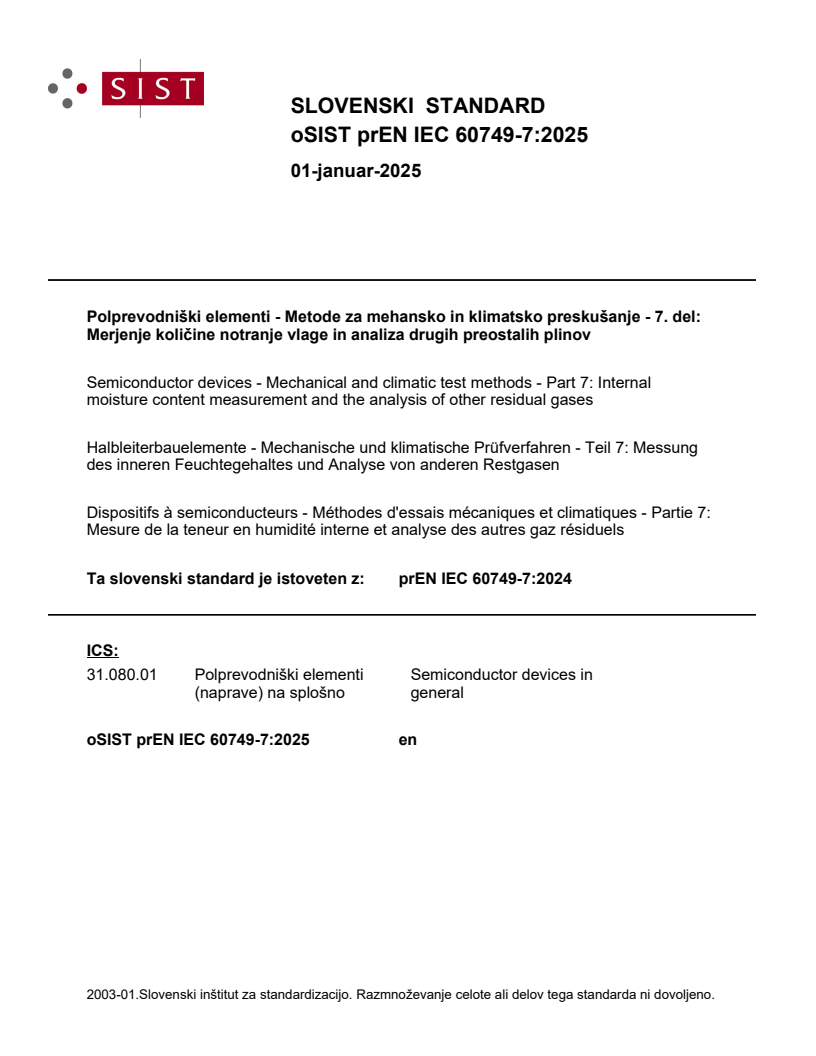
SLOVENSKI STANDARD
01-januar-2025
Polprevodniški elementi - Metode za mehansko in klimatsko preskušanje - 7. del:
Merjenje količine notranje vlage in analiza drugih preostalih plinov
Semiconductor devices - Mechanical and climatic test methods - Part 7: Internal
moisture content measurement and the analysis of other residual gases
Halbleiterbauelemente - Mechanische und klimatische Prüfverfahren - Teil 7: Messung
des inneren Feuchtegehaltes und Analyse von anderen Restgasen
Dispositifs à semiconducteurs - Méthodes d'essais mécaniques et climatiques - Partie 7:
Mesure de la teneur en humidité interne et analyse des autres gaz résiduels
Ta slovenski standard je istoveten z: prEN IEC 60749-7:2024
ICS:
31.080.01 Polprevodniški elementi Semiconductor devices in
(naprave) na splošno general
2003-01.Slovenski inštitut za standardizacijo. Razmnoževanje celote ali delov tega standarda ni dovoljeno.
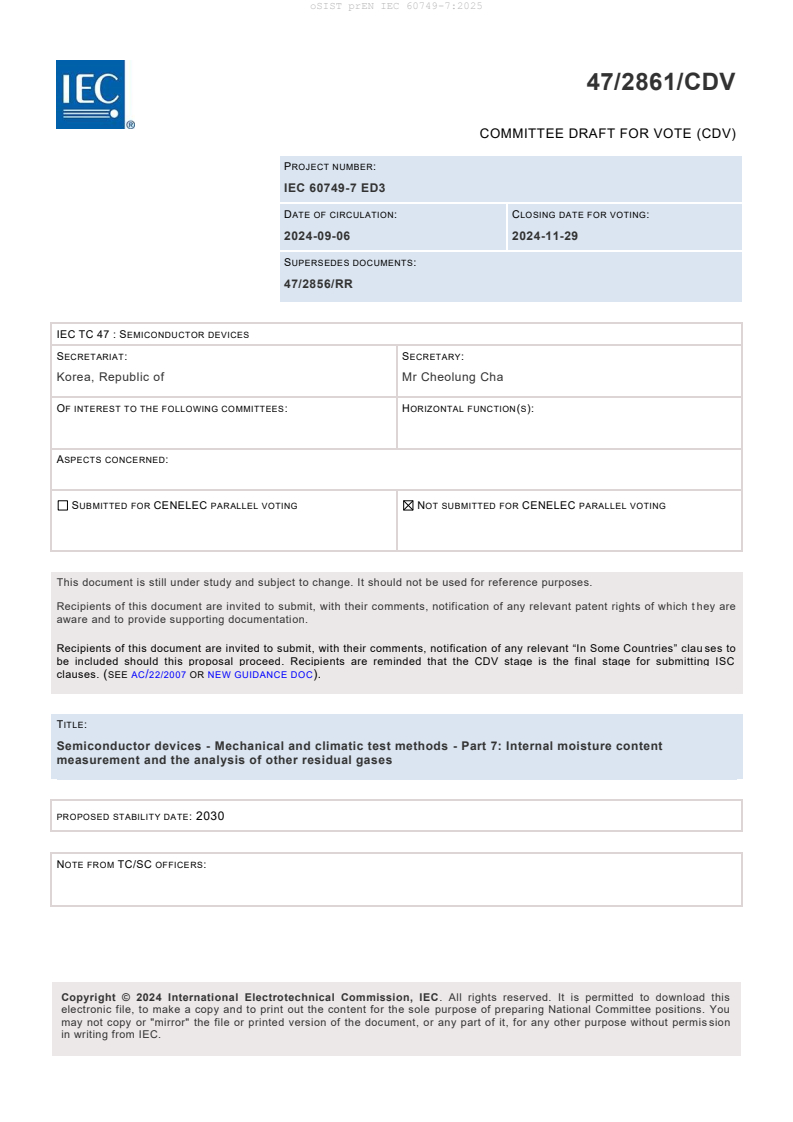
47/2861/CDV
COMMITTEE DRAFT FOR VOTE (CDV)
PROJECT NUMBER:
IEC 60749-7 ED3
DATE OF CIRCULATION: CLOSING DATE FOR VOTING:
2024-09-06 2024-11-29
SUPERSEDES DOCUMENTS:
47/2856/RR
IEC TC 47 : SEMICONDUCTOR DEVICES
SECRETARIAT: SECRETARY:
Korea, Republic of Mr Cheolung Cha
OF INTEREST TO THE FOLLOWING COMMITTEES: HORIZONTAL FUNCTION(S):
ASPECTS CONCERNED:
SUBMITTED FOR CENELEC PARALLEL VOTING NOT SUBMITTED FOR CENELEC PARALLEL VOTING
This document is still under study and subject to change. It should not be used for reference purposes.
Recipients of this document are invited to submit, with their comments, notification of any relevant patent rights of which t hey are
aware and to provide supporting documentation.
Recipients of this document are invited to submit, with their comments, notification of any relevant “In Some Countries” clau ses to
be included should this proposal proceed. Recipients are reminded that the CDV stage is the final stage for submitting ISC
clauses. (SEE AC/22/2007 OR NEW GUIDANCE DOC).
TITLE:
Semiconductor devices - Mechanical and climatic test methods - Part 7: Internal moisture content
measurement and the analysis of other residual gases
PROPOSED STABILITY DATE: 2030
NOTE FROM TC/SC OFFICERS:
electronic file, to make a copy and to print out the content for the sole purpose of preparing National Committee positions. You
may not copy or "mirror" the file or printed version of the document, or any part of it, for any other purpose without permis sion
in writing from IEC.
47/2861/CDV – 2 – IEC CDV 60749-7 © IEC 2024
CONTENTS
1 Purpose and scope . 5
2 Normative references . 5
3 Terms and definitions . 5
4 Test apparatus – Mass spectrometer . 5
4.1 Internal gas analysis (IGA) laboratory . 5
4.2 Mass spectrometer requirements . 6
4.2.1 Spectra range . 6
4.2.2 Moisture content . 6
4.2.3 Other gases . 6
4.2.4 Minimum detection limit for moisture . 6
4.2.5 Minimum detection limit for other gases . 6
4.3 Vacuum opening chamber . 6
4.4 Temperature control . 6
4.5 Piercing arrangement . 6
4.6 Pressure sensing device . 7
4.7 Package simulators . 7
4.8 Calibration capability . 7
5 Calibration requirements . 7
5.1 System calibration requirements . 7
5.2 Quarterly calibration for other gases . 8
5.3 Daily calibration check . 8
5.4 Daily calibration check substitution . 9
6 Procedure . 9
7 Failure Criteria . 10
8 Implementation . 10
9 Summary . 11
IEC CDV 60749-7 © IEC 2024 – 3 – 47/2861/CDV
1 INTERNATIONAL ELECTROTECHNICAL COMMISSION
2 ____________
4 SEMICONDUCTOR DEVICES –
5 MECHANICAL AND CLIMATIC TEST METHODS –
7 Part 7: Internal moisture content measurement
8 and the analysis of other residual gases
11 FOREWORD
12 1) The International Electrotechnical Commission (IEC) is a worldwide organization for standardization comprising
13 all national electrotechnical committees (IEC National Committees). The object of IEC is to promote
14 international co-operation on all questions concerning standardization in the electrical and electronic fields. To
15 this end and in addition to other activities, IEC publishes International Standards, Technical Specifications,
16 Technical Reports, Publicly Available Specifications (PAS) and Guides (hereafter referred to as “IEC
17 Publication(s)”). Their preparation is entrusted to technical committees; any IEC National Committee interested
18 in the subject dealt with may participate in this preparatory work. International, governmental and non -
19 governmental organizations liaising with the IEC also participate in this preparation. IEC collaborates closely
20 with the International Organization for Standardization (ISO) in accordance with conditions determined by
21 agreement between the two organizations.
22 2) The formal decisions or agreements of IEC on technical matters express, as nearly as possible, an international
23 consensus of opinion on the relevant subjects since each technical committee has representation from all
24 interested IEC National Committees.
25 3) IEC Publications have the form of recommendations for international use and are accepted by IEC National
26 Committees in that sense. While all reasonable efforts are made to ensure that the technical content of IEC
27 Publications is accurate, IEC cannot be held responsible for the way in which they are used or for any
28 misinterpretation by any end user.
29 4) In order to promote international uniformity, IEC National Committees undertake to apply IEC Publications
30 transparently to the maximum extent possible in their national and regional publications. Any divergence
31 between any IEC Publication and the corresponding national or regional publication shall be clearly indicated in
32 the latter.
33 5) IEC itself does not provide any attestation of conformity. Independent certification bodies provide conformity
34 assessment services and, in some areas, access to IEC marks of conformity. IEC is not responsible for any
35 services carried out by independent certification bodies.
36 6) All users should ensure that they have the latest edition of this publication.
37 7) No liability shall attach to IEC or its directors, employees, servants or agents including individual experts and
38 members of its technical committees and IEC National Committees for any personal injury, property damage or
39 other damage of any nature whatsoever, whether direct or indirect, or for costs (including legal fees) and
40 expenses arising out of the publication, use of, or reliance upon, this IEC Publication or any other IEC
41 Publications.
42 8) Attention is drawn to the Normative references cited in this publication. Use of the referenced publications is
43 indispensable for the correct application of this publication.
44 9) Attention is drawn to the possibility that some of the elements of this IEC Publication may be the subject of
45 patent rights. IEC shall not be held responsible for identifying any or all such patent rights.
46 International Standard IEC 60749-7 has been prepared by IEC technical committee 47:
47 Semiconductor devices.
48 This third edition cancels and replaces the second edition published in 2011 and constitutes a
49 technical revision. This third edition has been re-written and re-arranged to align it with the
50 text of MIL-STD-883, method 1018.10.
51 The main technical change is the additional detail in the calibration requirements.
47/2861/CDV – 4 – IEC CDV 60749-7 © IEC 2024
53 The text of this standard is based on the following documents:
FDIS Report on voting
47/xxxx/FDIS 47/yyyy/RVD
55 Full information on the voting for the approval of this standard can be found in the report on
56 voting indicated in the above table.
57 The language used for the development of this International Standard is English.
58 This publication has been drafted in accordance with the ISO/IEC Directives, Part 2, and
59 developed in accordance with ISO/IEC Directives, Part 1 and ISO/IEC Directives, IEC
60 Supplement, available at www.iec.ch/members_experts/refdocs. The main document types
61 developed by IEC are described in greater detail at www.iec.ch/publications.
63 A list of all parts in the IEC 60749 series, under the general title Semiconductor devices –
64 Mechanical and climatic test methods, can be found on the IEC website.
65 The committee has decided that the contents of this publication will remain unchanged until
66 the stability date indicated on the IEC web site under "http://webstore.iec.ch" in the data
67 related to the specific publication. At this date, the publication will be
68 • reconfirmed,
69 • withdrawn,
70 • replaced by a revised edition, or
71 • amended.
IEC CDV 60749-7 © IEC 2024 – 5 – 47/2861/CDV
75 SEMICONDUCTOR DEVICES –
76 MECHANICAL AND CLIMATIC TEST METHODS –
78 Part 7: Internal moisture content measurement
79 and the analysis of other residual gases
83 1 Purpose and scope
84 This International Standard specifies the testing and measurement of water vapour and other
85 gas content of the atmosphere inside a metal or ceramic hermetically sealed device. The test
86 is used as a measure of the quality of the sealing process and to provide information about
87 the long-term chemical stability of the atmosphere inside the package. It is applicable to
88 semiconductor devices sealed in such a manner but generally only used for high reliability
89 applications such as military or aerospace.
90 Of particular interest is the measurement of the primary sealing gases (or lack thereof), the
91 moisture content, the presence of bombing gases that are indicative of non-hermeticity (e.g.
92 helium), oxygen to argon ratio indicative of room air ~ 20 to 1 (±10 %), dissimilar
93 concentration of internally sealed gases (e.g. nitrogen, helium) than originally sealed in the
94 device package, the presence of leak test fluid (i.e. fluorocarbon, helium, air), and all other
95 gases to determine if the device meets the specified moisture, hermeticity and other criteria.
96 Also of interest is the measurement of all the other gases since they reflect upon the quality of
97 the sealing process and provide information about the long-term chemical stability of the
98 atmosphere inside the device. The presence of leak test fluorocarbon vapor in the IGA is an
99 indication of failure to meet leak test requirements of IEC 60749-8. This test is destructive.
100 This test is destructive.
102 2 Normative references
103 There are no normative references in this document.
104 3 Terms and definitions
105 For the purposes of this document, the following terms and definitions apply.
106 3.1
107 parts per million by volume
108 ppmv
109 the concentration of one substance in another substance expressed as a ratio of parts of the
110 one substance in a million parts of the other substance, measured by volume
111 4 Test apparatus – Mass spectrometer
112 4.1 Internal gas analysis (IGA) laboratory
113 The mass spectrometer shall be operated and maintained by an IGA laboratory meeting the
114 requirements of this standard.
47/2861/CDV – 6 – IEC CDV 60749-7 © IEC 2024
115 4.2 Mass spectrometer requirements
116 4.2.1 Spectra range
117 The mass spectrometer shall be capable of reading a minimum spectra range of 1 AMU to
118 140 AMU (atomic mass units).
119 4.2.2 Moisture content
120 The mass spectrometer shall be capable of reproducibly detecting the specified moisture
121 content for a given volume package with signal to noise ratio of 20 to 1 or greater. (i.e., for a
122 specified limit of 5 000 ppmv).
123 4.2.3 Other gases
124 For all gases that are specified in the failure criteria, other than moisture, the mass
125 spectrometer system shall be capable of detecting that gas at the specified limit with a signal -
126 to-noise ratio greater than 20 to 1.
127 4.2.4 Minimum detection limit for moisture
128 The mass spectrometer shall also be capable of detecting a 250 ppmv minimum detection
129 limit to moisture.
130 4.2.5 Minimum detection limit for other gases
131 The mass spectrometer shall be capable of a 50 ppmv minimum detection limit to nitrogen,
132 oxygen, argon, carbon dioxide, hydrogen, helium and fluorocarbons. Fluorocarbons shall be
133 identified by the presences of masses 69 and 119.
134 4.3 Vacuum opening chamber
135 The mass spectrometer shall include a vacuum opening chamber which can contain the
136 device and a vacuum transfer passage connecting the device to the mass spectrometer. A
137 vacuum transfer passage shall efficiently (without significant loss of moisture from adsorption)
138 transfer the gas from the device to the mass spectrometer ion source for measurement.
139 4.4 Temperature control
140 For initial certification of systems or extension of suitability, device temperature on systems
141 using an external fixture shall be characterized by placing a thermocouple into the cavity of a
142 blank device of similar mass, internal volume, construction, and size. This shall be a means
143 for proving the device temperature that has been maintained at 100 5 °C for the minimum
144 10 min. This also applies to devices prebaked in an external oven but tested with the external
145 fixture to adjust for any temperature drop during the transfer.
146 These records shall be maintained by the IGA laboratory.
147 4.5 Piercing arrangement
148 A piercing arrangement functioning within the opening chamber or transfer passage, which
149 can
...
Questions, Comments and Discussion
Ask us and Technical Secretary will try to provide an answer. You can facilitate discussion about the standard in here.