

ISO 4548-6:2021
(Main)Methods of test for full-flow lubricating oil filters for internal combustion engines — Part 6: Static burst pressure test
General Information
- Abstract
This document specifies a method of testing full‐flow lubricating oil filters for internal combustion engines to determine their ability to withstand a static pressure objective and to determine their burst pressure and the failure mode concerned. It does not apply to filters for use in aeronautical applications or plastic components.
- Status
- Published
- Publication Date
- 07-Jun-2021
- Technical Committee
- ISO/TC 70/SC 7 - Tests for lubricating oil filters
- Drafting Committee
- ISO/TC 70/SC 7 - Tests for lubricating oil filters
- Current Stage
- 9060 - Close of review
- Completion Date
- 02-Dec-2031
Buy Documents


ISO 4548-6:2021 - Methods of test for full-flow lubricating oil filters for internal combustion engines
ISO 4548-6:2021 - Methods of test for full-flow lubricating oil filters for internal combustion engines — Part 6: Static burst pressure test/8/2021
Overview
ISO 4548-6:2021 defines a standard method for testing full-flow lubricating oil filters used in internal combustion engines, specifically evaluating their ability to withstand static pressure and determining their burst pressure and failure modes. This standard does not apply to filters used in aeronautical applications or those with plastic components. By standardizing burst pressure testing, ISO 4548-6:2021 helps manufacturers and users evaluate filter robustness, safety, and performance under demanding operating conditions.
Full-flow lubricating oil filters are key components in ensuring engine reliability by removing particulate contaminants. Filters must maintain integrity against surges and prolonged static pressure. This standard provides a repeatable, widely recognized approach to assessing such critical mechanical characteristics.
Key Topics
- Burst Pressure Test: The main focus is on determining the maximum static pressure that an oil filter can withstand before catastrophic failure, providing insight into its performance limits.
- Testing Procedure: Guidance on setting up the test rig, using appropriate fluids, preparing the filter assembly (including torque requirements), stepwise pressurization, and safe observation methods.
- Filter Integrity Assessment: Procedures are provided for verifying leakage, distortion, and other failure modes during gradual pressure increases.
- Documentation: Details the information required in test reports, such as filter model, test pressures, tightening torque, and observed failure modes.
- Exclusions: The standard specifically excludes filters for aviation and plastic-bodied units, focusing on metal pressure vessel designs intended for automotive and industrial engine use.
Applications
ISO 4548-6:2021 is relevant to a range of stakeholders in the internal combustion engine supply chain, including:
- Filter Manufacturers: Enables consistent, comparable testing of product batches to verify product strength, safety margins, and compliance with OEM or industry requirements.
- Engine and Vehicle Manufacturers: Assures that installed filters meet durability and safety standards, reducing risk of engine damage due to filter rupture under pressure spikes.
- Testing Laboratories: Offers a validated protocol to ensure repeatable and reliable static burst pressure tests, supporting product certification and quality control.
- Quality Assurance and Procurement: Facilitates specification compliance by ensuring that only filters tested to this ISO method are sourced, promoting system reliability.
- Regulators and Standardization Bodies: Provides a reference methodology that can be included in procurement specifications, harmonizing safety and performance standards globally.
By following ISO 4548-6:2021, organizations demonstrate commitment to best practices in engine filtration and safety, boosting confidence in product claims and customer peace of mind.
Related Standards
A number of related standards complement or reference ISO 4548-6:2021 in the field of oil filtration and hydraulic filter testing:
- ISO 4548-1: Methods of test for full-flow lubricating oil filters for internal combustion engines - Differential pressure/flow characteristics.
- ISO 12829: Hydraulic spin-on filters - Method for verifying the rated fatigue life and the rated static burst pressure of the pressure-containing envelope.
- ISO 3448: Industrial liquid lubricants - ISO viscosity classification.
- ISO 19973-1: Pneumatic fluid power - Assessment of component reliability by testing - General procedures.
- SAE J300c: Engine oil viscosity classification.
- ISO 1219-1: Fluid power systems and components - Graphical symbols and circuit diagrams.
These standards provide additional methodologies for evaluating filtration system performance and defining lubrication parameters, supporting comprehensive quality management in engine design and maintenance. Use of ISO 4548-6:2021, alongside related standards, ensures high performance, reliability, and safety in automotive and industrial engine oil filtration.
Relations
- Effective Date
- 23-Apr-2020
Buy Documents
ISO 4548-6:2021 - Methods of test for full-flow lubricating oil filters for internal combustion engines
ISO 4548-6:2021 - Methods of test for full-flow lubricating oil filters for internal combustion engines — Part 6: Static burst pressure test/8/2021
Get Certified
Connect with accredited certification bodies for this standard

DNV
DNV is an independent assurance and risk management provider.

Lloyd's Register
Lloyd's Register is a global professional services organisation specialising in engineering and technology.
DNV Energy Systems
Energy and renewable energy certification.
Sponsored listings
Frequently Asked Questions
ISO 4548-6:2021 is a standard published by the International Organization for Standardization (ISO). Its full title is "Methods of test for full-flow lubricating oil filters for internal combustion engines — Part 6: Static burst pressure test". This standard covers: This document specifies a method of testing full‐flow lubricating oil filters for internal combustion engines to determine their ability to withstand a static pressure objective and to determine their burst pressure and the failure mode concerned. It does not apply to filters for use in aeronautical applications or plastic components.
This document specifies a method of testing full‐flow lubricating oil filters for internal combustion engines to determine their ability to withstand a static pressure objective and to determine their burst pressure and the failure mode concerned. It does not apply to filters for use in aeronautical applications or plastic components.
ISO 4548-6:2021 is classified under the following ICS (International Classification for Standards) categories: 27.020 - Internal combustion engines. The ICS classification helps identify the subject area and facilitates finding related standards.
ISO 4548-6:2021 has the following relationships with other standards: It is inter standard links to ISO 4548-6:2012. Understanding these relationships helps ensure you are using the most current and applicable version of the standard.
ISO 4548-6:2021 is available in PDF format for immediate download after purchase. The document can be added to your cart and obtained through the secure checkout process. Digital delivery ensures instant access to the complete standard document.
Standards Content (Sample)
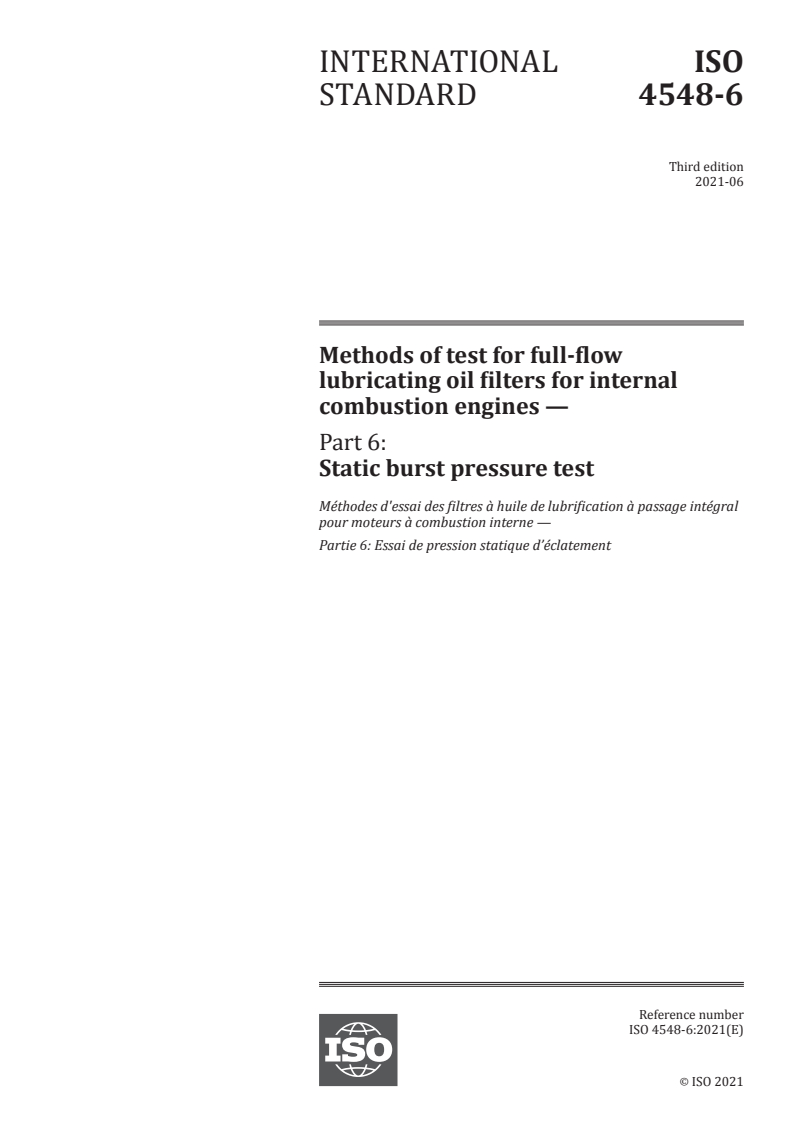
INTERNATIONAL ISO
STANDARD 4548-6
Third edition
2021-06
Methods of test for full-flow
lubricating oil filters for internal
combustion engines —
Part 6:
Static burst pressure test
Méthodes d'essai des filtres à huile de lubrification à passage intégral
pour moteurs à combustion interne —
Partie 6: Essai de pression statique d’éclatement
Reference number
©
ISO 2021
© ISO 2021
All rights reserved. Unless otherwise specified, or required in the context of its implementation, no part of this publication may
be reproduced or utilized otherwise in any form or by any means, electronic or mechanical, including photocopying, or posting
on the internet or an intranet, without prior written permission. Permission can be requested from either ISO at the address
below or ISO’s member body in the country of the requester.
ISO copyright office
CP 401 • Ch. de Blandonnet 8
CH-1214 Vernier, Geneva
Phone: +41 22 749 01 11
Email: copyright@iso.org
Website: www.iso.org
Published in Switzerland
ii © ISO 2021 – All rights reserved
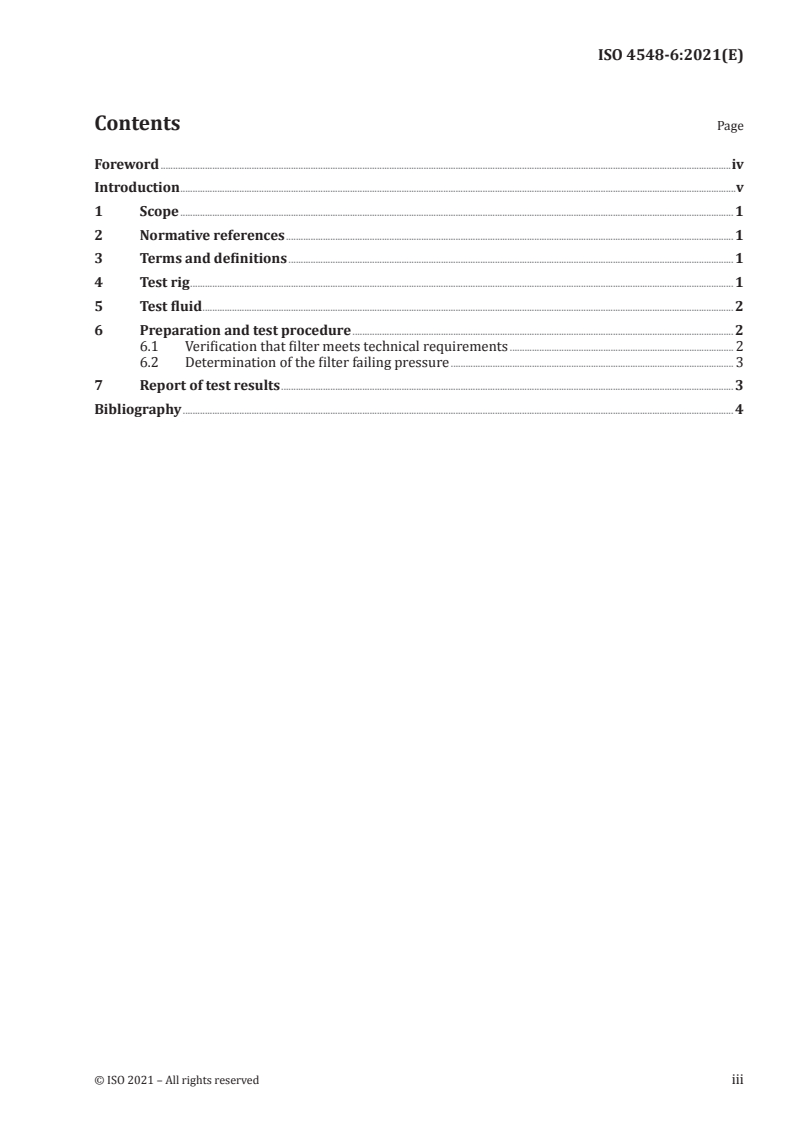
Contents Page
Foreword .iv
Introduction .v
1 Scope . 1
2 Normative references . 1
3 Terms and definitions . 1
4 Test rig . 1
5 Test fluid . 2
6 Preparation and test procedure . 2
6.1 Verification that filter meets technical requirements . 2
6.2 Determination of the filter failing pressure . 3
7 Report of test results . 3
Bibliography . 4
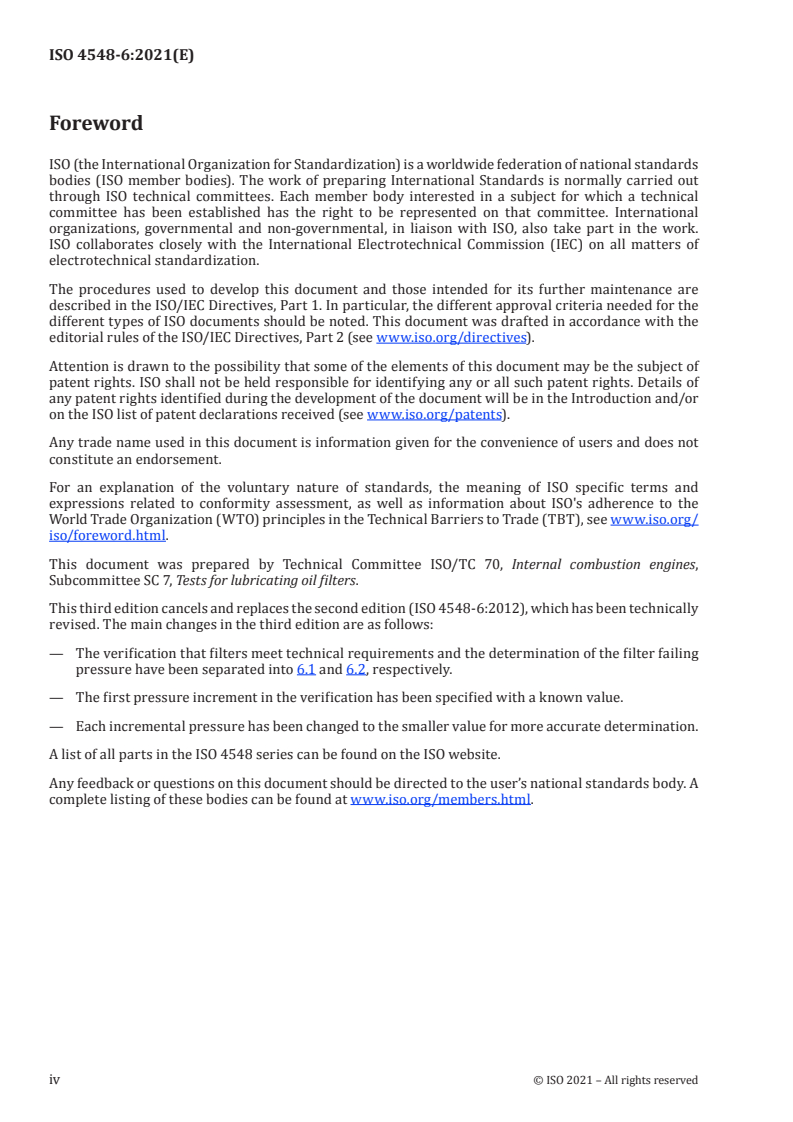
Foreword
ISO (the International Organization for Standardization) is a worldwide federation of national standards
bodies (ISO member bodies). The work of preparing International Standards is normally carried out
through ISO technical committees. Each member body interested in a subject for which a technical
committee has been established has the right to be represented on that committee. International
organizations, governmental and non-governmental, in liaison with ISO, also take part in the work.
ISO collaborates closely with the International Electrotechnical Commission (IEC) on all matters of
electrotechnical standardization.
The procedures used to develop this document and those intended for its further maintenance are
described in the ISO/IEC Directives, Part 1. In particular, the different approval criteria needed for the
different types of ISO documents should be noted. This document was drafted in accordance with the
editorial rules of the ISO/IEC Directives, Part 2 (see www .iso .org/ directives).
Attention is drawn to the possibility that some of the elements of this document may be the subject of
patent rights. ISO shall not be held responsible for identifying any or all such patent rights. Details of
any patent rights identified during the development of the document will be in the Introduction and/or
on the ISO list of patent declarations received (see www .iso .org/ patents).
Any trade name used in this document is information given for the convenience of users and does not
constitute an endorsement.
For an explanation of the voluntary nature of standards, the meaning of ISO specific terms and
expressions related to conformity assessment, as well as information about ISO's adherence to the
World Trade Organization (WTO) principles in the Technical Barriers to Trade (TBT), see www .iso .org/
iso/ foreword .html.
This document was prepared by Technical Committee ISO/TC 70, Internal combustion engines,
Subcommittee SC 7, Tests for lubricating oil filters.
This third edition cancels and replaces the second edition (ISO 4548-6:2012), which has been technically
revised. The main changes in the third edition are as follows:
— The verification that filters meet technical requirements and the determination of the filter failing
pressure have been separated into 6.1 and 6.2, respectively.
— The first pressure increment in the verification has been specified with a known value.
— Each incremental pressure has been changed to the smaller value for more accurate determination.
A list of all parts in the ISO 4548 series can be found on the ISO website.
Any feedback or questions on this document should be directed to the user’s national standards body. A
complete listing of these bodies can be found at www .iso .org/ members .html.
iv © ISO 2021 – All rights reserved
Introduction
This document establishes standard test procedures for measuring the performance of full- flow
lubricating oil filters manufactured with metal pressure vessel materials for internal combustion
engines. It
...
INTERNATIONAL ISO
STANDARD 4548-6
Third edition
2021-06
Methods of test for full-flow
lubricating oil filters for internal
combustion engines —
Part 6:
Static burst pressure test
Méthodes d'essai des filtres à huile de lubrification à passage intégral
pour moteurs à combustion interne —
Partie 6: Essai de pression statique d’éclatement
Reference number
©
ISO 2021
© ISO 2021
All rights reserved. Unless otherwise specified, or required in the context of its implementation, no part of this publication may
be reproduced or utilized otherwise in any form or by any means, electronic or mechanical, including photocopying, or posting
on the internet or an intranet, without prior written permission. Permission can be requested from either ISO at the address
below or ISO’s member body in the country of the requester.
ISO copyright office
CP 401 • Ch. de Blandonnet 8
CH-1214 Vernier, Geneva
Phone: +41 22 749 01 11
Email: copyright@iso.org
Website: www.iso.org
Published in Switzerland
ii © ISO 2021 – All rights reserved
Contents Page
Foreword .iv
Introduction .v
1 Scope . 1
2 Normative references . 1
3 Terms and definitions . 1
4 Test rig . 1
5 Test fluid . 2
6 Preparation and test procedure . 2
6.1 Verification that filter meets technical requirements . 2
6.2 Determination of the filter failing pressure . 3
7 Report of test results . 3
Bibliography . 4
Foreword
ISO (the International Organization for Standardization) is a worldwide federation of national standards
bodies (ISO member bodies). The work of preparing International Standards is normally carried out
through ISO technical committees. Each member body interested in a subject for which a technical
committee has been established has the right to be represented on that committee. International
organizations, governmental and non-governmental, in liaison with ISO, also take part in the work.
ISO collaborates closely with the International Electrotechnical Commission (IEC) on all matters of
electrotechnical standardization.
The procedures used to develop this document and those intended for its further maintenance are
described in the ISO/IEC Directives, Part 1. In particular, the different approval criteria needed for the
different types of ISO documents should be noted. This document was drafted in accordance with the
editorial rules of the ISO/IEC Directives, Part 2 (see www .iso .org/ directives).
Attention is drawn to the possibility that some of the elements of this document may be the subject of
patent rights. ISO shall not be held responsible for identifying any or all such patent rights. Details of
any patent rights identified during the development of the document will be in the Introduction and/or
on the ISO list of patent declarations received (see www .iso .org/ patents).
Any trade name used in this document is information given for the convenience of users and does not
constitute an endorsement.
For an explanation of the voluntary nature of standards, the meaning of ISO specific terms and
expressions related to conformity assessment, as well as information about ISO's adherence to the
World Trade Organization (WTO) principles in the Technical Barriers to Trade (TBT), see www .iso .org/
iso/ foreword .html.
This document was prepared by Technical Committee ISO/TC 70, Internal combustion engines,
Subcommittee SC 7, Tests for lubricating oil filters.
This third edition cancels and replaces the second edition (ISO 4548-6:2012), which has been technically
revised. The main changes in the third edition are as follows:
— The verification that filters meet technical requirements and the determination of the filter failing
pressure have been separated into 6.1 and 6.2, respectively.
— The first pressure increment in the verification has been specified with a known value.
— Each incremental pressure has been changed to the smaller value for more accurate determination.
A list of all parts in the ISO 4548 series can be found on the ISO website.
Any feedback or questions on this document should be directed to the user’s national standards body. A
complete listing of these bodies can be found at www .iso .org/ members .html.
iv © ISO 2021 – All rights reserved
Introduction
This document establishes standard test procedures for measuring the performance of full- flow
lubricating oil filters manufactured with metal pressure vessel materials for internal combustion
engines. It
...