

ISO/IEC 23000-18:2018
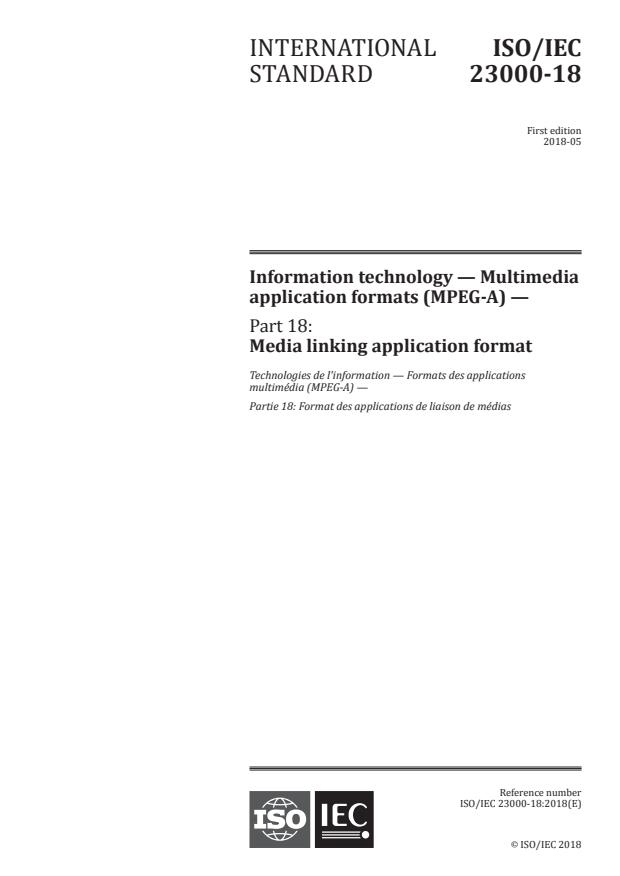
(Main)Information technology — Multimedia application formats (MPEG-A) — Part 18: Media linking application format
General Information
- Abstract
This document specifies a data structure called "bridget". A bridget is a link between a "source" content and a "destination" content. The bridget contains information on the source content and on the destination content, on the link between the two and on how the information contained in the bridget is to be presented to users consuming the source content in order to enable them to make considerate decisions about whether to consume the destination content.
- Status
- Published
- Publication Date
- 22-May-2018
- Current Stage
- 9060 - Close of review
- Completion Date
- 02-Dec-2028
Buy Documents
ISO/IEC 23000-18:2018 - Information technology -- Multimedia application formats (MPEG-A)
ISO/IEC 23000-18:2018 - Information technology — Multimedia application formats (MPEG-A) — Part 18: Media linking application format/23/2018
Overview
ISO/IEC 23000-18:2018 - part of the MPEG‑A (Multimedia Application Formats) family - defines the Media Linking Application Format (MLAF) and a data structure called a "bridget". A bridget links a source content item to a destination content item and carries metadata about both, the link, and how that link should be presented to users so they can make considerate decisions about following the link. The standard specifies the MLAF model, schema elements, namespace URI and syntax/semantics for machine‑readable bridgets.
Keywords: ISO/IEC 23000-18:2018, MLAF, bridget, media linking application format, MPEG-A, media linking, metadata.
Key technical topics and requirements
- Bridget data structure - central element representing a link between source and destination content with descriptive metadata.
- MLAF model and functional requirements - defines the expected behavior and use cases for media linking.
- Schema and namespace - imported schemas and MLAF namespace URI are specified to support interoperable implementations.
- Root and container elements - formal MLAF document structure, including syntax and semantics.
- Source Item / Destination Item - elements that describe content endpoints (identifiers, descriptors).
- Media segments - support for linking to specific temporal/spatial portions of media.
- Structural annotation and anchors - tagging and mapping content structure to link points.
- Spatiotemporal information - coordinates and timing for precise linking (e.g., video time ranges, image regions).
- Descriptors - media descriptors, bridget descriptors and EBU Core descriptor integration for richer metadata.
- Syntax, semantics and examples - normative guidance on how MLAF elements are formed and presented.
Practical applications
- Enabling contextual links in streaming platforms (recommendations, related clips).
- Supporting content moderation and user warnings by presenting link metadata before navigation.
- Allowing publishers and archives to link resources precisely (timecodes, image regions).
- Powering editorial workflows, interactive media, and accessibility features that need metadata-aware linking.
- Facilitating interoperability among media players, CMS, and discovery systems through a standard schema and namespace.
Who should use this standard
- Media platform architects and software developers building linking, recommendation or discovery features.
- Broadcasters, streaming services and digital archives implementing interoperable content linking.
- Metadata engineers, archivists and integrators working with MPEG‑A formats and EBU Core metadata.
- UI/UX designers and product teams needing to present link information for user consent and content safety.
Related standards
- ISO/IEC 23000 (MPEG‑A) multimedia application formats family.
- EBU Core metadata profiles (referenced in MLAF descriptors).
ISO/IEC 23000-18:2018 provides a machine‑readable, interoperable way to express and present media links (bridgets), improving discoverability, user-awareness and controlled navigation across multimedia content.
Buy Documents
ISO/IEC 23000-18:2018 - Information technology -- Multimedia application formats (MPEG-A)
ISO/IEC 23000-18:2018 - Information technology — Multimedia application formats (MPEG-A) — Part 18: Media linking application format/23/2018
Get Certified
Connect with accredited certification bodies for this standard

BSI Group
BSI (British Standards Institution) is the business standards company that helps organizations make excellence a habit.

NYCE
Mexican standards and certification body.
Sponsored listings
Frequently Asked Questions
ISO/IEC 23000-18:2018 is a standard published by the International Organization for Standardization (ISO). Its full title is "Information technology — Multimedia application formats (MPEG-A) — Part 18: Media linking application format". This standard covers: This document specifies a data structure called "bridget". A bridget is a link between a "source" content and a "destination" content. The bridget contains information on the source content and on the destination content, on the link between the two and on how the information contained in the bridget is to be presented to users consuming the source content in order to enable them to make considerate decisions about whether to consume the destination content.
This document specifies a data structure called "bridget". A bridget is a link between a "source" content and a "destination" content. The bridget contains information on the source content and on the destination content, on the link between the two and on how the information contained in the bridget is to be presented to users consuming the source content in order to enable them to make considerate decisions about whether to consume the destination content.
ISO/IEC 23000-18:2018 is classified under the following ICS (International Classification for Standards) categories: 35.040 - Information coding; 35.040.40 - Coding of audio, video, multimedia and hypermedia information. The ICS classification helps identify the subject area and facilitates finding related standards.
ISO/IEC 23000-18:2018 is available in PDF format for immediate download after purchase. The document can be added to your cart and obtained through the secure checkout process. Digital delivery ensures instant access to the complete standard document.
Standards Content (Sample)
INTERNATIONAL ISO/IEC
STANDARD 23000-18
First edition
2018-05
Information technology — Multimedia
application formats (MPEG-A) —
Part 18:
Media linking application format
Technologies de l'information — Formats des applications
multimédia (MPEG-A) —
Partie 18: Format des applications de liaison de médias
Reference number
©
ISO/IEC 2018
© ISO/IEC 2018
All rights reserved. Unless otherwise specified, or required in the context of its implementation, no part of this publication may
be reproduced or utilized otherwise in any form or by any means, electronic or mechanical, including photocopying, or posting
on the internet or an intranet, without prior written permission. Permission can be requested from either ISO at the address
below or ISO’s member body in the country of the requester.
ISO copyright office
CP 401 • Ch. de Blandonnet 8
CH-1214 Vernier, Geneva
Phone: +41 22 749 01 11
Fax: +41 22 749 09 47
Email: copyright@iso.org
Website: www.iso.org
Published in Switzerland
ii © ISO/IEC 2018 – All rights reserved
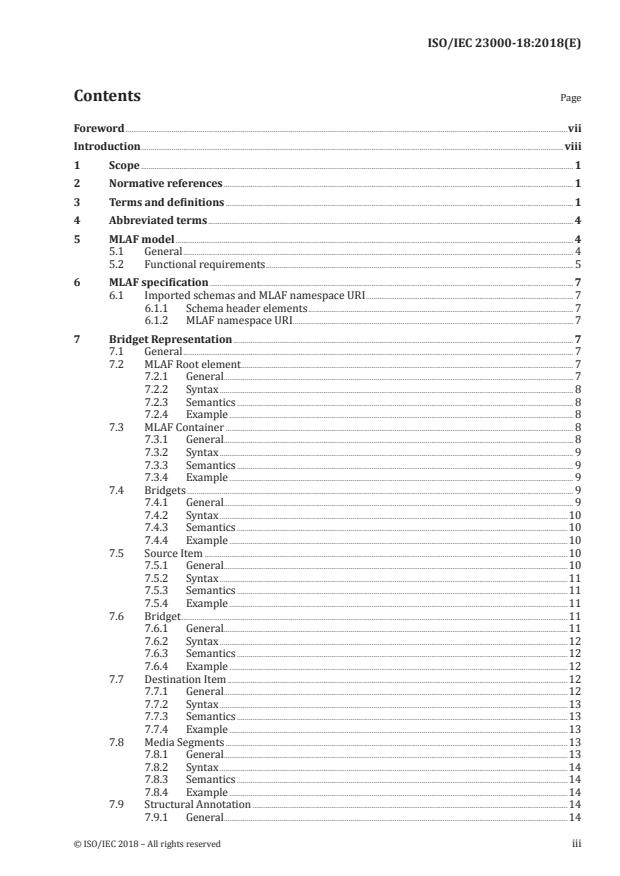
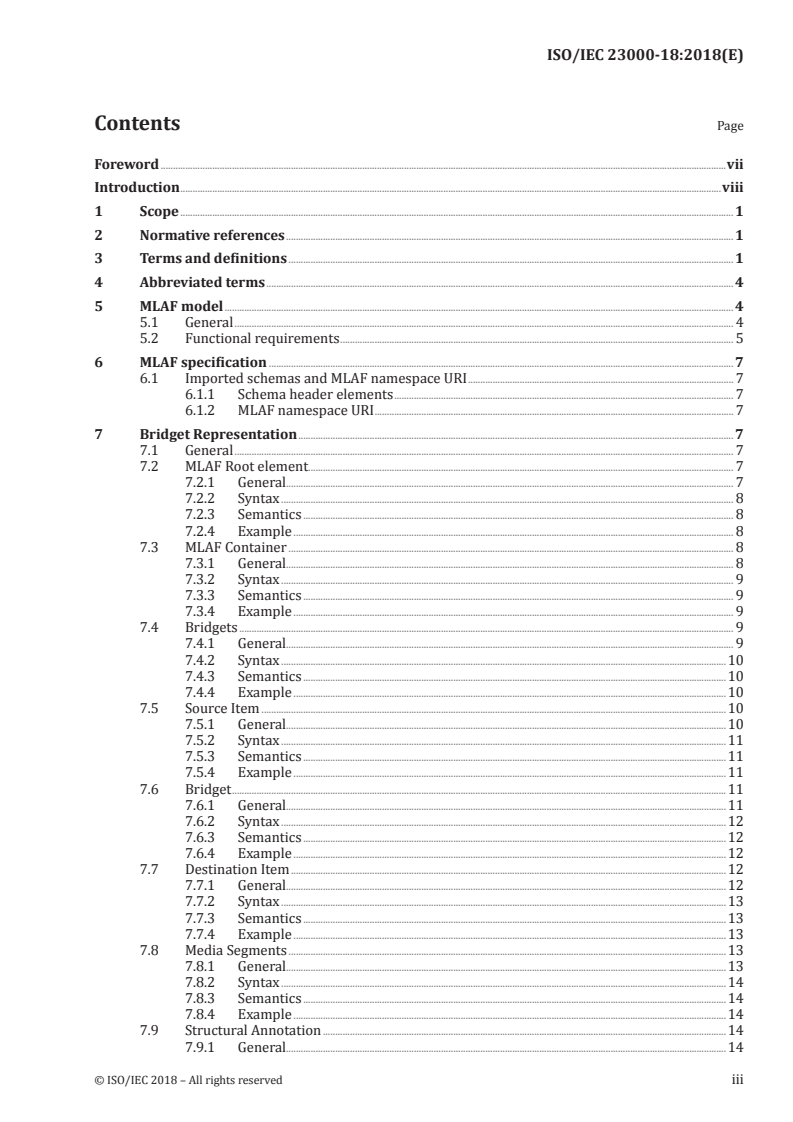
Contents Page
Foreword .vii
Introduction .viii
1 Scope . 1
2 Normative references . 1
3 Terms and definitions . 1
4 Abbreviated terms . 4
5 MLAF model . 4
5.1 General . 4
5.2 Functional requirements . 5
6 MLAF specification . 7
6.1 Imported schemas and MLAF namespace URI . 7
6.1.1 Schema header elements . 7
6.1.2 MLAF namespace URI . 7
7 Bridget Representation . 7
7.1 General . 7
7.2 MLAF Root element. 7
7.2.1 General. 7
7.2.2 Syntax . 8
7.2.3 Semantics . 8
7.2.4 Example . 8
7.3 MLAF Container . 8
7.3.1 General. 8
7.3.2 Syntax . 9
7.3.3 Semantics . 9
7.3.4 Example . 9
7.4 Bridgets . 9
7.4.1 General. 9
7.4.2 Syntax .10
7.4.3 Semantics .10
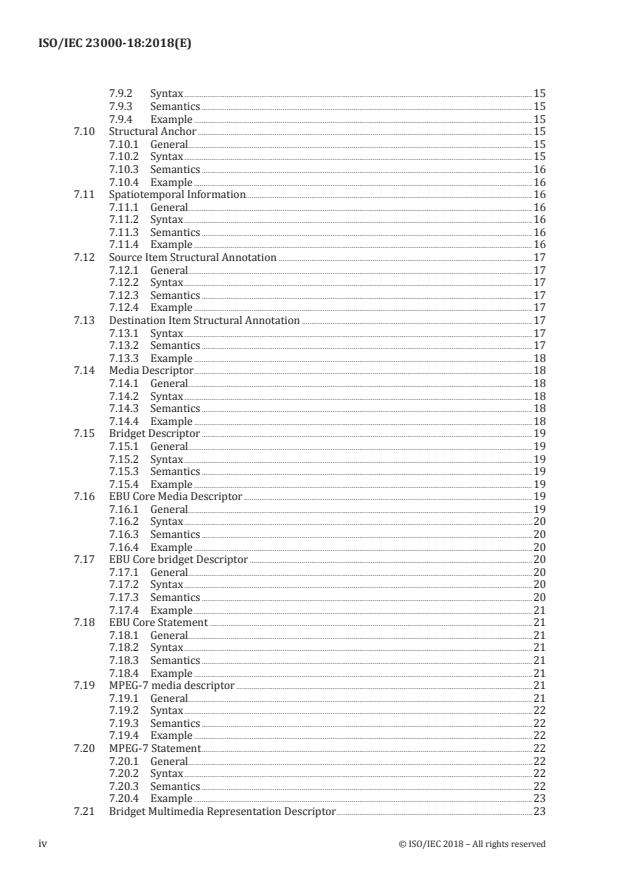
7.4.4 Example .10
7.5 Source Item .10
7.5.1 General.10
7.5.2 Syntax .11
7.5.3 Semantics .11
7.5.4 Example .11
7.6 Bridget .11
7.6.1 General.11
7.6.2 Syntax .12
7.6.3 Semantics .12
7.6.4 Example .12
7.7 Destination Item .12
7.7.1 General.12
7.7.2 Syntax .13
7.7.3 Semantics .13
7.7.4 Example .13
7.8 Media Segments .13
7.8.1 General.13
7.8.2 Syntax .14
7.8.3 Semantics .14
7.8.4 Example .14
7.9 Structural Annotation .14
7.9.1 General.14
© ISO/IEC 2018 – All rights reserved iii
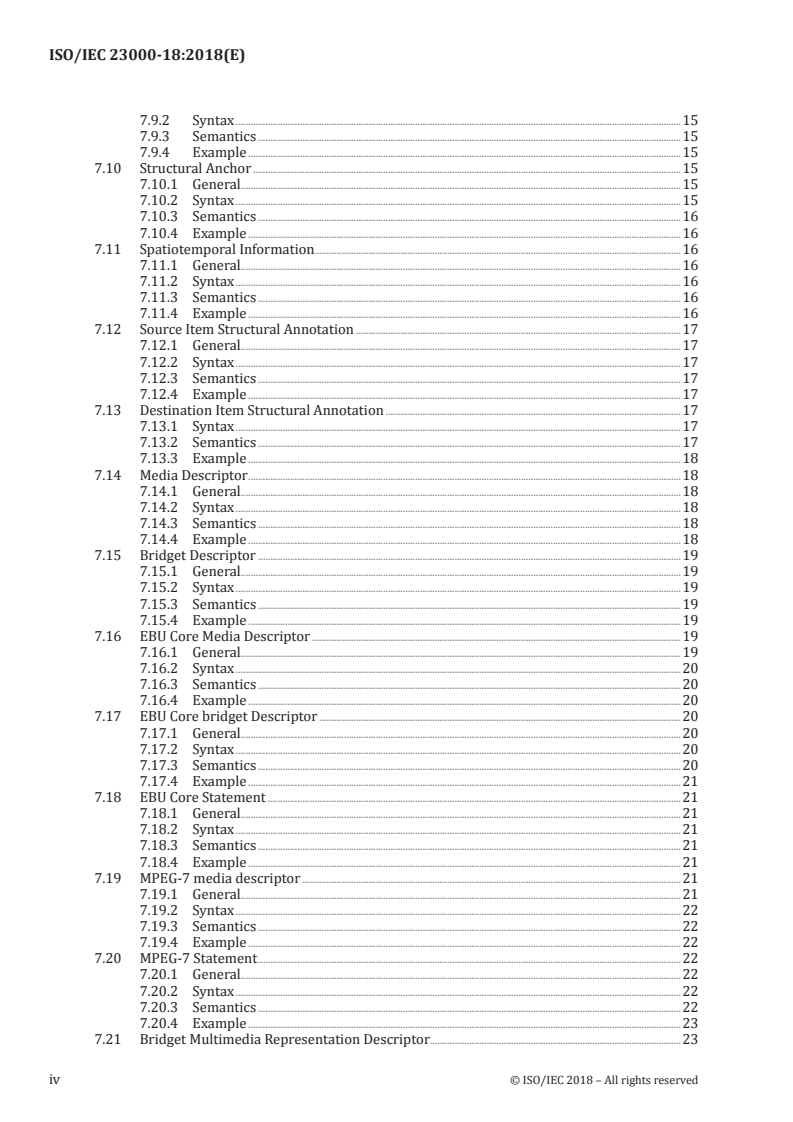
7.9.2 Syntax .15
7.9.3 Semantics .15
7.9.4 Example .15
7.10 Structural Anchor .15
7.10.1 General.15
7.10.2 Syntax .15
7.10.3 Semantics .16
7.10.4 Example .16
7.11 Spatiotemporal Information.16
7.11.1 General.16
7.11.2 Syntax .16
7.11.3 Semantics .16
7.11.4 Example .16
7.12 Source Item Structural Annotation .17
7.12.1 General.17
7.12.2 Syntax .17
7.12.3 Semantics .17
7.12.4 Example .17
7.13 Destination Item Structural Annotation .17
7.13.1 Syntax .17
7.13.2 Semantics .17
7.13.3 Example .18
7.14 Media Descriptor .18
7.14.1 General.18
7.14.2 Syntax .18
7.14.3 Semantics .18
7.14.4 Example .18
7.15 Bridget Descriptor .19
7.15.1 General.19
7.15.2 Syntax .19
7.15.3 Semantics .19
7.15.4 Example .19
7.16 EBU Core Media Descriptor .19
7.16.1 General.19
7.16.2 Syntax .20
7.16.3 Semantics .20
7.16.4 Example .20
7.17 EBU Core bridget Descriptor .20
7.17.1 General.20
7.17.2 Syntax .20
7.17.3 Semantics .20
7.17.4 Example .21
7.18 EBU Core Statement .21
7.18.1 General.21
7.18.2 Syntax .21
7.18.3 Semantics .21
7.18.4 Example .21
7.19 MPEG-7 media descriptor .21
7.19.1 General.21
7.19.2 Syntax .22
7.19.3 Semantics .22
7.19.4 Example .22
7.20 MPEG-7 Statement .22
7.20.1 General.22
7.20.2 Syntax .22
7.20.3 Semantics .22
7.20.4 Example .23
7.21 Bridget Multimedia Representation Descriptor .23
iv © ISO/IEC 2018 – All rights reserved
7.21.1 General.23
7.21.2 Syntax .23
7.21.3 Semantics .23
7.21.4 Example .23
7.22 Bridget Multimedia Representation Statement .23
7.22.1 General.23
7.22.2 Syntax .24
7.22.3 Semantics .24
7.22.4 Example .24
7.23 Target Condition .24
7.23.1 General.24
7.23.2 Syntax .24
7.23.3 Semantics .25
7.23.4 Example .25
8 Bridget Presentation .25
8.1 General .25
8.2 Layout Ref .25
8.2.1 General.25
8.2.2 Syntax .26
8.2.3 Semantics .26
8.2.4 Example .26
8.3 Main Layout Ref .26
8.3.1 General.26
8.3.2 Syntax .26
8.3.3 Semantics .27
8.3.4 Example .27
8.4 Bridget Layout Scene .27
8.4.1 General.27
8.4.2 Syntax .27
8.4.3 Semantics .27
8.4.4 Example .27
8.5 Bridget Layout Descriptor .28
8.5.1 General.28
8.5.2 Syntax .28
8.5.3 Semantics .28
8.5.4 Example .28
8.6 Bridget Layout Statement .28
8.6.1 General.28
8.6.2 Syntax .28
8.6.3 Semantics .29
8.6.4 Example .29
8.7 Main Layout Descriptor .29
8.7.1 General.29
8.7.2 Syntax .29
8.7.3 Semantics .29
8.7.4 Example .30
8.8 Main Layout Statement .30
8.8.1 General.30
8.8.2 Syntax .30
8.8.3 Semantics .30
8.8.4 Example .31
Annex A (normative) MLAF XML schema .32
Annex B (normative) XMTA restricted scene for MLAF presentation .40
Annex C (informative) Bridget presentation in BIFS .41
Annex D (informative) Examples .61
© ISO/IEC 2018 – All rights reserved v
Bibliography .68
vi © ISO/IEC 2018 – All rights reserved
Foreword
ISO (the International Organization for Standardization) and IEC (the International Electrotechnical
Commission) form the specialized system for worldwide standardization. National bodies that are
members of ISO or IEC participate in the development of International Standards through technical
committees established by the respective organization to deal with particular fields of technical
activity. ISO and IEC technical committees collaborate in fields of mutual interest. Other international
organizations, governmental and non-governmental, in liaison with ISO and IEC, also take part in the
work. In the field of information technology, ISO and IEC have established a joint technical committee,
ISO/IEC JTC 1.
The procedures used to develop this document and those intended for its further maintenance are
described in the ISO/IEC Directives, Part 1. In particular the different approval criteria needed for
the different types of document should be noted. This document was drafted in accordance with the
editorial rules of the ISO/IEC Directives, Part 2 (see www .iso .org/directives).
Attention is drawn to the possibility that some of the elements of this document may be the subject
of patent rights. ISO and IEC shall not be held responsible for identifying any or all such patent
rights. Details of any patent rights identified during the development of the document will be in the
Introduction and/or on the ISO list of patent declarations received (see www .iso .org/patents).
Any trade name used in this document is information given for the convenience of users and does not
constitute an endorsement.
For an explanation on the voluntary nature of standards, the meaning of ISO specific terms and
expressions related to conformity assessment, as well as information about ISO's adherence to the
World Trade Organization (WTO) principles in the Technical Barriers to Trade (TBT) see the following
URL: www .iso .org/iso/foreword .html.
This document was prepared by Technical Committee ISO/IEC JTC 1, Information technology,
Subcommittee SC 29, Coding of audio, picture, multimedia and hypermedia information.
A list of all parts in the ISO/IEC 23000 series can be found on the ISO website.
© ISO/IEC 2018 – All rights reserved vii
Introduction
ISO/IEC 23000 (also known as “MPEG-A”) is an MPEG standard that supports a fast track to
standardization by selecting readily tested and verified technologies taken from the MPEG corpus of
standards and combining them to form a Multimedia Application Format (MAF). If a needed piece of
technology is not available from the said corpus, then additional technologies originating from other
organizations may also included by reference in order to facilitate the envisioned MAF.
The development of the MAF called “Media Linking Application Format” (MLAF) has been prompted
by existing many examples of services where media transmitted for consumption on a primary
device give hints to users to consume related media on a secondary or companion device. To facilitate
interoperability of such services, it is beneficial to define a data structure (a “format”) that codifies the
relationship between the two information sources.
The core of MLAF structure is the representation of the structure of bridgets. A bridget is a pivotal
information element that links Source Content and Destination Content. A bridget is associated to
its Presentation Information. Clause 7 specifies the representation of bridgets. Clause 8 specifies the
presentation of bridgets.
The XML Schema of MLAF is defined in Annex A. Technology for bridget Presentation based on XMT is
included in Annex B. Bridget presentation in BIFS is defined in Annex C. Annex D reports some examples.
viii © ISO/IEC 2018 – All rights reserved
INTERNATIONAL STANDARD ISO/IEC 23000-18:2018(E)
Information technology — Multimedia application formats
(MPEG-A) —
Part 18:
Media linking application format
1 Scope
This document specifies a data structure called “bridget”. A bridget is a link between a “source”
content and a “destination” content. The bridget contains information on the source content and on the
destination content, on the link between the two and on how the information contained in the bridget
is to be presented to users consuming the source content in order to enable them to make considerate
decisions about whether to consume the destination content.
2 Normative references
The following documents are referred to in the text in such a way that some or all of their content
constitutes requirements of this document. For dated references, only the edition cited applies. For
undated references, the latest edition of the referenced document (including any amendments) applies.
ISO/IEC 14496-11:2015, Information technology — Coding of audio-visual objects — Part 11: Scene
description and application engine
3 Terms and definitions
For the purposes of this document, the following terms and definitions apply.
ISO and IEC maintain terminological databases for use in standardization at the following addresses:
— IEC Electropedia: available at http: //www .electropedia .org/
— ISO Online browsing platform: available at http: //www .iso .org/obp
3.1 MPEG-4 terminology
3.1.1
audiovisual scene
AV scene
set of audiovisual objects together with scene description information that defines their spatial and
temporal attributes including behaviours resulting from object and user interactions
3.1.2
binary format for scene
BIFS
coded representation of a parametric scene description format
3.2 MPEG-7 terminology
3.2.1
segment
spatial or temporal unit of multimedia, for example, a temporal segment of video, or a segment of an image
© ISO/IEC 2018 – All rights reserved 1
3.2.2
audiovisual segment
element of MPEG-7 multimedia description schemes structure description tools describing a time-
continuous arbitrary part (segment) of an audiovisual media
Note 1 to entry: See ISO/IEC 15938-5.
3.2.3
region
spatial unit of multimedia, for example, a 2D spatial region of an image, or a moving region (3.2.4) of video
3.2.4
moving region
region (3.2.3) changing its shape during a video timeline
3.3 MPEG-21 terminology
3.3.1
digital item identification
DII
standard used by MPEG-21 for identification of digital item and their components (3.3.5)
Note 1 to entry: See ISO/IEC 21000-3.
3.3.2
resource
individually identifiable asset such as a video or audio clip, an image or a text
Note 1 to entry: All resources shall be locatable via an unambiguous address.
3.3.3
container
structure that allows items (3.3.4) and/or containers to be grouped
Note 1 to entry: A container itself is not an item; containers are groupings of items and/or containers. Descriptors
allow for the "labelling" of containers with information appropriate for the purpose of the grouping.
3.3.4
item
grouping of sub-items and/or components (3.3.5) that are bound to relevant descriptors (3.3.6)
Note 1 to entry: These descriptors contain information about the item. Items may contain choices, which allow
them to be customized or configured. Items may be conditional (on predicates asserted by selections defined in
the choices). An item that contains no sub-items can be considered a whole. An item that does contain sub-items
can be considered a compilation. Items may also contain annotations to their sub-parts.
3.3.5
component
binding of a resource (3.3.2) to a set of descriptors (3.3.6)
Note 1 to entry: These descriptors are information concerning all or part of the specific resource instance. A
component itself is not an item; components are building blocks of items. Components may be conditional (see
ISO/IEC 21000-3 for details).
3.3.6
descriptor
associates information with the enclosing entity
Note 1 to entry: This information may be a component (such as a thumbnail of an image, or a text component) or
a textual statement. Descriptors may be conditional (see ISO/IEC 21000-3 for details).
2 © ISO/IEC 2018 – All rights reserved
3.3.7
statement
literal textual value that contains information, but not an asset
EXAMPLE Examples of likely statements include descriptive, control, revision tracking or identifying
information (such as an identifier as described in ISO/IEC 21000-3).
3.3.8
annotation
describes a set of information about another identified entity of the model without altering or adding to
that entity
Note 1 to entry: The information can take the form of assertions, descriptors and anchors.
3.3.9
anchor
binds descriptors (3.3.6) to a fragment, which corresponds to a specific location or part of a resource (3.3.2)
Note 1 to entry: These descriptors are information concerning all or part of the fragment. Anchors may be
conditional.
3.3.10
condition
describes the enclosing entity as being optional, and links it to the selection(s) that affect its inclusion
Note 1 to entry: Multiple predicates within a condition are combined as a conjunction (an AND relationship). Any
predicate may be negated within a condition. Multiple conditions associated with a given entity are combined as
a disjunction (an OR relationship) when determining whether to include the entity.
3.4 Terminology inherited from other standards — EBU Core terminology
3.4.1
core metadata
core descriptive information regarding a resource (3.3.2)
Note 1 to entry: Core descriptive information include, e.g., titles, contributors, genres, technical formats of a
given resource.
3.4.2
metadata provider
entity (person or organization) providing metadata
3.5 MLAF terminology
3.5.1
bridget
link from a piece of source content (3.5.2) (e.g. a TV programme) to a piece of destination content (3.5.3)
(e.g. an interactive media element such as a photograph, a multimedia presentation, a segment (3.2.1) or
another TV programme, an application)
3.5.2
source content
content that is linked to destination content (3.5.3) through a bridget (3.5.1)
Note 1 to entry: The source content is the content from which the bridget originates.
3.5.3
destination content
content that is linked to the source content (3.5.2) through a bridget (3.5.1)
Note 1 to entry: The destination content is the content to which the bridget points.
© ISO/IEC 2018 – All rights reserved 3
3.5.4
spatiotemporal scope
information that describe the spatiotemporal region (3.2.3) of the linked source content (3.5.2) or of the
linked destination content (3.5
...
INTERNATIONAL ISO/IEC
STANDARD 23000-18
First edition
2018-05
Information technology — Multimedia
application formats (MPEG-A) —
Part 18:
Media linking application format
Technologies de l'information — Formats des applications
multimédia (MPEG-A) —
Partie 18: Format des applications de liaison de médias
Reference number
©
ISO/IEC 2018
© ISO/IEC 2018
All rights reserved. Unless otherwise specified, or required in the context of its implementation, no part of this publication may
be reproduced or utilized otherwise in any form or by any means, electronic or mechanical, including photocopying, or posting
on the internet or an intranet, without prior written permission. Permission can be requested from either ISO at the address
below or ISO’s member body in the country of the requester.
ISO copyright office
CP 401 • Ch. de Blandonnet 8
CH-1214 Vernier, Geneva
Phone: +41 22 749 01 11
Fax: +41 22 749 09 47
Email: copyright@iso.org
Website: www.iso.org
Published in Switzerland
ii © ISO/IEC 2018 – All rights reserved
Contents Page
Foreword .vii
Introduction .viii
1 Scope . 1
2 Normative references . 1
3 Terms and definitions . 1
4 Abbreviated terms . 4
5 MLAF model . 4
5.1 General . 4
5.2 Functional requirements . 5
6 MLAF specification . 7
6.1 Imported schemas and MLAF namespace URI . 7
6.1.1 Schema header elements . 7
6.1.2 MLAF namespace URI . 7
7 Bridget Representation . 7
7.1 General . 7
7.2 MLAF Root element. 7
7.2.1 General. 7
7.2.2 Syntax . 8
7.2.3 Semantics . 8
7.2.4 Example . 8
7.3 MLAF Container . 8
7.3.1 General. 8
7.3.2 Syntax . 9
7.3.3 Semantics . 9
7.3.4 Example . 9
7.4 Bridgets . 9
7.4.1 General. 9
7.4.2 Syntax .10
7.4.3 Semantics .10
7.4.4 Example .10
7.5 Source Item .10
7.5.1 General.10
7.5.2 Syntax .11
7.5.3 Semantics .11
7.5.4 Example .11
7.6 Bridget .11
7.6.1 General.11
7.6.2 Syntax .12
7.6.3 Semantics .12
7.6.4 Example .12
7.7 Destination Item .12
7.7.1 General.12
7.7.2 Syntax .13
7.7.3 Semantics .13
7.7.4 Example .13
7.8 Media Segments .13
7.8.1 General.13
7.8.2 Syntax .14
7.8.3 Semantics .14
7.8.4 Example .14
7.9 Structural Annotation .14
7.9.1 General.14
© ISO/IEC 2018 – All rights reserved iii
7.9.2 Syntax .15
7.9.3 Semantics .15
7.9.4 Example .15
7.10 Structural Anchor .15
7.10.1 General.15
7.10.2 Syntax .15
7.10.3 Semantics .16
7.10.4 Example .16
7.11 Spatiotemporal Information.16
7.11.1 General.16
7.11.2 Syntax .16
7.11.3 Semantics .16
7.11.4 Example .16
7.12 Source Item Structural Annotation .17
7.12.1 General.17
7.12.2 Syntax .17
7.12.3 Semantics .17
7.12.4 Example .17
7.13 Destination Item Structural Annotation .17
7.13.1 Syntax .17
7.13.2 Semantics .17
7.13.3 Example .18
7.14 Media Descriptor .18
7.14.1 General.18
7.14.2 Syntax .18
7.14.3 Semantics .18
7.14.4 Example .18
7.15 Bridget Descriptor .19
7.15.1 General.19
7.15.2 Syntax .19
7.15.3 Semantics .19
7.15.4 Example .19
7.16 EBU Core Media Descriptor .19
7.16.1 General.19
7.16.2 Syntax .20
7.16.3 Semantics .20
7.16.4 Example .20
7.17 EBU Core bridget Descriptor .20
7.17.1 General.20
7.17.2 Syntax .20
7.17.3 Semantics .20
7.17.4 Example .21
7.18 EBU Core Statement .21
7.18.1 General.21
7.18.2 Syntax .21
7.18.3 Semantics .21
7.18.4 Example .21
7.19 MPEG-7 media descriptor .21
7.19.1 General.21
7.19.2 Syntax .22
7.19.3 Semantics .22
7.19.4 Example .22
7.20 MPEG-7 Statement .22
7.20.1 General.22
7.20.2 Syntax .22
7.20.3 Semantics .22
7.20.4 Example .23
7.21 Bridget Multimedia Representation Descriptor .23
iv © ISO/IEC 2018 – All rights reserved
7.21.1 General.23
7.21.2 Syntax .23
7.21.3 Semantics .23
7.21.4 Example .23
7.22 Bridget Multimedia Representation Statement .23
7.22.1 General.23
7.22.2 Syntax .24
7.22.3 Semantics .24
7.22.4 Example .24
7.23 Target Condition .24
7.23.1 General.24
7.23.2 Syntax .24
7.23.3 Semantics .25
7.23.4 Example .25
8 Bridget Presentation .25
8.1 General .25
8.2 Layout Ref .25
8.2.1 General.25
8.2.2 Syntax .26
8.2.3 Semantics .26
8.2.4 Example .26
8.3 Main Layout Ref .26
8.3.1 General.26
8.3.2 Syntax .26
8.3.3 Semantics .27
8.3.4 Example .27
8.4 Bridget Layout Scene .27
8.4.1 General.27
8.4.2 Syntax .27
8.4.3 Semantics .27
8.4.4 Example .27
8.5 Bridget Layout Descriptor .28
8.5.1 General.28
8.5.2 Syntax .28
8.5.3 Semantics .28
8.5.4 Example .28
8.6 Bridget Layout Statement .28
8.6.1 General.28
8.6.2 Syntax .28
8.6.3 Semantics .29
8.6.4 Example .29
8.7 Main Layout Descriptor .29
8.7.1 General.29
8.7.2 Syntax .29
8.7.3 Semantics .29
8.7.4 Example .30
8.8 Main Layout Statement .30
8.8.1 General.30
8.8.2 Syntax .30
8.8.3 Semantics .30
8.8.4 Example .31
Annex A (normative) MLAF XML schema .32
Annex B (normative) XMTA restricted scene for MLAF presentation .40
Annex C (informative) Bridget presentation in BIFS .41
Annex D (informative) Examples .61
© ISO/IEC 2018 – All rights reserved v
Bibliography .68
vi © ISO/IEC 2018 – All rights reserved
Foreword
ISO (the International Organization for Standardization) and IEC (the International Electrotechnical
Commission) form the specialized system for worldwide standardization. National bodies that are
members of ISO or IEC participate in the development of International Standards through technical
committees established by the respective organization to deal with particular fields of technical
activity. ISO and IEC technical committees collaborate in fields of mutual interest. Other international
organizations, governmental and non-governmental, in liaison with ISO and IEC, also take part in the
work. In the field of information technology, ISO and IEC have established a joint technical committee,
ISO/IEC JTC 1.
The procedures used to develop this document and those intended for its further maintenance are
described in the ISO/IEC Directives, Part 1. In particular the different approval criteria needed for
the different types of document should be noted. This document was drafted in accordance with the
editorial rules of the ISO/IEC Directives, Part 2 (see www .iso .org/directives).
Attention is drawn to the possibility that some of the elements of this document may be the subject
of patent rights. ISO and IEC shall not be held responsible for identifying any or all such patent
rights. Details of any patent rights identified during the development of the document will be in the
Introduction and/or on the ISO list of patent declarations received (see www .iso .org/patents).
Any trade name used in this document is information given for the convenience of users and does not
constitute an endorsement.
For an explanation on the voluntary nature of standards, the meaning of ISO specific terms and
expressions related to conformity assessment, as well as information about ISO's adherence to the
World Trade Organization (WTO) principles in the Technical Barriers to Trade (TBT) see the following
URL: www .iso .org/iso/foreword .html.
This document was prepared by Technical Committee ISO/IEC JTC 1, Information technology,
Subcommittee SC 29, Coding of audio, picture, multimedia and hypermedia information.
A list of all parts in the ISO/IEC 23000 series can be found on the ISO website.
© ISO/IEC 2018 – All rights reserved vii
Introduction
ISO/IEC 23000 (also known as “MPEG-A”) is an MPEG standard that supports a fast track to
standardization by selecting readily tested and verified technologies taken from the MPEG corpus of
standards and combining them to form a Multimedia Application Format (MAF). If a needed piece of
technology is not available from the said corpus, then additional technologies originating from other
organizations may also included by reference in order to facilitate the envisioned MAF.
The development of the MAF called “Media Linking Application Format” (MLAF) has been prompted
by existing many examples of services where media transmitted for consumption on a primary
device give hints to users to consume related media on a secondary or companion device. To facilitate
interoperability of such services, it is beneficial to define a data structure (a “format”) that codifies the
relationship between the two information sources.
The core of MLAF structure is the representation of the structure of bridgets. A bridget is a pivotal
information element that links Source Content and Destination Content. A bridget is associated to
its Presentation Information. Clause 7 specifies the representation of bridgets. Clause 8 specifies the
presentation of bridgets.
The XML Schema of MLAF is defined in Annex A. Technology for bridget Presentation based on XMT is
included in Annex B. Bridget presentation in BIFS is defined in Annex C. Annex D reports some examples.
viii © ISO/IEC 2018 – All rights reserved
INTERNATIONAL STANDARD ISO/IEC 23000-18:2018(E)
Information technology — Multimedia application formats
(MPEG-A) —
Part 18:
Media linking application format
1 Scope
This document specifies a data structure called “bridget”. A bridget is a link between a “source”
content and a “destination” content. The bridget contains information on the source content and on the
destination content, on the link between the two and on how the information contained in the bridget
is to be presented to users consuming the source content in order to enable them to make considerate
decisions about whether to consume the destination content.
2 Normative references
The following documents are referred to in the text in such a way that some or all of their content
constitutes requirements of this document. For dated references, only the edition cited applies. For
undated references, the latest edition of the referenced document (including any amendments) applies.
ISO/IEC 14496-11:2015, Information technology — Coding of audio-visual objects — Part 11: Scene
description and application engine
3 Terms and definitions
For the purposes of this document, the following terms and definitions apply.
ISO and IEC maintain terminological databases for use in standardization at the following addresses:
— IEC Electropedia: available at http: //www .electropedia .org/
— ISO Online browsing platform: available at http: //www .iso .org/obp
3.1 MPEG-4 terminology
3.1.1
audiovisual scene
AV scene
set of audiovisual objects together with scene description information that defines their spatial and
temporal attributes including behaviours resulting from object and user interactions
3.1.2
binary format for scene
BIFS
coded representation of a parametric scene description format
3.2 MPEG-7 terminology
3.2.1
segment
spatial or temporal unit of multimedia, for example, a temporal segment of video, or a segment of an image
© ISO/IEC 2018 – All rights reserved 1
3.2.2
audiovisual segment
element of MPEG-7 multimedia description schemes structure description tools describing a time-
continuous arbitrary part (segment) of an audiovisual media
Note 1 to entry: See ISO/IEC 15938-5.
3.2.3
region
spatial unit of multimedia, for example, a 2D spatial region of an image, or a moving region (3.2.4) of video
3.2.4
moving region
region (3.2.3) changing its shape during a video timeline
3.3 MPEG-21 terminology
3.3.1
digital item identification
DII
standard used by MPEG-21 for identification of digital item and their components (3.3.5)
Note 1 to entry: See ISO/IEC 21000-3.
3.3.2
resource
individually identifiable asset such as a video or audio clip, an image or a text
Note 1 to entry: All resources shall be locatable via an unambiguous address.
3.3.3
container
structure that allows items (3.3.4) and/or containers to be grouped
Note 1 to entry: A container itself is not an item; containers are groupings of items and/or containers. Descriptors
allow for the "labelling" of containers with information appropriate for the purpose of the grouping.
3.3.4
item
grouping of sub-items and/or components (3.3.5) that are bound to relevant descriptors (3.3.6)
Note 1 to entry: These descriptors contain information about the item. Items may contain choices, which allow
them to be customized or configured. Items may be conditional (on predicates asserted by selections defined in
the choices). An item that contains no sub-items can be considered a whole. An item that does contain sub-items
can be considered a compilation. Items may also contain annotations to their sub-parts.
3.3.5
component
binding of a resource (3.3.2) to a set of descriptors (3.3.6)
Note 1 to entry: These descriptors are information concerning all or part of the specific resource instance. A
component itself is not an item; components are building blocks of items. Components may be conditional (see
ISO/IEC 21000-3 for details).
3.3.6
descriptor
associates information with the enclosing entity
Note 1 to entry: This information may be a component (such as a thumbnail of an image, or a text component) or
a textual statement. Descriptors may be conditional (see ISO/IEC 21000-3 for details).
2 © ISO/IEC 2018 – All rights reserved
3.3.7
statement
literal textual value that contains information, but not an asset
EXAMPLE Examples of likely statements include descriptive, control, revision tracking or identifying
information (such as an identifier as described in ISO/IEC 21000-3).
3.3.8
annotation
describes a set of information about another identified entity of the model without altering or adding to
that entity
Note 1 to entry: The information can take the form of assertions, descriptors and anchors.
3.3.9
anchor
binds descriptors (3.3.6) to a fragment, which corresponds to a specific location or part of a resource (3.3.2)
Note 1 to entry: These descriptors are information concerning all or part of the fragment. Anchors may be
conditional.
3.3.10
condition
describes the enclosing entity as being optional, and links it to the selection(s) that affect its inclusion
Note 1 to entry: Multiple predicates within a condition are combined as a conjunction (an AND relationship). Any
predicate may be negated within a condition. Multiple conditions associated with a given entity are combined as
a disjunction (an OR relationship) when determining whether to include the entity.
3.4 Terminology inherited from other standards — EBU Core terminology
3.4.1
core metadata
core descriptive information regarding a resource (3.3.2)
Note 1 to entry: Core descriptive information include, e.g., titles, contributors, genres, technical formats of a
given resource.
3.4.2
metadata provider
entity (person or organization) providing metadata
3.5 MLAF terminology
3.5.1
bridget
link from a piece of source content (3.5.2) (e.g. a TV programme) to a piece of destination content (3.5.3)
(e.g. an interactive media element such as a photograph, a multimedia presentation, a segment (3.2.1) or
another TV programme, an application)
3.5.2
source content
content that is linked to destination content (3.5.3) through a bridget (3.5.1)
Note 1 to entry: The source content is the content from which the bridget originates.
3.5.3
destination content
content that is linked to the source content (3.5.2) through a bridget (3.5.1)
Note 1 to entry: The destination content is the content to which the bridget points.
© ISO/IEC 2018 – All rights reserved 3
3.5.4
spatiotemporal scope
information that describe the spatiotemporal region (3.2.3) of the linked source content (3.5.2) or of the
linked destination content (3.5
...