

ISO/IEC 14496-33:2019
(Main)Information technology — Coding of audio-visual objects — Part 33: Internet video coding
General Information
- Abstract
This document specifies MPEG-4 Internet video coding.
- Status
- Published
- Publication Date
- 27-Feb-2019
- Current Stage
- 9060 - Close of review
- Completion Date
- 02-Sep-2029
Buy Documents



ISO/IEC 14496-33:2019 - Information technology -- Coding of audio-visual objects

ISO/IEC 14496-33:2019 - Information technology — Coding of audio-visual objects — Part 33: Internet video coding/28/2019
Overview
ISO/IEC 14496-33:2019 - "Information technology - Coding of audio‑visual objects - Part 33: Internet video coding" specifies MPEG‑4 Internet video coding. The standard defines the coded bitstream, syntax and semantics, parsing and decoding processes, and profile/level constraints needed to implement interoperable internet video codecs and players.
Key topics
The standard covers the complete video coding pipeline and related syntax elements, including:
- Bitstream syntax and semantics - start codes, sequence header, frames, slices, macroblocks and block structures.
- Source, coded and decoded formats - colour format, frame types, frame re‑ordering and sequence organization.
- Prediction methods - detailed intra (4x4, 8x8, 16x16) and inter prediction processes and motion vector derivation.
- Transform and reconstruction - inverse scanning, inverse quantization, inverse transform and sample reconstruction.
- Parsing and decoding processes - methods for parsing ue(v)/ae(v), transform coefficient level parsing and overall decoding flow.
- Loop filtering and buffer management - post‑processing (loop filters) and reference frame buffer management for decoding.
- Profiles and levels - constraints for conformance and scalability across devices and use cases.
- Supporting sections include terms/definitions, abbreviations, operator conventions and normative references.
Applications
ISO/IEC 14496-33:2019 is intended for technologies and products involving internet video transport, storage and playback:
- Web and OTT video streaming services (client/player implementations)
- Browser‑based video codecs and media frameworks
- Software and hardware codec developers (encoders/decoders)
- Set‑top boxes, smart TVs and mobile device video stacks
- CDN and media server implementers concerned with compliant bitstream generation
- Test laboratories and interoperability labs validating conformance
Who should use this standard
- Codec engineers implementing MPEG‑4 Internet video decoders/encoders
- System integrators building interoperable streaming platforms
- Firmware/hardware designers for SoCs and video accelerators
- Testing and QA teams ensuring compliance with bitstream and decoding requirements
- Standards bodies and working groups aligning related multimedia specifications
Related standards
- ISO/IEC 14496 (the broader MPEG‑4 family) - Part 33 is one component of the MPEG‑4 series; implementers often consult adjacent MPEG‑4 parts and normative references cited within the document.
This standard is essential for anyone implementing or validating MPEG‑4 Internet video coding to ensure interoperable, standards‑compliant internet video services and devices.
Buy Documents
ISO/IEC 14496-33:2019 - Information technology -- Coding of audio-visual objects
ISO/IEC 14496-33:2019 - Information technology — Coding of audio-visual objects — Part 33: Internet video coding/28/2019
Get Certified
Connect with accredited certification bodies for this standard

BSI Group
BSI (British Standards Institution) is the business standards company that helps organizations make excellence a habit.

NYCE
Mexican standards and certification body.
Sponsored listings
Frequently Asked Questions
ISO/IEC 14496-33:2019 is a standard published by the International Organization for Standardization (ISO). Its full title is "Information technology — Coding of audio-visual objects — Part 33: Internet video coding". This standard covers: This document specifies MPEG-4 Internet video coding.
This document specifies MPEG-4 Internet video coding.
ISO/IEC 14496-33:2019 is classified under the following ICS (International Classification for Standards) categories: 35.040 - Information coding; 35.040.40 - Coding of audio, video, multimedia and hypermedia information. The ICS classification helps identify the subject area and facilitates finding related standards.
ISO/IEC 14496-33:2019 is available in PDF format for immediate download after purchase. The document can be added to your cart and obtained through the secure checkout process. Digital delivery ensures instant access to the complete standard document.
Standards Content (Sample)
INTERNATIONAL ISO/IEC
STANDARD 14496-33
First edition
2019-02
Information technology — Coding of
audio-visual objects —
Part 33:
Internet video coding
Technologies de l'information — Codage des objets audiovisuels —
Partie 33: Codage vidéo Internet
Reference number
©
ISO/IEC 2019
© ISO/IEC 2019
All rights reserved. Unless otherwise specified, or required in the context of its implementation, no part of this publication may
be reproduced or utilized otherwise in any form or by any means, electronic or mechanical, including photocopying, or posting
on the internet or an intranet, without prior written permission. Permission can be requested from either ISO at the address
below or ISO’s member body in the country of the requester.
ISO copyright office
CP 401 • Ch. de Blandonnet 8
CH-1214 Vernier, Geneva
Phone: +41 22 749 01 11
Fax: +41 22 749 09 47
Email: copyright@iso.org
Website: www.iso.org
Published in Switzerland
ii © ISO/IEC 2019 – All rights reserved
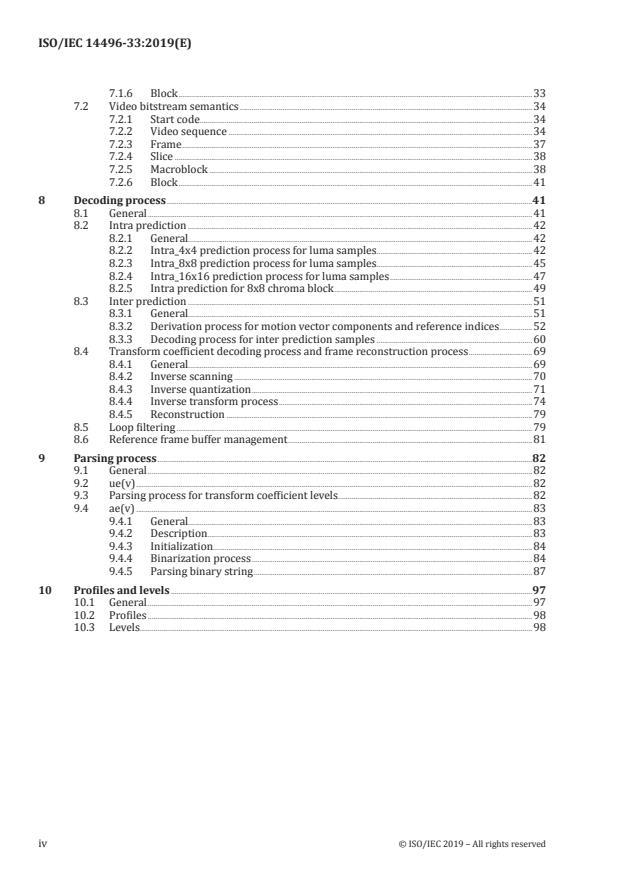
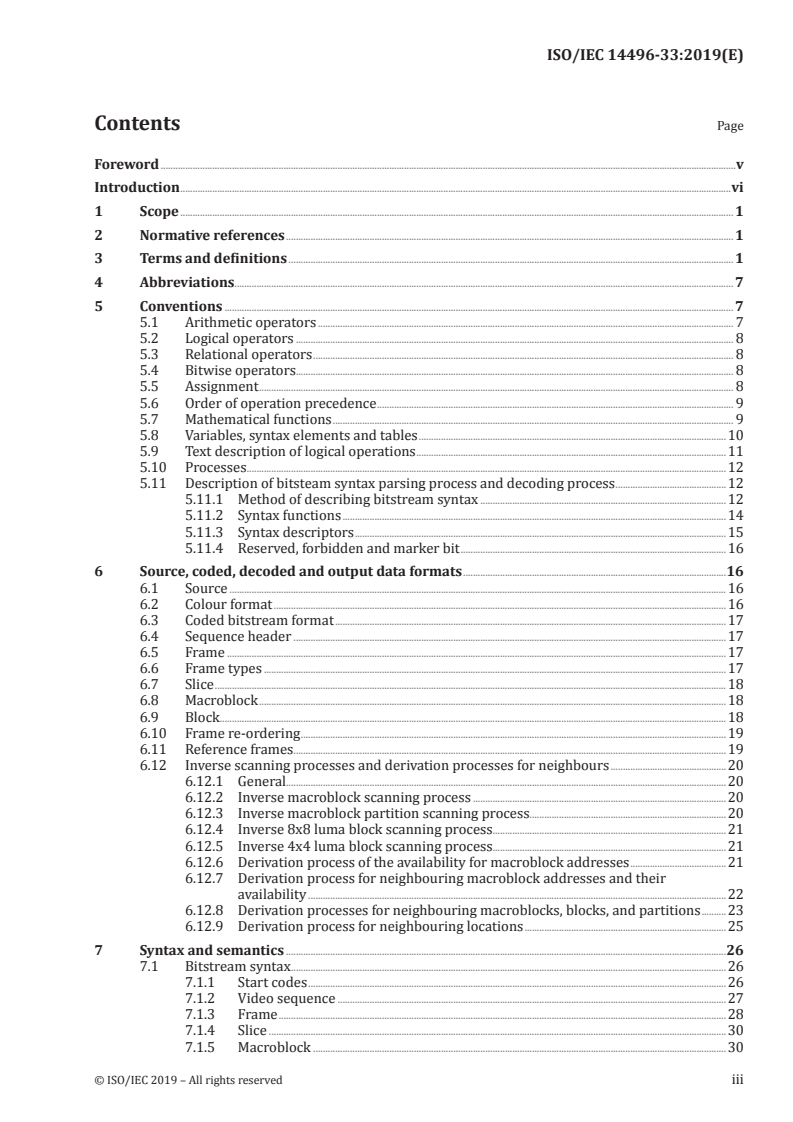
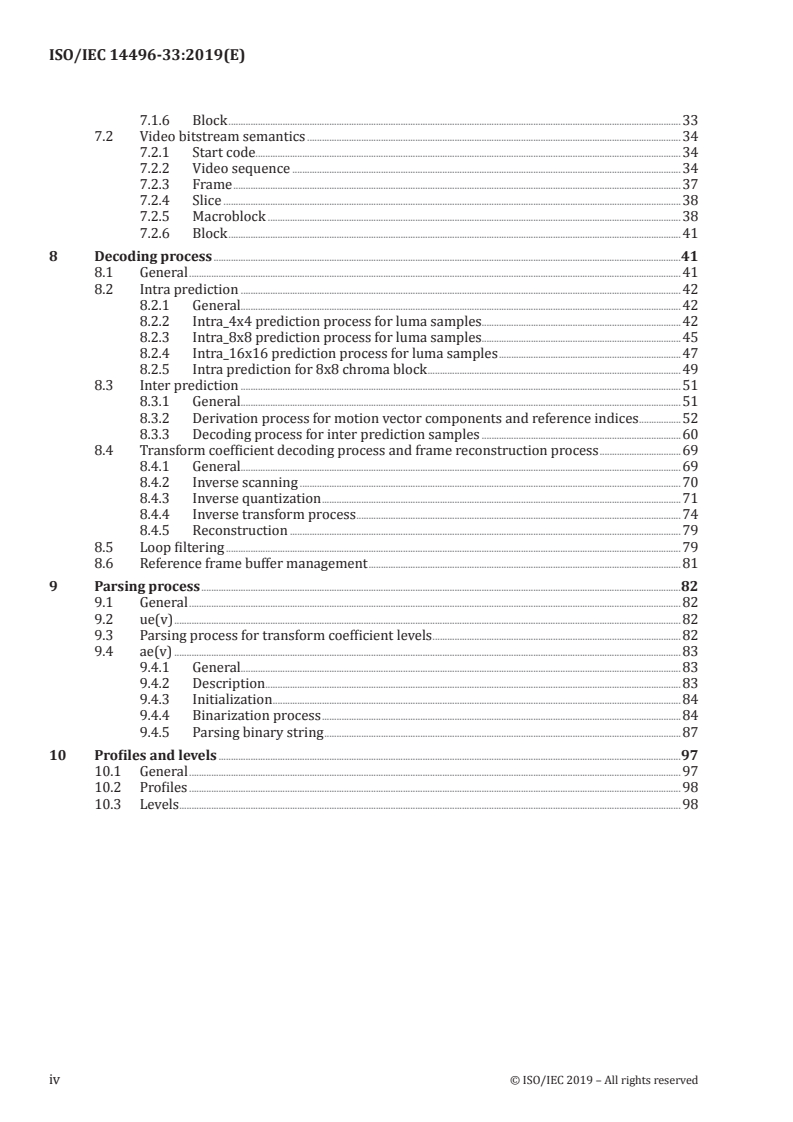
Contents Page
Foreword .v
Introduction .vi
1 Scope . 1
2 Normative references . 1
3 Terms and definitions . 1
4 Abbreviations. 7
5 Conventions . 7
5.1 Arithmetic operators . 7
5.2 Logical operators . 8
5.3 Relational operators . 8
5.4 Bitwise operators. 8
5.5 Assignment . 8
5.6 Order of operation precedence . 9
5.7 Mathematical functions . 9
5.8 Variables, syntax elements and tables .10
5.9 Text description of logical operations .11
5.10 Processes .12
5.11 Description of bitsteam syntax parsing process and decoding process .12
5.11.1 Method of describing bitstream syntax .12
5.11.2 Syntax functions .14
5.11.3 Syntax descriptors .15
5.11.4 Reserved, forbidden and marker bit .16
6 Source, coded, decoded and output data formats .16
6.1 Source .16
6.2 Colour format .16
6.3 Coded bitstream format .17
6.4 Sequence header .17
6.5 Frame .17
6.6 Frame types .17
6.7 Slice .18
6.8 Macroblock .18
6.9 Block.18
6.10 Frame re-ordering .19
6.11 Reference frames .19
6.12 Inverse scanning processes and derivation processes for neighbours .20
6.12.1 General.20
6.12.2 Inverse macroblock scanning process .20
6.12.3 Inverse macroblock partition scanning process.20
6.12.4 Inverse 8x8 luma block scanning process.21
6.12.5 Inverse 4x4 luma block scanning process.21
6.12.6 Derivation process of the availability for macroblock addresses .21
6.12.7 Derivation process for neighbouring macroblock addresses and their
availability .22
6.12.8 Derivation processes for neighbouring macroblocks, blocks, and partitions .23
6.12.9 Derivation process for neighbouring locations .25
7 Syntax and semantics .26
7.1 Bitstream syntax .26
7.1.1 Start codes .26
7.1.2 Video sequence .27
7.1.3 Frame .28
7.1.4 Slice .30
7.1.5 Macroblock .30
© ISO/IEC 2019 – All rights reserved iii
7.1.6 Block .33
7.2 Video bitstream semantics .34
7.2.1 Start code.34
7.2.2 Video sequence .34
7.2.3 Frame .37
7.2.4 Slice .38
7.2.5 Macroblock .38
7.2.6 Block .41
8 Decoding process .41
8.1 General .41
8.2 Intra prediction .42
8.2.1 General.42
8.2.2 Intra_4x4 prediction process for luma samples . .42
8.2.3 Intra_8x8 prediction process for luma samples . .45
8.2.4 Intra_16x16 prediction process for luma samples .47
8.2.5 Intra prediction for 8x8 chroma block .49
8.3 Inter prediction .51
8.3.1 General.51
8.3.2 Derivation process for motion vector components and reference indices .52
8.3.3 Decoding process for inter prediction samples .60
8.4 Transform coefficient decoding process and frame reconstruction process .69
8.4.1 General.69
8.4.2 Inverse scanning .70
8.4.3 Inverse quantization .71
8.4.4 Inverse transform process .74
8.4.5 Reconstruction .79
8.5 Loop filtering .79
8.6 Reference frame buffer management .81
9 Parsing process .82
9.1 General .82
9.2 ue(v) .82
9.3 Parsing process for transform coefficient levels .82
9.4 ae(v) .83
9.4.1 General.83
9.4.2 Description . . .83
9.4.3 Initialization .84
9.4.4 Binarization process .84
9.4.5 Parsing binary string .87
10 Profiles and levels .97
10.1 General .97
10.2 Profiles .98
10.3 Levels .98
iv © ISO/IEC 2019 – All rights reserved
Foreword
ISO (the International Organization for Standardization) and IEC (the International Electrotechnical
Commission) form the specialized system for worldwide standardization. National bodies that are
members of ISO or IEC participate in the development of International Standards through technical
committees established by the respective organization to deal with particular fields of technical
activity. ISO and IEC technical committees collaborate in fields of mutual interest. Other international
organizations, governmental and non-governmental, in liaison with ISO and IEC, also take part in the
work. In the field of information technology, ISO and IEC have established a joint technical committee,
ISO/IEC JTC 1.
The procedures used to develop this document and those intended for its further maintenance are
described in the ISO/IEC Directives, Part 1. In particular, the different approval criteria needed for
the different types of document should be noted. This document was drafted in accordance with the
editorial rules of the ISO/IEC Directives, Part 2 (see www .iso .org/directives).
Attention is drawn to the possibility that some of the elements of this document may be the subject
of patent rights. ISO and IEC shall not be held responsible for identifying any or all such patent
rights. Details of any patent rights identified during the development of the document will be in the
Introduction and/or on the ISO list of patent declarations received (see www .iso .org/patents).
Any trade name used in this document is information given for the convenience of users and does not
constitute an endorsement.
For an explanation of the voluntary nature of standards, the meaning of ISO specific terms and
expressions related to conformity assessment, as well as information about ISO's adherence to the
World Trade Organization (WTO) principles in the Technical Barriers to Trade (TBT) see www .iso
.org/iso/foreword .html.
This document was prepared by Technical Committee ISO/IEC JTC 1, Information technology,
Subcommittee SC 29, Coding of audio, picture, multimedia and hypermedia information.
A list of all parts in the ISO/IEC 14496 series can be found on the ISO website.
Any feedback or questions on this document should be directed to the user’s national standards body. A
complete listing of these bodies can be found at www .iso .org/members .html.
© ISO/IEC 2019 – All rights reserved v
Introduction
This document specifies Internet video coding, a video compression technology that is intended to be
suitable for video distribution models currently adopted on the Internet.
The International Organization for Standardization (ISO) and International Electrotechnical
Commission (IEC) draw attention to the fact that it is claimed that compliance with this document may
involve the use of patents.
ISO and IEC take no position concerning the evidence, validity and scope of these patent rights.
The holders of these patent rights have assured ISO and IEC that they are willing to negotiate licences
under reasonable and non-discriminatory terms and conditions with applicants throughout the world.
In this respect, the statements of the holders of these patent rights are registered with ISO and IEC.
Information may be obtained from:
Nokia Technologies Oy
Joensuunkatu 7E
FIN-24100 Salo
FINLAND
Telephone : +358 50 366 2022
Apple Inc.
Intellectual Property and Licensing
1 Infinite Loop, MS 169-3IPL
Cupertino, CA 95014
USA
Telephone: +1(408) 974-0015
Industry-University Cooperation Foundation Hanyang University
222 Wangsimni-ro, Seongdong-gu
Seoul 04763
REPUBLIC OF KOREA
Telephone: +82-2-2220-2212
vi © ISO/IEC 2019 – All rights reserved
Mitsubishi Electric Corporation
Corporate Licensing Division
2-7-3 Marunouchi, Chiyoda-ku
Tokyo 100-8310
JAPAN
Telephone: +81-3-3218-3465
QUALCOMM Incorporated
5775 Morehouse Drive
San Diego, CA 92121
USA
Telephone: +1 (858) 587-1121
Attention is drawn to the possibility that some of the elements of this document may be the subject of
patent rights other than those identified above. ISO and IEC shall not be held responsible for identifying
any or all such patent rights.
© ISO/IEC 2019 – All rights reserved vii
INTERNATIONAL STANDARD ISO/IEC 14496-33:2019(E)
Information technology — Coding of audio-visual
objects —
Part 33:
Internet video coding
1 Scope
This document specifies MPEG-4 Internet video coding.
2 Normative references
The following documents are referred to in the text in such a way that some or all of their content
constitutes requirements of this document. For dated references, only the edition cited applies. For
undated references, the latest edition of the referenced document (including any amendments) applies.
Rec. ITU-T H.262 | ISO/IEC 13818-2: 2013, Information technology — Generic coding of moving pictures
and associated audio information — Part 2: Video
IEC 60461, Time and control code
3 Terms and definitions
For the purposes of this document, the following terms and definitions apply.
ISO and IEC maintain terminological databases for use in standardization at the following addresses:
— IEC Electropedia: available at http: //www .electropedia .org/
— ISO Online browsing platform: available at http: //www .iso .org/obp
3.1
B frame
bidirectional frame
frame (3.28) that is coded using motion compensated prediction from past or future reference frames
(3.53) in output order (3.40)
3.2
backward prediction
process of predicting the current frame (3.28) by using future frames in an output order (3.40) as
reference frames (3.53)
3.3
bin
bit of a bin string (3.4)
3.4
bin string
intermediate binary representation of values of syntax elements (3.65) resulting from the binarization
(3.5) of the syntax element
© ISO/IEC 2019 – All rights reserved 1
3.5
binarization
set of bin strings (3.4) for all possible values of a syntax element (3.65)
3.6
binarization process
unique mapping process of all possible values of a syntax element (3.65) onto a set of bin strings (3.4)
3.7
bitstream
ordered series of bits that forms the coded representation (3.14) of the data
3.8
block
MxN (M-column by N-row) array of samples, or an MxN array of transform coefficients (3.66)
3.9
byte
sequence of 8 bits, written and read with the most significant bit on the left and the least significant bit on
the right, such that when represented in a sequence of data bits, the most significant bit of a byte is first
3.10
byte-aligned
positioning of a bit or byte (3.9) or syntax element (3.65) when the position at which it appears in a
bitstream (3.7) is an integer multiple of 8 bits from the position of the first bit in the bitstream
3.11
byte stream
ordered series of bytes that forms the coded representation (3.14) of the data
3.12
chroma
sample array or single sample, identified symbolically by Cb or Cr, representing one of the two colour
difference signals related to the primary colours
Note 1 to entry: The term chroma is used rather than the term chrominance in order to avoid the implication of
the use of linear light transfer characteristics that is often associated with the term chrominance.
3.13
coded frame
coded representation (3.14) of a frame (3.28)
3.14
coded representation
series of data elements as represented in coded form in the bitstream (3.7)
3.15
component
array or single sample from one of the three arrays (luma (3.37) and two chroma (3.12)) that make up a
frame (3.28) in 4:2:0 colour format
3.16
DC coefficient
transform coefficient (3.66) for which the frequency index (3.27) is zero in all dimensions
3.17
decoded frame
frame (3.28) derived by decoding a coded frame (3.13)
2 © ISO/IEC 2019 – All rights reserved
3.18
decoder
embodiment of the decoding process (3.20)
3.19
decoding order
order in which syntax elements are processed by the decoding process (3.20)
3.20
decoding process
process that derives decoded frames (3.17) from the syntax elements in the bitstream (3.7)
3.21
dequantization
process of scaling (3.57) the quantized transform coefficients (3.49) after their representation in the
bitstream (3.7) has been parsed (3.42) and before they are presented to the inverse transform (3.34)
part of the decoding process (3.20)
3.22
encoder
embodiment of an encoding process (3.23)
3.23
encoding process
process that produces a bitstream (3.7)
Note 1 to entry: This document does not specify an encoding process.
3.24
forbidden
specification that a value shall never be used
Note 1 to entry: This is usually to avoid emulation of a start code (3.63) pattern.
3.25
forward prediction
process of predicting the current frame by the past reference frames (3.53) in output order
3.26
flag
binary variable that can take one of the two possible values, 0 and 1
3.27
frequency index
one-dimensional or two-dimensional index associated with a transform coefficient (3.66) prior to an
inverse transform (3.34) part of a decoding process (3.20)
3.28
frame
successive lines, numbered from the top-most line to the bottom-most line, containing samples
numbered from the left-most sample to the right-most sample, representing the spatial information of a
video signal from a single time instant
3.29
I frame
intra frame
frame (3.28) coded using information only from itself
3.30
inter macroblock
macroblock (3.38) which is coded using inter prediction (3.31)
© ISO/IEC 2019 – All rights reserved 3
3.31
inter prediction
prediction (3.44) derived from data elements (e.g. sample value or motion vector (3.39)) of reference
frames (3.53) other than the current frame
3.32
intra macroblock
macroblock (3.38) which is coded using intra prediction (3.33)
3.33
intra prediction
prediction (3.44) derived from only data elements (e.g. sample values) of the same decoded slice (3.60)
3.34
inverse transform
part of the decoding process (3.20) by which a set of transform coefficients (3.66) are converted into
spatial-domain values, or by which a set of transform coefficients are converted into DC coefficients (3.16)
3.35
layer
one of a set of syntactical structures in a non-branching hierarchical relationship, such that higher
layers contain lower layers, with such coded layers being the coded frame (3.13), slice (3.60), macroblock
(3.38) and block (3.8)
3.36
level
defined set of constraints on the values that may be taken by syntax elements (3.65) and variables; or in
a different context, the value of a transform coefficient (3.66) prior to scaling (3.57)
Note 1 to entry: The same set of levels is defined for all profiles (3.47), with most aspects of the definition of each
level being in common across different profiles. Individual implementations may, within specified constraints,
support a different level for each supported profile.
3.37
luma
sample array or single sample, identified symbolically by Y or L, ordinarily representing the brightness
signal related to the primary colours
Note 1 to entry: The term luma is used rather than the term luminance in order to avoid the implication of the
use of linear light transfer characteristics that is often associated with the term luminance. The symbol L is
sometimes used instead of the symbol Y to avoid confusion with the symbol y as used for vertical location.
3.38
macroblock
16 × 16 luma (3.37) sample value block and its corresponding two chroma (3.12) sample value blocks
3.39
motion vector
two-dimensional vector used for inter prediction (3.31) that provides an offset from the coordinates in
the decoded frame (3.17) to the coordinates in a reference frame (3.53)
3.40
output order
order in which the decoded frames (3.17) are output from the decoded frame buffer in case the decoded
frames are to be output from the decoded frame buffer
3.41
P frame
predictive frame
frame (3.28) that is coded using motion compensated prediction from past reference frames (3.53) in
output order (3.40)
4 © ISO/IEC 2019 – All rights reserved
3.42
parse
procedure of obtaining the value of a syntax element (3.65) from a bitstream (3.7)
3.43
partitioning
division of a set into subsets such that each element of a set is in exactly one of the subsets
3.44
prediction
embodiment of a prediction process (3.45)
3.45
prediction process
use of a predictor (3.46) to provide an estimate of a data element (e.g. sample value or motion vector
(3.39)) currently being decoded
3.46
predictor
combination of specified values or previously decoded data elements (e.g. sample value or motion vector
(3.39)) used in the decoding process (3.20) of subsequent data elements
3.47
profile
specified subset of the syntax
3.48
quantization parameter
variable used by the decoding process (3.20) for scaling (3.57) of transform coefficient levels (3.67)
3.49
quantized transform coefficients
transform coefficients (3.66) before dequantization (3.21)
3.50
random access
starting the decoding process (3.20) for part of a bitstream at some point other than the beginning of the
bitstream (3.7)
3.51
raster scan
mapping of a rectangular two-dimensional pattern to a one-dimensional pattern such that the first
entries in the one-dimensional pattern are from the top-most row of the two-dimensional pattern
scanned from left to right, followed similarly by the second, third, etc., top-most rows of the pattern
(proceeding downwards), with each row scanned from left to right
3.52
reference index
order indication of the reference frames (3.53) in the frame buffer in the decoding process (3.20)
3.53
reference frame
frame that contains samples that may be used for inter prediction (3.31) in the decoding process (3.20) of
subsequent frames (3.28) in decoding order (3.19)
3.54
reserved
specification that some values of a particular syntax element (3.65) are for future use by ISO/IEC, such
that these values shall not be used in bitstreams (3.7), but may be specified for use in future extensions
by ISO/IEC
© ISO/IEC 2019 – All rights reserved 5
3.55
residual
decoded difference between a prediction (3.44) of a sample or data element and its decoded value
3.56
run
number of data elements with the same value or the same treatment in the decoding process (3.20)
Note 1 to entry: In one context, it means the number of zero coefficients before a non-zero coefficient in the block
scan, and in another context, it means the number of consecutive skipped macroblocks (3.59).
3.57
scaling
process of multiplying transform coefficient levels (3.67) by a factor, resulting in transform
coefficients (3.66)
3.58
sequence
highest layer syntax structure of the bitstream (3.7), including one or more consecutive coded
frames (3.13)
3.59
skipped macroblock
macroblock (3.38) for which no syntax elements are present in the bitstream (3.7) except for the
indication that the macroblock is a skipped macroblock (3.59)
3.60
slice
integer number of consecutive macroblock (3.38) rows in the raster scan (3.51) order that is associated
with the same header data
3.61
slice header
part of a coded slice (3.60) containing the data elements pertaining to the first or all macroblocks (3.58)
represented in a slice
3.62
source
video material or some of its attributes before operation of an encoding process (3.23)
3.63
start code
32-bit codeword pattern which is unique in the whole bitstream (3.7)
Note 1 to entry: Start codes can be used to identify the starting point of a syntax structure in the bitstream (e.g.
to enable random access (3.50)).
3.64
stuffing bits
bit string having a prescribed pattern of fixed values at a particular position in the bitstream (3.7)
3.65
syntax element
element of data represented in the bitstream (3.7)
3.66
transform coefficient
scalar quantity, considered to be in a frequency domain, that is associated with a particular one-
dimensional or two-dimensional frequency index (3.27) in an inverse transform (3.34) part of the
decoding process (3.20)
6 © ISO/IEC 2019 – All rights reserved
3.67
transform coefficient level
integer quantity representing the value associated with a particular two-dimensional frequency index in
the decoding process (3.20) prior to scaling (3.57) for computation of a transform coefficient value (3.66)
3.68
video buffering verifier
hypothetical reference decoder (3.18) that operates on the bitstream (3.7) to perform the decoding
process (3.20) with a specified timing and with a specified limited capacity for buffering the coded data
and decoded frames (3.17)
Note 1 to entry: Its purpose is to provide a constraint on the variability of the data rate that an encoder (3.22) or
editing process may produce.
4 Abbreviations
LSB least significant bit
MB macroblock
MSB most significant bit
VBV video buffering verifier
5 Conventions
NOTE The mathematical operators and their precedence rules used in this document are similar to those
used in the C programming language. However, operators of integer divisions with truncation and of rounding
are specifically defined. If not specifically explained, numbering and counting begin from zero.
5.1 Arithmetic operators
+ Addition
− Subtraction (as a binary operator) or negation (as a unary prefix operator)
* Multiplication
b
a Exponential operation: a is raised to power of b. (May alternatively represent a super-
script.)
/ Integer division with truncation of the result toward zero. For example, 7/4 and (−7)/(−4)
are truncated to 1 and (−7)/4 and 7/(−4) are truncated to −1.
÷ Division in mathematical formulae where no truncation or rounding is intended.
a
Division in mathematical formulae where no truncation or rounding is intended.
b
b
fi The summation of f(i) with i taking integral values from a up to and including b.
()
∑
ia=
a % b Remainder of a divided by b, defined only for a >= 0 and b > 0.
© ISO/IEC 2019 – All rights reserved 7
5.2 Logical operators
a && b Logical AND operation between a and b
a || b Logical OR operation between a and b
! Logical NOT operation
a ? b : c If a is TRUE or not equal to 0, evaluates to b; otherwise, evaluates to c.
5.3 Relational operators
> greater than
>= greater than or equal to
< less than
<= less than or equal to
== equal to
!= not equal to
5.4 Bitwise operators
& AND operation
| OR operation
~ Negation operation
a >> b Shift a in 2’s complement binary integer representation format to the right by b bit positions.
This operator is only defined with b, a positive integer.
a << b Shift a in 2’s complement binary integer representation format to the left by b bit positions.
This operator is only defined with b, a positive integer.
5.5 Assignment
= Assignment operator
++ Increment, x++ is equivalent to x = x + 1. When this operator is used for an array index, the
variable value is obtained before the increment operation.
−− Decrement, i.e. x−− is equivalent to x = x − 1. When this operator is used for an array index,
the variable value is obtained before the decrement operation.
+= Addition assignment operator, for example, x += 3 corresponds to x = x + 3, x += (−3) is
equivalent to x = x + (−3).
−= Subtraction assignment operator, for example, x −= 3 corresponds to x = x − 3, x −= (−3) is
equivalent to x = x − (−3).
8 © ISO/IEC 2019 – All rights reserved
5.6 Order of operation precedence
When order of precedence in an expression is not indicated explicitly by use of parentheses, the
following rules apply:
— operations of a higher precedence are evaluated before any operation of a lower precedence;
— operations of the same precedence are evaluated sequentially from left to right.
Table 1 specifies the precedence of operations from highest to lowest; a higher position in the table
indicates a higher precedence.
NOTE For those operators that are also used in the C programming language, the order of precedence used
in this document is the same as used in the C programming language.
Table 1 — Operation precedence from highest (at top of table) to lowest (at bottom of table)
operations (with operands x, y, and z)
“x++”, “x−−”
“!x", “−x” (as a unary prefix operator)
y
“x ”
x
“x * y”, “x / y”, “x ÷ y”, “ ”, “x % y”
y
b
“x + y”, “x − y” (as a two-argument operator), “ fi ”
()
∑
ia=
“x << y”, “x >> y”
“x < y”, “x <= y”, “x > y”, “x >= y”
“x == y”, “x != y”
“x & y”
“x | y”
“x && y”
“x | | y”
“x ? y : z”
“x = y”, “x += y”, “x −= y”
5.7 Mathematical functions
xx; >=0
abs(x) =
−
ceil(x) Takes the smallest integer not smaller than x
clip1(x) = clip3(0, 255, x)
ac;
bc; >b
clip3(a, b, c) =
c ;else
floor(x) Takes the biggest integer not bigger than x
© ISO/IEC 2019 – All rights reserved 9
log2(x) Logarithm number of x with base 2
log10(x) Logarithm number of x with base 10
median(x, y, z) = x + y + z − min(x, min(y, z)) − max(x, max(y, z))
x ; xy<=
min(x, y) =
y ; xy>
x ; xy>=
max(x, y) =
y ; xy<
round(x) = sign(x) * floor(abs(x) + 0.5)
00; x>=
sign(x) =
10; x<
ad%*bb ; e==0
()
()
InverseRasterScan
( a, b, c, d, e )=
ad/*bb ; e==1
()()
5.8 Variables, syntax elements and tables
Syntax elements in the bitstream are represented in bold type. Each syntax element is described by its
name (all lowercase letters with underscore characters), its one or two syntax categories, and one or
two descriptors for its method of coded representation. The decoding process behaves according to the
value of the syntax element and to the values of previously decoded syntax elements. When a value of a
syntax element is used in the syntax tables or the text, it appears in regular (i.e., not bold) type.
In some cases the syntax tables may use the values of other variables derived from syntax element
values. Such variables appear in the syntax tables, or text, named by a mixture of lowercase and
uppercase letter and without any underscore characters. Variables starting with an uppercase letter
are derived for the decoding of the current syntax structure and all depending syntax structures.
Variables starting with an uppercase letter may be used in the decoding process for later syntax
structures without mentioning the originating syntax structure of the variable. Variables starting with
a lowercase letter are only used within the subclause in which they are derived.
In some cases, “mnemonic” names for syntax element values or variable values are used interchangeably
with their numerical values. Sometimes “mnemonic” names are used without any associated numerical
values. The association of values and names is specified in the text. The names are constructed from one
or more groups of letters separated by an underscore character. Each group starts with an uppercase
letter and may contain more uppercase letters.
NOTE The syntax is described in a manner that closely follows the C-language syntactic constructs.
Functions that specify properties of the current position in the bitstream are referred to as syntax
functions. These functions are specified in subclause 5.11.2 and assume the existence of a bitstream
pointer with an indication of the position of the next bit to be read by the decoding process from the
bitstream. Syntax functions are described by their names, which are constructed as syntax element
names and end with left and right round parentheses including zero or more variable names (for
definition) or values (for usage), separated by commas (if more than one variable).
Functions that are not syntax functions (including mathematical functions specified in subclause 5.7)
are described by their names, which start with an uppercase letter, contain a mixture of lower and
uppercase letters without any underscore character, and end with left and right parentheses including
10 © ISO/IEC 2019 – All rights reserved
zero or more variable names (for definition) or values (for usage) separated by commas (if more than
one variable).
A one-dimensional array is referred to as a list. A two-dimensional array is referred to as a matrix.
Arrays can either be syntax elements or variables. Subscripts or square parentheses are used for the
indexing of arrays. In reference to a visual depiction of a matrix, the first subscript is used as a row
(vertical) index and the second subscript is used as a column (horizontal) index. The indexing order
is reversed when using square parentheses rather than subscripts for indexing. Thus, an element of a
matrix s at horizontal position x and vertical position y may be denoted either as s[ x, y ] or as s .
yx
Binary notation is indicated by enclosing the string of bit values by single quote marks. For example,
‘01000001’ represents an eight-bit string having only its second and its last bits (counted from the most
to the least significant bit) equal to 1.
Hexadecimal notation, indicated by prefixing the hexadecimal number by “0x”, may be used instead of
binary notation when the number of bits is an integer multiple of 4. For example, 0x41 represents an
eight-bit string having only its second and its last bits (counted from the most to the least significant
bit) equal to 1.
Numerical values not enclosed in single quotes and not prefixed by “0x” are decimal values.
A value equal to 0 represents a FALSE condit
...
INTERNATIONAL ISO/IEC
STANDARD 14496-33
First edition
2019-02
Information technology — Coding of
audio-visual objects —
Part 33:
Internet video coding
Technologies de l'information — Codage des objets audiovisuels —
Partie 33: Codage vidéo Internet
Reference number
©
ISO/IEC 2019
© ISO/IEC 2019
All rights reserved. Unless otherwise specified, or required in the context of its implementation, no part of this publication may
be reproduced or utilized otherwise in any form or by any means, electronic or mechanical, including photocopying, or posting
on the internet or an intranet, without prior written permission. Permission can be requested from either ISO at the address
below or ISO’s member body in the country of the requester.
ISO copyright office
CP 401 • Ch. de Blandonnet 8
CH-1214 Vernier, Geneva
Phone: +41 22 749 01 11
Fax: +41 22 749 09 47
Email: copyright@iso.org
Website: www.iso.org
Published in Switzerland
ii © ISO/IEC 2019 – All rights reserved
Contents Page
Foreword .v
Introduction .vi
1 Scope . 1
2 Normative references . 1
3 Terms and definitions . 1
4 Abbreviations. 7
5 Conventions . 7
5.1 Arithmetic operators . 7
5.2 Logical operators . 8
5.3 Relational operators . 8
5.4 Bitwise operators. 8
5.5 Assignment . 8
5.6 Order of operation precedence . 9
5.7 Mathematical functions . 9
5.8 Variables, syntax elements and tables .10
5.9 Text description of logical operations .11
5.10 Processes .12
5.11 Description of bitsteam syntax parsing process and decoding process .12
5.11.1 Method of describing bitstream syntax .12
5.11.2 Syntax functions .14
5.11.3 Syntax descriptors .15
5.11.4 Reserved, forbidden and marker bit .16
6 Source, coded, decoded and output data formats .16
6.1 Source .16
6.2 Colour format .16
6.3 Coded bitstream format .17
6.4 Sequence header .17
6.5 Frame .17
6.6 Frame types .17
6.7 Slice .18
6.8 Macroblock .18
6.9 Block.18
6.10 Frame re-ordering .19
6.11 Reference frames .19
6.12 Inverse scanning processes and derivation processes for neighbours .20
6.12.1 General.20
6.12.2 Inverse macroblock scanning process .20
6.12.3 Inverse macroblock partition scanning process.20
6.12.4 Inverse 8x8 luma block scanning process.21
6.12.5 Inverse 4x4 luma block scanning process.21
6.12.6 Derivation process of the availability for macroblock addresses .21
6.12.7 Derivation process for neighbouring macroblock addresses and their
availability .22
6.12.8 Derivation processes for neighbouring macroblocks, blocks, and partitions .23
6.12.9 Derivation process for neighbouring locations .25
7 Syntax and semantics .26
7.1 Bitstream syntax .26
7.1.1 Start codes .26
7.1.2 Video sequence .27
7.1.3 Frame .28
7.1.4 Slice .30
7.1.5 Macroblock .30
© ISO/IEC 2019 – All rights reserved iii
7.1.6 Block .33
7.2 Video bitstream semantics .34
7.2.1 Start code.34
7.2.2 Video sequence .34
7.2.3 Frame .37
7.2.4 Slice .38
7.2.5 Macroblock .38
7.2.6 Block .41
8 Decoding process .41
8.1 General .41
8.2 Intra prediction .42
8.2.1 General.42
8.2.2 Intra_4x4 prediction process for luma samples . .42
8.2.3 Intra_8x8 prediction process for luma samples . .45
8.2.4 Intra_16x16 prediction process for luma samples .47
8.2.5 Intra prediction for 8x8 chroma block .49
8.3 Inter prediction .51
8.3.1 General.51
8.3.2 Derivation process for motion vector components and reference indices .52
8.3.3 Decoding process for inter prediction samples .60
8.4 Transform coefficient decoding process and frame reconstruction process .69
8.4.1 General.69
8.4.2 Inverse scanning .70
8.4.3 Inverse quantization .71
8.4.4 Inverse transform process .74
8.4.5 Reconstruction .79
8.5 Loop filtering .79
8.6 Reference frame buffer management .81
9 Parsing process .82
9.1 General .82
9.2 ue(v) .82
9.3 Parsing process for transform coefficient levels .82
9.4 ae(v) .83
9.4.1 General.83
9.4.2 Description . . .83
9.4.3 Initialization .84
9.4.4 Binarization process .84
9.4.5 Parsing binary string .87
10 Profiles and levels .97
10.1 General .97
10.2 Profiles .98
10.3 Levels .98
iv © ISO/IEC 2019 – All rights reserved
Foreword
ISO (the International Organization for Standardization) and IEC (the International Electrotechnical
Commission) form the specialized system for worldwide standardization. National bodies that are
members of ISO or IEC participate in the development of International Standards through technical
committees established by the respective organization to deal with particular fields of technical
activity. ISO and IEC technical committees collaborate in fields of mutual interest. Other international
organizations, governmental and non-governmental, in liaison with ISO and IEC, also take part in the
work. In the field of information technology, ISO and IEC have established a joint technical committee,
ISO/IEC JTC 1.
The procedures used to develop this document and those intended for its further maintenance are
described in the ISO/IEC Directives, Part 1. In particular, the different approval criteria needed for
the different types of document should be noted. This document was drafted in accordance with the
editorial rules of the ISO/IEC Directives, Part 2 (see www .iso .org/directives).
Attention is drawn to the possibility that some of the elements of this document may be the subject
of patent rights. ISO and IEC shall not be held responsible for identifying any or all such patent
rights. Details of any patent rights identified during the development of the document will be in the
Introduction and/or on the ISO list of patent declarations received (see www .iso .org/patents).
Any trade name used in this document is information given for the convenience of users and does not
constitute an endorsement.
For an explanation of the voluntary nature of standards, the meaning of ISO specific terms and
expressions related to conformity assessment, as well as information about ISO's adherence to the
World Trade Organization (WTO) principles in the Technical Barriers to Trade (TBT) see www .iso
.org/iso/foreword .html.
This document was prepared by Technical Committee ISO/IEC JTC 1, Information technology,
Subcommittee SC 29, Coding of audio, picture, multimedia and hypermedia information.
A list of all parts in the ISO/IEC 14496 series can be found on the ISO website.
Any feedback or questions on this document should be directed to the user’s national standards body. A
complete listing of these bodies can be found at www .iso .org/members .html.
© ISO/IEC 2019 – All rights reserved v
Introduction
This document specifies Internet video coding, a video compression technology that is intended to be
suitable for video distribution models currently adopted on the Internet.
The International Organization for Standardization (ISO) and International Electrotechnical
Commission (IEC) draw attention to the fact that it is claimed that compliance with this document may
involve the use of patents.
ISO and IEC take no position concerning the evidence, validity and scope of these patent rights.
The holders of these patent rights have assured ISO and IEC that they are willing to negotiate licences
under reasonable and non-discriminatory terms and conditions with applicants throughout the world.
In this respect, the statements of the holders of these patent rights are registered with ISO and IEC.
Information may be obtained from:
Nokia Technologies Oy
Joensuunkatu 7E
FIN-24100 Salo
FINLAND
Telephone : +358 50 366 2022
Apple Inc.
Intellectual Property and Licensing
1 Infinite Loop, MS 169-3IPL
Cupertino, CA 95014
USA
Telephone: +1(408) 974-0015
Industry-University Cooperation Foundation Hanyang University
222 Wangsimni-ro, Seongdong-gu
Seoul 04763
REPUBLIC OF KOREA
Telephone: +82-2-2220-2212
vi © ISO/IEC 2019 – All rights reserved
Mitsubishi Electric Corporation
Corporate Licensing Division
2-7-3 Marunouchi, Chiyoda-ku
Tokyo 100-8310
JAPAN
Telephone: +81-3-3218-3465
QUALCOMM Incorporated
5775 Morehouse Drive
San Diego, CA 92121
USA
Telephone: +1 (858) 587-1121
Attention is drawn to the possibility that some of the elements of this document may be the subject of
patent rights other than those identified above. ISO and IEC shall not be held responsible for identifying
any or all such patent rights.
© ISO/IEC 2019 – All rights reserved vii
INTERNATIONAL STANDARD ISO/IEC 14496-33:2019(E)
Information technology — Coding of audio-visual
objects —
Part 33:
Internet video coding
1 Scope
This document specifies MPEG-4 Internet video coding.
2 Normative references
The following documents are referred to in the text in such a way that some or all of their content
constitutes requirements of this document. For dated references, only the edition cited applies. For
undated references, the latest edition of the referenced document (including any amendments) applies.
Rec. ITU-T H.262 | ISO/IEC 13818-2: 2013, Information technology — Generic coding of moving pictures
and associated audio information — Part 2: Video
IEC 60461, Time and control code
3 Terms and definitions
For the purposes of this document, the following terms and definitions apply.
ISO and IEC maintain terminological databases for use in standardization at the following addresses:
— IEC Electropedia: available at http: //www .electropedia .org/
— ISO Online browsing platform: available at http: //www .iso .org/obp
3.1
B frame
bidirectional frame
frame (3.28) that is coded using motion compensated prediction from past or future reference frames
(3.53) in output order (3.40)
3.2
backward prediction
process of predicting the current frame (3.28) by using future frames in an output order (3.40) as
reference frames (3.53)
3.3
bin
bit of a bin string (3.4)
3.4
bin string
intermediate binary representation of values of syntax elements (3.65) resulting from the binarization
(3.5) of the syntax element
© ISO/IEC 2019 – All rights reserved 1
3.5
binarization
set of bin strings (3.4) for all possible values of a syntax element (3.65)
3.6
binarization process
unique mapping process of all possible values of a syntax element (3.65) onto a set of bin strings (3.4)
3.7
bitstream
ordered series of bits that forms the coded representation (3.14) of the data
3.8
block
MxN (M-column by N-row) array of samples, or an MxN array of transform coefficients (3.66)
3.9
byte
sequence of 8 bits, written and read with the most significant bit on the left and the least significant bit on
the right, such that when represented in a sequence of data bits, the most significant bit of a byte is first
3.10
byte-aligned
positioning of a bit or byte (3.9) or syntax element (3.65) when the position at which it appears in a
bitstream (3.7) is an integer multiple of 8 bits from the position of the first bit in the bitstream
3.11
byte stream
ordered series of bytes that forms the coded representation (3.14) of the data
3.12
chroma
sample array or single sample, identified symbolically by Cb or Cr, representing one of the two colour
difference signals related to the primary colours
Note 1 to entry: The term chroma is used rather than the term chrominance in order to avoid the implication of
the use of linear light transfer characteristics that is often associated with the term chrominance.
3.13
coded frame
coded representation (3.14) of a frame (3.28)
3.14
coded representation
series of data elements as represented in coded form in the bitstream (3.7)
3.15
component
array or single sample from one of the three arrays (luma (3.37) and two chroma (3.12)) that make up a
frame (3.28) in 4:2:0 colour format
3.16
DC coefficient
transform coefficient (3.66) for which the frequency index (3.27) is zero in all dimensions
3.17
decoded frame
frame (3.28) derived by decoding a coded frame (3.13)
2 © ISO/IEC 2019 – All rights reserved
3.18
decoder
embodiment of the decoding process (3.20)
3.19
decoding order
order in which syntax elements are processed by the decoding process (3.20)
3.20
decoding process
process that derives decoded frames (3.17) from the syntax elements in the bitstream (3.7)
3.21
dequantization
process of scaling (3.57) the quantized transform coefficients (3.49) after their representation in the
bitstream (3.7) has been parsed (3.42) and before they are presented to the inverse transform (3.34)
part of the decoding process (3.20)
3.22
encoder
embodiment of an encoding process (3.23)
3.23
encoding process
process that produces a bitstream (3.7)
Note 1 to entry: This document does not specify an encoding process.
3.24
forbidden
specification that a value shall never be used
Note 1 to entry: This is usually to avoid emulation of a start code (3.63) pattern.
3.25
forward prediction
process of predicting the current frame by the past reference frames (3.53) in output order
3.26
flag
binary variable that can take one of the two possible values, 0 and 1
3.27
frequency index
one-dimensional or two-dimensional index associated with a transform coefficient (3.66) prior to an
inverse transform (3.34) part of a decoding process (3.20)
3.28
frame
successive lines, numbered from the top-most line to the bottom-most line, containing samples
numbered from the left-most sample to the right-most sample, representing the spatial information of a
video signal from a single time instant
3.29
I frame
intra frame
frame (3.28) coded using information only from itself
3.30
inter macroblock
macroblock (3.38) which is coded using inter prediction (3.31)
© ISO/IEC 2019 – All rights reserved 3
3.31
inter prediction
prediction (3.44) derived from data elements (e.g. sample value or motion vector (3.39)) of reference
frames (3.53) other than the current frame
3.32
intra macroblock
macroblock (3.38) which is coded using intra prediction (3.33)
3.33
intra prediction
prediction (3.44) derived from only data elements (e.g. sample values) of the same decoded slice (3.60)
3.34
inverse transform
part of the decoding process (3.20) by which a set of transform coefficients (3.66) are converted into
spatial-domain values, or by which a set of transform coefficients are converted into DC coefficients (3.16)
3.35
layer
one of a set of syntactical structures in a non-branching hierarchical relationship, such that higher
layers contain lower layers, with such coded layers being the coded frame (3.13), slice (3.60), macroblock
(3.38) and block (3.8)
3.36
level
defined set of constraints on the values that may be taken by syntax elements (3.65) and variables; or in
a different context, the value of a transform coefficient (3.66) prior to scaling (3.57)
Note 1 to entry: The same set of levels is defined for all profiles (3.47), with most aspects of the definition of each
level being in common across different profiles. Individual implementations may, within specified constraints,
support a different level for each supported profile.
3.37
luma
sample array or single sample, identified symbolically by Y or L, ordinarily representing the brightness
signal related to the primary colours
Note 1 to entry: The term luma is used rather than the term luminance in order to avoid the implication of the
use of linear light transfer characteristics that is often associated with the term luminance. The symbol L is
sometimes used instead of the symbol Y to avoid confusion with the symbol y as used for vertical location.
3.38
macroblock
16 × 16 luma (3.37) sample value block and its corresponding two chroma (3.12) sample value blocks
3.39
motion vector
two-dimensional vector used for inter prediction (3.31) that provides an offset from the coordinates in
the decoded frame (3.17) to the coordinates in a reference frame (3.53)
3.40
output order
order in which the decoded frames (3.17) are output from the decoded frame buffer in case the decoded
frames are to be output from the decoded frame buffer
3.41
P frame
predictive frame
frame (3.28) that is coded using motion compensated prediction from past reference frames (3.53) in
output order (3.40)
4 © ISO/IEC 2019 – All rights reserved
3.42
parse
procedure of obtaining the value of a syntax element (3.65) from a bitstream (3.7)
3.43
partitioning
division of a set into subsets such that each element of a set is in exactly one of the subsets
3.44
prediction
embodiment of a prediction process (3.45)
3.45
prediction process
use of a predictor (3.46) to provide an estimate of a data element (e.g. sample value or motion vector
(3.39)) currently being decoded
3.46
predictor
combination of specified values or previously decoded data elements (e.g. sample value or motion vector
(3.39)) used in the decoding process (3.20) of subsequent data elements
3.47
profile
specified subset of the syntax
3.48
quantization parameter
variable used by the decoding process (3.20) for scaling (3.57) of transform coefficient levels (3.67)
3.49
quantized transform coefficients
transform coefficients (3.66) before dequantization (3.21)
3.50
random access
starting the decoding process (3.20) for part of a bitstream at some point other than the beginning of the
bitstream (3.7)
3.51
raster scan
mapping of a rectangular two-dimensional pattern to a one-dimensional pattern such that the first
entries in the one-dimensional pattern are from the top-most row of the two-dimensional pattern
scanned from left to right, followed similarly by the second, third, etc., top-most rows of the pattern
(proceeding downwards), with each row scanned from left to right
3.52
reference index
order indication of the reference frames (3.53) in the frame buffer in the decoding process (3.20)
3.53
reference frame
frame that contains samples that may be used for inter prediction (3.31) in the decoding process (3.20) of
subsequent frames (3.28) in decoding order (3.19)
3.54
reserved
specification that some values of a particular syntax element (3.65) are for future use by ISO/IEC, such
that these values shall not be used in bitstreams (3.7), but may be specified for use in future extensions
by ISO/IEC
© ISO/IEC 2019 – All rights reserved 5
3.55
residual
decoded difference between a prediction (3.44) of a sample or data element and its decoded value
3.56
run
number of data elements with the same value or the same treatment in the decoding process (3.20)
Note 1 to entry: In one context, it means the number of zero coefficients before a non-zero coefficient in the block
scan, and in another context, it means the number of consecutive skipped macroblocks (3.59).
3.57
scaling
process of multiplying transform coefficient levels (3.67) by a factor, resulting in transform
coefficients (3.66)
3.58
sequence
highest layer syntax structure of the bitstream (3.7), including one or more consecutive coded
frames (3.13)
3.59
skipped macroblock
macroblock (3.38) for which no syntax elements are present in the bitstream (3.7) except for the
indication that the macroblock is a skipped macroblock (3.59)
3.60
slice
integer number of consecutive macroblock (3.38) rows in the raster scan (3.51) order that is associated
with the same header data
3.61
slice header
part of a coded slice (3.60) containing the data elements pertaining to the first or all macroblocks (3.58)
represented in a slice
3.62
source
video material or some of its attributes before operation of an encoding process (3.23)
3.63
start code
32-bit codeword pattern which is unique in the whole bitstream (3.7)
Note 1 to entry: Start codes can be used to identify the starting point of a syntax structure in the bitstream (e.g.
to enable random access (3.50)).
3.64
stuffing bits
bit string having a prescribed pattern of fixed values at a particular position in the bitstream (3.7)
3.65
syntax element
element of data represented in the bitstream (3.7)
3.66
transform coefficient
scalar quantity, considered to be in a frequency domain, that is associated with a particular one-
dimensional or two-dimensional frequency index (3.27) in an inverse transform (3.34) part of the
decoding process (3.20)
6 © ISO/IEC 2019 – All rights reserved
3.67
transform coefficient level
integer quantity representing the value associated with a particular two-dimensional frequency index in
the decoding process (3.20) prior to scaling (3.57) for computation of a transform coefficient value (3.66)
3.68
video buffering verifier
hypothetical reference decoder (3.18) that operates on the bitstream (3.7) to perform the decoding
process (3.20) with a specified timing and with a specified limited capacity for buffering the coded data
and decoded frames (3.17)
Note 1 to entry: Its purpose is to provide a constraint on the variability of the data rate that an encoder (3.22) or
editing process may produce.
4 Abbreviations
LSB least significant bit
MB macroblock
MSB most significant bit
VBV video buffering verifier
5 Conventions
NOTE The mathematical operators and their precedence rules used in this document are similar to those
used in the C programming language. However, operators of integer divisions with truncation and of rounding
are specifically defined. If not specifically explained, numbering and counting begin from zero.
5.1 Arithmetic operators
+ Addition
− Subtraction (as a binary operator) or negation (as a unary prefix operator)
* Multiplication
b
a Exponential operation: a is raised to power of b. (May alternatively represent a super-
script.)
/ Integer division with truncation of the result toward zero. For example, 7/4 and (−7)/(−4)
are truncated to 1 and (−7)/4 and 7/(−4) are truncated to −1.
÷ Division in mathematical formulae where no truncation or rounding is intended.
a
Division in mathematical formulae where no truncation or rounding is intended.
b
b
fi The summation of f(i) with i taking integral values from a up to and including b.
()
∑
ia=
a % b Remainder of a divided by b, defined only for a >= 0 and b > 0.
© ISO/IEC 2019 – All rights reserved 7
5.2 Logical operators
a && b Logical AND operation between a and b
a || b Logical OR operation between a and b
! Logical NOT operation
a ? b : c If a is TRUE or not equal to 0, evaluates to b; otherwise, evaluates to c.
5.3 Relational operators
> greater than
>= greater than or equal to
< less than
<= less than or equal to
== equal to
!= not equal to
5.4 Bitwise operators
& AND operation
| OR operation
~ Negation operation
a >> b Shift a in 2’s complement binary integer representation format to the right by b bit positions.
This operator is only defined with b, a positive integer.
a << b Shift a in 2’s complement binary integer representation format to the left by b bit positions.
This operator is only defined with b, a positive integer.
5.5 Assignment
= Assignment operator
++ Increment, x++ is equivalent to x = x + 1. When this operator is used for an array index, the
variable value is obtained before the increment operation.
−− Decrement, i.e. x−− is equivalent to x = x − 1. When this operator is used for an array index,
the variable value is obtained before the decrement operation.
+= Addition assignment operator, for example, x += 3 corresponds to x = x + 3, x += (−3) is
equivalent to x = x + (−3).
−= Subtraction assignment operator, for example, x −= 3 corresponds to x = x − 3, x −= (−3) is
equivalent to x = x − (−3).
8 © ISO/IEC 2019 – All rights reserved
5.6 Order of operation precedence
When order of precedence in an expression is not indicated explicitly by use of parentheses, the
following rules apply:
— operations of a higher precedence are evaluated before any operation of a lower precedence;
— operations of the same precedence are evaluated sequentially from left to right.
Table 1 specifies the precedence of operations from highest to lowest; a higher position in the table
indicates a higher precedence.
NOTE For those operators that are also used in the C programming language, the order of precedence used
in this document is the same as used in the C programming language.
Table 1 — Operation precedence from highest (at top of table) to lowest (at bottom of table)
operations (with operands x, y, and z)
“x++”, “x−−”
“!x", “−x” (as a unary prefix operator)
y
“x ”
x
“x * y”, “x / y”, “x ÷ y”, “ ”, “x % y”
y
b
“x + y”, “x − y” (as a two-argument operator), “ fi ”
()
∑
ia=
“x << y”, “x >> y”
“x < y”, “x <= y”, “x > y”, “x >= y”
“x == y”, “x != y”
“x & y”
“x | y”
“x && y”
“x | | y”
“x ? y : z”
“x = y”, “x += y”, “x −= y”
5.7 Mathematical functions
xx; >=0
abs(x) =
−
ceil(x) Takes the smallest integer not smaller than x
clip1(x) = clip3(0, 255, x)
ac;
bc; >b
clip3(a, b, c) =
c ;else
floor(x) Takes the biggest integer not bigger than x
© ISO/IEC 2019 – All rights reserved 9
log2(x) Logarithm number of x with base 2
log10(x) Logarithm number of x with base 10
median(x, y, z) = x + y + z − min(x, min(y, z)) − max(x, max(y, z))
x ; xy<=
min(x, y) =
y ; xy>
x ; xy>=
max(x, y) =
y ; xy<
round(x) = sign(x) * floor(abs(x) + 0.5)
00; x>=
sign(x) =
10; x<
ad%*bb ; e==0
()
()
InverseRasterScan
( a, b, c, d, e )=
ad/*bb ; e==1
()()
5.8 Variables, syntax elements and tables
Syntax elements in the bitstream are represented in bold type. Each syntax element is described by its
name (all lowercase letters with underscore characters), its one or two syntax categories, and one or
two descriptors for its method of coded representation. The decoding process behaves according to the
value of the syntax element and to the values of previously decoded syntax elements. When a value of a
syntax element is used in the syntax tables or the text, it appears in regular (i.e., not bold) type.
In some cases the syntax tables may use the values of other variables derived from syntax element
values. Such variables appear in the syntax tables, or text, named by a mixture of lowercase and
uppercase letter and without any underscore characters. Variables starting with an uppercase letter
are derived for the decoding of the current syntax structure and all depending syntax structures.
Variables starting with an uppercase letter may be used in the decoding process for later syntax
structures without mentioning the originating syntax structure of the variable. Variables starting with
a lowercase letter are only used within the subclause in which they are derived.
In some cases, “mnemonic” names for syntax element values or variable values are used interchangeably
with their numerical values. Sometimes “mnemonic” names are used without any associated numerical
values. The association of values and names is specified in the text. The names are constructed from one
or more groups of letters separated by an underscore character. Each group starts with an uppercase
letter and may contain more uppercase letters.
NOTE The syntax is described in a manner that closely follows the C-language syntactic constructs.
Functions that specify properties of the current position in the bitstream are referred to as syntax
functions. These functions are specified in subclause 5.11.2 and assume the existence of a bitstream
pointer with an indication of the position of the next bit to be read by the decoding process from the
bitstream. Syntax functions are described by their names, which are constructed as syntax element
names and end with left and right round parentheses including zero or more variable names (for
definition) or values (for usage), separated by commas (if more than one variable).
Functions that are not syntax functions (including mathematical functions specified in subclause 5.7)
are described by their names, which start with an uppercase letter, contain a mixture of lower and
uppercase letters without any underscore character, and end with left and right parentheses including
10 © ISO/IEC 2019 – All rights reserved
zero or more variable names (for definition) or values (for usage) separated by commas (if more than
one variable).
A one-dimensional array is referred to as a list. A two-dimensional array is referred to as a matrix.
Arrays can either be syntax elements or variables. Subscripts or square parentheses are used for the
indexing of arrays. In reference to a visual depiction of a matrix, the first subscript is used as a row
(vertical) index and the second subscript is used as a column (horizontal) index. The indexing order
is reversed when using square parentheses rather than subscripts for indexing. Thus, an element of a
matrix s at horizontal position x and vertical position y may be denoted either as s[ x, y ] or as s .
yx
Binary notation is indicated by enclosing the string of bit values by single quote marks. For example,
‘01000001’ represents an eight-bit string having only its second and its last bits (counted from the most
to the least significant bit) equal to 1.
Hexadecimal notation, indicated by prefixing the hexadecimal number by “0x”, may be used instead of
binary notation when the number of bits is an integer multiple of 4. For example, 0x41 represents an
eight-bit string having only its second and its last bits (counted from the most to the least significant
bit) equal to 1.
Numerical values not enclosed in single quotes and not prefixed by “0x” are decimal values.
A value equal to 0 represents a FALSE condit
...