

ISO 20500-1:2026
(Main)Mobile road construction machinery — Safety — Part 1: Common requirements
General Information
- Abstract
This document specifies the common safety requirements for mobile road construction machinery. The ISO 20500 series is applicable to mobile road construction machinery as listed in Annex A. NOTE 1 For travelling on public roads, the national roading regulations apply (e.g. braking, steering, lighting). This document deals with significant hazards, hazardous situations and events relevant to mobile road construction machinery, when used as intended and under conditions foreseen, but also taking into account any reasonably foreseeable misuse thereof (see Annex I). NOTE 2 The requirements specified in this document are common to two or more families of mobile road construction machinery. This document gives the common safety requirements for mobile road construction machinery and is intended to be used in conjunction with ISO 20500-2 to ISO 20500-7. These machine specific parts (ISO 20500-2 to ISO 20500-7) do not repeat the requirements from this document but supplement or modify the requirements for the family in question. This document does not deal with hazards related to transport of dangerous goods by road. Lightning as a significant and relevant hazard is not covered in this document. This document specifies the appropriate technical measures to eliminate or reduce risks arising from the significant hazards as specified in Annex I. This document is not applicable to mobile road construction machinery manufactured before the date of its publication. As a general principle, dimensions are used according to ISO 3411:2007 in order to cover 5 to 95 percentile of machine operators.
- Status
- Published
- Publication Date
- 08-Feb-2026
- Technical Committee
- ISO/TC 195 - Building construction machinery and equipment
- Drafting Committee
- ISO/TC 195/WG 9 - Safety of mobile road construction machinery
- Current Stage
- 6060 - International Standard published
- Start Date
- 09-Feb-2026
- Due Date
- 11-Sep-2022
- Completion Date
- 09-Feb-2026

Overview
ISO 20500-1:2026 - Mobile road construction machinery - Safety - Part 1: Common requirements establishes the core safety requirements for mobile road construction machinery. Developed by the International Organization for Standardization (ISO), this standard outlines the essential risk reduction measures aimed at preventing significant hazards during the operation, maintenance, and foreseeable misuse of mobile road construction machinery. It applies to a wide range of machine families as defined in Annex A, supplementing machine-specific standards within the ISO 20500 series (ISO 20500-2 to ISO 20500-7).
Importantly, ISO 20500-1:2026 is focused on machinery manufactured from its date of publication, aligning with other key standards for operator ergonomics and safety, such as ISO 3411:2007. While it specifies common safety requirements, it does not address the transport of dangerous goods or hazards posed by lightning, and national road regulations remain applicable when machinery travels on public roads.
Key Topics
Scope and Applicability
- Covers mobile machinery for road construction, maintenance, and marking.
- Applicable to multiple machine families; intended for integration with further parts of ISO 20500 series.
- Excludes hazards related to the transport of dangerous goods and lightning.
Significant Hazards and Risk Reduction
- Addresses all major hazards, hazardous situations, and events relevant to mobile road construction machinery (see Annex I).
- Considers intended use and reasonably foreseeable misuse.
- Specifies technical and organizational measures to reduce risks.
Operator Safety and Ergonomics
- Requirements for operator stations, including cab and canopy design, access systems, and seating.
- Operator field of view and visibility aids.
- Controls, indicators, emergency stop functions, and reliability of control systems.
Mechanical and Electrical Safety Features
- Braking, steering, and lighting equipment (with adherence to relevant national legislation for road travel).
- Stability measures, articulated frame locks, and guards for moving parts.
- Fire protection, noise, vibration, and electromagnetic compatibility.
Documentation and Marking
- Information for use, including operating manuals, warning signals, and mandatory safety markings.
- Requirements for noise and vibration emission declarations.
Applications
ISO 20500-1:2026 is vital for:
Manufacturers of road construction machinery
- Ensures product design meets international safety expectations.
- Supports global market access by aligning products with recognized safety standards.
- Facilitates clear risk assessment and hazard management throughout machinery development.
Regulators and Market Surveillance Authorities
- Provides a benchmark for assessing conformity and machinery compliance.
- Enhances occupational safety in construction environments.
Construction Contractors and Equipment Operators
- Improves workplace safety by promoting safer equipment designs.
- Enhances the usability, accessibility, and ergonomic comfort of machinery for a diverse operator base (covering 5-95 percentile, per ISO 3411).
Maintenance and Service Providers
- Clarifies requirements for safe maintenance protocols and operational instructions.
By adhering to ISO 20500-1:2026, organizations lower the risk of accidents, support a safety-centric culture, and comply with both international and local regulations.
Related Standards
- ISO 20500 Series:
- ISO 20500-2 to ISO 20500-7 (machine-family specific safety requirements)
- ISO 3411:2007: Earth-moving machinery - Operator dimensions and minimum operator space envelope
- ISO 12100:2010: Safety of machinery - General principles for design
- ISO 5006:2017: Operator’s field of view - Test method and performance criteria
- ISO 3450:2011, ISO 12509:2023: Braking systems, lighting, and marking requirements
- ISO 7096:2020: Operator seat vibration testing
- ISO 14120:2015: Safety guards design and construction
Staying current with ISO 20500-1:2026 and associated standards is essential for manufacturers and operators seeking to achieve the highest levels of road construction machinery safety and meet global supply chain requirements.
Get Certified
Connect with accredited certification bodies for this standard

Zavod za gradbeništvo Slovenije (ZAG) - Inšpekcija
ZAG inspection body for construction products, structures, and materials.
Sponsored listings
Frequently Asked Questions
ISO 20500-1:2026 is a standard published by the International Organization for Standardization (ISO). Its full title is "Mobile road construction machinery — Safety — Part 1: Common requirements". This standard covers: This document specifies the common safety requirements for mobile road construction machinery. The ISO 20500 series is applicable to mobile road construction machinery as listed in Annex A. NOTE 1 For travelling on public roads, the national roading regulations apply (e.g. braking, steering, lighting). This document deals with significant hazards, hazardous situations and events relevant to mobile road construction machinery, when used as intended and under conditions foreseen, but also taking into account any reasonably foreseeable misuse thereof (see Annex I). NOTE 2 The requirements specified in this document are common to two or more families of mobile road construction machinery. This document gives the common safety requirements for mobile road construction machinery and is intended to be used in conjunction with ISO 20500-2 to ISO 20500-7. These machine specific parts (ISO 20500-2 to ISO 20500-7) do not repeat the requirements from this document but supplement or modify the requirements for the family in question. This document does not deal with hazards related to transport of dangerous goods by road. Lightning as a significant and relevant hazard is not covered in this document. This document specifies the appropriate technical measures to eliminate or reduce risks arising from the significant hazards as specified in Annex I. This document is not applicable to mobile road construction machinery manufactured before the date of its publication. As a general principle, dimensions are used according to ISO 3411:2007 in order to cover 5 to 95 percentile of machine operators.
This document specifies the common safety requirements for mobile road construction machinery. The ISO 20500 series is applicable to mobile road construction machinery as listed in Annex A. NOTE 1 For travelling on public roads, the national roading regulations apply (e.g. braking, steering, lighting). This document deals with significant hazards, hazardous situations and events relevant to mobile road construction machinery, when used as intended and under conditions foreseen, but also taking into account any reasonably foreseeable misuse thereof (see Annex I). NOTE 2 The requirements specified in this document are common to two or more families of mobile road construction machinery. This document gives the common safety requirements for mobile road construction machinery and is intended to be used in conjunction with ISO 20500-2 to ISO 20500-7. These machine specific parts (ISO 20500-2 to ISO 20500-7) do not repeat the requirements from this document but supplement or modify the requirements for the family in question. This document does not deal with hazards related to transport of dangerous goods by road. Lightning as a significant and relevant hazard is not covered in this document. This document specifies the appropriate technical measures to eliminate or reduce risks arising from the significant hazards as specified in Annex I. This document is not applicable to mobile road construction machinery manufactured before the date of its publication. As a general principle, dimensions are used according to ISO 3411:2007 in order to cover 5 to 95 percentile of machine operators.
ISO 20500-1:2026 is classified under the following ICS (International Classification for Standards) categories: 93.080.10 - Road construction. The ICS classification helps identify the subject area and facilitates finding related standards.
ISO 20500-1:2026 is available in PDF format for immediate download after purchase. The document can be added to your cart and obtained through the secure checkout process. Digital delivery ensures instant access to the complete standard document.
Standards Content (Sample)
International
Standard
ISO 20500-1
First edition
Mobile road construction
2026-02
machinery — Safety —
Part 1:
Common requirements
Machines mobiles pour la construction de routes — Sécurité —
Partie 1: Prescriptions communes
Reference number
© ISO 2026
All rights reserved. Unless otherwise specified, or required in the context of its implementation, no part of this publication may
be reproduced or utilized otherwise in any form or by any means, electronic or mechanical, including photocopying, or posting on
the internet or an intranet, without prior written permission. Permission can be requested from either ISO at the address below
or ISO’s member body in the country of the requester.
ISO copyright office
CP 401 • Ch. de Blandonnet 8
CH-1214 Vernier, Geneva
Phone: +41 22 749 01 11
Email: copyright@iso.org
Website: www.iso.org
Published in Switzerland
ii
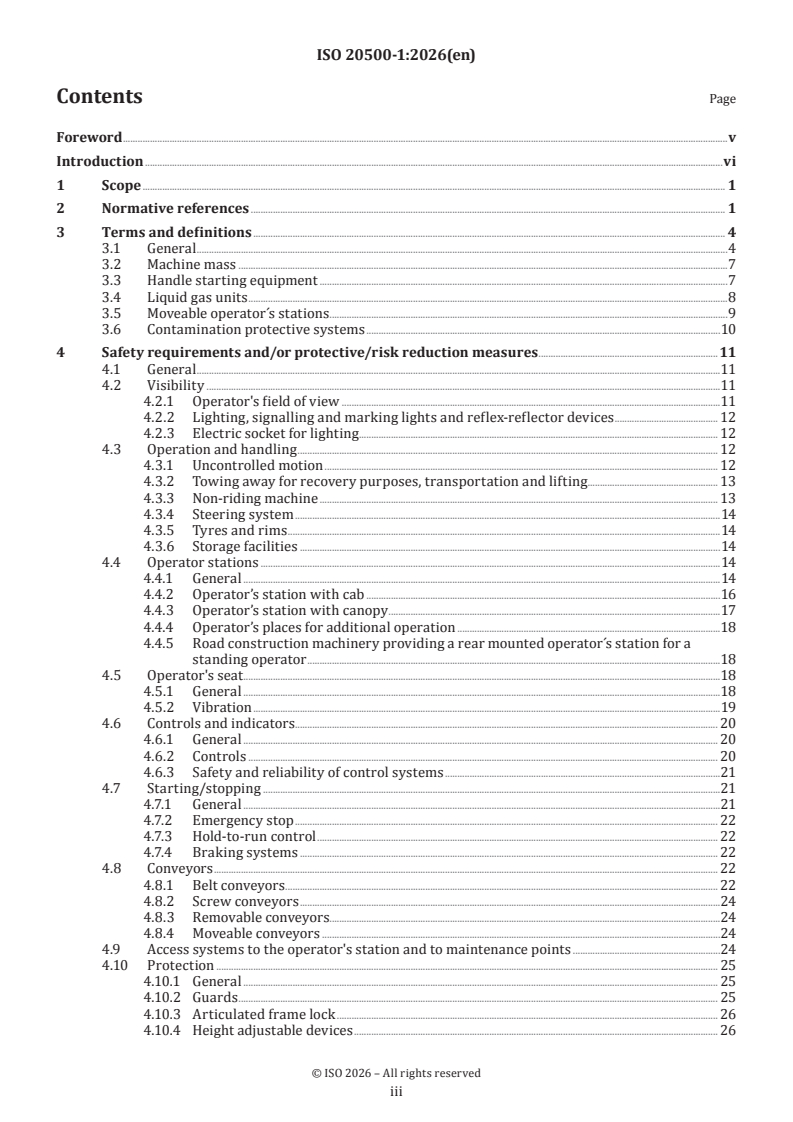
Contents Page
Foreword .v
Introduction .vi
1 Scope . 1
2 Normative references . 1
3 Terms and definitions . 4
3.1 General .4
3.2 Machine mass .7
3.3 Handle starting equipment .7
3.4 Liquid gas units .8
3.5 Moveable operator´s stations . .9
3.6 Contamination protective systems .10
4 Safety requirements and/or protective/risk reduction measures .11
4.1 General .11
4.2 Visibility .11
4.2.1 Operator's field of view .11
4.2.2 Lighting, signalling and marking lights and reflex-reflector devices . 12
4.2.3 Electric socket for lighting. 12
4.3 Operation and handling . 12
4.3.1 Uncontrolled motion . 12
4.3.2 Towing away for recovery purposes, transportation and lifting. 13
4.3.3 Non-riding machine . 13
4.3.4 Steering system .14
4.3.5 Tyres and rims .14
4.3.6 Storage facilities .14
4.4 Operator stations .14
4.4.1 General .14
4.4.2 Operator’s station with cab .16
4.4.3 Operator’s station with canopy .17
4.4.4 Operator’s places for additional operation .18
4.4.5 Road construction machinery providing a rear mounted operator´s station for a
standing operator .18
4.5 Operator's seat .18
4.5.1 General .18
4.5.2 Vibration .19
4.6 Controls and indicators. 20
4.6.1 General . 20
4.6.2 Controls . 20
4.6.3 Safety and reliability of control systems .21
4.7 Starting/stopping .21
4.7.1 General .21
4.7.2 Emergency stop . 22
4.7.3 Hold-to-run control . 22
4.7.4 Braking systems . 22
4.8 Conveyors . 22
4.8.1 Belt conveyors . 22
4.8.2 Screw conveyors .24
4.8.3 Removable conveyors.24
4.8.4 Moveable conveyors .24
4.9 Access systems to the operator's station and to maintenance points .24
4.10 Protection . 25
4.10.1 General . 25
4.10.2 Guards . 25
4.10.3 Articulated frame lock . 26
4.10.4 Height adjustable devices . 26
iii
4.11 Pressurized systems . 26
4.11.1 General . 26
4.11.2 Pipes, fittings and hoses . 26
4.12 Tanks (e.g. fuel, hydraulic and pressure vessels) .27
4.12.1 Filler openings .27
4.12.2 Fuel tanks .27
4.12.3 Hydraulic tanks .27
4.13 Fire protection .27
4.14 Hot surfaces.27
4.15 Signal devices and warning signs . 28
4.15.1 Audible warning device . 28
4.15.2 Safety signs . 28
4.16 Liquid gas units . 28
4.17 Electrical and electronic systems . 28
4.17.1 General . 28
4.17.2 Degree of protection . 28
4.17.3 Over-current protective devices . 29
4.17.4 Starter batteries . 29
4.17.5 Starter battery disconnection . 29
4.17.6 Electric connectors . 29
4.17.7 Electrically powered machines . 30
4.18 Electro-magnetic compatibility (EMC) . 30
4.19 Noise . 30
4.19.1 General . 30
4.19.2 Principles of noise reduction by design, at source and by protective devices . 30
4.20 Vibration .31
4.20.1 General .31
4.20.2 Principles for reduction of vibration at source by design .31
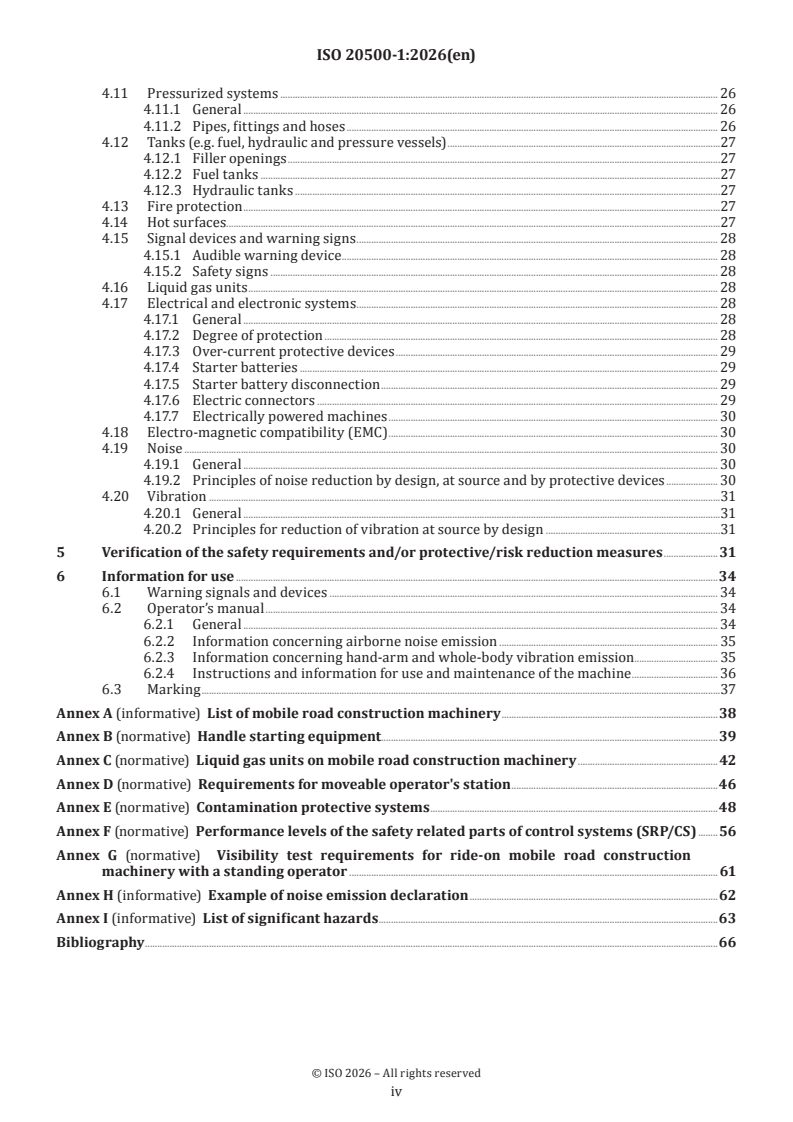
5 Verification of the safety requirements and/or protective/risk reduction measures .31
6 Information for use .34
6.1 Warning signals and devices . 34
6.2 Operator’s manual . 34
6.2.1 General . 34
6.2.2 Information concerning airborne noise emission . 35
6.2.3 Information concerning hand-arm and whole-body vibration emission . 35
6.2.4 Instructions and information for use and maintenance of the machine . 36
6.3 Marking .37
Annex A (informative) List of mobile road construction machinery .38
Annex B (normative) Handle starting equipment.39
Annex C (normative) Liquid gas units on mobile road construction machinery .42
Annex D (normative) Requirements for moveable operator's station .46
Annex E (normative) Contamination protective systems .48
Annex F (normative) Performance levels of the safety related parts of control systems (SRP/CS) .56
Annex G (normative) Visibility test requirements for ride-on mobile road construction
machinery with a standing operator . 61
Annex H (informative) Example of noise emission declaration .62
Annex I (informative) List of significant hazards .63
Bibliography .66
iv
Foreword
ISO (the International Organization for Standardization) is a worldwide federation of national standards
bodies (ISO member bodies). The work of preparing International Standards is normally carried out through
ISO technical committees. Each member body interested in a subject for which a technical committee
has been established has the right to be represented on that committee. International organizations,
governmental and non-governmental, in liaison with ISO, also take part in the work. ISO collaborates closely
with the International Electrotechnical Commission (IEC) on all matters of electrotechnical standardization.
The procedures used to develop this document and those intended for its further maintenance are described
in the ISO/IEC Directives, Part 1. In particular, the different approval criteria needed for the different types
of ISO document should be noted. This document was drafted in accordance with the editorial rules of the
ISO/IEC Directives, Part 2 (see www.iso.org/directives).
ISO draws attention to the possibility that the implementation of this document may involve the use of (a)
patent(s). ISO takes no position concerning the evidence, validity or applicability of any claimed patent
rights in respect thereof. As of the date of publication of this document, ISO had not received notice of (a)
patent(s) which may be required to implement this document. However, implementers are cautioned that
this may not represent the latest information, which may be obtained from the patent database available at
www.iso.org/patents. ISO shall not be held responsible for identifying any or all such patent rights.
Any trade name used in this document is information given for the convenience of users and does not
constitute an endorsement.
For an explanation of the voluntary nature of standards, the meaning of ISO specific terms and expressions
related to conformity assessment, as well as information about ISO's adherence to the World Trade
Organization (WTO) principles in the Technical Barriers to Trade (TBT), see www.iso.org/iso/foreword.html.
This document was prepared by Technical Committee ISO/TC 195, Building construction machinery and
equipment.
A list of all parts in the ISO 20500 series can be found on the ISO website.
Any feedback or questions on this document should be directed to the user’s national standards body. A
complete listing of these bodies can be found at www.iso.org/members.html.
v
Introduction
The structure of safety standards in the field of machinery is as follows.
a) Type-A standards (basis standards) give basic concepts, principles for design and general aspects that
can be applied to machinery.
b) Type-B standards (generic safety standards) dealing with one or more safety aspect(s) or one or more
type(s) of safeguards that can be used across a wide range of machinery:
— type-B1 standards on particular safety aspects (e.g. safety distances, surface temperature, noise);
— type-B2 standards on safeguards (e.g. two-hands controls, interlocking devices, pressure sensitive
devices, guards).
c) Type-C standards (machinery safety standards) dealing with detailed safety requirements for a
particular machine or group of machines.
This document is a type-C standard as stated in ISO 12100.
This document is of relevance, in particular, for the following stakeholder groups representing the market
players with regard to machinery safety:
— machine manufacturers (small, medium and large enterprises);
— health and safety bodies (regulators, accident prevention organisations, market surveillance, etc.).
Others can be affected by the level of machinery safety achieved with the means of the document by the
above-mentioned stakeholder groups:
— machine users/employers (small, medium and large enterprises);
— machine users/employees (small, medium and large enterprises);
— service providers, e.g. for maintenance (small, medium and large enterprises);
— consumers (in case of machinery intended for use by consumers).
The above-mentioned stakeholder groups have been given the possibility to participate at the drafting
process of this document.
The machinery concerned and the extent to which hazards, hazardous situations or hazardous events are
covered are indicated in the Scope of this document.
When requirements of this type-C standard are different from those which are stated in type-A or type-B
standards, the requirements of this type-C standard take precedence over the requirements of the other
standards for machines that have been designed and built according to the requirements of this type-C
standard.
vi
International Standard ISO 20500-1:2026(en)
Mobile road construction machinery — Safety —
Part 1:
Common requirements
1 Scope
This document specifies the common safety requirements for mobile road construction machinery. The
ISO 20500 series is applicable to mobile road construction machinery as listed in Annex A.
NOTE 1 For travelling on public roads, the national roading regulations apply (e.g. braking, steering, lighting).
This document deals with significant hazards, hazardous situations and events relevant to mobile road
construction machinery, when used as intended and under conditions foreseen, but also taking into account
any reasonably foreseeable misuse thereof (see Annex I).
NOTE 2 The requirements specified in this document are common to two or more families of mobile road
construction machinery.
This document gives the common safety requirements for mobile road construction machinery and
is intended to be used in conjunction with ISO 20500-2 to ISO 20500-7. These machine specific parts
(ISO 20500-2 to ISO 20500-7) do not repeat the requirements from this document but supplement or modify
the requirements for the family in question.
This document does not deal with hazards related to transport of dangerous goods by road.
Lightning as a significant and relevant hazard is not covered in this document.
This document specifies the appropriate technical measures to eliminate or reduce risks arising from the
significant hazards as specified in Annex I.
This document is not applicable to mobile road construction machinery manufactured before the date of its
publication.
As a general principle, dimensions are used according to ISO 3411:2007 in order to cover 5 to 95 percentile
of machine operators.
2 Normative references
The following documents are referred to in the text in such a way that some or all of their content constitutes
requirements of this document. For dated references, only the edition cited applies. For undated references,
the latest edition of the referenced document (including any amendments) applies.
EN 143:2021, Respiratory protective devices — Particle filters — Requirements, testing, marking
EN 12021:2014, Respiratory equipment — Compressed gases for breathing apparatus
ISO 2860:1992, Earth-moving machinery — Minimum access dimensions
ISO 2867:2011, Earth-moving machinery — Access systems
ISO 3411:2007, Earth-moving machinery — Physical dimensions of operators and minimum operator space
envelope
ISO 3450:2011, Earth-moving machinery — Wheeled or high-speed rubber-tracked machines — Performance
requirements and test procedures for brake systems
ISO 3457:2003, Earth-moving machinery — Guards — Definitions and requirements
ISO 3795:1989, Road vehicles, and tractors and machinery for agriculture and forestry — Determination of
burning behaviour of interior materials
ISO 3864-1:2011, Graphical symbols — Safety colours and safety signs — Part 1: Design principles for safety
signs and safety markings
ISO 3864-2:2016, Graphical symbols — Safety colours and safety signs — Part 2: Design principles for product
safety labels
ISO 3864-3:2024, Graphical symbols — Safety colours and safety signs — Part 3: Design principles for graphical
symbols for use in safety signs
ISO 3864-4:2011, Graphical symbols — Safety colours and safety signs — Part 4: Colorimetric and photometric
properties of safety sign materials
ISO 4413:2010, Hydraulic fluid power — General rules and safety requirements for systems and their components
ISO 4414:2010, Pneumatic fluid power — General rules and safety requirements for systems and their
components
ISO 4871:1996, Acoustics — Declaration and verification of noise emission values of machinery and equipment
ISO 5006:2017, Earth-moving machinery — Operator's field of view — Test method and performance criteria
ISO 5010:2019, Earth-moving machinery — Wheeled machines — Steering requirements
ISO 5353:1995, Earth-moving machinery, and tractors and machinery for agriculture and forestry — Seat index
point
ISO 5673-1:2005, Agricultural tractors and machinery — Power take-off drive shafts and power-input
connection — Part 1: General manufacturing and safety requirements
ISO 6405-1:2017, Earth-moving machinery — Symbols for operator controls and other displays — Part 1:
Common symbols
ISO 6405-1:2017/AMD 1:2022, Earth-moving machinery — Symbols for operator controls and other displays —
Part 1: Common symbols — Amendment 1: Additional symbols
ISO 6682:1986+AMD 1:1989, Earth-moving machinery — Zones of comfort and reach for controls
ISO 6750-1:2019, Earth-moving machinery — Operator's manual — Part 1: Contents and format
ISO 7010:2019, Graphical symbols — Safety colours and safety signs — Registered safety signs
ISO 7096:2020, Earth-moving machinery — Laboratory evaluation of operator seat vibration
ISO 7165:2017, Fire fighting — Portable fire extinguishers — Performance and construction
ISO 8643:2024, Earth-moving machinery — Hydraulic excavator and backhoe loader lowering control device —
Requirements and tests
ISO 9244:2008+AMD 1:2016, Earth-moving machinery — Machine safety labels — General principles
ISO 9533:2010, Earth-moving machinery — Machine-mounted audible travel alarms and forward horns — Test
methods and performance criteria
ISO 10263-4:2009, Earth-moving machinery — Operator enclosure environment — Part 4: Heating, ventilating
and air conditioning (HVAC) test method and performance
ISO 10264:1990, Earth-moving machinery — Key-locked starting systems
ISO 10265:2008, Earth-moving machinery — Crawler machines — Performance requirements and test
procedures for braking systems
ISO 10532:1995+AMD 1:2004, Earth-moving machinery — Machine-mounted retrieval device — Performance
requirements
ISO 10570:2004, Earth-moving machinery — Articulated frame lock — Performance requirements
ISO 10968:2020, Earth-moving machinery — Operator's controls
ISO 11112:1995+AMD 1:2001, Earth-moving machinery — Operator’s seat — Dimensions and requirements
ISO 11862:1993, Earth-moving machinery — Auxiliary starting aid electrical connector
ISO 12100:2010, Safety of machinery — General principles for design — Risk assessment and risk reduction
ISO 12508:1994, Earth-moving machinery — Operator station and maintenance areas — Bluntness of edges
ISO 12509:2023, Earth-moving machinery and rough-terrain trucks — Lighting, signalling and marking lights,
and reflex reflectors
ISO 13333:1994, Earth-moving machinery — Dumper body support and operator's cab tilt support devices
ISO 13732-1:2006, Ergonomics of the thermal environment — Methods for the assessment of human responses
to contact with surfaces — Part 1: Hot surfaces
ISO 13766-1:2018, Earth-moving and building construction machinery — Electromagnetic compatibility
(EMC) of machines with internal electrical power supply — Part 1: General EMC requirements under typical
electromagnetic environmental conditions
ISO 13766-2:2018, Earth-moving and building construction machinery — Electromagnetic compatibility (EMC)
of machines with internal electrical power supply — Part 2: Additional EMC requirements for functional safety
ISO 13849-1:2023, Safety of machinery — Safety-related parts of control systems — Part 1: General principles
for design
ISO 13850:2015, Safety of machinery — Emergency stop function — Principles for design
ISO 13856-1:2013, Safety of machinery — Pressure-sensitive protective devices — Part 1: General principles for
design and testing of pressure-sensitive mats and pressure-sensitive floors
ISO 13857:2019, Safety of machinery — Safety distances to prevent hazard zones being reached by upper and
lower limbs
ISO 14119:2024, Safety of machinery — Interlocking devices associated with guards — Principles for design and
selection
ISO 14120:2015, Safety of machinery — Guards — General requirements for the design and construction of fixed
and movable guards
ISO 14990-3:2016, Earth-moving machinery — Electrical safety of machines utilizing electric drives and related
components and systems — Part 3: Particular requirements for self-powered machines
ISO 15817:2012, Earth-moving machinery — Safety requirements for remote operator control systems
ISO 15818:2017, Earth-moving machinery — Lifting and tying-down attachment points — Performance
requirements
ISO 16001:2017, Earth-moving machinery — Object detection systems and visibility aids — Performance
requirements and tests
ISO 17063:2003, Earth-moving machinery — Braking systems of pedestrian-controlled machines — Performance
requirements and test procedures
ISO 29463-5:2022, High-efficiency filters and filter media for removing particles in air — Part 5: Test method
for filter elements
IEC 60204-1:2016+AMD1:2021, CSV, Safety of machinery — Electrical equipment of machines — Part 1: General
requirements
IEC 60364-4-41:2005+AMD1:2017, CSV, Low-voltage electrical installations — Part 4-41: Protection for
safety — Protection against electric shock
IEC 60364-5-55:2011+AMD1:2012, CSV, Electrical installations of buildings — Part 5-55: Selection and erection
of electrical equipment — Other equipment
IEC 60529:1989+AMD1:1999, CSV, Degrees of protection provided by enclosures (IP Code)
3 Terms and definitions
For the purposes of this document, the terms and definitions given in ISO 12100:2010 and the following
apply.
ISO and IEC maintain terminology databases for use in standardization at the following addresses:
— ISO Online browsing platform: available at https:// www .iso .org/ obp
— IEC Electropedia: available at https:// www .electropedia .org/
3.1 General
3.1.1
mobile road construction machinery
machine intended for either one of, or a combination of construction, maintenance and marking of roads or
other road like surfaces
Note 1 to entry: The machines are listed in Table A.1.
3.1.1.1
compact machine
mobile road construction machinery (3.1.1), except for vibratory plates and rammers, having an operating
mass (3.2.1) of 4 500 kg or less
Note 1 to entry: See ISO 20500-4 for vibratory plates and rammers.
3.1.1.2
direct-control machine
self-propelled mobile road construction machinery (3.1.1) where the machine is controlled by an operator in
physical contact with the machine
[SOURCE: ISO 6165:2022, 3.1.2, modified — The term "earth-moving machinery" has been replaced by
"mobile road construction machinery".]
3.1.1.3
ride-on machine
direct-control machine (3.1.1.2) where the control devices are located on the machine and the machine is
controlled by a seated or standing operator on the machine
[SOURCE: ISO 6165:2022, 3.1.2.1]
3.1.1.4
remote-control machine
self-propelled mobile road construction machinery (3.1.1) where the machine is controlled by the transmission
of signals from a control box (transmitter) that is not located on the machine to a receiving unit (receiver)
located on the machine
Note 1 to entry: The remote control can either be wireless or by wire.
[SOURCE: ISO 6165:2022, 3.1.3, modified — The term "earth-moving machinery" has been replaced by
"mobile road construction machinery".]
3.1.1.5
non-riding machine
direct-control machine (3.1.1.2) where the control devices are located on the machine and the machine is
controlled by a pedestrian operator (not carried on the machine) or a remote-control machine (3.1.1.4)
3.1.2
cab
enclosed structure mounted to mobile road construction machinery (3.1.1) surrounding the operator,
including glazing materials (e.g. glass, plastics) in the windows, doors and a windshield
Note 1 to entry: The cab can meet requirements for OPS (operator protective structures), for example, ROPS (roll-over
protective structure), FOPS (falling object protective structure).
3.1.3
canopy
overhead structure mounted to mobile road construction machinery (3.1.1) that covers in part or in whole the
operator station intended to protect the operator against weather conditions, e.g. rain or sun, UV radiation
for all positions of the operator’s station (3.1.7)
Note 1 to entry: The canopy can meet requirements for OPS (operator protective structures), for example, ROPS (roll-
over protective structure), FOPS (falling object protective structure).
3.1.4
equipment
set of components mounted onto the mobile road construction machine that allows an attachment (3.1.5) to
perform the primary design function of the machine
[SOURCE: ISO 6016:2008, 3.1.2, modified — Note 1 to entry has been removed.]
3.1.5
attachment
assembly of components that can be mounted onto the mobile road construction machine or equipment
(3.1.4) for specific use
Note 1 to entry: A tool is considered as an attachment.
[SOURCE: ISO 6016:2008, 3.1.4, modified — Note 1 to entry has been replaced by a new one.]
3.1.6
interchangeable equipment
attachment (3.1.5) used as an equipment (3.1.4) which, after the putting into service of a machine, is
assembled with the base machine by the operator in order to change its function or attribute a new function
Note 1 to entry: A tool is not considered as an interchangeable equipment.
Note 2 to entry: This definition is identical to the definition of "interchangeable equipment" as given in the European
Machinery Directive 2006/42/EC. For further reference, see CECE guideline "CECE guidance on the classification of
attachments to construction equipment for the machinery directive 2006/42/EC".
3.1.7
operator’s station
area on a ride-on machine (3.1.1.3) from which an operator controls the functions of the machine
3.1.8
operator’s place
area other than operator's station (3.1.7) as defined by the manufacturer from which an operator controls
the functions of the machine (e.g. work, travel functions, etc.)
3.1.9
nip point
point which occurs on the in-running side at the line of contact between the conveyor belt and rotating
pulley and in certain cases between the belt and an idler
3.1.10
nip guard
fixed guard inserted at a nip point (3.1.9) to directly safeguard that point by volume occupation
3.1.11
filament position center-point
FPCP
midpoint of the line between the light-bulb filaments
Note 1 to entry: See Figure 1.
Key
X distance of the FPCP to either side boundary of the standing platform
Y distance to the front side of the standing platform
1 standing platform
H height of the operator’s eyes above standing platform
FPCP filament position centre point
Figure 1 — Placement of the light source apparatus on the standing surface
[SOURCE: ISO 5006:2017, 3.2, modified — Note 1 to entry has been modified for standing operator.]
3.2 Machine mass
3.2.1
operating mass
OM
mass of the base machine, with equipment (3.1.4) and empty attachment (3.1.5) in the most usual configuration
as specified by the manufacturer, and with the operator (75 kg), full fuel tank and all fluid systems (i.e.
hydraulic oil, transmission oil, engine oil, engine coolant) at the levels specified by the manufacturer and,
when applicable, with half full material compartment (for example water, emulsion, powder binder)
Note 1 to entry: The mass of the operator is not included for non-riding machines (3.1.1.5).
Note 2 to entry: Ballast mass at delivery can be included if specified by the manufacturer.
[SOURCE: ISO 6016:2008, 3.2.1, modified — At the end of the definition, "sprinkler water tank(s) half full"
has been replaced by "with half full material compartment (for example water, emulsion, powder binder)".]
3.2.2
gross machinery mass
GMM
maximum machine mass as approved by the manufacturer, which combines the operating mass (OM) (3.2.1)
of the machine with the heaviest combination of equipment (3.1.4) and attachments (3.1.5), the heaviest
combination of optional equipment, as specified by the manufacturer, the ballast mass and, when applicable,
full material compartment (for example water, emulsion, powder binder)
[SOURCE: ISO 6016:2008, 3.2.4, modified — Mentioning of "the rated payload (PL)" has been removed; "rated
ballast mass (BM)" has been replaced by "ballast mass"; "full sprinkler water tank(s)" has been replaced by
"full material compartment (for example water, emulsion, powder binder)".]
3.3 Handle starting equipment
3.3.1
handle starting equipment
equipment (3.1.4) for starting an internal combustion engine by the use of a handle, such that the required
torque for starting can be exercised upon the starting shaft by the operator
3.3.2
automatic disengagement device
device which automatically breaks the connection between the starting handle and the engine in the event
of kick-back (3.3.5), thus preventing the handle from being turned by the engine
3.3.3
guide
part of the handle starting equipment (3.3.1) which guides the starting handle during starting but prevents
its being thrown out accidentally after disengagement
3.3.4
kick-back limiter
part of the handle starting equipment (3.3.1) which, when used in accordance with the instructions and when
maintained correctly, prevents or limits the kick-back (3.3.5) travel to such an extent as to avoid the risk of
injury
3.3.5
kick-back
sudden change of direction of rotation of the starting handle, caused by compression or combustion pressure
when starting
3.3.6
disengagement travel
distance which the grip of the handle travels from the moment of change of direction up to the disengagement
of the handle from the starting shaft, measured at the centre of the grip
Note 1 to entry: See Figure B.1.
3.3.7
angle of disengagement
angle through which the shank of the starting handle turns from the moment of change of direction up to
the disengagement of the handle from the starting shaft
Note 1 to entry: See Figure 2.
Key
1 starting direction α disengagement angle (area of energy absorption)
A disengagement travel α angle of decrease in energy
B kick-back travel α kick-back angle
Figure 2 — Direction of rotation of crank when starting engine
3.3.8
kick-back travel
distance which the grip of the handle travels from the moment of change of direction until it comes to rest,
measured at the centre of the grip
3.3.9
kick-back angle
angle through which the shank of the starting handle turns from the moment of change of direction until it
comes to rest
3.4 Liquid gas units
3.4.1
liquid gas
flammable gas of propane, propene (propylene), butane, butene (butylene) and mixtures thereof
3.4.2
liquid gas unit
supply unit (3.4.2.1) or consumer unit (3.4.2.2) for liquid gas (3.4.1)
3.4.2.1
supply unit
equipment (3.1.4) consisting of all components, e.g. ga
...