

ISO 20500-6:2026
(Main)Mobile road construction machinery — Safety — Part 6: Specific requirements for mobile feeders
General Information
- Abstract
This document, together with ISO 20500-1:2026, deals with all significant hazards, hazardous situations and events relevant to mobile feeders when used as intended and under the conditions of misuse which are reasonably foreseeable by the manufacturer (see Annex C) associated with the whole lifetime of the machine as described in ISO 12100:2010, 5.4. The requirements of this document are complementary to the common requirements formulated in ISO 20500-1:2026. This document does not repeat the requirements of ISO 20500-1:2026 but supplements or modifies the requirements for mobile feeders. Lightning as a significant and relevant hazard is not covered in this document. This document is not applicable to mobile feeders manufactured before the date of its publication.
- Status
- Published
- Publication Date
- 08-Feb-2026
- Technical Committee
- ISO/TC 195 - Building construction machinery and equipment
- Drafting Committee
- ISO/TC 195/WG 9 - Safety of mobile road construction machinery
- Current Stage
- 6060 - International Standard published
- Start Date
- 09-Feb-2026
- Due Date
- 11-Sep-2022
- Completion Date
- 09-Feb-2026

Overview
ISO 20500-6:2026 establishes specific safety requirements for mobile feeders used in road construction, supplementing ISO 20500-1:2026. Mobile feeders are self-propelled machines designed to transfer paving materials from trucks or windrows to paver-finishers continuously, without physical contact between the feeder and paver. This international standard addresses all significant hazards associated with mobile feeders throughout their operational lifetime, as outlined in ISO 12100:2010, with the exception of lightning hazards. The document ensures enhanced operator safety, reduces occupational risks, and promotes best practices for manufacturers, employers, and maintenance providers in the road construction industry.
Key Topics
- Safety Requirements: Covers machine design, risk reduction measures, and protection systems to minimize mechanical, electrical, and operational hazards.
- Visibility: Specifies performance criteria and testing methods to ensure operators have adequate visibility, minimizing blind spots and improving site safety.
- Operator's Station: Provides guidelines on controls, ergonomic layout, and access, including measures to prevent unintended machine movements.
- Protective Devices: Details requirements for guards, deflectors, and safeguards to prevent injury from moving parts and conveyed materials.
- Noise and EMC: Establishes criteria for noise testing and electromagnetic compatibility to protect operator health and ensure compliant machine operation.
- Warning Systems: Requires the use of flashing lights and warning signs in areas where crushing or shearing hazards may occur due to moving components.
Applications
ISO 20500-6:2026 is relevant for:
- Manufacturers: Assists manufacturers of mobile road construction machinery in designing and building mobile feeders that comply with international safety standards.
- Construction Contractors: Helps companies select compliant mobile feeders, ensuring operator safety and operational efficiency on site.
- Health and Safety Authorities: Provides a reliable basis for regulatory oversight and risk assessment in road construction applications.
- Maintenance Providers: Specifies clear instructions for safe maintenance access and procedures, reducing the risk of accidents during machine servicing.
- Training and Operations: Informs operator manuals with critical safety information covering recommended staffing, cleaning procedures, handling hazardous materials, and prohibited uses (e.g., transporting gas bottles or dangerous goods in the hopper).
Related Standards
- ISO 20500-1:2026 - Mobile road construction machinery - Safety - Part 1: Common requirements
Provides the foundational safety requirements for all mobile road construction machinery and should be used in conjunction with ISO 20500-6. - ISO 12100:2010 - Safety of machinery - General principles for design - Risk assessment and risk reduction
Details the general principles for risk assessment and reduction, forming the basis for hazard identification in this standard. - ISO 3744:2025 - Acoustics - Determination of sound power levels of noise sources using sound pressure
Specifies engineering methods for measuring noise emission. - ISO 11201:2010 - Acoustics - Noise emitted by machinery and equipment - Determination of emission sound pressure levels
Outlines procedures for determining noise levels at operator stations, referenced in the noise test code of ISO 20500-6.
Keywords: mobile road construction machinery, mobile feeders safety, ISO 20500-6:2026, road construction equipment standards, machine operator safety, visibility requirements, noise standards, protective devices, compliance, risk reduction, international safety standard.
Get Certified
Connect with accredited certification bodies for this standard

Zavod za gradbeništvo Slovenije (ZAG) - Inšpekcija
ZAG inspection body for construction products, structures, and materials.
Sponsored listings
Frequently Asked Questions
ISO 20500-6:2026 is a standard published by the International Organization for Standardization (ISO). Its full title is "Mobile road construction machinery — Safety — Part 6: Specific requirements for mobile feeders". This standard covers: This document, together with ISO 20500-1:2026, deals with all significant hazards, hazardous situations and events relevant to mobile feeders when used as intended and under the conditions of misuse which are reasonably foreseeable by the manufacturer (see Annex C) associated with the whole lifetime of the machine as described in ISO 12100:2010, 5.4. The requirements of this document are complementary to the common requirements formulated in ISO 20500-1:2026. This document does not repeat the requirements of ISO 20500-1:2026 but supplements or modifies the requirements for mobile feeders. Lightning as a significant and relevant hazard is not covered in this document. This document is not applicable to mobile feeders manufactured before the date of its publication.
This document, together with ISO 20500-1:2026, deals with all significant hazards, hazardous situations and events relevant to mobile feeders when used as intended and under the conditions of misuse which are reasonably foreseeable by the manufacturer (see Annex C) associated with the whole lifetime of the machine as described in ISO 12100:2010, 5.4. The requirements of this document are complementary to the common requirements formulated in ISO 20500-1:2026. This document does not repeat the requirements of ISO 20500-1:2026 but supplements or modifies the requirements for mobile feeders. Lightning as a significant and relevant hazard is not covered in this document. This document is not applicable to mobile feeders manufactured before the date of its publication.
ISO 20500-6:2026 is classified under the following ICS (International Classification for Standards) categories: 93.080.10 - Road construction. The ICS classification helps identify the subject area and facilitates finding related standards.
ISO 20500-6:2026 is available in PDF format for immediate download after purchase. The document can be added to your cart and obtained through the secure checkout process. Digital delivery ensures instant access to the complete standard document.
Standards Content (Sample)
International
Standard
ISO 20500-6
First edition
Mobile road construction
2026-02
machinery — Safety —
Part 6:
Specific requirements for mobile
feeders
Machines mobiles pour la construction de routes — Sécurité —
Partie 6: Prescriptions spécifiques pour alimentateurs d'enrobé
Reference number
© ISO 2026
All rights reserved. Unless otherwise specified, or required in the context of its implementation, no part of this publication may
be reproduced or utilized otherwise in any form or by any means, electronic or mechanical, including photocopying, or posting on
the internet or an intranet, without prior written permission. Permission can be requested from either ISO at the address below
or ISO’s member body in the country of the requester.
ISO copyright office
CP 401 • Ch. de Blandonnet 8
CH-1214 Vernier, Geneva
Phone: +41 22 749 01 11
Email: copyright@iso.org
Website: www.iso.org
Published in Switzerland
ii
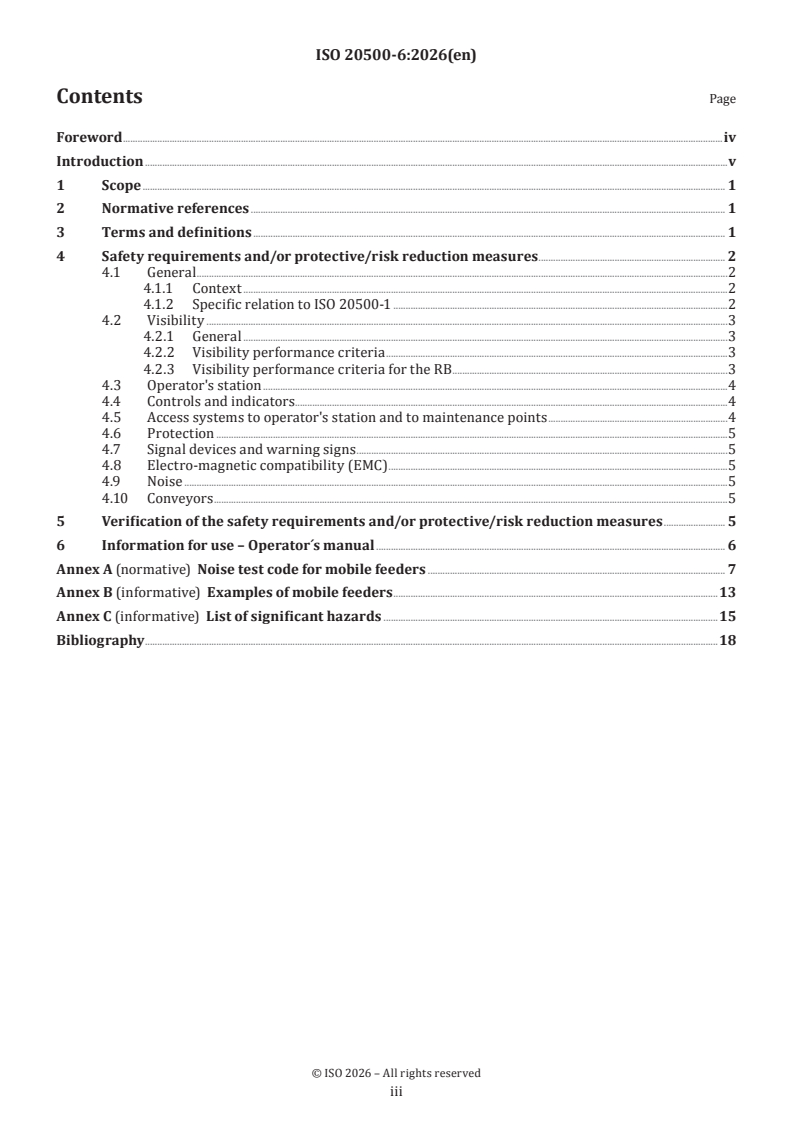
Contents Page
Foreword .iv
Introduction .v
1 Scope . 1
2 Normative references . 1
3 Terms and definitions . 1
4 Safety requirements and/or protective/risk reduction measures . 2
4.1 General .2
4.1.1 Context .2
4.1.2 Specific relation to ISO 20500-1 .2
4.2 Visibility .3
4.2.1 General .3
4.2.2 Visibility performance criteria .3
4.2.3 Visibility performance criteria for the RB .3
4.3 Operator's station .4
4.4 Controls and indicators.4
4.5 Access systems to operator's station and to maintenance points .4
4.6 Protection .5
4.7 Signal devices and warning signs .5
4.8 Electro-magnetic compatibility (EMC) .5
4.9 Noise .5
4.10 Conveyors .5
5 Verification of the safety requirements and/or protective/risk reduction measures . 5
6 Information for use – Operator´s manual . 6
Annex A (normative) Noise test code for mobile feeders . 7
Annex B (informative) Examples of mobile feeders .13
Annex C (informative) List of significant hazards .15
Bibliography .18
iii
Foreword
ISO (the International Organization for Standardization) is a worldwide federation of national standards
bodies (ISO member bodies). The work of preparing International Standards is normally carried out through
ISO technical committees. Each member body interested in a subject for which a technical committee
has been established has the right to be represented on that committee. International organizations,
governmental and non-governmental, in liaison with ISO, also take part in the work. ISO collaborates closely
with the International Electrotechnical Commission (IEC) on all matters of electrotechnical standardization.
The procedures used to develop this document and those intended for its further maintenance are described
in the ISO/IEC Directives, Part 1. In particular, the different approval criteria needed for the different types
of ISO document should be noted. This document was drafted in accordance with the editorial rules of the
ISO/IEC Directives, Part 2 (see www.iso.org/directives).
ISO draws attention to the possibility that the implementation of this document may involve the use of (a)
patent(s). ISO takes no position concerning the evidence, validity or applicability of any claimed patent
rights in respect thereof. As of the date of publication of this document, ISO had not received notice of (a)
patent(s) which may be required to implement this document. However, implementers are cautioned that
this may not represent the latest information, which may be obtained from the patent database available at
www.iso.org/patents. ISO shall not be held responsible for identifying any or all such patent rights.
Any trade name used in this document is information given for the convenience of users and does not
constitute an endorsement.
For an explanation of the voluntary nature of standards, the meaning of ISO specific terms and expressions
related to conformity assessment, as well as information about ISO's adherence to the World Trade
Organization (WTO) principles in the Technical Barriers to Trade (TBT), see www.iso.org/iso/foreword.html.
This document was prepared by Technical Committee ISO/TC 195, Building construction machinery and
equipment.
A list of all parts in the ISO 20500 series can be found on the ISO website.
Any feedback or questions on this document should be directed to the user’s national standards body. A
complete listing of these bodies can be found at www.iso.org/members.html.
iv
Introduction
This document is a type-C standard as stated in ISO 12100.
This document is of relevance, in particular, for the following stakeholder groups representing the market
players with regard to machinery safety:
— machine manufacturers (small, medium and large enterprises);
— health and safety bodies (regulators, accident prevention organisations, market surveillance, etc.).
Others can be affected by the level of machinery safety achieved with the means of the document by the
above-mentioned stakeholder groups:
— machine users/employers (small, medium and large enterprises);
— machine users/employees (e.g. trade unions, organisations for people with special needs);
— service providers, e.g. for maintenance (small, medium and large enterprises);
— consumers (in case of machinery intended for use by consumers).
The above-mentioned stakeholder groups have been given the possibility to participate at the drafting
process of this document.
The machinery concerned and the extent to which hazards, hazardous situations or hazardous events are
covered are indicated in the Scope of this document.
When requirements of this type-C standard are different from those which are stated in type-A or type-B
standards, the requirements of this type-C standard take precedence over the requirements of the other
standards for machines that have been designed and built according to the requirements of this type-C
standard.
Mobile feeders are typically self-propelled machines used in the continuous transfer of paving materials
from trucks to paver-finishers. Some mobile feeders are capable of feeding multiple paver-finishers.
v
International Standard ISO 20500-6:2026(en)
Mobile road construction machinery — Safety —
Part 6:
Specific requirements for mobile feeders
1 Scope
This document, together with ISO 20500-1:2026, deals with all significant hazards, hazardous situations
and events relevant to mobile feeders when used as intended and under the conditions of misuse which are
reasonably foreseeable by the manufacturer (see Annex C) associated with the whole lifetime of the machine
as described in ISO 12100:2010, 5.4.
The requirements of this document are complementary to the common requirements formulated in
ISO 20500-1:2026. This document does not repeat the requirements of ISO 20500-1:2026 but supplements or
modifies the requirements for mobile feeders.
Lightning as a significant and relevant hazard is not covered in this document.
This document is not applicable to mobile feeders manufactured before the date of its publication.
2 Normative references
The following documents are referred to in the text in such a way that some or all of their content constitutes
requirements of this document. For dated references, only the edition cited applies. For undated references,
the latest edition of the referenced document (including any amendments) applies.
ISO 3744:2025, Acoustics — Determination of sound power levels of noise sources using sound pressure —
Engineering methods for an essentially free field over a reflecting plane
ISO 11201:2010, Acoustics — Noise emitted by machinery and equipment — Determination of emission sound
pressure levels at a work station and at other specified positions in an essentially free field over a reflecting
plane with negligible environmental corrections
ISO 12100:2010, Safety of machinery — General principles for design — Risk assessment and risk reduction
ISO 20500-12026, Mobile road construction machinery — Safety — Part 1: Common requirements
3 Terms and definitions
For the purposes of this document, the terms and definitions given in ISO 12100:2010, ISO 20500-1:2026 and
the following apply.
ISO and IEC maintain terminology databases for use in standardization at the following addresses:
— ISO Online browsing platform: available at https:// www .iso .org/ obp
— IEC Electropedia: available at https:// www .electropedia .org/
3.1
mobile feeder
self-propelled machine intended to transfer paving material from a truck or a windrow to a paver-finisher
for continuous paving without physical contact of mobile feeder and paver
Note 1 to entry: Mobile feeders can be either rubber-tyred (see Figure B.2) or crawler-mounted (see Figure B.1).
3.2
windrow elevator
machine equipped with a windrow material reception (3.3) and a conveyor intended to transfer paving
material into the hopper of a paver-finisher or a hopper insert (3.7)
Note 1 to entry: It can be either self-propelled or rigidly fixed as an interchangeable equipment to a paver-finisher
equipped with a windrow material reception and a conveyor.
Note 2 to entry: An example can be found in Figure B.3
3.3
windrow material reception
device installed on a windrow elevator (3.2) or mobile feeder (3.1) intended to receive paving material laying
on the surface as a windrow and to guide it onto a conveyor
3.4
internal storage
device installed on a mobile feeder (3.1) intended to enlarge the storage capacity of the combination of mobile
feeder and paver-finisher
3.5
mixing unit
device installed on the lower side of a hopper insert (3.7) or at the beginning of the discharge conveyor (3.6)
of a mobile feeder (3.1) or windrow elevator (3.2) intended to break up and mix chunky portions of paving
material
3.6
discharge conveyor
device intended to transfer paving material from the mobile feeder (3.1) or windrow elevator (3.2) to the
paver-finisher
Note 1 to entry: This device can be rigid or slewing type.
3.7
hopper insert
device to increase hopper capacity
[SOURCE: ISO 15878:2021, 3.28]
4 Safety requirements and/or protective/risk reduction measures
4.1 General
4.1.1 Context
Mobile feeders shall conform to the safety requirements and/or protective/risk reduction measures of this
clause. In addition, the machines shall be designed according to the principles of ISO 12100:2010 for relevant
but not significant hazards which are not dealt with by this document.
4.1.2 Specific relation to ISO 20500-1
Mobile feeders shall conform to the requirements of ISO 20500-1:2026, as far as not modified or replaced by
the requirements of this document.
4.2 Visibility
4.2.1 General
ISO 20500-1:2026, 4.2 applies with the additions specified in 4.2.2 and 4.2.3.
4.2.2 Visibility performance criteria
The measurement results, when tested using the setup as shown in Figure 1, shall show no maskings or
maskings smaller than or equal to the performance criteria with direct or indirect view as specified in
Figure 1.
Sector A B C D E F RB
b b a
Eye spacing 205 mm 205 mm 205 mm 205 mm 205 mm 205 mm 405 mm
Number and 1 time 2 times 2 times 2 times 2 times 2 times 300 mm
width of
700 mm 1 300 mm 1 300 mm 1 300 mm 1 300 mm 1 300 mm
masking
Key
1 rectangular boundary (RB)
a
The area below the conveyor is not evaluated (dimension XX according to this figure).
b
If the maskings exceed the given value in Sector B or C, the requirement is also fulfilled, if only one masking remains
at a height of 1 000 mm above GRP (ground reference plane).
Y Y-axis and forward direction of machine
Figure 1 — Visibility performance criteria
4.2.3 Visibility performance criteria for the RB
The measurement results shall show no maskings or maskings smaller or equal to the acceptable maskings
(300 mm) when evaluated using the eye spacing specified in Table 1 for the RB and using the test object
height for each region as specified in Figure 2.
Table 1 — Vertical test object height by region of rectangular boundary
Region of the RB
Front side Left-hand side Right-hand side Rear side
1,5 m 1,5 m 1,5 m 1,5 m
(with gap XX
under the
conveyor, see
Figure 1)
a) side view
b) top view
Key
1 distance of 1 m (RB – rectangular boundary, 1 m from all four sides)
H height of pulley centre above ground
X width of the conveyor suspension + 2 × 150 mm
Figure 2 — Setup of the machines
The following additional information shall be recorded:
— dimension H;
— dimension X.
4.3 Operator's station
ISO 20500-1:2026, 4.4 applies with the following exception:
— in ISO 20500-1:2026, 4.4.2, the first sentence does not apply to mobile feeders.
4.4 Controls and indicators
ISO 20500-1:2026, 4.6 applies with the following addition:
— where a slewing conveyor is fitted, it shall not be activated simultaneously from more than one operator's
station;
— controls for slewing the conveyor shall be of hold-to-run type;
— the motion of slewing conveyor (if equipped) shall not be activated by unintended touch of the control
(for example by entanglement of clothing during getting up from the operator's seat).
4.5 Access systems to operator's station and to maintenance points
The requirements of ISO 20500-1:2026, 4.9 apply with the following exceptions:
ISO 20500-1:2026, 4.9 does not apply for access systems leading to service points in the area of the material
hopper.
4.6 Protection
In addition to the requirements of ISO 20500-1:2026, 4.10, the following applies:
— protective means (e.g. deflecting element on discharge conveyor or hopper insert equipped with guard)
shall be provided to prevent paver-finisher operators from being buried by conveyed paving material;
— protective means (e.g. tying down or positive engagement) shall be taken to prevent hopper insert from
falling out of the hopper.
4.7 Signal devices and warning signs
In addition to the requirements of ISO 20500-1:2026, 4.15, the following applies:
Discharge conveyors slewing transverse to working movement, which can form crushing or shearing zones
during their slewing movement shall be fitted with yellow flashing lights. Those flashing lights shall be
located on lateral sides in proximity to the pulleys and shall be activated automatically when the conveyor
is slewing.
4.8 Electro-magnetic compatibility (EMC)
In addition to the requirements of ISO 20500-1:2026, 4.18, the following applies:
The antenna shall be located successively on the left- and right-hand sides of the mobile feeder, with the
antenna parallel to the plane of the longitudinal symmetry of the mobile feeder and in line with the SIP (seat
index point).
4.9 Noise
ISO 20500-1:2026, 4.19 applies with the following addition:
The noise test shall be carried out as specified in Annex A.
4.10 Conveyors
ISO 20500-1:2026, 4.8 applies with the following exemption:
ISO 20500-1:2026, 4.8, does not apply to rigidly installed material conveyors placed inside the hopper.
5 Verification of the safety requirements and/or protective/risk reduction measures
Safety requirements and/or protective/risk reduction measures of Clauses 4 and 6 shall be verified
according to Table 2.
Table 2 sets out verification methods which shall be applied for each safety requirement in this document.
Where X(s) is indicated in the table, the corresponding verification method(s) shall be applied.
Table 2 shall be read in conjunction with the corresponding clauses/subclauses.
Table 2 applies in addition to ISO 20500-1:2026, Table 2.
Table 2 includes the following verification methods:
a) calculation: to establish that the requirements of this document have been met;
b) visual verification: to establish that something is present (e.g. a guard, a marking, a document);
c) measurement: to show that the required numerical values have been met (e.g. geometric dimensions,
safety distances, resistance of insulation of the electric circuits, results of physical tests);
d) functional tests: to show that the adequate signals intended to be forwarded to the main control
system of the complete machine are available and conform to the requirements and the technical
documentation;
e) special verification: by reference to a standard which is mentioned in the corresponding clause/
subclause.
Table 2 — Verification of safety requirements and/or protective/risk reduction measures
Clause/ Title a) b) c) d) e)
subclause Cal- Visual Meas- Func- Special
number cula- veri- ure- tion- verifi-
tion fica- ment al cation
tion test
4 Safety requirements and/or protective/risk reduction measures
4.1 General
4.1.1 Context X
4.1.2 Specific relation to ISO 20500-1 X
4.2 Visibility
4.2.1 General X
4.2.2 Visibility performance criteria X X
4.2.3 Visibility performance criteria for the RB X X
4.3 Operator's station X
4.4 Controls an
...