

ISO/IEC 14496-27:2009
(Main)Information technology — Coding of audio-visual objects — Part 27: 3D Graphics conformance
General Information
- Abstract
ISO/IEC 14496-27:2009 specifies how tests can be designed to verify whether compressed data (i.e. bitstreams) and decoders meet the requirements for the synthetic 3D graphics tools specified in ISO/IEC 14496‑11:2005, ISO/IEC 14496‑16:2006, ISO/IEC 14496‑21:2006, and ISO/IEC 14496‑25:2009. ISO/IEC 14496-27:2009 does not specifically address encoders. As far as synthetic 3D graphics are concerned, an encoder can be said to be an ISO/IEC 14496 encoder if it generates compressed data compliant with the syntactic and semantic bitstream payload requirements specified in ISO/IEC 14496‑11, ISO/IEC 14496‑16, ISO/IEC 14496‑21, and ISO/IEC 14496‑25. Characteristics of coded bitstreams and decoders are defined for ISO/IEC 14496‑11, ISO/IEC 14496‑16, ISO/IEC 14496‑21, and ISO/IEC 14496‑25. The characteristics of a bitstream define the subset of the standard that is exploited in the bitstream. Examples are the applied values or range of the bitrate. Decoder characteristics define the properties and capabilities of the applied decoding process. An example of a property is the applied arithmetic accuracy. The capabilities of a decoder specify which coded bitstreams the decoder can decode and reconstruct, by defining the subset of the standard that may be exploited in decodable bitstreams. A bitstream can be decoded by a decoder if the characteristics of the coded bitstream are within the subset of the normative references. ISO/IEC 14496-27:2009 describes procedures for testing conformance of compressed data and decoders to the requirements defined in ISO/IEC 14496‑11, ISO/IEC 14496‑16, ISO/IEC 14496‑21, and ISO/IEC 14496‑25; given the set of characteristics claimed, the requirements that shall be met are fully determined by these parts. ISO/IEC 14496-27:2009 summarizes the requirements, cross references them to characteristics, and defines how conformance with them can be tested. Guidelines are given on constructing tests to verify decoder conformance.
- Status
- Published
- Publication Date
- 09-Dec-2009
- Current Stage
- 9020 - International Standard under periodical review
- Start Date
- 15-Jul-2026
- Completion Date
- 15-Jul-2026
Buy Documents



ISO/IEC 14496-27:2009 - Information technology — Coding of audio-visual objects — Part 27: 3D Graphics conformance Released:12/10/2009




ISO/IEC 14496-27:2009 - Information technology — Coding of audio-visual objects — Part 27: 3D Graphics conformance Released:12/10/2009
Overview
ISO/IEC 14496-27:2009 - 3D Graphics conformance is a part of the MPEG‑4 family that defines how to design tests to verify whether compressed 3D graphics bitstreams and decoders conform to the synthetic 3D graphics tools defined in related MPEG‑4 parts. The standard focuses on bitstream conformance and decoder/terminal conformance for scene description, animation, graphics framework extensions and 3D compression - it does not specify encoder design. ISO/IEC 14496-27:2009 summarizes normative requirements, maps them to measurable characteristics, and gives guidelines for creating conformance test suites.
Key topics and requirements
- Scope of testing: Procedures for testing compressed data (bitstreams) and decoders against the requirements in ISO/IEC 14496‑11, ‑16, ‑21 and ‑25.
- Bitstream characteristics: Defines the subset of the normative specifications exploited by a bitstream (e.g., applied bitrate ranges); conformance tests validate syntactic and semantic payload requirements.
- Decoder characteristics: Defines properties (for example, arithmetic accuracy) and capabilities (which bitstream subsets a decoder can decode). A decoder passes if it decodes bitstreams whose characteristics lie within its declared capability subset.
- Conformance procedures: Methods for syntax checking (pass/fail for bitstream syntax), terminal conformance test suites, measurement procedures and tolerances where applicable.
- Covered toolsets:
- BIFS (Scene description and application engine) and AFX (Animation Framework eXtension) - scene graph node testing, rendering and terminal checks.
- MPEG‑J Graphics Framework eXtensions (GFX) - MPEG‑J conformance points and terminal behavior.
- 3D Graphics Compression Model - conformance points for compressed geometry, appearance and multiresolution compression.
- Test construction guidance: Cross-references requirements to characteristics and outlines how to build test suites and reference bitstreams to validate implementations.
Applications
- Ensuring interoperability of MPEG‑4 3D content across players, devices and authoring tools.
- Certifying decoder implementations (software/hardware) for compliance with MPEG‑4 3D graphics profiles and levels.
- Producing conformance test suites and reference bitstreams for test labs and QA teams.
- Supporting content providers and device manufacturers who need to guarantee playback correctness and predictable rendering of synthetic 3D scenes.
Who should use this standard
- Codec and decoder developers
- Test laboratories and conformance certification bodies
- Device manufacturers (media players, set‑top boxes, embedded devices)
- Tool and content creators working with MPEG‑4 3D graphics
Related standards
- ISO/IEC 14496‑11:2005 (Scene description and application engine - BIFS)
- ISO/IEC 14496‑16:2006 (Animation Framework eXtension - AFX)
- ISO/IEC 14496‑21:2006 (MPEG‑J GFX)
- ISO/IEC 14496‑25:2009 (3D Graphics Compression Model)
- ISO/IEC 14496 (MPEG‑4 family) and referenced documents such as ISO/IEC 14772‑1 and ISO/IEC 15444‑1
Keywords: ISO/IEC 14496-27:2009, 3D Graphics conformance, MPEG‑4, bitstream conformance, decoder conformance, BIFS, AFX, 3D compression, conformance testing.
Relations
- Effective Date
- 18-Dec-2021
- Effective Date
- 11-Dec-2021
- Effective Date
- 21-Aug-2021
- Effective Date
- 31-Jul-2021
- Effective Date
- 17-Jul-2021
- Effective Date
- 16-Apr-2011
- Effective Date
- 16-Apr-2011
- Effective Date
- 16-Apr-2011
- Effective Date
- 16-Apr-2011
- Effective Date
- 16-Apr-2011
Buy Documents
ISO/IEC 14496-27:2009 - Information technology — Coding of audio-visual objects — Part 27: 3D Graphics conformance Released:12/10/2009
ISO/IEC 14496-27:2009 - Information technology — Coding of audio-visual objects — Part 27: 3D Graphics conformance Released:12/10/2009
Get Certified
Connect with accredited certification bodies for this standard

BSI Group
BSI (British Standards Institution) is the business standards company that helps organizations make excellence a habit.

NYCE
Mexican standards and certification body.
Sponsored listings
Frequently Asked Questions
ISO/IEC 14496-27:2009 is a standard published by the International Organization for Standardization (ISO). Its full title is "Information technology — Coding of audio-visual objects — Part 27: 3D Graphics conformance". This standard covers: ISO/IEC 14496-27:2009 specifies how tests can be designed to verify whether compressed data (i.e. bitstreams) and decoders meet the requirements for the synthetic 3D graphics tools specified in ISO/IEC 14496‑11:2005, ISO/IEC 14496‑16:2006, ISO/IEC 14496‑21:2006, and ISO/IEC 14496‑25:2009. ISO/IEC 14496-27:2009 does not specifically address encoders. As far as synthetic 3D graphics are concerned, an encoder can be said to be an ISO/IEC 14496 encoder if it generates compressed data compliant with the syntactic and semantic bitstream payload requirements specified in ISO/IEC 14496‑11, ISO/IEC 14496‑16, ISO/IEC 14496‑21, and ISO/IEC 14496‑25. Characteristics of coded bitstreams and decoders are defined for ISO/IEC 14496‑11, ISO/IEC 14496‑16, ISO/IEC 14496‑21, and ISO/IEC 14496‑25. The characteristics of a bitstream define the subset of the standard that is exploited in the bitstream. Examples are the applied values or range of the bitrate. Decoder characteristics define the properties and capabilities of the applied decoding process. An example of a property is the applied arithmetic accuracy. The capabilities of a decoder specify which coded bitstreams the decoder can decode and reconstruct, by defining the subset of the standard that may be exploited in decodable bitstreams. A bitstream can be decoded by a decoder if the characteristics of the coded bitstream are within the subset of the normative references. ISO/IEC 14496-27:2009 describes procedures for testing conformance of compressed data and decoders to the requirements defined in ISO/IEC 14496‑11, ISO/IEC 14496‑16, ISO/IEC 14496‑21, and ISO/IEC 14496‑25; given the set of characteristics claimed, the requirements that shall be met are fully determined by these parts. ISO/IEC 14496-27:2009 summarizes the requirements, cross references them to characteristics, and defines how conformance with them can be tested. Guidelines are given on constructing tests to verify decoder conformance.
ISO/IEC 14496-27:2009 specifies how tests can be designed to verify whether compressed data (i.e. bitstreams) and decoders meet the requirements for the synthetic 3D graphics tools specified in ISO/IEC 14496‑11:2005, ISO/IEC 14496‑16:2006, ISO/IEC 14496‑21:2006, and ISO/IEC 14496‑25:2009. ISO/IEC 14496-27:2009 does not specifically address encoders. As far as synthetic 3D graphics are concerned, an encoder can be said to be an ISO/IEC 14496 encoder if it generates compressed data compliant with the syntactic and semantic bitstream payload requirements specified in ISO/IEC 14496‑11, ISO/IEC 14496‑16, ISO/IEC 14496‑21, and ISO/IEC 14496‑25. Characteristics of coded bitstreams and decoders are defined for ISO/IEC 14496‑11, ISO/IEC 14496‑16, ISO/IEC 14496‑21, and ISO/IEC 14496‑25. The characteristics of a bitstream define the subset of the standard that is exploited in the bitstream. Examples are the applied values or range of the bitrate. Decoder characteristics define the properties and capabilities of the applied decoding process. An example of a property is the applied arithmetic accuracy. The capabilities of a decoder specify which coded bitstreams the decoder can decode and reconstruct, by defining the subset of the standard that may be exploited in decodable bitstreams. A bitstream can be decoded by a decoder if the characteristics of the coded bitstream are within the subset of the normative references. ISO/IEC 14496-27:2009 describes procedures for testing conformance of compressed data and decoders to the requirements defined in ISO/IEC 14496‑11, ISO/IEC 14496‑16, ISO/IEC 14496‑21, and ISO/IEC 14496‑25; given the set of characteristics claimed, the requirements that shall be met are fully determined by these parts. ISO/IEC 14496-27:2009 summarizes the requirements, cross references them to characteristics, and defines how conformance with them can be tested. Guidelines are given on constructing tests to verify decoder conformance.
ISO/IEC 14496-27:2009 is classified under the following ICS (International Classification for Standards) categories: 35.040 - Information coding; 35.040.40 - Coding of audio, video, multimedia and hypermedia information. The ICS classification helps identify the subject area and facilitates finding related standards.
ISO/IEC 14496-27:2009 has the following relationships with other standards: It is inter standard links to ISO/IEC 14496-27:2009/Amd 2:2011, ISO/IEC 14496-27:2009/Amd 6:2015, ISO/IEC 14496-27:2009/Amd 4:2012, ISO/IEC 14496-27:2009/Amd 3:2011, ISO/IEC 14496-27:2009/Amd 5:2015, ISO/IEC 14496-4:2004/Amd 12:2007, ISO/IEC 14496-4:2004/Amd 16:2008, ISO/IEC 14496-4:2004/Amd 7:2005, ISO/IEC 14496-4:2004/Amd 21:2008, ISO/IEC 14496-4:2004/Amd 32:2009. Understanding these relationships helps ensure you are using the most current and applicable version of the standard.
ISO/IEC 14496-27:2009 is available in PDF format for immediate download after purchase. The document can be added to your cart and obtained through the secure checkout process. Digital delivery ensures instant access to the complete standard document.
Standards Content (Sample)
INTERNATIONAL ISO/IEC
STANDARD 14496-27
First edition
2009-12-15
Information technology — Coding of
audio-visual objects —
Part 27:
3D Graphics conformance
Technologies de l'information — Codage des objets audiovisuels —
Partie 27: Conformité aux graphiques 3D
Reference number
©
ISO/IEC 2009
PDF disclaimer
This PDF file may contain embedded typefaces. In accordance with Adobe's licensing policy, this file may be printed or viewed but
shall not be edited unless the typefaces which are embedded are licensed to and installed on the computer performing the editing. In
downloading this file, parties accept therein the responsibility of not infringing Adobe's licensing policy. The ISO Central Secretariat
accepts no liability in this area.
Adobe is a trademark of Adobe Systems Incorporated.
Details of the software products used to create this PDF file can be found in the General Info relative to the file; the PDF-creation
parameters were optimized for printing. Every care has been taken to ensure that the file is suitable for use by ISO member bodies. In
the unlikely event that a problem relating to it is found, please inform the Central Secretariat at the address given below.
© ISO/IEC 2009
All rights reserved. Unless otherwise specified, no part of this publication may be reproduced or utilized in any form or by any means,
electronic or mechanical, including photocopying and microfilm, without permission in writing from either ISO at the address below or
ISO's member body in the country of the requester.
ISO copyright office
Case postale 56 • CH-1211 Geneva 20
Tel. + 41 22 749 01 11
Fax + 41 22 749 09 47
E-mail copyright@iso.org
Web www.iso.org
Published in Switzerland
ii © ISO/IEC 2009 – All rights reserved
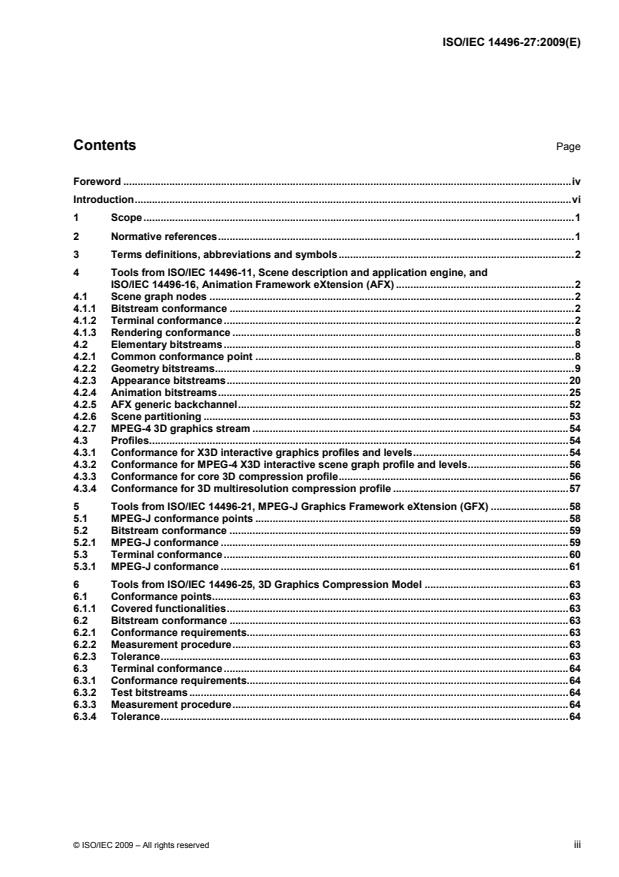
Contents Page
Foreword .iv
Introduction.vi
1 Scope.1
2 Normative references.1
3 Terms definitions, abbreviations and symbols.2
4 Tools from ISO/IEC 14496-11, Scene description and application engine, and
ISO/IEC 14496-16, Animation Framework eXtension (AFX) .2
4.1 Scene graph nodes .2
4.1.1 Bitstream conformance .2
4.1.2 Terminal conformance.2
4.1.3 Rendering conformance .8
4.2 Elementary bitstreams.8
4.2.1 Common conformance point .8
4.2.2 Geometry bitstreams.9
4.2.3 Appearance bitstreams.20
4.2.4 Animation bitstreams.25
4.2.5 AFX generic backchannel.52
4.2.6 Scene partitioning .53
4.2.7 MPEG-4 3D graphics stream .54
4.3 Profiles.54
4.3.1 Conformance for X3D interactive graphics profiles and levels.54
4.3.2 Conformance for MPEG-4 X3D interactive scene graph profile and levels.56
4.3.3 Conformance for core 3D compression profile.56
4.3.4 Conformance for 3D multiresolution compression profile .57
5 Tools from ISO/IEC 14496-21, MPEG-J Graphics Framework eXtension (GFX) .58
5.1 MPEG-J conformance points .58
5.2 Bitstream conformance .59
5.2.1 MPEG-J conformance .59
5.3 Terminal conformance.60
5.3.1 MPEG-J conformance .61
6 Tools from ISO/IEC 14496-25, 3D Graphics Compression Model .63
6.1 Conformance points.63
6.1.1 Covered functionalities.63
6.2 Bitstream conformance .63
6.2.1 Conformance requirements.63
6.2.2 Measurement procedure.63
6.2.3 Tolerance.63
6.3 Terminal conformance.64
6.3.1 Conformance requirements.64
6.3.2 Test bitstreams .64
6.3.3 Measurement procedure.64
6.3.4 Tolerance.64
© ISO/IEC 2009 – All rights reserved iii
Foreword
ISO (the International Organization for Standardization) and IEC (the International Electrotechnical
Commission) form the specialized system for worldwide standardization. National bodies that are members of
ISO or IEC participate in the development of International Standards through technical committees
established by the respective organization to deal with particular fields of technical activity. ISO and IEC
technical committees collaborate in fields of mutual interest. Other international organizations, governmental
and non-governmental, in liaison with ISO and IEC, also take part in the work. In the field of information
technology, ISO and IEC have established a joint technical committee, ISO/IEC JTC 1.
International Standards are drafted in accordance with the rules given in the ISO/IEC Directives, Part 2.
The main task of the joint technical committee is to prepare International Standards. Draft International
Standards adopted by the joint technical committee are circulated to national bodies for voting. Publication as
an International Standard requires approval by at least 75 % of the national bodies casting a vote.
Attention is drawn to the possibility that some of the elements of this document may be the subject of patent
rights. ISO and IEC shall not be held responsible for identifying any or all such patent rights.
ISO/IEC 14496-27 was prepared by Joint Technical Committee ISO/IEC JTC 1, Information technology,
Subcommittee SC 29, Coding of audio, picture, multimedia and hypermedia information.
ISO/IEC 14496 consists of the following parts, under the general title Information technology — Coding of
audio-visual objects:
⎯ Part 1: Systems
⎯ Part 2: Visual
⎯ Part 3: Audio
⎯ Part 4: Conformance testing
⎯ Part 5: Reference software
⎯ Part 6: Delivery Multimedia Integration Framework (DMIF)
⎯ Part 7: Optimized reference software for coding of audio-visual objects
⎯ Part 8: Carriage of ISO/IEC 14496 contents over IP networks
⎯ Part 9: Reference hardware description
⎯ Part 10: Advanced Video Coding
⎯ Part 11: Scene description and application engine
⎯ Part 12: ISO base media file format
⎯ Part 13: Intellectual Property Management and Protection (IPMP) extensions
⎯ Part 14: MP4 file format
iv © ISO/IEC 2009 – All rights reserved
⎯ Part 15: Advanced Video Coding (AVC) file format
⎯ Part 16: Animation Framework eXtension (AFX)
⎯ Part 17: Streaming text format
⎯ Part 18: Font compression and streaming
⎯ Part 19: Synthesized texture stream
⎯ Part 20: Lightweight Application Scene Representation (LASeR) and Simple Aggregation Format (SAF)
⎯ Part 21: MPEG-J Graphics Framework eXtensions (GFX)
⎯ Part 22: Open Font Format
⎯ Part 23: Symbolic Music Representation
⎯ Part 24: Audio and systems interaction
⎯ Part 25: 3D Graphics Compression Model
⎯ Part 27: 3D Graphics conformance
The following part is under preparation:
⎯ Part 26: Audio conformance
© ISO/IEC 2009 – All rights reserved v
Introduction
This part of ISO/IEC 14496 (MPEG-4) contains the description of all conformance bitstreams developed for
the synthetic 3D graphics tools published in the following four other parts of MPEG-4: ISO/IEC 14496-11:2005,
ISO/IEC 14496-16:2006, ISO/IEC 14496-21:2006 and ISO/IEC 14496-25:2009. This part of ISO/IEC 14496
also describes how tests can be designed to verify whether compressed data (i.e. bitstreams) and decoders
meet the requirements specified for synthetic 3D graphics tools by those four International Standards.
vi © ISO/IEC 2009 – All rights reserved
INTERNATIONAL STANDARD ISO/IEC 14496-27:2009(E)
Information technology — Coding of audio-visual objects —
Part 27:
3D Graphics conformance
1 Scope
This part of ISO/IEC 14496 specifies how tests can be designed to verify whether compressed data
(i.e. bitstreams) and decoders meet the requirements for the synthetic 3D graphics tools specified in
ISO/IEC 14496-11:2005, ISO/IEC 14496-16:2006, ISO/IEC 14496-21:2006, and ISO/IEC 14496-25:2009.
This part of ISO/IEC 14496 does not specifically address encoders. As far as synthetic 3D graphics are
concerned, an encoder can be said to be an ISO/IEC 14496 encoder if it generates compressed data
compliant with the syntactic and semantic bitstream payload requirements specified in ISO/IEC 14496-11,
ISO/IEC 14496-16, ISO/IEC 14496-21, and ISO/IEC 14496-25.
Characteristics of coded bitstreams and decoders are defined for ISO/IEC 14496-11, ISO/IEC 14496-16,
ISO/IEC 14496-21, and ISO/IEC 14496-25. The characteristics of a bitstream define the subset of the
standard that is exploited in the bitstream. Examples are the applied values or range of the bitrate. Decoder
characteristics define the properties and capabilities of the applied decoding process. An example of a
property is the applied arithmetic accuracy. The capabilities of a decoder specify which coded bitstreams the
decoder can decode and reconstruct, by defining the subset of the standard that may be exploited in
decodable bitstreams. A bitstream can be decoded by a decoder if the characteristics of the coded bitstream
are within the subset of the normative references.
This part of ISO/IEC 14496 describes procedures for testing conformance of compressed data and decoders
to the requirements defined in ISO/IEC 14496-11, ISO/IEC 14496-16, ISO/IEC 14496-21, and
ISO/IEC 14496-25; given the set of characteristics claimed, the requirements that shall be met are fully
determined by these parts.
This part of ISO/IEC 14496 summarizes the requirements, cross references them to characteristics, and
defines how conformance with them can be tested. Guidelines are given on constructing tests to verify
decoder conformance.
2 Normative references
The following referenced documents are indispensable for the application of this document. For dated
references, only the edition cited applies. For undated references, the latest edition of the referenced
document (including any amendments) applies.
ISO/IEC 14772-1:1997, Information technology — Computer graphics and image processing — The Virtual
Reality Modeling Language — Part 1: Functional specification and UTF-8 encoding
ISO/IEC 14496-1:2004, Information technology — Coding of audio-visual objects — Part 1: Systems
ISO/IEC 14496-5:2001, Information technology — Coding of audio-visual objects — Part 5: Reference
software
ISO/IEC 14496-11:2005, Information technology — Coding of audio-visual objects — Part 11: Scene
description and application engine
© ISO/IEC 2009 – All rights reserved 1
ISO/IEC 14496-16:2006, Information technology — Coding of audio-visual objects — Part 16: Animation
Framework eXtension (AFX)
ISO/IEC 14496-21:2006, Information technology — Coding of audio-visual objects — Part 21: MPEG-J
Graphics Framework eXtensions (GFX)
ISO/IEC 14496-25:2009, Information technology — Coding of audio-visual objects — Part 25: 3D Graphics
Compression Model
ISO/IEC 15444-1:2004, Information technology — JPEG 2000 image coding system: Core coding system
3 Terms definitions, abbreviations and symbols
For the purposes of this document, the terms, definitions, abbreviated terms and symbols given in
ISO/IEC 14496-1, ISO/IEC 14496-5, ISO/IEC 14496-11, ISO/IEC 14496-16, ISO/IEC 14496-21,
ISO/IEC 14496-25, ISO/IEC 14772-1 and ISO/IEC 15444-1 apply.
4 Tools from ISO/IEC 14496-11, Scene description and application engine, and
ISO/IEC 14496-16, Animation Framework eXtension (AFX)
4.1 Scene graph nodes
4.1.1 Bitstream conformance
4.1.1.1 Conformance Requirements
BIFS streams shall comply with the specifications of Clause 8 of ISO/IEC 14496-11:2005 and Clause 4 of
ISO/IEC 14496-16:2006.
4.1.1.2 Measurement procedure
The syntax of the BIFS stream shall meet the requirements of Clause 8 of ISO/IEC 14496-11:2005 and
Clause 4 of ISO/IEC 14496-16:2006.
4.1.1.3 Tolerance
There is no tolerance for bitstream syntax checking. The diagnosis is pass or fail.
4.1.2 Terminal conformance
4.1.2.1 Conformance requirements
The terminal shall comply with the specifications of Clause 8 of ISO/IEC 14496-11:2005 and Clause 4 of
ISO/IEC 14496-16:2006.
4.1.2.2 Measurement procedure
The terminal shall decode successfully all the test suites listed below. A test suite is a suite of material and
measurement algorithms and associated reference algorithms.
4.1.2.2.1 Feature list
The test suite shall verify the features in Table 1. For nodes, the following shall be tested:
• Presence in the scene tree after decoding.
• Appropriate value of the fields after decoding.
2 © ISO/IEC 2009 – All rights reserved
Table 1 — AFX test suite information
No. Feature Reference of test sequence and associated method
This node shall be tested together with the AFX bitstreams in 4.2; Both url
1 BitWrapper
and buffer shall be tested for each bitstream
This node shall be tested together with OctreeImage, PointTexture, and
2 DepthImage
SimpleTexture nodes
3 FFD FFD
Torus_C_LA_BIFS, Torus_C_OA_BIFS, Humanoid_LA_BIFS,
4 MeshGrid Humanoid_OA_BIFS, Sphere_GA_BIFS, Quad_LA_BIFS, Quad_OA_BIFS,
Quad_GA_BIFS, Cyclic_LA_BIFS, Cyclic_OA_BIFS, Cyclic_GA_BIFS
5 NonLinearDeformer Bend, taper, twist, shell
6 NurbsCurve NurbsCurve, NurbsCurve_anim
7 NurbsCurve2D NurbsCurve2D, NurbsCurve2D_anim
8 NurbsSurface NurbsSurface
9 OctreeImage OI_BVO_Still, OI_BVO_Anim, OI_TBVO_Still, OI_TBVO_Anim
10 PointTexture DI_Ortho-PT_8, DI_Ortho-PT_32, DI_Persp–PT_8, DI_Persp–PT_32
PositionAnimator, PositionAnimator_discrete, PositionAnimator_linear,
11 PositionAnimator PositionAnimator_NURBS_interp, PositionAnimator_paced,
PositionAnimator_spline
PositionAnimator2D, PositionAnimator2D_discrete,
12 PositionAnimator2D PositionAnimator2D_linear, PositionAnimator2D_NURBS_interp,
PositionAnimator2D_paced, PositionAnimator2D_spline
PT_Default, PT_Gradient1, PT_Gradient2, PT_Gradient3, PT_Gradient4,
13 ProceduralTexture PT_Gradient5, PT_Horizon, PT_Marble, PT_PinkGranite, PT_Brickwork,
PT_Fabric
14 SBBone SkinnedModel
15 SBMuscle SkinnedModel
16 SBSegment SkinnedModel
17 SBSite SkinnedModel
18 SBSkinnedModel SkinnedModel
19 SBVCAnimation SkinnedModel
ScalarAnimator_discrete, ScalarAnimator_linear, ScalarAnimator_paced,
20 ScalarAnimator
ScalarAnimator_spline
DI_Ortho-ST_Still, DI_Ortho-ST_Anim, DI_Persp-ST_Still, DI_Persp-
21 SimpleTexture
ST_Anim
Ss, SS_Goldfish, SS_Britney, SS_BritneyDance, SS_RooDance,
22 SubdivisionSurface
SS_RooFlip, SS_Shark
23 SubdivSurfaceSector ss_img, tagpipes, tagpipes_anim, icosa_normal, icosa_concave
{bunny,venus}_{I,O}{C,P}{G,L}N N N , e.g., bunny_ICG101010; this node
1 2 3
24 WaveletSubdivisionSurface
shall be tested according to 4.2.2.2.2
cube2sphere_morph_cube, cube2sphere_morph_dome,
cube2sphere_morph_etoile, cube2sphere_morph_forme,
25 MorphSpace
cube2sphere_morph_sphere, cube2sphere_morph_random
cube2sphere_morph_anim
This node shall be tested together with SimpleTextureV2 nodes and
26 DepthImageV2
PointTextureV2 node
27 SimpleTextureV2 shuttle
28 PointTextureV2 flower
29 Multitexturing tm
30 SBVCAnimationV2 VCAnimV2
31 FootPrintSetNode CityDynamic
32 FootPrintNode cityFootPrintLOD
33 BuildingPartNode CityDynamic
34 RoofNode CityDynamic
35 FacadeNode CityDynamic
36 Shadow windmill, transparency
© ISO/IEC 2009 – All rights reserved 3
4.1.2.3 Test bitstreams
Name (for bitstream
Provider Content Reference file (.wrl)
filename, add .mp4)
NonLinearDeformer that bends a
Bend Mindego Bend
rectangular object.
Multi-resolution cyclic quadrilateral mesh
Cyclic_MG, Cyclic_Lev0,
Cyclic_GA_BIFS VUB (uniformSplit = 1). Animation of the
Cyclic_Lev1, Cyclic_Lev2
gridCoord field.
Multi-resolution cyclic quadrilateral mesh
(uniformSplit = 1). Different resolution Cyclic_MG, Cyclic_Lev0,
Cyclic_LA_BIFS VUB
levels are displayed by animating the Cyclic_Lev1, Cyclic_Lev2
displayLevel field.
Multi-resolution cyclic quadrilateral mesh
Cyclic_MG, Cyclic_Lev0,
Cyclic_OA_BIFS VUB (uniformSplit = 1). Animation of the
Cyclic_Lev1, Cyclic_Lev2
vertexOffset field.
Orthographic projection in DepthImage
DI_Ortho-PT_8 Samsung AIT node. 8 bits representation of depth DI_Ortho-PT_8
value in PointTexture node.
Orthographic projection in DepthImage
DI_Ortho-PT_32 Samsung AIT node. 32 bits representation of depth DI_Ortho-PT_32
value in PointTexture node.
Orthographic projection in DepthImage
DI_Ortho-ST_Still Samsung AIT node. Still version of SimpleTexture DI_Ortho-ST_Still
node.
Orthographic projection in DepthImage
DI_Ortho-ST_Anim Samsung AIT node. Animated version of DI_Ortho- ST_Anim
SimpleTexture node.
Perspective projection in DepthImage
DI_Persp-PT_8 Samsung AIT node. 8 bits representation of depth DI_Persp-PT_8
value in PointTexture node.
Perspective projection in DepthImage
DI_Persp-PT_32 Samsung AIT node. 32 bits representation of depth DI_Persp-PT_32
value in PointTexture node.
Perspective projection in DepthImage
DI_Persp-ST_Still Samsung AIT node. Still version of SimpleTexture DI_Persp-ST_Still
node.
Perspective projection in DepthImage
DI_Persp-ST_Anim Samsung AIT node. Animated version of DI_Persp-ST_Anim
SimpleTexture node.
Multi-resolution non-homogeneous
Humanoid_MG,
mesh with non-uniform distributed
Humanoid_Lev0,
Humanoid_LA_BIFS VUB reference grid. Different resolution levels
Humanoid_Lev1,
are displayed by animating the
Humanoid_Lev2
displayLevel field.
Multi-resolution non-homogeneous Humanoid_MG,
mesh with non-uniform distributed Humanoid_Lev0,
Humanoid_OA_BIFS VUB
reference grid. Animation of the Humanoid_Lev1,
vertexOffset field. Humanoid_Lev2
Tagpipes sample with theta of three
Icosa_concave Mindego Icosa_concave
sectors animated.
Tagpipes sample with normal of a sector
Icosa_normal Mindego Icosa_normal
animated.
NurbsCurve Mindego Draw a NURBS curve. NurbsCurve
NurbsCurve_anim Mindego Animate a NURBS curve. NurbsCurve_anim
NurbsCurve2D Mindego Draw a 2D NURBS curve. NurbsCurve2D
NurbsCurve2D_anim Mindego Animate a 2D NURBS curve. NurbsCurve2D_anim
NurbsSurface Mindego Draw a NURBS surface. NurbsSurface
4 © ISO/IEC 2009 – All rights reserved
Name (for bitstream
Provider Content Reference file (.wrl)
filename, add .mp4)
Non-use of BitWrapper node. Non-use
OI_BVO_Still Samsung AIT of voxelImageIndex. Still version of OI_BVO_Still
OctreeImage node.
Non-use of BitWrapper node. Non-use
OI_BVO_Anim Samsung AIT of voxelImageIndex. Animated version of OI_BVO_Anim
OctreeImage node.
Non-use of BitWrapper node. Use of
OI_TBVO_Still Samsung AIT voxelImageIndex. Still version of OI_TBVO_Still
OctreeImage node.
Non-use of BitWrapper node. Use of
OI_TBVO_Anim Samsung AIT voxelImageIndex. Animated version of OI_TBVO_Anim
OctreeImage node.
PositionAnimator used as an interpolator
PositionAnimator Mindego PositionAnimator
(keyType 0, keyValueType 0).
PositionAnimator_dis PositionAnimator with discrete timeline
Mindego PositionAnimator_discrete
crete (keyType 1).
PositionAnimator_line PositionAnimator with linear timeline
Mindego PositionAnimator_linear
ar (keyType 2).
PositionAnimator with NURBS path
PositionAnimator_NU PositionAnimator_NURBS_i
Mindego (keyValueType 1, 2, 3) and basic
RBS_interp nterp
interpolator (keyType 0).
PositionAnimator with paced animation
PositionAnimator_pac
Mindego (keyType 3) over a piecewise linear path PositionAnimator_paced
ed
(keyValueType 0).
PositionAnimator with a velocity spline
PositionAnimator_spli
Mindego (keyType 4) over a piecewise linear path PositionAnimator_spline
ne
(keyValueType 0).
PT_Default Superscape Procedural texture with default values. PT_Default
PT_Gradient1 Superscape Simple gradient - rectangle + single cell. PT_Gradient1
Simple gradient - brick + 16 cells +
PT_Gradient2 Superscape PT_Gradient2
roughness + distortion.
Simple gradient - weave + 16 cells +
PT_Gradient3 Superscape PT_Gradient3
roughness + distortion.
Simple gradient - hexagonal + 16 cells +
PT_Gradient4 Superscape PT_Gradient4
roughness + distortion.
Simple gradient - ring + 4 cells +
PT_Gradient5 Superscape PT_Gradient5
roughness.
Horizon texture - high roughness +
PT_Horizon Superscape PT_Horizon
low/medium distortion.
Marble texture - multiple bWeights +
PT_Marble Superscape PT_Marble
unequal warpmap knots.
Granite texture - plasma based + high
PT_PinkGranite Superscape PT_PinkGranite
roughness.
Brickwork texture - brick tiling + multiple
PT_Brickwork Superscape aWeights + multiple knots + low PT_Brickwork
roughness.
Fabric texture - weave tiling + low
PT_Fabric Superscape roughness + low distortion + multiple PT_Fabric
aWeights.
Multi-resolution homogeneous
Quad_MG, Quad_Lev0,
Quad_GA_BIFS VUB quadrilateral mesh (uniformSplit = 1).
Quad_Lev1, Quad_Lev2
Animation of the gridCoord field.
Multi-resolution homogeneous
quadrilateral mesh (uniformSplit = 1). Quad_MG, Quad_Lev0,
Quad_LA_BIFS VUB
Different resolution levels are displayed Quad_Lev1, Quad_Lev2
by animating the displayLevel field
© ISO/IEC 2009 – All rights reserved 5
Name (for bitstream
Provider Content Reference file (.wrl)
filename, add .mp4)
Multi-resolution homogeneous
Quad_MG, Quad_Lev0,
Quad_OA_BIFS VUB quadrilateral mesh (uniformSplit = 1).
Quad_Lev1, Quad_Lev2
Animation of the vertexOffset field.
Combination of two NonLinearDeformer
Shell Mindego Shell
that twist and taper a rectangular object.
Skinned and articulated model defined
SkinnedModel INT SkinnedModel
by using the collection of SB nodes.
Multi-resolution non-homogeneous Sphere_MG, Sphere_Lev0,
Sphere_GA_BIFS VUB
mesh. Animation of the gridCoord field. Sphere_Lev1, Sphere_Lev2
Ss Mindego Shows a simple subdivision surface. Ss
Extended Loop subdivision static biped
SS_Britney Superscape SS_Britney
model.
Extended Loop subdivision animated
SS_BritneyDance Superscape SS_BritneyDance
biped model.
Extended Loop subdivision textured
SS_Goldfish Superscape SS_Goldfish
"goldfish" model.
Shows a simple subdivision surface with
Ss_img Mindego Ss_img
4 sectors with a texture mapped.
Extended Loop subdivision animated
SS_RooDance Superscape SS_RooDance
"kangaroo" model.
Extended Loop subdivision animated
SS_RooFlip Superscape SS_RooFlip
"kangaroo" model.
Extended Loop subdivision animated
SS_Shark Superscape SS_Shark
"shark" model.
Two crossing cylinders as subdivision
Tagpipes Mindego Tagpipes
surfaces with sectors tagged.
Same as tagpipes sample with flatness
Tagpipes_anim Mindego Tagpipes_anim
of sectors animated.
NonLinearDeformer that tapers a
Taper Mindego Taper
rectangular object.
Multi-resolution non-homogeneous
mesh with uniform distributed reference Torus_MG, Torus_Lev0,
Torus_C_LA_BIFS VUB grid. Different resolution levels are Torus_Lev1, Torus_Lev2,
displayed by animating the displayLevel Torus_Lev3. Torus_Lev4
field.
Multi-resolution non-homogeneous Torus_MG, Torus_Lev0,
Torus_C_OA_BIFS VUB mesh with uniform distributed reference Torus_Lev1, Torus_Lev2,
grid. Animation of the vertexOffset field. Torus_Lev3. Torus_Lev4
NonLinearDeformer that twists a
Twist Mindego Twist
rectangular object.
cube2sphere_morph INT-ARTEMIS MorphShape node test: static mesh cube2sphere_morph_cube
_cube obtained by morphing one base shape
and four target shapes with weights 0 0
0 0.
cube2sphere_morph INT-ARTEMIS MorphShape node test: static mesh cube2sphere_morph_dome
_dome obtained by morphing one base shape
and four target shapes with weights 0 1
0 0.
cube2sphere_morph INT-ARTEMIS MorphShape node test: static mesh cube2sphere_morph_etoile
_etoile obtained by morphing one base shape
and four target shapes with weights 0 0
1 0.
cube2sphere_morph INT-ARTEMIS MorphShape node test: static mesh cube2sphere_morph_forme
_forme obtained by morphing one base shape
and four target shapes with weights 0 0
0 1.
6 © ISO/IEC 2009 – All rights reserved
Name (for bitstream
Provider Content Reference file (.wrl)
filename, add .mp4)
cube2sphere_morph INT-ARTEMIS MorphShape node test: static mesh cube2sphere_morph_sphere
_sphere obtained by morphing one base shape
and four target shapes with weights 1 0
0 0.
cube2sphere_morph INT-ARTEMIS MorphShape node test: static mesh cube2sphere_morph_rando
_random obtained by morphing one base shape m
and four target shapes with weights 0.3
0.5 0.1 0.1.
cube2sphere_morph INT-ARTEMIS MorphShape node and BBA stream test: cube2sphere_morph_anim
_anim animated mesh obtained by morphing
into a morph space with one base shape
and four target shapes.
shuttle ETH Zurich DIBR2: SimpleTextureV2 node test: shuttle
shuttle with novel fields (normal,
splatU/V).
flower ETH Zurich DIBR2: PointTextureV2 node test: flower flower
with novel fields (normal, splatU/V).
tm FhG-HHI MultiTexture and MultiTextureCoord tm
node test: 3D Temple model with 4
Textures.
VCAnimV2 INT-ARTEMIS SBVCAnimationV2 node test: animation VCAnimV2
of a virtual character by using advanced
control.
DI-PT-pos-ori-fov- SAMSUNG DepthImage node with exposedFields DI-PT-pos-ori-fov-plane-
plane-ortho AIT (position, orientation, fieldofview, ortho
nearplane, farplane and orthographic)
for PointTexture node.
DI-ST-fov-pos-plane SAMSUNG DepthImage node with exposedFields DI-ST-fov-pos-plane
AIT (fieldofview, orientation, nearplane and
farplane) for SimpleTexture node.
DI-ST-ori-plane-fov SAMSUNG DepthImage node with exposedFields DI-ST-ori-plane-fov
AIT (orientation, nearplane, farplane and
fieldofview) for SimpleTexture node.
France FootPrintSetNode:The building
cityFootPrintStatic cityFootPrintStatic
Telecom footprints of a city.
cityFootPrintStaticBuf France FootPrintSetNode: The building
cityFootPrintStaticBuffer
fer Telecom footprints of a city.
France FootPrintSetNode: The building
cityFootPrintLOD cityFootPrintLOD
Telecom footprints of a city with LOD.
cityFootPrintLODBuff France FootPrintSetNode:The building
cityFootPrintLODBuffer
er Telecom footprints of a city with LOD.
FootPrintSetNode:The building
cityFootPrintLOD_0_ France footprints of a city with LOD using the
cityFootPrintLOD_0_001
001 Telecom compression based on the scene
accuracy.
FootPrintSetNode:The building
cityFootPrintLOD_0_ France footprints of a city with LOD using the cityFootPrintLOD_0_001Buff
001Buffer Telecom compression based on the scene er
accuracy.
France FootPrintSetNode:The 3D building of a
cityStatic cityStatic
Telecom city.
France FootPrintSetNode:The 3D building of a
cityStaticBuffer cityStaticBuffer
Telecom city.
FootPrintSetNode:The 3D building of a
France
cityDynamic city with LOD using the compression cityDynamic
Telecom
based on the scene accuracy.
© ISO/IEC 2009 – All rights reserved 7
Name (for bitstream
Provider Content Reference file (.wrl)
filename, add .mp4)
FootPrintSetNode:The 3D building of a
France
cityDynamicBuffer city with LOD using the compression cityDynamicBuffer
Telecom
based on the scene accuracy.
France FootPrintSetNode:The complex 3D
house house
Telecom model of a house.
University of Shadow: Animated windmill, that casts
windmill windmill
Ilmenau shadows on the ground.
Shadow: Several cubes with different
University of
transparent transparency cast shadows on the transparent
Ilmenau
ground.
4.1.2.4 Tolerance
There is no tolerance. The diagnosis is pass or fail.
4.1.3 Rendering conformance
4.1.3.1 Conformance requirements
All tools with non-trivial algorithms shall be tested for rendering conformance.
4.1.3.2 Measurement procedure and tolerance
4.1.3.2.1 ProceduralTexture
Nodes: ProceduralTexture
Provider: Superscape
Bitstreams: PT_Default, PT_Gradient1, PT_Gradient2, PT_Gradient3, PT_Gradient4, PT_Gradient5,
PT_Horizon, PT_Marble, PT_PinkGranite, PT_Brickwork, PT_Fabric
Procedural textures are a function of the supplied parameters.
While rendering is not required to be color exact - color depth will vary between terminals - the texture
structure must be pixel exact. In particular the (distorted) cell outline, cell positioning, and the interior of
plasma based textures must be preserved.
4.2 Elementary bitstreams
4.2.1 Common conformance point
4.2.1.1 Bitstream conformance
4.2.1.1.1 Conformance requirements
AFX bitstreams shall comply with the objectTypeIndication and DecoderSpecificInfo semantics specification in
7.2.6 of ISO/IEC 14496-1:2004.
4.2.1.1.2 Measurement procedure
The syntax of the AFX bitstreams shall meet the requirements specified in 7.2.6 of ISO/IEC 14496-1:2004.
8 © ISO/IEC 2009 – All rights reserved
4.2.1.1.3 Tolerance
There is no tolerance for bitstream syntax checking. The diagnosis is pass or fail.
4.2.2 Geometry bitstreams
4.2.2.1 3DMC extension
The 3D mesh object is a 3D polygonal model that can be represented as an IndexedFaceSet in BIFS. It is
defined by the position of its vertices (geometry), by the association between each face and its sustaining
vertices (connectivity), and optionally by colours, normals, and texture coordinates (properties). Properties do
not affect the 3D geometry, but influence the way the model is shaded.
3D mesh coding (3DMC) extension addresses the efficient coding of 3D mesh object. It comprises a basic
method and several options. The basic 3DMC extension method operates on manifold model and features
incremental representation of single resolution 3D model. The model may be triangular or polygonal – the
latter are triangulated for coding purposes and are fully recovered in the decoder. Options include: (a) support
for error resilience; (b) vertex order and face order preserving; (c) efficient texture mapping; and (d) support
for non-manifold and non-orientable model.
4.2.2.1.1 Conformance points
4.2.2.1.1.1 Covered functionalities
The conformance points for compression of 3DMC extension cover basic compression, backward
compatibility, forward compatibility, error resilience support, backward compatibility with error resilience,
forward compatibility with error resilience, vertex order and face order preserving, support of non-
manifold/non-orientable model (stitch), and efficient texture mapping. These functionalities relate to the
compressed representation of the IndexedFaceSet node carried by the BitWrapper node as described in
7.2.2.23 of ISO/IEC 14496-11:2005.
As for carriage of compressed representation by the IndexedFaceSet node using the BitWrapper node, it can
be carried either in a separate stream or within the scene stream (BIFS stream). Therefore, compression of
3DMC extension shall also be tested together with this node.
The following Subclauses specify the normative tests for verifying conformance of 3DMC extension
compressed bitstreams and 3DMC extension decoder. Those normative tests make use of test data
(bitstream test suites).
4.2.2.1.2 Bitstream conformance
4.2.2.1.2.1 Conformance requirements
BIFS streams shall comply with the specifications for compression of 3DMC extension in
ISO/IEC 14496-16:2006/Amd1:2007 and 7.2.2.23 of ISO/IEC 14496-11:2005.
4.2.2.1.2.2 Measurement procedure
Syntax of the BIFS stream shall meet the requirements of compression of 3DMC extension in
ISO/IEC 14496-16:2006/Amd1:2007 and 7.2.2.23 of ISO/IEC 14496-11:2005.
4.2.2.1.2.3 Tolerance
There is no tolerance for bitstream syntax checking. The diagnosis is pass or fail.
© ISO/IEC 2009 – All rights reserved 9
4.2.2.1.3 Terminal conformance
4.2.2.1.3.1 Conformance requirements
A compliant decoder shall implement a decoding process that is equivalent to the one specified in
ISO/IEC 14496-16:2006/Amd1:2007 and meets all the general requirements, defined in the document, which
apply for the functionalities considered. The decoder shall decode bitstreams with any options or parameters
with values permitted for the functionalities. In the case of using BIFS for scene representation, the decoding
process that is specified in Clause 8 of ISO/IEC 14496-11:2005 shall also be implemented.
4.2.2.1.3.2 Test bitstreams
Purpose 1 (URL): Exercise the basic compression, backward compatibility, forward compatibility, error
resilience support, backward compatibility with error resilience, forward compatibility with error resilience,
vertex order and face order preserving, support of non-manifold/non-orientable model (stitch), and efficient
texture mapping functionalities of MPEG-4 3DMC extension compression carried in a separate stream from
the scene stream.
Purpose 2 (Buffer): Exercise the basic compression, backward compatibility, forward compatibility, error
resilience support, backward compatibility with error resilience, forward compatibility with error resilience,
vertex order and face order preserving, support of non-manifold/non-orientable model (stitch), and efficient
texture mapping functionalities of MPEG-4 3DMC extension compression carried in a BIFS scene stream.
Files:
Name Attribute Bitstream (.mp4) Reference file (.wrl)
Use of URL field in the Bitwrapper node. Use of
basic compression of polygonal 3D mesh with
BASIC#1-1 BASIC-object #1-1 BASIC-object#1-1
geometry, connectivity, color, normal, and texture
coordinates.
Use of URL field in the Bitwrapper node. Use of
basic compression of triangle 3D mesh with
BASIC#1-2 BASIC-object #1-2 BASIC-object#1-2
geometry, connectivity, color, normal, and texture
coordinates composed of 1 connected component.
Use of URL field in the Bitwrapper node. Use of
basic compression of triangle 3D mesh with
BASIC#1-3 geometry, connectivity, color, normal, and texture BASIC-object #1-3 BASIC-object#1-3
coordinates composed of several connected
components.
Use of URL field in the Bitwrapper node. Use of
CROSS#1-1 CROSS-object #1-1 CROSS-object#1-1
backward compatibility. Use of 3DMC decoder.
Use of URL field in the Bitwrapper node. Use of
CROSS#1-2 CROSS-object#1-2 CROSS-object#1-2
forward compatibility.
Use of URL field in the Bitwrapper node. Use of
ERR_MODE ERR_MODE- ERR_MODE-
error resilience mode (error resilience mode: 0,
#1-1 object#1-1 object#1-1
packetsize: 360, boundary predicition type: 0)
Use of URL field in the Bitwrapper node. Use of
ERR_MODE ERR_MODE- ERR_MODE-
error resilience mode (error resilience mode: 0,
#1-2 object#1-2 object#1-2
packetsize: 360, boundary predicition type: 1)
Use of URL field in the Bitwrapper node. Use of
ERR_MODE ERR_MODE- ERR_MODE-
error resilience mode (error resilience mode: 1,
#1-3 object#1-3 object#1-3
packetsize: 360, boundary predicition type: 0)
Use of URL field in the Bitwrapper node. Use of
ERR_MODE ERR_MODE- ERR_MODE-
error resilience mode (error resilience mode: 1,
#1-4 object#1-4 object#1-4
packetsize: 360, boundary predicition type: 1)
10 © ISO/IEC 2009 – All rights reserved
Name Attribute Bitstream (.mp4) Reference file (.wrl)
Use of URL field in the Bitwrapper node. Use of
backward compatibility and error resilience mode
ERR_CROS ERR_CROSS- ERR_CROSS -
(error resilience mode: 0, packetsize: 360,
S#1-1
object#1-1 object#1-1
boundary predicition type: 0). Use of 3DMC
decoder.
Use of URL field in the Bitwrapper node. Use of
ERR_CROS forward compatibility and error resilience mode ERR_CROSS - ERR_CROSS -
S#1-2 (error resilience mode: 0, packetsize: 360, object#1-2 object#1-2
boundary predicition type: 0)
Use of URL field in the Bitwrapper node. Use of
ORDER#1-1 ORDER-object#1-1 ORDER -object#1-1
vertex order preserving coded at the unit of IFS
Use of URL field in the Bitwrapper node. Use of
ORDER#1-2 ORDER -object#1-2 ORDER -object#1-2
vertex order preserving coded at the unit of CC
Use of URL field in the Bitwrapper node. Use of
ORDER#1-3 ORDER -object#1-3 ORDER -object#1-3
face order preserving coded at the unit of IFS
Use of URL field in the Bitwrapper node. Use of
ORDER#1-4 ORDER -object#1-4 ORDER -object#1-4
face order preserving coded at the unit of CC
Use of URL field in the Bitwrapper node. Use of
ORDER#1-5 vertex order and face order preserving coded at ORDER -object#1-5 ORDER -object#1-5
the unit of IFS
Use of URL field in the Bitwrapper node. Use of
ORDER#1-6 vertex order and face order preserving coded at ORDER -object#1-6 ORDER -object#1-6
the unit of CC
Use of URL field in the Bitwrapper node. Use of
STITCH#1-1 STITCH-object#1-1 STITCH -object#1-1
support of non-manifold model.
Use of URL field in the Bitwrapper node. Use of
STITCH#1-2 STITCH -object#1-2 STITCH -object#1-2
support of non-manifold and non-orientable model.
Use of URL field in the Bitwrapper node. Use of
TC#1-1 efficient texture mapping with use of TC-object#1-1 TC-object#1-1
Adaptive_quant_texCoord_mode.
Use of URL field in the Bitwrapper node. Use of
TC#1-2 efficient texture mapping with no use of TC-object#1-2 TC-object#1-2
Adaptive_quant_texCoord_mode.
Use of buffer field in the Bitwrapper node. Use of
basic compression of polygonal 3D mesh with
BASIC#2-1 BASIC-object #2-1 BASIC-object#2-1
geometry, connectivity, color, normal, and texture
coordinates.
Use of buffer field in the Bitwrapper node. Use of
basic compression of triangle 3D mesh with
BASIC#2-2 BASIC-object #2-2 BASIC-object#2-2
geometry, connectivity, color, normal, and texture
coordinates composed of 1 connected component.
Use of buffer field in the Bitwrapper node. Use of
basic compression of triangle 3D mesh with
BASIC#2-3 geometry, connectivity, color, normal, and texture BASIC-object #2-3 BASIC-object#2-3
coordinates composed of several connected
components.
Use of buffer field in the Bitwrapper node. Use of
CROSS#2-1 CROSS-object #2-1 CROSS-object#2-1
backward compatibility. Use of 3DMC decoder.
Use of buffer field in the Bitwrapper node. Use of
CROSS#2-2 CROSS -object #2-2 CROSS -object#2-2
forward compatibility.
Use of buffer field in the Bitwrapper node. Use of
ERR_MODE ERR_MODE- ERR_MODE -
error resilience mode (error resilience mode: 0,
#2-1 object#2-1 object#2-1
packetsize: 360, boundary predicition type: 0)
© ISO/IEC 2009 – All rights reserved 11
Name Attribute Bitstream (.mp4) Reference file (.wrl)
Use of buffer field in the Bitwrapper node. Use of
ERR_MODE ERR_MODE - ERR_MODE -
error resilience mode (error resilience mode: 0,
#2-2 object#2-2 object#2-2
packetsize: 360, boundary predicition type: 1)
Use of buffer field in the Bitwrapper node. Use of
ERR_MODE ERR_MODE - ERR_MODE -
error resilience mode (error resilience mode: 1,
#2-3 object#2-3 object#2-3
packetsize: 360, boundary predicition type: 0)
Use of buffer field in the Bitwrapper node. Use of
ERR_MODE ERR_MODE - ERR_MODE -
error resilience mode (error resilience mode: 1,
#2-4 object#2-4 object#2-4
packetsize: 360, boundary predicition type: 1)
Use of buffer field in the Bitwrapper node. Use of
backward compatibility and error resilience mode
ERR_CROS ERR_CROSS- ERR_CROSS -
(error resilience mode: 0, packetsize: 360,
S#2-1
object#2-1 object#2-1
boundary predicition type: 0). Use of 3DMC
decoder.
Use of buffer field in the Bitwrapper node.Use of
ERR_CROS forward compatibility and error resilience mode ERR_CROSS - ERR_CROSS -
S#2-2 (error resilience mode: 0, packetsize: 360, object#2-2 object#2-2
boundary predicition type: 0)
Use of buffer field in the Bitwrapper node. Use of
ORDER#2-1 ORDER-object#2-1 ORDER -object#2-1
vertex order preserving coded at the unit of IFS
Use of buffer field in the Bitwrapper node. Use of
ORDER#2-2 ORDER -object#2-2 ORDER -object#2-2
vertex order preserving coded at the unit of CC
Use of buffer field in the Bitwrapper node. Use of
ORDER#2-3 ORDER -object#2-3 ORDER -object#2-3
face order prese
...
INTERNATIONAL ISO/IEC
STANDARD 14496-27
First edition
2009-12-15
Information technology — Coding of
audio-visual objects —
Part 27:
3D Graphics conformance
Technologies de l'information — Codage des objets audiovisuels —
Partie 27: Conformité aux graphiques 3D
Reference number
©
ISO/IEC 2009
PDF disclaimer
PDF files may contain embedded typefaces. In accordance with Adobe's licensing policy, such files may be printed or viewed but shall
not be edited unless the typefaces which are embedded are licensed to and installed on the computer performing the editing. In
downloading a PDF file, parties accept therein the responsibility of not infringing Adobe's licensing policy. The ISO Central Secretariat
accepts no liability in this area.
Adobe is a trademark of Adobe Systems Incorporated.
Details of the software products used to create the PDF file(s) constituting this document can be found in the General Info relative to
the file(s); the PDF-creation parameters were optimized for printing. Every care has been taken to ensure that the files are suitable for
use by ISO member bodies. In the unlikely event that a problem relating to them is found, please inform the Central Secretariat at the
address given below.
This CD-ROM contains:
1) the publication ISO/IEC 14496-27:2009 in portable document format (PDF), which can be viewed
using Adobe® Acrobat® Reader;
2) electronic attachments pertinent to 3D Graphics conformance.
Adobe and Acrobat are trademarks of Adobe Systems Incorporated.
© ISO/IEC 2009
All rights reserved. Unless required for installation or otherwise specified, no part of this CD-ROM may be reproduced, stored in a retrieval
system or transmitted in any form or by any means without prior permission from ISO. Requests for permission to reproduce this product
should be addressed to
ISO copyright office • Case postale 56 • CH-1211 Gen
...