

ISO/IEC 15938-5:2003
(Main)Information technology — Multimedia content description interface — Part 5: Multimedia description schemes
General Information
- Abstract
ISO/IEC 15938-5:2003 specifies a metadata system for describing multimedia content. ISO/IEC 15938-5:2003 specifies the Multimedia Description Schemes (MDS) description tools (Description Schemes, Descriptors, and datatypes) that comprise ISO/IEC 15938-5:2003 by specifying the normative syntax of each description tool using Description Definition Language (DDL) (see ISO/IEC 15938-2) and the normative semantics including semantics of each component of each description tool (attributes and elements). ISO/IEC 15938-5:2003 also provides informative examples that illustrate the instantiation of description tools in creating descriptions conforming to ISO/IEC 15938-5:2003. ISO/IEC 15938-5:2003 defines the following basic elements: schema tools (the root element, top-level types, description metadata, and packages), basic datatypes (integers, reals, vectors, matrices), linking and media localization tools (spatial and temporal localization), basic description tools (language, text, classification schemes). ISO/IEC 15938-5:2003 defines the following content description tools, which describe the features of the multimedia content and the immutable metadata related to the multimedia content: structure description tools (spatio-temporal segments of multimedia content) and semantic description tools ("real-world" semantics related to or captured by the multimedia content, including objects, events, concepts, and so forth). ISO/IEC 15938-5:2003 defines additionally the following description tools for content metadata: media description (storage format, encoding), creation and production (title, creator, classification, purpose), and usage (access rights, publication). The content description and metadata tools are related in the sense that the content description tools use the content metadata tools. For example, a description of creation and production or media information can be attached to an individual video or video segment in order to describe the structure and creation and production of the multimedia content. ISO/IEC 15938-5:2003 also defines description tools for navigation and access (browsing, summarization), content organization (collections and models), and user interaction (user preferences pertaining to consumption of multimedia and usage history). Finally, ISO/IEC 15938-5:2003 defines classification schemes, which organize terms that are used by the description tools.
- Status
- Published
- Publication Date
- 22-May-2003
- Current Stage
- 9060 - Close of review
- Completion Date
- 02-Sep-2029
Overview
ISO/IEC 15938-5:2003 - part of the MPEG‑7 family - specifies the Multimedia Description Schemes (MDS) used to describe multimedia content. The standard defines the normative syntax (using the Description Definition Language, see ISO/IEC 15938-2) and semantics for description tools: Description Schemes (DS), Descriptors (D) and datatypes. It also provides informative examples showing how to instantiate these tools to create interoperable multimedia metadata.
Keywords: ISO/IEC 15938-5:2003, MPEG-7, multimedia metadata, Description Schemes, DDL, multimedia content description interface
Key topics and technical requirements
- Schema tools and root element: framework for packaging and top-level types to compose descriptions.
- Basic datatypes: integers, reals, vectors, matrices, probability and string types for structured metadata.
- Linking & localization: unique identifiers, references, spatial and temporal localization for media segments.
- Basic description tools: language IDs, textual annotation, classification schemes, agent/place descriptions, ordering and relations.
- Content description tools:
- Structure description: spatio‑temporal segmentation and segment attributes for video/audio/ink and mixed media.
- Semantic description: entities, attributes and relations that capture “real‑world” semantics (objects, events, concepts).
- Content metadata: media format/encoding, creation & production metadata (title, creator, purpose), and usage (access rights, publication).
- Navigation & access: summarization, browsing views, partitions and content variations to support efficient retrieval.
- Content organization & user interaction: collections, models, user preferences and usage history.
- Normative syntax & semantics: all DS/D/DATATYPES are defined using DDL and include formal semantics; informative examples illustrate instantiation.
Practical applications and users
ISO/IEC 15938-5:2003 is for practitioners who need standardized, machine‑readable metadata for multimedia:
- Multimedia application developers (search, recommendation, playback) implementing MPEG‑7 metadata.
- Digital asset management & archives that require rich, structured descriptions for indexing and retrieval.
- Broadcasting and production houses tagging segments, versions and production metadata.
- Researchers in content‑based retrieval and semantic annotation using standardized descriptors and datatypes.
- Standards implementers and testers building conformance tools and reference software.
Benefits include interoperable metadata, precise segment localization, and a reusable library of description tools for consistent content discovery and rights/usage management.
Related standards
- ISO/IEC 15938 (MPEG‑7) Parts 1–4, 6–8 (Systems, DDL, Visual, Audio, Reference software, Conformance testing, Extraction/use).
- ISO/IEC 15938-2 for the Description Definition Language (DDL) used to define MDS elements.
Relations
- Effective Date
- 06-Jun-2022
- Effective Date
- 06-Jun-2022
- Effective Date
- 06-Jun-2022
- Effective Date
- 31-Jul-2021
- Effective Date
- 25-Apr-2020
- Effective Date
- 15-Apr-2008
- Effective Date
- 15-Apr-2008
- Effective Date
- 15-Apr-2008
Get Certified
Connect with accredited certification bodies for this standard

BSI Group
BSI (British Standards Institution) is the business standards company that helps organizations make excellence a habit.

NYCE
Mexican standards and certification body.
Sponsored listings
Frequently Asked Questions
ISO/IEC 15938-5:2003 is a standard published by the International Organization for Standardization (ISO). Its full title is "Information technology — Multimedia content description interface — Part 5: Multimedia description schemes". This standard covers: ISO/IEC 15938-5:2003 specifies a metadata system for describing multimedia content. ISO/IEC 15938-5:2003 specifies the Multimedia Description Schemes (MDS) description tools (Description Schemes, Descriptors, and datatypes) that comprise ISO/IEC 15938-5:2003 by specifying the normative syntax of each description tool using Description Definition Language (DDL) (see ISO/IEC 15938-2) and the normative semantics including semantics of each component of each description tool (attributes and elements). ISO/IEC 15938-5:2003 also provides informative examples that illustrate the instantiation of description tools in creating descriptions conforming to ISO/IEC 15938-5:2003. ISO/IEC 15938-5:2003 defines the following basic elements: schema tools (the root element, top-level types, description metadata, and packages), basic datatypes (integers, reals, vectors, matrices), linking and media localization tools (spatial and temporal localization), basic description tools (language, text, classification schemes). ISO/IEC 15938-5:2003 defines the following content description tools, which describe the features of the multimedia content and the immutable metadata related to the multimedia content: structure description tools (spatio-temporal segments of multimedia content) and semantic description tools ("real-world" semantics related to or captured by the multimedia content, including objects, events, concepts, and so forth). ISO/IEC 15938-5:2003 defines additionally the following description tools for content metadata: media description (storage format, encoding), creation and production (title, creator, classification, purpose), and usage (access rights, publication). The content description and metadata tools are related in the sense that the content description tools use the content metadata tools. For example, a description of creation and production or media information can be attached to an individual video or video segment in order to describe the structure and creation and production of the multimedia content. ISO/IEC 15938-5:2003 also defines description tools for navigation and access (browsing, summarization), content organization (collections and models), and user interaction (user preferences pertaining to consumption of multimedia and usage history). Finally, ISO/IEC 15938-5:2003 defines classification schemes, which organize terms that are used by the description tools.
ISO/IEC 15938-5:2003 specifies a metadata system for describing multimedia content. ISO/IEC 15938-5:2003 specifies the Multimedia Description Schemes (MDS) description tools (Description Schemes, Descriptors, and datatypes) that comprise ISO/IEC 15938-5:2003 by specifying the normative syntax of each description tool using Description Definition Language (DDL) (see ISO/IEC 15938-2) and the normative semantics including semantics of each component of each description tool (attributes and elements). ISO/IEC 15938-5:2003 also provides informative examples that illustrate the instantiation of description tools in creating descriptions conforming to ISO/IEC 15938-5:2003. ISO/IEC 15938-5:2003 defines the following basic elements: schema tools (the root element, top-level types, description metadata, and packages), basic datatypes (integers, reals, vectors, matrices), linking and media localization tools (spatial and temporal localization), basic description tools (language, text, classification schemes). ISO/IEC 15938-5:2003 defines the following content description tools, which describe the features of the multimedia content and the immutable metadata related to the multimedia content: structure description tools (spatio-temporal segments of multimedia content) and semantic description tools ("real-world" semantics related to or captured by the multimedia content, including objects, events, concepts, and so forth). ISO/IEC 15938-5:2003 defines additionally the following description tools for content metadata: media description (storage format, encoding), creation and production (title, creator, classification, purpose), and usage (access rights, publication). The content description and metadata tools are related in the sense that the content description tools use the content metadata tools. For example, a description of creation and production or media information can be attached to an individual video or video segment in order to describe the structure and creation and production of the multimedia content. ISO/IEC 15938-5:2003 also defines description tools for navigation and access (browsing, summarization), content organization (collections and models), and user interaction (user preferences pertaining to consumption of multimedia and usage history). Finally, ISO/IEC 15938-5:2003 defines classification schemes, which organize terms that are used by the description tools.
ISO/IEC 15938-5:2003 is classified under the following ICS (International Classification for Standards) categories: 35.040 - Information coding; 35.040.40 - Coding of audio, video, multimedia and hypermedia information. The ICS classification helps identify the subject area and facilitates finding related standards.
ISO/IEC 15938-5:2003 has the following relationships with other standards: It is inter standard links to ISO/IEC 15938-5:2003/Amd 2:2005, ISO/IEC 15938-5:2003/Amd 3:2008, ISO/IEC 15938-5:2003/Amd 1:2004, ISO/IEC 15938-5:2003/Amd 4:2012, ISO/IEC 15938-5:2003/Amd 5:2015; is excused to ISO/IEC 15938-5:2003/Amd 3:2008, ISO/IEC 15938-5:2003/Amd 2:2005, ISO/IEC 15938-5:2003/Amd 1:2004. Understanding these relationships helps ensure you are using the most current and applicable version of the standard.
ISO/IEC 15938-5:2003 is available in PDF format for immediate download after purchase. The document can be added to your cart and obtained through the secure checkout process. Digital delivery ensures instant access to the complete standard document.
Standards Content (Sample)
INTERNATIONAL ISO/IEC
STANDARD 15938-5
First edition
2003-05-15
Information technology — Multimedia
content description interface —
Part 5:
Multimedia description schemes
Technologies de l'information — Interface de description du contenu
multimédia —
Partie 5: Schémas de description multimédia
Reference number
©
ISO/IEC 2003
PDF disclaimer
This PDF file may contain embedded typefaces. In accordance with Adobe's licensing policy, this file may be printed or viewed but shall not
be edited unless the typefaces which are embedded are licensed to and installed on the computer performing the editing. In downloading this
file, parties accept therein the responsibility of not infringing Adobe's licensing policy. The ISO Central Secretariat accepts no liability in this
area.
Adobe is a trademark of Adobe Systems Incorporated.
Details of the software products used to create this PDF file can be found in the General Info relative to the file; the PDF-creation parameters
were optimized for printing. Every care has been taken to ensure that the file is suitable for use by ISO member bodies. In the unlikely event
that a problem relating to it is found, please inform the Central Secretariat at the address given below.
© ISO/IEC 2003
All rights reserved. Unless otherwise specified, no part of this publication may be reproduced or utilized in any form or by any means, electronic
or mechanical, including photocopying and microfilm, without permission in writing from either ISO at the address below or ISO's member body
in the country of the requester.
ISO copyright office
Case postale 56 • CH-1211 Geneva 20
Tel. + 41 22 749 01 11
Fax + 41 22 749 09 47
E-mail copyright@iso.org
Web www.iso.org
Published in Switzerland
ii © ISO/IEC 2003 – All rights reserved
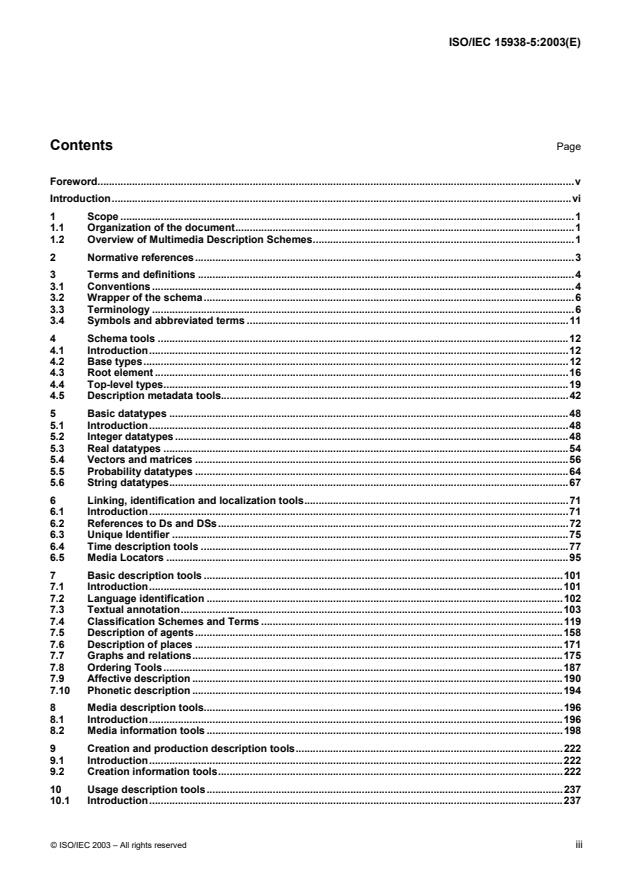
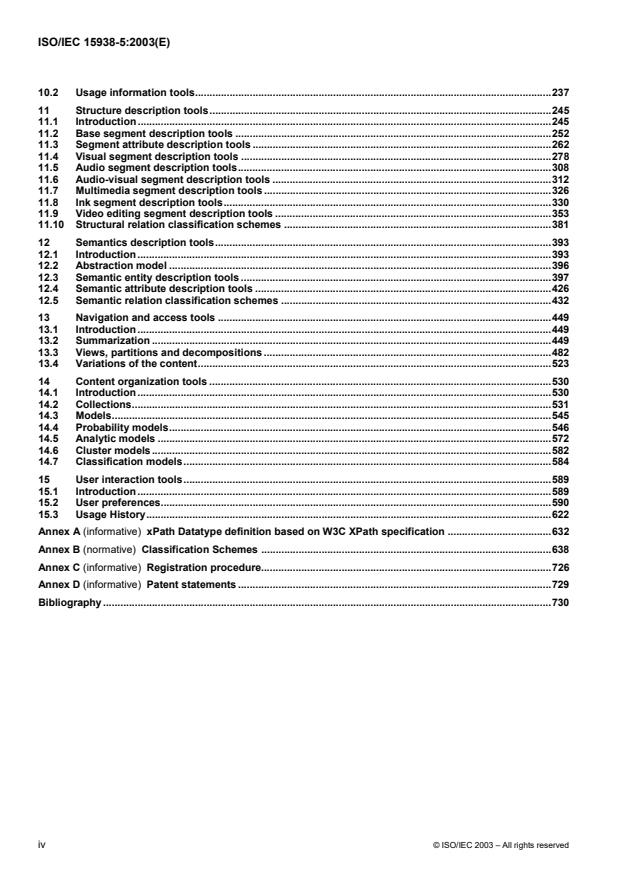
Contents Page
Foreword.v
Introduction.vi
1 Scope .1
1.1 Organization of the document.1
1.2 Overview of Multimedia Description Schemes.1
2 Normative references.3
3 Terms and definitions .4
3.1 Conventions .4
3.2 Wrapper of the schema.6
3.3 Terminology .6
3.4 Symbols and abbreviated terms .11
4 Schema tools .12
4.1 Introduction.12
4.2 Base types.12
4.3 Root element .16
4.4 Top-level types.19
4.5 Description metadata tools.42
5 Basic datatypes .48
5.1 Introduction.48
5.2 Integer datatypes .48
5.3 Real datatypes .54
5.4 Vectors and matrices .56
5.5 Probability datatypes .64
5.6 String datatypes.67
6 Linking, identification and localization tools.71
6.1 Introduction.71
6.2 References to Ds and DSs.72
6.3 Unique Identifier .75
6.4 Time description tools .77
6.5 Media Locators .95
7 Basic description tools .101
7.1 Introduction.101
7.2 Language identification .102
7.3 Textual annotation.103
7.4 Classification Schemes and Terms .119
7.5 Description of agents.158
7.6 Description of places .171
7.7 Graphs and relations.175
7.8 Ordering Tools .187
7.9 Affective description .190
7.10 Phonetic description .194
8 Media description tools.196
8.1 Introduction.196
8.2 Media information tools .198
9 Creation and production description tools.222
9.1 Introduction.222
9.2 Creation information tools.222
10 Usage description tools.237
10.1 Introduction.237
© ISO/IEC 2003 – All rights reserved iii
10.2 Usage information tools.237
11 Structure description tools.245
11.1 Introduction.245
11.2 Base segment description tools .252
11.3 Segment attribute description tools .262
11.4 Visual segment description tools .278
11.5 Audio segment description tools.308
11.6 Audio-visual segment description tools .312
11.7 Multimedia segment description tools .326
11.8 Ink segment description tools.330
11.9 Video editing segment description tools .353
11.10 Structural relation classification schemes .381
12 Semantics description tools.393
12.1 Introduction.393
12.2 Abstraction model .396
12.3 Semantic entity description tools .397
12.4 Semantic attribute description tools .426
12.5 Semantic relation classification schemes .432
13 Navigation and access tools .449
13.1 Introduction.449
13.2 Summarization .449
13.3 Views, partitions and decompositions .482
13.4 Variations of the content.523
14 Content organization tools .530
14.1 Introduction.530
14.2 Collections.531
14.3 Models.545
14.4 Probability models.546
14.5 Analytic models .572
14.6 Cluster models.582
14.7 Classification models.584
15 User interaction tools.589
15.1 Introduction.589
15.2 User preferences.590
15.3 Usage History.622
Annex A (informative) xPath Datatype definition based on W3C XPath specification .632
Annex B (normative) Classification Schemes .638
Annex C (informative) Registration procedure.726
Annex D (informative) Patent statements .729
Bibliography .730
iv © ISO/IEC 2003 – All rights reserved
Foreword
ISO (the International Organization for Standardization) and IEC (the International Electrotechnical Commission)
form the specialized system for worldwide standardization. National bodies that are members of ISO or IEC
participate in the development of International Standards through technical committees established by the
respective organization to deal with particular fields of technical activity. ISO and IEC technical committees
collaborate in fields of mutual interest. Other international organizations, governmental and non-governmental, in
liaison with ISO and IEC, also take part in the work. In the field of information technology, ISO and IEC have
established a joint technical committee, ISO/IEC JTC 1.
International Standards are drafted in accordance with the rules given in the ISO/IEC Directives, Part 3.
The main task of the joint technical committee is to prepare International Standards. Draft International Standards
adopted by the joint technical committee are circulated to national bodies for voting. Publication as an International
Standard requires approval by at least 75 % of the national bodies casting a vote.
ISO/IEC 15938-5 was prepared by Joint Technical Committee ISO/IEC JTC 1, Information technology,
Subcommittee SC 29, Coding of audio, picture, multimedia and hypermedia information.
ISO/IEC 15938 consists of the following parts, under the general title Information technology — Multimedia content
description interface:
— Part 1: Systems
— Part 2: Description definition language
— Part 3: Visual
— Part 4: Audio
— Part 5: Multimedia description schemes
— Part 6: Reference software
— Part 7: Conformance testing
— Part 8: Extraction and use of MPEG-7 descriptions
Annex B forms a normative part of this part of ISO/IEC 15938. Annexes A, C and D are for information only.
© ISO/IEC 2003 – All rights reserved v
Introduction
This standard, also known as "Multimedia Content Description Interface," provides a standardized set of
technologies for describing multimedia content. The standard addresses a broad spectrum of multimedia
applications and requirements by providing a metadata system for describing the features of multimedia content.
The following are specified in this standard:
• Description Schemes (DS) describe entities or relationships pertaining to multimedia content. Description
Schemes specify the structure and semantics of their components, which may be Description Schemes,
Descriptors, or datatypes.
• Descriptors (D) describe features, attributes, or groups of attributes of multimedia content.
• Datatypes are the basic reusable datatypes employed by Description Schemes and Descriptors
• Systems tools support delivery of descriptions, multiplexing of descriptions with multimedia content,
synchronization, file format, and so forth.
This standard is subdivided into eight parts:
Part 1 – Systems: specifies the tools for preparing descriptions for efficient transport and storage, compressing
descriptions, and allowing synchronization between content and descriptions.
Part 2 – Description definition language: specifies the language for defining the standard set of description tools
(DSs, Ds, and datatypes) and for defining new description tools.
Part 3 – Visual: specifies the description tools pertaining to visual content.
Part 4 – Audio: specifies the description tools pertaining to audio content.
Part 5 – Multimedia description schemes: specifies the generic description tools pertaining to multimedia
including audio and visual content.
Part 6 – Reference software: provides a software implementation of the standard.
Part 7 – Conformance testing: specifies the guidelines and procedures for testing conformance of
implementations of the standard.
Part 8 – Extraction and use of MPEG-7 descriptions: provides guidelines and examples of the extraction and
use of descriptions.
This document specifies the Multimedia Description Schemes (MDS) part of the ISO/IEC 15938 standard. This
document specifies the MDS description tools and provides informative examples of descriptions. The normative
syntax of the MDS description tools is specified in this document using the Description Definition Language (DDL)
and the normative semantics is specified using text.
vi © ISO/IEC 2003 – All rights reserved
INTERNATIONAL STANDARD ISO/IEC 15938-5:2003(E)
Information technology — Multimedia content description
interface —
Part 5:
Multimedia description schemes
1 Scope
1.1 Organization of the document
This International Standard specifies a metadata system for describing multimedia content. This document
specifies the Multimedia Description Schemes (MDS) description tools (Description Schemes, Descriptors, and
datatypes) that comprise ISO/IEC 15938-5. The following set of subclauses are provided for each MDS description
tool, where optional subclauses are indicated as (optional):
• Syntax: specifies the normative syntax of the description tool using Description Definition Language (DDL) (see
ISO/IEC 15938-2).
• Binary syntax (optional): specifies the normative binary representation for the description tool, where relevant.
If a binary syntax is not specified, then the binary coding method of ISO/IEC 15938-1 shall apply for the
description tool.
• Semantic: specifies the normative semantics of the description tool and each of its components (attributes and
elements).
• Informative examples (optional): provides informative examples that illustrate the use or instantiation of the
description tool in creating descriptions.
1.2 Overview of Multimedia Description Schemes
The MDS description tools are organized on the basis of functionality as shown in Figure 1.
User
Collections Models
Content Organization
Interaction
Navigation &
User
Creation &
Access
Preferences
Production
Summaries
Media Usage
User
Content Metadata
History
ViVieewws s
Content Description
Structure Semantics
Variations
Basic Elements
Schema Basic Links & Media Basic
Tools Datatypes Localization Tools
Figure 1 — Overview of the Multimedia Description Scheme (MDS) description tools
© ISO/IEC 2003 – All rights reserved 1
The basic elements, which are shown at the bottom level in Figure 1, form the building blocks for the higher-level
description tools. The following basic elements are defined: schema tools (the root element, top-level types,
description metadata, and packages), basic datatypes (integers, reals, vectors, matrices), linking and media
localization tools (spatial and temporal localization), basic description tools (language, text, classification schemes).
The basic elements are specified in the following clauses: clause 4 (Schema tools), clause 5 (Basic datatypes),
clause 6 (Linking, identification and localization tools), and clause 7 (Basic description tools). Table 1 summarizes
the basic elements.
Table 1 — Overview of basic elements
Set of description tools Functionality
Schema tools (clause 4) Specifies schema tools that facilitate the making of descriptions. The schema tools
include the base type hierarchy of the description tools defined in ISO/IEC 15938,
the root element and top-level tools, the multimedia content entity tools, and the
package and description metadata tools.
Basic datatypes (clause 5) Specifies the basic datatypes used by description tools defined in the
ISO/IEC 15938.
Linking, identification and Specifies the basic datatypes that are used for referencing within descriptions and
localization tools (clause 6) linking of descriptions to multimedia content.
Basic description tools Specifies basic tools that are used as components for building other description
(clause 7) tools.
The content description tools, which are shown at the middle level in Figure 1, describe the features of the
multimedia content and the immutable metadata related to the multimedia content. The following description tools
for content description are defined: structure description tools (spatio-temporal segments of multimedia content)
and semantic description tools (objects, events). The following description tools for content metadata are defined:
media description (storage format, encoding), creation & production (title, creator, classification), and usage
(access rights, publication). The content description and metadata tools are related in the sense that the content
description tools use the content metadata tools. For example, a description of creation and production or media
information can be attached to an individual video or video segment in order to describe the structure and creation
and production of the multimedia content. Table 2 summarizes tools for describing content and related metadata.
Table 2 — Overview of tools for describing content and related metadata
Set of description tools Functionality
Media description tools Describes the storage of the multimedia data. The media features include the
(clause 8) format, encoding, storage media. The tools allow multiple media description
instances for the same multimedia content.
Creation and production
Describes the creation and production of the multimedia content. The creation and
description tools
production features include title, creator, classification, purpose of the creation, and
(clause 9) so forth. The creation and production information is typically not extracted from the
content but corresponds to metadata related to the content.
Usage description tools Describes the usage of the multimedia content. The usage features include access
(clause 10) rights, publication, and financial information. The usage information may change
during the lifetime of the multimedia content.
Structure description Describes the structure of the multimedia content. The structural features include
tools (clause 11) spatial, temporal or spatio-temporal segments of the multimedia content.
Semantics description Describes the "real-world" semantics related to or captured by the multimedia
tools (clause 12) content. The semantic features include objects, events, concepts, and so forth.
2 © ISO/IEC 2003 – All rights reserved
The tools for navigation and access, which are shown at the middle level in Figure 1, describe the browsing,
summarization, and access of content. These tools are specified in clause 13 (Navigation and access tools). The
tools for content organization tools, shown at the top level in Figure 1, describe collections and models of
multimedia content. These tools are specified in clause 14 (Content organization tools). The tools for user
interaction, shown on the right in Figure 1, describe user preferences pertaining to consumption of multimedia and
usage history. These tools are specified in clause 15 (User interaction tools). Table 3 summarizes tools for
describing content organization, navigation and access, and user interaction.
Table 3 — Overview of tools for describing content organization, navigation and access, and user
interaction
Set of description tools Functionality
Navigation and access
Specifies tools that describe the navigation and access of multimedia. The
tools (clause 13)
navigation and access tools describe multimedia summaries and abstracts; describe
partitions, views and decompositions of image, video, and audio signals in space,
time and frequency; and describe the relationships between different variations of
multimedia content.
Content organization Specifies tools that describe the organization and modeling of multimedia content.
tools (clause 14) The content organization tools include collections, probability models, analytic
models, cluster models, and classification models.
User interaction tools Specifies tools related to user interaction with multimedia content. The user
(clause 15) interaction tools describe user preferences pertaining to multimedia content, and
describe the usage history of users of multimedia content.
Finally, classification schemes, which organize terms that are used by the description tools, are specified in
Annex B (Classification Schemes).
2 Normative references
The following normative documents contain provisions which, through reference in this text, constitute provisions of
this part of ISO/IEC 15938. For dated references, subsequent amendments to, or revisions of, any of these
publications do not apply. However, parties to agreements based on this part of ISO/IEC 15938 are encouraged to
investigate the possibility of applying the most recent editions of the normative documents indicated below. For
undated references, the latest edition of the normative document referred to applies. Members of ISO and IEC
maintain registers of currently valid International Standards. The Telecommunication Standardization Bureau
maintains a list of currently valid ITU-T Recommendations.
• ISO 8601, Data elements and interchange formats — Information interchange — Representation of dates and
times
• ISO 639 (all parts), Codes for the representation of names of languages
• ISO 3166-1, Codes for the representation of names of countries and their subdivisions — Part 1: Country
codes
• ISO 3166-2, Codes for the representation of names of countries and their subdivisions — Part 2: Country
subdivision code
Note: The current list of valid ISO 3166-1 country and ISO 3166-2 region codes is maintained by the ISO 3166 maintenance
agency at the ISO Central Secretariat. Information on the current list of valid region and country codes can be found at
http://www.iso.org/mara/iso3166.
• ISO 4217, Codes for the representation of currencies and funds
© ISO/IEC 2003 – All rights reserved 3
Note: The current list of valid ISO 4217 currency codes is maintained by the official maintenance authority British Standards
Institution (http://www.bsi-global.com/iso4217currency).
• XML, Extensible Markup Language (XML) 1.0, 6 October 2000 〈http://www.w3.org/TR/2000/REC-xml-
20001006〉
• XML Schema, W3C Recommendation, 2 May 2001 〈http://www.w3.org/XML/Schema〉
• XML Schema Part 0: Primer, W3C Recommendation, 2 May 2001 〈http://www.w3.org/TR/xmlschema-0/〉
• XML Schema Part 1: Structures, W3C Recommendation, 2 May 2001 〈http://www.w3.org/TR/xmlschema-1/〉
• XML Schema Part 2: Datatypes, W3C Recommendation, 2 May 2001 〈http://www.w3.org/TR/xmlschema-2/〉
• XPath, XML Path Language, W3C Recommendation, 16 November 1999 〈http://www.w3.org/TR/1999/REC-
xpath-19991116〉
Note: These documents are maintained by the W3C (http://www.w3.org).
• RFC 2045 Multipurpose Internet Mail Extensions (MIME) Part One: Format of Internet Message Bodies
• RFC 2046 Multipurpose Internet Mail Extensions (MIME) Part Two: Media Types
• RFC 2048, Multipurpose Internet Mail Extensions (MIME) Part Four: Registration Procedures
• RFC 2045-CHARSETS, Registered Character set codes of RFC2045
• RFC 2046-MIMETYPES, Registered Mimetypes of RFC2046
Note: The relevant lists can be obtained as follows:
o MIMETYPES. The current list of registered mimetypes, as defined in RFC2046, RFC2048, is maintained by IANA
(Internet Assigned Numbers Authority). It is available from ftp://ftp.isi.edu/in-notes/iana/assignments/media-
types/media-types/.
o CHARSETS. The current list of registered character set codes, as defined in RFC2045 and RFC2048 is
maintained by IANA (Internet Assigned Numbers Authority). It is available from ftp://ftp.isi.edu/in-
notes/iana/assignments/character-sets.
3 Terms and definitions
3.1 Conventions
3.1.1 Description tools
This part of ISO/IEC 15938 specifies the multimedia description tools as follows:
• Description Scheme (DS) – a description tool that describes entities or relationships pertaining to
multimedia content. DSs specify the structure and semantics of their components, which may be
Description Schemes, Descriptors, or datatypes.
• Descriptor (D) – a description tool that describes a feature, attribute, or group of attributes of multimedia
content.
• Datatype – a basic reusable datatype employed by Description Schemes and Descriptors.
• Description Tool (or tool) – refers to a Description Scheme, Descriptor, or Datatype.
4 © ISO/IEC 2003 – All rights reserved
3.1.2 Naming convention
In order to specify the multimedia description tools, this part of ISO/IEC 15938 uses constructs provided by the
Description Definition Language (DDL) specified in ISO/IEC 15938-2, such as "element," "attribute," "simpleType"
and "complexType." The names associated to these constructs are created on the basis of the following
conventions:
• If the name is composed of multiple words, the first letter of each word is capitalized, with the exception that the
capitalization of the first word depends on the type of construct as follows:
• Element naming: the first letter of the first word is capitalized (e.g. TimePoint element of TimeType).
• Attribute naming: the first letter of the first word is not capitalized (e.g. timeUnit attribute of
IncrDurationType).
• complexType naming: the first letter of the first word is capitalized, and the suffix "Type" is used at the end of
the name (e.g. PersonType).
• simpleType naming: the first letter of the first word is not capitalized, the suffix "Type" may be used at the end
of the name (e.g. timePointType).
Note that when referencing a complexType or simpleType in the definition of a description tool, the "Type" suffix is
not used. For instance, the text refers to the "Time datatype" (instead of "TimeType datatype"), to the
"MediaLocator D" (instead of "MediaLocatorType D") and to the "Person DS" (instead of PersonType DS).
3.1.3 Documentation convention
The syntax of each description tool is specified using the constructs provided by the DDL specified in
ISO/IEC 15938-2, and is presented in this document using a specific font and background as shown in the
following example:
The semantics of each description tool is specified in text using a table format, where each row contains the name
and a definition of a type, element or attribute as shown in the following example:
Name Definition
ExampleType
Specifies an .
element1
Describes the …
attribute1 Describes the …
Diagrammatic notation is sometimes used to depict overviews of the description tools. Such overview diagrams
generally depict aggregation and generalization relationships between description tools or the entities being
described. In these diagrams, rectangular shapes containing a name denote description tools (DSs or Ds) that are
used to describe entities. In some diagrams, multiple description tools are listed in a single rectangle. Large
diamond shapes containing a name denote description tools (DSs or Ds) that are used to describe relationships.
Furthermore, paths between rectangles or diamonds denote association, generalization or aggregation
relationships. Generalization relationships are indicated by a solid path with a filled triangle pointing at the more
© ISO/IEC 2003 – All rights reserved 5
general entity. Aggregation (composition) relationships are indicated by a solid path with a (filled) diamond at the
aggregating (composing) entity. Aggregation relationship paths may be accompanied by an indication of the
multiplicity (minOccurs, maxOccurs) of the relation in text form.
The informative examples are included in separate subclauses, and are presented in this document using a
separate font and background as shown in the following example:
example element content
Moreover, the schema or set of description tools defined in this document follows a type-centric approach. The
description tools are specified by defining the complexType or simpleType for each tool, but not declaring an
element of this type at the global scope with the exception of the root element. However, in order to illustrate
informative example descriptions in this document, the examples assume that an element of the example type
(complexType or simpleType) has been declared, such as a member of another complexType or simpleType. For
example, the description above assumes that the following declaration has been made:
The term "reserved" is used in specifying the semantics of some description tools. The term "reserved" indicates
that particular values are reserved for use in future extensions of ISO/IEC 15938.
3.2 Wrapper of the schema
The description examples and syntax of description tools specified in this document assume that a schema
wrapper is provided which identifies the XML Schema namespace (XML Schema) and MPEG-7 namespace:
xmlns:mpeg7="urn:mpeg:mpeg7:schema:2001"
targetNamespace="urn:mpeg:mpeg7:schema:2001"
elementFormDefault="qualified" attributeFormDefault="unqualified">
The following tag is used to close the schema:
3.3 Terminology
For the purposes of this part of ISO/IEC 15938, the following terms and definitions apply.
3.3.1 Schema-related terminology
3.3.1.1
Attribute
A field of a description tool which is of simple type.
3.3.1.2
Base type
A type that serves as the root type of a derivation hierarchy for other types.
6 © ISO/IEC 2003 – All rights reserved
3.3.1.3
Datatype
A primitive reusable type employed by Description Schemes and Descriptors.
3.3.1.4
Derived type
A type that is defined in terms of extension or restriction of other types.
3.3.1.5
Description
An instantiation of one or more description tools.
3.3.1.6
Description Scheme
A description tool that describes entities or relationships pertaining to multimedia content. Description
Schemes specify the structure and semantics of their components, which may be Description Schemes,
Descriptors, or datatypes.
3.3.1.7
Description Tool
A Description Scheme, Descriptor, or datatype.
3.3.1.8
Descriptor
A description tool that describes a feature, attribute, or group of attributes of multimedia content.
3.3.1.9
Instantiation
Assignment of values to the fields (elements, attributes) of one or more description tools.
3.3.1.10
Element
A field of a description tool which is of complex type.
3.3.1.11
Schema
The set of related description tools, for example, those specified in ISO/IEC 15938.
3.3.1.12
Type
The format used for collection of letters, digits, and/or symbols, to depict values of an element or attribute of
description tool. A type consists of a set of distinct values, a set of lexical representations, and a set of facets that
characterize properties of the value space, individual values, or lexical items.
3.3.2 Content-related terminology
3.3.2.1
Abstraction
A secondary representation that is created from or is related to the content. For example, a summary of a video
or a model of a feature.
3.3.2.2
Acquisition
The process of acquiring audio or visual data from a source.
3.3.2.3
Action
A semantically identifiable behaviour of an object or group of objects, for example, a soccer player kicking ball.
© ISO/IEC 2003 – All rights reserved 7
3.3.2.4
Agent
A person, organization, or group of persons.
3.3.2.5
Audio
Time-varying data or signal intended for listening or hearing. Also, related to the aural modality.
3.3.2.6
Audio-visual
content consisting of both audio and video data.
3.3.2.7
Automatic
Processing of multimedia data, content, or metadata by means of computer, hardware, or other software device.
3.3.2.8
Classification Scheme
A list of defined terms and their meanings.
3.3.2.9
Content
Multimedia content
A representation of the information contained in or related to multimedia data in a formalized manner suitable for
interpretation by human means. Content refers to the data and the metadata.
3.3.2.10
Copyright
A right that establishes the ownership of data, content, or metadata.
3.3.2.11
Data
Essence
Multimedia Data
A representation of multimedia in a formalized manner suitable for communication, interpretation, or processing by
automatic means.
3.3.2.12
Editing
The process of combining, extracting, and refining multimedia data.
3.3.2.13
Entity
Any concrete or abstract thing of interest related to the multimedia content.
3.3.2.14
Event
A noteworthy occurrence that happens at a point in time or during a temporal interval. Alternatively used as a
change in state.
3.3.2.15
Feature
A distinctive characteristic of multimedia content that signifies something to a human observer, such as the
"color" or "texture" of an image.
3.3.2.16
Filtering
A process for selecting multimedia content that satisfies certain criteria. This process may include ranking the
content according to the extent that it satisfies the criteria.
8 © ISO/IEC 2003 – All rights reserved
3.3.2.17
Format
The characteristics of the stored or physical representation of the data.
3.3.2.18
Frame
A single image from a video.
3.3.2.19
Image
2D spatially-varying visual data acquired from a visual source.
3.3.2.20
Key frame
A representative frame of a video or a segment.
3.3.2.21
Locator
Specifies the location or address of multimedia data or a segment.
3.3.2.22
Model
A parametric or statistical representation of multimedia content or features.
3.3.2.23
Manual
Processing of multimedia data, content, or metadata by human means.
3.3.2.24
Metadata
The information and documentation which makes multimedia data understandable and shareable to users over
time.
3.3.2.25
Multimedia
Data comprising one or modalities, such as images, audio, video, 3D models, ink content, and so forth.
3.3.2.26
Navigation
A process by which a user accesses multimedia content and steers a course through the content in a controlled
manner.
3.3.2.27
Object
An object with a physical representation in the natural world.
3.3.2.28
Region
A spatial unit of multimedia, for example, a 2D spatial region of an image, or a moving region of video.
3.3.2.29
Relation
Any association among entities.
3.3.2.30
Rights
Information that determines the ownership and terms of use of multimedia data, content, or metadata. Refers to
Intellectual Property Rights, Copyrights, and the Access Rights.
© ISO/IEC 2003 – All rights reserved 9
3.3.2.31
Scene
An episode or sequence of events representing continuous action in one location.
3.3.2.32
Search
A process for searching multimedia content that satisfies certain criteria. This process may include ranking the
content according to the extent that it satisfies the criteria.
3.3.2.33
Segment
A spatial or temporal unit of multimedia, for example, a temporal segment of video, or a segment of an image.
3.3.2.34
Semantics
Information relating to the underlying meaning or understanding of multimedia content. Alternatively, refers to the
specification of the meaning of description tools.
3.3.2.35
Summary
An abstraction of multimedia content that summarizes the content.
3.3.2.36
User
An end-user or consumer of multimedia content.
3.3.2.37
User Preferences
The preferences of a user pertaining to multimedia content. This includes the user's tastes, likes and dislikes with
respect to the content and its properties, as well as preferences with respect to the consumption process.
3.3.2.38
Usage History
A history of actions that a user of multimedia content has carried out over a certain period of time, such as
recording a specific piece of content, or playing back recorded content at a specific time.
3.3.2.39
Variation
An alternative version of multimedia content, which may be derived through transcoding, summarization,
translation, reduction, and so forth.
3.3.2.40
Video
A space- and time-varying visual data or signal intended for viewing; commonly represented as a discrete
sequence of images or frames.
3.3.2.41
View
A portion of an image, video or audio signal, defined in terms of a partition. A partition is a multi-dimensional
region defined in the space, time and/or frequency plane.
3.3.2.42
Visual
Related to the visual modality.
3.3.2.43
View Decomposition
An
...