

ISO/FDIS 14460
(Main)Protective clothing for automobile racing drivers — Protection against heat and flame — Performance requirements and test methods
- Status
- Not Published
- Technical Committee
- ISO/TC 94/SC 13 - Protective clothing
- Drafting Committee
- ISO/TC 94/SC 13 - Protective clothing
- Current Stage
- 5000 - FDIS registered for formal approval
- Start Date
- 11-Oct-2024
- Completion Date
- 14-Sep-2026
Buy Documents
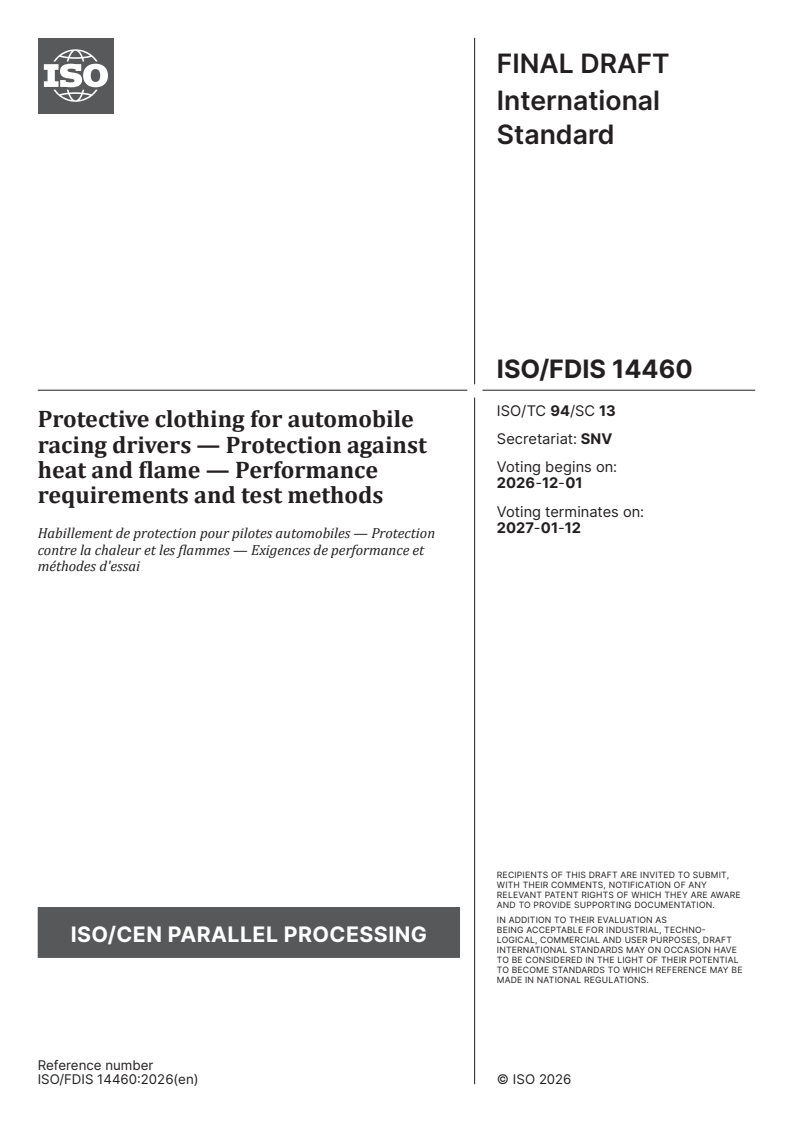
ISO/FDIS 14460 - Protective clothing for automobile racing drivers — Protection against heat and flame — Performance requirements and test methods
REDLINE ISO/FDIS 14460 - Protective clothing for automobile racing drivers — Protection against heat and flame — Performance requirements and test methods

ISO/FDIS 14460 - Protective clothing for automobile racing drivers — Protection against heat and flame — Performance requirements and test methods/30/2022

ISO/FDIS 14460 - Habillement de protection pour pilotes automobiles — Protection contre la chaleur et les flammes — Exigences de performance et méthodes d'essai/16/2023
Overview
ISO/FDIS 14460 is an international standard developed by ISO for protective clothing intended for automobile racing drivers, focusing specifically on providing protection against heat and flame. This standard outlines performance requirements and test methods for garments designed to safeguard drivers who are not covered directly by FIA provisions but require a comparable level of heat and flame protection as FIA 8856. Applying to outer garments, undergarments, socks, gloves, and balaclavas, ISO/FDIS 14460 establishes rigorous benchmarks for design, testing, and certification, excluding shoes and helmets from its scope.
Protective clothing compliant with ISO/FDIS 14460 is critical for driver safety in motorsport environments where exposure to high temperatures and open flames is a significant hazard. The standard specifies how such apparel should perform under intense conditions, ensuring reliability and confidence for participants in national and international racing events.
Key Topics
- Performance Testing: The standard defines detailed test methods for limited flame spread, convective heat resistance, mechanical resistance after flame exposure, and dimensional stability of materials. Compliance requires rigorous laboratory tests before and after washing or dry-cleaning cycles.
- Garment Design Requirements: ISO/FDIS 14460 specifies construction and design parameters for each protective item, including minimum weight, layer requirements, collar heights, and overlap zones to maximize coverage of vulnerable areas like neck, wrists, and ankles.
- Marking & Labelling: Each item must be clearly labelled, referencing the standard, size designations, manufacturer identification, care instructions according to ISO 3758, and relevant pictograms indicating protection against heat and flame.
- Manufacturer Information: Essential instructions accompanying garments include advice on repairs, maintenance, conformity indications, and replacement intervals to ensure continued safety and performance.
Applications
- Automobile Racing Drivers: The primary users are competitors in racing disciplines outside FIA-sanctioned events. The standard ensures drivers have access to high-performance protective clothing against heat and flame, supporting safety in national and regional motorsports.
- Personal Protective Equipment (PPE) Regulators and Manufacturers: Entities involved in the design, testing, and certification of racing apparel rely on ISO/FDIS 14460 to align with current regulatory requirements and customer safety expectations.
- Compliance with EU Regulation 2016/425: The standard supports conformity with the European Union’s personal protective equipment legislation, providing a pathway for CE marking and market approval across Europe.
- Motorsport Teams and Event Organizers: Teams and organizations use ISO/FDIS 14460 as a reference point to verify the compliance of driver clothing, ensuring alignment with safety regulations and best practices in risk management.
Related Standards
- ISO 15025: Method of test for limited flame spread in protective clothing.
- ISO 9151: Determination of heat transmission on exposure to flame.
- ISO 13688: General requirements for protective clothing, including size designation and marking.
- ISO 21420: General requirements and test methods for gloves.
- ISO 3758: Care labelling code using symbols for textiles and garments.
- ISO 6330 & ISO 3175-1: Procedures for domestic washing, drying, and dry-cleaning in textile testing.
- EU Regulation 2016/425: Legislation governing the safety requirements for personal protective equipment in the European Union.
By establishing standardized performance and test methods for heat- and flame-resistant racing apparel, ISO/FDIS 14460 enhances driver safety and sets a global benchmark for manufacturers, teams, and motorsport authorities. Compliance with this standard ensures robust, proven protection for those at the forefront of automotive competition.
Keywords: ISO 14460, protective clothing, automobile racing, heat protection, flame resistance, PPE, performance requirements, test methods, motorsport safety, racing garments, standard compliance.
Relations
- Effective Date
- 12-Feb-2026
- Effective Date
- 05-Nov-2022
- Effective Date
- 22-Oct-2022
- Effective Date
- 22-Oct-2022
Buy Documents
ISO/FDIS 14460 - Protective clothing for automobile racing drivers — Protection against heat and flame — Performance requirements and test methods
REDLINE ISO/FDIS 14460 - Protective clothing for automobile racing drivers — Protection against heat and flame — Performance requirements and test methods
ISO/FDIS 14460 - Protective clothing for automobile racing drivers — Protection against heat and flame — Performance requirements and test methods/30/2022
ISO/FDIS 14460 - Habillement de protection pour pilotes automobiles — Protection contre la chaleur et les flammes — Exigences de performance et méthodes d'essai/16/2023
Get Certified
Connect with accredited certification bodies for this standard

CIS Institut d.o.o.
Personal Protective Equipment (PPE) certification body. Notified Body NB-2890 for EU Regulation 2016/425 PPE.

Kiwa BDA Testing
Building and construction product certification.
Kmetijski inštitut Slovenije
Agricultural Institute of Slovenia. Soil testing, plant health, agricultural product analysis.
Sponsored listings
Frequently Asked Questions
ISO/FDIS 14460 is a draft published by the International Organization for Standardization (ISO). Its full title is "Protective clothing for automobile racing drivers — Protection against heat and flame — Performance requirements and test methods". This standard covers: La présente Norme internationale spécifie les méthodes d'essai, les exigences de performance et les paramètres de conception des vêtements de protection contre la chaleur et le feu destinés à être portés par les pilotes automobiles lors des compétitions. La présente Norme internationale couvre les vêtements de dessus et de dessous, les chaussettes, les gants et les cagoules; elle ne couvre pas les chaussures et les casques.
La présente Norme internationale spécifie les méthodes d'essai, les exigences de performance et les paramètres de conception des vêtements de protection contre la chaleur et le feu destinés à être portés par les pilotes automobiles lors des compétitions. La présente Norme internationale couvre les vêtements de dessus et de dessous, les chaussettes, les gants et les cagoules; elle ne couvre pas les chaussures et les casques.
ISO/FDIS 14460 is classified under the following ICS (International Classification for Standards) categories: 13.340.10 - Protective clothing; 97.220.40 - Outdoor and water sports equipment. The ICS classification helps identify the subject area and facilitates finding related standards.
ISO/FDIS 14460 has the following relationships with other standards: It is inter standard links to prEN ISO 14460, ISO 21622-3:2024, ISO 14460:1999/Amd 1:2002, ISO 14460:1999. Understanding these relationships helps ensure you are using the most current and applicable version of the standard.
ISO/FDIS 14460 is available in PDF format for immediate download after purchase. The document can be added to your cart and obtained through the secure checkout process. Digital delivery ensures instant access to the complete standard document.
Standards Content (Sample)
FINAL DRAFT
International
Standard
ISO/TC 94/SC 13
Protective clothing for automobile
Secretariat: SNV
racing drivers — Protection against
Voting begins on:
heat and flame — Performance
2026-12-01
requirements and test methods
Voting terminates on:
2027-01-12
Habillement de protection pour pilotes automobiles — Protection
contre la chaleur et les flammes — Exigences de performance et
méthodes d'essai
RECIPIENTS OF THIS DRAFT ARE INVITED TO SUBMIT,
WITH THEIR COMMENTS, NOTIFICATION OF ANY
RELEVANT PATENT RIGHTS OF WHICH THEY ARE AWARE
AND TO PROVIDE SUPPOR TING DOCUMENTATION.
IN ADDITION TO THEIR EVALUATION AS
BEING ACCEPTABLE FOR INDUSTRIAL, TECHNO
ISO/CEN PARALLEL PROCESSING LOGICAL, COMMERCIAL AND USER PURPOSES, DRAFT
INTERNATIONAL STANDARDS MAY ON OCCASION HAVE
TO BE CONSIDERED IN THE LIGHT OF THEIR POTENTIAL
TO BECOME STAN DARDS TO WHICH REFERENCE MAY BE
MADE IN NATIONAL REGULATIONS.
Reference number
FINAL DRAFT
International
Standard
ISO/TC 94/SC 13
Protective clothing for automobile
Secretariat: SNV
racing drivers — Protection against
Voting begins on:
heat and flame — Performance
requirements and test methods
Voting terminates on:
Habillement de protection pour pilotes automobiles — Protection
contre la chaleur et les flammes — Exigences de performance et
méthodes d'essai
© ISO 2026
All rights reserved.
RECIPIENTS OF THIS DRAFT ARE INVITED TO SUBMIT,
WITH THEIR COMMENTS, NOTIFICATION OF ANY
This ISO publication is protected by copyright and is owned by ISO and/or its licensors.
RELEVANT PATENT RIGHTS OF WHICH THEY ARE AWARE
The content of this ISO publication is provided under licence, not sold. Use is subject to the applicable licence terms issued by ISO,
AND TO PROVIDE SUPPOR TING DOCUMENTATION.
an ISO member body, or an authorized third-party distributor.
IN ADDITION TO THEIR EVALUATION AS
BEING ACCEPTABLE FOR INDUSTRIAL, TECHNO
Except as required for implementation or expressly permitted by a separate licence, no part of this ISO publication may be
ISO/CEN PARALLEL PROCESSING
LOGICAL, COMMERCIAL AND USER PURPOSES, DRAFT
reproduced, distributed, modified, used, or made available in any form or by any means – electronic or mechanical, including
INTERNATIONAL STANDARDS MAY ON OCCASION HAVE
photocopying, scanning, recording, or posting on internal or external digital platforms. TO BE CONSIDERED IN THE LIGHT OF THEIR POTENTIAL
TO BECOME STAN DARDS TO WHICH REFERENCE MAY BE
Any use beyond the scope of the granted rights is prohibited and may result in legal action.
MADE IN NATIONAL REGULATIONS.
ISO copyright office
CP 401 • CH-1214 Vernier, Geneva
Phone: +41 22 749 01 11
Email: copyright@iso.org
Website: www.iso.org
Published in Switzerland
Reference number
ii
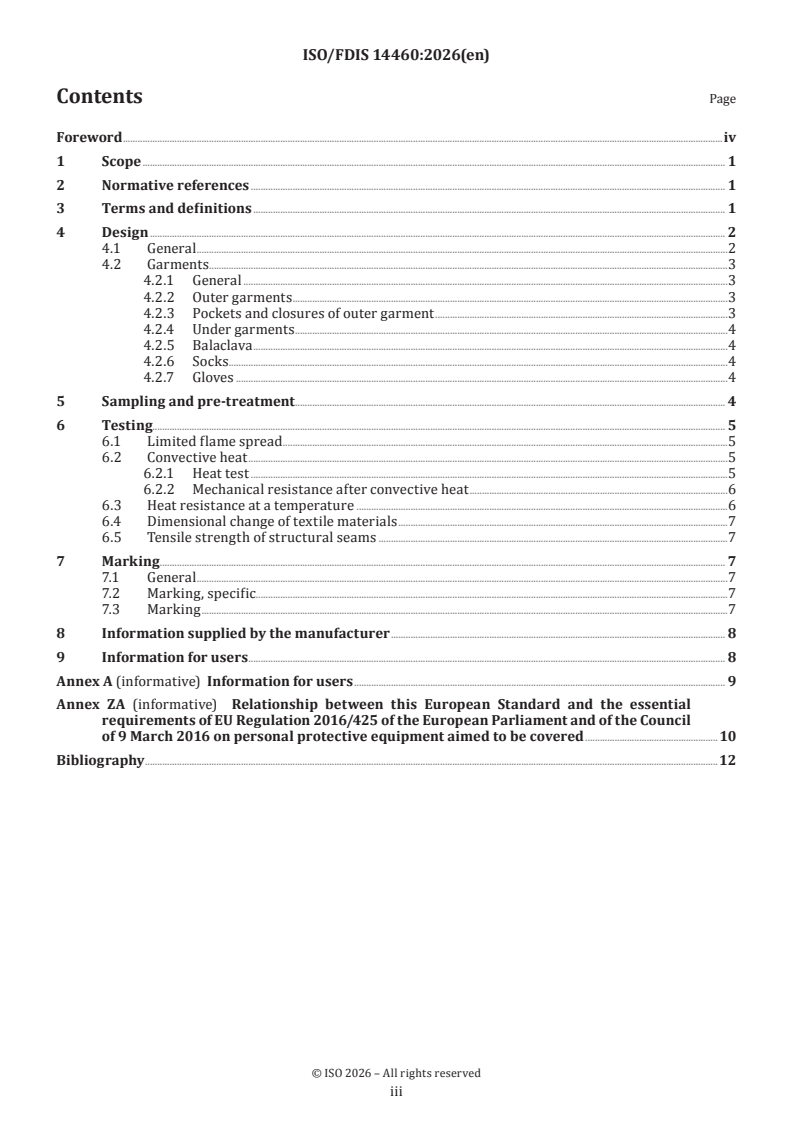
Contents Page
Foreword .iv
1 Scope . 1
2 Normative references . 1
3 Terms and definitions . 1
4 Design . 2
4.1 General .2
4.2 Garments.3
4.2.1 General .3
4.2.2 Outer garments .3
4.2.3 Pockets and closures of outer garment .3
4.2.4 Under garments .4
4.2.5 Balaclava .4
4.2.6 Socks.4
4.2.7 Gloves .4
5 Sampling and pre-treatment . . 4
6 Testing. 5
6.1 Limited flame spread .5
6.2 Convective heat .5
6.2.1 Heat test .5
6.2.2 Mechanical resistance after convective heat .6
6.3 Heat resistance at a temperature .6
6.4 Dimensional change of textile materials .7
6.5 Tensile strength of structural seams .7
7 Marking . . 7
7.1 General .7
7.2 Marking, specific.7
7.3 Marking .7
8 Information supplied by the manufacturer . 8
9 Information for users . 8
Annex A (informative) Information for users . 9
Annex ZA (informative) Relationship between this European Standard and the essential
requirements of EU Regulation 2016/425 of the European Parliament and of the Council
of 9 March 2016 on personal protective equipment aimed to be covered .10
Bibliography .12
iii
Foreword
ISO (the International Organization for Standardization) is a worldwide federation of national standards
bodies (ISO member bodies). The work of preparing International Standards is normally carried out through
ISO technical committees. Each member body interested in a subject for which a technical committee
has been established has the right to be represented on that committee. International organizations,
governmental and non-governmental, in liaison with ISO, also take part in the work. ISO collaborates closely
with the International Electrotechnical Commission (IEC) on all matters of electrotechnical standardization.
The procedures used to develop this document and those intended for its further maintenance are described
in the ISO/IEC Directives, Part 1. In particular, the different approval criteria needed for the different types
of ISO documents should be noted. This document was drafted in accordance with the editorial rules of the
ISO/IEC Directives, Part 2 (see www.iso.org/directives).
Attention is drawn to the possibility that some of the elements of this document may be the subject of patent
rights. ISO shall not be held responsible for identifying any or all such patent rights. Details of any patent
rights identified during the development of the document will be in the Introduction and/or on the ISO list of
patent declarations received (see www.iso.org/patents).
Any trade name used in this document is information given for the convenience of users and does not
constitute an endorsement.
For an explanation of the voluntary nature of standards, the meaning of ISO specific terms and expressions
related to conformity assessment, as well as information about ISO's adherence to the World Trade
Organization (WTO) principles in the Technical Barriers to Trade (TBT), see www.iso.org/iso/foreword.html.
This document was prepared by Technical Committee ISO/TC 94, Personal safety — Personal protective
equipment, Subcommittee SC 13, Protective clothing, in collaboration with the European Committee for
Standardization (CEN) Technical Committee CEN/TC 162, Protective clothing including hand and arm
protection and lifejackets, in accordance with the Agreement on technical cooperation between ISO and CEN
(Vienna Agreement).
This second edition cancels and replaces the first edition (ISO 14460:1999), which has been technically
revised.
The main changes are as follows:
— Terms and definitions, added new CEN & ISO documents;
— Normative references updated;
— Annex ZA updated.
Any feedback or questions on this document should be directed to the user’s national standards body. A
complete listing of these bodies can be found at www.iso.org/members.html.
iv
FINAL DRAFT International Standard ISO/FDIS 14460:2026(en)
Protective clothing for automobile racing drivers —
Protection against heat and flame — Performance
requirements and test methods
1 Scope
This document specifies test methods, performance requirements and design parameters for clothing for
protection against heat and flame intended for drivers in automobile competitions. This document concerns
outer garments, under garments, socks, gloves and balaclava. Shoes and helmets are excluded.
NOTE The intent of this document is to provide a standard for drivers of automobiles that do not fall within the
scope of the FIA. The intent is to provide a similar level of protection as FIA 8856.
2 Normative references
The following documents are referred to in the text in such a way that some or all of their content constitutes
requirements of this document. For dated references, only the edition cited applies. For undated references,
the latest edition of the referenced document (including any amendments) applies.
ISO 3175-1, Textiles —Dry-cleaning and finishing — Part 1: Method for assessing the cleanability of textiles and
garments
ISO 3758, Textiles — Care labelling code using symbols
ISO 3801, Textiles — Woven fabrics — Determination of mass per unit length and mass per unit area
ISO 5077, Textiles — Determination of dimensional change in washing and drying
ISO 6330, Textiles — Domestic washing and drying procedures for textile testing
ISO 9151, Protective clothing against heat and flame — Determination of heat transmission on exposure to
flame
ISO 11610, Protective clothing — Vocabulary
ISO 13688, Protective clothing — General requirements
ISO 13688:2013/Amd.1:2021, Protective clothing — General requirements/ — Amendment 1
ISO 13935-2:2014, Textiles — Seam tensile properties of fabrics and made-up textile articles — Part 2:
Determination of maximum force to seam rupture using the grab method
ISO 15025:2016, Protective clothing — Protection against flame — Method of test for limited flame spread
ISO 21420, Protective gloves — General requirements and test methods
3 Terms and definitions
For the purposes of this document, the terms and definitions in ISO 11610 and the following apply.
ISO and IEC maintain terminology databases for use in standardization at the following addresses:
— ISO Online browsing platform: available at https:// www .iso .org/ obp
— IEC Electropedia: available at https:// www .electropedia .org/
3.1
balaclava
one-piece garment (3.2) designed to fit closely over the entire head and to extend downwards to cover the
neck
3.2
garment
single item of clothing which may consist of a single or multiple layers
3.3
outer garment
one-piece garment (3.2) which is worn as an outermost layer over an under garment (3.4) and which is
designed to entirely cover the wearer except for the head, hands and feet
3.4
under garment
garment (3.2) which is designed to be worn between an outer garment (3.3) and the wearer's body
3.5
component assembly
combination of materials of a multilayer garment (3.2), presented exactly as in the finished garment (3.2)
construction
3.6
innermost layer
lining found on that face of the component assembly (3.5) which is intended to be nearest to the wearer's skin
3.7
closure system
method of fastening openings in the garment (3.2) including combinations of more than one method of
achieving a secure closure
EXAMPLE A slide fastener covered by an overflap fastened down with a touch and close fastener.
3.8
seam
junction of two edges of material which are permanently attached in the garment (3.2) by sewing or any
other method
3.9
structural seam
seam (3.8) which holds the outer garment (3.3) together and which if broken would expose the under
garments (3.4) and reduce the protection
4 Design
4.1 General
Any garment and its components shall meet the relevant requirements of ISO 13688 in addition to the
requirements set in this document. For gloves, these shall meet the requirements of ISO 21420.
Garment and glove sizes shall be in accordance with the requirements respectively of ISO 13688 and
ISO 21420.
4.2 Garments
4.2.1 General
All garments shall meet the requirements of Clause 6, unless specified differently in 4.2.2 to 4.2.7.
NOTE Any garments worn underneath or above garments of this document need to have Fire Resistant properties
that do not imperil the protective properties of the garments of this document.
In this document, the mass of any garments shall be measured in accordance with ISO 3801 after treatment
in Clause 5.
4.2.2 Outer garments
The outer garment shall be constructed as one piece and have a minimum weight of 190 g/m2 before pre-
treatment of Clause 5. It shall extend to cover the neck and be close-fitting at the wrists and ankles.
The collar shall be at least 50 mm high at the back of the neck and 35 mm high at the front.
All structural seams shall be constructed so as to maintain the integrity of the garment.
It is possible to incorporate elastic bands that do not comply with limited flame clause, provided that the
bands are covered and are not in direct contact with the undergarment or skin. One exception is permitted
at ankle level, in order to ensure that the lower legs of the overalls are kept in position, and only allowed in
case in contact exclusively with the sock (see 4.2.6) and the inside of the shoe.
Embroidery sewn or labels directly onto the outer garment shall be stitched onto the outermost layer only.
The stitching of badges/labels sewn onto the outer garment shall be through the outermost layer only. The
material of the support (or backing) of the badge shall comply with 6.1.
Samples submitted for testing shall be representative of the shoulder handle and its attachment to the rest
of the outer garment. The sample should be constituted such that one end is the handle itself and the other
end is the assembly of the outer garment to which the handle is fixed.
Straps intended for lifting the wearer shall be incorporated in the garment in the following places:
— on top of each shoulder;
— on each side, at waist level, forward of the median line between the armpit and hip.
Straps shall be placed so as not to make contact with the car seat.
The entry-exit of the cooling system tubes, communication or biometric device cables through the outer
garment shall be validated by the laboratory. The maximum length of the aperture is 50 mm. The outer
garment shall be equipped with a flap which closes over this opening when tubes or cables are not used.
4.2.3 Pockets and closures of outer garment
The construction of the pockets shall meet the requirements of 6.1.
In the case of the pockets constructed by cutting through the outer garment material or assembly and
adding an envelope attached internally (hidden pockets), the assembly created by the envelope material and
any other layer between the envelope (whatever the position of th
...
Formatted
...
Style Definition
...
Style Definition
...
Style Definition
...
Style Definition
...
ISO/FDIS 14460:2024(en)
Style Definition
...
ISO /TC 94/SC 13
Style Definition
...
Style Definition
...
Secretariat: SNV
Style Definition
...
Date: 2024-10-182025-XX
Style Definition
...
Style Definition
...
Style Definition
...
Style Definition
...
Style Definition
...
Style Definition
...
Protective clothing for automobile racing drivers — Protection
Style Definition
...
against heat and flame — Performance requirements and test
Style Definition
...
methods
Style Definition
...
Habillement de protection pour pilotes automobiles — Protection contre la chaleur et les flammes — Exigences
Style Definition
...
de performance et méthodes d'essai
Style Definition
...
Style Definition
...
Style Definition
...
Style Definition
...
Style Definition
...
Style Definition
...
Style Definition
...
Style Definition
...
FDIS stage
Style Definition
...
Style Definition
...
Style Definition
...
Style Definition
...
Style Definition
...
Style Definition
...
Style Definition
...
Style Definition
...
Style Definition
...
Style Definition
...
Style Definition
...
Style Definition
...
Style Definition
...
Style Definition
...
Style Definition
...
Style Definition
...
Style Definition
...
Style Definition
...
Style Definition
...
Style Definition
...
Style Definition
...
Style Definition
...
Style Definition
...
Style Definition
...
Style Definition
...
Style Definition
...
Style Definition
...
Style Definition
...
Style Definition
...
Style Definition
...
Style Definition
...
Style Definition
...
Style Definition
...
Style Definition
...
Style Definition
...
Style Definition
...
Style Definition
...
Formatted
...
Formatted
...
Formatted
...
Formatted
...
Formatted: Font: 11 pt, Bold
Formatted: HeaderCentered, Space After: 0 pt, Line
spacing: single
Formatted: Default Paragraph Font
All rights reserved. Unless otherwise specified, or required in the context of its implementation, no part of this publication
may be reproduced or utilized otherwise in any form or by any means, electronic or mechanical, including photocopying, Formatted: Indent: Left: 0 cm, Right: 0 cm, Adjust
space between Latin and Asian text, Adjust space
or posting on the internet or an intranet, without prior written permission. Permission can be requested from either ISO
between Asian text and numbers
at the address below or ISO’s member body in the country of the requester.
ISO copyright office
CP 401 • Ch. de Blandonnet 8
CH-1214 Vernier, Geneva
Phone: + 41 22 749 01 11
Formatted: French (France)
EmailE-mail: copyright@iso.org
Formatted: French (France)
Website: www.iso.orgwww.iso.org
Formatted: French (France)
Published in Switzerland
Formatted: FooterPageRomanNumber
ii © ISO 2024 – All rights reserved
ii
Formatted: Font: 11 pt, Bold
Formatted: Font: Bold
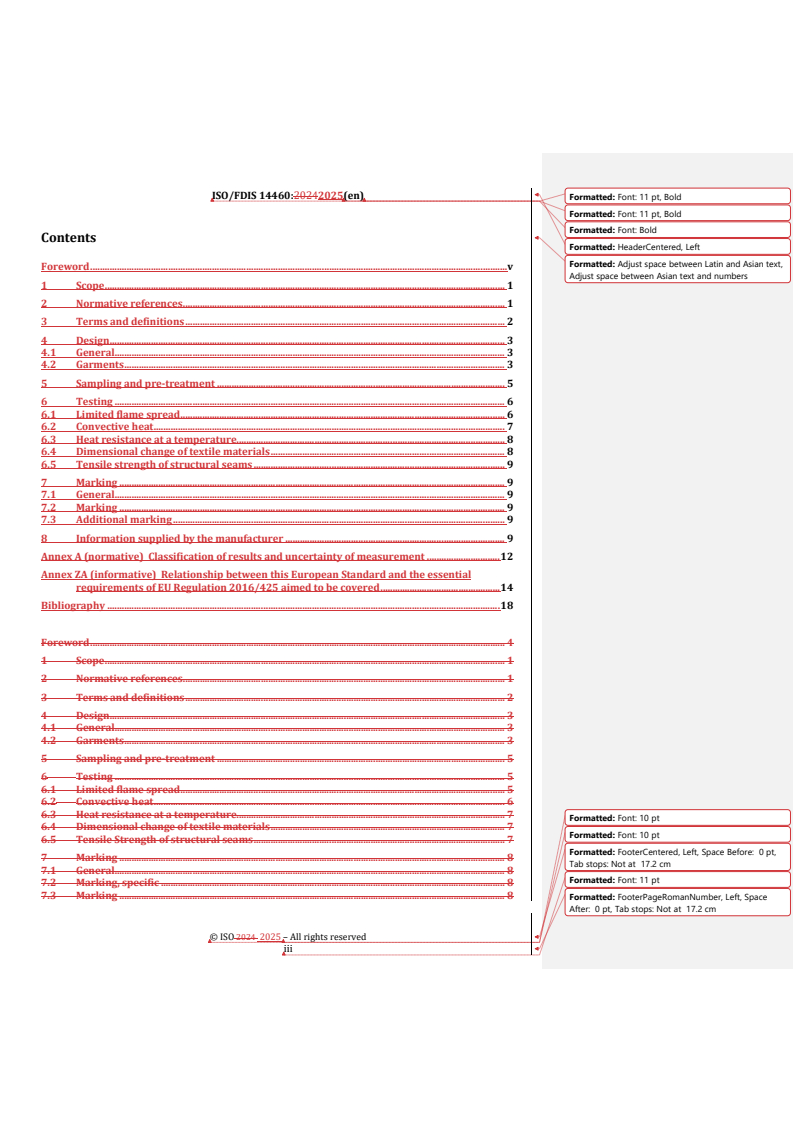
Contents
Formatted: HeaderCentered, Left
Formatted: Adjust space between Latin and Asian text,
Foreword . v
Adjust space between Asian text and numbers
1 Scope . 1
2 Normative references . 1
3 Terms and definitions . 2
4 Design . 3
4.1 General. 3
4.2 Garments . 3
5 Sampling and pre-treatment . 5
6 Testing . 6
6.1 Limited flame spread . 6
6.2 Convective heat . 7
6.3 Heat resistance at a temperature . 8
6.4 Dimensional change of textile materials . 8
6.5 Tensile strength of structural seams . 9
7 Marking . 9
7.1 General. 9
7.2 Marking . 9
7.3 Additional marking . 9
8 Information supplied by the manufacturer . 9
Annex A (normative) Classification of results and uncertainty of measurement . 12
Annex ZA (informative) Relationship between this European Standard and the essential
requirements of EU Regulation 2016/425 aimed to be covered . 14
Bibliography . 18
Foreword . 4
1 Scope . 1
2 Normative references . 1
3 Terms and definitions . 2
4 Design . 3
4.1 General. 3
4.2 Garments . 3
5 Sampling and pre-treatment . 5
6 Testing . 5
6.1 Limited flame spread . 5
6.2 Convective heat . 6
6.3 Heat resistance at a temperature . 7
Formatted: Font: 10 pt
6.4 Dimensional change of textile materials . 7
Formatted: Font: 10 pt
6.5 Tensile Strength of structural seams . 7
Formatted: FooterCentered, Left, Space Before: 0 pt,
7 Marking . 8
Tab stops: Not at 17.2 cm
7.1 General. 8
Formatted: Font: 11 pt
7.2 Marking, specific . 8
7.3 Marking . 8
Formatted: FooterPageRomanNumber, Left, Space
After: 0 pt, Tab stops: Not at 17.2 cm
iii
Formatted: Font: 11 pt, Bold
Formatted: HeaderCentered, Space After: 0 pt, Line
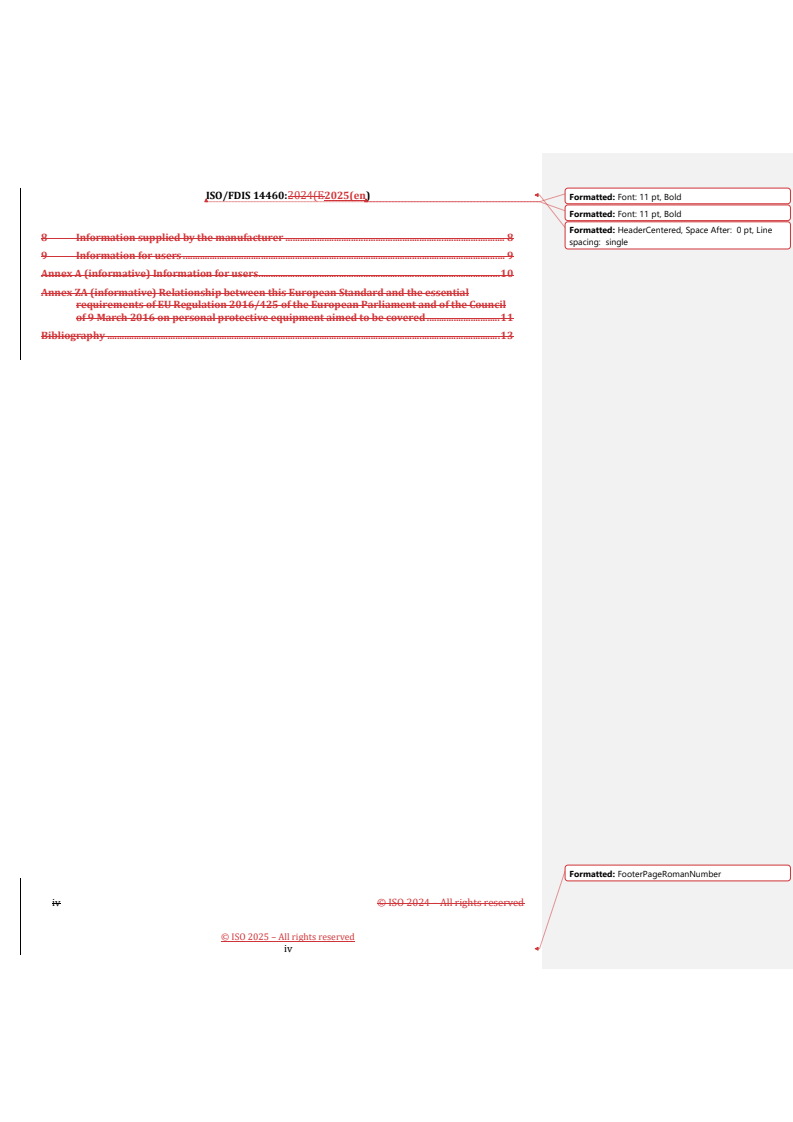
8 Information supplied by the manufacturer . 8
spacing: single
9 Information for users . 9
Annex A (informative) Information for users . 10
Annex ZA (informative) Relationship between this European Standard and the essential
requirements of EU Regulation 2016/425 of the European Parliament and of the Council
of 9 March 2016 on personal protective equipment aimed to be covered . 11
Bibliography . 13
Formatted: FooterPageRomanNumber
iv © ISO 2024 – All rights reserved
iv
Formatted: Font: 11 pt, Bold
Formatted: Font: Bold
Foreword
Formatted: HeaderCentered, Left
ISO (the International Organization for Standardization) is a worldwide federation of national standards Formatted: Adjust space between Latin and Asian text,
bodies (ISO member bodies). The work of preparing International Standards is normally carried out through Adjust space between Asian text and numbers
ISO technical committees. Each member body interested in a subject for which a technical committee has been
established has the right to be represented on that committee. International organizations, governmental and
non-governmental, in liaison with ISO, also take part in the work. ISO collaborates closely with the
International Electrotechnical Commission (IEC) on all matters of electrotechnical standardization.
The procedures used to develop this document and those intended for its further maintenance are described
in the ISO/IEC Directives, Part 1. In particular, the different approval criteria needed for the different types of
ISO documents should be noted. This document was drafted in accordance with the editorial rules of the
ISO/IEC Directives, Part 2 (see www.iso.org/directiveswww.iso.org/directives).
Attention is drawn to the possibility that some of the elements of this document may be the subject of patent
rights. ISO shall not be held responsible for identifying any or all such patent rights. Details of any patent rights
identified during the development of the document will be in the Introduction and/or on the ISO list of patent
declarations received (see www.iso.org/patentswww.iso.org/patents).
Any trade name used in this document is information given for the convenience of users and does not
constitute an endorsement.
For an explanation of the voluntary nature of standards, the meaning of ISO specific terms and expressions
related to conformity assessment, as well as information about ISO's adherence to the World Trade
Organization (WTO) principles in the Technical Barriers to Trade (TBT), see
www.iso.org/iso/foreword.htmlwww.iso.org/iso/foreword.html.
This document was prepared by Technical Committee ISO/TC 94, Personal safety — Personal protective
equipment, Subcommittee SC 13, Protective clothing, in collaboration with the European Committee for
Standardization (CEN) Technical Committee CEN/TC 162, Protective clothing including hand and arm
protection and lifejackets, in accordance with the Agreement on technical cooperation between ISO and CEN
(Vienna Agreement).
This second edition cancels and replaces the first edition (ISO 14460:1999), which has been technically
Formatted: Default Paragraph Font
revised.
Formatted: Default Paragraph Font
Formatted: Default Paragraph Font
The main changes are as follows:
Formatted: Adjust space between Latin and Asian text,
— — Terms and definitions, added new CEN & ISO documents;
Adjust space between Asian text and numbers, Tab
stops: Not at 0.7 cm + 1.4 cm + 2.1 cm + 2.8 cm +
— — Normative references updated;
3.5 cm + 4.2 cm + 4.9 cm + 5.6 cm + 6.3 cm + 7 cm
Formatted: Adjust space between Latin and Asian text,
— — Annex ZAAnnex ZA updated.
Adjust space between Asian text and numbers
Any feedback or questions on this document should be directed to the user’s national standards body. A
Commented [eXtyles1]: The URL
complete listing of these bodies can be found at www.iso.org/members.html.www.iso.org/members.html. https://www.iso.org/members.html has been redirected to
http://www.iso.org/about/members. Please verify the URL.
Formatted: Font: 10 pt
Formatted: Font: 10 pt
Formatted: FooterCentered, Left, Space Before: 0 pt,
Tab stops: Not at 17.2 cm
Formatted: Font: 11 pt
Formatted: FooterPageRomanNumber, Left, Space
After: 0 pt, Tab stops: Not at 17.2 cm
v
FINAL DRAFT International Standard ISO/FDIS 14460:2024(en)
Formatted: Font: Not Bold
Formatted: Header, Left, Space After: 0 pt, Line
spacing: single
Formatted: Main Title 1, Space After: 0 pt, Adjust
Protective clothing for automobile racing drivers — Protection
space between Latin and Asian text, Adjust space
against heat and flame — Performance requirements and test
between Asian text and numbers
methods
1 Scope
Formatted: Adjust space between Latin and Asian text,
Adjust space between Asian text and numbers
This document specifies test methods, performance requirements and design parameters for clothing for
protection against heat and flame intended for drivers in automobile competitions. This document concerns
outer garments, under garments, socks, gloves and balaclava. Shoes and helmets are excluded.
NOTE The intent of this document is to provide a standard for drivers of automobiles that do not fall within the
Formatted: Adjust space between Latin and Asian text,
scope of the FIA. The intent is to provide a similar level of protection as FIA 8856.
Adjust space between Asian text and numbers, Tab
stops: Not at 0.7 cm + 1.4 cm + 2.1 cm + 2.8 cm +
2 Normative references
3.5 cm + 4.2 cm + 4.9 cm + 5.6 cm + 6.3 cm + 7 cm
Formatted: Adjust space between Latin and Asian text,
The following documents are referred to in the text in such a way that some or all of their content constitutes
Adjust space between Asian text and numbers
requirements of this document. For dated references, only the edition cited applies. For undated references,
the latest edition of the referenced document (including any amendments) applies.
ISO 3175-1, Textiles —Dry-cleaning and finishing — Part 1: Method for assessing the cleanability of textiles
and garments
Commented [eXtyles2]: The match came back with a
different title. The original title was: Textiles — Dry-cleaning
and finishing — Part 1: Method for assessing the cleanability
ISO 3758:2023, Textiles — Care labelling code using symbols
of textiles and garments
ISO 5077, Textiles — Determination of dimensional change in washing and drying Commented [eXtyles3]: eXtyles Inline Standards Citation
Match reports that the normative reference "ISO 3758:2023"
is not cited in the text.
ISO 6330, Textiles — Domestic washing and drying procedures for textile testing
ISO 9151, Protective clothing against heat and flame — Determination of heat transmission on exposure
to flame
ISO 11610, Protective clothing — Vocabulary
ISO 13688, Protective clothing — General requirements
ISO 13688:2013/Amd.1:2021, Protective clothing — ISO 3175-1, Textiles —Dry-cleaning and finishing —
Part 1: Method for assessing the cleanability of textiles and garments
ISO 3758, Textiles — Care labelling code using symbols
ISO 3759, Textiles — Preparation, marking and measuring of fabric specimens and garments in tests for
determination of dimensional change
ISO 5077, Textiles — Determination of dimensional change in washing and drying
ISO 8559-1:2017, Size designation of clothes — Part 1: Anthropometric definitions for body measurement
ISO 9151, Protective clothing against heat and flame — Determination of heat transmission on exposure to flame
Formatted: Footer, Left, Space After: 0 pt, Tab stops:
ISO 11610, Protective clothing — Vocabulary
Not at 17.2 cm
Formatted: Font: 11 pt, Bold
Formatted: HeaderCentered, Space After: 0 pt, Line
ISO 13688, Protective clothing — General requirements
spacing: single
ISO 13935-2General requirements/ — Amendment 1
Commented [eXtyles4]: eXtyles Inline Standards Citation
Match reports that the normative reference
"ISO 13688:2013/Amd.1:2021" is not cited in the text.
ISO 13935-2:2014, Textiles — Seam tensile properties of fabrics and made-up textile articles — Part 2:
Determination of maximum force to seam rupture using the grab method
Formatted: Default Paragraph Font
Formatted: Default Paragraph Font, Font: Italic
ISO 15025, Protective clothing — Protection against flame — Method of test for limited flame
Formatted: Adjust space between Latin and Asian text,
spread
Adjust space between Asian text and numbers, Tab
stops: Not at 0.7 cm + 1.4 cm + 2.1 cm + 2.8 cm +
ISO 15025:2016, Protective clothing — Protection against flame — Method of test for limited flame spread
3.5 cm + 4.2 cm + 4.9 cm + 5.6 cm + 6.3 cm + 7 cm
ISO 21420, Protective gloves — General requirements and test methods
Commented [eXtyles5]: The match came back with a
different title. The original title was: Textiles — Seam tensile
properties of fabrics and made-up textile articles — Part 1:
ISO 17493, Clothing and equipment for protection against heat — Test method for convective heat resistance
Determination of maximum force to seam rupture using the
using a hot air circulating oven
grab method
Commented [eXtyles6]: eXtyles Inline Standards Citation
ISO 21420, Protective gloves — General requirements and test methods
Match reports that the normative reference
"ISO 13935-2:2014" is not cited in the text.
3 Terms and definitions
Formatted: Default Paragraph Font
For the purposes of this document, the terms and definitions in ISO 11610 and the following apply.
Formatted: Default Paragraph Font
Formatted: Default Paragraph Font, Font: Italic
ISO and IEC maintain terminology databases for use in standardization at the following addresses:
Formatted: Default Paragraph Font
— — ISO Online browsing platform: available at https://www.iso.org/obphttps://www.iso.org/obp
Formatted: Default Paragraph Font
Formatted: Default Paragraph Font, Font: Italic
— — IEC Electropedia: available at https://www.electropedia.org/https://www.electropedia.org/
Formatted: Default Paragraph Font
3.1 3.1
Formatted: Default Paragraph Font
balaclava
Formatted: Default Paragraph Font, Font: Italic
one-piece garment (3.2)(3.2) designed to fit closely over the entire head and to extend downwards to cover
the neck
Formatted: Adjust space between Latin and Asian text,
Adjust space between Asian text and numbers
3.2 3.2
Formatted: Default Paragraph Font
garment
Formatted: Default Paragraph Font
single item of clothing which may consist of a single or multiple layers
Commented [eXtyles7]: The URL
3.3 3.3
https://www.iso.org/obp has been redirected to
https://www.iso.org/obp/ui. Please verify the URL.
outer garment
one-piece garment (3.2)(3.2) which is worn as an outermost layer over an under garment (3.4)(3.4) and which
Formatted: Adjust space between Latin and Asian text,
is designed to entirely cover the wearer except for the head, hands and feet
Adjust space between Asian text and numbers, Tab
stops: Not at 0.7 cm + 1.4 cm + 2.1 cm + 2.8 cm +
3.4 3.4
3.5 cm + 4.2 cm + 4.9 cm + 5.6 cm + 6.3 cm + 7 cm
under garment
Formatted: TermNum2, Adjust space between Latin
garment (3.2)(3.2) which is designed to be worn between an outer garment (3.3)(3.3) and the wearer's body
and Asian text, Adjust space between Asian text and
numbers
3.5 3.5
component assembly
combination of materials of a multilayer garment (3.2),(3.2), presented exactly as in the finished garment
(3.2)(3.2) construction
Formatted: FooterPageNumber
2 © ISO 2024 – All rights reserved
Formatted: Font: 11 pt, Bold
Formatted: Font: Bold
3.6 3.6
Formatted: HeaderCentered, Left
innermost layer
lining found on that face of the component assembly (3.5)(3.5) which is intended to be nearest to the wearer's
skin
3.7 3.7
Formatted: Adjust space between Latin and Asian text,
closure system
Adjust space between Asian text and numbers, Tab
method of fastening openings in the garment (3.2)(3.2) including combinations of more than one method of
stops: Not at 0.7 cm + 1.4 cm + 2.1 cm + 2.8 cm +
achieving a secure closure
3.5 cm + 4.2 cm + 4.9 cm + 5.6 cm + 6.3 cm + 7 cm
EXAMPLE A slide fastener covered by an overflap fastened down with a touch and close fastener.
Formatted: TermNum2, Adjust space between Latin
and Asian text, Adjust space between Asian text and
3.8 3.8
numbers
seam
Formatted: Adjust space between Latin and Asian text,
junction of two edges of material which are permanently attached in the garment (3.2)(3.2) by sewing or any
Adjust space between Asian text and numbers, Tab
other method
stops: Not at 0.71 cm
Formatted: Default Paragraph Font
3.9 3.9
structural seam
Formatted: Default Paragraph Font
seam (3.8)(3.8) which holds the outer garment (3.3)(3.3) together and which if broken would expose the under
Formatted: Adjust space between Latin and Asian text,
garments (3.4)(3.4) and reduce the protection
Adjust space between Asian text and numbers
Formatted: Default Paragraph Font
4 Design
Formatted: Default Paragraph Font
4.1 General
Formatted: Default Paragraph Font
Formatted: Default Paragraph Font
Any garment and its components shall meet the relevant requirements of ISO 13688 in addition to the
requirements set in this document. For gloves, these shall meet the requirements of ISO 21420.
Formatted: Default Paragraph Font
Formatted: Default Paragraph Font
Garment and glove sizes shall be in accordance with the requirements respectively of ISO 13688 and
Formatted: Adjust space between Latin and Asian text,
ISO 21420.
Adjust space between Asian text and numbers, Tab
stops: Not at 0.71 cm
All tests in 4 and 6 shall be evaluated in accordance with Annex A. Wherever in 6, the requirements for a
property value are expressed in terms of a minimum or maximum value and wherever a minimum or
Formatted: Adjust space between Latin and Asian text,
maximum value is to determine a Level or Class for that property, the resultant property value shall be
Adjust space between Asian text and numbers, Tab
determined in accordance with Annex A.
stops: Not at 0.71 cm + 0.99 cm + 1.27 cm
Formatted: Default Paragraph Font
4.2 Garments
Formatted: Adjust space between Latin and Asian text,
4.2.1 General Adjust space between Asian text and numbers
Formatted: Body Text, Adjust space between Latin and
All garments shall meet the requirements of Clause 6,6, unless specified differently in 4.2.24.2.2 to 4.2.74.2.7.
Asian text, Adjust space between Asian text and
numbers, Tab stops: Not at 0.7 cm + 1.4 cm + 2.1 cm
NOTE Any garments worn underneath or above garments of this document need to have Fire Resistant
+ 2.8 cm + 3.5 cm + 4.2 cm + 4.9 cm + 5.6 cm + 6.3
properties that do not imperil the protective properties of the garments of this document. The instructions for
cm + 7 cm
use shall include a warning statement covering this risk (see 8).
Formatted
...
4.2.2 Outer garments Formatted: Superscript
Formatted
...
The outer garment shall be constructed as one piece and have a fabric minimum weight of 190 g/m before
Formatted: Font: 10 pt
pre-treatment of Clause 5.5. It shall extend to cover the neck and be close-fitting at the wrists and ankles.
Formatted: Font: 10 pt
The collar shall be at least 50 mm high at the back of the neck and 35 mm high at the front. All measurements
Formatted
...
shall be made using ISO 8559-1.
Formatted: Font: 11 pt
All structural seams shall be constructed so as to maintain the integrity of the garment.
Formatted
...
Formatted: Font: 11 pt, Bold
Formatted: HeaderCentered, Space After: 0 pt, Line
It is possible to incorporate elastic bands that do not comply with limited flame clause, provided that the bands
spacing: single
are covered and are not in direct contact with the undergarment or skin. One exception is permitted at ankle
level, in order to ensure that the lower legs of the overalls are kept in position, and only allowed in case in
contact exclusively with the sock (see 4.2.6)4.2.6) and the inside of the shoe.
Embroidery sewn or labels directly onto the outer garment shall be stitched onto the outermost layer only.
The stitching of badges/labels sewn onto the outer garment shall be through the outermost layer only. The
material of the support (or backing) of the badge shall comply with Clause 6.1.6.1.
Straps intended for lifting the wearer shall be incorporated in the garment in the following places:
— — on top of each shoulder;
Formatted: Adjust space between Latin and Asian text,
Adjust space between Asian text and numbers, Tab
— — on each side, at waist level, forward of the median line between the armpit and hip. stops: Not at 0.7 cm + 1.4 cm + 2.1 cm + 2.8 cm +
3.5 cm + 4.2 cm + 4.9 cm + 5.6 cm + 6.3 cm + 7 cm
The sampling procedure for the straps shall be in accordance with 1.1 and five test specimens shall be tested.
When tested in accordance with ISO 13935-2, strap materials shall have a minimum seam strength of 375 N.
Straps shall be placed so as not to make contact with the car seat.
Formatted: Adjust space between Latin and Asian text,
Adjust space between Asian text and numbers
The entry-exit of the cooling system tubes, communication or biometric device cables through the outer
garment shall be particularly well executed and the design must be validated by the laboratory on a case by
case basis. The maximum length of the aperture is 50 mm. The outer garment shall be equipped with a flap
which closes over this opening when tubes or cables are not used.
All requirements of this subclause shall be checked by visual inspection and measurement.
4.2.3 Pockets and closures of outer garment
Formatted: Adjust space between Latin and Asian text,
Adjust space between Asian text and numbers, Tab
The constructionmaterial of the pockets shall meet the requirements of the limit flame spread in clause 6.1.6.1.
stops: Not at 0.71 cm + 0.99 cm + 1.27 cm
Formatted: Adjust space between Latin and Asian text,
In the case of the pockets constructed by cutting through the outer garment material or assembly and adding
Adjust space between Asian text and numbers
an envelope attached internally (hidden pockets), the assembly created by the envelope material and any
other layer between the envelope (whatever the position of the envelope) and the undergarment shall also
meet the requirements of the convective heat clause 6.2.6.2.
Closure systems shall be constructed so as to fulfil the performance requirements of the garment and shall be
covered by an overflap of the same materials as in the component assembly.
Any closure system of an opening longer than 50 mm shall provide continuous closing.
Zip fasteners shall be made from metal and the teeth must be at least size T3. The teeth shall be covered by an
overflap on the outerside and overflap on the innermost side so that they are not in direct contact with the
undergarment. Zip fasteners, regardless of whether exposed or covered when all closure systems in the
garment are in the closed position, shall be directly exposed to flame, using ISO 15025:2016 Procedure A. At
Formatted: Default Paragraph Font
least 5 min after completion of the test, it shall be verified that the zip fasteners can be opened at least once.
Formatted: Default Paragraph Font
Formatted: Default Paragraph Font
The closure system shall meet the requirements of clause 6.1 limit flame spread (including for structural
seam), 6.2 convective heat, and 6.5 structural seam clauses.6.1 (including structural seam), 6.2 and 6.5.
Formatted: FooterPageNumber
4 © ISO 2024 – All rights reserved
Formatted: Font: 11 pt, Bold
Formatted: Font: Bold
4.2.4 Under garments
Formatted: HeaderCentered, Left
Under garments for the upper body shall be designed to cover the wearer's neck (e.g. polo neck) and upper
Formatted: Adjust space between Latin and Asian text,
arm.
Adjust space between Asian text and numbers, Tab
stops: Not at 0.71 cm + 0.99 cm + 1.27 cm
The minimum mass of the materials shall be ≥180 g/m .
Formatted: Adjust space between Latin and Asian text,
Adjust space between Asian text and numbers
The minimum collar height of 40 mm.
Under garments for the lower body shall consist of boxer shorts, with a minimum inner leg measurement of
50 mm, or long underpants. Long underpants are recommended.
NOTE Long underpants are recommended.
All measurements shall be made using ISO 8559-1.
It is possible to incorporate elastic bands that do not comply with clause 6.1,6.1, provided that the bands are
Formatted: Adjust space between Latin and Asian text,
covered and are not in direct contact with the driver’s skin. Adjust space between Asian text and numbers
4.2.5 Balaclava
Formatted: Adjust space between Latin and Asian text,
Adjust space between Asian text and numbers, Tab
All the part of the balaclava seen in frontal projection when the garment is worn, shall consist of at least two
stops: Not at 0.71 cm + 0.99 cm + 1.27 cm
layers and shall have not more than two apertures, no larger than is necessary for normal vision.large enough
Formatted: Adjust space between Latin and Asian text,
not to impair vision. Check by visual inspection. A maximum of four supplementary apertures with a maximum
Adjust space between Asian text and numbers
area of 1 cm each and a maximum length of 20 mm are permitted.
The mass per area of the two layers together shall be ≥180 g/m . The lower part shall be designed to extend
inside the outer or inner garment all around the neck so that it will not come free whichever way the head is
Formatted: Adjust space between Latin and Asian text,
moved.
Adjust space between Asian text and numbers, Tab
stops: Not at 0.71 cm + 0.99 cm + 1.27 cm
A minimum overlap with top undergarments of at least 30 mm around the driver’s neck once the helmet is
Formatted: Adjust space between Latin and Asian text,
tightened, except at the front central line where they shall overlap by at least 80 mm.
Adjust space between Asian text and numbers
4.2.6 Socks
Formatted: Adjust space between Latin and Asian text,
Adjust space between Asian text and numbers, Tab
Socks shall be half-hose with a minimum length of ≥250 mm from base of heal to the top of the sock and the
stops: Not at 0.71 cm + 0.99 cm + 1.27 cm
materials shall have a mass per area ≥180 g/m .
Formatted: Adjust space between Latin and Asian text,
Adjust space between Asian text and numbers
4.2.7 Gloves
Formatted: Default Paragraph Font
The back of the glove shall be composed of at least two layers. The mass per area of the two layers together
Formatted: Default Paragraph Font
shall be ≥180 g/m . Seam stitching shall be invisible. The glove shall be fitted at the wrist and shall be designed
Formatted: Default Paragraph Font
to normally cover at least 8 cm above the wrist joint as defined in ISO 8559-1:2017, 3.1.19. Gloves shall cover
the cuffs of the wearer's outer garment.
Formatted: Default Paragraph Font
Formatted: Default Paragraph Font
As leather shrinks considerably on exposure to flame, it is recommended that its use is limited shall only tobe
Formatted: Adjust space between Latin and Asian text,
used for the tactile areas of the hand. The thickness of the leather shall be maximum 0,8 mm and preferably
Adjust space between Asian text and numbers
as thin as possible to limit the strain due to shrinkage.
Formatted: Font: 10 pt
NOTE The leather needs to be as thin as possible to limit the strain due to shrinkage.
Formatted: Font: 10 pt
Formatted: FooterCentered, Left, Space Before: 0 pt,
5 Sampling and pre-treatment
Tab stops: Not at 17.2 cm
5.1 Samples submitted for testing shall consist of at least one new complete garment.
Formatted: Font: 11 pt
Additional garments or material samples may be required, and these shall be to the same
Formatted: FooterPageNumber, Left, Space After: 0 pt,
specifications as the appropriate component assemblies (see 3.3).
Tab stops: Not at 17.2 cm
Formatted: Font: 11 pt, Bold
Formatted: HeaderCentered, Space After: 0 pt, Line
5.1 5.2 If all regions of the garment are not composed of the same materials, each different region shall
spacing: single
be sampled and tested.
Formatted: Font: 11 pt, Not Bold
5.3 The number and size of specimens for the different tests shall be in accordance with the
Formatted: Adjust space between Latin and Asian text,
respective standards.
Adjust space between Asian text and numbers, Tab
stops: Not at 0.7 cm + 1.4 cm + 2.1 cm + 2.8 cm +
5.2 5.4 In all surface tests the outermost surface shall be exposed.
3.5 cm + 4.2 cm + 4.9 cm + 5.6 cm + 6.3 cm + 7 cm
Formatted: Font: Not Bold
5.5 All tests shall be carried out on materials as received. Tests in 6.1 and 6.2 shall also be carried out on
Formatted: Font: 11 pt, Not Bold
materials which have been 5.3 Before each test specified in this document, the test materials and test
specimens shall be pre-treated. The by cleaning. If the manufacturer’s instructions and information indicates
Formatted: Font: Not Bold
that cleaning is not allowed, then testing shall be carried out on new material. In addition, 6.1 requires that
Formatted
...
the limited flame spread tests shall be carried out both before and after the pre-treatment.
The cleaning shall consist be in line with the manufacturer’s instructions and information, on the basis of
standardized processes. If the number of 15 washingcleaning cycles in accordance with ISO 6330, using the
procedure specified by the manufacturer or procedure 6N if not otherwiseis not specified, and 15 dry the tests
shall be carried out after five cleaning cycles in accordance with ISO 3175-1. Materials, such as leather, which
Formatted
...
are unsuitable for(a cleaning cycle is one wash and one dry cycle). This shall be reflected in the information
supplied by the manufacturer. If the garment can be washed and dry cleaning should-cleaned, it shall only be Formatted
...
washed-cycled with no detergent. If only dry-cleaning is allowed, the garment shall be dry-cleaned in
Formatted
...
accordance with the manufacturer's instructions and information.
Formatted: Default Paragraph Font
NOTE Manufacturer’s instructions and information typically indicates one or several of the various methods and
Formatted: Default Paragraph Font
[ ] [ ] [ ]
processes of ISO 6330 0 , ISO 15797 0 , ISO 3175-2 0 , or equivalent as standardized processes for cleaning.
Formatted
...
Formatted
6 Testing
...
Formatted: Default Paragraph Font
6.1 Limited flame spread
Formatted: Default Paragraph Font
Testing of materials and seams shall take place in accordance with ISO 15025:2016, Procedure A (code letter
Formatted: Font: Not Bold
A1). Three test specimens shall be used to carry out each test. Specimens from the garment assembly shall
Formatted
...
meet the following requirements (see Table 1).Table 1).
Formatted Table
This test shall be carried out both before and after the pre-treatment specified in 5.5.
Formatted: Font: Not Bold
Formatted
...
Table 1 — Limited flame spread performance requirements, ISO 15025:2016, Procedure A (code
letter A1) Formatted
...
Formatted
...
PropertieProp Requirement
erty
Formatted
...
Formatted
Flame spread No specimen shall permit any part of the lowest boundary of any flame to reach the upper or
...
either vertical edge.
Formatted
...
Flaming debris No specimen shall give flaming or molten debris.
Formatted
...
Hole formation No specimen shall give hole formation of 5 mm or greater in any direction, except for an
Formatted
...
interlining that is used for specific protection other than flame protection
Formatted: Default Paragraph Font
Afterglow Afterglow time shall be ≤2 s.
Formatted: Default Paragraph Font
A glowing inside the charred area is defined in ISO 15025 as afterglow without combustion and,
Formatted
for the purpose of this clause, shall not be regarded as afterglow
...
Formatted
Afterflame Afterflame time shall be ≤2 s. .
Formatted: FooterPageNumber
6 © ISO 2024 – All rights reserved
Formatted: Font: 11 pt, Bold
Formatted: Font: Bold
For seams, three specimens containing a structural seam shall be tested in accordance with ISO 15025:2016,
Formatted: HeaderCentered, Left
Procedure A. Specimens shall be oriented with the seam running up the centreline of the outer surface of the
test specimen so that the burner flame impinges directly upon the seam. Seams shall meet the requirements
Formatted: Default Paragraph Font
of Table 1Table 1 and shall not separate.
Formatted: Default Paragraph Font
Formatted: Space Before: 12 pt, Adjust space between
Labels, badges, retro-reflective materials, and transfers, etc., which are applied to the outermost surface of the
Latin and Asian text, Adjust space between Asian text
garment, shall be tested only after pre-treatment according to 55 in combination with the outer layer to make
and numbers
it possible to take samples with the dimensions as indicated in ISO 15025:2016, Procedure A. Three
specimens containing the item shall be tested. The items shall be oriented with the longer dimensions running
Formatted: Adjust space between Latin and Asian text,
up the centreline of the test specimen so that the burner flame impinges directly upon the middle surface of Adjust space between Asian text and numbers
the item, not the edge. The combination with the outermost layer of the garment shall meet the requirements
Formatted: Default Paragraph Font
of Table 1.Table 1.
Formatted: Default Paragraph Font
6.2 Convective heat
Formatted: Adjust space between Latin and Asian text,
Adjust space between Asian text and numbers, Tab
6.2.1 Heat test
stops: Not at 0.71 cm
Formatted: Adjust space between Latin and Asian text,
When tested in accordance with ISO 9151, three test specimens of each of the different fabric
Adjust space between Asian text and numbers, Tab
assemblyassemblies shall have the following Heat Transfer Indexheat transfer index (HTI) for:
stops: Not at 0.71 cm + 0.99 cm + 1.27 cm
Formatted: Default Paragraph Font
— — outer garment – HTI24 ≥ 12;
Formatted: Default Paragraph Font
— — under garment – HTI ≥ 5:;
Formatted: Adjust space between Latin and Asian text,
Adjust space between Asian text and numbers
— — balaclava – HTI ≥ 5;
Formatted: Adjust space between Latin and Asian text,
— — socks– HTI ≥ 5; Adjust space between Asian text and numbers, Tab
stops: Not at 0.7 cm + 1.4 cm + 2.1 cm + 2.8 cm +
— — gloves. – for palm HTI ≥ 9, for back of hand HTI ≥ 13,5. 3.5 cm + 4.2 cm + 4.9 cm + 5.6 cm + 6.3 cm + 7 cm
24 24
Commented [eXtyles8]: No section matches the in-text
6.2.2 Mechanical resistance after convective heat
citation "13.5". Please supply the missing section or delete
the citation.
The mechanical resistance of component assemblies after exposure to flame shall be tested in accordance with
Formatted: Adjust space between Latin and Asian text,
the followingthree test. The mechanical resistance of specimens of each of the component assemblies after
Adjust space between Asian text and numbers, Tab
exposure to flame shall be tested in accordance with the following test.:
stops: Not at 0.71 cm + 0.99 cm + 1.27 cm
Formatted: Adjust space between Latin and Asian text,
— Mount a component assembly specimen, 140 mm by × 140 mm centrally face downwards on the ISO 9151
Adjust space between Asian text and numbers
test apparatus. Apply the flame for (11,0 ± 0,2) s. Within 1 min following the removal of the flame, place
Formatted: Default Paragraph Font
the specimen on a horizontal plane.
Formatted: Default Paragraph Font
— Manually fold the specimen 180°, along the middle of the burn. As shown in Figure 1, llaceFigure 1, place
a 2 kg weight piece on the fold fabric, centring the weight piece over the middle of the folded edge of the
specimen at the intersection of lines 2 and 3. Leave the weight piece in this position for 3 s, then remove
the weight piece. Fold the specimen in the opposite direction along the same edge. Again place a 2 kg
weight piece on the calorimeter location plate, centring the weight piece over the middle of the folded edge
Formatted: Adjust space between Latin and Asian text,
of the specimen at the intersection of lines 2 and 3. Leave the weight piece again for 3 s. Repeat this folding Adjust space between Asian text and numbers, Tab
procedure three more times to reach a total of five times. stops: Not at 0.7 cm + 1.4 cm + 2.1 cm + 2.8 cm +
3.5 cm + 4.2 cm + 4.9 cm + 5.6 cm + 6.3 cm + 7 cm
NOTE If the fabric is too thick for the weight to remain stable, a non-flexible board, that does not significantly
Formatted
...
increase the weight on the tested fabric is to be used.
Formatted
...
DRAFT INTERNATIONAL STANDARD
ISO/DIS 14460
ISO/TC 94/SC 13 Secretariat: SNV
Voting begins on: Voting terminates on:
2023-01-25 2023-04-19
Protective clothing for automobile racing drivers —
Protection against heat and flame — Performance
requirements and test methods
Vêtements de protection pour pilotes automobiles — Protection contre la chaleur et le feu — Exigences de
performance et méthodes d'essai
ICS: 97.220.40; 13.340.10
This document is circulated as received from the committee secretariat.
THIS DOCUMENT IS A DRAFT CIRCULATED
FOR COMMENT AND APPROVAL. IT IS
ISO/CEN PARALLEL PROCESSING
THEREFORE SUBJECT TO CHANGE AND MAY
NOT BE REFERRED TO AS AN INTERNATIONAL
STANDARD UNTIL PUBLISHED AS SUCH.
IN ADDITION TO THEIR EVALUATION AS
BEING ACCEPTABLE FOR INDUSTRIAL,
TECHNOLOGICAL, COMMERCIAL AND
USER PURPOSES, DRAFT INTERNATIONAL
STANDARDS MAY ON OCCASION HAVE TO
BE CONSIDERED IN THE LIGHT OF THEIR
POTENTIAL TO BECOME STANDARDS TO
WHICH REFERENCE MAY BE MADE IN
Reference number
NATIONAL REGULATIONS.
ISO/DIS 14460:2023(E)
RECIPIENTS OF THIS DRAFT ARE INVITED
TO SUBMIT, WITH THEIR COMMENTS,
NOTIFICATION OF ANY RELEVANT PATENT
RIGHTS OF WHICH THEY ARE AWARE AND TO
PROVIDE SUPPORTING DOCUMENTATION. © ISO 2023
ISO/DIS 14460:2023(E)
DRAFT INTERNATIONAL STANDARD
ISO/DIS 14460
ISO/TC 94/SC 13 Secretariat: SNV
Voting begins on: Voting terminates on:
Protective clothing for automobile racing drivers —
Protection against heat and flame — Performance
requirements and test methods
Vêtements de protection pour pilotes automobiles — Protection contre la chaleur et le feu — Exigences de
performance et méthodes d'essai
ICS: 97.220.40; 13.340.10
This document is circulated as received from the committee secretariat.
THIS DOCUMENT IS A DRAFT CIRCULATED
FOR COMMENT AND APPROVAL. IT IS
© ISO 2023
ISO/CEN PARALLEL PROCESSING
THEREFORE SUBJECT TO CHANGE AND MAY
All rights reserved. Unless otherwise specified, or required in the context of its implementation, no part of this publication may
NOT BE REFERRED TO AS AN INTERNATIONAL
be reproduced or utilized otherwise in any form or by any means, electronic or mechanical, including photocopying, or posting on STANDARD UNTIL PUBLISHED AS SUCH.
the internet or an intranet, without prior written permission. Permission can be requested from either ISO at the address below
IN ADDITION TO THEIR EVALUATION AS
or ISO’s member body in the country of the requester. BEING ACCEPTABLE FOR INDUSTRIAL,
TECHNOLOGICAL, COMMERCIAL AND
ISO copyright office
USER PURPOSES, DRAFT INTERNATIONAL
CP 401 • Ch. de Blandonnet 8
STANDARDS MAY ON OCCASION HAVE TO
BE CONSIDERED IN THE LIGHT OF THEIR
CH-1214 Vernier, Geneva
POTENTIAL TO BECOME STANDARDS TO
Phone: +41 22 749 01 11
WHICH REFERENCE MAY BE MADE IN
Reference number
Email: copyright@iso.org
NATIONAL REGULATIONS.
Website: www.iso.org ISO/DIS 14460:2022(E)
RECIPIENTS OF THIS DRAFT ARE INVITED
Published in Switzerland
TO SUBMIT, WITH THEIR COMMENTS,
NOTIFICATION OF ANY RELEVANT PATENT
RIGHTS OF WHICH THEY ARE AWARE AND TO
ii
PROVIDE SUPPORTING DOCUMENTATION. © ISO 2022
ISO/DIS 14460:2022(E)
Contents Page
Foreword .iv
1 Scope . 1
2 Normative references . 1
3 Terms and definitions . 1
4 Design . 2
4.1 General . 2
4.2 Garments. 3
4.2.1 General . 3
4.2.2 Outer Garments . 3
4.2.3 Pockets and closures of outer garment . 3
4.2.4 Under garments . 4
4.2.5 Balaclava . 4
4.2.6 Socks. 4
4.2.7 Gloves . 4
5 Sampling and pre-treatment . .4
6 Testing. 5
6.1 Limited flame spread . 5
6.2 Convective heat . 5
6.2.1 Heat test . 5
6.2.2 Mechanical resistance after convective heat . 6
6.3 Heat resistance at a temperature . 6
6.4 The mechanical resistance of component assemblies after exposure to flame shall
be tested in accordance with the following test. . 6
6.5 Dimensional change of textile materials . 7
6.6 Tensile Strength of structural seams . 7
7 Marking . . 8
7.1 General . 8
7.2 Marking, specific. 8
7.3 Marking,. 8
8 Information supplied by the manufacturer . 8
Annex A (informative) Information for users . 9
Annex ZA (informative) Relationship between this European Standard and the essential
requirements of EU Regulation 2016/425 of the European Parliament and of the
Council of 9 March 2016 on personal protective equipment aimed to be covered .10
iii
ISO/DIS 14460:2022(E)
Foreword
ISO (the International Organization for Standardization) is a worldwide federation of national standards
bodies (ISO member bodies). The work of preparing International Standards is normally carried out
through ISO technical committees. Each member body interested in a subject for which a technical
committee has been established has the right to be represented on that committee. International
organizations, governmental and non-governmental, in liaison with ISO, also take part in the work.
ISO collaborates closely with the International Electrotechnical Commission (IEC) on all matters of
electrotechnical standardization.
The procedures used to develop this document and those intended for its further maintenance are
described in the ISO/IEC Directives, Part 1. In particular, the different approval criteria needed for the
different types of ISO documents should be noted. This document was drafted in accordance with the
editorial rules of the ISO/IEC Directives, Part 2 (see www.iso.org/directives).
Attention is drawn to the possibility that some of the elements of this document may be the subject of
patent rights. ISO shall not be held responsible for identifying any or all such patent rights. Details of
any patent rights identified during the development of the document will be in the Introduction and/or
on the ISO list of patent declarations received (see www.iso.org/patents).
Any trade name used in this document is information given for the convenience of users and does not
constitute an endorsement.
For an explanation of the voluntary nature of standards, the meaning of ISO specific terms and
expressions related to conformity assessment, as well as information about ISO's adherence to
the World Trade Organization (WTO) principles in the Technical Barriers to Trade (TBT), see
www.iso.org/iso/foreword.html.
This document was prepared by Technical Committee ISO/TC 94, Personal safety — Personal protective
equipment, Subcommittee SC 13, Protective clothing.
The intent of this document is to provide a standard for drivers of automobiles that do not fall within
the scope of the FIA. The intent is to provide a similar level of protection as FIA 8856.
This second edition cancels and replaces the first edition (ISO 14460:1999), which has been technically
revised.
The main changes are as follows:
— Terms and Definition, added new CEN & ISO Documents
— Normative references updated
— Annex ZA updated
Any feedback or questions on this document should be directed to the user’s national standards body. A
complete listing of these bodies can be found at www.iso.org/members.html.
iv
DRAFT INTERNATIONAL STANDARD ISO/DIS 14460:2022(E)
Protective clothing for automobile racing drivers —
Protection against heat and flame — Performance
requirements and test methods
1 Scope
This document specifies test methods, performance requirements and design parameters for clothing
for protection against heat and flame intended for drivers in automobile competitions. This document
concerns outer garments, under garments, socks, gloves and balaclava. Shoes and helmets are excluded.
The intent of this is to provide a standard for drivers of automobiles that do not fall within the scope of
the FIA. The intent is to provide a similar level of protection as FIA 8856
2 Normative references
The following documents are referred to in the text in such a way that some or all of their content
constitutes requirements of this document. For dated references, only the edition cited applies. For
undated references, the latest edition of the referenced document (including any amendments) applies.
ISO 3175-1:2017, Textiles — Dry-cleaning and finishing — Part 1: Method for assessing the cleanability of
textiles and garments
ISO 3758:2012, Textiles — Care labelling code using symbols
ISO 4675:2017, Rubber- or plastics-coated fabrics — Low-temperature bend test
ISO 6330:2021, Textiles — Domestic washing and drying procedures for textile testing
ISO 9151:2016, Protective clothing against heat and flame — Determination of heat transmission on
exposure to flame
ISO 13688:2013, Protective clothing — General requirements
I S O 136 8 8:2013/A md1: 2021, Protective clothing — General requirements – Amendment 1
ISO 13935-1:2014, Textiles — Seam tensile properties of fabrics and made-up textile articles — Part 1:
Determination of maximum force to seam rupture using the strip method
ISO 15025:2016, Protective clothing — Protection against flame — Method of test for limited flame spread
ISO 17493:2016, Clothing and equipment for protection against heat — Test method for convective heat
resistance using a hot air circulating oven
ISO 23407:2021, Protective gloves against thermal risks (heat and/or fire)
ISO 5077:2007, Textiles — Determination of dimensional change in washing and drying
ISO 21420:2020, Protective gloves — General requirements and test methods
3 Terms and definitions
For the purposes of this document, the terms and definitions in ISO 11610 and the following apply.
ISO/DIS 14460:2022(E)
ISO and IEC maintain terminology databases for use in standardization at the following addresses:
— ISO Online browsing platform: available at https:// www .iso .org/ obp
— IEC Electropedia: available at https:// www .electropedia .org/
3.1
balaclava
one-piece garment designed to fit closely over the entire head and to extend downwards to cover the
neck
3.2
garment
single item of clothing which may consist of a single or multiple layers
3.4
outer garment
one-piece garment which is worn as an outermost layer over an under garment and which is designed
to entirely cover the wearer except for the head, hands and feet
3.5
under garment
garment which is designed to be worn between an outer garment and the wearer's body
3.6
component assembly
combination of materials of a multilayer garment, presented exactly as in the finished garment
construction
3.7
innermost layer
lining found on that face of the component assembly which is intended to be nearest to the wearer's skin
3.8
closure system
method of fastening openings in the garment including combinations of more than one method of
achieving a secure closure
EXAMPLE A slide fastener covered by an overflap fastened down with a touch and close fastener.
3.9
seam
junction of two edges of material which are permanently attached in the garment by sewing or any
other method
3.10
structural seam
seam which holds the outer garment together and which if broken would expose the under garments
and reduce the protection
4 Design
4.1 General
Any garment and its component shall meet the relevant requirements of ISO 13688 in addition to the
requirements set in this document. For gloves, these shall meet the requirements of ISO 21420.
Garment and glove sizes shall be in accordance with the requirements respectively of ISO 13688 and
ISO 21420.
ISO/DIS 14460:2022(E)
4.2 Garments
4.2.1 General
All garments shall meet the requirements of Clause 6, unless specified differently in the subclauses
below.
NOTE Any garments worn underneath or above garments of this document need to have FR properties that
do not imperil the protective properties of the garments of this document.
4.2.2 Outer Garments
The outer garment shall be constructed as one piece and have a minimum weight of 190 g/m2 before
pre-treatment of clause 5. It shall extend to cover the neck and be close-fitting at the wrists and ankles.
The collar shall be at least 50 mm high at the back of the neck and 35 mm high at the front.
All structural seams shall be constructed so as to maintain the integrity of the garment.
It is possible to incorporate elastic bands that do not comply with limited flame clause, provided that
the bands are covered and are not in direct contact with the undergarment or skin. On
...
PROJET DE NORME INTERNATIONALE
ISO/DIS 14460
ISO/TC 94/SC 13 Secrétariat: SNV
Début de vote: Vote clos le:
2023-01-25 2023-04-19
Habillement de protection pour pilotes automobiles —
Protection contre la chaleur et les flammes — Exigences de
performance et méthodes d'essai
Protective clothing for automobile racing drivers — Protection against heat and flame — Performance
requirements and test methods
ICS: 97.220.40; 13.340.10
Le présent document est distribué tel qu’il est parvenu du secrétariat du comité.
CE DOCUMENT EST UN PROJET DIFFUSÉ POUR
OBSERVATIONS ET APPROBATION. IL EST DONC
SUSCEPTIBLE DE MODIFICATION ET NE PEUT
ÊTRE CITÉ COMME NORME INTERNATIONALE
TRAITEMENT PARALLÈLE ISO/CEN
AVANT SA PUBLICATION EN TANT QUE TELLE.
OUTRE LE FAIT D’ÊTRE EXAMINÉS POUR
ÉTABLIR S’ILS SONT ACCEPTABLES À DES
FINS INDUSTRIELLES, TECHNOLOGIQUES ET
COMMERCIALES, AINSI QUE DU POINT DE VUE
DES UTILISATEURS, LES PROJETS DE NORMES
INTERNATIONALES DOIVENT PARFOIS ÊTRE
CONSIDÉRÉS DU POINT DE VUE DE LEUR
POSSIBILITÉ DE DEVENIR DES NORMES
POUVANT SERVIR DE RÉFÉRENCE DANS LA
RÉGLEMENTATION NATIONALE.
Numéro de référence
LES DESTINATAIRES DU PRÉSENT PROJET ISO/DIS 14460:2023(F)
SONT INVITÉS À PRÉSENTER, AVEC LEURS
OBSERVATIONS, NOTIFICATION DES DROITS
DE PROPRIÉTÉ DONT ILS AURAIENT
ÉVENTUELLEMENT CONNAISSANCE ET À
FOURNIR UNE DOCUMENTATION EXPLICATIVE.
ISO/DIS 14460:2023(F)
ISO/TC 94/SC 13
Date : 2023-04-19
ISO/DIS 14460:2022(F)
ISO/TC 94/SC 13
Secrétariat : SNV
Habillement de protection pour pilotes automobiles — Protection
contre la chaleur et les flammes — Exigences de performance et
méthodes d’essai
Protective clothing for automobile racing drivers — Protection against heat and flame — Performance
requirements and test methods
ICS : 97.220.40 ; 13.340.10
Avertissement
Ce document n'est pas une Norme internationale de l'ISO. Il est distribué pour examen et observations.
Il est susceptible de modification sans préavis et ne peut être cité comme Norme internationale.
Les destinataires du présent projet sont invités à présenter, avec leurs observations, notification des
droits de propriété dont ils auraient éventuellement connaissance et à fournir une documentation
explicative.
DOCUMENT PROTÉGÉ PAR COPYRIGHT
© ISO 2023
Tous droits réservés. Sauf prescription différente ou nécessité dans le contexte de sa mise en œuvre, aucune partie de cette
publication ne peut être reproduite ni utilisée sous quelque forme que ce soit et par aucun procédé, électronique ou mécanique,
y compris la photocopie, ou la diffusion sur l’internet ou sur un intranet, sans autorisation écrite préalable. Une autorisation peut
être demandée à l’ISO à l’adresse ci-après ou au comité membre de l’ISO dans le pays du demandeur.
ISO copyright office
Case postale 401 • Ch. de Blandonnet 8
CH-1214 Vernier, Genève
Type du document: Norme internationale
Tél.: +41 22 749 01 11
Sous-type du document:
E-mail: copyright@iso.org
Web: www.iso.org
Stade du document: (40) Enquête
Langue du document: F
Publié en Suisse
ii
ISO/DIS 14460:2023(F)
Sommaire Page
Avant-propos . iv
1 Domaine d’application . 1
2 Références normatives . 1
3 Termes et définitions . 2
4 Conception . 3
4.1 Généralités . 3
4.2 Vêtements . 3
4.2.1 Généralités . 3
4.2.2 Vêtements de dessus . 3
4.2.3 Poches et fermetures du vêtement de dessus . 4
4.2.4 Sous-vêtements . 5
4.2.5 Cagoule . 5
4.2.6 Chaussettes . 5
4.2.7 Gants . 5
5 Échantillonnage et prétraitement . 5
6 Essais . 6
6.1 Propagation de flamme limitée . 6
6.2 Chaleur convective . 7
6.2.1 Essai à la chaleur . 7
6.2.2 Résistance mécanique après chaleur convective . 7
6.3 Résistance à la chaleur à une température donnée . 7
6.4 La résistance mécanique des assemblages de composants après exposition à une
flamme doit être déterminée en utilisant l’essai suivant. . 8
6.5 Variation dimensionnelle des matériaux textiles . 9
6.6 Résistance à la traction des coutures de structure . 9
7 Marquage . 9
7.1 Généralités . 9
7.2 Spécificités du marquage . 9
7.3 Marquage . 9
8 Informations fournies par le fabricant . 10
Annexe A (informative) Informations destinées aux utilisateurs . 11
Annexe ZA (informative) Relation entre la présente Norme européenne et les exigences
essentielles concernées du Règlement UE 2016/425 du Parlement européen et du
Conseil du 9 mars 2016 relatif aux équipements de protection individuelle . 12
ISO/DIS 14460:2023(F)
Avant-propos
L’ISO (Organisation internationale de normalisation) est une fédération mondiale d’organismes
nationaux de normalisation (comités membres de l’ISO). L’élaboration des Normes internationales est
en général confiée aux comités techniques de l’ISO. Chaque comité membre intéressé par une étude a le
droit de faire partie du comité technique créé à cet effet. Les organisations internationales,
gouvernementales et non gouvernementales, en liaison avec l’ISO participent également aux travaux.
L’ISO collabore étroitement avec la Commission électrotechnique internationale (IEC) en ce qui
concerne la normalisation électrotechnique.
Les procédures utilisées pour élaborer le présent document et celles destinées à sa mise à jour sont
décrites dans les Directives ISO/IEC, Partie 1. Il convient, en particulier de prendre note des différents
critères d’approbation requis pour les différents types de documents ISO. Le présent document a été
rédigé conformément aux règles de rédaction données dans les Directives ISO/IEC, Partie 2
(voir www.iso.org/directives).
L’attention est attirée sur le fait que certains des éléments du présent document peuvent faire l’objet de
droits de propriété intellectuelle ou de droits analogues. L’ISO ne saurait être tenu pour responsable de
ne pas avoir identifié de tels droits de propriété et averti de leur existence. Les détails concernant les
références aux droits de propriété intellectuelle ou autres droits analogues identifiés lors de
l’élaboration du document sont indiqués dans l’Introduction et/ou dans la liste des déclarations de
brevets reçues par l’ISO (voir www.iso.org/brevets).
Les appellations commerciales éventuellement mentionnées dans le présent document sont données
pour information, par souci de commodité, à l’intention des utilisateurs et ne sauraient constituer un
engagement.
Pour une explication de la nature volontaire des normes, la signification des termes et expressions
spécifiques de l’ISO liés à l’évaluation de la conformité, ou pour toute information au sujet de l’adhésion
de l’ISO aux principes de l’Organisation mondiale du commerce (OMC) concernant les obstacles
techniques au commerce (OTC), voir le lien suivant : www.iso.org/iso/fr/avant-propos.
Ce document a été élaboré par le comité technique ISO/TC 94, Sécurité individuelle — Équipement de
protection individuelle, sous-comité SC 13, Vêtements de protection.
Le présent document a pour objectif de fournir une norme pour les pilotes d’automobiles qui n’entrent
pas dans le domaine d’application de la FIA. Son intention est de fournir un niveau de protection
similaire à celui de la norme FIA 8856.
Cette deuxième édition annule et remplace la première édition (ISO 14460:1999), qui a fait l’objet d’une
révision technique.
Les principales modifications sont les suivantes :
— ajout de nouveaux documents de référence CEN et ISO à la partie Termes et définitions ;
— mise à jour des Références normatives ;
— mise à jour de l’Annexe ZA.
Il convient que l’utilisateur adresse tout retour d’information ou toute question concernant le présent
document à l’organisme national de normalisation de son pays. Une liste exhaustive desdits organismes
se trouve à l’adresse www.iso.org/members.html.
iv © ISO 2023 – Tous droits réservés
PROJET DE NORME INTERNATIONALE ISO/DIS 14460:2023(F)
Habillement de protection pour pilotes automobiles — Protection
contre la chaleur et les flammes — Exigences de performance et
méthodes d’essai
1 Domaine d’application
Le présent document spécifie les méthodes d’essai, les exigences de performance et les paramètres de
conception de l’habillement de protection contre la chaleur et les flammes destiné à être porté par les
pilotes lors des courses automobiles. Le présent document porte sur les vêtements de dessus,
les sous-vêtements, les chaussettes, les gants et les cagoules. Les chaussures et les casques sont exclus.
Le présent document a pour objectif de fournir une norme pour les pilotes d’automobiles qui n’entrent
pas dans le domaine d’application de la FIA. Son intention est de fournir un niveau de protection
similaire à celui de la norme FIA 8856.
2 Références normatives
Les documents suivants sont cités dans le texte de sorte qu’ils constituent, pour tout ou partie de leur
contenu, des exigences du présent document. Pour les références datées, seule l’édition citée s’applique.
Pour les références non datées, la dernière édition du document de référence s’applique (y compris les
éventuels amendements).
ISO 3175-1:2017, Textiles — Entretien professionnel, nettoyage à sec et nettoyage à l’eau des étoffes et
des vêtements — Partie 1 : Évaluation de la résistance après le nettoyage et la finition.
ISO 3758:2012, Textiles — Code d’étiquetage d’entretien au moyen de symboles.
ISO 4675:2017, Supports textiles revêtus de caoutchouc ou de plastique — Essai de flexion à basse
température.
ISO 6330:2021, Textiles — Méthodes de lavage et de séchage domestiques en vue des essais des textiles.
ISO 9151:2016, Vêtements de protection contre la chaleur et les flammes — Détermination de la
transmission de chaleur à l’exposition d’une flamme.
ISO 13688:2013, Vêtements de protection — Exigences générales.
ISO 13688:2013/A1:2021, Vêtements de protection — Exigences générales — Amendement 1.
ISO 13935-1:2014, Textiles — Propriétés de résistance à la traction des coutures d’étoffes et d’articles
textiles confectionnés — Partie 1 : Détermination de la force maximale avant rupture des coutures par la
méthode sur bande.
ISO 15025:2016, Vêtements de protection — Protection contre les flammes — Méthode d’essai pour la
propagation de flamme limitée.
ISO/DIS 14460:2023(F)
ISO 17493:2016, Vêtements et équipement de protection contre la chaleur — Méthode d’essai de la
résistance à la chaleur de convection au moyen d’un four à circulation d’air chaud.
ISO 23407:2021, Gants de protection contre les risques thermiques (chaleur et/ou feu).
ISO 5077:2007, Textiles — Détermination des variations dimensionnelles au lavage et au séchage
domestiques.
ISO 21420:2020, Gants de protection — Exigences générales et méthodes d’essai.
3 Termes et définitions
Pour les besoins du présent document, les termes et définitions donnés dans l’ISO 11610 ainsi que les
suivants s’appliquent.
L’ISO et l’IEC tiennent à jour des bases de données terminologiques destinées à être utilisées en
normalisation, consultables aux adresses suivantes :
— ISO Online browsing platform : disponible à l’adresse https://www.iso.org/obp ;
— IEC Electropedia : disponible à l’adresse https://www.electropedia.org/.
3.1
cagoule
vêtement fait d’une seule pièce porté ajusté sur la tête et se prolongeant de manière à recouvrir le cou
3.2
vêtement
article individuel d’habillement qui peut être constitué d’une ou plusieurs couches
3.4
vêtement de dessus
vêtement fait d’une seule pièce destiné à être porté comme couche la plus extérieure sur un
sous-vêtement et qui est conçu pour recouvrir intégralement le porteur à l’exception de la tête,
des mains et des pieds
3.5
sous-vêtement
vêtement destiné à être porté entre un vêtement de dessus et le corps du porteur
3.6
assemblage de composants
combinaison de matériaux d’un vêtement multicouche se présentant comme dans la constitution du
vêtement fini
3.7
couche la plus intérieure
doublure se trouvant sur la face de l’assemblage de composants destinée à être la plus proche de la
peau du porteur
2 © ISO 2023 – Tous droits réservés
ISO/DIS 14460:2023(F)
3.8
système de fermeture
méthode d’attache des ouvertures du vêtement, y compris les combinaisons de plusieurs méthodes
procurant une fermeture sûre
EXAMPLE Une fermeture à glissière recouverte d’un rabat fermé par une fermeture à pression.
3.9
couture
jonction de deux bords de matériaux qui sont assemblés de façon permanente dans le vêtement par
couture ou toute autre méthode
3.10
couture de structure
couture maintenant le vêtement de dessus assemblé et qui, en cas de rupture, exposerait les
sous-vêtements et réduirait la protection
4 Conception
4.1 Généralités
Tout vêtement et ses composants doivent satisfaire aux exigences applicables de l’ISO 13688 en plus
des exigences définies dans le présent document. Pour les gants, ils doivent satisfaire aux exigences de
l’ISO 21420.
Les tailles de vêtement et de gant doivent être conformes aux exigences respectives de l’ISO 13688 et de
l’ISO 21420.
4.2 Vêtements
4.2.1 Généralités
Tous les vêtements doivent satisfaire aux exigences de l’Article 6, sauf spécification contraire dans les
paragraphes ci-dessous.
NOTE Il est nécessaire que les vêtements portés par-dessous ou en dessus des vêtements relevant du présent
document présentent des propriétés de résistance au feu qui ne compromettent pas les propriétés de protection
des vêtements relevant du présent document.
4.2.2 Vêtements de dessus
Le vêtement de dessus doit être réalisé en une seule pièce et avoir une masse surfacique minimale de
190 g/m² avant le prétraitement décrit dans l’Article 5. Il doit permettre de couvrir le cou et être ajusté
aux poignets et aux chevilles.
Le col doit avoir une hauteur minimale de 50 mm à l’arrière du cou et de 35 mm à l’avant.
Toutes les coutures de structure doivent être réalisées de manière à maintenir le vêtement assemblé.
ISO/DIS 14460:2023(F)
Il est possible d’incorporer des bandes élastiques non conformes au paragraphe relatif à la propagation
de flamme limitée, à condition que celles-ci soient recouvertes et qu’elles ne soient pas en contact direct
avec le sous-vêtement ou la peau. Une exception est admise au niveau de la cheville afin de s’assurer
que les jambes des combinaisons restent bien en place. Cette exception n’est autorisée qu’en cas de
contact exclusif avec la chaussette (voir 4.2.6) et l’intérieur de la chaussure.
Les broderies ou les étiquettes cousues directement sur le vêtement de dessus doivent être cousues
uniquement sur la couche la plus extérieure. Elles doivent répondre aux exigences en matière de
propagation de flamme limitée.
Les sangles destinées à soulever le porteur doivent être intégrées dans le vêtement aux endroits
suivants :
— au-dessus de chaque épaule ;
— de chaque côté, à hauteur de la taille, en avant de l’axe médian entre l’aisselle et la hanche.
Les sangles doivent être placées de manière à ne pas entrer en contact avec le siège de l’automobile.
L’entrée et la sortie des tuyaux du système de refroidissement et des câbles des dispositifs de
communication ou biométriques à travers le vêtement de dessus doivent être réalisées avec le plus
grand soin et la conception doit être validée par le laboratoire au cas par cas. La longueur maximale de
l’ouverture est de 50 mm. Le vêtement de dessus doit être équipé d’un rabat qui se ferme au-dessus de
cette ouverture lorsque les tuyaux ou les câbles ne sont pas utilisés.
4.2.3 Poches et fermetures du vêtement de dessus
La co
...