

ISO 23945-3:2026
(Main)Test methods for sprayed concrete — Part 3: Measurement of compressive strength
- Abstract
This document specifies the test methods for measurement and determination of the compressive strength of sprayed concrete at different age, from young hardened to long term hardened sprayed concrete. The test methods could be applied to measure compressive strength of sprayed concrete in the range of 0,2 MPa to 100 MPa. The specimens of hardened sprayed concrete are extracted from either an in-situ element or a test panel.
- Status
- Published
- Publication Date
- 19-Nov-2026
- Technical Committee
- ISO/TC 71/SC 1 - Test methods for concrete
- Drafting Committee
- ISO/TC 71/SC 1 - Test methods for concrete
- Current Stage
- 6060 - International Standard published
- Start Date
- 20-Nov-2026
- Completion Date
- 20-Nov-2026

ISO 23945-3:2026, published by the International Organization for Standardization (ISO), specifies test methods for measuring and determining the compressive strength of sprayed concrete. It is written for people who test sprayed concrete in the field or in the laboratory, including in-situ elements and test panels, and it covers young hardened to long-term hardened material.
The document brings together a needle penetration method, a pin driving method, and compressive testing of specimens so that different strength ranges can be assessed with methods suited to the age and condition of the concrete.
What does ISO 23945-3:2026 specify?
ISO 23945-3:2026 specifies how to measure and determine compressive strength of sprayed concrete over a range from 0.2 MPa to 100 MPa. The scope covers specimens taken from either an in-situ element or a test panel, and it notes that safety concerns linked to use still need to be addressed by the user.
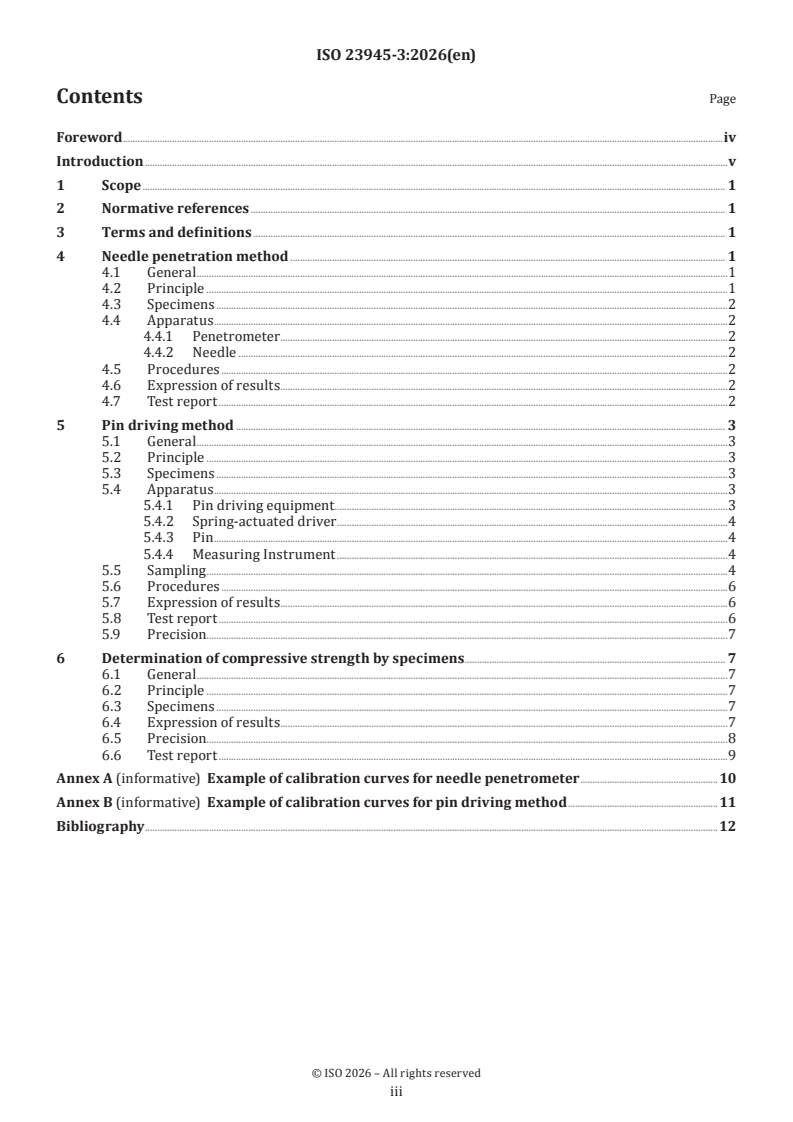
The document is organized into scope, normative references, terms and definitions, and three method clauses. Clause 4 covers the needle penetration method, Clause 5 covers the pin driving method, and Clause 6 covers determination of compressive strength by specimens.
| Annex | What it covers |
|---|---|
| Annex A | Example calibration curves for the needle penetrometer |
| Annex B | Example calibration curves for the pin driving method |
What are the key requirements of ISO 23945-3:2026?
ISO 23945-3:2026 separates the work by strength range and by whether the result is estimated in place or obtained from a tested specimen. In practice, the user needs to choose the method that matches the expected strength, the specimen type, and the level of detail needed for acceptance or comparison.
Needle penetration method
Clause 4 is for estimating the in-situ compressive strength of young hardened sprayed concrete in the range 0.2 MPa to 1.5 MPa. The method measures the force needed to push a specified needle to a defined depth, then converts the measured resistance through a calibration curve supplied with the equipment.
Clause 4 requires a sprayed concrete layer at least 100 mm thick and specimens prepared according to ISO 23945-2. For in-situ work, no special specimen is needed, which matters when testing directly on a structure without advance preparation.
The penetrometer must read force to an accuracy of 10 N, and the needle dimensions are specified. The procedure requires the operator to work perpendicular to the surface, take 10 measurements in a representative area, and record the times of spraying and testing. The mean force is then converted to estimated compressive strength, and extrapolation is not permitted.
Pin driving method
Clause 5 estimates in-situ compressive strength of young hardened sprayed concrete in the range 1.5 MPa to 16.0 MPa, and it is recommended where the expected strength is not above 28 MPa. The method is based on driving a pin into the concrete and measuring the penetration depth.
Clause 5 requires a layer at least 100 mm thick, specimens prepared according to ISO 23945-2, and no special specimen for in-situ structures. The equipment must control the driving energy, the pin is single-use, and the depth gage must measure to the nearest 0.02 mm.
Sampling rules matter here because the measurements must be spaced correctly. Clause 5 requires six valid pin readings for one test, with limits on spacing between penetrations and from the edge, and Table 1 is used to check whether the six readings are consistent enough. The surface may need grinding if it is heavily textured, soft, or loose mortar.
Clause 5.7 converts the average penetration depth to compressive strength using the calibration curve in Annex B. Clause 5.9 states that there are currently no precision data for this test, so users should treat results with that limitation in mind.
Determination by specimens
Clause 6 covers hardened sprayed concrete with compressive strength from 10 MPa to 100 MPa. Unlike Clauses 4 and 5, this method uses test specimens loaded to failure in a compression testing machine conforming to ISO 1920-4.
Clause 6 allows specimens cut or drilled from sprayed concrete test panels prepared according to ISO 23945-2, or from in-situ structures. The minimum specimen sizes are specified, damaged or honeycombed specimens are not to be tested as normal specimens, and any such condition must be reported if testing proceeds.
The strength is calculated from the maximum load divided by the loaded area. If the specimen dimensions differ from the designated size, Clause 6 requires the actual dimensions to be used, in line with ISO 1920-3. For drilled cores with a height/diameter ratio other than 2.0, Table 2 gives conversion factors to equivalent cube or cylinder strengths.
Clause 6 also includes precision data in Tables 3 and 4 for cube and cylinder testing. That helps laboratories judge repeatability and reproducibility when they compare results between operators or between test locations.
Who uses ISO 23945-3:2026?
ISO 23945-3:2026 is used by sprayed concrete contractors, testing laboratories, site engineers, quality managers, and inspectors who need to verify compressive strength. It is relevant in tunnelling, mining, repairs, restoration, new construction, and other sprayed concrete applications.
The document is especially useful when users need early-age strength estimates on site, or when they need specimen-based results for acceptance, comparison, or documentation.
Which standards are used with ISO 23945-3:2026?
ISO 23945-3:2026 names ISO 23945-2 for sampling fresh and hardened concrete. That part is needed whenever specimens are prepared from sprayed concrete for the methods in this document.
ISO 1920-3 is the other normative reference, and it provides the basis for making and curing test specimens when actual dimensions must be used for strength calculation.
Clause 6 also requires the compression testing machine to conform to ISO 1920-4, so users who carry out specimen testing need that test-method framework as well.
What does the ISO 23945-3:2026 document contain?
ISO 23945-3:2026 contains one strength formula, detailed apparatus descriptions, step-by-step procedures, report contents, and precision information. It also includes a figure showing spacing for pin penetrations, Table 1 for pin-test precision limits, Table 2 for core-strength conversion factors, and Tables 3 and 4 for precision data on cube and cylinder tests.
Annex A and Annex B provide example calibration curves for the two in-place estimation methods. In practice, these annexes support equipment setup, calibration, and interpretation of readings during site testing or laboratory verification.
Get Certified
Connect with accredited certification bodies for this standard

DIBt (Deutsches Institut für Bautechnik)
German Institute for Building Technology.

DIN CERTCO
DIN Group product certification.

Aboma Certification B.V.
Specialized in construction, metal, and transport sectors.
Sponsored listings
Frequently Asked Questions
ISO 23945-3:2026 is a standard published by the International Organization for Standardization (ISO). Its full title is "Test methods for sprayed concrete — Part 3: Measurement of compressive strength". This standard covers: This document specifies the test methods for measurement and determination of the compressive strength of sprayed concrete at different age, from young hardened to long term hardened sprayed concrete. The test methods could be applied to measure compressive strength of sprayed concrete in the range of 0,2 MPa to 100 MPa. The specimens of hardened sprayed concrete are extracted from either an in-situ element or a test panel.
This document specifies the test methods for measurement and determination of the compressive strength of sprayed concrete at different age, from young hardened to long term hardened sprayed concrete. The test methods could be applied to measure compressive strength of sprayed concrete in the range of 0,2 MPa to 100 MPa. The specimens of hardened sprayed concrete are extracted from either an in-situ element or a test panel.
ISO 23945-3:2026 is classified under the following ICS (International Classification for Standards) categories: 91.100.30 - Concrete and concrete products. The ICS classification helps identify the subject area and facilitates finding related standards.
ISO 23945-3:2026 is available in PDF format for immediate download after purchase. The document can be added to your cart and obtained through the secure checkout process. Digital delivery ensures instant access to the complete standard document.
Standards Content (Sample)
International
Standard
ISO 23945-3
First edition
Test methods for sprayed
2026-11
concrete —
Part 3:
Measurement of compressive
strength
Reference number
© ISO 2026
All rights reserved.
This ISO publication is protected by copyright and is owned by ISO and/or its licensors.
The content of this ISO publication is provided under licence, not sold. Use is subject to the applicable licence terms issued by ISO,
an ISO member body, or an authorized third-party distributor.
Except as required for implementation or expressly permitted by a separate licence, no part of this ISO publication may be
reproduced, distributed, modified, used, or made available in any form or by any means – electronic or mechanical, including
photocopying, scanning, recording, or posting on internal or external digital platforms.
Any use beyond the scope of the granted rights is prohibited and may result in legal action.
ISO copyright office
CP 401 • CH-1214 Vernier, Geneva
Phone: +41 22 749 01 11
Email: copyright@iso.org
Website: www.iso.org
Published in Switzerland
ii
Contents Page
Foreword .iv
Introduction .v
1 Scope . 1
2 Normative references . 1
3 Terms and definitions . 1
4 Needle penetration method . 1
4.1 General .1
4.2 Principle .1
4.3 Specimens .2
4.4 Apparatus .2
4.4.1 Penetrometer .2
4.4.2 Needle .2
4.5 Procedures .2
4.6 Expression of results . .2
4.7 Test report .2
5 Pin driving method . 3
5.1 General .3
5.2 Principle .3
5.3 Specimens .3
5.4 Apparatus .3
5.4.1 Pin driving equipment . .3
5.4.2 Spring-actuated driver .4
5.4.3 Pin .4
5.4.4 Measuring Instrument .4
5.5 Sampling .4
5.6 Procedures .6
5.7 Expression of results .6
5.8 Test report .6
5.9 Precision . . .7
6 Determination of compressive strength by specimens . 7
6.1 General .7
6.2 Principle .7
6.3 Specimens .7
6.4 Expression of results . .7
6.5 Precision . . .8
6.6 Test report .9
Annex A (informative) Example of calibration curves for needle penetrometer .10
Annex B (informative) Example of calibration curves for pin driving method .11
Bibliography .12
iii
Foreword
ISO (the International Organization for Standardization) is a worldwide federation of national standards
bodies (ISO member bodies). The work of preparing International Standards is normally carried out through
ISO technical committees. Each member body interested in a subject for which a technical committee
has been established has the right to be represented on that committee. International organizations,
governmental and non-governmental, in liaison with ISO, also take part in the work. ISO collaborates closely
with the International Electrotechnical Commission (IEC) on all matters of electrotechnical standardization.
The procedures used to develop this document and those intended for its further maintenance are described
in the ISO/IEC Directives, Part 1. In particular, the different approval criteria needed for the different types
of ISO documents should be noted. This document was drafted in accordance with the editorial rules of the
ISO/IEC Directives, Part 2 (see www.iso.org/directives).
ISO draws attention to the possibility that the implementation of this document may involve the use of (a)
patent(s). ISO takes no position concerning the evidence, validity or applicability of any claimed patent
rights in respect thereof. As of the date of publication of this document, ISO had not received notice of (a)
patent(s) which may be required to implement this document. However, implementers are cautioned that
this may not represent the latest information, which may be obtained from the patent database available at
www.iso.org/patents. ISO shall not be held responsible for identifying any or all such patent rights.
Any trade name used in this document is information given for the convenience of users and does not
constitute an endorsement.
For an explanation of the voluntary nature of standards, the meaning of ISO specific terms and expressions
related to conformity assessment, as well as information about ISO's adherence to the World Trade
Organization (WTO) principles in the Technical Barriers to Trade (TBT), see www.iso.org/iso/foreword.html.
This document was prepared by Technical Committee ISO/TC 71, Concrete, reinforced concrete and pre-
stressed concrete, Subcommittee SC 1, Test methods for concrete.
A list of all parts in the ISO 23945 series can be found on the ISO website.
Any feedback or questions on this document should be directed to the user’s national standards body. A
complete listing of these bodies can be found at www.iso.org/members.html.
iv
Introduction
Sprayed concrete is widely used for the stabilization of structures in a very short time and for concrete
applications without using moulds. In addition to being ideal for ground support in tunnelling and mining,
sprayed concrete is also used in repairs, restoration, new constructions and many other fields.
The requirements for properties, test methods, standards and specifications for the spray forming process
of concrete are different from those of cast forming concrete. This document is intended to provide a
normative test method for sprayed concrete.
This document is applied under various climatic and geographical conditions, various levels of protection
and under different established regional traditions and experiences. Consequently, this document includes
conditions for tests covering standard, tropical and subtropical region environments.
This document is intended for use with other parts of the ISO 23945 series which provide requirements
associated with the level of quality specified and the methods to be employed for the execution of sprayed
concrete.
v
International Standard ISO 23945-3:2026(en)
Test methods for sprayed concrete —
Part 3:
Measurement of compressive strength
1 Scope
This document specifies the test methods for measurement and determination of the compressive strength
of sprayed concrete at different age, from young hardened to long term hardened sprayed concrete. The test
methods could be applied to measure compressive strength of sprayed concrete in the range of 0,2 MPa to
100 MPa. The specimens of hardened sprayed concrete are extracted from either an in-situ element or a test
panel.
This document does not purport to address all of the safety concerns, if any, associated with its use.
2 Normative references
The following documents are referred to in the text in such a way that some or all of their content constitutes
requirements of this document. For dated references, only the edition cited applies. For undated references,
the latest edition of the referenced document (including any amendments) applies.
ISO 23945-2, Test Methods for Sprayed Concrete — Part 2: Sampling fresh and hardened concrete
ISO 1920-3, Testing of concrete — Part 3: Making and curing test specimens
3 Terms and definitions
No terms and definitions are listed in this document.
ISO and IEC maintain terminology databases for use in standardization at the following addresses:
— ISO Online browsing platform: available at https:// www .iso .org/ obp
— IEC Electropedia: available at https:// www .electropedia .org/
4 Needle penetration method
4.1 General
This clause specifies the method from which an estimate of the in-situ compressive strength of young
hardened sprayed concrete can be made in the range of 0,2 MPa to 1,5 MPa.
4.2 Principle
The needle penetration method is used to measure the force required to push a needle of specified
dimensions to penetrate into the sprayed concrete to a depth of 15 mm ± 2 mm. A penetrometer indicates the
resisting force, through compression of a calibrated spring from which an estimated compressive strength
can be derived from a calibration curve provided by the producer of the test equipment.
4.3 Specimens
The thickness of the sprayed concrete layer shall be not less than 100 mm for testing.
The specimens for test shall be prepared according to ISO 23945-2.
No special test specimen is required for test of in-situ structures. The testing procedure can be used for
measurements at any location without advance preparation.
4.4 Apparatus
4.4.1 Penetrometer
The penetrometer shall be capable of driving the needle into the surface and recording the force required to
an accuracy of 10 N. The penetrometer shall be provided with a certified calibration curve, able to correlate
readings to estimated compressive strength. An example of calibration curves is shown in Annex A.
4.4.2 Needle
The needle shall have a diameter of 3 mm ± 0,1 mm and a tip with a taper angle of 60° ± 5°. The needle length
shall be more than 15 mm.
4.5 Procedures
4.5.1 Record time and place of completion of spraying and start of testing.
4.5.2 Ensure the force indicator is set to zero.
4.5.3 Apply the device perpendicularly to the surface of the sprayed concrete layer and steadily push in
the needle to a depth of 15 mm ± 2 mm in a single continuous movement. If this is prevented, for instance
because of a large aggregate particle or reinforcement, then discontinue the test and repeat in an adjacent
location.
4.5.4 Read the resistance force from the scale, record the value on the protocol form and return indicator
to original position.
4.5.5 Clean the needle if necessary.
4.5.6 Repeat the test ten times as quickly as possible (and within 1 min for strengths below 0,5 MPa) in an
area representative of the sprayed region.
4.5.7 Record the time at which the testing is finished (on protocol
...