

ISO 10605:2023
(Main)Road vehicles — Test methods for electrical disturbances from electrostatic discharge
General Information
- Abstract
This document specifies the electrostatic discharge (ESD) test methods necessary to evaluate electronic modules intended for vehicle use. It applies to discharges in the following cases: — ESD in assembly; — ESD caused by service staff; — ESD caused by occupants. This document describes test procedures for evaluating both electronic modules on the bench and complete vehicles. This document applies to all types of road vehicles regardless of the propulsion system (e.g. spark-ignition engine, diesel engine, electric motor). The test for electronic modules on the bench described in this document applies to any DUT (powered by an unshielded power system, DUT powered by a shielded power system, self-powered DUT, etc.). This document does not apply to pyrotechnic modules.
- Status
- Published
- Publication Date
- 01-Jun-2023
- Technical Committee
- ISO/TC 22/SC 32 - Electrical and electronic components and general system aspects
- Drafting Committee
- ISO/TC 22/SC 32/WG 3 - Electromagnetic compatibility
- Current Stage
- 9093 - International Standard confirmed
- Start Date
- 05-Dec-2025
- Completion Date
- 29-Aug-2026
Overview
ISO 10605:2023 - Road vehicles - Test methods for electrical disturbances from electrostatic discharge - defines standardized ESD (electrostatic discharge) test methods for evaluating electronic modules and complete vehicles. The standard covers ESD scenarios occurring during assembly, by service staff, and from vehicle occupants. It applies to all road vehicles regardless of propulsion (ICE or electric) and to a wide range of devices under test (DUTs): powered by unshielded or shielded power systems, self-powered modules, etc. Pyrotechnic modules are excluded.
Key topics and technical requirements
- Discharge modes: Defines and distinguishes contact discharge and air discharge techniques for reproducing real‑world ESD events.
- Test configurations: Procedures for both bench/component testing (powered-up immunity and unpowered packaging/handling) and complete vehicle testing.
- Test apparatus & instrumentation: Requirements and guidance for ESD generators, discharge tips, ground plane (GP), field coupling plane (FCP), insulating blocks, and dissipative mats.
- Direct vs indirect discharge: Methods for applying energy directly to DUTs and indirectly via coupling fixtures or vehicle structures.
- Test planning and reporting: Specified test plans, minimum discharge counts, timing between discharges, and required test report content to document behavior and pass/fail criteria.
- Verification and annexes: Normative and informative annexes include generator current target verification, standard target drawings, Function Performance Status Classification (FPSC), guidance on generator resistor selection and air/contact verification, field coupling fixture design, and automated ESD testing.
- Notable updates in 2023 edition: introduction of alternative FCP test set-up, reduction of minimum indirect discharges on components from 50 to 10, and change of interval between indirect discharges to 1 s (from 50 ms), among other clarifications.
Practical applications and who uses ISO 10605:2023
- Automotive OEMs and Tier‑1 suppliers: Validate module immunity to occupant‑ and service‑related ESD events during design validation and production release.
- EMC/ESD test laboratories: Implement standardized bench and vehicle ESD test procedures for customer testing and certification.
- Design and hardware engineers: Use results to harden circuits, connectors, and PCB layouts against ESD-related failures.
- Quality, reliability, and compliance teams: Incorporate ISO 10605 test evidence into conformity assessments and supplier quality audits.
- Maintenance and service organizations: Understand ESD risks and handling requirements for modules during repair and assembly.
Related standards and keywords
- Normative reference: ISO 11452-1 (component test methods for narrowband radiated electromagnetic energy).
- SEO keywords naturally integrated: ISO 10605:2023, ESD automotive testing, electrostatic discharge test methods, road vehicle ESD, component immunity testing, contact discharge, air discharge, ESD generator, vehicle EMC testing.
Relations
- Effective Date
- 23-Apr-2020
- Effective Date
- 23-Apr-2020
Get Certified
Connect with accredited certification bodies for this standard

TÜV Rheinland
TÜV Rheinland is a leading international provider of technical services.

TÜV SÜD
TÜV SÜD is a trusted partner of choice for safety, security and sustainability solutions.

DEKRA Certification Inc.
DEKRA US certification services.
Sponsored listings
Frequently Asked Questions
ISO 10605:2023 is a standard published by the International Organization for Standardization (ISO). Its full title is "Road vehicles — Test methods for electrical disturbances from electrostatic discharge". This standard covers: This document specifies the electrostatic discharge (ESD) test methods necessary to evaluate electronic modules intended for vehicle use. It applies to discharges in the following cases: — ESD in assembly; — ESD caused by service staff; — ESD caused by occupants. This document describes test procedures for evaluating both electronic modules on the bench and complete vehicles. This document applies to all types of road vehicles regardless of the propulsion system (e.g. spark-ignition engine, diesel engine, electric motor). The test for electronic modules on the bench described in this document applies to any DUT (powered by an unshielded power system, DUT powered by a shielded power system, self-powered DUT, etc.). This document does not apply to pyrotechnic modules.
This document specifies the electrostatic discharge (ESD) test methods necessary to evaluate electronic modules intended for vehicle use. It applies to discharges in the following cases: — ESD in assembly; — ESD caused by service staff; — ESD caused by occupants. This document describes test procedures for evaluating both electronic modules on the bench and complete vehicles. This document applies to all types of road vehicles regardless of the propulsion system (e.g. spark-ignition engine, diesel engine, electric motor). The test for electronic modules on the bench described in this document applies to any DUT (powered by an unshielded power system, DUT powered by a shielded power system, self-powered DUT, etc.). This document does not apply to pyrotechnic modules.
ISO 10605:2023 is classified under the following ICS (International Classification for Standards) categories: 43.040.10 - Electrical and electronic equipment. The ICS classification helps identify the subject area and facilitates finding related standards.
ISO 10605:2023 has the following relationships with other standards: It is inter standard links to ISO 10605:2008/Amd 1:2014, ISO 10605:2008. Understanding these relationships helps ensure you are using the most current and applicable version of the standard.
ISO 10605:2023 is available in PDF format for immediate download after purchase. The document can be added to your cart and obtained through the secure checkout process. Digital delivery ensures instant access to the complete standard document.
Standards Content (Sample)
INTERNATIONAL ISO
STANDARD 10605
Third edition
2023-06
Road vehicles — Test methods
for electrical disturbances from
electrostatic discharge
Véhicules routiers — Méthodes d'essai des perturbations électriques
provenant de décharges électrostatiques
Reference number
© ISO 2023
All rights reserved. Unless otherwise specified, or required in the context of its implementation, no part of this publication may
be reproduced or utilized otherwise in any form or by any means, electronic or mechanical, including photocopying, or posting on
the internet or an intranet, without prior written permission. Permission can be requested from either ISO at the address below
or ISO’s member body in the country of the requester.
ISO copyright office
CP 401 • Ch. de Blandonnet 8
CH-1214 Vernier, Geneva
Phone: +41 22 749 01 11
Email: copyright@iso.org
Website: www.iso.org
Published in Switzerland
ii
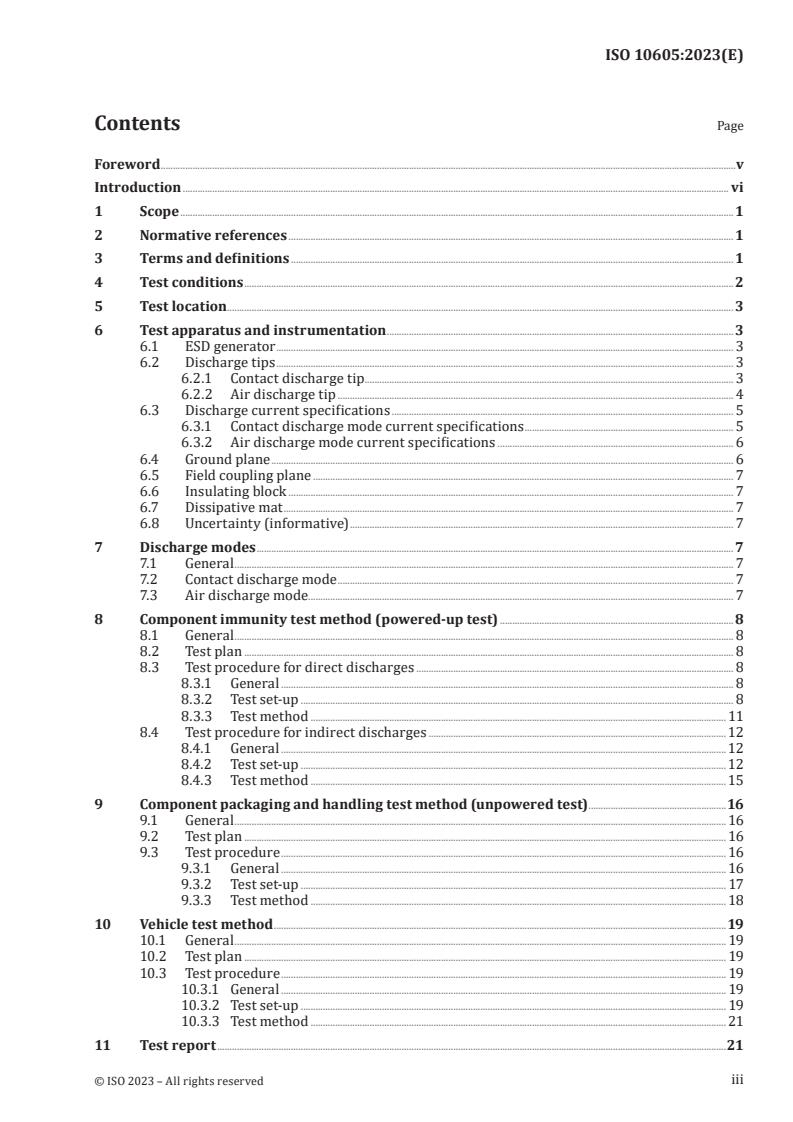
Contents Page
Foreword .v
Introduction . vi
1 Scope . 1
2 Normative references . 1
3 Terms and definitions . 1
4 Test conditions .2
5 Test location . 3
6 Test apparatus and instrumentation .3
6.1 ESD generator . 3
6.2 Discharge tips . 3
6.2.1 Contact discharge tip . 3
6.2.2 Air discharge tip . 4
6.3 Discharge current specifications . 5
6.3.1 Contact discharge mode current specifications . 5
6.3.2 Air discharge mode current specifications . 6
6.4 Ground plane . 6
6.5 Field coupling plane . 7
6.6 Insulating block . 7
6.7 Dissipative mat . 7
6.8 Uncertainty (informative) . 7
7 Discharge modes . 7
7.1 General . 7
7.2 Contact discharge mode . 7
7.3 Air discharge mode . . 7
8 Component immunity test method (powered-up test) . 8
8.1 General . 8
8.2 Test plan . 8
8.3 Test procedure for direct discharges . 8
8.3.1 General . 8
8.3.2 Test set-up . 8
8.3.3 Test method . 11
8.4 Test procedure for indirect discharges .12
8.4.1 General .12
8.4.2 Test set-up . 12
8.4.3 Test method . 15
9 Component packaging and handling test method (unpowered test) .16
9.1 General . 16
9.2 Test plan . 16
9.3 Test procedure . 16
9.3.1 General . 16
9.3.2 Test set-up . 17
9.3.3 Test method . 18
10 Vehicle test method .19
10.1 General . 19
10.2 Test plan . 19
10.3 Test procedure . 19
10.3.1 General . 19
10.3.2 Test set-up . 19
10.3.3 Test method . 21
11 Test report .21
iii
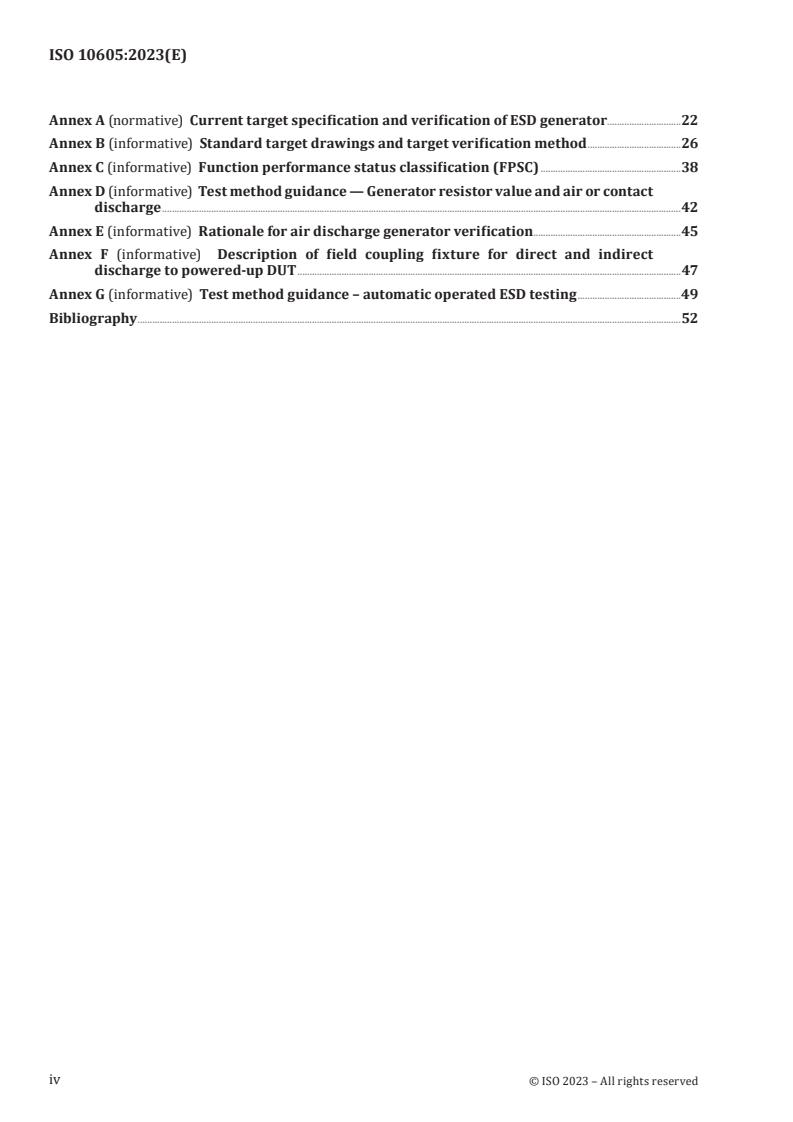
Annex A (normative) Current target specification and verification of ESD generator .22
Annex B (informative) Standard target drawings and target verification method .26
Annex C (informative) Function performance status classification (FPSC) .38
Annex D (informative) Test method guidance — Generator resistor value and air or contact
discharge .42
Annex E (informative) Rationale for air discharge generator verification .45
Annex F (informative) Description of field coupling fixture for direct and indirect
discharge to powered-up DUT .47
Annex G (informative) Test method guidance – automatic operated ESD testing .49
Bibliography .52
iv
Foreword
ISO (the International Organization for Standardization) is a worldwide federation of national standards
bodies (ISO member bodies). The work of preparing International Standards is normally carried out
through ISO technical committees. Each member body interested in a subject for which a technical
committee has been established has the right to be represented on that committee. International
organizations, governmental and non-governmental, in liaison with ISO, also take part in the work.
ISO collaborates closely with the International Electrotechnical Commission (IEC) on all matters of
electrotechnical standardization.
The procedures used to develop this document and those intended for its further maintenance are
described in the ISO/IEC Directives, Part 1. In particular, the different approval criteria needed for the
different types of ISO documents should be noted. This document was drafted in accordance with the
editorial rules of the ISO/IEC Directives, Part 2 (see www.iso.org/directives).
Attention is drawn to the possibility that some of the elements of this document may be the subject of
patent rights. ISO shall not be held responsible for identifying any or all such patent rights. Details of
any patent rights identified during the development of the document will be in the Introduction and/or
on the ISO list of patent declarations received (see www.iso.org/patents).
Any trade name used in this document is information given for the convenience of users and does not
constitute an endorsement.
For an explanation of the voluntary nature of standards, the meaning of ISO specific terms and
expressions related to conformity assessment, as well as information about ISO's adherence to
the World Trade Organization (WTO) principles in the Technical Barriers to Trade (TBT), see
www.iso.org/iso/foreword.html.
This document was prepared by Technical Committee ISO/TC 22, Road vehicles, Subcommittee SC 32,
Electrical and electronic components and general system aspects.
This third edition cancels and replaces the second edition (ISO 10605:2008), which has been
technically revised. It also incorporates the Amendment ISO 10605:2008/Amd 1 2014 and the Technical
Corrigendum ISO 10605:2008/Cor 1:2010.
The main changes are as follows:
— introduction of alternative test set-up with field coupling plane for direct and indirect discharges on
component (powered-up test);
— minimum number of discharges changed from 50 to 10 for indirect discharge on component
(powered-up test);
— interval between successive single discharges changed from 50 ms to 1 s for indirect discharge on
component (powered-up test);
— addition of a ground connection for discharges on DUT pins for component packaging and handling
test method (unpowered test);
— optional test set-up and procedure for electronic modules (powered-up test) moved from Annex to
main body;
— addition of new Annex G.
Any feedback or questions on this document should be directed to the user’s national standards body. A
complete listing of these bodies can be found at www.iso.org/members.html.
v
Introduction
The electrostatic discharge, due to former charge build-ups generated, for example, when moving
about inside a vehicle or getting out of it, has assumed greater significance with the increase of vehicle
electronic modules. Tests simulating the electrostatic discharge of humans, in common use by various
industries, were examined and it was determined that they were not fully applicable to the automotive
environment. As a consequence, tests tailored to the automotive environment were developed.
Tests that simulate an electrostatic discharge (ESD) into a vehicle electrical system are based on the
human ESD model. Sensitive electrical devices can be adversely affected by energy either coupled or
radiated from electrostatic discharges.
This document describes ESD tests that are applicable to both automotive electronic modules and
vehicles.
vi
INTERNATIONAL STANDARD ISO 10605:2023(E)
Road vehicles — Test methods for electrical disturbances
from electrostatic discharge
1 Scope
This document specifies the electrostatic discharge (ESD) test methods necessary to evaluate electronic
modules intended for vehicle use. It applies to discharges in the following cases:
— ESD in assembly;
— ESD caused by service staff;
— ESD caused by occupants.
This document describes test procedures for evaluating both electronic modules on the bench and
complete vehicles. This document applies to all types of road vehicles regardless of the propulsion
system (e.g. spark-ignition engine, diesel engine, electric motor).
The test for electronic modules on the bench described in this document applies to any DUT (powered
by an unshielded power system, DUT powered by a shielded power system, self-powered DUT, etc.).
This document does not apply to pyrotechnic modules.
2 Normative references
The following documents are referred to in the text in such a way that some or all of their content
constitutes requirements of this document. For dated references, only the edition cited applies. For
undated references, the latest edition of the referenced document (including any amendments) applies.
ISO 11452-1, Road vehicles — Component test methods for electrical disturbances from narrowband
radiated electromagnetic energy — Part 1: General principles and terminology
3 Terms and definitions
For the purposes of this document, the terms and definitions given in ISO 11452-1 and the following
apply.
ISO and IEC maintain terminology databases for use in standardization at the following addresses:
— ISO Online browsing platform: available at https:// www .iso .org/ obp
— IEC Electropedia: available at https:// www .electropedia .org/
3.1
air discharge
test method characterized by bringing the test generator discharge tip close to the device under test
(DUT) (3.3); the discharge is by arcing on the DUT
3.2
contact discharge
test method characterized by contact of the test generator discharge tip with the device under test
(DUT) (3.3), where discharge is initiated by the generator discharge switch
3.3
DUT
device under test
single component or combination of components as defined to be tested
3.4
direct discharge
discharge directly on the device under test (DUT) (3.3)
3.5
ESD
electrostatic discharge
transfer of electrostatic charge between bodies at different potentials occurring prior to contact or
induced by an electrostatic field
3.6
ESD generator
instrument that simulates the human ESD model (3.9)
3.7
GP
ground plane
flat conductive surface (3.11) whose potential is used as a common reference
Note 1 to entry: The test voltage should also be referenced to the ground plane.
3.8
holding time
interval of time within which the decrease of the test voltage due to leakage, prior to the discharge, is
10 %
3.9
human ESD model
network of passive elements and voltage that characterizes a charged person as a source of an
electrostatic discharge (3.5) for automotive conditions
3.10
indirect discharge
discharge to a coupling plane near the device under test (DUT) (3.3)
Note 1 to entry: Discharge current produces a transient field that might affect the DUT. Indirect discharge
simulates discharge by a human being on items near the DUT.
3.11
surface
uninterrupted housing area, gap or opening
EXAMPLE Switches, tip switches, points of contact, air vents, speaker openings.
4 Test conditions
The user shall specify the test severity level(s) for the component and vehicle tests. Suggested test levels
are included in Annex C.
Standard test conditions shall be as follows:
— ambient temperature: (25 ± 10) °C;
— relative humidity between 20 % and 60 %.
If other values are agreed to by the users, these values shall be documented in the test report.
5 Test location
Shielded enclosures or even absorber-lined shielded enclosures are allowed but not required.
NOTE ESD testing creates transient fields, which can interfere with sensitive electronic devices or receivers,
even at a distance of a few meters. It is advisable that this be considered when choosing a test location.
6 Test apparatus and instrumentation
6.1 ESD generator
The ESD generator characteristics shall be as specified in Table 1.
Table 1 — General ESD generator parameters
Parameter Characteristic
a
Output voltage range contact discharge mode 2 kV to 15 kV, or as required in the test plan
a
Output voltage range air discharge mode 2 kV to 25 kV, or as required in the test plan
Output voltage accuracy ≤ 5 %
Output polarity Positive and negative
Rise time of short circuit current in contact discharge mode (10 %
0,7 ns to 1,0 ns
to 90 %)
Holding time ≥ 5 s
b
Storage capacitances 150 pF, 330 pF
b
Discharge resistances 330 Ω, 2 000 Ω
a
See examples in Annex C.
b
Storage capacitance and discharge resistance are nominal values, ESD generator shall meet discharge current
specifications in 6.3.
NOTE When an ESD generator is supplied from an external supply source, AC or DC, or controlled by a
separate unit and this (these) cable(s) is (are) not combined (bundled) with the ESD generator discharge return
cable, unintended current can flow through this (these) cable(s).
The ESD generator should be able to generate a repetition rate of at least 20 discharges per second
down to manual control without any degradation of the discharge current waveform.
The tip voltage should be checked continuously by the generator internal tip voltage supervision.
For contact discharge a grounded discharge resistor with 1 MΩ ±20 % resistance from tip to ground
is recommended and prevents pre-pulse-voltage occurrence which can lead to non-reproducible test
results; proper fixing of resistor shall not change the current shape.
In cases where a 2 m length of the discharge return cable is insufficient (e.g. for tall DUTs), a length not
exceeding 3 m may be used and compliance with the waveform specifications shall be guaranteed (e.g.
by the manufacturer or from calibration).
The ESD generator protective earth terminal shall be terminated to the facility protective earth.
Guidance on automatic operated ESD testing can be found in Annex G.
6.2 Discharge tips
6.2.1 Contact discharge tip
The discharge tip for contact mode ESD is shown in Figure 1. The tip is typically made of stainless steel.
For contact discharge to pins the discharge tip shape can be varied. The diameter of the tip shall be
12 ± 1 mm. Springs for safe contact and a bending of not more than 90° are possible. The current shape
with modified tip shall comply with the given specification. The angle “alpha” shall be between 25° and
40°.
Dimensions in millimetres
Key
1 sharp point
Figure 1 — Contact discharge tip of the ESD generator
6.2.2 Air discharge tip
The discharge tip for air discharge mode ESD is shown in Figure 2.
Dimensions in millimetres
Key
1 body of simulator
NOTE For air discharge at test voltages higher than 15 kV, a larger tip (e.g. 20 mm to 30 mm diameter) can be
used to avoid pre-discharge.
Figure 2 — Air discharge tip of the ESD generator
6.3 Discharge current specifications
6.3.1 Contact discharge mode current specifications
The contact discharge mode currents shall be verified according to Annex A. The contact discharge
mode waveform parameters for each discharge network shall be within the value ranges specified in
Table 2.
Table 2 — Contact discharge mode current specifications
Nominal capac-
Peak current/ Current at t / Current at t /
1 2
itance/ resist- Tolerance Tolerance Tolerance
test voltage test voltage test voltage
ance values
A/kV % A/kV % A/kV %
2 1
150 pF / 330 Ω 3,75 ±10 ±30 ±30
(at t = 30 ns) (at t = 60 ns)
1 2
2 1
330 pF / 330 Ω 3,75 ±10 ±30 ±30
(at t = 65 ns) (at t = 130 ns)
1 2
0,275 0,15
+30
150 pF / 2 000 Ω 3,75 ±30 ±50
(at t = 180 ns) (at t = 360 ns)
1 2
0,275 0,15
+30
330 pF / 2 000 Ω 3,75 ±30 ±50
(at t = 400 ns) (at t = 800 ns)
1 2
NOTE 1 The peak current level is taken from the measurement system without any data interpolation.
NOTE 2 The target used with this measurement system fulfils the requirements of Clauses A.1 and A.2. An example is
defined in Annex B.
The measurement times (30 ns, 60 ns, 65 ns, 130 ns, 180 ns, 360 ns, 400 ns and 800 ns) are derived
from the resistance-capacitive (RC) time constant − 40 % (current t ) and +20 % (current t ), to define
1 2
two values on the falling slope of the current pulse in accordance with IEC 61000-4-2.
Examples of calculated contact discharge waveforms in accordance with the specifications in Table 2
are given in Figures 3 a) and 3 b).
a) Calculated contact discharge waveform of ESD generator
(for 150 pF / 330 pF, 330 Ω and 1 kV)
Key
X time [ns]
Y current [A]
1 150 pF, 330 Ω
2 330 pF, 330 Ω
3 150 pF, 2 kΩ
4 330 pF, 2 kΩ
b) Calculated contact discharge waveform of ESD generator
(for 150 pF/330 pF, 2 kΩ and 1 kV)
Figure 3 — Calculated contact discharge waveform of ESD generator
6.3.2 Air discharge mode current specifications
Information on possible air discharge generator verification procedures is given in Annex E.
6.4 Ground plane
The ground plane (GP) shall be metallic sheets (e.g. copper, brass or aluminium) and have a minimum
thickness of 0,25 mm.
NOTE If aluminium is used, care is taken that oxidation does not prevent a good ground connection.
The minimum width of the GP shall be 800 mm, or the width of the entire underneath of the test setup
[DUT and associated equipment (e.g. harness including supply lines, load simulator located on the test
bench and AN(s)), excluding battery and/or power supply] plus 200 mm, whichever is the larger.
The minimum length of the GP shall be 1 600 mm or the length of the entire underneath of the test
setup [DUT and associated equipment (e.g. harness including supply lines, load simulator located on the
test bench and AN(s)), excluding battery and/or power supply] plus 200 mm, whichever is the larger.
In case of very large DUT, the above GP dimensions/shape can be adapted by using a GP extension.
Connection between an already existing GP and a GP extension should have a DC resistance lower or
equal to 2,5 mΩ.
6.5 Field coupling plane
Details of the construction of the field coupling plane can be found in Annex F.
6.6 Insulating block
Insulating blocks, if used, shall be constructed of clean non-hygroscopic material. The relative
permittivity should range between 1 and 5 (e.g. polyethylene). The blocks shall be (50 +/- 5) mm in
height and extend beyond the test setup by at least 20 mm on all sides.
6.7 Dissipative mat
7 9
Dissipative support from a material which has a surface resistivity between 10 Ω per square and 10 Ω
per square with a height between 2 mm and 3 mm.
6.8 Uncertainty (informative)
Refer to IEC 61000-4-2:2008, Annex E.
7 Discharge modes
7.1 General
Discharges can be applied by two discharge modes: contact and air. See Annex D for guidance on air
versus contact discharge modes.
7.2 Contact discharge mode
In the case of contact discharges, the discharge tip (see Figure 1) shall touch a conducting point on the
DUT before the discharge switch is actuated.
Where painted surfaces cover a conducting substrate, the following procedure is used. If the coating
is not declared to be an insulating coating by the equipment manufacturer, then the pointed tip of the
generator penetrates the coating so as to make contact with the conducting substrate.
7.3 Air discharge mode
In air discharge mode, the discharge tip is charged to the test voltage and then brought with the
demanded speed of approach to the DUT, applying the discharge through an arc that happens when the
tip approaches close enough to the DUT to break down the dielectric material between the tip and test
point.
The speed of approach of the discharge tip is a critical factor in the rise time and amplitude of the
injected current during an air discharge. Because the approach speed is not trivial to measure, in
practice the ESD generator should approach the DUT as quickly as possible (e.g. between 0,1 m/s and
0,5 m/s) until the discharge occurs or the discharge tip touches the discharge point without causing
mechanical damage to the DUT or generator.
Where painted surfaces cover a conducting substrate or dielectric surfaces are used as boxes, the
following procedure is used. If the coating is declared to be an insulating coating for the dielectric
surfaces, then the surface is tested as an insulating surface using the air discharge mode.
8 Component immunity test method (powered-up test)
8.1 General
These tests consist of direct and indirect types of application of discharges to the DUT, as follows:
— direct type discharges (contact or air discharge mode) are applied directly to the DUT and to the
remote parts that are accessible by the vehicle users, e.g. surfaces of switches, diagnostic connectors,
buttons (see 8.3).
— indirect type discharges (contact discharge mode) simulate discharges that occur to other conductive
objects in the vicinity of the DUT and are applied through an intervening metal, such as to GP (see
8.4).
For direct and indirect discharge testing of electronic modules, the ESD generator shall be configured
with the 330 pF or 150 pF capacitor, depending on the DUT location in the vehicle (see 10.1), and the
330 Ω resistor. If the DUT location is not specified, the 330 pF capacitor shall be used.
Conductive surfaces shall be tested using contact discharge mode. For contact discharge, use the contact
discharge tip (see Figure 1). Air discharge may also be applied to conductive surfaces, if required in the
test plan.
Non-conductive surfaces shall be tested using air discharge mode. For air discharge, use the air
discharge tip (see Figure 2).
Before applying any discharges to the DUT, verify that the ESD generator discharge verification
procedure, as specified in Annex A, has been performed within the time period established by the
laboratory or the customer.
8.2 Test plan
Prior to performing the test, generate a test plan, including the following:
— the detailed test set-up;
— test points;
— electronic module mode of operation;
— any special instructions and changes from the standard test.
8.3 Test procedure for direct discharges
8.3.1 General
Discharges shall be applied to all specified test points with the equipment operating in normal modes.
Product response may be affected by the polarity of the discharge. Both polarities of discharge shall be
used during testing to determine their effect on the DUT.
8.3.2 Test set-up
Two alternative test setups can be used:
— test setup with GP only;
— test setup with GP and field coupling plane.
The test set-up to be used shall be defined in the test plan.
8.3.2.1 Test set-up with GP only
Place the DUT on the GP (see Figure 4). Chassis-mounted DUTs shall be placed on and directly connected
to the GP. DUTs that are not chassis-mounted shall be placed with an insulating block between the DUT
and the GP (see 6.5).
For testing, the DUT shall be connected to all peripheral devices (e.g. load simulator, AN(s), power
+300
supply, battery) necessary for functional testing. The test harness shall be 1 700 mm long (or as
()
agreed upon the test plan).
If vehicle intent peripheral devices are not available for testing, substitute peripheral devices and test
discharge points shall be addressed in the test plan.
All components on the test table shall be a minimum distance of 200 mm from each other. The lines
shall be laid in such a way that they run parallel to the GP edges and the plane and, like all components,
they shall be a distance of 100 mm ± 10 mm away from the GP edges. The lines should be bundled and
shall be secured on an insulating block, in accordance with 6.5. The wiring type is defined by the actual
system application and requirement.
Unless otherwise specified, the load simulator and remotely accessible part of DUT shall be placed on
an insulating block.
The supply battery shall be on the test table, with the negative terminal of the battery directly
connected to the GP. The explosion hazard of the battery shall be taken into account and appropriate
protective measures taken.
The ESD test bench (test surface) shall be a minimum of 100 mm from other conductive structures,
such as the surfaces of a shielded room.
The same generator discharge return cable to the GP shall be used for verification and testing. While
the discharge is being applied, the discharge return cable of the generator shall be kept at least 200 mm
away from the DUT and all cables connected to the DUT (to reduce coupling from this cable which might
affect the test results).
Key
1 DUT 7 GP connection
2 ESD generator 8 remotely accessible parts of the DUT
3 ESD generator main unit 9 load simulator
4 non-conductive table 10 battery
5 GP 11 insulating blocks (for non-chassis mounted DUT)
6 facility protective earth 12 insulating blocks
Figure 4 — Test set-up example for testing powered DUT immunity to direct ESD with GP only
8.3.2.2 Test set-up with GP and field coupling plane
Place and connect chassis mounted DUTs on the field coupling plane. DUTs that are not chassis-mounted
shall be placed with a dissipative mat between the DUT and the field coupling plane.
For testing, the DUT shall be connected to all peripheral devices necessary for functional testing. The
+300
test harness(es) (LV, HV, etc.) shall have a length of 1 700 mm and placed directly on the field
()
coupling strip. The harness(es) shall exit the DUT harness support 10 mm from the edge of the discharge
island most distant from the DUT. The ground reference for the DUT wiring harness and load box is at
point 10 shown in Figure 5.
The field coupling plane shall be large enough so as to extend beyond the DUT on all sides by at least
10 mm.
The ground connection (wiring) of the DUT shall be connected according to the intended grounding
configuration in the vehicle (for local ground, directly connected to the field coupling plane (key 12)
and for remote ground connected to ground reference point (key 10) via the wiring harness(es), in
Figure 5).
The battery ground shall be electrically connected to the ground reference point.
All of the switches, displays, sensors, actuators, etc. required to operate the DUT shall be part of the test
configuration. Wherever possible, production intent parts and wiring shall be used.
Unless otherwise specified, the load simulator and remotely accessible part of DUT shall be placed on
an insulating block.
Any peripheral devices shall be separated from the field coupling strip by at least 200 mm.
If vehicle intent peripheral devices are not available for testing, substitute peripheral devices and test
discharge points shall be addressed in the test plan.
Dimensions in millimetres
Key
1 field coupling plane 10 ground reference point
2 field coupling strip 11 DUT local ground (if required)
3 discharge island 12 coupling fixture ground reference point
4 DUT and wiring harness(es) isolation block 13 facility protective earth
5 DUT 14 GP
6 DUT wiring harness(es) 15 ESD generator main unit
7 battery 16 dissipative mat (for the non-chassis mounted DUT)
8 load simulator 17 remotely accessible parts of the DUT
9 artificial network (AN) (if required in the test plan) 18 insulating block
NOTE The tolerance of dimensions is ±5 %.
Figure 5 — Test set-up example for testing powered DUT immunity to direct ESD with GP and
field coupling plane
8.3.3 Test method
The discharges shall be applied to all accessible points on the DUT that can be touched during normal
operation (surfaces, tip switches, switches, connectors, antennas, displays etc., as well as the diagnostic
plug with pins). Ungrounded conductive surfaces shall be tested for subsequent voltage breakdown at
the desired test voltage. The individual discharge points shall be specified in the test plan.
DUTs that are accessible to occupants inside the vehicle shall be tested using an ESD simulator with a
discharge network of 330 pF and 330 Ω; otherwise, use a discharge network of 150 pF and 330 Ω. Refer
to Clause C.4 for discharge probe and test level information.
For direct discharge, the ESD generator's discharge tip is held perpendicular to the surface of the DUT
when possible; if not possible, an angle of at least 45° to the surface of the DUT is preferred.
All test points shall be tested with the required test voltage steps and both polarities. Suggested test
levels are given in Clause C.4.
For each polarity and test voltage, at least three contact discharges to conductive points on the DUT,
only as defined in the test plan, shall be carried out at each of the specified discharge points. In this
process, the ESD simulator with the contact discharge tip shall be positioned on the device and then
discharged.
For each polarity and test voltage (see Annex C), at least three air discharges shall be carried out at each
of the specified discharge points. In this process, the ESD simulator with the air discharge tip shall be
moved towards the discharge point in the way described in 7.3.
The time interval between successive single discharges shall be as long as necessary in order to allow
charges that were built up due to the tests to dissipate, but not less than 1 s, in order to ensure that the
charges are removed before each new discharge
The methods described below can be applied.
— Between two individual discharges, the charge applied shall be removed via a grounded discharge
resistor with 1 MΩ ±20 % resistance by touching the discharge point and the housing. Alternatively,
a duration of at least 2 s can be allowed to pass between two discharges.
— If the time interval is lengthened between two successive discharges, the build-up charge vanishes
due to the natural charge decay.
— Air-ionizers may be used to speed up the “natural” discharging process of the DUT to its environment.
The ionizer shall be turned off when applying an air discharge test.
The test voltages (in accordance with Annex C) shall be increased, using at least two values, up to the
maximum test level.
NOTE Some products have the tendency to exhibit susceptibility responses when exposed to specific test
voltages, but not necessarily at other test voltage levels.
The performance of the DUT shall be monitored and recorded according to the test plan.
8.4 Test procedure for indirect discharges
8.4.1 General
Discharges to objects placed or installed near the DUT are simulated by applying contact discharges of
the ESD generator to a GP or to a field coupling plane.
8.4.2 Test set-up
Two alternative test setups can be used:
— test setup with GP only;
— test setup with GP and field coupling plane.
The test set-up to be used shall be defined in the test plan.
8.4.2.1 Test set-up with GP only
Place the DUT on the GP (see Figure 6). Chassis-mounted DUTs shall be placed on and directly connected
to the GP. DUTs that are not chassis-mounted shall be placed with an insulating blocks between the DUT
and the GP (see 6.5).
The DUT shall be positioned on the GP such that its closest surface is 100 mm ± 10 mm from the edge
of the GP receiving the discharge. The DUT may need to be repositioned during the test, when applying
ESD to the edge of the GP, in order to maintain this 100 mm ± 10 mm spacing between the DUT edge and
the edge of the GP.
For testing, the DUT shall be connected to all peripheral devices necessary for functional testing. The
+300
test harness shall be 1 700 mm long (or as agreed upon the test plan).
()
If vehicle intent peripheral devices are not available for testing, substitute peripheral devices and test
discharge points shall be addressed in the test plan.
All components on the test table shall be a minimum distance of 200 mm from each other. The lines
shall be laid in such a way that they run parallel to the GP edges and the plane and, like all components,
they shall be a distance of 100 mm ± 10 mm away from the GP edges. The lines should be bundled and
shall be secured on an insulating block, in accordance with 6.5. The wiring type is defined by the actual
system application and requirement.
Unless otherwise specified, the load simulator and remotely accessible part of DUT shall be placed on
an insulating block.
The supply battery shall be on the test table, with the negative terminal of the battery directly
connected to the GP. The explosion hazard of the battery shall be taken into account and appropriate
protective measures taken.
For indirect discharge, the discharge return cable of the ESD generator shall be connected to the GP (as
defined in the test plan), as shown in Figure 6. The ESD test bench (test surface) shall be a minimum of
100 mm from other conductive structures, such as the surfaces of a shielded room.
The same generator discharge return cable to the GP shall be used for verification and testing. While
the discharge is being applied, the discharge return cable of the generator shall be kept at least 200 mm
away from the DUT and all cables connected to the DUT (to reduce coupling from this cable which might
affect the test results).
Contact discharges shall be applied to:
— the GP at points around the cable harness with a distance of 100 mm ± 10 mm;
— the edges of the GP.
Key
1 DUT 7 GP connection
2 ESD generator 8 remotely accessible parts of the DUT
3 ESD generator main unit 9 load simulator
4 non-conductive table 10 battery
5 GP 11 insulating block, (for non-chassis mounted DUT)
6 facility protective earth 12 insulating blocks
Figure 6 — Test set-up example for testing powered DUT immunity to indirect ESD with GP only
8.4.2.2 Test set-up with GP and field coupling plane
The DUT shall be placed on the field coupling plane (see Figure 7). Place and connect chassis-mounted
electronic modules directly on the field coupling plane.
For testing, the DUT shall be connected to all peripheral devices necessary for functional testing. The
+300
test harness(es) (LV, HV, etc.) shall have a length of 1 700 mm and placed directly on the field
()
coupling strip.
The harness(es) shall exit the DUT harness(es) support 10 mm ± 1 mm from the edge of the discharge
island most distant from the DUT. The ground reference for the DUT wiring harness(es) and load box is
at point 10 shown in Figure 7.
The DUT coupling plane shall be large enough so as to extend beyond the DUT on all sides by at least
10 mm.
The ground connection (wiring) of the DUT shall be connected according
...