

ISO 10924-1:2025
(Main)Road vehicles — Circuit breakers — Part 1: Definitions and general test requirements
General Information
- Abstract
This document defines terms and specifies general test requirements for circuit breakers for use in road vehicles with a nominal voltage of 12 V (DC), 24 V (DC), 48 V (DC) and 450 V (DC). This document is intended to be used in conjunction with ISO 10924-2, ISO 10924-3, ISO 10924-4 and ISO 10924-5. The numbering of its clauses corresponds to that of the document whose requirements are applicable, except where modified by requirements particular to this document. This document is not applicable to circuit breaker holders (electrical centres or fuse-holders) used in vehicles.
- Status
- Published
- Publication Date
- 31-Mar-2025
- Current Stage
- 6060 - International Standard published
- Start Date
- 01-Apr-2025
- Due Date
- 24-Nov-2024
- Completion Date
- 31-Mar-2025


Overview
ISO 10924-1:2025 - Road vehicles - Circuit breakers - Part 1: Definitions and general test requirements is an international standard developed by ISO that defines terminology and specifies general test requirements for circuit breakers used in road vehicles. This standard applies to circuit breakers operating at nominal voltages of 12 V (DC), 24 V (DC), 48 V (DC), and 450 V (DC). As a foundational document, it serves as the basis for further, more detailed parts in the ISO 10924 series, providing consistency and harmonization in electrical protection within the automotive sector.
Key Topics
Definitions of Circuit Breakers and Components
ISO 10924-1:2025 clearly defines terms related to circuit breakers, including their types (automatic reset, manual reset, electrically reset, and switchable), core functions (trip mechanics, reset mechanisms), and component parts (housing, terminal, time-delayed element).General Test Requirements
The standard outlines general methodologies for testing circuit breakers, ensuring they meet robust performance and safety criteria:- Ambient test conditions (temperature, humidity)
- Test fixture configurations
- Measurement tolerances for critical variables including current, voltage, and resistance
Marking and Identification
Circuit breakers must display critical markings such as rated current, supply voltage, manufacturer information, and part numbers, along with visible and permanent color coding.Performance and Environmental Testing
Extensive test requirements ensure that circuit breakers function reliably under various stresses found in vehicle environments:- Voltage drop tests: Measure efficiency and energy consumption
- Thermal tests: Assess maximum housing temperature and operational limits
- Mechanical, climatic, and chemical load tests: Evaluate performance under real-world operating conditions as prescribed by referenced standards
- Overcurrent protection: Tests evaluating operating time, trip and reset characteristics, and breaking capacity
Applications
The practical applications of ISO 10924-1:2025 center on its use in the automotive industry, supporting both manufacturers and users of circuit breakers in road vehicles:
Automotive Manufacturers
Build reliable electrical systems for passenger cars, commercial vehicles, buses, and trucks that meet internationally recognized safety and quality requirements for overcurrent protection.Component Suppliers
Develop and test circuit breakers to consistent benchmarks, ensuring global market compatibility and regulatory compliance.Testing Laboratories
Employ standardized test procedures to validate the safety and performance of circuit breakers at varying nominal voltages (12 V to 450 V DC).Regulatory Authorities and Inspectors
Reference the standard for conformity assessments and technical inspections, thereby promoting harmonized safety standards across regions.
Related Standards
For comprehensive electrical safety and system design in vehicles, ISO 10924-1:2025 should be used alongside the following related standards:
ISO 10924-2 – Guidance for users
Provides detailed instructions for selecting and applying circuit breakers defined in Part 1.ISO 10924-3 – Miniature circuit breakers with tabs (Blade type), Form CB11
ISO 10924-4 – Medium circuit breakers with tabs (Blade type), Form CB15
ISO 10924-5 – Circuit breakers with bolt for rated voltages up to 450 V
ISO 8820 Series – Fuse-links requirements
ISO 16750 Series – Environmental testing for electrical and electronic equipment in road vehicles
IEC 60068-2-70 – Abrasion testing of markings and labels
ISO 10924-1:2025 plays a vital role in promoting the safety, interoperability, and reliability of automotive electrical systems by standardizing definitions, marking requirements, and general testing protocols for circuit breakers across global markets. For stakeholders involved in automotive electrical protection, aligning with this standard ensures product quality, safety, and regulatory compliance.
Relations
- Effective Date
- 06-Jun-2022
Get Certified
Connect with accredited certification bodies for this standard

TÜV Rheinland
TÜV Rheinland is a leading international provider of technical services.

TÜV SÜD
TÜV SÜD is a trusted partner of choice for safety, security and sustainability solutions.

DEKRA Certification Inc.
DEKRA US certification services.
Sponsored listings
Frequently Asked Questions
ISO 10924-1:2025 is a standard published by the International Organization for Standardization (ISO). Its full title is "Road vehicles — Circuit breakers — Part 1: Definitions and general test requirements". This standard covers: This document defines terms and specifies general test requirements for circuit breakers for use in road vehicles with a nominal voltage of 12 V (DC), 24 V (DC), 48 V (DC) and 450 V (DC). This document is intended to be used in conjunction with ISO 10924-2, ISO 10924-3, ISO 10924-4 and ISO 10924-5. The numbering of its clauses corresponds to that of the document whose requirements are applicable, except where modified by requirements particular to this document. This document is not applicable to circuit breaker holders (electrical centres or fuse-holders) used in vehicles.
This document defines terms and specifies general test requirements for circuit breakers for use in road vehicles with a nominal voltage of 12 V (DC), 24 V (DC), 48 V (DC) and 450 V (DC). This document is intended to be used in conjunction with ISO 10924-2, ISO 10924-3, ISO 10924-4 and ISO 10924-5. The numbering of its clauses corresponds to that of the document whose requirements are applicable, except where modified by requirements particular to this document. This document is not applicable to circuit breaker holders (electrical centres or fuse-holders) used in vehicles.
ISO 10924-1:2025 is classified under the following ICS (International Classification for Standards) categories: 43.040.10 - Electrical and electronic equipment. The ICS classification helps identify the subject area and facilitates finding related standards.
ISO 10924-1:2025 has the following relationships with other standards: It is inter standard links to ISO 10924-1:2016. Understanding these relationships helps ensure you are using the most current and applicable version of the standard.
ISO 10924-1:2025 is available in PDF format for immediate download after purchase. The document can be added to your cart and obtained through the secure checkout process. Digital delivery ensures instant access to the complete standard document.
Standards Content (Sample)
International
Standard
ISO 10924-1
Third edition
Road vehicles — Circuit breakers —
2025-03
Part 1:
Definitions and general test
requirements
Véhicules routiers — Coupe-circuits —
Partie 1: Définitions et exigences d'essais générales
Reference number
© ISO 2025
All rights reserved. Unless otherwise specified, or required in the context of its implementation, no part of this publication may
be reproduced or utilized otherwise in any form or by any means, electronic or mechanical, including photocopying, or posting on
the internet or an intranet, without prior written permission. Permission can be requested from either ISO at the address below
or ISO’s member body in the country of the requester.
ISO copyright office
CP 401 • Ch. de Blandonnet 8
CH-1214 Vernier, Geneva
Phone: +41 22 749 01 11
Email: copyright@iso.org
Website: www.iso.org
Published in Switzerland
ii
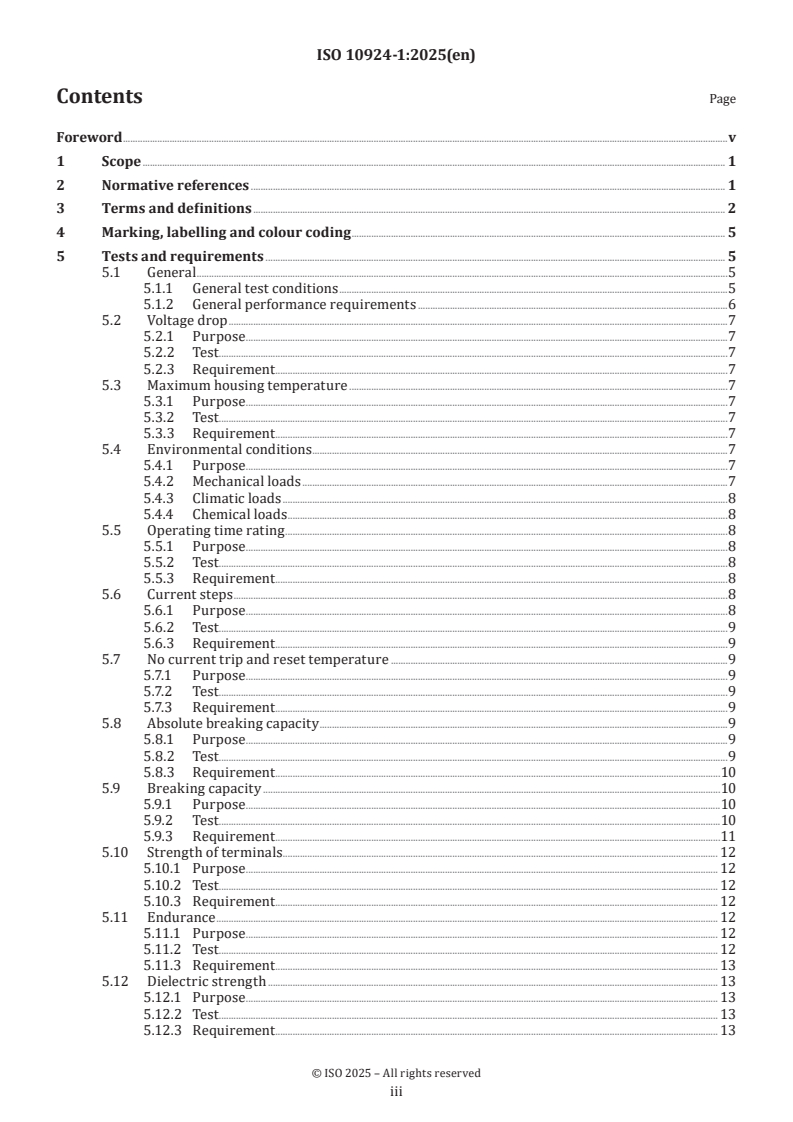
Contents Page
Foreword .v
1 Scope . 1
2 Normative references . 1
3 Terms and definitions . 2
4 Marking, labelling and colour coding . 5
5 Tests and requirements . 5
5.1 General .5
5.1.1 General test conditions .5
5.1.2 General performance requirements .6
5.2 Voltage drop .7
5.2.1 Purpose .7
5.2.2 Test . . .7
5.2.3 Requirement .7
5.3 Maximum housing temperature .7
5.3.1 Purpose .7
5.3.2 Test . . .7
5.3.3 Requirement .7
5.4 Environmental conditions .7
5.4.1 Purpose .7
5.4.2 Mechanical loads .7
5.4.3 Climatic loads .8
5.4.4 Chemical loads .8
5.5 Operating time rating .8
5.5.1 Purpose .8
5.5.2 Test . . .8
5.5.3 Requirement .8
5.6 Current steps .8
5.6.1 Purpose .8
5.6.2 Test . . .9
5.6.3 Requirement .9
5.7 No current trip and reset temperature .9
5.7.1 Purpose .9
5.7.2 Test . . .9
5.7.3 Requirement .9
5.8 Absolute breaking capacity .9
5.8.1 Purpose .9
5.8.2 Test . . .9
5.8.3 Requirement .10
5.9 Breaking capacity .10
5.9.1 Purpose .10
5.9.2 Test . . .10
5.9.3 Requirement .11
5.10 Strength of terminals. 12
5.10.1 Purpose . 12
5.10.2 Test . . . 12
5.10.3 Requirement . 12
5.11 Endurance . 12
5.11.1 Purpose . 12
5.11.2 Test . . . 12
5.11.3 Requirement . 13
5.12 Dielectric strength . 13
5.12.1 Purpose . 13
5.12.2 Test . . . 13
5.12.3 Requirement . 13
iii
Annex A (normative) Cycling profiles . 14
Annex B (normative) Test circuit . 17
Annex C (informative) Temperature rise test . 19
iv
Foreword
ISO (the International Organization for Standardization) is a worldwide federation of national standards
bodies (ISO member bodies). The work of preparing International Standards is normally carried out through
ISO technical committees. Each member body interested in a subject for which a technical committee
has been established has the right to be represented on that committee. International organizations,
governmental and non-governmental, in liaison with ISO, also take part in the work. ISO collaborates closely
with the International Electrotechnical Commission (IEC) on all matters of electrotechnical standardization.
The procedures used to develop this document and those intended for its further maintenance are described
in the ISO/IEC Directives, Part 1. In particular, the different approval criteria needed for the different types
of ISO document should be noted. This document was drafted in accordance with the editorial rules of the
ISO/IEC Directives, Part 2 (see www.iso.org/directives).
ISO draws attention to the possibility that the implementation of this document may involve the use of (a)
patent(s). ISO takes no position concerning the evidence, validity or applicability of any claimed patent
rights in respect thereof. As of the date of publication of this document, ISO had not received notice of (a)
patent(s) which may be required to implement this document. However, implementers are cautioned that
this may not represent the latest information, which may be obtained from the patent database available at
www.iso.org/patents. ISO shall not be held responsible for identifying any or all such patent rights.
Any trade name used in this document is information given for the convenience of users and does not
constitute an endorsement.
For an explanation of the voluntary nature of standards, the meaning of ISO specific terms and expressions
related to conformity assessment, as well as information about ISO's adherence to the World Trade
Organization (WTO) principles in the Technical Barriers to Trade (TBT), see www.iso.org/iso/foreword.html.
This document was prepared by Technical Committee ISO/TC 22, Road vehicles, Subcommittee SC 32,
Electrical and electronic components and general system aspects.
This third edition cancels and replaces the second edition (ISO 10924-1:2016), which has been technically
revised.
The main changes are as follows:
— in Clause 3 definition of insulation resistance was added;
— in Table 1 more details at the tolerances of measurement values were added;
— in Table 2 the test voltage of the DC power supply u was added;
t
— in 5.8.2 and 5.8.3 the test and requirements for absolute breaking capacity were clarified;
— in 5.9.2 and 5.9.3 the test and requirements for breaking capacity were clarified;
— in 5.11.3 the requirements for endurance were clarified;
— in Annex B Figure B.2 was added;
— Annex C the temperature rise test was added.
A list of all parts in the ISO 10924 series can be found on the ISO website.
Any feedback or questions on this document should be directed to the user’s national standards body. A
complete listing of these bodies can be found at www.iso.org/members.html.
v
International Standard ISO 10924-1:2025(en)
Road vehicles — Circuit breakers —
Part 1:
Definitions and general test requirements
1 Scope
This document defines terms and specifies general test requirements for circuit breakers for use in road
vehicles with a nominal voltage of 12 V (DC), 24 V (DC), 48 V (DC) and 450 V (DC).
This document is intended to be used in conjunction with ISO 10924-2, ISO 10924-3, ISO 10924-4 and
ISO 10924-5. The numbering of its clauses corresponds to that of the document whose requirements are
applicable, except where modified by requirements particular to this document.
This document is not applicable to circuit breaker holders (electrical centres or fuse-holders) used in
vehicles.
2 Normative references
The following documents are referred to in the text in such a way that some or all of their content constitutes
requirements of this document. For dated references, only the edition cited applies. For undated references,
the latest edition of the referenced document (including any amendments) applies.
1)
ISO 6722-1 , Road vehicles — 60 V and 600 V single-core cables — Part 1: Dimensions, test methods and
requirements for copper conductor cables
ISO 8820-1, Road vehicles — Fuse-links — Part 1: Definitions and general test requirements
ISO 8820-3, Road vehicles — Fuse-links — Part 3: Fuse-links with tabs (blade type) Type C (medium), Type E
(high current) and Type F (miniature)
ISO 10924-2, Road vehicles — Circuit breakers — Part 2: Guidance for users
ISO 10924-3:2025, Road vehicles — Circuit breakers — Part 3: Miniature circuit breakers with tabs (Blade type),
Form CB11
ISO 10924-4:2025, Road vehicles — Circuit breakers — Part 4: Medium circuit breakers with tabs (Blade type),
Form CB15
ISO 10924-5:2025, Road vehicles — Circuit breakers — Part 5: Circuit breakers with bolt with rated voltage of 450 V
ISO 16750-1, Road vehicles — Environmental conditions and testing for electrical and electronic equipment —
Part 1: General
ISO 16750-3, Road vehicles — Environmental conditions and testing for electrical and electronic equipment —
Part 3: Mechanical loads
ISO 16750-4, Road vehicles — Environmental conditions and testing for electrical and electronic equipment —
Part 4: Climatic loads
ISO 16750-5, Road vehicles — Environmental conditions and testing for electrical and electronic equipment —
Part 5: Chemical loads
1) Withdrawn standard.
IEC 60068-2–70, Environmental testing — Part 2: Tests — Test Xb: Abrasion of markings and letterings caused
by rubbing of fingers and hands
3 Terms and definitions
For the purposes of this document, the terms and definitions given in ISO 16750-1, ISO 8820-1 and the
following apply.
ISO and IEC maintain terminology databases for use in standardization at the following addresses:
— ISO Online browsing platform: available at https:// www .iso .org/ obp
— IEC Electropedia: available at https:// www .electropedia .org/
3.1
absolute breaking capacity
value of prospective breaking current that a circuit breaker (3.3) is capable of breaking at least once at U
Smax
under prescribed conditions of use and behaviour
3.2
breaking capacity
I
B
value of prospective breaking current a circuit breaker (3.3) is capable of breaking several times at U
Smax
under prescribed conditions of use and behaviour
3.3
circuit breaker
overcurrent protection device that mechanically interrupts the circuit reversibly, responsive to electric current
Note 1 to entry: The test fixture for the circuit breaker may be identical to the test fixture as described in ISO 8820-3.
However, some circuit breaker designs do not require a separate test fixture as the cables are directly connected to
the circuit breaker terminals (3.4.2).
3.4
Circuit breaker components
3.4.1
housing
electrically non-conductive mechanical support for conductive and non-conductive parts of the circuit
breaker (3.3)
3.4.2
terminal
part of the circuit breaker (3.3) which makes the electrical connection in the electrical circuit
3.4.3
time-delayed element
active part that acts depending on the current and causes the reversible interruption of the circuit in the
case of an overcurrent
3.5
Circuit breaker features
3.5.1
reset mechanism
provides a user interface in a manual reset circuit breaker (3.3) for resetting the device after an overcurrent
condition
3.5.2
snap-action mechanism
ensures that the contact closing speed by mechanical reset is independent of the speed of operation of the
reset mechanism (3.5.1)
3.5.3
switching mechanism
provides the ability to switch off the circuit breaker (3.3) by mechanical means
3.5.4
trip mechanism
comprises a time-delayed actuator and mechanical components
3.5.5
cycling trip free
circuit breaker mechanism that cycles to open and close the contact(s) repeatedly if the actuator is
maintained in the “ON” position in case of overcurrent
3.5.6
fully trip free
circuit breaker mechanism that causes the moving contact(s) to open and remain open, even if the actuator
is maintained in the “ON” position in case of overcurrent
3.5.7
trip free mechanism
prevents the switching mechanism (3.5.3) from being defeated by forcibly holding the actuator “ON” position,
i.e. cannot be held closed against an overload
3.6
Circuit breaker types
3.6.1
type I
automatic reset
device that provides the reversal of an overcurrent condition after a cool-down period without any manual
activity required by a user
3.6.2
type II
electrically reset
device that is opened by overcurrent and remains open as long as a minimum voltage and current is available
to the affected circuit
Note 1 to entry: The type II circuit breaker has a secondary heating circuit which, after an overcurrent condition
occurs, creates heat internally upon the time-delayed element (3.4.3) of the circuit breaker (3.3) to keep it from
reversing as long as the electrical system voltage and a small current flow (<1,0 A) is available, the reset function is
accomplished by removing all electrical power supplied to the circuit breaker until the internal thermal element cools
down and returns to its conductive position.
3.6.3
type III
manual reset
device that contains a reset mechanism (3.5.1) that the user is required to operate manually to reverse a
circuit interruption
3.6.4
type IV
switchable
device that contains a mechanism like type III (3.6.3) and additionally capable of being switched off manually
for user testing or maintenance
3.7
dielectric strength
strength measured between specified measuring points, as shown in ISO 10924-3, ISO 10924-4 and
ISO 10924-5, at a specified voltage without disruptive discharge
3.8
nominal voltage
U
N
voltage value used to describe the electrical system of a vehicle
[SOURCE: ISO 16750-1:2023, 3.13, modified — "12/24 V electrical system" has been replaced by "electrical
system".]
3.9
operating time
time between the application of an overcurrent and the moment when the current drops below a value as
specified in the appropriate part of the ISO 8820 series
[SOURCE: ISO 8820-1:2014, 3.7]
3.10
operating time rating
operating time (3.9), as a function of the current under defined test conditions
[SOURCE: ISO 8820-1:2014, 3.8]
3.11
prospective current
I
P
current, which would flow in a circuit, if the circuit breaker (3.3) would be replaced by a conductor with
negligible impedance
Note 1 to entry: See Figure B.1 for the test circuit.
3.12
rated current
I
R
current used for identifying the circuit breaker (3.3), according to specified tests
Note 1 to entry: The continuous current can be lower than the rated current.
3.13
rated voltage
U
R
maximum supply voltage for which the circuit breaker (3.3) is designed
3.14
rerating factor
correction factor of rated
...