

ISO 10924-2:2025
(Main)Road vehicles — Circuit breakers — Part 2: Guidance for users
General Information
- Abstract
This document provides guidance for the choice and application of automotive circuit breakers. It describes the various parameters that are taken into account when selecting circuit breakers.
- Status
- Published
- Publication Date
- 31-Mar-2025
- Current Stage
- 6060 - International Standard published
- Start Date
- 01-Apr-2025
- Due Date
- 24-Nov-2024
- Completion Date
- 31-Mar-2025

Overview
ISO 10924-2:2025, Road vehicles - Circuit breakers - Part 2: Guidance for users, is an international standard developed by ISO. This document provides essential guidance for the selection and application of automotive circuit breakers in road vehicles. It helps users evaluate key parameters in order to select the most suitable circuit breaker for specific electrical and electronic applications within automotive systems.
Choosing the right automotive circuit breaker ensures reliable circuit protection, prevents premature equipment failure, and maintains the safety and integrity of vehicle electrical systems. This standard is designed for use by engineers, designers, manufacturers, and maintenance professionals in the automotive industry.
Key Topics
ISO 10924-2:2025 covers a comprehensive range of factors affecting the choice and efficient use of circuit breakers in road vehicles:
- Selection Criteria: Outlines important parameters such as continuous current, operating time, overload protection, and environmental conditions for proper circuit breaker selection.
- Electrical Parameters: Discusses circuit breaker nominal voltage, rated current, and continuous current relevant to specific automotive applications.
- Cable and Conductor Considerations: Examines the impact of cable cross-section, insulation, and installation conditions on circuit breaker performance.
- Temperature Effects: Explains how ambient temperature and temperature rise affect current ratings and circuit breaker operations.
- Contact Resistance: Describes the influence of connection resistance and the importance of proper circuit breaker terminals and cable specifications.
- Cable Protection: Provides guidance on ensuring that circuit breakers trip in advance of reaching maximum cable temperatures, preventing cable overheating.
- Selectivity: Covers hierarchical circuit breaker coordination to prevent cascading circuit disconnections.
- Replacement and Safety: Recommends best practices for safe replacement of circuit breakers.
- Inrush and Overcurrent: Advises on considering the inrush withstand characteristics of circuit breakers when selecting for loads with high startup currents.
- Environmental Compatibility: Addresses the need for materials suitable for vehicle environments, avoiding hazardous metals, and proper terminal plating to prevent corrosion.
Applications
The practical guidance in ISO 10924-2:2025 is applicable to a wide spectrum of automotive electrical system designs and maintenance procedures:
- Vehicle Electrical System Design: Supports automotive engineers during the initial design phase of electrical systems, aiding in matching circuit breakers to specific loads and cable configurations.
- Maintenance and Repair: Assists workshop technicians and maintenance personnel in identifying compatible replacement circuit breakers and conducting safe replacements.
- Manufacturing: Helps OEMs and automotive component manufacturers ensure correct specification and installation of circuit breakers in vehicles, enhancing product safety and reliability.
- Aftermarket Installations: Provides valuable reference for installing additional electrical accessories or custom equipment, ensuring proper circuit protection is maintained.
- Circuit Diagnostics: Facilitates troubleshooting by explaining factors influencing breaker operation, such as temperature, voltage peaks, and conductor specifications.
Related Standards
For a complete approach to automotive circuit protection, ISO 10924-2:2025 references and aligns with other international standards, including:
- ISO 10924-1: Road vehicles - Circuit breakers - Part 1: Definitions and general test requirements (defining basic automotive circuit breaker parameters and tests)
- ISO 8820-1: Road vehicles - Fuse-links - Part 1: Definitions and general test requirements (for comparable fuse standards and terminology)
- ISO 10924-3, -4, -5: Additional parts in the ISO 10924 series addressing specific types and requirements for automotive circuit breakers
These related standards help ensure harmonization, interoperability, and a unified approach to automotive electrical component selection and testing.
Keywords: ISO 10924-2:2025, automotive circuit breakers, road vehicles, circuit protection, cable selection, electrical system safety, circuit breaker application, automotive standards, vehicle maintenance, circuit breaker selection guidance
Relations
- Effective Date
- 06-Jun-2022
Get Certified
Connect with accredited certification bodies for this standard

TÜV Rheinland
TÜV Rheinland is a leading international provider of technical services.

TÜV SÜD
TÜV SÜD is a trusted partner of choice for safety, security and sustainability solutions.

DEKRA Certification Inc.
DEKRA US certification services.
Sponsored listings
Frequently Asked Questions
ISO 10924-2:2025 is a standard published by the International Organization for Standardization (ISO). Its full title is "Road vehicles — Circuit breakers — Part 2: Guidance for users". This standard covers: This document provides guidance for the choice and application of automotive circuit breakers. It describes the various parameters that are taken into account when selecting circuit breakers.
This document provides guidance for the choice and application of automotive circuit breakers. It describes the various parameters that are taken into account when selecting circuit breakers.
ISO 10924-2:2025 is classified under the following ICS (International Classification for Standards) categories: 43.040.10 - Electrical and electronic equipment. The ICS classification helps identify the subject area and facilitates finding related standards.
ISO 10924-2:2025 has the following relationships with other standards: It is inter standard links to ISO 10924-2:2014. Understanding these relationships helps ensure you are using the most current and applicable version of the standard.
ISO 10924-2:2025 is available in PDF format for immediate download after purchase. The document can be added to your cart and obtained through the secure checkout process. Digital delivery ensures instant access to the complete standard document.
Standards Content (Sample)
International
Standard
ISO 10924-2
Second edition
Road vehicles — Circuit breakers —
2025-03
Part 2:
Guidance for users
Véhicules routiers — Coupe-circuits —
Partie 2: Recommandations pour les utilisateurs
Reference number
© ISO 2025
All rights reserved. Unless otherwise specified, or required in the context of its implementation, no part of this publication may
be reproduced or utilized otherwise in any form or by any means, electronic or mechanical, including photocopying, or posting on
the internet or an intranet, without prior written permission. Permission can be requested from either ISO at the address below
or ISO’s member body in the country of the requester.
ISO copyright office
CP 401 • Ch. de Blandonnet 8
CH-1214 Vernier, Geneva
Phone: +41 22 749 01 11
Email: copyright@iso.org
Website: www.iso.org
Published in Switzerland
ii
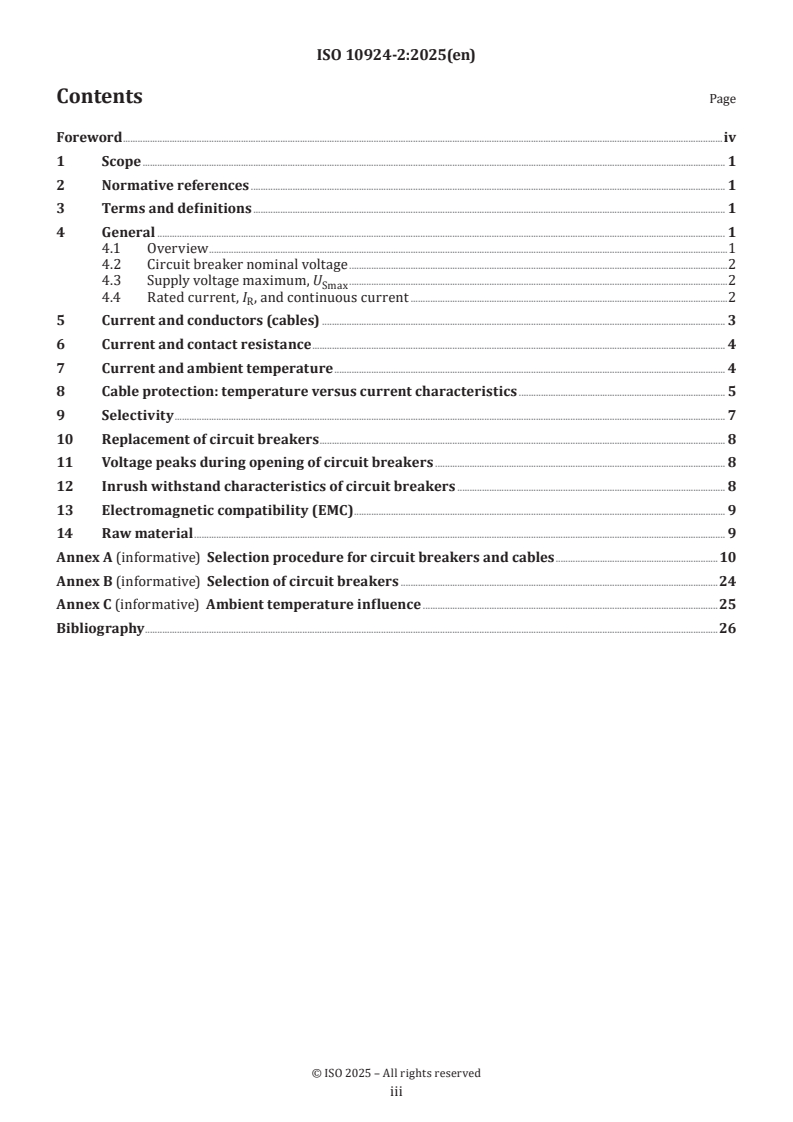
Contents Page
Foreword .iv
1 Scope . 1
2 Normative references . 1
3 Terms and definitions . 1
4 General . 1
4.1 Overview .1
4.2 Circuit breaker nominal voltage .2
4.3 Supply voltage maximum, U .2
Smax
4.4 Rated current, I , and continuous current .2
R
5 Current and conductors (cables) . 3
6 Current and contact resistance . 4
7 Current and ambient temperature . 4
8 Cable protection: temperature versus current characteristics . 5
9 Selectivity . 7
10 Replacement of circuit breakers . 8
11 Voltage peaks during opening of circuit breakers . 8
12 Inrush withstand characteristics of circuit breakers . 8
13 Electromagnetic compatibility (EMC) . . 9
14 Raw material . 9
Annex A (informative) Selection procedure for circuit breakers and cables .10
Annex B (informative) Selection of circuit breakers .24
Annex C (informative) Ambient temperature influence .25
Bibliography .26
iii
Foreword
ISO (the International Organization for Standardization) is a worldwide federation of national standards
bodies (ISO member bodies). The work of preparing International Standards is normally carried out through
ISO technical committees. Each member body interested in a subject for which a technical committee
has been established has the right to be represented on that committee. International organizations,
governmental and non-governmental, in liaison with ISO, also take part in the work. ISO collaborates closely
with the International Electrotechnical Commission (IEC) on all matters of electrotechnical standardization.
The procedures used to develop this document and those intended for its further maintenance are described
in the ISO/IEC Directives, Part 1. In particular, the different approval criteria needed for the different types
of ISO document should be noted. This document was drafted in accordance with the editorial rules of the
ISO/IEC Directives, Part 2 (see www.iso.org/directives).
ISO draws attention to the possibility that the implementation of this document may involve the use of (a)
patent(s). ISO takes no position concerning the evidence, validity or applicability of any claimed patent
rights in respect thereof. As of the date of publication of this document, ISO had not received notice of (a)
patent(s) which may be required to implement this document. However, implementers are cautioned that
this may not represent the latest information, which may be obtained from the patent database available at
www.iso.org/patents. ISO shall not be held responsible for identifying any or all such patent rights.
Any trade name used in this document is information given for the convenience of users and does not
constitute an endorsement.
For an explanation of the voluntary nature of standards, the meaning of ISO specific terms and expressions
related to conformity assessment, as well as information about ISO's adherence to the World Trade
Organization (WTO) principles in the Technical Barriers to Trade (TBT), see www.iso.org/iso/foreword.html.
This document was prepared by Technical Committee ISO/TC 22, Road vehicles, Subcommittee SC 32,
Electrical and electronic components and general system aspects.
This second edition cancels and replaces the first edition (ISO 10924-2:2014), which has been technically
revised.
The main changes are as follows:
— added Clause 14.
A list of all parts in the ISO 10924 series can be found on the ISO website.
Any feedback or questions on this document should be directed to the user’s national standards body. A
complete listing of these bodies can be found at www.iso.org/members.html.
iv
International Standard ISO 10924-2:2025(en)
Road vehicles — Circuit breakers —
Part 2:
Guidance for users
1 Scope
This document provides guidance for the choice and application of automotive circuit breakers. It describes
the various parameters that are taken into account when selecting circuit breakers.
2 Normative references
The following documents are referred to in the text in such a way that some or all of their content constitutes
requirements of this document. For dated references, only the edition cited applies. For undated references,
the latest edition of the referenced document (including any amendments) applies.
ISO 8820-1, Road vehicles — Fuse-links — Part 1: Definitions and general test requirements
ISO 10924-1, Road vehicles — Circuit breakers — Part 1: Definitions and general test requirements
3 Terms and definitions
For the purposes of this document, the terms and definitions given in ISO 8820-1 and ISO 10924-1 apply.
ISO and IEC maintain terminology databases for use in standardization at the following addresses:
— ISO Online browsing platform: available at https:// www .iso .org/ obp
— IEC Electropedia: available at https:// www .electropedia .org/
4 General
4.1 Overview
ISO 10924-1, ISO 10924-3, ISO 10924-4 and ISO 10924-5 define basic requirements and test methods for
nominal voltage, rated current, I , and time/current characteristics to give comparable and reproducible
R
results of circuit breakers.
In practice, however, there are other parameters which shall be considered for the correct selection of circuit
breakers in road vehicles, such as:
— continuous current;
— operating time;
— overload protection of one or more electrical/electronic devices;
— connection resistance;
— types of cables, e.g. different cross section, length, insulation, bundling;
— internal resistances (voltage drop) of the circuit breakers, contacts, cables and devices;
— power dissipation of the components comprising the system;
— short-circuit parameters;
— inrush parameters of devices;
— operating mode of the load;
— operating of one or more electrical/electronic devices;
— orientation and location of the circuit breakers, e.g. engine, passenger or luggage compartment;
— different currents, voltages, and temperatures of the system and surroundings;
— distances or clearances inside circuit breaker boxes or holders;
— different circuit breakers, circuit breaker holders and boxes (see Annex B);
— environmental conditions (mechanical loads, climatically loads, chemical loads);
— forced cooling of the circuit breakers.
NOTE Consult the manufacturers of the circuit-breaker, contacts and cables, because not all of the above points
can be addressed in this document.
The parameters listed are not intended to cover all the possible parameters that need to be taken into
consideration for circuit breaker selection nor is it intended that all parameters are considered in each
vehicle application.
4.2 Circuit breaker nominal voltage
See ISO 10924-1:2025, Clause 3.
4.3 Supply voltage maximum, U
Smax
See ISO 10924-1:2025, Clause 3.
4.4 Rated current, I , and continuous current
R
The rated current, I , is the current used for identifying the circuit breaker.
R
The continuous current, I , in Figure 1 is the maximum current which the circuit can continuously carry
C
under specified conditions: room temperature (23 °C), duration maximum 1 h, standard test holder, cross
sections of wires. The continuous current can be lower than the rated current, I .
R
See I-t characteristics of the circuit breaker described in A.2.2.3.
Key
X current, I
Y operating time, t
I continuous current
C
I rated current
R
1 time current characteristic
Figure 1 — Rated current (IR), continuous current and time-current characteristic
5 Current and conductors (cables)
The temperature rise of a cable is a function of current, conductor cross-section, strands, insolating materials
time duration and room temperature.
See I-t - characteristic of the insulated conductor (cable) in A.2.2.4.
Figure 2 shows stabilized temperature rise for various conductor cross sections at room temperature (RT).
Key
X1 current, I
X2 conductor cross section
Y conductor temperature, T
Figure 2 — Conductor temperatures for different conductor cross sections versus current at room
temperature
6 Current and contact resistance
A higher resistance of mated terminals results in a temperature rise and reduced thermal conduction away
from the circuit breaker. Hence, the temperature of the circuit breaker terminal is higher and the continuous
current for the application lower.
A temperature rise test can be conducted using circuit breakers, circuit breaker holders and connections as
specified by the vehicle manufacturer. At a specified test current, the temperature of the connections shall
be measured at the points, either tabs or bolt connection of the circuit breaker that protrude from the base
of the circuit breaker body (specified in ISO 10924-1 according to the type of circuit breaker). After thermal
equilibrium has been achieved, the temperature rise of the connection shall not exceed the limits specified
for terminals and cable.
7 Current and ambient temperature
All components of a circuit and their parts have their own characteristic curve as shown in Figure 3.
Each component in a circuit has an upper temperature limit. An increase of temperature results in increased
resistance, which can increase the temperature by itself. As a result, the circuit breaker can trip. It is always
recommended to consult with specific manufacturers of circuit breakers for current versus temperature
curves as both design and thermal materials used result in different curve characteristics.
See I-t - characteristic of the insulated conductor (cable) A.2.2.4 and rerating factor Table C.1.
Key
X room temperature, T
Y current, I
1 application area
2 cable
3 connection
4 insulator
5 circuit breaker
Figure 3 — Maximum continuous currents of circuit components vs. room temperature
8 Cable protection: temperature versus current characteristics
To ensure satisfactory cable protection, circuit breakers shall be chosen such that they will always open
before the maximum allowed cable temperature, T is exceeded. Figure 4 shows the correct circuit breaker
max,
selection. The maximum allowed temperature is never exceeded, because above a certain minimal operating
current, I , the circuit breaker trips before reaching the maximum permitted temperature of the cable.
f
See the selection procedure for circuit breakers and cables in Annex A.
Key
X times rated current
Y cable temperature, T
I trip current
t
T maximum allowed cable temperature
max
Figure 4 — Correct circuit breaker selection
Figure 5 shows incorrect circuit breaker selection. The circuit breaker allows some potentially damaging
current to flow for too long, causing the cable to overheat.
Key
X times rated current
Y cable temperature, T
I trip current
t
T maximum allowed cable temperature
max
1 unprotected region
Figure 5 — Incorrect circuit breaker selection
9 Selectivity
Higher level circuit breakers shall not trip when lower level circuit breakers are opening (see Figure 6).
Key
1 battery
2 circuit breaker level 1
3 circuit breaker level 2
4 circuit breaker level n
5 load
Figure 6 — Example for a structure hierarchy
10 Replacement of circuit breakers
Circuit breakers in a circuit shall be replaced with the circuit de-energised.
11 Voltage peaks during opening of circuit breakers
During the opening process of the circuit breaker, voltage peaks can occur. The peaks can achieve six times
the rated voltage, depending on the load and the supply.
12 Inrush withstand characteristics of circuit breakers
In selecting a circuit breaker, not only shall the continuous current and the rated current, I , be considered,
R
but also the inrush characteristics of electrical devices.
The inrush characteristic describes the time-current behaviour of electrical devices until the stabilized
continuous current has been attained.
The inrush withstand characteristics shall be considered as there are different requirements on the circuit
breaker depending on the type of load. The circuit breaker shall withstand the inrush energy without
opening. If the inrush energy is either too high or too long, or a combination thereof, it can be necessary to
select a higher rated circuit breaker to eliminate nuisance openings.
See the rating based on the I-t - characteristic curves (load, circuit breaker, and cable) in A.2.2.5.
13 Electromagnetic compatibility (EMC)
The EMC test for circuit breakers is not required by this document.
14 Raw material
Alloys for contacts shall not contain heavy metals such as cadmium or lead.
The terminals shall be plated with materials as it is common to wire harness connector or socket plating to
avoid electrochemical corrosion (e.g. tin plating with tin-plated connectors or sockets).
Annex A
(informative)
Selection procedure for circuit breakers and cables
A.1 General
In any given application, the characteristics of load, connecting cable and circuit breaker should be carefully
matched. This is necessary if the circuit breaker is to provide the expected degree of protection in the event
of an overcurrent in the circuit and to maintain a level of protection throughout the lifetime of the vehicle.
See Figure A.1.
Key
U nominal voltage
N
1 circuit breaker
2 cable
3 load
Figure A.1 — Scheme of a generic circuit with a circuit breaker
The protection of a load in a vehicle electrical system is typically performed by a protection element close to
the load. But there are loads where the protection of the cable is also a sufficient protection for the load itself
at the same time.
Conventional cables generally consist of a copper-core and an insulation-layer. The copper-core heats up
when the cable is exposed to a current. If an overload occurs, the insulation-layer can be damaged or can
even start to melt.
There are three main reasons for this failure:
— the cross-section of the cable is too small to carry the current, which means voltage drop of the cable is
too high;
— an unintended overcurrent leads to critical overheating of the copper-core and the insulation-layer, even
if it was dimensioned correctly;
— wire breakage, loose contact or other damage to the cables led to an arc.
To reliably master the first and second cause, the cross section of the cable and the rated current, I , of the
R
circuit breaker shall be evaluated. After the evaluation of the cable cross section and the rated current, I , of
R
the circuit breaker, these figures shall be adjusted to the cable insulation class. If possible, the behaviour of
the load should be considered.
Regarding the third point, there are solutions available by means of arc tracking to detect low current flow
between two conductors. This is not part of this document. For further information, the manufacturer shall
be contacted.
There are various factors that should be taken into account (see Clause 4) when determining the value of
rated current, I , to be used for selection of circuit breakers and cables. In the following clause, the listed
R
factors are considered:
— continuous current;
— ambient temperature (set to room temperature (RT) and 60 °C);
— operating mode of the load shall be co
...