

ISO/TS 4971:2023
(Main)Nanotechnologies — Performance evaluation of nanosuspensions containing clay nanoplates for quorum quenching
General Information
- Abstract
This document specifies the performance evaluation of nanosuspensions containing clay nanoplates for quorum quenching in crop production. This document does not cover safety and environmental aspects.
- Status
- Published
- Publication Date
- 25-Jun-2023
- Technical Committee
- ISO/TC 229 - Nanotechnologies
- Drafting Committee
- ISO/TC 229/WG 5 - Products and Applications
- Current Stage
- 9093 - International Standard confirmed
- Start Date
- 25-Sep-2026
- Completion Date
- 26-Sep-2026

Overview
ISO/TS 4971:2023 - Nanotechnologies - Performance evaluation of nanosuspensions containing clay nanoplates for quorum quenching - specifies how to evaluate the functional performance of clay-nanoplate nanosuspensions intended for quorum quenching in crop production. The technical specification focuses on measurable characteristics and laboratory methods to assess quorum quenching, antibacterial performance, and quality control of nanosuspensions. It explicitly does not cover safety and environmental risk management (Annex C is informative only).
Key topics and technical requirements
- Scope and definitions
- Terms defined include nanosuspension, clay, nanoplate, critical micelle concentration (CMC), MIC and MBC.
- Characteristics to measure
- Chemical composition (wt %) - ICP‑MS, ICP‑OES or XRF (powder).
- Mineral composition (wt %) - XRD (powder).
- Specific surface area (m2/g) - BET method (ISO 9277).
- Cation exchange capacity (meq/100 g) - ammonium acetate method (ISO/DIS 22171).
- Hydrodynamic size - DLS (ISO 22412) or laser diffraction (ISO 13320) on suspensions.
- Zeta potential - electrophoretic light scattering (ISO 13099‑2); pH must be reported.
- Performance testing
- Quorum quenching ability (QQA) quantified by interaction with representative surfactants (cationic: dodecyltrimethylammonium bromide; non‑ionic: octylphenol ethoxylate; anionic: sodium dodecyl sulfate). Surface‑tension titration (Wilhelmy plate) at CMC is used to detect affinity/adsorption effects.
- Antibacterial activities - determination of Minimum Inhibitory Concentration (MIC) and Minimum Bactericidal Concentration (MBC) following the specified incubation conditions.
- Reporting
- Requirements for test reports and informative annexes linking nanoplate characteristics with antibacterial performance (Annex A) and correlating QQA with antibacterial outcomes (Annex B).
Practical applications and users
- Intended for developers and manufacturers of agro‑nanotechnologies, crop protection product formulators and quality control laboratories who need standardized methods to:
- Evaluate and compare clay nanoplate nanosuspensions for suppression of pathogenic bacteria via quorum quenching.
- Establish product specifications (surface area, CEC, hydrodynamic size, zeta potential) tied to functional antibacterial performance.
- Support R&D, formulation optimization, and internal quality assurance of nanosuspensions for crop production.
- Also useful to academic researchers studying quorum sensing/quenching, nanomaterials’ surface chemistry, and antimicrobial mechanisms in agricultural contexts.
Related standards
- ISO/TS 80004 (nanotechnology vocabulary)
- ISO/TS 21236‑1, ISO/TS 21236‑2 (clay/nanoplate references)
- ISO 9277 (BET surface area)
- ISO 22412 (DLS), ISO 13320 (laser diffraction)
- ISO 13099‑2 (zeta potential)
- ISO/DIS 22171 (CEC method)
Keywords: ISO/TS 4971:2023, clay nanoplates, nanosuspensions, quorum quenching, crop production, antibacterial performance, MIC, MBC, zeta potential, specific surface area, cation exchange capacity.
Frequently Asked Questions
ISO/TS 4971:2023 is a technical specification published by the International Organization for Standardization (ISO). Its full title is "Nanotechnologies — Performance evaluation of nanosuspensions containing clay nanoplates for quorum quenching". This standard covers: This document specifies the performance evaluation of nanosuspensions containing clay nanoplates for quorum quenching in crop production. This document does not cover safety and environmental aspects.
This document specifies the performance evaluation of nanosuspensions containing clay nanoplates for quorum quenching in crop production. This document does not cover safety and environmental aspects.
ISO/TS 4971:2023 is classified under the following ICS (International Classification for Standards) categories: 07.120 - Nanotechnologies. The ICS classification helps identify the subject area and facilitates finding related standards.
ISO/TS 4971:2023 is available in PDF format for immediate download after purchase. The document can be added to your cart and obtained through the secure checkout process. Digital delivery ensures instant access to the complete standard document.
Standards Content (Sample)
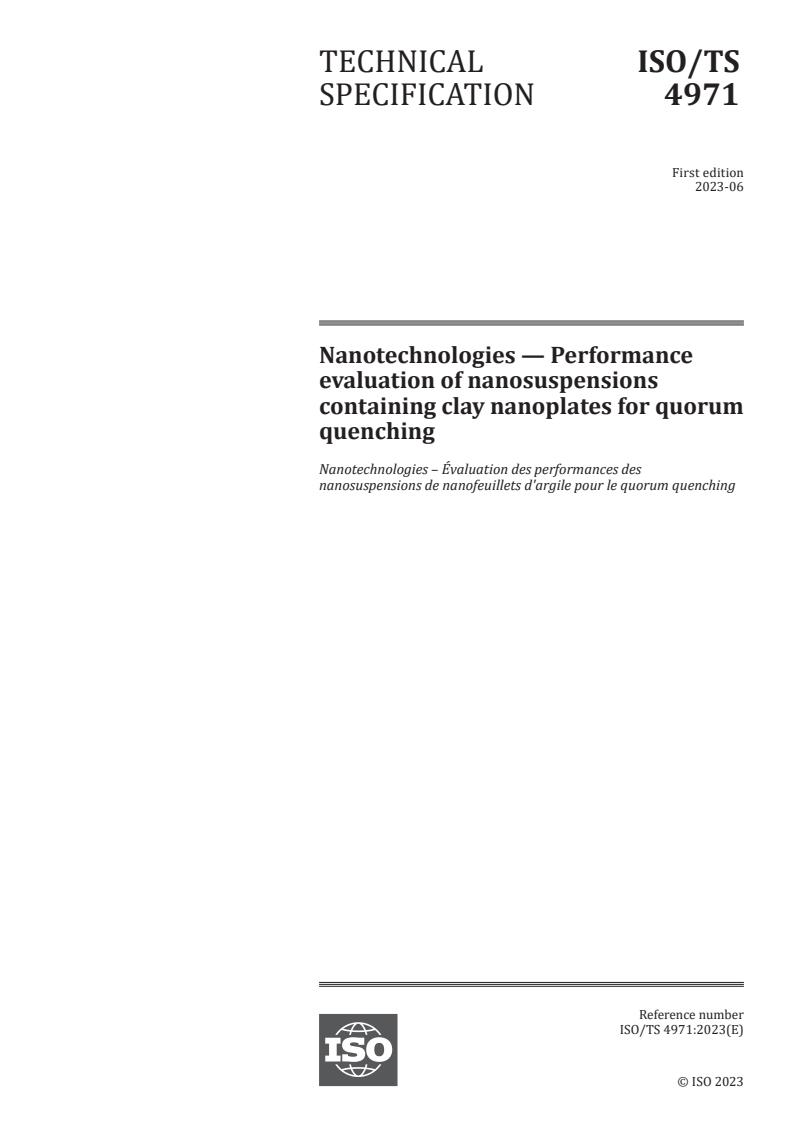
TECHNICAL ISO/TS
SPECIFICATION 4971
First edition
2023-06
Nanotechnologies — Performance
evaluation of nanosuspensions
containing clay nanoplates for quorum
quenching
Nanotechnologies – Évaluation des performances des
nanosuspensions de nanofeuillets d'argile pour le quorum quenching
Reference number
© ISO 2023
All rights reserved. Unless otherwise specified, or required in the context of its implementation, no part of this publication may
be reproduced or utilized otherwise in any form or by any means, electronic or mechanical, including photocopying, or posting on
the internet or an intranet, without prior written permission. Permission can be requested from either ISO at the address below
or ISO’s member body in the country of the requester.
ISO copyright office
CP 401 • Ch. de Blandonnet 8
CH-1214 Vernier, Geneva
Phone: +41 22 749 01 11
Email: copyright@iso.org
Website: www.iso.org
Published in Switzerland
ii
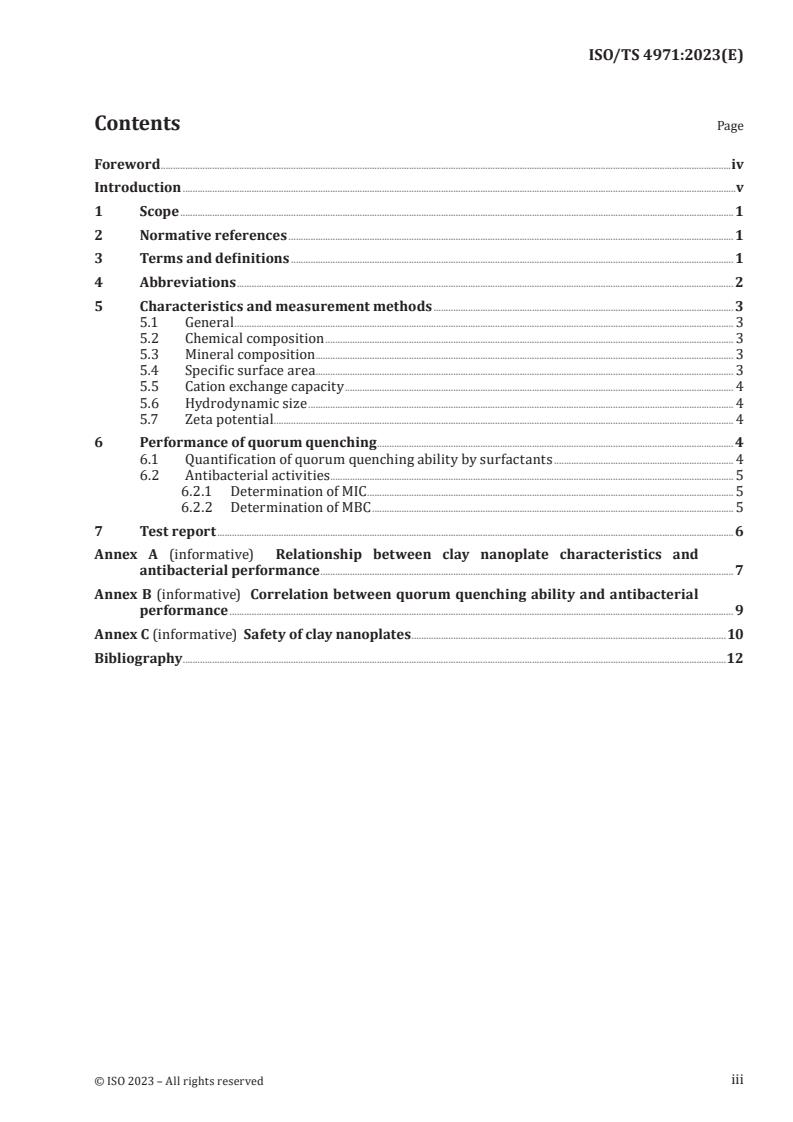
Contents Page
Foreword .iv
Introduction .v
1 Scope . 1
2 Normative references . 1
3 Terms and definitions . 1
4 Abbreviations . 2
5 Characteristics and measurement methods . 3
5.1 General . 3
5.2 Chemical composition . 3
5.3 Mineral composition . 3
5.4 Specific surface area . 3
5.5 Cation exchange capacity . 4
5.6 Hydrodynamic size . 4
5.7 Zeta potential . . 4
6 Performance of quorum quenching . 4
6.1 Quantification of quorum quenching ability by surfactants . 4
6.2 Antibacterial activities . . 5
6.2.1 Determination of MIC . 5
6.2.2 Determination of MBC . 5
7 Test report . 6
Annex A (informative) Relationship between clay nanoplate characteristics and
antibacterial performance .7
Annex B (informative) Correlation between quorum quenching ability and antibacterial
performance . 9
Annex C (informative) Safety of clay nanoplates .10
Bibliography .12
iii
Foreword
ISO (the International Organization for Standardization) is a worldwide federation of national standards
bodies (ISO member bodies). The work of preparing International Standards is normally carried out
through ISO technical committees. Each member body interested in a subject for which a technical
committee has been established has the right to be represented on that committee. International
organizations, governmental and non-governmental, in liaison with ISO, also take part in the work.
ISO collaborates closely with the International Electrotechnical Commission (IEC) on all matters of
electrotechnical standardization.
The procedures used to develop this document and those intended for its further maintenance are
described in the ISO/IEC Directives, Part 1. In particular, the different approval criteria needed for the
different types of ISO documents should be noted. This document was drafted in accordance with the
editorial rules of the ISO/IEC Directives, Part 2 (see www.iso.org/directives).
Attention is drawn to the possibility that some of the elements of this document may be the subject of
patent rights. ISO shall not be held responsible for identifying any or all such patent rights. Details of
any patent rights identified during the development of the document will be in the Introduction and/or
on the ISO list of patent declarations received (see www.iso.org/patents).
Any trade name used in this document is information given for the convenience of users and does not
constitute an endorsement.
For an explanation of the voluntary nature of standards, the meaning of ISO specific terms and
expressions related to conformity assessment, as well as information about ISO's adherence to
the World Trade Organization (WTO) principles in the Technical Barriers to Trade (TBT), see
www.iso.org/iso/foreword.html.
This document was prepared by Technical Committee ISO/TC 229, Nanotechnologies.
Any feedback or questions on this document should be directed to the user’s national standards body. A
complete listing of these bodies can be found at www.iso.org/members.html.
iv
Introduction
Among the abundant minerals in the earth’s crust, the naturally occurring clays in the class of
phyllosilicates such as smectite, talc and mica are layer silicates existed as laminated mass. The stacks
of smectite can be exfoliated into individual clay nanoplates of high surface area and high charge
density on the surface. Due to the presence of the surface charges, the clay nanoplate gives rise to a
strong electrostatic and charge attraction on microbial surface. The clay nanoplates can be further
modified by introducing various surfactants to enhance their functions for inhibiting bacterial growth
through quorum quenching interactions. The clay nanoplate suspension in water is designed to inhibit
the growth of pathogenic bacteria for crop protection from diseases. Moreover, as an additional benefit,
harvesting yield increased.
The antibacterial efficacy is attributed to the unique combinations of chemical and physical properties
including the nanoplate shape and size dimension, high surface area, ionic charge attraction and
water dispersion stability. These combined characteristics in a single nanoplate enable for a long-
term antibacterial effect. The inter-relation between clay nanoplate characteristics and antibacterial
performance are described in Annex A. The quorum quenching ability depends on the interaction of
clay nanoplates with bacterial signaling molecules and bacterial surfaces. It can be used as the standard
for quality control for the clay nanoplate, and more importantly, the antimicrobial efficacy by using clay
nanoplates can be measured and predicted. The correlation between quorum quenching ability and
antibacterial performance is described in Annex B.
This document does not cover safety and environmental aspects. Some safety of clay nanoplate
regarding the cytotoxicity and genotoxicity toward human cell, oral lethal dose (LD ), and aquatic
toxicity are described in Annex C.
v
TECHNICAL SPECIFICATION ISO/TS 4971:2023(E)
Nanotechnologies — Performance evaluation of
nanosuspensions containing clay nanoplates for quorum
quenching
1 Scope
This document specifies the performance evaluation of nanosuspensions containing clay nanoplates
for quorum quenching in crop production. This document does not cover safety and environmental
aspects.
2 Normative references
There are no normative references in this document.
3 Terms and definitions
For the purposes of this document, the following terms and definitions apply.
ISO and IEC maintain terminology databases for use in standardization at the following addresses:
— ISO Online browsing platform: available at https:// www .iso .org/ obp
— IEC Electropedia: available at https:// www .electropedia .org/
3.1
nanosuspension
fluid nanodispersion where the dispersed phase is a solid
Note 1 to entry: The use of the term “nanosuspension” carries no implication regarding thermodynamic stability.
[SOURCE: ISO/TS 80004-4:2011, 3.5.1]
3.2
clay
naturally occurring or synthetically manufactured material composed primarily of fine-grained
minerals, which is generally plastic at appropriate water contents and will harden when dried or fired
Note 1 to entry: Taken from Reference [1].
Note 2 to entry: Although clay usually contains phyllosilicates, it may contain other materials that impart
plasticity and harden when dried or fired. Associated phases in clay may include materials that do not impart
plasticity and organic matter. Different disciplines have uniquely defined the size of clay particles, and it is for
this reason that “fine grained” is used in the definition rather than a precise value. However, because of these
size variations from discipline to discipline, it is important that the particle size be specified in the context of the
application.
[SOURCE: ISO/TS 21236-1:2019, 3.4]
3.3
nanoplate
nano-object with one external dimension in the nanoscale and the other two external dimensions
significantly larger
[SOURCE: ISO/TS 80004-2:2015, 4.6]
3.4
clay nanoplate
nanoplate composed of clay
[SOURCE: ISO/TS 21236-2:2021, 3.3]
3.5
critical micelle concentration
concentration of a surfactant above which micelles will form
3.6
minimum inhibitory concentration
lowest concentration of the clay nanoplate that completely inhibits visible growth of the initial inoculum
after incubation at 35 °C for 18 h
3.7
minimum bactericidal concentration
lowest concentration of the clay nanoplate that 99,9 % of the final inoculum is killed after incubation at
35 °C for 24 h
3.8
nano-object
discrete piece of material with one, two or three external dimensions in the nanoscale
Note 1 to entry: The second and third external dimensions are orthogonal to the first dimension and to each
other.
[SOURCE: ISO/TS 80004-2: 2015, 2.2]
4 Abbreviations
AFM Atomic force microscopy
BET Brunauer–Emmett–Teller
CEC Cationic exchange capacity
CMC Critical micelle concentration
DLS Dynamic light-scattering
ELS Electrophoretic light-scattering
FB1 Fumonisin B1
ICP-MS Inductively coupled plasma mass spectrometry
ICP-OES Inductively coupled plasma optical emission spectrometry
IEP Isoelectric point
LD Oral lethal dose, 50 %
MIC Minimum inhibitory concentration
MBC Minimum bactericidal concentration
MMT Montmorillonite
QQA Quorum quenching ability
SEM Scanning electron microscope
TEM Transmission electron microscopy
XRD X-ray Diffractometer
XRF X-ray Fluorescence Spectrometer
5 Characteristics and measurement methods
5.1 General
The characteristics and measurement methods of clay nanoplate are listed in Table 1. The essential
characteristics of clay nanoplate can provide understanding of the potential quorum quenching ability
and antibacterial performance. Characteristics can be determined using the methods listed in Table 1.
The inter-relation between clay nanoplate characteristics and antibacterial performance are described
in Annex A.
Table 1 — Characteristics of clay nanoplate to be measured
Test specimen
Characteristics Units Measurement method Relevant documents
form
Chemical
wt % ICP-MS or XRF Powder ISO/TS 21236-1
composition
Mineral
wt % XRD Powder ISO/TS 21236-1
composition
Specific surface
m /g BET Powder ISO 9277
area
Cation exchange
a
meq/100 g Ammonium acetate method Powder ISO 22171
capacity
DLS ISO 22412
Hydrodynamic size μm Suspension
Laser diffraction method ISO 13320
Zeta potential V ELS Suspension ISO 13099-2
a
Under preparation. Stage at the time of publication: ISO/DIS 22171:2023.
5.2 Chemical composition
The chemical composition of clay nanoplate can be determined using ICP-MS, ICP-OES or XRF. The
measurement results of the constituent oxides fractions are expressed as wt %.
5.3 Mineral composition
The mineral composition of clay nanoplate can be determined using XRD. The XRD pattern could
provide the crystalline mineral phase with their corresponding d-spacing values, the measurement
results are expressed as wt % to the mineral composition.
5.4 Specific surface area
The high surface area with the surface charge exposure in water enables the function of inhibiting
microbial growth. The specific surface area of clay nanoplate can be determined according to ISO 9277.
This standard specifies the determination of the overall specific external and internal surface area of
samples by measuring the amount of physically adsorbed gas according to the BET method.
5.5 Cation exchange capacity
The generation of the negative surface charge of clay nanoplate is described by the isomorphous
substitution of Si, Al or Mg in clay crystal and balanced by the adsorbed counter ions (cations). The
cation exchange capacity indicates how many cations can be exchanged on the surface of silicates
[2]
expressed as meq/100 g. The ammonium acetate at pH 7 method proposed by Schollenberger et al.
1)
is widely used to determine the cation exchange capacity. ISO/DIS 22171 specifies a method for the
determination of cation exchange capacity and the content of exchangeable cations (Ca, K, Mg, Na) in
soils using ammonium acetate solution at pH 7 as extractant.
5.6 Hydrodynamic size
Clay nanoplate samples are typically powders. Powder samples shall be well dispersed in the aqueous
suspension for size measurement, a higher concentration of clay nanoplate can cause agglomeration.
Suspensions often need to be diluted to minimize agglomeration prior to the size measurement. The
hydrodynamic diameter of clay nanoplate generally is larger than the primary particle size observed in
TEM, SEM or AFM images due to the additional hydration layer, or possible aggregation/agglomeration.
The hydrodynamic size shall be measured using DLS or the laser diffraction method according to
ISO 22412 or ISO 13320 respectively.
5.7 Zeta potential
Zeta potential reflects the surface charge characterization of a particle and its dispersion stability in
aqueous suspension; a higher value of zeta potential (absolute value) indicates a high surface charge,
leading to strong repulsion forces between charged particles to prevent aggregation. A low value of
zeta potential increases the probability of aggregation due to van der Waals attraction.
The differences are lied on the exfoliated clays, that is silicate nanoplates, a surface totally exposed
silicates from the pristine clay stacks. With a significantly different charge behaviour from the clay,
the clay nanoplates usually exhibit an isoelectric point (IEP) and pH functions of zeta potential. An
[9]
apparent coagulation can occur when the pH is below the IEP at high edge charge density.
The pH value shall be reported along with the zeta potential. ISO 13099-2 specifies a method of
measurement of electrophoretic mobility of particles suspended in a liquid for calculating zeta-
potential.
6 Performance of quorum quenching
6.1 Quantification of quorum quenching ability by surfactants
The quorum quenching ability depends on the interaction of clay nanoplates with bacterial signaling
molecules and bacterial surfaces. It is the measurement and indication of the non-covalent affinity of
the clay nanoplate with polar organic molecules or the microbial cell surface. Three types of commonly
used surfactants are selected as the representatives including cationic (dodecyltrimethylammonium
bromide), nonionic (octylphenol ethoxylate) and anionic (sodium dodecyl sulfate) surfactants for
measuring the quorum quenching ability.
The surface tension with the Wilhelmy plate method is measured by varying the quantity of clay
nanoplate to individual surfactant at the original point of the CMC, indicating the quantitative effect on
the intrinsic characteristics of the surfactant CMC. The alternation of the surface tension in the titration
process of clay nanoplate adding to surfactant is measured. A sharp change in surface tension can be
[10]
observed at the equivalent point of a titration.
In the beginning of the titration process, the small volume of clay nanoplate solution in specified
concentration is slowly added to the surfactant solution at the point of CMC. In general, during the
measurements of surface tension drops, the time to reach an equilibrium is necessary before the final
1) Under preparation. Stage at the time of publication: ISO/DIS 22171:2023.
data reading. The completion of the reaction is monitored in reaching its equilibrium or no further
change of surface tension reading. The added amount of the clay is plotted against the surface tension
changes at the surfactant CMC.
The QQA, expressed in units of meq/100 g, is calculated at the equivalent point with Formula (1):
Ws /Es ⋅10
()
QQA = (1)
Wc
where
Wc is the clay nanoplate concentration at the equivalent point, wt %;
Ws is the surfactant concentration at the equivalent point, wt %;
Es is the surfactant equivalent weight, in g/eq;
10 is the factor to convert eq/g to meq/100 g.
The change of surface tension at CMC actually represents the quorum quenching ability toward the
specific surfactant. The cationic surfactant has a strong ionic exchange or formation of ionic bonds on
the clay nanoplate surface and equivalent ratio at critical point. The nonionic surfactant is less affected
due to the lacking of ionic exchange interaction but only by C-O bonding dipole-dipole interaction
with the added clay nanoplate, it represents a weaker interaction than the charge species. The anionic
surfactant has no noticeable interaction on the addition of clay nanoplate due to the absence of both
charges and dipole- dipole interactions.
The quantitative strength of interaction between clay nanoplate and surfactant
...