

ISO/TS 23361:2024
(Main)Nanotechnologies — Crystallinity of cellulose nanomaterials by powder X-ray diffraction (Rietveld analysis)
General Information
- Abstract
This document specifies the determination of the bulk crystallinity (crystalline contribution relative to the total crystalline and amorphous contributions in the material) of cellulose nanomaterials using powder X-ray diffraction followed by deconvolution of the diffraction patterns based on Rietveld analysis. It is applicable to all types of cellulose nanomaterials, assuming a representative sample.
- Status
- Published
- Publication Date
- 17-Oct-2024
- Technical Committee
- ISO/TC 229 - Nanotechnologies
- Drafting Committee
- ISO/TC 229/JWG 2 - Measurement and characterization
- Parallel Committee
- IEC/TC 113 - Nanotechnology for electrotechnical products and systems
- Current Stage
- 6060 - International Standard published
- Start Date
- 18-Oct-2024
- Due Date
- 23-Jan-2025
- Completion Date
- 18-Oct-2024


Overview
ISO/TS 23361:2024 - Nanotechnologies - Crystallinity of cellulose nanomaterials by powder X‑ray diffraction (Rietveld analysis) specifies a standardized procedure to determine the bulk crystallinity of cellulose nanomaterials (CNM) using powder X‑ray diffraction (PXRD) combined with Rietveld deconvolution. The Technical Specification applies to all types of nanocellulose (cellulose nanocrystals, cellulose nanofibrils, cellulose filaments) provided a representative, randomly oriented sample is used. The method reports the mass fraction of material composed of crystallites by separating crystalline scattering from amorphous/background contributions.
Key Topics
- Measurement principle: PXRD pattern deconvolution using the Rietveld least‑squares fitting method to model crystalline peaks and fit background (amorphous) scattering across the whole angular range.
- Scope and definitions: Terms and CNM classifications (CNC, CNF, iCNF) are aligned with existing ISO nanotechnology terminology.
- Sample preparation: Emphasis on representative sampling and ensuring random orientation to make diffraction patterns reflective of bulk crystallinity.
- Instrument and software requirements: Guidance on diffractometer setup, detector sensitivity and required crystallographic information files for Rietveld modelling.
- Data collection and processing: Parameters for PXRD acquisition and the Rietveld modelling workflow, including peak models, background fitting and deconvolution strategies.
- Uncertainty and reporting: Procedures to estimate measurement uncertainty and required contents of the test report.
- Validation: Includes results from interlaboratory comparisons (informative Annex A) to support reproducibility.
Applications
ISO/TS 23361:2024 is suitable for laboratories and organizations needing reproducible, quantitative crystallinity data for cellulose nanomaterials. Typical users and use cases include:
- Quality control and batch release for CNM producers - ensuring product consistency and grade differentiation.
- R&D and materials characterization in academia and industry studying structure–property relationships of nanocellulose and nanocomposites.
- Process optimization and degradation monitoring - tracking crystallinity changes during chemical or mechanical processing.
- Regulatory and standards testing where documented, comparable crystallinity metrics are required for specification or claims.
Keywords naturally aligned with this standard: ISO/TS 23361:2024, crystallinity measurement, cellulose nanomaterials, powder X‑ray diffraction, Rietveld analysis, nanocellulose, CNC, CNF, PXRD crystallinity.
Related Standards
- ISO/TS 20477:2023 (terms for cellulose nanomaterials)
- ISO 80004‑1:2023 (nanotechnology terminology)
- ISO 472:2013 (definitions related to amorphous/crystalline polymer regions)
These related documents provide terminology and background that complement the technical procedures in ISO/TS 23361:2024.
Frequently Asked Questions
ISO/TS 23361:2024 is a technical specification published by the International Organization for Standardization (ISO). Its full title is "Nanotechnologies — Crystallinity of cellulose nanomaterials by powder X-ray diffraction (Rietveld analysis)". This standard covers: This document specifies the determination of the bulk crystallinity (crystalline contribution relative to the total crystalline and amorphous contributions in the material) of cellulose nanomaterials using powder X-ray diffraction followed by deconvolution of the diffraction patterns based on Rietveld analysis. It is applicable to all types of cellulose nanomaterials, assuming a representative sample.
This document specifies the determination of the bulk crystallinity (crystalline contribution relative to the total crystalline and amorphous contributions in the material) of cellulose nanomaterials using powder X-ray diffraction followed by deconvolution of the diffraction patterns based on Rietveld analysis. It is applicable to all types of cellulose nanomaterials, assuming a representative sample.
ISO/TS 23361:2024 is classified under the following ICS (International Classification for Standards) categories: 07.120 - Nanotechnologies. The ICS classification helps identify the subject area and facilitates finding related standards.
ISO/TS 23361:2024 is available in PDF format for immediate download after purchase. The document can be added to your cart and obtained through the secure checkout process. Digital delivery ensures instant access to the complete standard document.
Standards Content (Sample)
Technical
Specification
ISO/TS 23361
First edition
Nanotechnologies — Crystallinity of
2024-10
cellulose nanomaterials by powder
X-ray diffraction (Rietveld analysis)
Nanotechnologies — Cristallinité des nanomatériaux à base de
cellulose par diffraction aux rayons X sur poudre (analyse de
Ruland-Rietveld)
Reference number
© ISO 2024
All rights reserved. Unless otherwise specified, or required in the context of its implementation, no part of this publication may
be reproduced or utilized otherwise in any form or by any means, electronic or mechanical, including photocopying, or posting on
the internet or an intranet, without prior written permission. Permission can be requested from either ISO at the address below
or ISO’s member body in the country of the requester.
ISO copyright office
CP 401 • Ch. de Blandonnet 8
CH-1214 Vernier, Geneva
Phone: +41 22 749 01 11
Email: copyright@iso.org
Website: www.iso.org
Published in Switzerland
ii
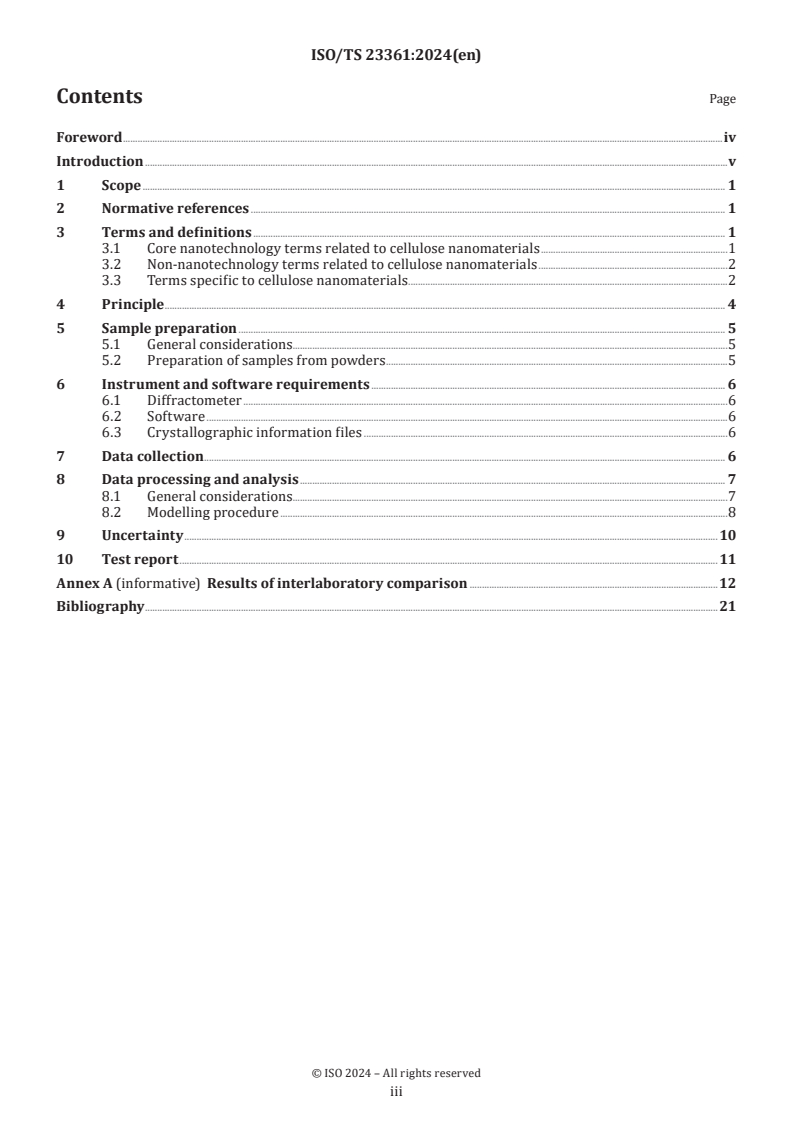
Contents Page
Foreword .iv
Introduction .v
1 Scope . 1
2 Normative references . 1
3 Terms and definitions . 1
3.1 Core nanotechnology terms related to cellulose nanomaterials .1
3.2 Non-nanotechnology terms related to cellulose nanomaterials .2
3.3 Terms specific to cellulose nanomaterials.2
4 Principle . 4
5 Sample preparation . 5
5.1 General considerations.5
5.2 Preparation of samples from powders .5
6 Instrument and software requirements . 6
6.1 Diffractometer .6
6.2 Software .6
6.3 Crystallographic information files .6
7 Data collection . . 6
8 Data processing and analysis . 7
8.1 General considerations.7
8.2 Modelling procedure .8
9 Uncertainty . 10
10 Test report .11
Annex A (informative) Results of interlaboratory comparison .12
Bibliography .21
iii
Foreword
ISO (the International Organization for Standardization) is a worldwide federation of national standards
bodies (ISO member bodies). The work of preparing International Standards is normally carried out through
ISO technical committees. Each member body interested in a subject for which a technical committee
has been established has the right to be represented on that committee. International organizations,
governmental and non-governmental, in liaison with ISO, also take part in the work. ISO collaborates closely
with the International Electrotechnical Commission (IEC) on all matters of electrotechnical standardization.
The procedures used to develop this document and those intended for its further maintenance are described
in the ISO/IEC Directives, Part 1. In particular, the different approval criteria needed for the different types
of ISO document should be noted. This document was drafted in accordance with the editorial rules of the
ISO/IEC Directives, Part 2 (see www.iso.org/directives).
ISO draws attention to the possibility that the implementation of this document may involve the use of (a)
patent(s). ISO takes no position concerning the evidence, validity or applicability of any claimed patent
rights in respect thereof. As of the date of publication of this document, ISO had not received notice of (a)
patent(s) which may be required to implement this document. However, implementers are cautioned that
this may not represent the latest information, which may be obtained from the patent database available at
www.iso.org/patents. ISO shall not be held responsible for identifying any or all such patent rights.
Any trade name used in this document is information given for the convenience of users and does not
constitute an endorsement.
For an explanation of the voluntary nature of standards, the meaning of ISO specific terms and expressions
related to conformity assessment, as well as information about ISO's adherence to the World Trade
Organization (WTO) principles in the Technical Barriers to Trade (TBT), see www.iso.org/iso/foreword.html.
This document was prepared by Technical Committee ISO/TC 229, Nanotechnologies.
Any feedback or questions on this document should be directed to the user’s national standards body. A
complete listing of these bodies can be found at www.iso.org/members.html.
iv
Introduction
Cellulose nanomaterials (CNM) are a family of emerging bioproducts with significant commercial impact. Their
production from abundant cellulose sources such as wood pulps makes them a candidate for use as a potentially
non-toxic, biodegradable and sustainable nanomaterial for a wide range of applications, including those that
currently use petroleum-based components. Several types of CNM are currently produced in a number of
countries on pilot, pre-commercial or commercial scales. Realizing the full potential of these materials requires
standard methods for characterization of a range of material properties, including crystallinity. Crystallinity
is an indication of material quality, success of processing, and degradation of the material during processing,
which can affect performance for various applications, particularly for use in nanocomposites. Crystallinity
is also important for distinguishing between CNC grades and products and ensuring batch control and
repeatability, and can provide information on the cellulose source and production method.
Crystallinity of CNM is defined as the fraction of the material composed of crystallites. There are several
approaches for measuring crystallinity of materials, including powder X-ray diffraction, differential
scanning calorimetry and solid-state nuclear magnetic resonance. Each of these techniques obviously has
its merits and limitations. Use of crystallinity for quality control purposes for CNM production and further
processing requires a measurement method that can be quickly, routinely and reproducibly implemented
and that is easily accessible and can be run in most laboratories with the same level of proficiency. Powder
X-ray diffraction addresses these criteria. This technical specification describes the measurement of CNM
crystallinity by powder X-ray diffraction using deconvolution of the diffraction pattern based on Rietveld
analysis. The Rietveld method allows a diffraction profile to be modelled based on known diffraction peaks
for a specific crystallographic structure by attempting to minimize the difference between the calculated
and observed patterns by the least-squares method.
The Rietveld method requires that the powder diffraction pattern be representative of the sample, which
requires careful sample preparation and assumes a randomly oriented sample. The instrument configuration
and detector sensitivity are also important. This document provides guidance on both sample preparation
and instrument configuration and operating parameters. The method is applicable to all types of CNM,
including cellulose nanocrystals, cellulose nanofibrils and cellulose filaments.
v
Technical Specification ISO/TS 23361:2024(en)
Nanotechnologies — Crystallinity of cellulose nanomaterials
by powder X-ray diffraction (Rietveld analysis)
1 Scope
This document specifies the determination of the bulk crystallinity (crystalline contribution relative to the
total crystalline and amorphous contributions in the material) of cellulose nanomaterials using powder
X-ray diffraction followed by deconvolution of the diffraction patterns based on Rietveld analysis. It is
applicable to all types of cellulose nanomaterials, assuming a representative sample.
2 Normative references
There are no normative references in this document.
3 Terms and definitions
For the purposes of this document, the following terms and definitions apply.
ISO and IEC maintain terminology databases for use in standardization at the following addresses:
— ISO Online browsing platform: available at https:// www .iso .org/ obp
— IEC Electropedia: available at https:// www .electropedia .org/
3.1 Core nanotechnology terms related to cellulose nanomaterials
3.1.1
nanoscale
length range approximately from 1 nm to 100 nm
[SOURCE: ISO 80004-1:2023, 3.1.1]
3.1.2
nanomaterial
material with any external dimension in the nanoscale (3.1.1) or having internal structure or surface
structure in the nanoscale
Note 1 to entry: Certain types of nanomaterials include engineered, manufactured and incidental nanomaterials.
Note 2 to entry: The nanoform of a material is a nanomaterial.
[SOURCE: ISO 80004-1:2023, 3.14, modified — Note 1 to entry has been adapted to this document.]
3.1.3
nano-object
discrete piece of material with one, two or three external dimensions in the nanoscale (3.1.1)
[SOURCE: ISO 80004-1:2023, 3.1.5]
3.1.4
nanofibre
nano-object (3.1.3) with two similar external dimensions in the nanoscale (3.1.1) and the third dimension
significantly larger
Note 1 to entry: The largest external dimension is not necessarily in the nanoscale.
[SOURCE: ISO 80004-1:2023, 3.3.5]
3.1.5
nanocrystal
nano-object (3.1.3) with a crystalline structure
[SOURCE: ISO 80004-1:2023, 3.1.15]
3.2 Non-nanotechnology terms related to cellulose nanomaterials
3.2.1
crystalline
having a solid structure with a three-dimensional arrangement of ions, molecules, or atoms with long
range order
[SOURCE: ISO/TS 20477:2023, 3.2.1]
3.2.2
amorphous
regions within a polymeric material that, on the basis of X-ray diffraction or other suitable techniques, do
not show any evidence of crystalline structure
[SOURCE: ISO 472:2013, 2.50]
3.2.3
paracrystalline
having short and medium range ordered lattice structure and lacking long range order in at least one
direction; in the intermediate state between crystalline (3.2.1) and amorphous (3.2.2)
[SOURCE: ISO/TS 20477:2023, 3.2.2]
3.2.4
cellulose
linear polymeric chains of β (1→4) linked D-glucopyranose units
[SOURCE: ISO/TS 20477:2023, 3.2.3]
3.2.5
elementary fibril
structure, originating from a single terminal enzyme complex, having a configuration of cellulose chains
specific to each cellulose-producing plant, animal, algal and bacterial species
[SOURCE: ISO/TS 20477:2023, 3.2.4]
3.3 Terms specific to cellulose nanomaterials
3.3.1
cellulose nanomaterial
CNM
material composed predominantly of cellulose (3.2.4), with any external dimension in the nanoscale (3.1.1),
or a material having internal structure or surface structure in the nanoscale, with the internal structure or
surface structure composed predominantly of cellulose
Note 1 to entry: Some cellulose nanomaterials can be composed of chemically modified cellulose.
Note 2 to entry: This term is inclusive of cellulose nano-object and cellulose nanostructured material.
[SOURCE: ISO/TS 20477:2023, 3.3.1]
3.3.2
cellulose nanofibre
nanofibre (3.1.4) composed predominantly of cellulose (3.2.4)
Note 1 to entry: This definition is a description of the morphology and the size of an object. It should not be confused
with wood fibres or wood pulp fibres which typically have diameters of tens of micrometres.
[SOURCE: ISO/TS 20477:2023, 3.3.4]
3.3.3
cellulose nanocrystal
CNC
nanocrystal (3.1.5) predominantly composed of cellulose (3.2.4) containing predominantly crystalline (3.2.1)
and paracrystalline (3.2.3) regions, with at least one elementary fibril (3.2.5), not exhibiting longitudinal splits
Note 1 to entry: The aspect ratio of cellulose nanocrystals is usually smaller than 50 but usually greater than 5, where
aspect ratio refers to the ratio of the longest to the shortest dimensions.
Note 2 to entry: Cellulose nanocrystals do not exhibit interparticle entanglement or network-like structures.
Note 3 to entry: Historically, cellulose nanocrystals have been called nanocrystalline cellulose (NCC) and whiskers
such as cellulose nanowhiskers (CNW); they have also been called spheres, needles or nanowires based on their
shape, dimensions and morphology; other names have included cellulose micelles, cellulose crystallites and cellulose
microcrystals.
[SOURCE: ISO/TS 20477:2023, 3.3.5, modified — Note 4 to entry has been deleted.]
3.3.4
cellulose nanofibril
CNF
cellulose (3.2.4) nanofibre (3.1.4) composed of at least one elementary fibril (3.2.5) that can contain branches,
a significant fraction of which are in the nanoscale
Note 1 to entry: The dimensions are typically 3 nm to 100 nm in cross-section and typically up to 100 μm in length.
Note 2 to entry: CNF can form entanglements between particles or network-like structure when the distance between
CNF fibres is sufficiently close.
Note 3 to entry: Cellulose nanofibrils from plant sources, produced by mechanical processes, can be accompanied by
hemicellulose, and in some cases lignin.
Note 4 to entry: Some cellulose nanofibrils can have functional groups on their surface as a result of the manufacturing
process.
Note 5 to entry: The terms nanofibrillated cellulose (NFC), nanofibrillar cellulose (NFC), microfibrillated cellulose
(MFC), microfibrillar cellulose (MFC), cellulose microfibril (CMF) and cellulose nanofibre (3.3.2) have been used
interchangeably with cellulose nanofibril. The terms microfibrillated cellulose (MFC), microfibrillar cellulose (MFC),
cellulose microfibril (CMF) have also been used incorrectly to describe cellulose nanofibrils.
Note 6 to entry: The term cellulose nanoribbon has been used to describe cellulose nanofibrils from bacterial sources.
[SOURCE: ISO/TS 20477:2023, 3.3.6, modified —Note 5 to entry has been adapted to this document and Note
7 to entry has been deleted.]
3.3.5
individualized cellulose nanofibril
iCNF
discrete cellulose nanofibril (3.3.4) composed of one elementary fibril (3.2.5) with ionic functional groups on
its surface
[SOURCE: ISO/TS 20477:2023, 3.3.7]
4 Principle
Crystallinity of cellulose nanomaterials (CNM) is defined as the mass fraction of the material composed of
crystallites. This document describes the measurement of CNM crystallinity by powder X-ray diffraction
[1],[2]
using deconvolution of the diffraction pattern based on Rietveld analysis. The scattering due to the
crystalline peaks is separated from background scattering, including any amorphous component, and the
[3]
background is fit over the entire angular range. The Rietveld method fits either known crystallographic
structures or peaks, or both, to collected powder diffraction data, attempting to minimize the difference
between the calculated and observed patterns by the least-squares method. As such, the method adopts the
original diffraction pattern in its entirety, unlike the widely used Segal method which uses the intensity of
the (200) peak as an indicator of crystalline content and the minimum between the (100) and (200) peaks
[4]
as the indicator of amorphous content. The minimum, which is assumed to represent the maximum of
[5]
amorphous scattering, has been reported to depend on crystallite size for small crystals.
A commonly overlooked and poorly understood requirement is that the powder diffraction pattern must be
representative of the sample if the Rietveld method is to be employed. This is not a trivial matter and requires
[6]
stringent sample preparation. In general, the sample must be in powder form, with particles between
1 µm to 5 µm in size, packed in random orientations (theory requires infinite depth). Proper instrument
alignment and sample placement are also important. Selecting instrument components with higher spatial
resolution or better resolved options can also improve the data quality. For example, using a silicon strip
position sensitive detector on the X-ray diffractometer rather than a sodium iodide (NaI) scintillation point
detector results in vastly improved signal to noise ratios within a given time and, consequently, improved
data and models.
Once the sample is properly prepared and a representative data set is obtained, a large number of corrections
can be applied to obtain a better fit during Rietveld modelling. These corrections range from instrumental
parameters to finer crystallographic details of each particular sample. Since it is difficult to completely
remove preferred orientation for samples with high aspect ratio particles, it is important that the modelling
procedure be able to correct for preferred orientation and crystallite size anisotropy. The modelling process
is involved and requires crystallographic understanding and is thus impacted by the subjectivity of the
analyst. A fitting description of the Rietveld modelling process is given in Reference [7].
The availability of crystallographic information files (CIF) for cellulose Iα and Iβ and Cellulose II and III
[8] - [10]
allows the crystal structure to be input directly into the Rietveld modelling program. The space group,
unit cell dimensions and atomic coordinates of a material are used to construct the CIF and are routinely
output from single crystal diffraction software. The use of a CIF eliminates the need for a peak fitting method
which would require that individual peaks representing cellulose peak positions be input into the modelling
program. That is not a simple procedure because cellulose samples result in broad and overlapped peaks
which are difficult to model. The availability of CIF files significantly simplifies the modelling procedure and
provides higher crystallographic accuracy.
The raw powder X-ray diffraction patterns are deconvoluted based on the Rietveld approach using known
diffraction patterns for cellulose from the appropriate CIF. When modelling percent crystallinity using the
degree of crystallinity method, the crystalline and amorphous areas are defined, and their total area is
used to calculate the percentage of crystallinity. In general, the crystalline peaks are the well-defined peaks
(although there can be considerable peak overlap due to broadened peaks). Amorphous phase contributions
normally appear as very broad humps in the same region as background signals from other sources. A
number of factors can contribute to the background signal. Minimizing or eliminating these contributions
is critical to avoid a situation where secondary background-related factors significantly contribute to the
amorphous content. The following factors can affect the background contribution:
— air scatter, particularly at lower angles;
— an uneven sample surface;
— fluorescence;
— contributions from the sample holder, mount or mounting medium.
Refer to Reference [11] for a summary and examples of the relative merits and limitations of the Rietveld
modelling approach as compared to the Segal method and an amorphous subtraction method. Reference
[11] discusses the various approaches that have been used to model the amorphous component, specifically
the use of a small cellulose crystallite or a user-input function.
5 Sample preparation
5.1 General considerations
The method described in this document has been tested with different types of wood-derived-CNM, including
cellulose nanocrystals (CNC), cellulose nanofibrils (CNF), and individualized cellulose nanofibrils (iCNF) in
an interlaboratory comparison (see Annex A) and may also be applicable to CNM derived from other sources.
The CNM samples used in this study were received as dry powders that had been dried by either spray drying
(CNC) or freeze-drying (CNF, iCNF). The CNF and iCNF samples were milled using a laboratory Wiley Mill
with a 0,5 mm sieve opening to ensure uniform particle size. Using randomly packed dry powdered samples
with uniform particle sizes in the range of 1 μm to 5 μm will average out orientational effects in individual
crystals. Independent of the CNM source or the method used to prepare samples, the sub-sample(s) used for
XRD analysis must be representative of the bulk sample.
A range of sample preparation methods have been used in literature studies, including preparation of thin
films or sheets and pellets. Different sample preparation methods can lead to issues with orientational
effects that require larger corrections than those in the interlaboratory comparison (ILC) study (see
Annex A). Similarly, CNM generated from other sources can lead to larger degrees of orientation, depending
on the particle morphology. Although it is desirable to ensure that the sample has a uniform particle size,
unnecessary or excessive grinding of the sample should be avoided in order to minimize possible damage to
the crystalline structure.
As for any hygroscopic material, care should be employed to ensure that the effects of moisture content in the
sample are taken into account either by recording the environmental conditions during sample preparation
and XRD measurements or by using sample holders specifically designed for environmentally sensitive
samples. While studies that focus on the moisture content effects on the XRD data from cellulosic materials
are limited, it is known that the moisture content in various types of lignocellulosic samples (including
[12],[13]
wood, cotton and even CNC) will directly influence the diffraction peak position and, consequently,
[14],[15]
the apparent crystallinity can decrease if the water content is higher. Thus, it is important to prepare
the samples to be compared in the same environmental conditions; this can be accomplished by equilibrating
the sample at a specific relative humidity and temperature for 24 h. Likewise, the room conditions during
the XRD measurements should be recorded, which is particularly important if the sample holders used allow
for any moisture to enter the samples.
5.2 Preparation of samples from powders
Mix the sample to ensure homogeneity prior to removing a specimen of powder for powder X-ray diffraction
measurement. Pack the powdered CNM into the sample holder. A zero-background cell is preferred to
minimize background signals, but other typical sample cells (e.g. 25 mm plastic, Al sample holder) can also
be used. Level the surface that will be exposed to the X-ray beam with a blade. This is the normal sample
preparation method for data collection in the Bragg-Brentano configuration for Rietveld modelling.
NOTE This sample preparation method works well for fine powdered samples (e.g. spray-dried CNC). Samples
that have interconnected fibrous structures (e.g. freeze-dried CNC, CNF or iCNF) do not pack as well, leading to a rough
surface that can increase background signals and peak broadening. It is recommended to pre-treat such samples by
milling with a laboratory mill with an appropriately sized sieve opening to ensure a uniform particle size.
6 Instrument and software requirements
6.1 Diffractometer
The protocol described here is appropriate for powder X-ray diffractometers capable of being used in the
Bragg-Brentano configuration and equipped with a copper X-ray tube and a position sensitive detector.
The instrument configuration should be capable of removing CuKβ radiation from the measurement, for
example by using a Ni-filter. Other X-ray sources are acceptable provided that the resolution and angular
range are similar. Benchtop XRD instruments have lower power and slightly reduced resolution. However, as
they allow use of more of the X-ray source beam, giving higher scattering intensity, they can also be suitable.
A rotating specimen holder should be used for data collection, if available.
NOTE A silicon strip position sensitive detector provides better signal-to-noise ratios than point detectors (e.g.,
NaI scintillation or Xe proportional detectors) which is important for these measurements.
6.2 Software
Software that is capable of Rietveld analysis is provided with some instruments, including TOPAS from
Bruker, HighScorePlus from Malvern and SmartLab Studio II from Rigaku. There are also free software
packages such as MAUD, a Java based package for material diffraction, JCryst for visualization and
calculations, GSASII for Rietveld refinement of crystal structure and MTex, a Matlab toolbox for quantitative
texture analysis. This list is not meant to be inclusive of all software packages suitable for Rietveld analysis.
Most commercial XRD analysis software with Rietveld capabilities is likely to contain the required analytical
capabilities, although there can possibly be some differences in implementation. More than one routine or
algorithm can be needed for free software.
An important software requirement is that the X-ray powder line profile fitting must take into account
the contribution of the instrument configuration to the peak shape and width for the diffraction pattern.
This can be accomplished using the fundamental parameters approach which is available in some software
packages (e.g. TOPAS and SmartLab Studio II). The fundamental parameters approach uses physically based
[16],[17]
models to generate the line profile shapes. Fits can be obtained over the whole 2θ range using the
known properties of the diffractometer, such as the slit sizes and diffractometer radius, and the emission
profile. Alternately, the user shall measure a standard crystalline sample with the same instrument
geometry to be used for the cellulose samples and fit the diffraction pattern to the Cagliotti equation to
1)
obtain the instrument response (e.g. HighScorePlus).
6.3 Crystallographic information files
Selection of the proper CIF file should be based on either the material source or processing, or both. Wood
pulp derived CNM (i.e. the samples used in the ILC summarized in Annex A) and other plant-based CNM will
generally exhibit a cellulose Iβ crystal structure, whereas CNM derived from algae and bacterial cellulose
have a cellulose Iα structure. Small crystallites of Cellulose II or IV have been suggested as appropriate
[11]
models for the amorphous component.
NOTE Cellulose Iα and Iβ CIF are available from the Crystallography Open Database (http:// www .crystallography
[8],[9] [14]
.net) and are based on neutron data for tunicate obtained by Nishiyama. Cellulose II and III CIF are also
available. An overview of powder diffraction patterns for various cellulose polymorphs based on the published atomic
coordinates and unit cell dimensions contained in modified CIF has been provided in Reference [18].
7 Data collection
The data collection process should be as follows:
a) Set up the instrument in accordance with the manufacturer's instructions.
1) TOPAS, HighScorePlus, SmartLab Studio II, MAUD, JCryst, GSASII and MTex are examples of suitable products available.
This information is given for the convenience of users of this document and does not constitute an endorsement by ISO of
these products.
b) Measure a standard (or a material with known diffraction peak positions within the accessible range of
the instrument) to ensure that the instrument is properly calibrated. Alumina is a suitable sample.
c) Configure the instrument slits as specified in the user manual. The instrument parameters shall be
adjusted to have as much of the beam as possible incident on the sample, while avoiding the sample
holder. The following examples of instrument configurations are provided for reference:
— Bruker D8-Advance powder diffractometer in Bragg-Brentano configuration, with a 1,0 mm
divergent slit, 8,0 mm anti-scatter slit, 2,5° Soller slits and 3,7° window opening.
— Malvern PANalytical X’Pert powder diffractometer in Bragg-Brentano configuration with 0,04 rad
Soller slits, anti-scatter slits with a fixed 1º aperture, anti-diffusion slits with a 2º aperture, and
20 mm mask.
— Rigaku SmartLab powder diffractometer in Bragg-Brentano configuration with 1/6º incident slit,
2)
2,5º Soller slit, fully-opened receiving slit, anti-scatter slit.
d) Collect scattering data for the CNM sample from an angular range of 5° to 90° in 2θ, with a step size
(sampling interval) of Δ2θ = 0,04°. The counting time per step should be selected so as to collect a
minimum of 30 000 counts at the position of maximum intensity in the area corresponding to d-spacings
of 6 Å to 3,5 Å (15° to 25° 2θ with 1,5406 Å CuKα radiation). The number of counts required will depend
on the noise level. A measurement of 10 000 counts is typically considered sufficient such that random
noise will contribute ≤ 1 % to the signal; therefore a minimum of 30 000 counts is recommended to
avoid noise issues.
e) Collect an environmental background scan under the same conditions but with an empty sample holder
to account and correct for contributions such as air scatter that can possibly contribute to the intensity
and can be confused with amorphous signal. Note that a zero-background sample holder does not
eliminate the environmental background. Additional background signals can be related to the use of a
standard sample holder or the choice of slits.
f) Repeat measurements in triplicate using three separate sub-samples of the material. Fewer replicates
can be adequate for repeat measurements of similar samples if the repeatability has been previously
demonstrated to be adequate for the stated purpose.
g) Measure scattering from a standard crystalline sample (e.g. quartz) if required to determine the
contribution of instrumental factors to line broadening (see 6.2).
NOTE 1 Both data collection and analysis software must be configured for fixed slits.
NOTE 2 An angular range of 5° to 60° 2θ is adequate for cellulose samples and can be used to reduce data
collection time.
NOTE 3 In some cases, it can be necessary to subtract a reduced fraction of the background signal to avoid
systematically negative data after correction. If the instrument is stable, it can be possible to use a single background
collection for each sample that was measured in the same sample holder.
NOTE 4 If for any reason it is not possible or practical to record a background scan, preparation of samples using the
same method will help to ensure that the background signals are consistent and comparable across different samples,
allowing for analysis of trends in the data.
8 Data processing and analysis
8.1 General considerations
The results obtained from the Rietveld method on properly prepared samples can be quite precise.
Sample preparation is important as there is no point to attempt to model a scan that is not representative
2) Bruker D8-Advance powder diffractometer, Malvern PANalytical X’Pert powder diffractometer, and Rigaku SmartLab
powder diffractometer are examples of suitable products available commercially. This information is given for the
convenience of users of this document and does not constitute an endorsement by ISO of these products.
(the results would differ from different data collections on the same sample). However, this less exacting
expectation allows or tolerates a pursuit of modelling on non-powdered cellulose-type samples to look for
trends indicating that ideal Rietveld sample preparation cannot be achieved and that errors are possible.
When modelling percent crystallinity using the degree of crystallinity method, the crystalline and
amorphous areas are defined, and their total area is used to calculate the percentage of crystallinity. In
general, the crystalline peaks are the well-defined peaks, although there can be considerable peak overlap
due to broadened peaks. Amorphous peaks normally appear as very broad humps that lie in the background
of the scan.
8.2 Modelling procedure
The modelling procedure should be as follows:
a) Read in the diffraction data file and CIF files(s).
b) Adjust the scale factor and crystal size and peak width for the CIF, so that the sample diffraction pattern
and CIF files can be compared.
c) Apply corrections for sample displacement and absorption.
d) Correct the raw data by subtracting the environmental background scan recorded in Clause 7 e) prior
to data refinement. Subtraction of a blank run possibly will not eliminate all background signals (for
example, that due to inelastic scattering), in which case a background component modelled as a second-
order polynomial can be added during Rietveld modelling. In some cases, the blank background data
can be input into the Rietveld modelling software.
e) Select one of the following two options to model the amorphous component.
— Option 1: Insert broad peaks at 17° to 21° and 8° to 10° 2θ to represent the amorphous component
commonly designated in cellulose diffraction patterns. Model the amorphous component with a
polynomial function. A Chebyshev polynomial with coefficients 0,1 (so this parameter does not vary
significantly across the models) is frequently used.
[10]
— Option 2: Use Cellulose II with a 12 Å crystallite size to model the amorphous component.
For either option 1 or 2, start the model at 10° 2θ, with a fitting range from 10° to 60° 2θ.
NOTE 1 Both the starting point and additional low angle amorphous peak will affect the percentage of
crystallinity results.
NOTE 2 The broad peaks (option 1) are based on the fundamental parameters geometry with a maximum
crystal size limit of 1,5 nm and 1,0 nm for the 8° and 17° peaks, respectively. An additional minimum crystal size
of 0,3 nm is used for the 17° peak to ensure that this peak has an amorphous peak shape instead of a shape that
looks like modelling background. In general, model-based Rietveld analysis is also used to model the amorphous
profile using the 17° peak (e.g. SmartLab Studio II). Using other software (e.g. HighScorePlus), the broad peak is
based on peak shape parameters determined by measuring a standard crystalline sample. The width should be
constrained so that it does not become so broad that it starts to model background.
f) Allow the unit cell of the cellulose structures to refine within reasonable parameters. Track the goodness
of fit parameter to determine whether the model improves.
NOTE 3 Use of the absolute values of the residuals is not recommended as a method to assess whether the
[19]
model is suitable or not. However, this approach can be used to monitor the course of the modelling process.
The parameters available to monitor the goodness of fit vary with the software. The available parameters must
be monitored at each step in the refinement and a record kept of the order in which the parameters are adjusted.
This will help to avoid overfitting of the data as new variables are added. Suggested allowable variations for the
various parameters are noted in A.4.
g) Refine the crystallite size and peak shape employing a double-Voigt approach, correcting for both
Lorentzian and Gaussian contributions to crystallite size peak broadening. The proportion of Lorentzian
and Gaussian contributions depends on the software. As a starting point, one can select 0,75 Lorentzian
and 0,25 Gaussian. If possible, keep this proportion parameter fixed during the refinement or allow it to
vary with ±0,01 of the desired value.
NOTE 4 Other approximations for correction are possible as an alternative to the double-Voigt approach (e.g.
pseudo-Voigt), and will work well for most cases.
h) Correct for orientation and anisotropic broadening.
[20],[21]
A preferred orientation correction is required for samples that have some alignment of particles.
This can be accomplished with one of two options in most software packages. The March-Dollase
correction (5 parameter) is simpler and is adequate in most cases; this approach is recommended for
use with MAUD software. Alternately, the spherical harmonics correction with order of 6 can be used
and is recommended with TOPAS. A refinement cycle using one of the two corrections should be used to
correct for possible orientation effects.
[5],[22]
Some software packages include an option to correct for anisotropic broadening, which can be
[5]
tested in a final refinement step. A model to correct for this effect is available.
NOTE 5 Some spray-dried, packed CNC samples show a sharp feature at ∼35° 2θ. The (004) peak in this region
overlaps with several other peaks and can appear as a sharp feature in samples that exhibit some level of preferred
orientation. A similar feature has been observed previously in diffraction patterns of cotton fibres obtained using
synchrotron radiation; the feature is assigned to the (004) meridional and its intensity varies with the degree of
[23]
orientation.
i) Calculate the percentage of crystallinity and crystallite size.
Calculate the percent crystallinity of the sample by dividing the crystalline area (A ) over the sum of
cry
the crystalline and amorphous (A ) areas, determined by the deconvolution approach.
amor
% crystallinity = (A / (A + A )) × 100 (1)
cry cry amor
Plot raw data and the final results of Rietveld analysis (raw data, calculated, cellulose Iβ, background,
amorphous and difference between raw data and calculated).
The reported crystallite size (the technically accurate term is “domain size”) is based on the integral
breadth (IB) of the peak.
λ
β = (2)
i
L cosθ
vol
where
[24]
β is integral breadth as proposed by Stokes and Wilson, addressing domain-size broadening inde-
i
pendent of crystallite shape;
L is the volume-weighted mean column height;
vol
λ is the radiation wavelength (1,542 Å);
θ is the Bragg diffraction angle, corresponding to the (200) plane in the present case.
Conceptually, Equation 2 is identical to the Scherrer equation with the constant K set to 1:
Kλ
D= (3)
βθcos
where
D is the “apparent crystallite size”;
β is the full width of the diffraction peak measured at half maximum height (FWHM) of the instru-
ment corrected line profile.
Calculate the crystallite size using Equation 3.
NOTE 6 Some software packages (e.g. MAUD) give percentage of crystallinity values that are different from those
calculated by taking the areas under the curves.
NOTE 7 Some software packages do not use the Scherrer equation, which can be considered a first approximation
to crystallite size. More sophisticated routines are built into the software and it is not straightforward to obtain a
Scherrer result without exporting the data and measuring peak widths.
9 Uncertainty
Annex A provides a summary of an ILC that recorded and analyzed powder X-ray diffraction data for three
CNM. Annex A also provides an assessment of the reproducibility of results across laboratories for these
samples. The raw data collected by ten laboratories was in agreement, except for some differences at low
angles due to background-related issues which varied between laboratories and related to differences in
signal-to-noise due to instrumental factors. The ILC labs used different diffractometers and detectors, so
that the results were representative of most of the common instrumental setups for collection of powder
X-ray diffraction data. The final results of Rietveld modelling were used to obtain ILC consensus values for
both the percentage of crystallinity and crystallite size (see Table A.1) using the NIST consensus builder.
[25]
The expanded uncertainties for percentage of crystallinity were 8,5 %, 13,3 % and 8,6 % for CNC, CNF
and i-CNF, respectively. These values are substantially larger than the standard deviations for individual
samples in each laboratory (mean standard deviation for ten laboratories of 2,9 %, 3,3 % and 4,4 % for CN
...