

ISO 50002-1:2025
(Main)Energy audits — Part 1: General requirements with guidance for use
General Information
- Abstract
This document specifies: — the principles of carrying out energy audits; — the process requirements for carrying out an energy audit in relation to energy performance; — the roles and responsibilities of the organization and the energy auditor; — deliverables for energy audits. It gives guidance on determining and/or evaluating the competence of the energy auditor. This document is applicable to any organization regardless of its size, complexity, geographical location, organizational culture or the products and services it provides, irrespective of the quantity, use or types of energy used. This document does not apply to selecting and evaluating the competence of bodies providing energy audit services. It also does not apply to auditing an organization’s energy management system (EnMS), as this is described in ISO 50003. Additional documents provide information guidance on applying the energy audit process to buildings (see ISO 50002-2), processes (see ISO 50002-3) and other applications or uses.
- Status
- Published
- Publication Date
- 01-Jun-2025
- Technical Committee
- ISO/TC 301 - Energy management and energy savings
- Drafting Committee
- ISO/TC 301 - Energy management and energy savings
- Current Stage
- 6060 - International Standard published
- Start Date
- 02-Jun-2025
- Due Date
- 06-Dec-2024
- Completion Date
- 02-Jun-2025



Overview
ISO 50002-1:2025 - Energy audits - Part 1: General requirements with guidance for use defines the principles, process requirements and deliverables for conducting energy audits focused on energy performance. Applicable to any organization regardless of size, sector or location, this first part of the ISO 50002 series sets out how to plan, execute and report an energy audit and gives guidance on evaluating the competence of the energy auditor. It supports credible, traceable identification and prioritization of energy performance improvement opportunities (EPIAs) and complements energy management systems such as ISO 50001.
Key topics and requirements
- Principles of energy auditing
- Competency, confidentiality and objectivity
- Access to equipment, resources and information
- Evidence‑based and risk‑based approaches
- Clear communication between organization and auditor
- Energy audit process (chronological but iterative)
- Planning and defining scope/boundary and audit objectives
- Opening meeting to align expectations
- Data collection and measurement planning
- Site visit and on‑site observations
- Analysis: current energy performance, identification, evaluation and prioritization of EPIAs
- Reporting: required content and deliverables
- Closing meeting to present findings
- Competence of the energy auditor
- Guidance on assessing generic, energy‑specific and lead auditor competencies
- Clarifies auditor roles and responsibilities (note: does not cover selection/evaluation of audit service bodies)
- Deliverables
- Audit report with current energy use, analysis, ranked recommendations and supporting evidence
- Supporting elements
- Annexes provide guidance on use, applicability to other standards and sampling methods
Practical applications and users
ISO 50002-1:2025 is designed for practical use across a broad range of situations:
- Who uses it:
- Energy auditors and audit teams
- Facility, operations and sustainability managers
- Energy consultants and service providers (for process design, not for vendor selection rules)
- Organizations implementing or integrating with ISO 50001 EnMS
- Typical applications:
- Baseline energy assessments and benchmarking
- Identifying energy savings, decarbonization and renewable energy options
- Prioritizing investments in energy performance improvement measures
- Supporting energy reviews within ISO 50001 or standalone audit programs
- Benefits highlighted in the standard:
- Reduced energy consumption and costs
- Lower CO2/GHG emissions and related environmental benefits
- Improved transparency and credibility of audit outcomes
Related standards
- ISO 50002 series:
- ISO 50002-2 - guidance for buildings
- ISO 50002-3 - guidance for processes
- ISO 50001 - Energy management systems (EnMS)
- ISO 50003 - Conformity assessment and auditing of EnMS (note: auditing EnMS is covered in ISO 50003, not ISO 50002-1)
Keywords: ISO 50002-1:2025, energy audits, energy auditor, energy performance, energy audit process, ISO 50001, EnMS, energy performance improvement opportunities, energy audit report.
Relations
- Effective Date
- 06-Jun-2022
Get Certified
Connect with accredited certification bodies for this standard

DNV
DNV is an independent assurance and risk management provider.

Lloyd's Register
Lloyd's Register is a global professional services organisation specialising in engineering and technology.
DNV Energy Systems
Energy and renewable energy certification.
Sponsored listings
Frequently Asked Questions
ISO 50002-1:2025 is a standard published by the International Organization for Standardization (ISO). Its full title is "Energy audits — Part 1: General requirements with guidance for use". This standard covers: This document specifies: — the principles of carrying out energy audits; — the process requirements for carrying out an energy audit in relation to energy performance; — the roles and responsibilities of the organization and the energy auditor; — deliverables for energy audits. It gives guidance on determining and/or evaluating the competence of the energy auditor. This document is applicable to any organization regardless of its size, complexity, geographical location, organizational culture or the products and services it provides, irrespective of the quantity, use or types of energy used. This document does not apply to selecting and evaluating the competence of bodies providing energy audit services. It also does not apply to auditing an organization’s energy management system (EnMS), as this is described in ISO 50003. Additional documents provide information guidance on applying the energy audit process to buildings (see ISO 50002-2), processes (see ISO 50002-3) and other applications or uses.
This document specifies: — the principles of carrying out energy audits; — the process requirements for carrying out an energy audit in relation to energy performance; — the roles and responsibilities of the organization and the energy auditor; — deliverables for energy audits. It gives guidance on determining and/or evaluating the competence of the energy auditor. This document is applicable to any organization regardless of its size, complexity, geographical location, organizational culture or the products and services it provides, irrespective of the quantity, use or types of energy used. This document does not apply to selecting and evaluating the competence of bodies providing energy audit services. It also does not apply to auditing an organization’s energy management system (EnMS), as this is described in ISO 50003. Additional documents provide information guidance on applying the energy audit process to buildings (see ISO 50002-2), processes (see ISO 50002-3) and other applications or uses.
ISO 50002-1:2025 is classified under the following ICS (International Classification for Standards) categories: 27.015 - Energy efficiency. Energy conservation in general. The ICS classification helps identify the subject area and facilitates finding related standards.
ISO 50002-1:2025 has the following relationships with other standards: It is inter standard links to ISO 50002:2014. Understanding these relationships helps ensure you are using the most current and applicable version of the standard.
ISO 50002-1:2025 is available in PDF format for immediate download after purchase. The document can be added to your cart and obtained through the secure checkout process. Digital delivery ensures instant access to the complete standard document.
Standards Content (Sample)
SLOVENSKI STANDARD
01-december-2025
Nadomešča:
SIST ISO 50002:2017
Energetske presoje - 1. del: Splošne zahteve z napotki za uporabo
Energy audits - Part 1: General requirements with guidance for use
Zahteve z navodili za uporabo - Dopolnilo A2
Audits énergétiques - Partie 1: Exigences et recommandations de mise en œuvre
Ta slovenski standard je istoveten z: ISO 50002-1:2025
ICS:
03.100.70 Sistemi vodenja Management systems
27.015 Energijska učinkovitost. Energy efficiency. Energy
Ohranjanje energije na conservation in general
splošno
2003-01.Slovenski inštitut za standardizacijo. Razmnoževanje celote ali delov tega standarda ni dovoljeno.
International
Standard
ISO 50002-1
First edition
Energy audits —
2025-06
Part 1:
General requirements with
guidance for use
Audits énergétiques —
Partie 1: Exigences et recommandations de mise en œuvre
Reference number
© ISO 2025
All rights reserved. Unless otherwise specified, or required in the context of its implementation, no part of this publication may
be reproduced or utilized otherwise in any form or by any means, electronic or mechanical, including photocopying, or posting on
the internet or an intranet, without prior written permission. Permission can be requested from either ISO at the address below
or ISO’s member body in the country of the requester.
ISO copyright office
CP 401 • Ch. de Blandonnet 8
CH-1214 Vernier, Geneva
Phone: +41 22 749 01 11
Email: copyright@iso.org
Website: www.iso.org
Published in Switzerland
ii
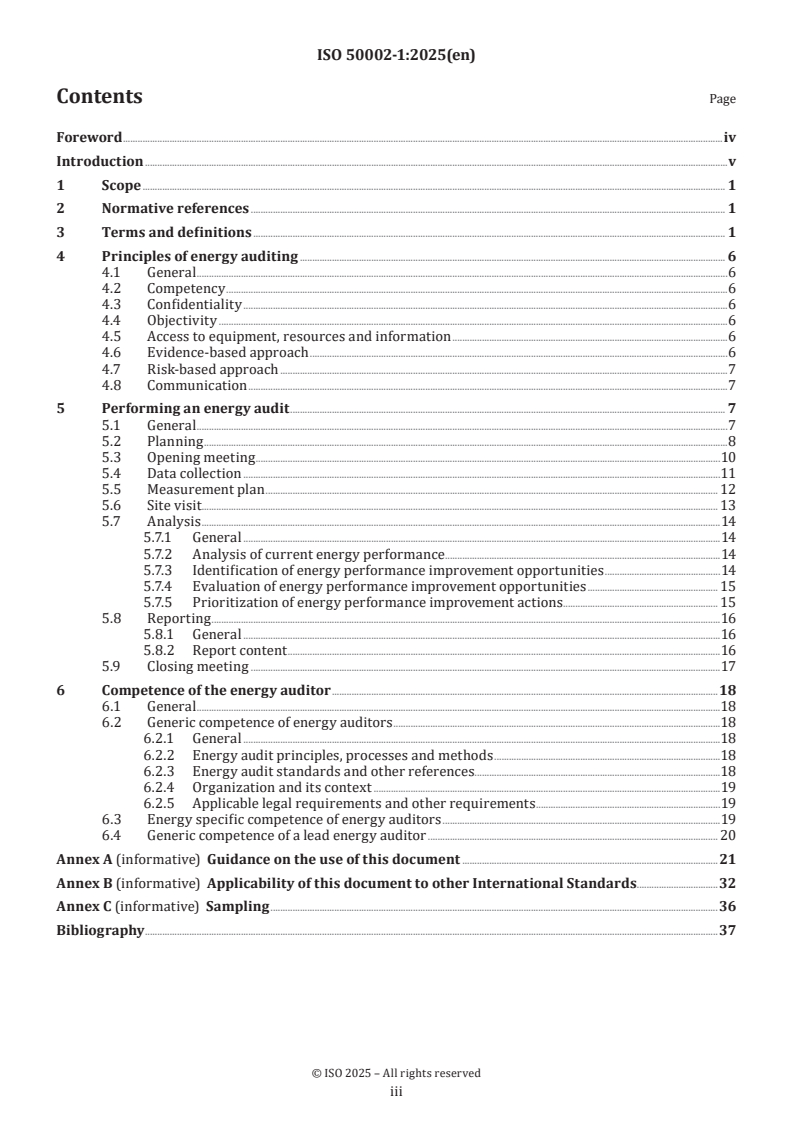
Contents Page
Foreword .iv
Introduction .v
1 Scope . 1
2 Normative references . 1
3 Terms and definitions . 1
4 Principles of energy auditing . 6
4.1 General .6
4.2 Competency .6
4.3 Confidentiality .6
4.4 Objectivity .6
4.5 Access to equipment, resources and information .6
4.6 Evidence-based approach .6
4.7 Risk-based approach .7
4.8 Communication .7
5 Performing an energy audit . 7
5.1 General .7
5.2 Planning .8
5.3 Opening meeting .10
5.4 Data collection .11
5.5 Measurement plan . 12
5.6 Site visit . . 13
5.7 Analysis .14
5.7.1 General .14
5.7.2 Analysis of current energy performance .14
5.7.3 Identification of energy performance improvement opportunities .14
5.7.4 Evaluation of energy performance improvement opportunities . 15
5.7.5 Prioritization of energy performance improvement actions . . 15
5.8 Reporting .16
5.8.1 General .16
5.8.2 Report content .16
5.9 Closing meeting .17
6 Competence of the energy auditor .18
6.1 General .18
6.2 Generic competence of energy auditors .18
6.2.1 General .18
6.2.2 Energy audit principles, processes and methods .18
6.2.3 Energy audit standards and other references.18
6.2.4 Organization and its context .19
6.2.5 Applicable legal requirements and other requirements .19
6.3 Energy specific competence of energy auditors .19
6.4 Generic competence of a lead energy auditor . 20
Annex A (informative) Guidance on the use of this document .21
Annex B (informative) Applicability of this document to other International Standards .32
Annex C (informative) Sampling .36
Bibliography .37
iii
Foreword
ISO (the International Organization for Standardization) is a worldwide federation of national standards
bodies (ISO member bodies). The work of preparing International Standards is normally carried out through
ISO technical committees. Each member body interested in a subject for which a technical committee
has been established has the right to be represented on that committee. International organizations,
governmental and non-governmental, in liaison with ISO, also take part in the work. ISO collaborates closely
with the International Electrotechnical Commission (IEC) on all matters of electrotechnical standardization.
The procedures used to develop this document and those intended for its further maintenance are described
in the ISO/IEC Directives, Part 1. In particular, the different approval criteria needed for the different types
of ISO document should be noted. This document was drafted in accordance with the editorial rules of the
ISO/IEC Directives, Part 2 (see www.iso.org/directives).
ISO draws attention to the possibility that the implementation of this document may involve the use of (a)
patent(s). ISO takes no position concerning the evidence, validity or applicability of any claimed patent
rights in respect thereof. As of the date of publication of this document, ISO had not received notice of (a)
patent(s) which may be required to implement this document. However, implementers are cautioned that
this may not represent the latest information, which may be obtained from the patent database available at
www.iso.org/patents. ISO shall not be held responsible for identifying any or all such patent rights.
Any trade name used in this document is information given for the convenience of users and does not
constitute an endorsement.
For an explanation of the voluntary nature of standards, the meaning of ISO specific terms and expressions
related to conformity assessment, as well as information about ISO's adherence to the World Trade
Organization (WTO) principles in the Technical Barriers to Trade (TBT), see www.iso.org/iso/foreword.html.
This document was prepared by Technical Committee ISO/TC 301, Energy management and energy savings.
This first edition cancels and replaces ISO 50002:2014, which has been technically revised.
The main changes are as follows:
— the terms and definitions have been aligned with ISO 50001:2018;
— new principles have been added;
— decarbonization options have been included in improvement opportunities (renewable energy and
achievement of net zero);
— energy auditor competencies have been clarified.
A list of all parts in the ISO 50002 series can be found on the ISO website.
Any feedback or questions on this document should be directed to the user's national standards body. A
complete listing of these bodies can be found at www.iso.org/members.html.
iv
Introduction
0.1 Background
An energy audit comprises multiple yet interlinked activities and processes ranging from establishing the
scope of the energy audit, collecting and measuring the appropriate data, analysing the energy performance
of an organization, building(s), equipment, system(s) and/or process(es), site observations and using the
information to draw conclusions about energy performance improvement actions (EPIAs). The intended
result of energy audits is to use a structured and planned process to identify and prioritize EPIAs, which will
help reduce wasted energy and can obtain related environmental benefits.
Audit outputs include information on current energy use and performance, and they provide ranked
recommendations for improvement that are relevant and practicable. The benefits of carrying out an energy
audit include:
— reduced energy consumption;
— economic and financial benefits;
— reduced CO emissions and greenhouse gas (GHG) reduction arising from energy use;
2e
— related environmental benefits (e.g. air quality, water reduction);
— distribution of energy use and GHG emissions among various energy systems;
— benchmarking of energy use;
— assessment of energy performance of specific energy systems;
— other benefits (e.g. production efficiencies, maintenance, training).
0.2 ISO 50002series
The ISO 50002 series was revised using ISO 50002:2014 and EN 16247-1:2022 as the starting point. It allows
for differences in approach and in terms of scope, boundary and audit objective, and seeks to harmonize
common aspects of energy auditing in order to enhance clarity and transparency.
The ISO 50002 series includes the following parts:
— This document provides the principles and defines the common set of requirements for conducting
energy audits for buildings, equipment, processes, systems, transport and other applications needed
to identify opportunities to improve energy performance. The energy audit process is presented as a
simple chronological sequence, but this does not preclude repeated iterations of certain steps.
— ISO 50002-2 provides guidance for using this document when conducting an energy audit of a building or
a portfolio of buildings.
— ISO 50002-3 provides guidance for using this document when conducting an energy audit involving
processes. This applies to any process that converts an input of an organization into saleable outputs
such as a manufacturing process or industrial process.
The ISO 50002 series benefits organizations, energy auditors, and stakeholders worldwide by providing
clarity and consistency for designing, developing, conducting and reporting energy audits. Specifically, the
use of the ISO 50002 series:
— enhances the credibility and transparency of energy auditing activities;
— promotes a common understanding and expectations between the organization and the energy auditors
on the energy audit processes and the roles and responsibilities of each parties;
— facilitates the development and implementation of EPIAs that provide credible and tracible analysis;
— facilitates the ability to track performance and progress of the energy audit activity;
v
— facilitates the design of energy audit services by organizations providing energy auditing services;
— supports sustainable development and the actions needed to achieve a low-carbon economy.
The applicability of this document to other International Standards is given in Annex B.
0.3 Usingthis document as part of an ISO 50001energy review
An energy audit can be used as part of an ISO 50001 energy review or part of other associated organizational
initiatives (e.g. environmental management, sustainability, net zero initiatives). It can also be conducted
independent of the organization’s other initiatives.
Some organizations implementing an ISO 50001 energy management system can require additional support
to implement the technical elements of an ISO 50001 energy review. Using this document as part of an
ISO 50001 energy review enables the organization to:
— organize, plan and resource the energy review activities;
— ensure that the activities are carried out by competent energy auditors;
— be able to monitor and track its progress.
Clause B.1 gives additional guidance on how to structure an energy audit as part of an ISO 50001 energy review.
If an energy audit is going to be part of a wider EnMS, the energy auditor can be required to have competence
in ISO 50001.
vi
International Standard ISO 50002-1:2025(en)
Energy audits —
Part 1:
General requirements with guidance for use
1 Scope
This document specifies:
— the principles of carrying out energy audits;
— the process requirements for carrying out an energy audit in relation to energy performance;
— the roles and responsibilities of the organization and the energy auditor;
— deliverables for energy audits.
It gives guidance on determining and/or evaluating the competence of the energy auditor.
This document is applicable to any organization regardless of its size, complexity, geographical location,
organizational culture or the products and services it provides, irrespective of the quantity, use or types of
energy used.
This document does not apply to selecting and evaluating the competence of bodies providing energy audit
services.
It also does not apply to auditing an organization’s energy management system (EnMS), as this is described
in ISO 50003.
Additional documents provide information guidance on applying the energy audit process to buildings (see
ISO 50002-2), processes (see ISO 50002-3) and other applications or uses.
2 Normative references
There are no normative references in this document.
3 Terms and definitions
For the purposes of this document, the following terms and definitions apply.
ISO and IEC maintain terminology databases for use in standardization at the following addresses:
— ISO Online browsing platform: available at https:// www .iso .org/ obp
— IEC Electropedia: available at https:// www .electropedia .org/
3.1
audit objective
purpose of an energy audit (3.4) agreed between the organization (3.18) and the energy auditor (3.6)
3.2
boundary
physical and/or organizational limits as agreed between the organization (3.18) and the energy auditor (3.6)
for the purpose of conducting an energy audit (3.4)
EXAMPLE A process, a group of processes, a site, multiple sites under the control of an organization, an entire
organization.
Note 1 to entry: The boundary of an energy management system can be different from the boundary of an energy audit.
Note 2 to entry: The energy audit can include one or more boundaries.
[SOURCE: ISO 50006:2023, 3.1.2, modified — “virtual” deleted and “as agreed between the organization and
the energy auditor for the purpose of conducting an energy audit” replaced “as defined by the entity for a
stated purpose”. Example added. Notes to entry replaced.]
3.3
energy
electricity, fuels, steam, heat, compressed air and other similar media
Note 1 to entry: For the purposes of this document, energy refers to the various types of energy, including renewable,
which can be purchased, stored, treated, used in an equipment or in a process, or recovered.
[SOURCE: ISO 50001:2018, 3.5.1]
3.4
energy audit
systematic analysis of energy use (3.16), energy balance (3.7) and energy consumption (3.9) within a defined
energy audit scope (3.5) and time frame, in order to identify, quantify and report on the opportunities for
improved energy performance (3.12)
Note 1 to entry: “Energy audit” is the normal expression in English. There are other expressions for the same concept,
e.g. “diagnosi” in Italian and “diagnóstico” in Portuguese.
Note 2 to entry: In industry, “energy audits” and “energy assessment” are both commonly used terms. An assessment
deals primarily with examining adherence to a set of concepts and principles and evaluating the outcome through
both quantitative and qualitative data. In contrast, the focus of an audit is primarily on procedures and processes that
are to be followed.
3.5
energy audit scope
extent of energy use (3.16) and related activities to be included in the energy audit (3.4), as defined by the
organization (3.18) in consultation with the energy auditor (3.6), which can include several boundaries (3.2)
EXAMPLE Organization, facility/facilities, equipment, system(s), process(es).
Note 1 to entry: The energy audit scope can include energy (3.3) related to transport.
3.6
energy auditor
individual or team of people conducting an energy audit (3.4)
Note 1 to entry: Energy audits can be conducted by the organization (3.18) using internal resources or external
resources, such as energy consultants and energy service companies.
Note 2 to entry: An energy auditor, whether internal or external, needs to work with internal personnel relevant to the
defined energy audit scope (3.5).
[SOURCE: EN 16247-1:2022, 3.2, modified — “or team of people” replaced “group of people or body”, Note 1
to entry deleted.]
3.7
energy balance
accounting, by energy type and/or energy use (3.16), of energy input and energy output of an energy-using
system, considering energy storage and energy loss
Note 1 to entry: Energy storage is considered within energy supply or energy use. If included in the energy audit scope
(3.5), an energy balance needs to include energy storage and feedstock variation, as well as wasted energy or energy
content in material flows.
Note 2 to entry: An energy balance reconciles all energy (3.3), goods and products that enter the system boundary
(3.2) against the energy, goods and products leaving the system boundary.
3.8
energy baseline
EnB
value providing a basis for comparison of energy performance (3.12)
[SOURCE: ISO 50006:2023, 3.1.4, modified — Notes 1 and 2 to entry deleted.]
3.9
energy consumption
quantity of energy (3.3) applied
Note 1 to entry: Energy consumption can be represented in volume (e.g. litres of fuel), mass, weight units or energy
units (e.g. GJ, kWh).
[SOURCE: ISO 50006:2023, 3.1.5]
3.10
energy efficiency
ratio or other quantitative relationship between an output of process and an input of energy (3.3)
EXAMPLE Conversion efficiency, energy required/energy consumed, theoretical energy used to operate/energy
used to operate.
Note 1 to entry: The output of a process can be products, services or energy.
Note 2 to entry: Both input and output should be clearly specified in terms of quantity and quality and should be
measurable.
[SOURCE: ISO 50006:2023, 3.16, modified — Example revised.]
3.11
energy flow
description or mapping of processes for transfer of energy (3.3) or conversion of energy within the defined
energy audit scope (3.5)
3.12
energy performance
measurable result(s) related to energy efficiency (3.10), energy use (3.16) and energy consumption (3.9)
[SOURCE: ISO 50001:2018, 3.4.3, modified — Notes 1 and 2 to entry deleted.]
3.13
energy performance improvement
improvement in measurable results of energy efficiency (3.10) or energy consumption (3.9) related to energy
use (3.16), compared to a baseline
[SOURCE: ISO 50001:2018, 3.4.6, modified — “a baseline” replaced “the energy baseline”.]
3.14
energy performance improvement action
EPIA
action or measure or group of actions or measures implemented or planned within an organization
(3.18) intended to achieve energy performance improvement (3.13) through technological, managerial or
operational, behavioural, economical or other changes
[SOURCE: ISO 50015:2014, 3.5]
3.15
energy performance indicator
EnPI
measure used to quantify energy performance (3.12)
Note 1 to entry: If the EnPI is used for the demonstration of energy performance improvement (3.13), it refers to energy
efficiency (3.10) or energy consumption (3.9).
Note 2 to entry: The EnPI is defined by the organization (3.18).
Note 3 to entry: EnPI(s) can be calculated by using an energy model.
[SOURCE: ISO 50006:2023, 3.1.10]
3.16
energy use
energy end-use
application of energy (3.3)
EXAMPLE Ventilation, lighting, heating, cooling, transportation, processes, data storage.
Note 1 to entry: Energy use is based on “what the energy is used for” as compared to energy consumption (3.9) which is
based on “how much energy is used”.
Note 2 to entry: The application can be from any energy type including renewables.
[SOURCE: ISO 50006:2023, 3.1.7]
3.17
normalization
process to enable analysis under equivalent or standard conditions
Note 1 to entry: Normalization can be used for the purpose of comparison of energy performance (3.12) or energy
performance improvement (3.13), which accounts for the changes in relevant variables (3.19).
[SOURCE: ISO 50006:2023, 3.1.13]
3.18
organization
person or group of people that has its own functions with responsibilities, authorities and relationships to
achieve its objectives, and that has the authority to control its energy use (3.16) and consumption
Note 1 to entry: The concept of an organization includes, but is not limited to, sole-trader, company, corporation, firm,
enterprise, authority, partnership, charity or institution or part or combination thereof, whether incorporated or not,
public or private.
Note 2 to entry: The person or an organization requesting an energy audit (3.4) can be called a “client”. The subject of
the energy audit can be called an “auditee”. Their roles and responsibilities in the energy audit can be different.
[SOURCE: ISO 50001:2018, 3.1.1, modified — “and that has the authority to control its energy use and
consumption” added to the definition. Note 2 to entry added.]
3.19
relevant variable
quantifiable factor that significantly impacts energy performance (3.12) and routinely changes
Note 1 to entry: Significance criteria are discussed and agreed between the energy auditor (3.6) and the organization (3.18).
EXAMPLE Weather conditions, operating conditions (indoor temperature, light level), working hours,
production output.
[SOURCE: ISO 50006:2023, 3.1.15, modified — “determined by” replaced “discussed and agreed between the
energy auditor and” in Note 1 to entry. Note 2 to entry deleted.]
3.20
risk
effect of uncertainty
Note 1 to entry: An effect is a deviation from the expected – positive or negative.
Note 2 to entry: Uncertainty is the state, even partial, of deficiency of information related to, understanding or
knowledge of, an event, its consequence, or likelihood.
Note 3 to entry: Risk is often characterized by reference to potential “events” and “consequences”, or a combination
of these.
Note 4 to entry: Risk is often expressed in terms of a combination of the consequences of an event (including changes
in circumstances) and the associated “likelihood” of occurrence.
[SOURCE: ISO 50001:2018, 3.4.11]
3.21
sampling
method of studying from representative selected audited objects, instead of the entire number of objects
Note 1 to entry: The selection is called a “sample”.
Note 2 to entry: The principle of sampling is to analyse the samples selected in order to issue recommendations that
will be valid for all audited objects.
3.22
significant energy use
SEU
energy use (3.16) accounting for substantial energy consumption (3.9) and/or offering considerable potential
for energy performance improvement (3.13)
Note 1 to entry: Significance criteria are discussed and agreed between the energy auditor (3.6) and the organization (3.18).
Note 2 to entry: SEUs can be facilities, systems, processes or equipment.
[SOURCE: ISO 50001:2018, 3.5.6 — “discussed and agreed between the energy auditor and” replaced
“determined by” in Note 1 to entry.]
3.23
static factor
identified factor that significantly impacts energy performance (3.12) and does not routinely change
Note 1 to entry: Significance criteria are discussed and agreed between the energy auditor (3.6) and the organization (3.18).
EXAMPLE Facility size, design of installed equipment, number of weekly shifts, range of products.
[SOURCE: ISO 50015:2014, 3.22, modified — “significantly” added to the definition. Note 1 to entry added.
Example 1 modified. Example 2 deleted.]
4 Principles of energy auditing
4.1 General
An energy audit is characterized by reliance on a number of principles. These principles help to make the
energy audit an effective and reliable tool in support of management decisions and controls by providing
information on which an organization can act in order to improve its energy performance.
Adherence to these principles provides a consistent approach to an effective energy audit that enables energy
auditors, working independently from one another, to reach similar conclusions in similar circumstances.
Clauses 5 and 6 are based on the principles outlined in 4.2 to 4.8.
4.2 Competency
The energy auditor should undertake the energy audit if suitably competent to do so within the agreed
energy audit scope, boundaries and audit objectives. The energy auditor should also plan to conduct the
energy audit ethically, truthfully and accurately. The minimum level of competence required for an energy
auditor is described in Clause 6.
4.3 Confidentiality
The confidentiality of the audit deliverables should be agreed upon by the organization and the auditor prior
to the start of the energy audit. Energy audit information shall not be used inappropriately for personal gain
by the energy auditor or in a manner detrimental to the legitimate interest of the organization.
NOTE This concept includes the proper handling of sensitive or confidential information and data.
4.4 Objectivity
The energy auditor should act independently, in an impartial manner and with due professional care.
Conflicts of interest (personal, financial or other) should be identified and disclosed to the organization in a
timely manner.
If the organization intends to carry out an energy audit using internal personnel, every effort should be
made to remove bias and encourage objectivity.
4.5 Access to equipment, resources and information
For completion of the energy audit based on the defined energy audit scope and boundaries, access is
required to:
a) the organization, site(s), asset(s), equipment, system(s) and energy-using process(es);
b) personnel (engineering, operations, maintenance, etc.), their equipment vendors, contractors and others
to collect information pertinent and useful to the energy audit and analysis of data;
c) other information sources, such as drawings, manuals, test reports, historical utility bill information,
monitoring and control data, electrical equipment panels and calibration records.
4.6 Evidence-based approach
The energy audit should be based on representative data drawn from typical operation, measurements
and observations collected. On-site measurements should be obtained based on a traceable, accurate and
repeatable manner. Identified energy performance opportunities should be analysed and quantified using
appropriate data and technical and economic analysis.
NOTE Appropriate analysis is consistent with the energy audit scope and sufficiently detailed to allow for
effective decision-making.
4.7 Risk-based approach
The risk should substantively influence the planning, conducting and reporting of energy audits in order to
ensure that audits are focused on matters that are significant for the audit client, and for achieving the audit
programme objectives.
When an organization conducts an energy audit, they should consider the energy performance risks to the
organization and the opportunities to improve its energy performance towards a defined intended outcome.
4.8 Communication
Clear lines of communication are essential for the energy auditor, both among the team and with the
organization. Communication channels and methods necessary to facilitate the audit should be established
in a timely manner.
5 Performing an energy audit
5.1 General
The energy audit process consists of the following stages, as illustrated in Figure 1. The extent to which
the stages are applicable, the inclusion of new stage(s), the sequence or repeated iterations depends on the
objectives and scope of the energy audit agreed between the organization and the energy auditor:
a) planning (see 5.2);
b) opening meeting (see 5.3);
c) data collection (see 5.4);
d) measurement plan (see 5.5);
e) site visit (see 5.6);
f) analysis (see 5.7);
g) reporting (see 5.8);
h) closing meeting (see 5.9).
Figure 1 — Energy audit process flow diagram
5.2 Planning
Planning activities are essential to define the energy audit scope and objective(s), and to gather preliminary
information from the organization to understand the organization structure and operations, and to plan for
the energy audit.
In order to develop the energy audit scope and ensure an effective energy audit is conducted, the following
applies:
a) the energy auditor and the organization shall agree on:
1) the energy audit scope, boundaries and objective(s);
2) needs and expectations to achieve the audit objectives;
EXAMPLE 1 Comply with legal requirements, contractual obligations, voluntary obligations, the
organization’s aspirations towards climate change mitigation, adaptation and net zero goals.
3) the level of detail required;
NOTE 1 Annex A provides guidance that can be useful at the planning stage, including the three
indicative levels of audit described in A.2.1.
NOTE 2 Legal requirements can supersede the lower level(s) of energy audit.
4) the energy audit schedule and agenda;
5) criteria for evaluating and ranking opportunities to improve energy performance;
EXAMPLE 2 Return on investment; potential energy performance improvement over time; life cycle
costing; incremental cost analysis for replacement with more energy efficient equipment over the current
equipment; simple payback period.
NOTE 3 Opportunities for improving energy performance can include non-energy benefits and non-
energy costs when applicable.
6) time commitments and other resources from the organization;
7) relevant data to be made available prior to the start of the energy audit;
EXAMPLE 3 Drawings; plant layout; process and/or activity description; historical energy consumption;
utility and other bills when appropriately verified; equipment manuals and other technical documentation,
including planned measurement and/or inspections to be made during the energy audit.
8) expected deliverables and report format;
9) whether a draft of the final report shall be presented to the organization for comment;
10) the organization’s representative responsible for the energy audit process;
11) roles, responsibilities and authority of the energy auditor, organization, and, if applicable, guides
and observers;
NOTE 4 Annex A provides guidance on the typical roles and responsibilities during an energy audit.
12) the process for agreeing on any change in the objective(s), energy audit scope and data collection;
b) the energy auditor shall request information that can affect the outcome of the energy audit, including,
as applicable:
1) legal requirements and other requirements or constraints affecting the scope or other aspects of
the proposed energy audit;
2) strategic plans that can affect the organization’s energy performance;
EXAMPLE 4 Asset management plans; changing product mix; expansion plans; planned projects;
outsourcing facilities management or equipment maintenance.
3) management systems, such as environmental, quality, energy management or others;
4) access to equipment, resources, systems, processes, services and information related to the energy
audit scope;
5) factors or special considerations that can change the energy audit scope, process and conclusions;
6) any considerations, even subjective ones, including existing opinions, ideas and restrictions relating
to potential energy performance improvement measures;
c) the energy auditor shall inform the organization of:
1) commercial or other interests which can influence their conclusions or recommendations;
2) any other conflict of interest issues;
d) the auditee should inform the auditor of any specific access, security requirements, and health and
safety preparations within the scope and boundary of the audit (these requirements should be applied
and adhered to throughout the audit process);
e) the energy auditor shall determine the feasibility of the energy audit to provide reasonable confidence
that the audit objectives can be achieved.
5.3 Opening meeting
The purpose of the opening meeting is to review the energy audit objectives, energy audit scope, boundaries
and methods, introduce the energy auditors and the arrangements for the energy audit (e.g. site safety
inductions, access, security).
NOTE A meeting can include telephone calls, teleconferencing and other electronic/remote contact methods.
The energy auditor shall request that the organization:
a) assigns personnel or appropriate individuals constituted as a team to assist the energy auditor: these
individuals shall have the necessary competences and authority to request or carry out direct operations
on processes and equipment, and support the defined energy audit scope and objectives;
b) informs the appropriate personnel and other interested parties about the energy audit, their roles,
responsibilities, cooperation and any requirements placed on them;
c) ensures the cooperation of affected parties, leveraging the experience of the energy auditor and the
knowledge of the organization;
d) confirms any unusual conditions that can affect the energy audit or energy performance, i.e. maintenance
work, special visits (customer, regulatory, etc.), significant changes in production volumes and others.
Where the energy auditor is not an individual, a member of the energy auditing team shall be nominated as
lead energy auditor.
The energy auditor shall agree with the organization on:
— arrangements for access, as required by the defined energy audit scope for the energy auditor;
— requirements for health, safety, security, and emergency rules and procedures;
— availability of resources, including energy data and the need for additional metering;
— applicable non-disclosure agreements;
— requirements for any special measurements, if needed;
— procedures to be followed for installation of measuring equipment, if needed.
5.4 Data collection
Where available, the energy auditor shall collect and collate the appropriate energy data subject to the
energy audit objectives and energy audit scope. This should include the following information, as applicable:
a) a list of energy consuming systems, processes and equipment;
b) detailed characteristics of the energy uses within the defined energy audit scope, including relevant
variables and how the organization believes they impact energy performance;
c) historical and current energy performance data, including:
1) energy types;
2) energy use and consumption;
3) relevant variables and static factors (if applicable);
4) relevant related measurements;
EXAMPLE 1 Equipment or system load measurements; results from a thermographic or compressed
air survey.
EXAMPLE 2 Operational characteristics such as shift timings, labour rate to be used in implementation
analysis, equipment capacities and “nameplate” information, waste streams with energy content to consider as
alternative fuel feedstock, process description, purchased energy streams such as steam and compressed air.
5) operational history and past events that have potentially affected energy consumption in the period
covered by the data collected;
d) methods used for normalization of energy performance indicator (EnPI) value(s) and their
corresponding energy baselines (EnBs) where the organization has data which indicate that relevant
variables significantly affect energy performance;
e) monitoring equipment, configuration and analysis information;
EXAMPLE 3 Local gauges, distributed control systems, instrumentation types.
NOTE Part of the available data can be collected and collated by an external party, e.g. a utility company.
f) future plans that can affect energy performance;
EXAMPLE 4 Planned expansions, contractions or changes in production volume.
EXAMPLE 5 Planned changes in, or replacement of, equipment or systems that have significant energy
implications.
EXAMPLE 6 Removal of facilities, equipment or systems.
g) design, operation and maintenance documents;
EXAMPLE 7 As-built drawings, equipment specification sheet; plot plan; control system data, energy supply
connections and system schematics, asset register.
h) previous energy audits related to energy performance;
i) current energy rate schedule(s) (or tariffs) or a reference rate (or tariff) to be used for financial analysis;
j) other relevant economic data;
k) knowledge on how the organization manages its energy use and consumption;
l) the energy distribution system and its management.
If there are missing data and information, depending on the energy audit scope and level of thoroughness
required, the energy auditor shall:
— request the information from the organization;
— plan and conduct additional measurements;
— where qua
...
International
Standard
ISO 50002-1
First edition
Energy audits —
2025-06
Part 1:
General requirements with
guidance for use
Audits énergétiques —
Partie 1: Exigences et recommandations de mise en œuvre
Reference number
© ISO 2025
All rights reserved. Unless otherwise specified, or required in the context of its implementation, no part of this publication may
be reproduced or utilized otherwise in any form or by any means, electronic or mechanical, including photocopying, or posting on
the internet or an intranet, without prior written permission. Permission can be requested from either ISO at the address below
or ISO’s member body in the country of the requester.
ISO copyright office
CP 401 • Ch. de Blandonnet 8
CH-1214 Vernier, Geneva
Phone: +41 22 749 01 11
Email: copyright@iso.org
Website: www.iso.org
Published in Switzerland
ii
Contents Page
Foreword .iv
Introduction .v
1 Scope . 1
2 Normative references . 1
3 Terms and definitions . 1
4 Principles of energy auditing . 6
4.1 General .6
4.2 Competency .6
4.3 Confidentiality .6
4.4 Objectivity .6
4.5 Access to equipment, resources and information .6
4.6 Evidence-based approach .6
4.7 Risk-based approach .7
4.8 Communication .7
5 Performing an energy audit . 7
5.1 General .7
5.2 Planning .8
5.3 Opening meeting .10
5.4 Data collection .11
5.5 Measurement plan . 12
5.6 Site visit . . 13
5.7 Analysis .14
5.7.1 General .14
5.7.2 Analysis of current energy performance .14
5.7.3 Identification of energy performance improvement opportunities .14
5.7.4 Evaluation of energy performance improvement opportunities . 15
5.7.5 Prioritization of energy performance improvement actions . . 15
5.8 Reporting .16
5.8.1 General .16
5.8.2 Report content .16
5.9 Closing meeting .17
6 Competence of the energy auditor .18
6.1 General .18
6.2 Generic competence of energy auditors .18
6.2.1 General .18
6.2.2 Energy audit principles, processes and methods .18
6.2.3 Energy audit standards and other references.18
6.2.4 Organization and its context .19
6.2.5 Applicable legal requirements and other requirements .19
6.3 Energy specific competence of energy auditors .19
6.4 Generic competence of a lead energy auditor . 20
Annex A (informative) Guidance on the use of this document .21
Annex B (informative) Applicability of this document to other International Standards .32
Annex C (informative) Sampling .36
Bibliography .37
iii
Foreword
ISO (the International Organization for Standardization) is a worldwide federation of national standards
bodies (ISO member bodies). The work of preparing International Standards is normally carried out through
ISO technical committees. Each member body interested in a subject for which a technical committee
has been established has the right to be represented on that committee. International organizations,
governmental and non-governmental, in liaison with ISO, also take part in the work. ISO collaborates closely
with the International Electrotechnical Commission (IEC) on all matters of electrotechnical standardization.
The procedures used to develop this document and those intended for its further maintenance are described
in the ISO/IEC Directives, Part 1. In particular, the different approval criteria needed for the different types
of ISO document should be noted. This document was drafted in accordance with the editorial rules of the
ISO/IEC Directives, Part 2 (see www.iso.org/directives).
ISO draws attention to the possibility that the implementation of this document may involve the use of (a)
patent(s). ISO takes no position concerning the evidence, validity or applicability of any claimed patent
rights in respect thereof. As of the date of publication of this document, ISO had not received notice of (a)
patent(s) which may be required to implement this document. However, implementers are cautioned that
this may not represent the latest information, which may be obtained from the patent database available at
www.iso.org/patents. ISO shall not be held responsible for identifying any or all such patent rights.
Any trade name used in this document is information given for the convenience of users and does not
constitute an endorsement.
For an explanation of the voluntary nature of standards, the meaning of ISO specific terms and expressions
related to conformity assessment, as well as information about ISO's adherence to the World Trade
Organization (WTO) principles in the Technical Barriers to Trade (TBT), see www.iso.org/iso/foreword.html.
This document was prepared by Technical Committee ISO/TC 301, Energy management and energy savings.
This first edition cancels and replaces ISO 50002:2014, which has been technically revised.
The main changes are as follows:
— the terms and definitions have been aligned with ISO 50001:2018;
— new principles have been added;
— decarbonization options have been included in improvement opportunities (renewable energy and
achievement of net zero);
— energy auditor competencies have been clarified.
A list of all parts in the ISO 50002 series can be found on the ISO website.
Any feedback or questions on this document should be directed to the user's national standards body. A
complete listing of these bodies can be found at www.iso.org/members.html.
iv
Introduction
0.1 Background
An energy audit comprises multiple yet interlinked activities and processes ranging from establishing the
scope of the energy audit, collecting and measuring the appropriate data, analysing the energy performance
of an organization, building(s), equipment, system(s) and/or process(es), site observations and using the
information to draw conclusions about energy performance improvement actions (EPIAs). The intended
result of energy audits is to use a structured and planned process to identify and prioritize EPIAs, which will
help reduce wasted energy and can obtain related environmental benefits.
Audit outputs include information on current energy use and performance, and they provide ranked
recommendations for improvement that are relevant and practicable. The benefits of carrying out an energy
audit include:
— reduced energy consumption;
— economic and financial benefits;
— reduced CO emissions and greenhouse gas (GHG) reduction arising from energy use;
2e
— related environmental benefits (e.g. air quality, water reduction);
— distribution of energy use and GHG emissions among various energy systems;
— benchmarking of energy use;
— assessment of energy performance of specific energy systems;
— other benefits (e.g. production efficiencies, maintenance, training).
0.2 ISO 50002series
The ISO 50002 series was revised using ISO 50002:2014 and EN 16247-1:2022 as the starting point. It allows
for differences in approach and in terms of scope, boundary and audit objective, and seeks to harmonize
common aspects of energy auditing in order to enhance clarity and transparency.
The ISO 50002 series includes the following parts:
— This document provides the principles and defines the common set of requirements for conducting
energy audits for buildings, equipment, processes, systems, transport and other applications needed
to identify opportunities to improve energy performance. The energy audit process is presented as a
simple chronological sequence, but this does not preclude repeated iterations of certain steps.
— ISO 50002-2 provides guidance for using this document when conducting an energy audit of a building or
a portfolio of buildings.
— ISO 50002-3 provides guidance for using this document when conducting an energy audit involving
processes. This applies to any process that converts an input of an organization into saleable outputs
such as a manufacturing process or industrial process.
The ISO 50002 series benefits organizations, energy auditors, and stakeholders worldwide by providing
clarity and consistency for designing, developing, conducting and reporting energy audits. Specifically, the
use of the ISO 50002 series:
— enhances the credibility and transparency of energy auditing activities;
— promotes a common understanding and expectations between the organization and the energy auditors
on the energy audit processes and the roles and responsibilities of each parties;
— facilitates the development and implementation of EPIAs that provide credible and tracible analysis;
— facilitates the ability to track performance and progress of the energy audit activity;
v
— facilitates the design of energy audit services by organizations providing energy auditing services;
— supports sustainable development and the actions needed to achieve a low-carbon economy.
The applicability of this document to other International Standards is given in Annex B.
0.3 Usingthis document as part of an ISO 50001energy review
An energy audit can be used as part of an ISO 50001 energy review or part of other associated organizational
initiatives (e.g. environmental management, sustainability, net zero initiatives). It can also be conducted
independent of the organization’s other initiatives.
Some organizations implementing an ISO 50001 energy management system can require additional support
to implement the technical elements of an ISO 50001 energy review. Using this document as part of an
ISO 50001 energy review enables the organization to:
— organize, plan and resource the energy review activities;
— ensure that the activities are carried out by competent energy auditors;
— be able to monitor and track its progress.
Clause B.1 gives additional guidance on how to structure an energy audit as part of an ISO 50001 energy review.
If an energy audit is going to be part of a wider EnMS, the energy auditor can be required to have competence
in ISO 50001.
vi
International Standard ISO 50002-1:2025(en)
Energy audits —
Part 1:
General requirements with guidance for use
1 Scope
This document specifies:
— the principles of carrying out energy audits;
— the process requirements for carrying out an energy audit in relation to energy performance;
— the roles and responsibilities of the organization and the energy auditor;
— deliverables for energy audits.
It gives guidance on determining and/or evaluating the competence of the energy auditor.
This document is applicable to any organization regardless of its size, complexity, geographical location,
organizational culture or the products and services it provides, irrespective of the quantity, use or types of
energy used.
This document does not apply to selecting and evaluating the competence of bodies providing energy audit
services.
It also does not apply to auditing an organization’s energy management system (EnMS), as this is described
in ISO 50003.
Additional documents provide information guidance on applying the energy audit process to buildings (see
ISO 50002-2), processes (see ISO 50002-3) and other applications or uses.
2 Normative references
There are no normative references in this document.
3 Terms and definitions
For the purposes of this document, the following terms and definitions apply.
ISO and IEC maintain terminology databases for use in standardization at the following addresses:
— ISO Online browsing platform: available at https:// www .iso .org/ obp
— IEC Electropedia: available at https:// www .electropedia .org/
3.1
audit objective
purpose of an energy audit (3.4) agreed between the organization (3.18) and the energy auditor (3.6)
3.2
boundary
physical and/or organizational limits as agreed between the organization (3.18) and the energy auditor (3.6)
for the purpose of conducting an energy audit (3.4)
EXAMPLE A process, a group of processes, a site, multiple sites under the control of an organization, an entire
organization.
Note 1 to entry: The boundary of an energy management system can be different from the boundary of an energy audit.
Note 2 to entry: The energy audit can include one or more boundaries.
[SOURCE: ISO 50006:2023, 3.1.2, modified — “virtual” deleted and “as agreed between the organization and
the energy auditor for the purpose of conducting an energy audit” replaced “as defined by the entity for a
stated purpose”. Example added. Notes to entry replaced.]
3.3
energy
electricity, fuels, steam, heat, compressed air and other similar media
Note 1 to entry: For the purposes of this document, energy refers to the various types of energy, including renewable,
which can be purchased, stored, treated, used in an equipment or in a process, or recovered.
[SOURCE: ISO 50001:2018, 3.5.1]
3.4
energy audit
systematic analysis of energy use (3.16), energy balance (3.7) and energy consumption (3.9) within a defined
energy audit scope (3.5) and time frame, in order to identify, quantify and report on the opportunities for
improved energy performance (3.12)
Note 1 to entry: “Energy audit” is the normal expression in English. There are other expressions for the same concept,
e.g. “diagnosi” in Italian and “diagnóstico” in Portuguese.
Note 2 to entry: In industry, “energy audits” and “energy assessment” are both commonly used terms. An assessment
deals primarily with examining adherence to a set of concepts and principles and evaluating the outcome through
both quantitative and qualitative data. In contrast, the focus of an audit is primarily on procedures and processes that
are to be followed.
3.5
energy audit scope
extent of energy use (3.16) and related activities to be included in the energy audit (3.4), as defined by the
organization (3.18) in consultation with the energy auditor (3.6), which can include several boundaries (3.2)
EXAMPLE Organization, facility/facilities, equipment, system(s), process(es).
Note 1 to entry: The energy audit scope can include energy (3.3) related to transport.
3.6
energy auditor
individual or team of people conducting an energy audit (3.4)
Note 1 to entry: Energy audits can be conducted by the organization (3.18) using internal resources or external
resources, such as energy consultants and energy service companies.
Note 2 to entry: An energy auditor, whether internal or external, needs to work with internal personnel relevant to the
defined energy audit scope (3.5).
[SOURCE: EN 16247-1:2022, 3.2, modified — “or team of people” replaced “group of people or body”, Note 1
to entry deleted.]
3.7
energy balance
accounting, by energy type and/or energy use (3.16), of energy input and energy output of an energy-using
system, considering energy storage and energy loss
Note 1 to entry: Energy storage is considered within energy supply or energy use. If included in the energy audit scope
(3.5), an energy balance needs to include energy storage and feedstock variation, as well as wasted energy or energy
content in material flows.
Note 2 to entry: An energy balance reconciles all energy (3.3), goods and products that enter the system boundary
(3.2) against the energy, goods and products leaving the system boundary.
3.8
energy baseline
EnB
value providing a basis for comparison of energy performance (3.12)
[SOURCE: ISO 50006:2023, 3.1.4, modified — Notes 1 and 2 to entry deleted.]
3.9
energy consumption
quantity of energy (3.3) applied
Note 1 to entry: Energy consumption can be represented in volume (e.g. litres of fuel), mass, weight units or energy
units (e.g. GJ, kWh).
[SOURCE: ISO 50006:2023, 3.1.5]
3.10
energy efficiency
ratio or other quantitative relationship between an output of process and an input of energy (3.3)
EXAMPLE Conversion efficiency, energy required/energy consumed, theoretical energy used to operate/energy
used to operate.
Note 1 to entry: The output of a process can be products, services or energy.
Note 2 to entry: Both input and output should be clearly specified in terms of quantity and quality and should be
measurable.
[SOURCE: ISO 50006:2023, 3.16, modified — Example revised.]
3.11
energy flow
description or mapping of processes for transfer of energy (3.3) or conversion of energy within the defined
energy audit scope (3.5)
3.12
energy performance
measurable result(s) related to energy efficiency (3.10), energy use (3.16) and energy consumption (3.9)
[SOURCE: ISO 50001:2018, 3.4.3, modified — Notes 1 and 2 to entry deleted.]
3.13
energy performance improvement
improvement in measurable results of energy efficiency (3.10) or energy consumption (3.9) related to energy
use (3.16), compared to a baseline
[SOURCE: ISO 50001:2018, 3.4.6, modified — “a baseline” replaced “the energy baseline”.]
3.14
energy performance improvement action
EPIA
action or measure or group of actions or measures implemented or planned within an organization
(3.18) intended to achieve energy performance improvement (3.13) through technological, managerial or
operational, behavioural, economical or other changes
[SOURCE: ISO 50015:2014, 3.5]
3.15
energy performance indicator
EnPI
measure used to quantify energy performance (3.12)
Note 1 to entry: If the EnPI is used for the demonstration of energy performance improvement (3.13), it refers to energy
efficiency (3.10) or energy consumption (3.9).
Note 2 to entry: The EnPI is defined by the organization (3.18).
Note 3 to entry: EnPI(s) can be calculated by using an energy model.
[SOURCE: ISO 50006:2023, 3.1.10]
3.16
energy use
energy end-use
application of energy (3.3)
EXAMPLE Ventilation, lighting, heating, cooling, transportation, processes, data storage.
Note 1 to entry: Energy use is based on “what the energy is used for” as compared to energy consumption (3.9) which is
based on “how much energy is used”.
Note 2 to entry: The application can be from any energy type including renewables.
[SOURCE: ISO 50006:2023, 3.1.7]
3.17
normalization
process to enable analysis under equivalent or standard conditions
Note 1 to entry: Normalization can be used for the purpose of comparison of energy performance (3.12) or energy
performance improvement (3.13), which accounts for the changes in relevant variables (3.19).
[SOURCE: ISO 50006:2023, 3.1.13]
3.18
organization
person or group of people that has its own functions with responsibilities, authorities and relationships to
achieve its objectives, and that has the authority to control its energy use (3.16) and consumption
Note 1 to entry: The concept of an organization includes, but is not limited to, sole-trader, company, corporation, firm,
enterprise, authority, partnership, charity or institution or part or combination thereof, whether incorporated or not,
public or private.
Note 2 to entry: The person or an organization requesting an energy audit (3.4) can be called a “client”. The subject of
the energy audit can be called an “auditee”. Their roles and responsibilities in the energy audit can be different.
[SOURCE: ISO 50001:2018, 3.1.1, modified — “and that has the authority to control its energy use and
consumption” added to the definition. Note 2 to entry added.]
3.19
relevant variable
quantifiable factor that significantly impacts energy performance (3.12) and routinely changes
Note 1 to entry: Significance criteria are discussed and agreed between the energy auditor (3.6) and the organization (3.18).
EXAMPLE Weather conditions, operating conditions (indoor temperature, light level), working hours,
production output.
[SOURCE: ISO 50006:2023, 3.1.15, modified — “determined by” replaced “discussed and agreed between the
energy auditor and” in Note 1 to entry. Note 2 to entry deleted.]
3.20
risk
effect of uncertainty
Note 1 to entry: An effect is a deviation from the expected – positive or negative.
Note 2 to entry: Uncertainty is the state, even partial, of deficiency of information related to, understanding or
knowledge of, an event, its consequence, or likelihood.
Note 3 to entry: Risk is often characterized by reference to potential “events” and “consequences”, or a combination
of these.
Note 4 to entry: Risk is often expressed in terms of a combination of the consequences of an event (including changes
in circumstances) and the associated “likelihood” of occurrence.
[SOURCE: ISO 50001:2018, 3.4.11]
3.21
sampling
method of studying from representative selected audited objects, instead of the entire number of objects
Note 1 to entry: The selection is called a “sample”.
Note 2 to entry: The principle of sampling is to analyse the samples selected in order to issue recommendations that
will be valid for all audited objects.
3.22
significant energy use
SEU
energy use (3.16) accounting for substantial energy consumption (3.9) and/or offering considerable potential
for energy performance improvement (3.13)
Note 1 to entry: Significance criteria are discussed and agreed between the energy auditor (3.6) and the organization (3.18).
Note 2 to entry: SEUs can be facilities, systems, processes or equipment.
[SOURCE: ISO 50001:2018, 3.5.6 — “discussed and agreed between the energy auditor and” replaced
“determined by” in Note 1 to entry.]
3.23
static factor
identified factor that significantly impacts energy performance (3.12) and does not routinely change
Note 1 to entry: Significance criteria are discussed and agreed between the energy auditor (3.6) and the organization (3.18).
EXAMPLE Facility size, design of installed equipment, number of weekly shifts, range of products.
[SOURCE: ISO 50015:2014, 3.22, modified — “significantly” added to the definition. Note 1 to entry added.
Example 1 modified. Example 2 deleted.]
4 Principles of energy auditing
4.1 General
An energy audit is characterized by reliance on a number of principles. These principles help to make the
energy audit an effective and reliable tool in support of management decisions and controls by providing
information on which an organization can act in order to improve its energy performance.
Adherence to these principles provides a consistent approach to an effective energy audit that enables energy
auditors, working independently from one another, to reach similar conclusions in similar circumstances.
Clauses 5 and 6 are based on the principles outlined in 4.2 to 4.8.
4.2 Competency
The energy auditor should undertake the energy audit if suitably competent to do so within the agreed
energy audit scope, boundaries and audit objectives. The energy auditor should also plan to conduct the
energy audit ethically, truthfully and accurately. The minimum level of competence required for an energy
auditor is described in Clause 6.
4.3 Confidentiality
The confidentiality of the audit deliverables should be agreed upon by the organization and the auditor prior
to the start of the energy audit. Energy audit information shall not be used inappropriately for personal gain
by the energy auditor or in a manner detrimental to the legitimate interest of the organization.
NOTE This concept includes the proper handling of sensitive or confidential information and data.
4.4 Objectivity
The energy auditor should act independently, in an impartial manner and with due professional care.
Conflicts of interest (personal, financial or other) should be identified and disclosed to the organization in a
timely manner.
If the organization intends to carry out an energy audit using internal personnel, every effort should be
made to remove bias and encourage objectivity.
4.5 Access to equipment, resources and information
For completion of the energy audit based on the defined energy audit scope and boundaries, access is
required to:
a) the organization, site(s), asset(s), equipment, system(s) and energy-using process(es);
b) personnel (engineering, operations, maintenance, etc.), their equipment vendors, contractors and others
to collect information pertinent and useful to the energy audit and analysis of data;
c) other information sources, such as drawings, manuals, test reports, historical utility bill information,
monitoring and control data, electrical equipment panels and calibration records.
4.6 Evidence-based approach
The energy audit should be based on representative data drawn from typical operation, measurements
and observations collected. On-site measurements should be obtained based on a traceable, accurate and
repeatable manner. Identified energy performance opportunities should be analysed and quantified using
appropriate data and technical and economic analysis.
NOTE Appropriate analysis is consistent with the energy audit scope and sufficiently detailed to allow for
effective decision-making.
4.7 Risk-based approach
The risk should substantively influence the planning, conducting and reporting of energy audits in order to
ensure that audits are focused on matters that are significant for the audit client, and for achieving the audit
programme objectives.
When an organization conducts an energy audit, they should consider the energy performance risks to the
organization and the opportunities to improve its energy performance towards a defined intended outcome.
4.8 Communication
Clear lines of communication are essential for the energy auditor, both among the team and with the
organization. Communication channels and methods necessary to facilitate the audit should be established
in a timely manner.
5 Performing an energy audit
5.1 General
The energy audit process consists of the following stages, as illustrated in Figure 1. The extent to which
the stages are applicable, the inclusion of new stage(s), the sequence or repeated iterations depends on the
objectives and scope of the energy audit agreed between the organization and the energy auditor:
a) planning (see 5.2);
b) opening meeting (see 5.3);
c) data collection (see 5.4);
d) measurement plan (see 5.5);
e) site visit (see 5.6);
f) analysis (see 5.7);
g) reporting (see 5.8);
h) closing meeting (see 5.9).
Figure 1 — Energy audit process flow diagram
5.2 Planning
Planning activities are essential to define the energy audit scope and objective(s), and to gather preliminary
information from the organization to understand the organization structure and operations, and to plan for
the energy audit.
In order to develop the energy audit scope and ensure an effective energy audit is conducted, the following
applies:
a) the energy auditor and the organization shall agree on:
1) the energy audit scope, boundaries and objective(s);
2) needs and expectations to achieve the audit objectives;
EXAMPLE 1 Comply with legal requirements, contractual obligations, voluntary obligations, the
organization’s aspirations towards climate change mitigation, adaptation and net zero goals.
3) the level of detail required;
NOTE 1 Annex A provides guidance that can be useful at the planning stage, including the three
indicative levels of audit described in A.2.1.
NOTE 2 Legal requirements can supersede the lower level(s) of energy audit.
4) the energy audit schedule and agenda;
5) criteria for evaluating and ranking opportunities to improve energy performance;
EXAMPLE 2 Return on investment; potential energy performance improvement over time; life cycle
costing; incremental cost analysis for replacement with more energy efficient equipment over the current
equipment; simple payback period.
NOTE 3 Opportunities for improving energy performance can include non-energy benefits and non-
energy costs when applicable.
6) time commitments and other resources from the organization;
7) relevant data to be made available prior to the start of the energy audit;
EXAMPLE 3 Drawings; plant layout; process and/or activity description; historical energy consumption;
utility and other bills when appropriately verified; equipment manuals and other technical documentation,
including planned measurement and/or inspections to be made during the energy audit.
8) expected deliverables and report format;
9) whether a draft of the final report shall be presented to the organization for comment;
10) the organization’s representative responsible for the energy audit process;
11) roles, responsibilities and authority of the energy auditor, organization, and, if applicable, guides
and observers;
NOTE 4 Annex A provides guidance on the typical roles and responsibilities during an energy audit.
12) the process for agreeing on any change in the objective(s), energy audit scope and data collection;
b) the energy auditor shall request information that can affect the outcome of the energy audit, including,
as applicable:
1) legal requirements and other requirements or constraints affecting the scope or other aspects of
the proposed energy audit;
2) strategic plans that can affect the organization’s energy performance;
EXAMPLE 4 Asset management plans; changing product mix; expansion plans; planned projects;
outsourcing facilities management or equipment maintenance.
3) management systems, such as environmental, quality, energy management or others;
4) access to equipment, resources, systems, processes, services and information related to the energy
audit scope;
5) factors or special considerations that can change the energy audit scope, process and conclusions;
6) any considerations, even subjective ones, including existing opinions, ideas and restrictions relating
to potential energy performance improvement measures;
c) the energy auditor shall inform the organization of:
1) commercial or other interests which can influence their conclusions or recommendations;
2) any other conflict of interest issues;
d) the auditee should inform the auditor of any specific access, security requirements, and health and
safety preparations within the scope and boundary of the audit (these requirements should be applied
and adhered to throughout the audit process);
e) the energy auditor shall determine the feasibility of the energy audit to provide reasonable confidence
that the audit objectives can be achieved.
5.3 Opening meeting
The purpose of the opening meeting is to review the energy audit objectives, energy audit scope, boundaries
and methods, introduce the energy auditors and the arrangements for the energy audit (e.g. site safety
inductions, access, security).
NOTE A meeting can include telephone calls, teleconferencing and other electronic/remote contact methods.
The energy auditor shall request that the organization:
a) assigns personnel or appropriate individuals constituted as a team to assist the energy auditor: these
individuals shall have the necessary competences and authority to request or carry out direct operations
on processes and equipment, and support the defined energy audit scope and objectives;
b) informs the appropriate personnel and other interested parties about the energy audit, their roles,
responsibilities, cooperation and any requirements placed on them;
c) ensures the cooperation of affected parties, leveraging the experience of the energy auditor and the
knowledge of the organization;
d) confirms any unusual conditions that can affect the energy audit or energy performance, i.e. maintenance
work, special visits (customer, regulatory, etc.), significant changes in production volumes and others.
Where the energy auditor is not an individual, a member of the energy auditing team shall be nominated as
lead energy auditor.
The energy auditor shall agree with the organization on:
— arrangements for access, as required by the defined energy audit scope for the energy auditor;
— requirements for health, safety, security, and emergency rules and procedures;
— availability of resources, including energy data and the need for additional metering;
— applicable non-disclosure agreements;
— requirements for any special measurements, if needed;
— procedures to be followed for installation of measuring equipment, if needed.
5.4 Data collection
Where available, the energy auditor shall collect and collate the appropriate energy data subject to the
energy audit objectives and energy audit scope. This should include the following information, as applicable:
a) a list of energy consuming systems, processes and equipment;
b) detailed characteristics of the energy uses within the defined energy audit scope, including relevant
variables and how the organization believes they impact energy performance;
c) historical and current energy performance data, including:
1) energy types;
2) energy use and consumption;
3) relevant variables and static factors (if applicable);
4) relevant related measurements;
EXAMPLE 1 Equipment or system load measurements; results from a thermographic or compressed
air survey.
EXAMPLE 2 Operational characteristics such as shift timings, labour rate to be used in implementation
analysis, equipment capacities and “nameplate” information, waste streams with energy content to consider as
alternative fuel feedstock, process description, purchased energy streams such as steam and compressed air.
5) operational history and past events that have potentially affected energy consumption in the period
covered by the data collected;
d) methods used for normalization of energy performance indicator (EnPI) value(s) and their
corresponding energy baselines (EnBs) where the organization has data which indicate that relevant
variables significantly affect energy performance;
e) monitoring equipment, configuration and analysis information;
EXAMPLE 3 Local gauges, distributed control systems, instrumentation types.
NOTE Part of the available data can be collected and collated by an external party, e.g. a utility company.
f) future plans that can affect energy performance;
EXAMPLE 4 Planned expansions, contractions or changes in production volume.
EXAMPLE 5 Planned changes in, or replacement of, equipment or systems that have significant energy
implications.
EXAMPLE 6 Removal of facilities, equipment or systems.
g) design, operation and maintenance documents;
EXAMPLE 7 As-built drawings, equipment specification sheet; plot plan; control system data, energy supply
connections and system schematics, asset register.
h) previous energy audits related to energy performance;
i) current energy rate schedule(s) (or tariffs) or a reference rate (or tariff) to be used for financial analysis;
j) other relevant economic data;
k) knowledge on how the organization manages its energy use and consumption;
l) the energy distribution system and its management.
If there are missing data and information, depending on the energy audit scope and level of thoroughness
required, the energy auditor shall:
— request the information from the organization;
— plan and conduct additional measurements;
— where quantifying the requested data is not possible, make an assumption about the data and document
the assumption made.
5.5 Measurement plan
In cases where the data collected (see 5.4) are not sufficient, the energy auditor may consider the need to
carry out additional data measurement and collection. The energy auditor and the organization shall come
to an agreement on a measurement plan. In the measurement plan, the minimum content to be considered
by the organization shall include:
a) a list of relevant measurement points and their associated processes and measuring equipment;
b) identification of any additional measurement points, suitable measurement equipment, their associated
processes and feasibility of installation;
c) accuracy and repeatability required for the measurements and their associated measurement
uncertainty;
d) measurement duration and frequency for each measurement (i.e. individual data points or continuous
monitoring);
e) acquisition frequency for each measurement;
f) a suitable time period for the activities to be conducted;
g) relevant variables provided by the organization (e.g. operating parameters, production data);
h) responsibilities for carrying out the measurements, including personnel wor
...