


ISO/TS 13329:2024
(Main)Nanomaterials — Preparation of safety data sheets (SDS)
Nanomaterials — Preparation of safety data sheets (SDS)
This document provides guidance on the development of content for, and consistency in, the communication of information on safety, health and environmental matters in safety data sheets (SDS) for substances classified as manufactured nanomaterials (and materials or products that contain manufactured nanomaterials). It provides additional information on safety issues associated with manufactured nanomaterials. It provides supplemental guidance to ISO 11014 on the preparation of SDSs.
Nanomatériaux — Préparation des fiches de données de sécurité (FDS)
L'ISO/TR 13329:2012 donne des lignes directrices pour fournir des informations cohérentes sur la sécurité, la santé et l'environnement dans des fiches de données de sécurité (FDS) concernant des substances classées en tant que nanomatériaux manufacturés et des produits chimiques contenant des nanomatériaux manufacturés. Il fournit des lignes directrices complémentaires de l'ISO 11014:2009 sur la préparation des FDS en général, en traitant la préparation d'une fiche de données de sécurité (FDS) à la fois pour un (des) nanomatériau(x) manufacturé(s) avec des matériaux et des mélanges contenant des nanomatériaux manufacturés.
General Information
- Status
- Published
- Publication Date
- 24-Sep-2024
- Technical Committee
- ISO/TC 229 - Nanotechnologies
- Drafting Committee
- ISO/TC 229 - Nanotechnologies
- Current Stage
- 9092 - International Standard to be revised
- Start Date
- 26-Nov-2025
- Completion Date
- 12-Feb-2026
Relations
- Effective Date
- 06-Jun-2022
Overview
ISO/TS 13329:2024 - "Nanomaterials - Preparation of safety data sheets (SDS)" is a Technical Specification that provides supplemental guidance to ISO 11014 for preparing Safety Data Sheets specifically for manufactured nanomaterials and products that contain them. It aims to improve consistency and completeness in communicating safety, health and environmental information for nanoforms, taking account of the Globally Harmonized System (GHS) and the particular challenges of nanoscale materials (1–100 nm).
Key topics and requirements
- SDS structure and content - Guidance mapped to standard SDS sections (identification; hazard identification; composition; first‑aid; fire‑fighting; accidental release; handling & storage; exposure controls & PPE; physical/chemical properties; stability/reactivity; toxicology; ecotoxicology; disposal; transport; regulatory and other information).
- Nano‑specific information - Recommendations to include nanoform descriptors (e.g., nanoparticle, nanofibre, agglomerate, aggregate), size range, surface area, crystallinity, dustiness, biodurability/biopersistence and potential for release of nano‑objects (NOAA).
- Precautionary approach and hierarchy of controls - Emphasis on communicating risks and risk‑management measures even when hazard data are limited; advise providing an SDS for nano‑containing products unless evidence demonstrates non‑hazard or no possibility of nano‑release.
- Cut‑off values and concentration limits - Supplemental guidance on reporting concentrations and cut‑off rules when nanoforms are present.
- Measurement and test references - Links to informative methods and standards (e.g., ISO/TR 13014) to support characterization and exposure assessment.
Practical applications and users
ISO/TS 13329 is intended for:
- Manufacturers and formulators preparing SDSs for nanomaterials or nano‑enabled products.
- SDS authors and regulatory compliance teams needing to align SDS content with nano‑specific hazards and disclosure expectations.
- Occupational health & safety professionals, industrial hygienists and downstream users who rely on SDSs for risk assessment and control decisions.
- Regulators and transport authorities assessing labeling, classification and communication of nano‑related hazards.
Practical benefits include clearer hazard communication, improved workplace safety, better support for exposure control decisions, and consistency across jurisdictions adopting GHS-aligned SDS requirements.
Related standards
- ISO 11014 - Preparation of safety data sheets (baseline SDS standard)
- ISO 80004-1 - Nanotechnologies - Vocabulary (core terms)
- GHS (UN) - Classification and labelling of chemicals
- ISO/TR 13014 - Example measurement methods and standards for nanomaterials

Get Certified
Connect with accredited certification bodies for this standard

BSI Group
BSI (British Standards Institution) is the business standards company that helps organizations make excellence a habit.

Bureau Veritas
Bureau Veritas is a world leader in laboratory testing, inspection and certification services.

DNV
DNV is an independent assurance and risk management provider.
Sponsored listings
Frequently Asked Questions
ISO/TS 13329:2024 is a technical specification published by the International Organization for Standardization (ISO). Its full title is "Nanomaterials — Preparation of safety data sheets (SDS)". This standard covers: This document provides guidance on the development of content for, and consistency in, the communication of information on safety, health and environmental matters in safety data sheets (SDS) for substances classified as manufactured nanomaterials (and materials or products that contain manufactured nanomaterials). It provides additional information on safety issues associated with manufactured nanomaterials. It provides supplemental guidance to ISO 11014 on the preparation of SDSs.
This document provides guidance on the development of content for, and consistency in, the communication of information on safety, health and environmental matters in safety data sheets (SDS) for substances classified as manufactured nanomaterials (and materials or products that contain manufactured nanomaterials). It provides additional information on safety issues associated with manufactured nanomaterials. It provides supplemental guidance to ISO 11014 on the preparation of SDSs.
ISO/TS 13329:2024 is classified under the following ICS (International Classification for Standards) categories: 07.120 - Nanotechnologies; 13.100 - Occupational safety. Industrial hygiene. The ICS classification helps identify the subject area and facilitates finding related standards.
ISO/TS 13329:2024 has the following relationships with other standards: It is inter standard links to ISO/TR 13329:2012. Understanding these relationships helps ensure you are using the most current and applicable version of the standard.
ISO/TS 13329:2024 is available in PDF format for immediate download after purchase. The document can be added to your cart and obtained through the secure checkout process. Digital delivery ensures instant access to the complete standard document.
Standards Content (Sample)
Technical
Specification
ISO/TS 13329
Second edition
Nanomaterials — Preparation of
2024-09
safety data sheets (SDS)
Nanomatériaux — Préparation des fiches de données de
sécurité (FDS)
Reference number
© ISO 2024
All rights reserved. Unless otherwise specified, or required in the context of its implementation, no part of this publication may
be reproduced or utilized otherwise in any form or by any means, electronic or mechanical, including photocopying, or posting on
the internet or an intranet, without prior written permission. Permission can be requested from either ISO at the address below
or ISO’s member body in the country of the requester.
ISO copyright office
CP 401 • Ch. de Blandonnet 8
CH-1214 Vernier, Geneva
Phone: +41 22 749 01 11
Email: copyright@iso.org
Website: www.iso.org
Published in Switzerland
ii
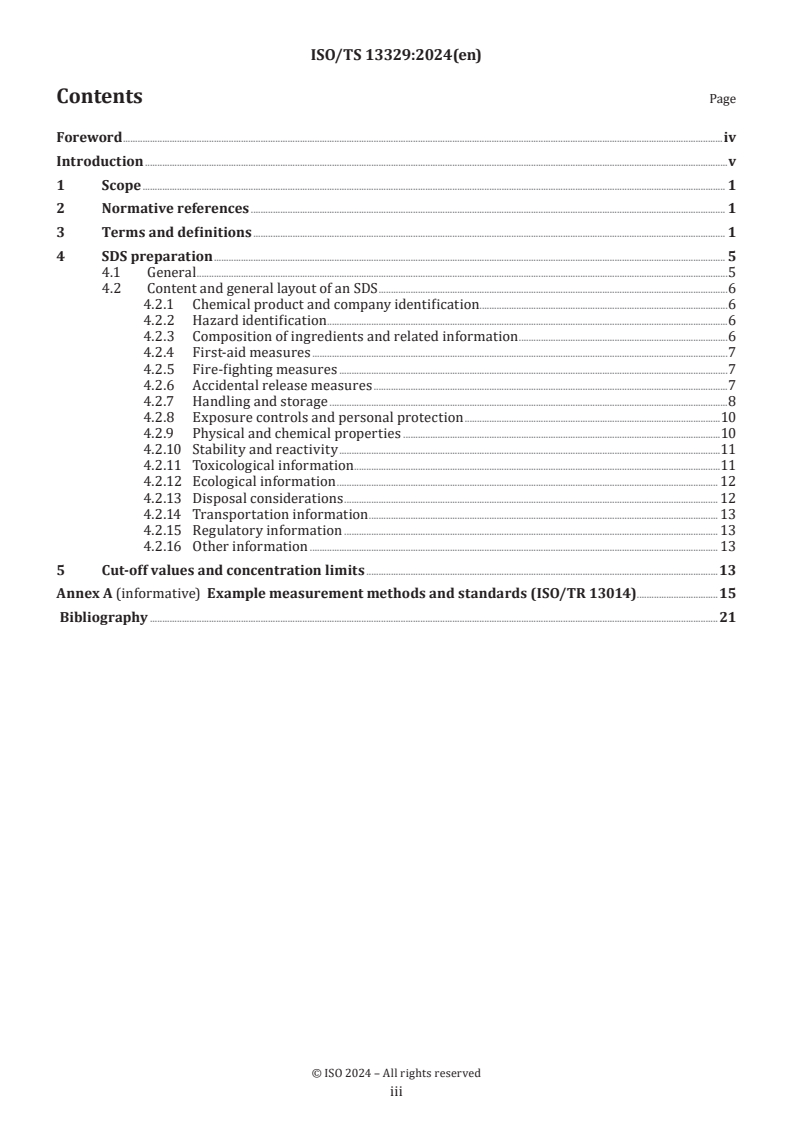
Contents Page
Foreword .iv
Introduction .v
1 Scope . 1
2 Normative references . 1
3 Terms and definitions . 1
4 SDS preparation . 5
4.1 General .5
4.2 Content and general layout of an SDS .6
4.2.1 Chemical product and company identification . .6
4.2.2 Hazard identification .6
4.2.3 Composition of ingredients and related information .6
4.2.4 First-aid measures .7
4.2.5 Fire-fighting measures .7
4.2.6 Accidental release measures .7
4.2.7 Handling and storage .8
4.2.8 Exposure controls and personal protection .10
4.2.9 Physical and chemical properties .10
4.2.10 Stability and reactivity .11
4.2.11 Toxicological information .11
4.2.12 Ecological information . 12
4.2.13 Disposal considerations . 12
4.2.14 Transportation information . 13
4.2.15 Regulatory information . 13
4.2.16 Other information . 13
5 Cut-off values and concentration limits .13
Annex A (informative) Example measurement methods and standards (ISO/TR 13014) .15
Bibliography .21
iii
Foreword
ISO (the International Organization for Standardization) is a worldwide federation of national standards
bodies (ISO member bodies). The work of preparing International Standards is normally carried out through
ISO technical committees. Each member body interested in a subject for which a technical committee
has been established has the right to be represented on that committee. International organizations,
governmental and non-governmental, in liaison with ISO, also take part in the work. ISO collaborates closely
with the International Electrotechnical Commission (IEC) on all matters of electrotechnical standardization.
The procedures used to develop this document and those intended for its further maintenance are described
in the ISO/IEC Directives, Part 1. In particular, the different approval criteria needed for the different types
of ISO document should be noted. This document was drafted in accordance with the editorial rules of the
ISO/IEC Directives, Part 2 (see www.iso.org/directives).
ISO draws attention to the possibility that the implementation of this document may involve the use of (a)
patent(s). ISO takes no position concerning the evidence, validity or applicability of any claimed patent
rights in respect thereof. As of the date of publication of this document, ISO had not received notice of (a)
patent(s) which may be required to implement this document. However, implementers are cautioned that
this may not represent the latest information, which may be obtained from the patent database available at
www.iso.org/patents. ISO shall not be held responsible for identifying any or all such patent rights.
Any trade name used in this document is information given for the convenience of users and does not
constitute an endorsement.
For an explanation of the voluntary nature of standards, the meaning of ISO specific terms and expressions
related to conformity assessment, as well as information about ISO's adherence to the World Trade
Organization (WTO) principles in the Technical Barriers to Trade (TBT), see www.iso.org/iso/foreword.html.
This document was prepared by Technical Committee 229 Nanotechnologies.
This second edition cancels and replaces the first edition (ISO/TR 13329:2012), which has been technically
revised.
The main change is as follows:
— The document has been changed to a Technical Specification.
Any feedback or questions on this document should be directed to the user’s national standards body. A
complete listing of these bodies can be found at www.iso.org/members.html.
iv
Introduction
Manufactured nanomaterials are defined as materials that are intentionally produced to have specific
properties or a specific composition and which have any external dimension in the nanoscale or internal
structure or surface structure in the nanoscale. This document is not a stand-alone document and should
[1]
be used in conjunction with ISO 11014. This document takes into account the Globally harmonized system
of classification and labelling of chemicals (GHS) document on hazard communication, i.e. safety data sheets.
The GHS was developed by the United Nations and is being incorporated into the laws of various regions and
nations, many of which already have laws that govern the preparation of SDSs.
Currently, there is limited information on the possible hazards of some nanomaterials. In some cases,
the degree of risk to workers or others who can be exposed to nanomaterials is partly unknown, as the
possible toxicological effects of nanomaterials are not yet well known and exposure is difficult to measure.
Most hazard information and communication approaches necessitate preparation of an SDS for hazardous
chemicals, including those containing nanomaterials, for use in manufacture, storage, transport or other
occupational handling activities. Yet, only a few SDSs contain specific information about nanomaterials
or are specific to nanomaterials. Those that exist generally provide insufficient hazard information (see
Reference [2]). There is evidence that some nanomaterials can be more hazardous, e.g. more bio-reactive
or active, leading to higher toxicity, than the same material in bulk (non-nanoscale) form. Characteristics
predictive of potential safety issues or toxicity for manufactured nanomaterials need to be determined and
included in the preparation of an SDS. Within the European Union and the UK, the legislation that addresses
industrial substances including nanomaterials specifies that hazardous substances and mixtures are
accompanied by an SDS when placed on the market.
The most fundamental ethical responsibility faced by manufacturers is to make users aware that
nanomaterials have been added to a product and to communicate, in an SDS, the hazards the product
can present and the most effective ways to mitigate those hazards, relying on the hierarchy of controls.
The hierarchy of controls is a method that is found in nearly every international guidance document on
responsible management of nanomaterials. This document considers the precautionary approach in terms of
toxicity and other risks associated with nanomaterials. It recommends providing an SDS for nanomaterials
and nanomaterial-containing products, regardless of whether or not the material is classified as hazardous,
unless there are existing data for the nanomaterial which demonstrates that it is non-hazardous, or if it is
not envisaged that they can be released as nano-objects, or their agglomerates and aggregates greater than
100 nm (NOAA), during handling or use.
v
Technical Specification ISO/TS 13329:2024(en)
Nanomaterials — Preparation of safety data sheets (SDS)
1 Scope
This document provides guidance on the development of content for, and consistency in, the communication of
information on safety, health and environmental matters in safety data sheets (SDS) for substances classified
as manufactured nanomaterials (and materials or products that contain manufactured nanomaterials). It
provides additional information on safety issues associated with manufactured nanomaterials. It provides
[1]
supplemental guidance to ISO 11014 on the preparation of SDSs.
2 Normative references
The following documents are referred to in the text in such a way that some or all of their content constitutes
requirements of this document. For dated references, only the edition cited applies. For undated references,
the latest edition of the referenced document (including any amendments) applies.
ISO 80004-1, Nanotechnologies – Vocabulary — Part 1: Core vocabulary
Globally harmonized system of classification and labelling of chemicals (GHS). United Nations Economic
Commission for Europe, Tenth revised edition, 2023
3 Terms and definitions
For the purposes of this document, the terms and definitions given in ISO 80004-1, GHS and the following apply.
ISO and IEC maintain terminology databases for use in standardization at the following addresses:
— ISO Online browsing platform: available at https:// www .iso .org/ obp
— IEC Electropedia: available at https:// www .electropedia .org/
3.1
agglomerate
collection of weakly bound particles or aggregates or mixtures of the two where the resulting external
surface area is similar to the sum of the surface areas of the individual components
Note 1 to entry: The forces holding an agglomerate together are weak forces, for example van der Waals forces or
simple physical entanglement.
Note 2 to entry: Agglomerates are also termed secondary particles and the original source particles are termed
primary particles.
[SOURCE: ISO 80004-1:2023, 3.2.4]
3.2
aggregate
particle comprising strongly bonded or fused particles where the resulting external surface area is
significantly smaller than the sum of surface areas of the individual components
Note 1 to entry: The forces holding an aggregate together are strong forces, for example covalent bonds, or those
resulting from sintering or complex physical entanglement.
Note 2 to entry: Aggregates are also termed secondary particles and the original source particles are termed primary
particles.
[SOURCE: ISO 80004-1:2023, 3.2.5]
3.3
bioaccumulation
process of accumulation of a substance in organisms or parts thereof
[SOURCE: ISO 6107:2021, 3.64]
3.4
biodurability
physicochemical property which depends on dissolution and leaching as well as mechanical breaking and
splitting of a material in a physiological solution such as a Gamble solution
Note 1 to entry: The biodurability test is usually performed in vitro.
3.5
biopersistence
ability of a material to persist in a tissue in spite of the tissue’s physiological clearance mechanisms and
environmental conditions
[SOURCE: EU R 18748:1999, 1.2, modified — The word "fibre" has been removed and the word "lung"
replaced by "tissue".]
3.6
biodegradability
susceptibility of an organic substance to biodegradation
[SOURCE: ISO 6107:2021, 3.68]
3.7
chemical product
substance or mixture
[SOURCE: ISO 11014:2009, 3.1]
3.8
crystallinity
presence of three-dimensional order at the level of molecular dimensions
[SOURCE: ISO 472:2013, 2.240]
3.9
dustiness
propensity of materials to produce airborne dust during handling
Note 1 to entry: Dustiness is not an intrinsic property as it depends on how it is measured.
[SOURCE: EN 1540:2021, 3.1.2.9]
3.10
engineered nanomaterial
nanomaterial designed for a specific purpose or function
[SOURCE: ISO 80004-1:2023, 3.1.8]
3.11
hazard class
nature of the physical, health or environmental hazard as used in GHS
[SOURCE: GHS: 2023, Chapter 1.2, modified — Examples removed from definition and "as used in GHS" added.]
3.12
hazard statement
statement assigned to a hazard class and category as used in GHS that describes the nature of the hazards of
a hazardous substance or mixture, including, where appropriate, the degree of hazard
[SOURCE: ISO 11014:2009, 3.6, modified — "Hazardous product" replaced with "hazardous substance or
mixture" and "as used in GHS" added.]
3.13
incidental nanomaterial
nanomaterial generated as an unintentional by-product of a process
Note 1 to entry: The process includes manufacturing, biotechnological or other processes, including natural processes.
Note 2 to entry: Used as a synonym for “ultrafine particle” in ISO/TR 27628:2007.
[SOURCE: ISO 80004-1:2023, 3.1.10]
3.14
manufactured nanomaterial
nanomaterial intentionally produced to have selected properties or composition
[SOURCE: ISO 80004-1:2023, 3.1.9]
3.15
mixture
mixture or solution composed of two or more substances in which they do not react
[SOURCE: GHS: 2023, Chapter 1.2]
3.16
nanofibre
nano-object with two similar external dimensions in the nanoscale and the third dimension significantly larger
Note 1 to entry: The largest external dimension is not necessarily in the nanoscale.
[SOURCE: ISO 80004-1:2023, 3.3.5]
3.17
nanomaterial
material with any external dimension in the nanoscale or having internal structure or surface structure in
the nanoscale
Note 1 to entry: This generic term is inclusive of nano-object and nanostructured material.
Note 2 to entry: See also engineered nanomaterial, manufactured nanomaterial and incidental nanomaterial.
Note 3 to entry: The nanoform of a material is a nanomaterial.
[SOURCE: ISO 80004-1:2023, 3.1.4, modified — Notes to entry have been changed.]
3.18
nano-object
discrete piece of material with one, two or three external dimensions in the nanoscale
[SOURCE: ISO 80004-1:2023, 3.1.5]
3.19
nanoparticle
nano-object with all three external dimensions in the nanoscale
Note 1 to entry: If the dimensions differ significantly (typically by more than three times), terms such as nanofibre or
nanoplate are preferred to the term nanoparticle.
[SOURCE: ISO 80004-1:2023, 3.3.4]
3.20
nanopowder
particulate material only composed of nano-objects
Note 1 to entry: Nanopowder can include agglomerates and/or aggregates in the nanoscale (largest dimension ≤
100 nm).
[SOURCE: ISO 18451-1:2019, 3.85]
3.21
nanoscale
length range approximately from 1 nm to 100 nm
[SOURCE: ISO 80004-1:2023, 3.1.1]
3.22
nanostructure
surface or internal feature with one or more dimensions in the nanoscale
Note 1 to entry: A feature includes but is not limited to nano-objects, structures, morphologies or other identifiable
areas of nanoscale dimensions. For example, the nanostructure can be a nanopore or a solid feature on an object.
[SOURCE: ISO 80004-1:2023, 3.1.6]
3.23
nanostructured material
material having internal nanostructure or surface nanostructure
Note 1 to entry: This definition does not exclude the possibility for a nano-object to have internal structure or surface
structure. If external dimensions are in the nanoscale, the term nano-object is recommended.
[SOURCE: ISO 80004-1:2023, 3.1.7]
3.24
particle
minute piece of matter with defined physical boundaries
Note 1 to entry: A physical boundary can also be described as an interface.
Note 2 to entry: This general particle definition applies to nano-objects.
[SOURCE: ISO 26824:2022, 3.1.1, modified — A note to entry has been deleted.]
3.25
primary particle
original source particle of agglomerates or aggregates or mixtures of the two
Note 1 to entry: Constituent particles of agglomerates or aggregates at a certain actual state can be primary particles,
but often the constituents are aggregates.
Note 2 to entry: Agglomerates and aggregates are also termed secondary particles.
[SOURCE: ISO 26824:2022, 3.1.4]
3.26
safety data sheet
SDS
document specifying the properties of a substance, its potential hazardous effects for humans and the
environment, and the precautions necessary to handle and dispose of the substance safely
[SOURCE: ISO 11139:2018, 3.239]
3.27
substance
chemical elements and their compounds in the natural state or obtained by any production process, including
any additive necessary to preserve the stability of the product and any impurities deriving from the process
used, but excluding any solvent which can be separated without affecting the stability of the substance or
changing its composition
[SOURCE: GHS: 2023, Chapter 1.2]
3.28
surface area
area of the external surface of a solid plus the internal surface of its accessible macro-, meso- and micropores
[SOURCE: ISO 9277:2022, 3.10]
4 SDS preparation
4.1 General
4.1.1 An SDS should be prepared for all manufactured nanomaterials, regardless of whether or not the
bulk (non-nanoscale) material is classified as hazardous, except when:
— testing or assessment results that meet the requirements of competent authorities, or are based upon
national or international standards, or generally accepted scientific practices, have indicated they are
non-hazardous; or
— it is not envisaged that manufactured nanomaterials can be released as nano-objects or agglomerates
and aggregates (NOAAs) under reasonably anticipated conditions of use to be exposed to humans, and
the matrix (including the manufactured nanomaterial) does not exhibit a hazard; or
— the hazard class of manufactured nanomaterials is known and the manufactured nanomaterials are
present in concentrations lower than the cut-off levels identified in 5.1.
4.1.2 The information in the SDS should be written in a clear and concise manner. The SDS should be
prepared by one or more competent persons. The specific needs of the intended audience should be taken
into account. The SDS should provide either comprehensive information or conclusions, or both, about
the data that are evaluated, making it easy for any reader to identify all of the hazards, including those
associated with the material’s nanostructure. In addition to the minimum information necessary, the SDS
should contain any available information relevant to the safe use of the material.
[1]
4.1.3 The format of the SDS should conform to ISO 11014.
NOTE The format of the SDS can also be subject to applicable legal requirements.
4.1.4 If relevant information for any of the 16 SDS sections cannot be found, this should be indicated on
the SDS in the appropriate section using phrases such as "not available". The SDS should have no blanks
under any of the headings.
4.1.5 Separate SDSs should be provided for different forms of the same chemical if they pose different
hazards.
NOTE Mixtures of different formulations do not necessitate separate SDSs for each formulation, they can be tested
as any other mixture, as per 4.2.3.4. For instance, a graphene additive for cement can be recommended in different
concentrations for specific applications or in concrete for other purposes, but one SDS is possibly sufficient.
4.2 Content and general layout of an SDS
4.2.1 Chemical product and company identification
Due to the rapidly changing state of knowledge in the area of nanomaterial safety, the date that an SDS was
prepared and the identity of the organization that prepared the SDS should be included. The SDS should
include a revision number and the superseding date or other indications of what version has been replaced.
4.2.2 Hazard identification
The SDS should describe all the hazards associated with the manufactured nanomaterial or mixture for
which the SDS is being prepared. In line with ISO 11014, GHS hazard statements should be used to describe
hazards. Vague and potentially misleading descriptions such as "can be dangerous", "no health effects", "safe
under most conditions of use" or "harmless" are not recommended. If the manufactured nanomaterial or
mixture is classified according to GHS, the specific hazard and category should be identified. Also, hazards
associated with the intended use of the material, but which do not result in classification or are not currently
covered by GHS should be included in the "hazard identification" section of the SDS. For example, possible
dust formation should be mentioned among the potential hazards if the material is milled or ground. Further
guidance on evaluating exposure scenarios is provided in 4.2.8.
4.2.3 Composition of ingredients and related information
4.2.3.1 If a nanomaterial has the same chemical abstracts service (CAS) number as the bulk (non-
nanoscale) material, the CAS number should be used and a statement should be included that the material is
a manufactured nanomaterial according to ISO's definition or other applicable definitions, e.g. Anatase TiO2,
CAS Number 1317-70-0, (manufactured nanomaterial).
4.2.3.2 The composition of manufactured nanomaterials, including stabilizing additives and impurities,
should be identified to the extent necessary for classification and identification of occupational health
and safety measures. If the manufactured nanomaterial is chemically modified, the hazardous properties
of modified nanomaterial should also be evaluated. Manufacturer or suppliers may choose to list all
ingredients, including non-hazardous ingredients. If coating ingredients are proprietary, the manufacturer
should, at a minimum, identify the impact the coating can have on behaviour of the nano-object.
General information on the status of the surface, such as chemical modifications of the manufactured
nanomaterial, should be provided where necessary for the classification, risk assessment and development
of occupational health and safety measures.
Solubility information should be included for the determination of relevant hazard profiles, if applicable.
All substances having an associated occupational exposure limit must be listed. This should include
substances where the exposure limit is for bulk (non-nanoscale) materials or manufactured nanomaterials.
These limits are listed in 4.2.8.
NOTE Regulations can apply regarding confidential business information taking precedence over product
identification. Refer to the relevant competent authority for further information.
If confidential information about the composition was omitted, this should be specified.
4.2.3.3 The SDS should describe whether the manufactured nanomaterial is pure or an additive. For
mixtures, the SDS should identify the manufactured nanomaterials and concentrations, or concentration
ranges, or proportion ranges of all ingredients which are hazardous as specified in GHS, and should provide
the cut-off levels given in 5.1. Materials or products that contain manufactured nanomaterials should identify
all manufactured nanomaterials, which are hazardous as specified in GHS. If the mixed material or product
has not been tested as a whole, the manufactured nanomaterial and common names of all ingredients which
have been determined to be hazardous should be listed.
When using a proportion range, the concentration or percentage range of the manufactured nanomaterial
in the mixture should be taken into account, such as mass, volume, or any other appropriate metric for
nanomaterials.
4.2.3.4 If the mixture has been tested as a whole to determine its hazards, then the manufactured
nanomaterial and common names of the ingredients which contribute to these known hazards, and the
common name of the mixture itself should be included. If the mixture has not been tested as a whole, the
manufactured nanomaterial and common names of all ingredients which have been determined to be
hazardous, and where concentrations are equal to or greater than the cut-off levels as described in 5.2,
should be listed. The manufactured nanomaterial and common names of all ingredients which have been
identified as posing a physical hazard when present in the mixture as described in 5.2 should also be listed.
4.2.4 First-aid measures
[1]
Information provided in the "first-aid measures" section of the SDS should be based on ISO 11014. There is
no further guidance specific to manufactured nanomaterials at this time.
4.2.5 Fire-fighting measures
Manufactured nanomaterials of some materials, particularly powders, can show unusually high reactivity
(especially for fire, explosion and catalytic reactions) when compared with equivalent materials with larger
particle sizes. Nanomaterials have been known to exhibit characteristics of reactivity that are not able to be
anticipated from their chemical composition alone (see Reference [11]).
Decreasing the particle size of combustible materials has the potential to reduce minimum ignition energy
and increase combustion potential and rate. Some normally stable powders become pyrophoric if deposited
on a filter and subject to high airflow, such as the conditions inside a vacuum cleaner. This means that they
can release energy at a much faster rate, tending towards to the explosion scenario. This suggests that some
manufactured nanomaterials should be handled as sources of ignition that have the potential to result in
fire or explosion.
Generally, the maximum explosion pressure, rates of pressure rise and equivalent K (dust deflagration
St
index) of powders containing manufactured nanomaterials have been found to be broadly similar to
conventional micron-scale powders, probably due to the agglomeration of particles. However, if particles
are dispersed more efficiently, then the K and P (peak maximum explosion pressure) can be increased
St max
beyond those of micron-scale powders. Therefore, the minimum ignition energies of some powders
containing manufactured nanomaterials have been found to be lower than those for the equivalent micron-
scale material (see Reference [12]).
All recommended agents should be checked for ingredient compatibility with the nanomaterials, with a focus
on their potential content of water. Some metallic dusts react with water to form hydrogen gas, among other
things, which ignites very easily. The conductive nanopowders, such as the carbon nanopowders, are not
likely to be an electrostatic hazard but, if these powders penetrate into electric and electronic equipment,
they can give rise to short circuits and constitute sources of ignition. The possibility of nanopowders
penetrating into electrical and electronic equipment can be greater as a result of their reduced particle
size (see Reference [12]). Use of dry sand can also quench and exclude oxygen from the burning material
without disturbing the burning mass of the material. Additional information on fire-fighting measures can
[13] [14]
be obtained from ISO/TR 12885 and ISO/TS 12901-1.
4.2.6 Accidental release measures
4.2.6.1 The measures specified in the SDS that should be taken in response to accidents (especially worst-
case scenarios), such as spills or releases involving manufactured nanomaterials, should be based on the
hazardous properties of the nanomaterial and take into account hazard statements and toxicological and
ecological information created pursuant to 4.2.3, 4.2.11 and 4.2.12. Methods for cleaning up spills and leaks of
manufactured nanomaterial should describe, as appropriate, measures to avoid dispersion, e.g. atmospheric
re-suspension, runoff or tracking through the premises, uncontrolled accumulation or explosion. Clean-
up methods should be described in sufficient detail to prevent or minimize adverse effects due to spills or
leakages on persons or the environment. Before selecting a cleaning method, the potential for complications
due to the physical and chemical properties of the manufactured nanomaterial should be taken into account,
particularly in the case of larger spills. Complications can include reactions with cleaning materials and
other materials in the locations where wastes generated by clean-up activities will be stored, e.g. vacuum
cleaner filters and canisters.
4.2.6.2 Possible clean-up methods for dry, manufactured nanomaterials include:
a) using a dedicated high-efficiency particulate air (HEPA) vacuum cleaner intended for use in industrial
or laboratory settings;
b) wet wiping;
c) other facility-approved methods that do not involve dry sweeping or the use of compressed air.
Using a dedicated HEPA-filtered vacuum cleaner such as type H industrial vacuum cleaners for dusts
hazardous to health (see BS 5415-2.2:Supplement No. 1) can avoid mixing waste nanomaterials with other
wastes, thereby decreasing the amount of waste nanomaterials. This avoids potential contamination of
the waste nanomaterials with other wastes, and decreases the likelihood of unintentional releases of
nanomaterials by making it known that the vacuum cleaner is dedicated to that use (see ISO/TS 12901-1:2012,
[14]
Clause 13 ).
Possible pyrophoric hazards associated with the vacuuming of manufactured nanomaterials should be
taken into account, such as spontaneous combustion or ignition. Clean-up equipment should be grounded
and bonded if any flammable hazard exists.
4.2.6.3 For spills of liquids containing manufactured nanomaterials, the wet-wiping method is
recommended for clean-up. In order to prevent the spread of liquids containing suspended manufactured
nanomaterials during clean-up, it is recommended that the access to the spill area be controlled and either
that absorbent walk-off mats are placed where clean-up personnel will exit the spill area, or that barriers
are installed to minimize air currents across the surface affected by the spill, or both. A HEPA-filtered
vacuum cleaner dedicated to the clean-up of manufactured nanomaterials can also be used to clean-up
residual manufactured nanomaterials left behind after the spill area has dried. Additional information can
[14]
be obtained from ISO/TS 12901-1.
NOTE There are unresolved problems with using vacuum cleaners for nanomaterials:
a) the motor produces nanoparticles (causing either potential contamination of product or trigger of alarm system
when measuring nanoparticle concentration, or both);
b) HEPA filters that are used in commercially available vacuum cleaners have been shown to not always fulfil
industry standards on HEPA.
4.2.6.4 The SDS should outline ways of managing clean-up materials, including the collected spilled
materials and the materials used to clean up the spill according to the hazard classification of manufactured
nanomaterials. If the manufactured nanomaterial in the waste stream are not classified, it is recommended
that they be managed as if they were hazardous, unless testing or assessment results that meet the
requirements of the competent authorities, or are based upon national or international standards, or
generally accepted scientific practices, have indicated they are non-hazardous. If the waste nanomaterials
are not classified, a competent person should be consulted to determine how they should be managed.
4.2.7 Handling and storage
Scenarios that can result in exposure to manufactured nanomaterials (e.g. formation of aerosols), for which
risk management measures are necessary, should be identified. A statement identifying the method for
measuring and assessing exposure for the substance should be given, if available. Preventive occupational
health and safety measures should be recommended in accordance with the hierarchy of controls (see
[14]
ISO/TS 12901-1 ). Manufactured nanomaterial exposure can be mitigated by implementing engineering
control (see Reference [16]). Therefore, the SDS should contain details on storage, e.g. temperature or
humidity.
Measures described should provide protection for all people that can enter the workplace. Where applicable,
it should be stated that the safety information provided does not apply to all uses. The same principles
that apply to bulk (non-nanoscale) materials which generate dust and fine powders can be applied to
manufactured nanomaterials, with additional consideration given to account for the typically long settling
times for nanoparticles. As an example, attention should be given to oxidizable metallic manufactured
nanomaterials. If the stored nanomaterials exhibit properties of self-heating, guidance on the maximum
container size and container proximity should be included in the SDS.
If the manufactured nanomaterials are classified as hazardous or regarded as potentially hazardous,
recommended work practices include the following:
— Appropriate engineering controls, such as HEPA filtered ventilation in the work space, etc., should be
described if necessitated by the specific characteristics of the manufactured nanomaterials and the
involved processes.
— Some manufactured nanomaterials can warrant the use of controlled-atmosphere production and
storage processes using carbon dioxide, nitrogen or another inert gas to reduce the risk of fire and
deflagration. Equipment which will be exposed to certain manufactured nanomaterials can be required
to be explosion-proof.
— Transfer manufactured nanomaterial samples between workstations such as exhaust hoods, glove boxes
and furnaces, inside a sealed, labelled container such as a marked, self-sealing bag. The container or bag
should be placed in a second clean container or bag.
— Take reasonable precautions to minimize the likelihood of skin contact with manufactured nanomaterials
or nanomaterial-containing materials which are likely to release manufactured nanomaterials.
— When small amounts of powders containing manufactured nanomaterials are handled without the use
of exhaust ventilation such as a laboratory exhaust hood or without an enclosure such as a glove-box,
alternative work practice controls to reduce the potential for contamination and exposure events should
be implemented.
— Handle manufactured nanomaterial-bearing waste according to the local guidelines on hazardous
chemical waste, unless testing or assessment results that meet the requirements of competent authorities
have indicated they are non-hazardous.
— Use only a dedicated HEPA-filtered vacuum cleaner, such as type H vacuum cleaner intended for use in
industrial or laboratory settings, to clean dry nanomaterials.
— Administrative protective measures should be considered. Examples of such measures include decreasing
exposure time, decreasing the number of persons exposed, implementing access restrictions, and training
personnel on the risks associated with working with manufactured nanomaterials. Alternative work
practice controls to reduce the potential for contamination and exposure events should be implemented.
— Personal protective equipment (PPE) should be identified as a last step after all other measures to
limit exposure have been implemented. Examples include face shields, anti-static shoes, jumpsuits, hair
bonnets, respiratory protection (including information on respirator type and use procedures) and
hand protection (including information on penetration time and glove material). The suitability of PPE,
for example respirator and gloves, should be sufficiently substantiated. If necessary, differentiations of
protective measures should be made according to different uses of the manufactured nanomaterial.
NOTE Although current methods for certification of respirator filters do not routinely require test at particle
sizes below 100 nm, recent research indicates that a number of respirators can offer levels of protection against
nanomaterials (see Reference [17]), assuming the respirator is well fitted.
More detailed information and references about occupational safety measures for manufactured
[13] [14] [18]
nanomaterials can be found in ISO/TR 12885, ISO/TS 12901-1 and ISO/TS 12901-2 .
4.2.8 Exposure controls and personal protection
4.2.8.1 People undertaking a wide range of different roles and tasks, including factory workers,
researchers in laboratories, cleaning and maintenance staff, and worksite visitors, can potentially be
exposed to manufactured nanomaterials in locations where they are used. Conditions that should be taken
into account in evaluating the potential for occupational exposure (and thus identifying recommended
protective measures) include those given in References [16], [19] and [20], as well as the following:
— Working with nanomaterials in liquid media, presenting a risk of skin and eye exposure. If pouring,
mixing or agitation is involved, there is an increase in the likelihood of inhalable and respirable droplets
forming.
— Generating gas-phase nanoparticles in non-enclosed systems and handling nanostructured powders,
increasing the chance of aerosol release into the workplace.
— Cleaning and maintaining manufacturing equipment, PPE and dust collection systems used to capture
aerosol nanomaterials that pose a risk to skin and eyes and can lead to potential inhalation.
— Dust formation, or the possibility of nano-objects such as nanoparticles or nanofibres (including
persistent nanofibres or fibrous structures) being released into the air during expected conditions of
use (including release of agglomerates or aggregates of nano-objects), leading to potential inhalation and
skin and eye exposure.
— Working with manufactured nanomaterials in powdered form that carry a risk of oxidation, auto-
ignition, fire or explosion (e.g. oxidizable metallic powders).
This evaluation should assess the most important routes of exposure.
4.2.8.2 Existing occupational exposure limits for all ingredients listed under 4.2.3 should be given. The
information should state whether the workplace limit is for the bulk (non-nanoscale) or nanomaterial form of
the material. Occupational exposure limits for bulk (non-nanoscale) materials are not necessarily protective
for the nanomaterial form of the material. Therefore, if occupational exposure limits are not available for the
manufactured nanomaterial, protective measures, such as those described in 4.2.7, should be recommended
to minimize exposure.
In cases where primary nanoparticles are likely to either aggregate or agglomerate, or both, in the workplace
atmosphere to form inhalable non-nanoscale particles (see Reference [12]), the occupational exposure limits
for the primary nanoparticles (where available) should be documented in the SDS and constitute the basis
for engineering control requirements.
For substances without occupational exposure limits, limiting exposure by all routes to levels as low as
possible should be taken into account. This approach is recommended for carcinogens with a designation of
(L) by The American Conference of Governmental Industrial Hygienists (ACGIH).
4.2.9 Physical and chemical properties
4.2.9.1 In addition to the physical and chemical properties listed in ISO 11014:2009 A.10, it is recommended
that the following information and measurement methods also be included:
a) Primary particle size (average and range).
Mean, median and mode are all acceptable measures, but it should be stated which is being used.
Multimodal distributions may also be used.
b) Size distribution.
The relationship between aggregation, agglomeration and hazard is variable and dependent on the
dispersant and the composition of the aggregate and/or agglomerate.
c) Shape and aspect ratio.
Aspect ratio is frequently used to describe nanofibres.
d) Crystallinity.
2 3 2
e) Specific surface area (m /cm or m /g).
f) Dispersion stability.
It is important to consider dispersants such as air, water, media or other materials when evaluating
the
...
Questions, Comments and Discussion
Ask us and Technical Secretary will try to provide an answer. You can facilitate discussion about the standard in here.
Loading comments...