


ISO/IEC 23093-4:2023
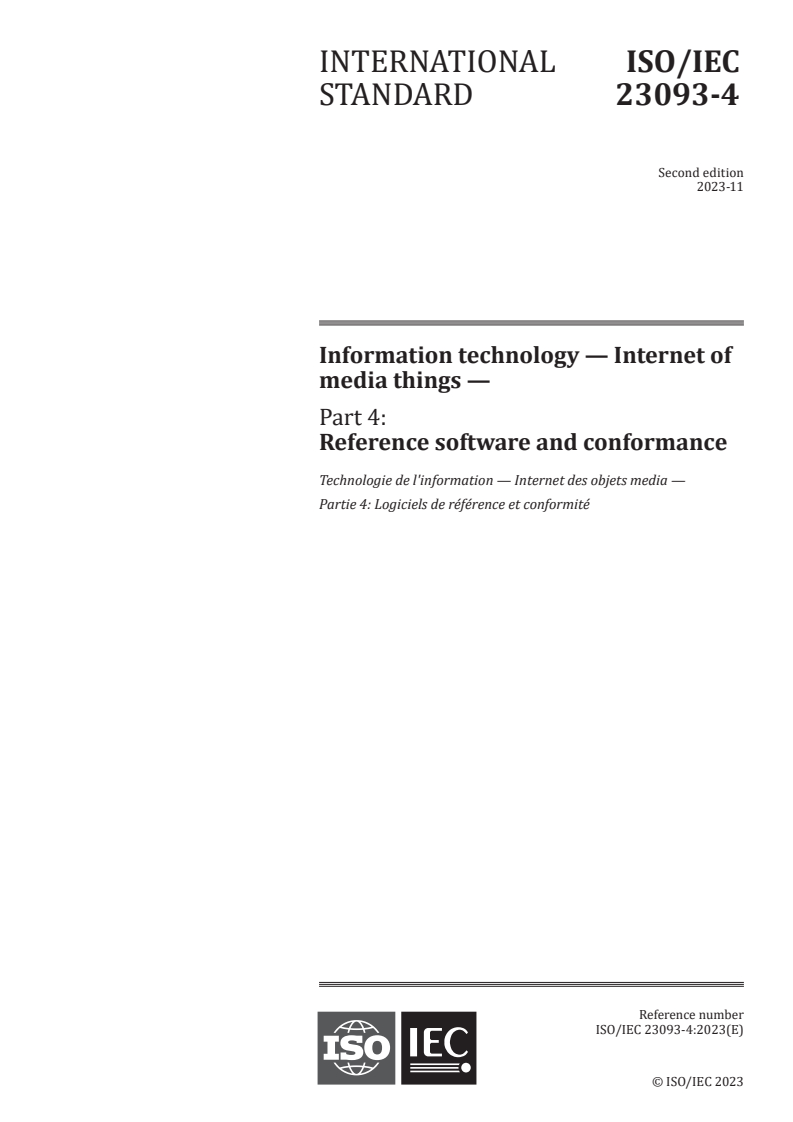
(Main)Information technology — Internet of media things — Part 4: Reference software and conformance
Information technology — Internet of media things — Part 4: Reference software and conformance
This document specifies the conformance and reference software implementing ISO/IEC 23093-3. The information provided is applicable for determining the reference software modules available for ISO/IEC 23093-3, understanding the functionality of the available reference software modules, and utilising the available reference software modules. Furthermore, this document provides means for conformance testing, i.e. bitstreams – XML and binary descriptions – that conform or do not conform to ISO/IEC 23093-3.
Technologie de l'information — Internet des objets media — Partie 4: Logiciels de référence et conformité
General Information
- Status
- Published
- Publication Date
- 07-Nov-2023
- Current Stage
- 9092 - International Standard to be revised
- Start Date
- 21-Jul-2024
- Completion Date
- 12-Feb-2026
Relations
- Effective Date
- 06-Jun-2022
Overview
ISO/IEC 23093-4:2023 - "Information technology - Internet of media things - Part 4: Reference software and conformance" specifies the reference software and conformance materials that implement ISO/IEC 23093-3. It documents the available reference software modules, their Java-based APIs and package structure, and provides conformance test vectors (XML and binary bitstreams) for validating implementations of the media‑thing data formats and APIs.
Keywords: ISO/IEC 23093-4:2023, Internet of media things, reference software, conformance, APIs, MTDL, MSOV, MACV, MAOV, binary representation.
Key topics and technical requirements
- Reference software implementation
- Java® reference code adopting defined package structures (e.g., org.iso.mpeg.iomt.mtdl, .msov, .macv, .maov).
- Package/class layout designed to support tool generation (for example, JAXB).
- APIs for MTDL (Media Thing Description Language)
- Java APIs and class types for MThing, MSensor, MActuator, MAnalyser, MStorage, MManager, MAggregator.
- Concrete class types described (e.g., MThingInfo, SensedDataBaseType, ActuationDataBaseType, AnalysedDataBaseType).
- Binary and XML representation APIs
- Common APIs and binary representation modules to serialize/deserialize media‑thing data flows.
- Conformance testing
- Schema‑based conformance rules and example test bitstreams (valid and invalid XML and binary instances) to verify compliance with ISO/IEC 23093-3.
- Test material supports verifying API behavior and data format correctness.
Applications and practical value
- Ensures interoperability among media things (sensors, actuators, analysers, storage) in Internet of Media Things (IoMT) systems by providing canonical reference code and test vectors.
- Enables developers and integrators to:
- Rapidly prototype and validate MThing implementations using the Java reference libraries.
- Perform conformance testing with provided XML and binary bitstreams to confirm correct handling of MTDL, MSOV, MACV, MAOV formats.
- Useful in deployments such as multimedia sensing networks, distributed media analytics, smart camera ecosystems, and media actuator control systems where standardized data exchange and conformance are critical.
Who should use this standard
- Firmware/software developers implementing IoMT devices and services
- System architects and integrators building media-sensor/actuator networks
- Test laboratories and QA teams performing conformance and interoperability testing
- Standards developers and tool vendors generating bindings from the reference packages
Related standards
- ISO/IEC 23093-1 - Architecture
- ISO/IEC 23093-2 - Discovery and communication API
- ISO/IEC 23093-3 - Media data formats and APIs (implemented by this Part 4)
Reference software and conformance material for ISO/IEC 23093-4:2023 are published by ISO; consult the ISO website for downloads and implementation details.
Get Certified
Connect with accredited certification bodies for this standard

BSI Group
BSI (British Standards Institution) is the business standards company that helps organizations make excellence a habit.

NYCE
Mexican standards and certification body.
Sponsored listings
Frequently Asked Questions
ISO/IEC 23093-4:2023 is a standard published by the International Organization for Standardization (ISO). Its full title is "Information technology — Internet of media things — Part 4: Reference software and conformance". This standard covers: This document specifies the conformance and reference software implementing ISO/IEC 23093-3. The information provided is applicable for determining the reference software modules available for ISO/IEC 23093-3, understanding the functionality of the available reference software modules, and utilising the available reference software modules. Furthermore, this document provides means for conformance testing, i.e. bitstreams – XML and binary descriptions – that conform or do not conform to ISO/IEC 23093-3.
This document specifies the conformance and reference software implementing ISO/IEC 23093-3. The information provided is applicable for determining the reference software modules available for ISO/IEC 23093-3, understanding the functionality of the available reference software modules, and utilising the available reference software modules. Furthermore, this document provides means for conformance testing, i.e. bitstreams – XML and binary descriptions – that conform or do not conform to ISO/IEC 23093-3.
ISO/IEC 23093-4:2023 is classified under the following ICS (International Classification for Standards) categories: 35.040.40 - Coding of audio, video, multimedia and hypermedia information. The ICS classification helps identify the subject area and facilitates finding related standards.
ISO/IEC 23093-4:2023 has the following relationships with other standards: It is inter standard links to ISO/IEC 23093-4:2020. Understanding these relationships helps ensure you are using the most current and applicable version of the standard.
ISO/IEC 23093-4:2023 is available in PDF format for immediate download after purchase. The document can be added to your cart and obtained through the secure checkout process. Digital delivery ensures instant access to the complete standard document.
Standards Content (Sample)
INTERNATIONAL ISO/IEC
STANDARD 23093-4
Second edition
2023-11
Information technology — Internet of
media things —
Part 4:
Reference software and conformance
Technologie de l'information — Internet des objets media —
Partie 4: Logiciels de référence et conformité
Reference number
© ISO/IEC 2023
© ISO/IEC 2023
All rights reserved. Unless otherwise specified, or required in the context of its implementation, no part of this publication may
be reproduced or utilized otherwise in any form or by any means, electronic or mechanical, including photocopying, or posting on
the internet or an intranet, without prior written permission. Permission can be requested from either ISO at the address below
or ISO’s member body in the country of the requester.
ISO copyright office
CP 401 • Ch. de Blandonnet 8
CH-1214 Vernier, Geneva
Phone: +41 22 749 01 11
Email: copyright@iso.org
Website: www.iso.org
Published in Switzerland
ii
© ISO/IEC 2023 – All rights reserved
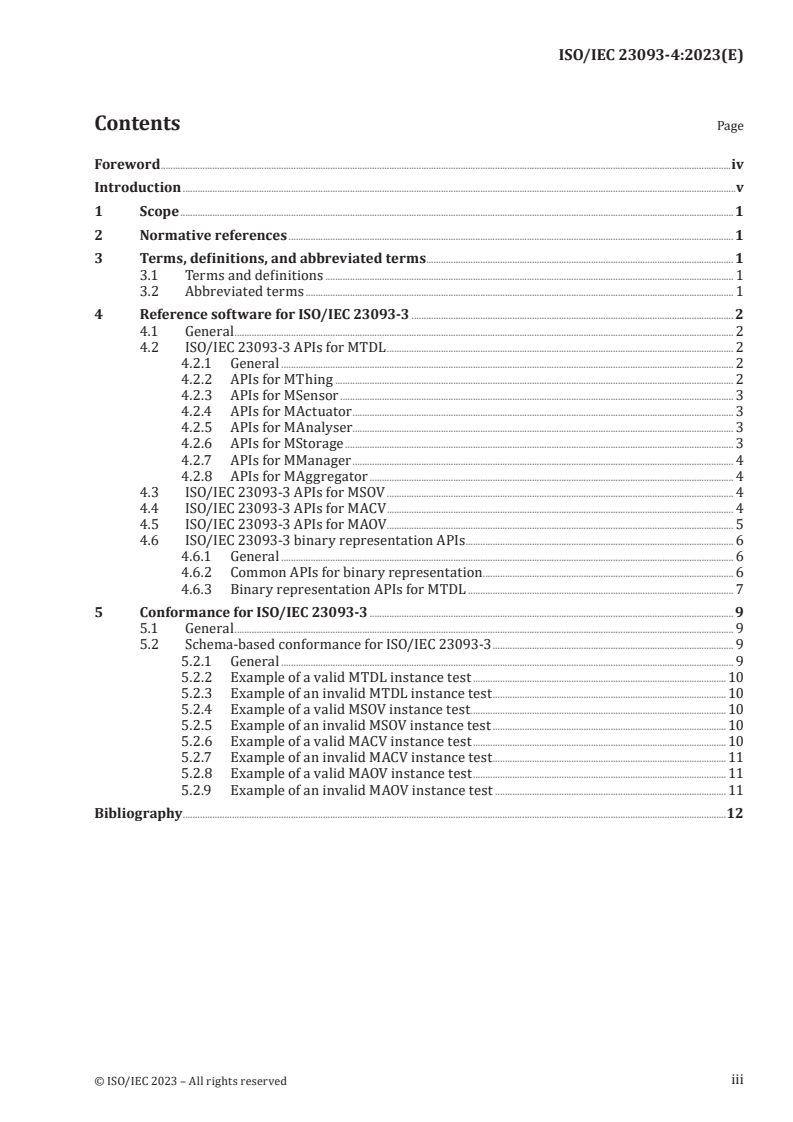
Contents Page
Foreword .iv
Introduction .v
1 Scope . 1
2 Normative references . 1
3 Terms, definitions, and abbreviated terms . 1
3.1 Terms and definitions . 1
3.2 Abbreviated terms . 1
4 Reference software for ISO/IEC 23093-3 . 2
4.1 General . 2
4.2 ISO/IEC 23093-3 APIs for MTDL . 2
4.2.1 General . 2
4.2.2 APIs for MThing . 2
4.2.3 APIs for MSensor . 3
4.2.4 APIs for MActuator . 3
4.2.5 APIs for MAnalyser. 3
4.2.6 APIs for MStorage . 3
4.2.7 APIs for MManager . 4
4.2.8 APIs for MAggregator . 4
4.3 ISO/IEC 23093-3 APIs for MSOV . 4
4.4 ISO/IEC 23093-3 APIs for MACV . 4
4.5 ISO/IEC 23093-3 APIs for MAOV . 5
4.6 ISO/IEC 23093-3 binary representation APIs . 6
4.6.1 General . 6
4.6.2 Common APIs for binary representation . 6
4.6.3 Binary representation APIs for MTDL . 7
5 Conformance for ISO/IEC 23093-3 .9
5.1 General . 9
5.2 Schema-based conformance for ISO/IEC 23093-3 . 9
5.2.1 General . 9
5.2.2 Example of a valid MTDL instance test . 10
5.2.3 Example of an invalid MTDL instance test . 10
5.2.4 Example of a valid MSOV instance test . 10
5.2.5 Example of an invalid MSOV instance test . 10
5.2.6 Example of a valid MACV instance test . 10
5.2.7 Example of an invalid MACV instance test . 11
5.2.8 Example of a valid MAOV instance test . 11
5.2.9 Example of an invalid MAOV instance test . 11
Bibliography .12
iii
© ISO/IEC 2023 – All rights reserved
Foreword
ISO (the International Organization for Standardization) and IEC (the International Electrotechnical
Commission) form the specialized system for worldwide standardization. National bodies that are
members of ISO or IEC participate in the development of International Standards through technical
committees established by the respective organization to deal with particular fields of technical
activity. ISO and IEC technical committees collaborate in fields of mutual interest. Other international
organizations, governmental and non-governmental, in liaison with ISO and IEC, also take part in the
work.
The procedures used to develop this document and those intended for its further maintenance
are described in the ISO/IEC Directives, Part 1. In particular, the different approval criteria
needed for the different types of document should be noted. This document was drafted in
accordance with the editorial rules of the ISO/IEC Directives, Part 2 (see www.iso.org/directives or
www.iec.ch/members_experts/refdocs).
ISO and IEC draw attention to the possibility that the implementation of this document may involve the
use of (a) patent(s). ISO and IEC take no position concerning the evidence, validity or applicability of
any claimed patent rights in respect thereof. As of the date of publication of this document, ISO and IEC
had not received notice of (a) patent(s) which may be required to implement this document. However,
implementers are cautioned that this may not represent the latest information, which may be obtained
from the patent database available at www.iso.org/patents and https://patents.iec.ch. ISO and IEC shall
not be held responsible for identifying any or all such patent rights.
Any trade name used in this document is information given for the convenience of users and does not
constitute an endorsement.
For an explanation of the voluntary nature of standards, the meaning of ISO specific terms and
expressions related to conformity assessment, as well as information about ISO's adherence to
the World Trade Organization (WTO) principles in the Technical Barriers to Trade (TBT) see
www.iso.org/iso/foreword.html. In the IEC, see www.iec.ch/understanding-standards.
This document was prepared by Joint Technical Committee ISO/IEC JTC 1, Information technology,
Subcommittee SC 29, Coding of audio, picture, multimedia and hypermedia information.
This second edition cancels and replaces the first edition (ISO/IEC 23093-4:2020), which has been
technically revised.
The main changes are as follows:
— modification of introduction;
— addition of new APIs;
— addition of binary reference software and its conformance streams.
A list of all parts in the ISO/IEC 23093 series can be found on the ISO website.
Any feedback or questions on this document should be directed to the user ’s national standards
body. A complete listing of these bodies can be found at www.iso.org/members.html and
www.iec.ch/national-committees.
iv
© ISO/IEC 2023 – All rights reserved
Introduction
The ISO/IEC 23093 series provides an architecture and specifies APIs and compressed representation
of data flowing between media things.
The APIs for the media things facilitate discovering other media things in the network, connecting, and
efficiently exchanging data between media things. The APIs also support transaction tokens to access
valuable functionalities, resources, and data from media things.
Information related to media things consists of characteristics and discovery data, setup information
from a system designer, raw and processed sensed data, and actuation information. The ISO/IEC 23093
series specifies input and output data formats for media things such as media sensors, actuators,
storage, and analysers. In addition, media analysers can process sensed data from media sensors to
produce analysed data, and the media analysers can be cascaded to extract semantic information.
This document contains the conformance and reference software implementing ISO/IEC 23093-3,
which includes the tools to describe data exchanged between media things and their APIs.
v
© ISO/IEC 2023 – All rights reserved
INTERNATIONAL STANDARD ISO/IEC 23093-4:2023(E)
Information technology — Internet of media things —
Part 4:
Reference software and conformance
1 Scope
This document specifies the conformance and reference software implementing ISO/IEC 23093-3.
The information provided is applicable for determining the reference software modules available for
ISO/IEC 23093-3, understanding the functionality of the available reference software modules, and
utilising the available reference software modules.
Furthermore, this document provides means for conformance testing, i.e. bitstreams – XML and binary
descriptions – that conform or do not conform to ISO/IEC 23093-3.
2 Normative references
The following documents are referred to in the text in such a way that some or all of their content
constitutes requirements of this document. For dated references, only the edition cited applies. For
undated references, the latest edition of the referenced document (including any amendments) applies.
ISO/IEC 23093-1, Information technology — Internet of media things — Part 1: Architecture
ISO/IEC 23093-2, Information technology — Internet of media things — Part 2: Discovery and
communication API
ISO/IEC 23093-3, Information technology — Internet of media things — Part 3: Media data formats and
APIs
3 Terms, definitions, and abbreviated terms
3.1 Terms and definitions
For the purposes of this document, the terms and definitions given in ISO/IEC 23093-1, ISO/IEC 23093-2,
and ISO/IEC 23093-3 apply.
ISO and IEC maintain terminology databases for use in standardization at the following addresses:
— ISO Online browsing platform: available at https:// www .iso .org/ obp
— IEC Electropedia: available at https:// www .electropedia .org/
3.2 Abbreviated terms
API application programming interface
MACV media actuator command vocabulary
MAOV media analyser output vocabulary
MSOV media sensor output vocabulary
MTDL media thing description language
© ISO/IEC 2023 – All rights reserved
4 Reference software for ISO/IEC 23093-3
4.1 General
This clause specifies the reference software for ISO/IEC 23093-3. The software is available at https://
1)
standards .iso .org/ iso -iec/ 23093/ -4/ ed -2/ en. The reference software is written in Java® and adopts
the package structure in Table 1.
Table 1 — The package structure of the IoMT reference software
Name Definition
org
Java package name for reference software provided by organisations such
as ISO/IEC, W3C, or similar.
org.iso
Java package name for reference software provided by ISO/IEC.
org.iso.mpeg
Java package name for reference software.
org.iso.mpeg.iomt
Java package name for reference software developing the ISO/IEC 23093 series.
- org.iso.mpeg.iomt.mtdl, org.iso.mpeg.iomt.msov, org.iso.
mpeg.iomt.macv, and org.iso.mpeg.iomt.maov for ISO/IEC 23093-3.
NOTE Code included within these packages can automatically generate tools
[1]
such as JAXB (Java Architecture for XML Binding) .
4.2 ISO/IEC 23093-3 APIs for MTDL
4.2.1 General
This subclause specifies the API to the ISO/IEC 23093-3 reference software. The API is defined in Java®
and adopts the package structures in Table 2.
Table 2 — MTDL reference softaware package structures
Name Definition
org.iso.mpeg.iomt.mtdl
Java package name for API to the ISO/IEC 23093-3 reference
software.
4.2.2 APIs for MThing
This subclause specifies classes related to the basic information of an MThing (Table 3).
Table 3 — Class types of MThing
Name Definition
MThingInfo
Java class containing essential elements and attributes for an
MThing.
MSensorType
Java class (i.e. superclass) that all media sensors shall extend.
MActuatorType
Java class (i.e. superclass) that all media actuators shall extend.
MAnalyserType
Java class (i.e. superclass) that all media analysers shall extend.
MStorageType
Java class (i.e. superclass) that all media storage shall extend.
MManagerType
Java class (i.e. superclass) that all MThing managers shall extend.
MAggregatorType
Java class (i.e. superclass) that all MThing aggregators shall extend.
1) Java® is the trademark of a product supplied by Oracle®. This information is given for the convenience of users
of this document and does not constitute an endorsement by ISO or IEC of the product named. Equivalent products
may be used if they can be shown to lead to the same results.
© ISO/IEC 2023 – All rights reserved
4.2.3 APIs for MSensor
This subclause specifies classes that are related to an MSensor (Table 4).
Table 4 — Class types of MSensor
Name Definition
SensedDataBaseType
Java class describing sensed data. All of the classes in the org.
iso.mpeg.iomt.msov shall extend this class.
SensorCapabilityListEnumType
Java class specifying the type of sensor capa-
bilities among allSensorCapabilityList,
availableSensorCapabilityList, and
appliedSensorCapabilityList.
SensorCapabilityListType
Java class describing a list of sensor capabilities.
SensorCapabilityPara
...
Questions, Comments and Discussion
Ask us and Technical Secretary will try to provide an answer. You can facilitate discussion about the standard in here.
Loading comments...