

ISO 15181-4:2008
(Main)Paints and varnishes — Determination of release rate of biocides from antifouling paints — Part 4: Determination of pyridine-triphenylborane (PTPB) concentration in the extract and calculation of the release rate
General Information
- Abstract
ISO 15181-4:2008 specifies the apparatus and analytical method for determining the amount of pyridine-triphenylborane (PTPB) that has been released from an antifouling paint into artificial seawater in accordance with the procedure given in ISO 15181‑1. It determines the PTPB concentration in the artificial seawater extract and gives the final calculation for the release rate of PTPB under the specified laboratory conditions. This part of ISO 15181 is designed to allow the concurrent determination of PTPB and other biocides that can be released by a given antifouling paint (for example, zineb) through the analysis of separate sub-samples of an artificial seawater extract generated in accordance with the procedure given in ISO 15181‑1. When used in conjunction with ISO 15181‑1, the practical limits on the quantitative measurement of release rates by this method are from 1,8 micrograms per square centimetre per day to 500 micrograms per square centimetre per day. The quantitative measurement of release rates below this range will require an additional concentration step described in the text or the use of an analytical method with a lower limit of quantitation for PTPB in artificial seawater.
- Status
- Published
- Publication Date
- 22-Jul-2008
- Technical Committee
- ISO/TC 35/SC 9 - General test methods for paints and varnishes
- Drafting Committee
- ISO/TC 35/SC 9 - General test methods for paints and varnishes
- Current Stage
- 9093 - International Standard confirmed
- Start Date
- 22-May-2022
- Completion Date
- 29-Aug-2026
Buy Documents
ISO 15181-4:2008 - Paints and varnishes — Determination of release rate of biocides from antifouling paints — Part 4: Determination of pyridine-triphenylborane (PTPB) concentration in the extract and calculation of the release rate Released:7/23/2008
ISO 15181-4:2008 - Peintures et vernis — Détermination du taux de lixiviation des biocides contenus dans les peintures antisalissures — Partie 4: Détermination de la concentration de pyridine-triphénylborane (PTPB) dans l'extrait et calcul du taux de lixiviation Released:7/23/2008
Overview
ISO 15181-4:2008 - Paints and varnishes - Determination of release rate of biocides from antifouling paints - Part 4 specifies a laboratory method to determine the concentration of pyridine‑triphenylborane (PTPB) in artificial seawater extracts and to calculate the PTPB release rate from antifouling paints. Used together with ISO 15181‑1 (general extraction), this ISO 15181-4:2008 method provides a repeatable laboratory release-rate value for quality assurance and material selection under controlled temperature, salinity and pH.
Key Topics and Requirements
- Analyte: Pyridine‑triphenylborane (PTPB) in artificial seawater extracts.
- Analytical principle: HPLC with UV detection at 220 nm after pre‑concentration by solid‑phase extraction (SPE), or another method with equivalent sensitivity.
- Sample preparation: Add pyridine to 1% v/v, pass 100 ml through a pre‑conditioned C‑18 SPE cartridge (360 mg sorbent), wash and elute; final eluate adjusted to 20 ml. Optional concentration step (rotary evaporation + N2 drying) allows lower limits of quantitation.
- Chromatography essentials: Reverse‑phase C‑18 column (4.6 mm × 250 mm, ~5 µm), isocratic eluent (acetonitrile/water/TBAP ion‑pair reagent), autosampler (10 µl injections), column oven at 30 °C.
- Limits and performance: The method targets a limit of quantitation (LOQ) for PTPB in artificial seawater of ≤10 µg/L; with additional concentration the LOQ can reach ~0.5 µg/L. Practical measurable release‑rate range when used with ISO 15181‑1: 1.8 to 500 µg·cm⁻²·d⁻¹.
- Quality controls: Triplicate determinations, calibration using PTPB standards (50–1 000 µg/L range), instrument blank checks and linear regression calibration.
Applications and Who Uses It
- Paint manufacturers and R&D teams: evaluate antifouling formulations and adjust biocide content.
- Independent testing laboratories: provide standardized release‑rate data for product specifications and batch quality control.
- Coatings formulators and material selection specialists: compare biocide leaching behaviour under standardized lab conditions.
- Regulatory or advisory bodies (for lab-based comparisons only): note that ISO 15181‑4 results are not direct environmental release rates and typically overestimate in‑service releases; apply correction factors if used in environmental assessments.
Related Standards
- ISO 15181‑1:2007 - General method for extraction of biocides (required for sample generation).
- Other parts of ISO 15181: Part 2 (copper), Part 3 (zineb/ETU), Part 5 (tolylfluanid/dichlofluanid analyses).
- ISO 3696 (water for analytical use) and ASTM D6442 (copper release method) referenced for performance checks.
Keywords: ISO 15181-4:2008, PTPB, antifouling paints, biocide release rate, HPLC, solid‑phase extraction, artificial seawater, limit of quantitation, testing standard.
Relations
- Effective Date
- 25-Aug-2026
- Effective Date
- 12-Feb-2026
- Effective Date
- 06-Jun-2022
Buy Documents
ISO 15181-4:2008 - Paints and varnishes — Determination of release rate of biocides from antifouling paints — Part 4: Determination of pyridine-triphenylborane (PTPB) concentration in the extract and calculation of the release rate Released:7/23/2008
ISO 15181-4:2008 - Peintures et vernis — Détermination du taux de lixiviation des biocides contenus dans les peintures antisalissures — Partie 4: Détermination de la concentration de pyridine-triphénylborane (PTPB) dans l'extrait et calcul du taux de lixiviation Released:7/23/2008
Frequently Asked Questions
ISO 15181-4:2008 is a standard published by the International Organization for Standardization (ISO). Its full title is "Paints and varnishes — Determination of release rate of biocides from antifouling paints — Part 4: Determination of pyridine-triphenylborane (PTPB) concentration in the extract and calculation of the release rate". This standard covers: ISO 15181-4:2008 specifies the apparatus and analytical method for determining the amount of pyridine-triphenylborane (PTPB) that has been released from an antifouling paint into artificial seawater in accordance with the procedure given in ISO 15181‑1. It determines the PTPB concentration in the artificial seawater extract and gives the final calculation for the release rate of PTPB under the specified laboratory conditions. This part of ISO 15181 is designed to allow the concurrent determination of PTPB and other biocides that can be released by a given antifouling paint (for example, zineb) through the analysis of separate sub-samples of an artificial seawater extract generated in accordance with the procedure given in ISO 15181‑1. When used in conjunction with ISO 15181‑1, the practical limits on the quantitative measurement of release rates by this method are from 1,8 micrograms per square centimetre per day to 500 micrograms per square centimetre per day. The quantitative measurement of release rates below this range will require an additional concentration step described in the text or the use of an analytical method with a lower limit of quantitation for PTPB in artificial seawater.
ISO 15181-4:2008 specifies the apparatus and analytical method for determining the amount of pyridine-triphenylborane (PTPB) that has been released from an antifouling paint into artificial seawater in accordance with the procedure given in ISO 15181‑1. It determines the PTPB concentration in the artificial seawater extract and gives the final calculation for the release rate of PTPB under the specified laboratory conditions. This part of ISO 15181 is designed to allow the concurrent determination of PTPB and other biocides that can be released by a given antifouling paint (for example, zineb) through the analysis of separate sub-samples of an artificial seawater extract generated in accordance with the procedure given in ISO 15181‑1. When used in conjunction with ISO 15181‑1, the practical limits on the quantitative measurement of release rates by this method are from 1,8 micrograms per square centimetre per day to 500 micrograms per square centimetre per day. The quantitative measurement of release rates below this range will require an additional concentration step described in the text or the use of an analytical method with a lower limit of quantitation for PTPB in artificial seawater.
ISO 15181-4:2008 is classified under the following ICS (International Classification for Standards) categories: 87.040 - Paints and varnishes. The ICS classification helps identify the subject area and facilitates finding related standards.
ISO 15181-4:2008 has the following relationships with other standards: It is inter standard links to EN ISO 15181-1:2007, EN ISO 15181-4:2008, ISO/IEC ISP 12061-4:1995. Understanding these relationships helps ensure you are using the most current and applicable version of the standard.
ISO 15181-4:2008 is available in PDF format for immediate download after purchase. The document can be added to your cart and obtained through the secure checkout process. Digital delivery ensures instant access to the complete standard document.
Standards Content (Sample)
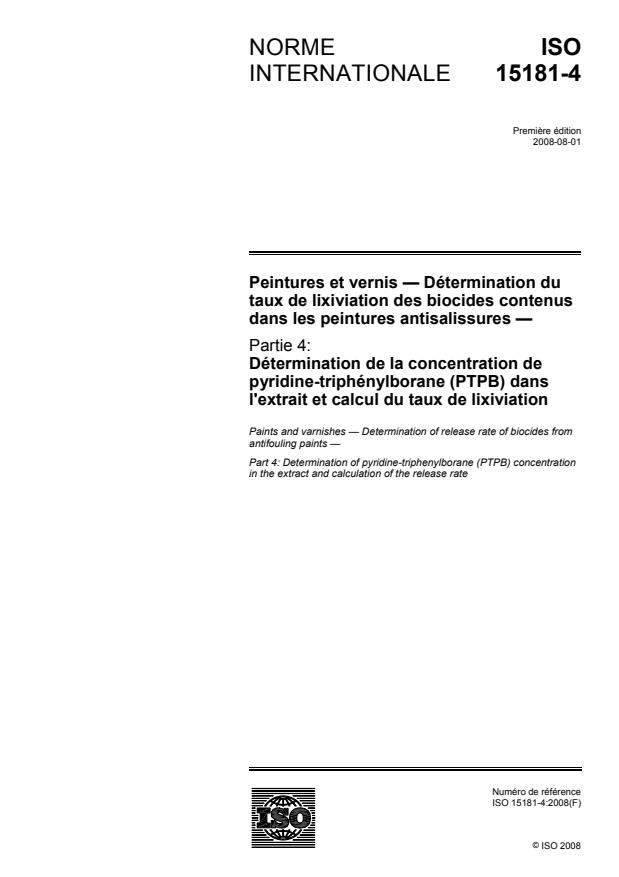
INTERNATIONAL ISO
STANDARD 15181-4
First edition
2008-08-01
Paints and varnishes — Determination of
release rate of biocides from antifouling
paints —
Part 4:
Determination of pyridine-
triphenylborane (PTPB) concentration in
the extract and calculation of the release
rate
Peintures et vernis — Détermination du taux de lixiviation des biocides
contenus dans les peintures antisalissures —
Partie 4: Détermination de la concentration de pyridine-triphénylborane
(PTPB) dans l'extrait et calcul du taux de lixiviation
Reference number
©
ISO 2008
PDF disclaimer
This PDF file may contain embedded typefaces. In accordance with Adobe's licensing policy, this file may be printed or viewed but
shall not be edited unless the typefaces which are embedded are licensed to and installed on the computer performing the editing. In
downloading this file, parties accept therein the responsibility of not infringing Adobe's licensing policy. The ISO Central Secretariat
accepts no liability in this area.
Adobe is a trademark of Adobe Systems Incorporated.
Details of the software products used to create this PDF file can be found in the General Info relative to the file; the PDF-creation
parameters were optimized for printing. Every care has been taken to ensure that the file is suitable for use by ISO member bodies. In
the unlikely event that a problem relating to it is found, please inform the Central Secretariat at the address given below.
© ISO 2008
All rights reserved. Unless otherwise specified, no part of this publication may be reproduced or utilized in any form or by any means,
electronic or mechanical, including photocopying and microfilm, without permission in writing from either ISO at the address below or
ISO's member body in the country of the requester.
ISO copyright office
Case postale 56 • CH-1211 Geneva 20
Tel. + 41 22 749 01 11
Fax + 41 22 749 09 47
E-mail copyright@iso.org
Web www.iso.org
Published in Switzerland
ii © ISO 2008 – All rights reserved
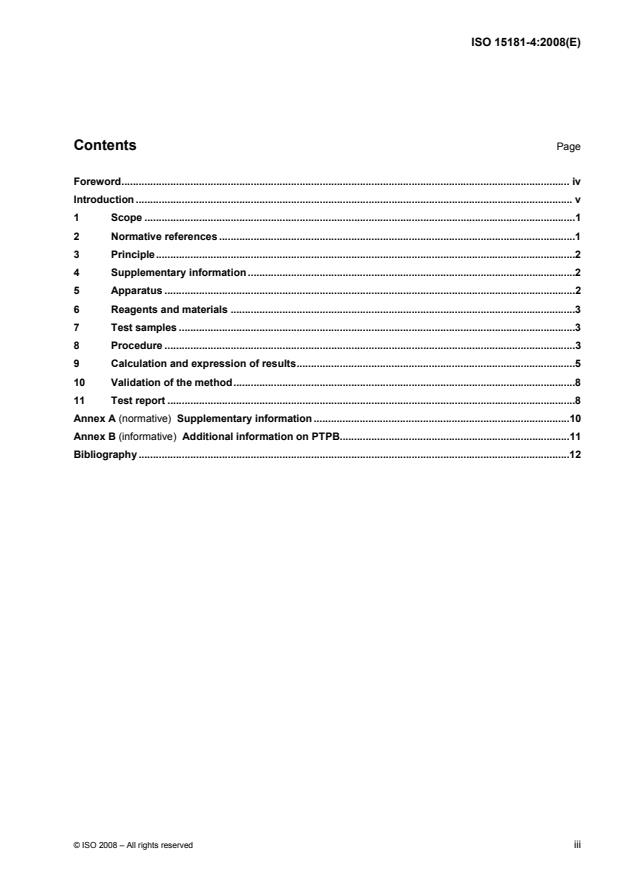
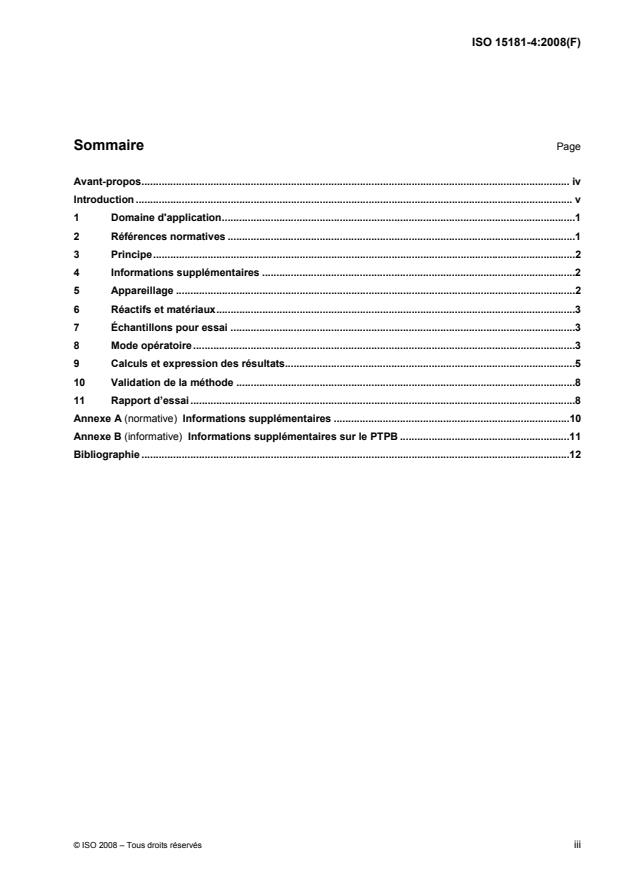
Contents Page
Foreword. iv
Introduction . v
1 Scope .1
2 Normative references .1
3 Principle.2
4 Supplementary information.2
5 Apparatus .2
6 Reagents and materials .3
7 Test samples .3
8 Procedure .3
9 Calculation and expression of results.5
10 Validation of the method.8
11 Test report .8
Annex A (normative) Supplementary information .10
Annex B (informative) Additional information on PTPB.11
Bibliography .12
Foreword
ISO (the International Organization for Standardization) is a worldwide federation of national standards bodies
(ISO member bodies). The work of preparing International Standards is normally carried out through ISO
technical committees. Each member body interested in a subject for which a technical committee has been
established has the right to be represented on that committee. International organizations, governmental and
non-governmental, in liaison with ISO, also take part in the work. ISO collaborates closely with the
International Electrotechnical Commission (IEC) on all matters of electrotechnical standardization.
International Standards are drafted in accordance with the rules given in the ISO/IEC Directives, Part 2.
The main task of technical committees is to prepare International Standards. Draft International Standards
adopted by the technical committees are circulated to the member bodies for voting. Publication as an
International Standard requires approval by at least 75 % of the member bodies casting a vote.
Attention is drawn to the possibility that some of the elements of this document may be the subject of patent
rights. ISO shall not be held responsible for identifying any or all such patent rights.
ISO 15181-4 was prepared by Technical Committee ISO/TC 35, Paints and varnishes, Subcommittee SC 9,
General test methods for paints and varnishes.
ISO 15181 consists of the following parts, under the general title Paints and varnishes — Determination of
release rate of biocides from antifouling paints:
⎯ Part 1: General method for extraction of biocides
⎯ Part 2: Determination of copper-ion concentration in the extract and calculation of the release rate
⎯ Part 3: Calculation of the zinc ethylene-bis(dithiocarbamate) (zineb) release rate by determination of the
concentration of ethylenethiourea in the extract
⎯ Part 4: Determination of pyridine-triphenylborane (PTPB) concentration in the extract and calculation of
the release rate
⎯ Part 5: Calculation of the tolylfluanid and dichlofluanid release rate by determination of the concentration
of dimethyltolylsulfamide (DMST) and dimethylphenylsulfamide (DMSA) in the extract
The following part is under preparation:
⎯ Part 6: Determination of tralopyril release rate by quantification of its degradation product in the extract
iv © ISO 2008 – All rights reserved
Introduction
By using standard conditions of temperature, salinity and pH at low biocide concentrations in the surrounding
artificial seawater, a repeatable value of the release rate under the specified laboratory conditions can be
determined using the method given in this part of ISO 15181, which can be used for quality assurance and
material selection purposes. The actual release rate of biocides from antifouling paints on ships' hulls into the
environment will, however, depend on many factors, such as ship operating schedules, length of service,
berthing conditions, paint condition, as well as the temperature, salinity, pH, pollutants and biological
community in a particular area.
The results of this test do not reflect environmental biocide release rates for antifouling products and are not
suitable for direct use in the process of generating environmental-risk assessments, producing environmental-
loading estimates or for establishing release rate limits for regulatory purposes. In comparison with copper
and organotin release rates obtained either by direct or indirect measurements of the copper and organotin
release rate from ships’ hulls and from measurements made on panels exposed in harbours, all available data
indicate that the results of this generic test method significantly overestimate the release rate of biocides
under in-service conditions. Published results demonstrate that the results of this test method are generally
higher than direct in situ measurements of copper and organotin release rates from in-service ship hulls by a
[1, 2]
factor of about 10 or more for several commercial antifouling coatings . A similar relationship is expected
to be found for other biocides. Realistic estimates of the biocide release rate from a ship’s hull under
in-service conditions can only be obtained from this test method if this difference is taken into account.
Where the results of this test method are used in the process of generating environmental-risk assessments,
producing environmental-loading estimates or for regulatory purposes, it is most strongly recommended that
the relationship between laboratory release rates and actual environmental inputs be taken into account to
allow a more accurate estimate of the biocide release rate from antifouling coatings under real-life conditions
[2]
to be obtained. This can be accomplished through the application of appropriate correction factors .
INTERNATIONAL STANDARD ISO 15181-4:2008(E)
Paints and varnishes — Determination of release rate of
biocides from antifouling paints —
Part 4:
Determination of pyridine-triphenylborane (PTPB)
concentration in the extract and calculation of the release rate
1 Scope
This part of ISO 15181 specifies the apparatus and analytical method for determining the amount of pyridine-
triphenylborane (PTPB) that has been released from an antifouling paint into artificial seawater in accordance
with the procedure given in ISO 15181-1. It determines the PTPB concentration in the artificial seawater
extract and gives the final calculation for the release rate of PTPB under the specified laboratory conditions.
This part of ISO 15181 is designed to allow the concurrent determination of PTPB and other biocides that can
be released by a given antifouling paint (for example zineb) through the analysis of separate sub-samples of
an artificial seawater extract generated in accordance with the procedure given in ISO 15181-1.
When used in conjunction with ISO 15181-1, the practical limits on the quantitative measurement of release
−2 −1 −2 −1
rates by this method are from 1,8 µg⋅cm ⋅d to 500 µg⋅cm ⋅d . The quantitative measurement of release
rates below this range will require the concentration step described in the last paragraph in 8.2 or the use of
an analytical method with a limit of quantitation for PTPB in artificial seawater which is lower than the limit
specified in Clause 3 and in 5.1.
2 Normative references
The following referenced documents are indispensable for the application of this document. For dated
references, only the edition cited applies. For undated references, the latest edition of the referenced
document (including any amendments) applies.
ISO 3696, Water for analytical laboratory use — Specification and test methods
ISO 15181-1:2007, Paints and varnishes — Determination of release rate of biocides from antifouling
paints — Part 1: General method for extraction of biocides
ASTM D 6442-06, Standard Test Method for Determination of Copper Release Rate from Antifouling Coatings
in Substitute Ocean Water
3 Principle
The quantity of PTPB biocide released into artificial seawater by the method given in ISO 15181-1 is
determined by the use of a high-performance liquid chromatograph (HPLC) with UV detection at 220 nm after
pre-concentration by solid-phase extraction (SPE), or by an alternative analytical method provided that it
demonstrates a limit of quantitation for PTPB in artificial seawater of 10 µg/l or less. The release rate of the
biocide under the specified laboratory conditions is then calculated as PTPB.
The use of the HPLC method in conjunction with the additional sample concentration step described in the last
paragraph in 8.2 can allow a limit of quantitation for PTPB in artificial seawater of 0,5 µg/l to be achieved.
NOTE Additional information on PTPB is given in Annex B. Additional background information on the analytical
[3]
method has been published by Takahashi, et al. .
4 Supplementary information
The items of supplementary information required to be able to use the general extraction procedure, described
in ISO 15181-1, for PTPB are given in Annex A.
5 Apparatus
5.1 High-performance liquid chromatograph (HPLC), or other equivalent instrument, which has a limit
of quantitation for PTPB in artificial seawater of 10 µg/l or less. The limit of quantitation shall be determined by
the procedure given in Annex 2 (Determination of the LOQ for Copper in Substitute Ocean Water for the
Analytical Method) of ASTM D 6442-06, suitably modified for PTPB. If HPLC is used, the system shall, where
possible, include the components specified in 5.1.1 to 5.1.6.
5.1.1 Isocratic pump, capable of achieving a pressure of 150 bar and a flow-rate of 1,0 ml/min.
5.1.2 Ultraviolet detector, capable of monitoring at 220 nm.
5.1.3 Autosampler, capable of making 10 µl injections.
5.1.4 Chromatography column: A reverse-phase column with an internal diameter of 4,6 mm and a length
of 250 mm, packed with a microparticulate octadecylsilane (C-18, end-capped) stationary phase (mean
particle size 5,0 µm) or equivalent.
5.1.5 Column oven, capable of maintaining a constant column temperature of 30 °C.
5.1.6 Electronic data-processing system, capable of controlling the HPLC system, acquiring data and
automatically integrating peak areas.
5.2 Pipettes, with disposable tips.
5.3 Volumetric flasks, made of glass.
5.4 Solid-phase extraction (SPE) cartridges, packed with 360 mg of C-18 sorbent, and sequentially
conditioned prior to use with 10 ml of a solvent blend of acetonitrile and pyridine in a ratio of 99:1 parts by
volume, then 10 ml of water, and finally 10 ml of artificial seawater.
5.5 Solid-phase extraction system, or equivalent system suitable for use with the extraction cartridges.
5.6 Rotary vacuum evaporator, with heating bath.
2 © ISO 2008 – All rights reserved
6 Reagents and materials
Suppliers’ material safety data sheets should be consulted for details of any hazards associated with the
reagents listed below, and the risks associated with their use should be assessed. Appropriate protective
clothing and equipment should be utilized.
Unless otherwise specified, use only reagents of recognized analytical grade.
6.1 Cleaning reagents.
Use one of the following reagents for cleaning all the equipment:
6.1.1 Hydrochloric acid, concentrated aqueous solution, 37 % by mass.
6.1.2 Hydrochloric acid, aqueous solution, 10 % by volume.
6.2 Acetonitrile, HPLC grade.
6.3 Pyridine.
6.4 Water, conforming to the requirements of grade 2 of ISO 3696.
6.5 Artificial seawater, as defined in ISO 15181-1.
6.6 Pyridine-triphenylborane (PTPB), analytical grade, with a certified mass fraction of PTPB of at least
99,0 %.
6.7 Tetra-n-butylammonium phosphate (TBAP), ion-pair reagent, aqueous solution, 0,5 mol/l.
NOTE The source of the reagent can have an effect on the result of the test. Material supplied by Tokyo Chemical
Industry Co., Ltd. (TCI) is an example of a suitable product available commercially. This information is given for the
convenience of users of this part of ISO 15181 and does not constitute an endorsement by ISO of this product. Equivalent
products may be used if they can be shown to lead to the same results.
7 Test samples
Use extracts taken from the release rate measuring containers as described in ISO 15181-1.
8 Procedure
8.1 General
Carry out all determinations on the extract in triplicate.
Clean all non-disposable or re-used apparatus by immersion in concentrated hydrochloric acid (6.1.1) for at
least 30 min, or dilute hydrochloric acid (6.1.2) for at least 6 h, to remove all traces of biocide. Rinse
thoroughly with grade 2 water (6.4).
Operate the chromatograh or other suitable instrument in accordance with the manufacturer’s instructions.
Ensure that all treated test samples and calibration standards are at equilibrium at room temperature prior to
analysis.
8.2 Sample treatment
Add pyridine to the test sample to give a concentration 1 % by volume. Pass 100 ml of this solution through a
pre-conditioned C-18 solid-phase extraction cartridge at a flow rate of about 7 ml/min to 10 ml/min usin
...
NORME ISO
INTERNATIONALE 15181-4
Première édition
2008-08-01
Peintures et vernis — Détermination du
taux de lixiviation des biocides contenus
dans les peintures antisalissures —
Partie 4:
Détermination de la concentration de
pyridine-triphénylborane (PTPB) dans
l'extrait et calcul du taux de lixiviation
Paints and varnishes — Determination of release rate of biocides from
antifouling paints —
Part 4: Determination of pyridine-triphenylborane (PTPB) concentration
in the extract and calculation of the release rate
Numéro de référence
©
ISO 2008
PDF – Exonération de responsabilité
Le présent fichier PDF peut contenir des polices de caractères intégrées. Conformément aux conditions de licence d'Adobe, ce fichier
peut être imprimé ou visualisé, mais ne doit pas être modifié à moins que l'ordinateur employé à cet effet ne bénéficie d'une licence
autorisant l'utilisation de ces polices et que celles-ci y soient installées. Lors du téléchargement de ce fichier, les parties concernées
acceptent de fait la responsabilité de ne pas enfreindre les conditions de licence d'Adobe. Le Secrétariat central de l'ISO décline toute
responsabilité en la matière.
Adobe est une marque déposée d'Adobe Systems Incorporated.
Les détails relatifs aux produits logiciels utilisés pour la création du présent fichier PDF sont disponibles dans la rubrique General Info
du fichier; les paramètres de création PDF ont été optimisés pour l'impression. Toutes les mesures ont été prises pour garantir
l'exploitation de ce fichier par les comités membres de l'ISO. Dans le cas peu probable où surviendrait un problème d'utilisation,
veuillez en informer le Secrétariat central à l'adresse donnée ci-dessous.
DOCUMENT PROTÉGÉ PAR COPYRIGHT
© ISO 2008
Droits de reproduction réservés. Sauf prescription différente, aucune partie de cette publication ne peut être reproduite ni utilisée sous
quelque forme que ce soit et par aucun procédé, électronique ou mécanique, y compris la photocopie et les microfilms, sans l'accord écrit
de l'ISO à l'adresse ci-après ou du comité membre de l'ISO dans le pays du demandeur.
ISO copyright office
Case postale 56 • CH-1211 Geneva 20
Tel. + 41 22 749 01 11
Fax + 41 22 749 09 47
E-mail copyright@iso.org
Web www.iso.org
Publié en Suisse
ii © ISO 2008 – Tous droits réservés
Sommaire Page
Avant-propos. iv
Introduction . v
1 Domaine d'application.1
2 Références normatives .1
3 Principe.2
4 Informations supplémentaires .2
5 Appareillage .2
6 Réactifs et matériaux.3
7 Échantillons pour essai .3
8 Mode opératoire.3
9 Calculs et expression des résultats.5
10 Validation de la méthode .8
11 Rapport d’essai.8
Annexe A (normative) Informations supplémentaires .10
Annexe B (informative) Informations supplémentaires sur le PTPB .11
Bibliographie .12
Avant-propos
L'ISO (Organisation internationale de normalisation) est une fédération mondiale d'organismes nationaux de
normalisation (comités membres de l'ISO). L'élaboration des Normes internationales est en général confiée
aux comités techniques de l'ISO. Chaque comité membre intéressé par une étude a le droit de faire partie du
comité technique créé à cet effet. Les organisations internationales, gouvernementales et non
gouvernementales, en liaison avec l'ISO participent également aux travaux. L'ISO collabore étroitement avec
la Commission électrotechnique internationale (CEI) en ce qui concerne la normalisation électrotechnique.
Les Normes internationales sont rédigées conformément aux règles données dans les Directives ISO/CEI,
Partie 2.
La tâche principale des comités techniques est d'élaborer les Normes internationales. Les projets de Normes
internationales adoptés par les comités techniques sont soumis aux comités membres pour vote. Leur
publication comme Normes internationales requiert l'approbation de 75 % au moins des comités membres
votants.
L'attention est appelée sur le fait que certains des éléments du présent document peuvent faire l'objet de
droits de propriété intellectuelle ou de droits analogues. L'ISO ne saurait être tenue pour responsable de ne
pas avoir identifié de tels droits de propriété et averti de leur existence.
L'ISO 15181-4 a été élaborée par le comité technique ISO/TC 35, Peintures et vernis, sous-comité SC 9,
Méthodes générales d'essais des peintures et vernis.
L'ISO 15181 comprend les parties suivantes, présentées sous le titre général Peintures et vernis —
Détermination du taux de lixiviation des biocides contenus dans les peintures antisalissures:
⎯ Partie 1: Méthode générale d'extraction des biocides
⎯ Partie 2: Détermination de la concentration ionique du cuivre dans l’extrait et calcul du taux de lixiviation
⎯ Partie 3: Calcul du taux de lixiviation de l'éthylène-bis(dithiocarbamate) de zinc (zinèbe) par détermination
de la concentration d'éthylènethiourée dans l'extrait
⎯ Partie 4: Détermination de la concentration de pyridine-triphénylborane (PTPB) dans l'extrait et calcul du
taux de lixiviation
⎯ Partie 5: Calcul du taux de lixiviation du tolylfluanide et du dichlofluanide par détermination de la
concentration du diméthyl-tolylsulfamide (DMST) et du diméthyl-phénylsulfamide (DMSA) dans l'extrait
La partie suivante est en cours d’élaboration:
⎯ Partie 6: Calcul du taux de lixiviation du tralopyril par détermination de la concentration de son produit de
dégradation dans l’extrait
iv © ISO 2008 – Tous droits réservés
Introduction
Dans des conditions normales de température, de salinité et de pH et aux faibles concentrations de biocide
contenues dans un milieu d'eau de mer synthétique, la méthode décrite dans la présente partie de
l’ISO 15181 permet de déterminer une valeur reproductible du taux de lixiviation dans des conditions de
laboratoire spécifiées et peut être utilisée pour l'assurance de la qualité et le choix des matériaux. Le taux réel
de lixiviation de biocides contenus dans des peintures antisalissures des coques de navires dépendra
toutefois de nombreux facteurs, tels que les conditions opérationnelles de service des navires, la durée de
service, les conditions de mouillage, l’état de la peinture, ainsi que la température, la salinité, le pH, les
polluants et la flore microbienne dans une zone donnée.
Les résultats de cet essai ne reflètent pas les taux de lixiviation de biocides de produits antisalissures dans
l’environnement. Les résultats de la présente méthode d'essai ne s’appliquent pas à une utilisation directe
dans le cadre des procédures d'évaluation des risques liés à l’environnement, d’estimation de la contrainte
environnementale ou d’établissement de limites de taux de lixiviation à des fins réglementaires. Si l’on
compare les taux de lixiviation du cuivre et des composés organostanniques, obtenus par des mesures
directes ou indirectes du taux de lixiviation du cuivre des coques de navire et par des mesures effectuées sur
des panneaux exposés dans des ports, toutes les données disponibles indiquent que les résultats de la
présente méthode d'essai générique surestiment de manière significative le taux de lixiviation de biocides
dans les conditions de service. Les résultats publiés démontrent que les résultats de la présente méthode
présentent généralement des valeurs supérieures d'un facteur d'environ 10, ou plus, aux mesures directes
effectuées sur site des taux de lixiviation du cuivre et des composés organostanniques des coques de navire
[1, 2]
en service pour plusieurs revêtements antisalissures du commerce . Un rapport similaire est escompté
pour d'autres biocides. Des estimations réalistes du taux de lixiviation de biocides d’une coque de navire dans
des conditions de service ne peuvent être obtenues avec la présente méthode d'essai que lorsque cette
différence est prise en compte.
Lorsque les résultats de la présente méthode d'essai sont utilisés dans le cadre des procédures d'évaluation
des risques liés à l'environnement, d’estimation de la contrainte environnementale ou d’établissement de
limites de taux de lixiviation à des fins réglementaires, il est vivement recommandé de tenir compte du rapport
entre les taux de lixiviation de laboratoire et les quantités réelles relarguées dans l’environnement, afin
d’obtenir une approximation plus précise du taux de lixiviation de biocides des revêtements antisalissures
[2]
dans des conditions réelles. Cela peut être réalisé en appliquant les facteurs de correction appropriés .
NORME INTERNATIONALE ISO 15181-4:2008(F)
Peintures et vernis — Détermination du taux de lixiviation des
biocides contenus dans les peintures antisalissures —
Partie 4:
Détermination de la concentration de pyridine-triphénylborane
(PTPB) dans l'extrait et calcul du taux de lixiviation
1 Domaine d'application
La présente partie de l’ISO 15181 spécifie l’appareillage et la technique d’analyse permettant de déterminer la
quantité de pyridine-triphénylborane (PTPB) relarguée par une peinture antisalissure dans de l’eau de mer
synthétique, conformément au mode opératoire décrit dans l’ISO 15181-1. Elle permet de déterminer la
concentration de PTPB dans l’extrait d’eau de mer synthétique et de calculer le taux de lixiviation du PTPB
dans des conditions de laboratoire spécifiées.
La présente partie de l’ISO 15181 est conçue pour permettre la détermination simultanée du PTPB et d’autres
biocides pouvant être relargués par une peinture antisalissure donnée (zinèbe, par exemple) par l’analyse de
sous-échantillons séparés d’un extrait d’eau de mer synthétique confectionné conformément à l’ISO 15181-1.
Conjointement à l’ISO 15181-1, les limites pratiques de quantification des taux de lixiviation par la présente
−2 −1 −2 −1
méthode sont comprises entre 1,8 µg·cm ·d et 500 µg·cm ·d . La quantification de taux de lixiviation
inférieurs à cette plage nécessite la mise en œuvre de l’étape de concentration décrite en 8.2, dernier alinéa,
ou l’utilisation d’une méthode d’analyse dont la limite de quantification du PTPB dans l’eau de mer synthétique
est inférieure à celle spécifiée à l’Article 3 et en 5.1.
2 Références normatives
Les documents de référence suivants sont indispensables pour l'application du présent document. Pour les
références datées, seule l'édition citée s'applique. Pour les références non datées, la dernière édition du
document de référence s'applique (y compris les éventuels amendements)
ISO 3696, Eau pour laboratoire à usage analytique — Spécification et méthodes d'essai
ISO 15181-1:2007, Peintures et vernis — Détermination du taux de lixiviation des biocides contenus dans les
peintures antisalissures — Partie 1: Méthode générale d'extraction des biocides
ASTM D 6442-06, Standard Test Method for Determination of Copper Release Rate from Antifouling Coatings
in Substitute Ocean Water
3 Principe
La quantité de biocide PTPB relarguée dans l’eau de mer synthétique est déterminée selon la méthode
décrite dans l’ISO 15181-1 à l’aide d’un chromatographe liquide haute performance (CLHP) avec détecteur
UV à 220 nm, après concentration préalable de l’échantillon par extraction en phase solide, ou par une autre
méthode analytique, à condition que celle-ci démontre une limite de quantification du PTPB dans l’eau de mer
synthétique inférieure ou égale à 10 µg/l. Le taux de lixiviation du biocide dans les conditions spécifiées de
laboratoire est ensuite exprimé sous forme de PTPB.
L’utilisation de la méthode CLHP, conjointement avec l’étape supplémentaire de concentration de l’échantillon
décrite en 8.2, dernier alinéa, peut permettre d’atteindre une limite de quantification du PTPB dans l’eau de
mer synthétique de 0,5 µg/l.
NOTE L’Annexe B donne des informations supplémentaires sur les PTPB. Des informations supplémentaires sur la
[3]
méthode d’analyse ont été publiées par Takahashi, et al. .
4 Informations supplémentaires
Les informations supplémentaires exigées pour utiliser le mode opératoire général d’extraction, décrit dans
l’ISO 15181-1, pour le PTPB, sont données dans l’Annexe A.
5 Appareillage
5.1. Chromatographe liquide haute performance (CLHP), ou autre instrument équivalent, possédant
une limite de quantification pour le PTPB dans de l’eau de mer synthétique inférieure ou égale à 10 µg/l. La
limite de quantification doit être déterminée par le mode opératoire général donné dans l’Annexe 2 de
l’ASTM D 6442-06 («Determination of the LOQ for Copper in Substitute Ocean Water for the Analytical
Method»), celui-ci ayant été convenablement adapté au cas du PTPB. En cas d’utilisation de la méthode
CLHP, le système doit, dans la mesure du possible, inclure les éléments spécifiés de 5.1.1 à 5.1.6.
5.1.1 Pompe isocratique, capable d’atteindre une pression de 150 bar et un débit de 1,0 ml/min.
5.1.2 Détecteur ultraviolet, réglable à une longueur d’onde de 220 nm.
5.1.3 Échantillonneur automatique, capable d’effectuer des injections de 10 µl.
5.1.4 Colonne de chromatographie, constituée d’une colonne phase inverse ayant un diamètre intérieur
de 4,6 mm et une longueur de 250 mm, remplie d’une phase stationnaire à base de microparticules
d’octadécylsilane (C-18, avec end-capping) (taille moyenne des particules 5,0 µm) ou équivalent.
5.1.5 Four tubulaire, permettant de maintenir une température de colonne constante de 30 °C.
5.1.6 Système électronique d’acquisition de données, capable de gérer le système CLHP, de saisir des
données et de permettre l’intégration automatique des surfaces de pics.
5.2 Pipettes, munies d’embouts à usage unique.
5.3 Fioles jaugées, en verre.
5.4 Cartouches d’extraction en phase solide, remplies de 360 mg de sorbant C-18, conditionnées avant
usage avec 10 ml d’un mélange solvant d’acétonitrile et de pyridine (99 + 1), 10 ml d’eau et 10 ml d’eau de
mer synthétique.
5.5 Système d’extraction en phase solide ou système équivalent pouvant être utilisé avec les cartouches
d’extraction.
5.6 Évaporateur rotatif sous vide, avec bain chauffant.
2 © ISO 2008 – Tous droits réservés
6 Réactifs et matériaux
Il convient de consulter les fiches de données de sécurité des fournisseurs pour obtenir des détails afférents
aux dangers associés aux réactifs répertoriés ci-dessous et d’évaluer les risques associés à leur utilisation. Il
convient d’utiliser des vêtements et des équipements de protection appropriés.
Sauf spécification contraire, n'utiliser que des réactifs de qualité analytique reconnue.
6.1 Réactifs de nettoyage.
Utiliser l’un des réactifs suivants pour nettoyer tout l’équipement.
6.1.1 Acide chlorhydrique, en solution aqueuse concentrée, 37 % en masse.
6.1.2 Acide chlorhydrique, solution aqueuse, 10 % en volume.
6.2 Acétonitrile, de qualité CLHP.
6.3 Pyridine.
6.4 Eau, de qualité 2, conformément aux exigences de l’ISO 3696.
6.5 Eau de mer synthétique, comme défini dans l’ISO 15181-1.
6.6 Pyridine-triphénylborane (PTPB), qualité analytique, ayant une fraction massique certifiée de PTPB
d’au moins 99,0 %.
6.7 Phosphate de n-tétra-butyl ammonium (TBAP), réactif à paire d’ions, en solution aqueuse à
0,5 mol/l.
NOTE L’origine du réactif peut avoir une incidence sur le résultat de l’essai. Le produit fourni par Tokyo Chemical
Industry Co., Ltd. (TCI) est un exemple de produit disponible sur le marché. Cette information est donnée à l'intention des
utilisateurs de la présente partie de l’ISO 15181 et ne signifie nullement que l'ISO approuve ou recommande l'emploi
exclusif du produit ainsi désigné. Des produits équivalents peuvent être utilisés s'il est démontré qu'ils conduisent aux
mêmes résultats.
7 Échantillons pour essai
Utiliser des extraits prélevés dans les récipients de mesure du taux de lixiviation décrits dans l’ISO 15181-1.
8 Mode opératoire
8.1 Généralités
Effectuer toutes les déterminations sur l’extrait en triple exemplaire.
Nettoyer tous les appareils non jetables ou réutilisés en les immergeant dans de l'acide chlorhydrique
concentré (6.1.1) pendant au moins 30 min, ou dans de l'acide chlorhydrique dilué (6.1.2) pendant au moins
6 h, pour éliminer toute trace de biocide. Rincer soigneusement à l’aide d’une eau de qualité analytique 2
(6.4).
Faire fonctionner le chromatographe ou tout autre instrument équivalent conformément aux instructions du
fabricant.
S’assurer que tous les échantillons pour essai traités et les étalons de référence sont à l’équilibre à
température ambiante avant de procéder à l’analyse.
8.2 Traitement
...