

ISO 22785-4:2026
(Main)Paints and varnishes — Coatings on plastics and composites — Part 4: Abrasion and scratch testing
General Information
- Abstract
This document specifies the abrasion and scratch tests of coatings on plastics, plastics composites, and similar substrates, hereinafter collectively referred to as plastics. This document shows the potential effect of plastics on the behaviour of the coating during abrasion and scratch testing.
- Status
- Published
- Publication Date
- 02-Aug-2026
- Technical Committee
- ISO/TC 35/SC 9 - General test methods for paints and varnishes
- Drafting Committee
- ISO/TC 35/SC 9/WG 31 - Properties after application
- Current Stage
- 6060 - International Standard published
- Start Date
- 03-Aug-2026
- Due Date
- 06-May-2027
- Completion Date
- 03-Aug-2026
Overview
ISO 22785-4:2026 - Paints and varnishes - Coatings on plastics and composites - Part 4: Abrasion and scratch testing is an international standard developed by the International Organization for Standardization (ISO). This document defines standardized methods for abrasion and scratch testing of coatings applied to plastics, plastic composites, and similar substrates. By detailing test procedures and evaluation methods, ISO 22785-4:2026 provides a reliable basis for assessing the durability and mechanical resistance of coatings on plastic materials. This standard is essential for quality control, research and development, and regulatory compliance within industries utilizing coated plastics and composites.
Key Topics
- Selection and Preparation of Samples: The standard outlines requirements for sample composition, substrate condition, surface preparation, and conditioning. It emphasizes that substrate elasticity and surface characteristics significantly influence test outcomes.
- Abrasion and Scratch Test Methods:
- Linear Abrasion: Utilizes linear abrasion testers to simulate wear created by mechanical motion.
- Hand Abrasion: Replicates hand abrasion using devices simulating finger movements and the application of various media (e.g., sweat, cream).
- Scratch Tests: Includes manual and automatic tests to evaluate coating resistance against sharp objects using hardness pens or controlled styluses.
- Rotating Abrasion: Methods such as the Taber, Martindale, and car-wash scratch tests are used for specific abrasion simulations.
- Evaluation After Testing:
- Visual Inspection: Standardizes lighting and conditions for assessing coating damage.
- Colour, Gloss, and Haze Measurement: Provides guidance for using appropriate instruments and methods for quantitative assessment.
- Gravimetric Analysis: Specifies use in cases of significant material loss due to abrasion.
Applications
ISO 22785-4:2026 is widely applied in various sectors where coatings on plastic substrates are essential for functionality, aesthetics, and protection. Practical uses include:
- Automotive Industry: Evaluating coatings on plastic exterior and interior components to ensure resistance to scratches, washing, and everyday wear.
- Consumer Electronics: Testing the durability of coated plastic covers and displays for mobile devices, computers, and appliances.
- Industrial Equipment: Assessing the performance of protective coatings on plastics exposed to frequent mechanical contact and environmental conditions.
- Construction and Interior Design: Verifying abrasion resistance of plastic decorative coatings and protective layers used in furnishings and architectural applications.
- Quality Assurance and Regulatory Compliance: Supporting standardized testing methods for product development, certification, and benchmarking.
The standard promotes consistency, repeatability, and objectivity in the evaluation of coating performance, enhancing confidence in coated plastics used in demanding environments.
Related Standards
ISO 22785-4:2026 references and complements several important international standards for paints, varnishes, and plastics testing, including:
- ISO 4618: Paints and varnishes - Vocabulary
- ISO 2813: Determination of gloss value at 20°, 60° and 85°
- ISO 3270: Conditioning and testing of paints and varnishes
- ISO 1514: Standard panels for testing
- ISO 7784 series: Determination of resistance to abrasion (Taber method)
- ISO 20566: Laboratory-scale car-wash scratch resistance
- ISO 22557: Scratch test using a spring-loaded pen
- ISO 13803: Determination of haze on paint films
- IEC 60068-2-70: Environmental testing - Abrasion of markings and letterings
For additional reference, related testing and terminology standards for plastics, coatings, and surface properties add further context and support for implementing ISO 22785-4:2026 in industrial laboratories and quality systems.
In summary, ISO 22785-4:2026 serves as a crucial benchmark for abrasion and scratch resistance testing, improving product reliability and supporting innovation in coated plastics and composites.
Get Certified
Connect with accredited certification bodies for this standard

DIN CERTCO
DIN Group product certification.

Smithers Quality Assessments
US management systems and product certification.
Sponsored listings
Frequently Asked Questions
ISO 22785-4:2026 is a standard published by the International Organization for Standardization (ISO). Its full title is "Paints and varnishes — Coatings on plastics and composites — Part 4: Abrasion and scratch testing". This standard covers: This document specifies the abrasion and scratch tests of coatings on plastics, plastics composites, and similar substrates, hereinafter collectively referred to as plastics. This document shows the potential effect of plastics on the behaviour of the coating during abrasion and scratch testing.
This document specifies the abrasion and scratch tests of coatings on plastics, plastics composites, and similar substrates, hereinafter collectively referred to as plastics. This document shows the potential effect of plastics on the behaviour of the coating during abrasion and scratch testing.
ISO 22785-4:2026 is classified under the following ICS (International Classification for Standards) categories: 83.080.01 - Plastics in general; 83.120 - Reinforced plastics; 87.040 - Paints and varnishes. The ICS classification helps identify the subject area and facilitates finding related standards.
ISO 22785-4:2026 is available in PDF format for immediate download after purchase. The document can be added to your cart and obtained through the secure checkout process. Digital delivery ensures instant access to the complete standard document.
Standards Content (Sample)
International
Standard
ISO 22785-4
First edition
Paints and varnishes — Coatings on
2026-08
plastics and composites —
Part 4:
Abrasion and scratch testing
Peintures et vernis — Revêtements sur plastiques et
composites —
Partie 4: Essais d'abrasion et de rayure
Reference number
© ISO 2026
All rights reserved. Unless otherwise specified, or required in the context of its implementation, no part of this publication may
be reproduced or utilized otherwise in any form or by any means, electronic or mechanical, including photocopying, or posting on
the internet or an intranet, without prior written permission. Permission can be requested from either ISO at the address below
or ISO’s member body in the country of the requester.
ISO copyright office
CP 401 • Ch. de Blandonnet 8
CH-1214 Vernier, Geneva
Phone: +41 22 749 01 11
Email: copyright@iso.org
Website: www.iso.org
Published in Switzerland
ii
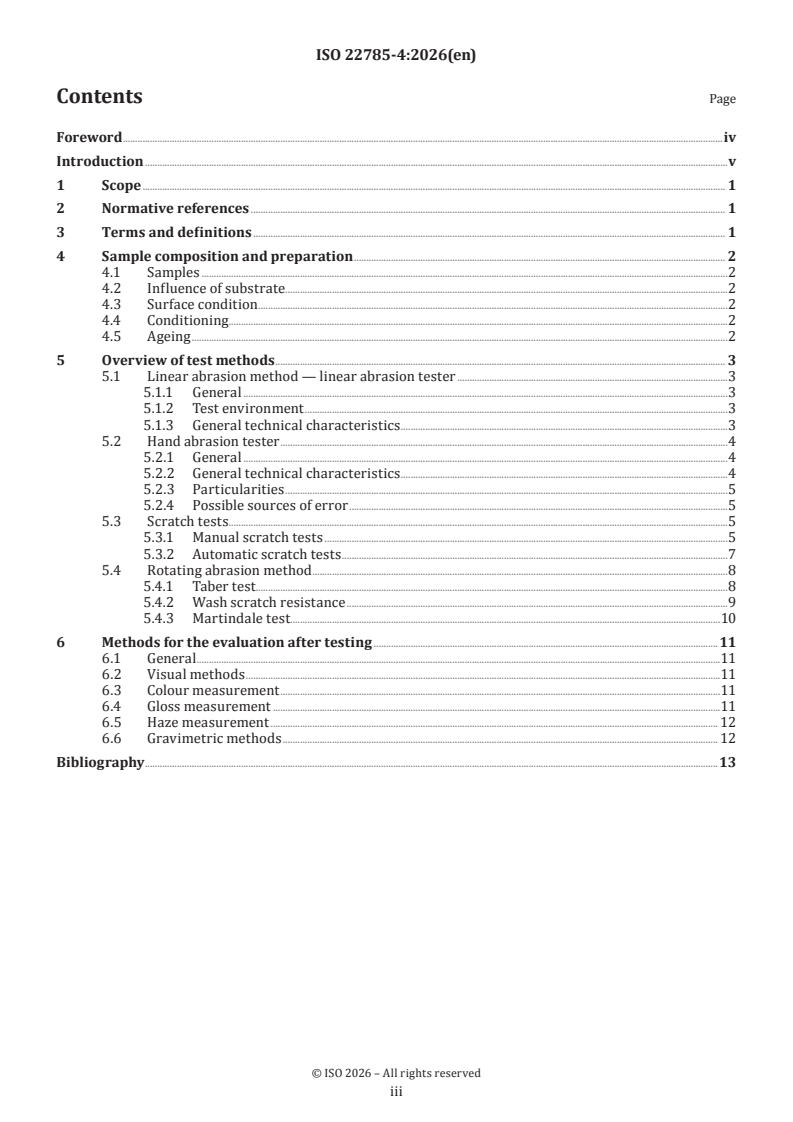
Contents Page
Foreword .iv
Introduction .v
1 Scope . 1
2 Normative references . 1
3 Terms and definitions . 1
4 Sample composition and preparation . 2
4.1 Samples .2
4.2 Influence of substrate.2
4.3 Surface condition .2
4.4 Conditioning.2
4.5 Ageing .2
5 Overview of test methods . 3
5.1 Linear abrasion method — linear abrasion tester .3
5.1.1 General .3
5.1.2 Test environment .3
5.1.3 General technical characteristics .3
5.2 Hand abrasion tester .4
5.2.1 General .4
5.2.2 General technical characteristics .4
5.2.3 Particularities .5
5.2.4 Possible sources of error .5
5.3 Scratch tests .5
5.3.1 Manual scratch tests .5
5.3.2 Automatic scratch tests .7
5.4 Rotating abrasion method .8
5.4.1 Taber test.8
5.4.2 Wash scratch resistance .9
5.4.3 Martindale test.10
6 Methods for the evaluation after testing .11
6.1 General .11
6.2 Visual methods .11
6.3 Colour measurement .11
6.4 Gloss measurement .11
6.5 Haze measurement . 12
6.6 Gravimetric methods . 12
Bibliography .13
iii
Foreword
ISO (the International Organization for Standardization) is a worldwide federation of national standards
bodies (ISO member bodies). The work of preparing International Standards is normally carried out through
ISO technical committees. Each member body interested in a subject for which a technical committee
has been established has the right to be represented on that committee. International organizations,
governmental and non-governmental, in liaison with ISO, also take part in the work. ISO collaborates closely
with the International Electrotechnical Commission (IEC) on all matters of electrotechnical standardization.
The procedures used to develop this document and those intended for its further maintenance are described
in the ISO/IEC Directives, Part 1. In particular, the different approval criteria needed for the different types
of ISO document should be noted. This document was drafted in accordance with the editorial rules of the
ISO/IEC Directives, Part 2 (see www.iso.org/directives).
ISO draws attention to the possibility that the implementation of this document may involve the use of (a)
patent(s). ISO takes no position concerning the evidence, validity or applicability of any claimed patent
rights in respect thereof. As of the date of publication of this document, ISO had not received notice of (a)
patent(s) which may be required to implement this document. However, implementers are cautioned that
this may not represent the latest information, which may be obtained from the patent database available at
www.iso.org/patents. ISO shall not be held responsible for identifying any or all such patent rights.
Any trade name used in this document is information given for the convenience of users and does not
constitute an endorsement.
For an explanation of the voluntary nature of standards, the meaning of ISO specific terms and expressions
related to conformity assessment, as well as information about ISO's adherence to the World Trade
Organization (WTO) principles in the Technical Barriers to Trade (TBT), see www.iso.org/iso/foreword.html.
This document was prepared by Technical Committee ISO/TC 35, Paints and varnishes, Subcommittee SC 9,
General test methods for paints and varnishes.
A list of all parts in the ISO 22785 series can be found on the ISO website.
Any feedback or questions on this document should be directed to the user’s national standards body. A
complete listing of these bodies can be found at www.iso.org/members.html.
iv
Introduction
The ISO 22785 series explains the characteristics of plastics and the differences between plastics substrates
and metallic substrates.
v
International Standard ISO 22785-4:2026(en)
Paints and varnishes — Coatings on plastics and
composites —
Part 4:
Abrasion and scratch testing
1 Scope
This document specifies the abrasion and scratch tests of coatings on plastics, plastics composites, and
similar substrates, hereinafter collectively referred to as plastics.
This document shows the potential effect of plastics on the behaviour of the coating during abrasion and
scratch testing.
2 Normative references
The following documents are referred to in the text in such a way that some or all of their content constitutes
requirements of this document. For dated references, only the edition cited applies. For undated references,
the latest edition of the referenced document (including any amendments) applies.
ISO 4618, Paints and varnishes — Vocabulary
ISO 22785-1, Paints and varnishes — Coatings on plastics and composites — Part 1: General introduction
3 Terms and definitions
For the purposes of this document, the terms and definitions given in ISO 4618, ISO 22785-1 and the
following apply.
ISO and IEC maintain terminology databases for use in standardization at the following addresses:
— ISO Online browsing platform: available at https:// www .iso .org/ obp
— IEC Electropedia: available at https:// www .electropedia .org/
3.1
abrasion resistance
resistance of solid surfaces to mechanical stress, in particular friction
Note 1 to entry: The abrasion resistance is determined by the surface characteristics of the substances involved, such
as roughness and hardness.
3.2
abrasion test
test method which serves for the determination of the abrasion resistance (3.1)
Note 1 to entry: Abrasion can be tested together with various stresses, e.g. media. The stress is normally applied
in parallel and can be applied in different ways. The evaluation is specified respectively, since there are different
evaluation methods (optical change of colour, gloss, transmission/haze, loss of mass).
3.3
surface condition
totality of surface characteristics such as grain, gloss, and roughness
Note 1 to entry: The surface condition has a great influence on the abrasion behaviour.
4 Sample composition and preparation
4.1 Samples
Coatings on specimen plates as specified in ISO 1514 as well as coatings on components are tested. Defects
and damage of all kinds in the substrate affect the appearance and characteristics. The surface shall be
free of any substances that can impair the adhesion of the coating. Likewise, the surface shall be free from
substances sweating out or migrating to the surface over a longer period, potentially due to exposure to
moisture or temperature.
The coating system and the substrate are selected together with the pre-treatment and coating methods so
that a homogeneous coating is achieved. The coating thickness is documented according to the optical or
coating requirement.
Components and samples which are not flat are selected to avoid bending during the test.
4.2 Influence of substrate
The elasticity of the plastics substrate has an influence on the abrasion and scratch resistance of the coating
under test. Typically, the scratch resistance of the coating decreases as the elasticity of the substrate
increases.
4.3 Surface condition
For most abrasion tests, samples with a flat uniform surface are used. Depending on the surface condition or
type of plastic, only certain tests are reasonable.
For retests, the same surface condition of the samples is considered.
4.4 Conditioning
Conditioning serves to increase the repeatability and reproducibility of test results.
The values and times to be selected depend on the material to be tested.
Since the characteristics of plastics substrates strongly depend on humidity and conditioning that usually
takes longer than for metals, a longer conditioning time is normally used for plastics substrates.
Unless otherwise specified, the samples are conditioned for 16 h in the standard climate specified in
ISO 3270.
4.5 Ageing
For some tests and materials, it can be reasonable to use special atmospheres for upstream ageing or drying.
This is shall be documented in the test report.
5 Overview of test methods
5.1 Linear abrasion method — linear abrasion tester
5.1.1 General
By means of a linear abrasion tester as specified in ISO 21546 (see Figure 1), a specified load is applied with
a parallel movement. Testers which can perform a linear back and forth movement (double stroke) with a
suitable friction partner are suitable for the determination of the abrasion resistance. Often the name of
the historically used tester “crockmeter” is used colloquially as the name (“crockmeter test”) for the tests.
There are a variety of testers which are used and reproduce the required conditions.
Key
1 crank mechanism (crank handle)
2 abrasion tool
3 test specimen
a
Direction of stroke motion.
Figure 1 — Crockmeter (example with manual crank mechanism)
5.1.2 Test environment
Carry out the test at a temperature of (23 ± 2) °C. Measure the relative humidity during the test and record
in the test report. In case of high relative humidity, be careful that no condensation water forms on the test
specimen due to falling below the dew point.
Carry out the test as quick as possible, however, not later than 30 min after the conditioning phase.
5.1.3 General technical characteristics
The following adjustable parameters shall be agreed between the interested parties:
— stress (adjustable depending on the device, historically 9 N, additional 1 N to 40 N possible);
— friction path (historically 104 mm, many devices freely adjustable);
— total number of double strokes;
— number of double strokes per time unit;
— friction partner, e.g. cotton fabric, felt, metal, abrasive paper;
— rubbing finger, e.g. rubbing finger A: 16 mm plastic, rubbing finger C: holder for abrasive paper;
— media (dry, wet, cleaning agent, etc.).
Interim assessments are recommended according to internal guidelines.
5.2 Hand abrasion tester
5.2.1 General
These testers simulate hand abrasion by a combination of mechanical and chemical load on the surface.
During this process, a silicone stamp is used to replicate the pliability of the human fingers while the fabric
simulates the roughness and greasiness of the skin. Depending on the requirements, additional media are
used, such as hand sweat and hand cream.
A stamp hits the surface to be tested at a 45° angle (see Figure 2) and runs over it. The supplementary
media, if appropriate, can be applied eit
...