

ISO 17855-1:2014
(Main)Plastics — Polyethylene (PE) moulding and extrusion materials — Part 1: Designation system and basis for specifications
General Information
- Abstract
ISO 17855-1:2014 establishes a system of designation for polyethylene thermoplastic material, which may be used as the basis for specifications. ISO 17855-1:2014 is applicable to all polyethylene homopolymers and to copolymers of ethylene having a content of other 1-olefinic monomers of less than 50 % (mass fraction) and a content of non-olefinic monomers with functional groups up to a maximum of 3 % (mass fraction). ISO 17855-1:2014 applies to materials ready for normal use in the form of powder, granules or pellets, unmodified or modified by colorants, additives, fillers, etc.
- Status
- Published
- Publication Date
- 14-Oct-2014
- Technical Committee
- ISO/TC 61/SC 9 - Thermoplastic materials
- Drafting Committee
- ISO/TC 61/SC 9/WG 6 - Polyolefins
- Current Stage
- 9060 - Close of review
- Completion Date
- 02-Dec-2029
Buy Documents
ISO 17855-1:2014 - Plastics — Polyethylene (PE) moulding and extrusion materials — Part 1: Designation system and basis for specifications Released:10/15/2014
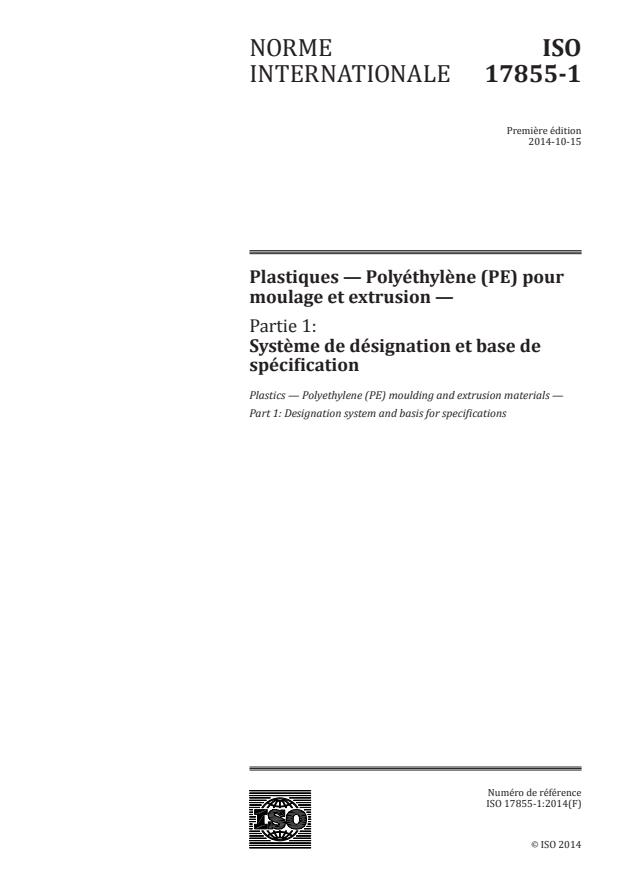
ISO 17855-1:2014 - Plastiques — Polyéthylene (PE) pour moulage et extrusion — Partie 1: Systeme de désignation et base de spécification Released:10/15/2014
Overview
ISO 17855-1:2014 establishes a standardized system for the designation of polyethylene (PE) moulding and extrusion materials. This international standard, developed by ISO, is essential for manufacturers, suppliers, and users of PE thermoplastics who require clear, unambiguous identification and specification of material types. Applicable to all polyethylene homopolymers and most copolymers (excluding some specialized forms), ISO 17855-1:2014 supports quality assurance, procurement, and technical communication across the plastics industry.
Polyethylene, a widely used thermoplastic polymer, is available in various grades and forms, making standardized identification crucial for consistent performance in applications ranging from packaging to piping.
Key Topics
Polyethylene Identification:
The standard covers the classification of polyethylene homopolymers and copolymers based on density and melt mass-flow rate (MFR). It includes materials in powder, granule, or pellet form, whether unmodified or modified with additives, colorants, or fillers.Designation System Structure:
The designation is structured into multiple data blocks, each providing specific and relevant information:- Data Block 1: Polyethylene type symbol (e.g., PE-LD, PE-HD)
- Data Block 2: Filler or reinforcing material codes
- Data Block 3: Intended application and key properties/additives
- Data Block 4: Designatory properties such as density and melt mass-flow rate
- Data Block 5 (optional): Additional requirements for specific applications
Scope Limitations:
The standard does not cover masterbatches, PE-UHMW (ultra-high-molecular-weight polyethylene), or EPM rubber. Reference to ISO 11542-1 is recommended for PE-UHMW materials.Basis for Specifications:
ISO 17855-1:2014 is intended as a framework for developing detailed product specifications, rather than providing engineering or performance data.
Applications
ISO 17855-1:2014 is widely applicable in industries that handle polyethylene moulding and extrusion materials, including:
Material Specification and Procurement:
Provides a uniform system for requesting specific grades of polyethylene for manufacturing and processing.Quality Assurance and Documentation:
Streamlines communication between suppliers and customers, ensuring that technical properties and material types are accurately described in contracts and technical documents.Processing and Manufacturing:
Assists engineers and production teams in selecting appropriate PE materials for applications such as blow moulding, injection moulding, extrusion (films, pipes, profiles), wire and cable jacketing, and coating.Product Development and R&D:
Offers a clear framework for describing new or modified polyethylene materials with specific combinations of density, MFR, colorants, and additives.Regulatory and Compliance Reporting:
Facilitates adherence to international standards for labelling, product traceability, and technical reporting.
Related Standards
For comprehensive implementation and understanding, ISO 17855-1:2014 makes reference to several key related standards:
- ISO 1043-1: Plastics – Symbols and abbreviated terms for basic polymers and characteristics
- ISO 1133-1: Determination of melt mass-flow rate (MFR) and melt volume-flow rate (MVR) of thermoplastics
- ISO 1183 (Parts 1, 2, 3): Methods for determining the density of non-cellular plastics
- ISO 1872-2: Preparation of test specimens and determination of properties for polyethylene moulding and extrusion materials
- ISO 11542-1: Designation and specifications for ultra-high-molecular-weight polyethylene (PE-UHMW)
By following ISO 17855-1:2014, organizations enhance the reliability and consistency of polyethylene material specifications in global markets, supporting efficient product development and high standards of quality in plastics manufacturing.
Relations
- Effective Date
- 25-Aug-2026
- Effective Date
- 25-Aug-2026
- Effective Date
- 25-Aug-2026
- Effective Date
- 25-Aug-2026
- Effective Date
- 12-Feb-2026
- Effective Date
- 06-Jun-2022
- Effective Date
- 12-Nov-2011
Buy Documents
ISO 17855-1:2014 - Plastics — Polyethylene (PE) moulding and extrusion materials — Part 1: Designation system and basis for specifications Released:10/15/2014
ISO 17855-1:2014 - Plastiques — Polyéthylene (PE) pour moulage et extrusion — Partie 1: Systeme de désignation et base de spécification Released:10/15/2014
Get Certified
Connect with accredited certification bodies for this standard

DIN CERTCO
DIN Group product certification.

Smithers Quality Assessments
US management systems and product certification.
Sponsored listings
Frequently Asked Questions
ISO 17855-1:2014 is a standard published by the International Organization for Standardization (ISO). Its full title is "Plastics — Polyethylene (PE) moulding and extrusion materials — Part 1: Designation system and basis for specifications". This standard covers: ISO 17855-1:2014 establishes a system of designation for polyethylene thermoplastic material, which may be used as the basis for specifications. ISO 17855-1:2014 is applicable to all polyethylene homopolymers and to copolymers of ethylene having a content of other 1-olefinic monomers of less than 50 % (mass fraction) and a content of non-olefinic monomers with functional groups up to a maximum of 3 % (mass fraction). ISO 17855-1:2014 applies to materials ready for normal use in the form of powder, granules or pellets, unmodified or modified by colorants, additives, fillers, etc.
ISO 17855-1:2014 establishes a system of designation for polyethylene thermoplastic material, which may be used as the basis for specifications. ISO 17855-1:2014 is applicable to all polyethylene homopolymers and to copolymers of ethylene having a content of other 1-olefinic monomers of less than 50 % (mass fraction) and a content of non-olefinic monomers with functional groups up to a maximum of 3 % (mass fraction). ISO 17855-1:2014 applies to materials ready for normal use in the form of powder, granules or pellets, unmodified or modified by colorants, additives, fillers, etc.
ISO 17855-1:2014 is classified under the following ICS (International Classification for Standards) categories: 83.080.20 - Thermoplastic materials. The ICS classification helps identify the subject area and facilitates finding related standards.
ISO 17855-1:2014 has the following relationships with other standards: It is inter standard links to EN ISO 17855-2:2024, EN ISO 14632:2021, EN ISO 17855-2:2016, EN ISO 15527:2022, EN ISO 17855-1:2014, ISO 14275:2002, ISO 1872-1:1993. Understanding these relationships helps ensure you are using the most current and applicable version of the standard.
ISO 17855-1:2014 is available in PDF format for immediate download after purchase. The document can be added to your cart and obtained through the secure checkout process. Digital delivery ensures instant access to the complete standard document.
Standards Content (Sample)
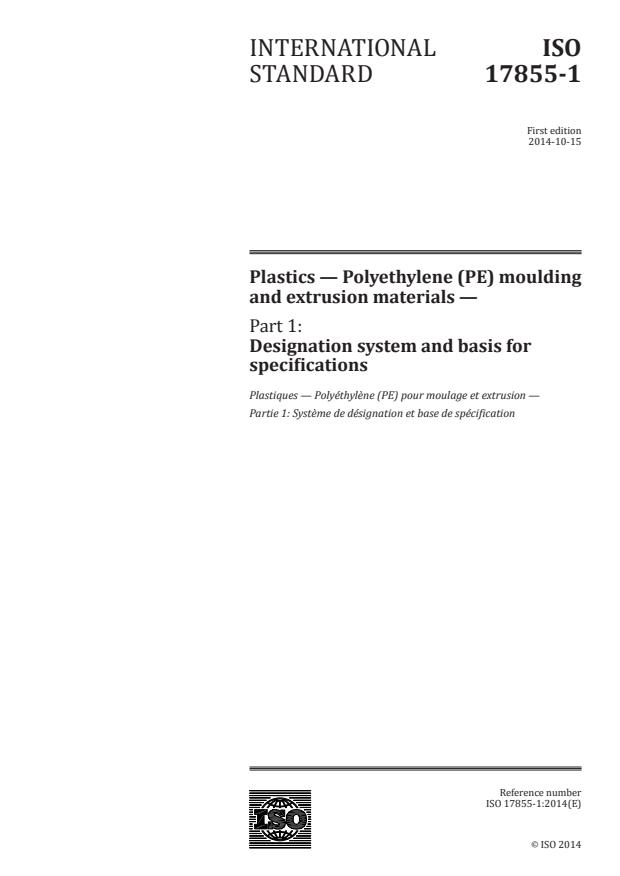
INTERNATIONAL ISO
STANDARD 17855-1
First edition
2014-10-15
Plastics — Polyethylene (PE) moulding
and extrusion materials —
Part 1:
Designation system and basis for
specifications
Plastiques — Polyéthylène (PE) pour moulage et extrusion —
Partie 1: Système de désignation et base de spécification
Reference number
©
ISO 2014
© ISO 2014
All rights reserved. Unless otherwise specified, no part of this publication may be reproduced or utilized otherwise in any form
or by any means, electronic or mechanical, including photocopying, or posting on the internet or an intranet, without prior
written permission. Permission can be requested from either ISO at the address below or ISO’s member body in the country of
the requester.
ISO copyright office
Case postale 56 • CH-1211 Geneva 20
Tel. + 41 22 749 01 11
Fax + 41 22 749 09 47
E-mail copyright@iso.org
Web www.iso.org
Published in Switzerland
ii © ISO 2014 – All rights reserved
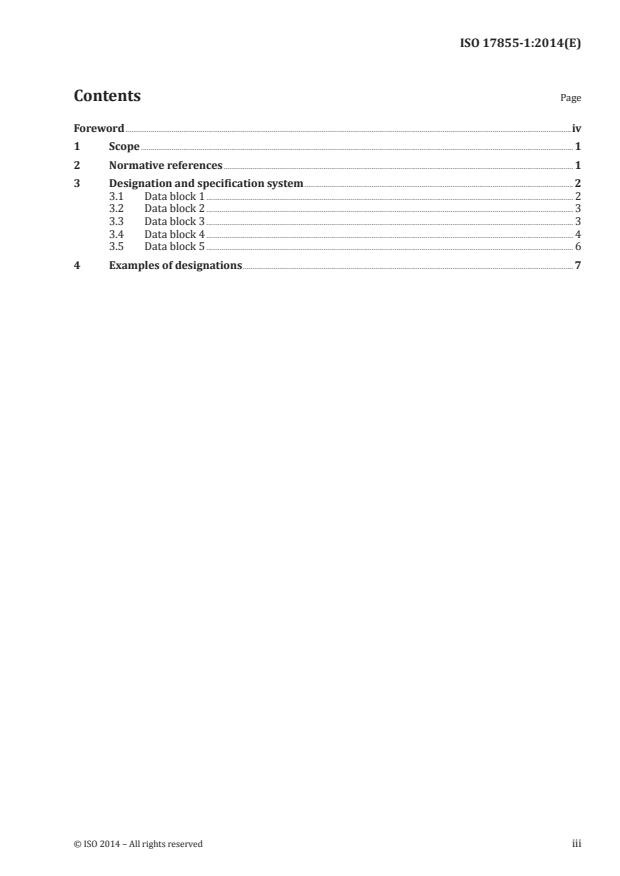
Contents Page
Foreword .iv
1 Scope . 1
2 Normative references . 1
3 Designation and specification system . 2
3.1 Data block 1 . 2
3.2 Data block 2 . 3
3.3 Data block 3 . 3
3.4 Data block 4 . 4
3.5 Data block 5 . 6
4 Examples of designations . 7
Foreword
ISO (the International Organization for Standardization) is a worldwide federation of national standards
bodies (ISO member bodies). The work of preparing International Standards is normally carried out
through ISO technical committees. Each member body interested in a subject for which a technical
committee has been established has the right to be represented on that committee. International
organizations, governmental and non-governmental, in liaison with ISO, also take part in the work.
ISO collaborates closely with the International Electrotechnical Commission (IEC) on all matters of
electrotechnical standardization.
The procedures used to develop this document and those intended for its further maintenance are
described in the ISO/IEC Directives, Part 1. In particular the different approval criteria needed for the
different types of ISO documents should be noted. This document was drafted in accordance with the
editorial rules of the ISO/IEC Directives, Part 2. www.iso.org/directives
Attention is drawn to the possibility that some of the elements of this document may be the subject of
patent rights. ISO shall not be held responsible for identifying any or all such patent rights. Details of any
patent rights identified during the development of the document will be in the Introduction and/or on
the ISO list of patent declarations received. www.iso.org/patents
Any trade name used in this document is information given for the convenience of users and does not
constitute an endorsement.
For an explanation on the meaning of ISO specific terms and expressions related to conformity
assessment, as well as information about ISO’s adherence to the WTO principles in the Technical Barriers
to Trade (TBT), see the following URL: Foreword - Supplementary information
The committee responsible for this document is ISO/TC 61, Plastics, Subcommittee SC 9, Thermoplastic
materials.
This first edition of ISO 17855-1 cancels and replaces ISO 1872-1:1993, which has been technically
revised to introduce a new designation system.
ISO 17855 consists of the following parts, under the general title Plastics — Polyethylene (PE) moulding
and extrusion materials:
— Part 1: Designation system and basis for specifications
— Part 2: Preparation of test specimens and determination of properties
iv © ISO 2014 – All rights reserved
INTERNATIONAL STANDARD ISO 17855-1:2014(E)
Plastics — Polyethylene (PE) moulding and extrusion
materials —
Part 1:
Designation system and basis for specifications
1 Scope
1.1 This part of ISO 17855 establishes a system of designation for polyethylene thermoplastic material,
which may be used as the basis for specifications.
1.2 The types of polyethylene plastics are differentiated from each other by a classification system
based on appropriate levels of the designatory properties
a) density,
b) melt mass-flow rate,
and on information about the intended application and/or method of processing, important properties,
additives, colorants, fillers and reinforcing materials.
1.3 This part of ISO 17855 is applicable to all polyethylene homopolymers and to copolymers of
ethylene having a content of other 1-olefinic monomers of less than 50 % (mass fraction) and a content of
non-olefinic monomers with functional groups up to a maximum of 3 % (mass fraction).
It applies to materials ready for normal use in the form of powder, granules or pellets, unmodified or
modified by colorants, additives, fillers, etc.
This part of ISO 17855 does not apply to masterbatches or to EPM rubber. This part of ISO 17855 also
does not apply to PE-UHMW. It should reference to ISO 11542-1 for PE-UHMW.
1.4 It is not intended to imply that materials having the same designation give necessarily the same
performance. This part of ISO 17855 does not provide engineering data, performance data or data on
processing conditions which may be required to specify a material for a particular application and/or
method of processing.
If such additional properties are required, they shall be determined in accordance with the test methods
specified in ISO 1872-2, if suitable.
1.5 In order to specify a thermoplastic material for a particular application or to ensure reproducible
processing, additional requirements may be given in data block 5 (see Clause 3, introductory paragraph).
2 Normative references
The following documents, in whole or in part, are normatively referenced in this document and are
indispensable for its application. For dated references, only the edition cited applies. For undated
references, the latest edition of the referenced document (including any amendments) applies.
ISO 1043-1, Plastics — Symbols and abbreviated terms — Part 1: Basic polymers and their special
characteristics
ISO 1133-1, Plastics — Determination of the melt mass-flow rate (MFR) and melt volume-flow rate (MVR) of
thermoplastics — Part 1: Standard method
ISO 1183-1, Plastics — Methods for determining the density of non-cellular plastics — Part 1: Immersion
method, liquid pyknometer method and titration method
ISO 1183-2, Plastics — Methods for determining the density of non-cellular plastics — Part 2: Density
gradient column method
ISO 1183-3, Plastics — Methods for determining the density of non-cellular plastics — Part 3: Gas pyknometer
method
ISO 1872-2, Plastics — Polyethylene (PE) moulding and extrusion materials — Part 2: Preparation of test
specimens and determination of properties
ISO 11542-1, Plastics — Ultra-high-molecular-weight polyethylene (PE-UHMW) moulding and extrusion
materials — Part 1: Designation system and basis for specifications
3 Designation and specification system
The designation and specification system for thermoplastics is based on the following standardized
pattern:
Designation
Identity block
Designation International Individual-item block
block (optional) Standard number
Data Data Data Data Data
block
block 1 block 2 block 3 block 4 block 5
The designation consists of an optional description block, reading “Thermoplastics”, and an identity
block comprising the International Standard number and an individual-item block. For unambiguous
designation, the individual-item block is subdivided into five data blocks comprising the following
information:
Data block 1: Identification of the plastic by i
...
NORME ISO
INTERNATIONALE 17855-1
Première édition
2014-10-15
Plastiques — Polyéthylène (PE) pour
moulage et extrusion —
Partie 1:
Système de désignation et base de
spécification
Plastics — Polyethylene (PE) moulding and extrusion materials —
Part 1: Designation system and basis for specifications
Numéro de référence
©
ISO 2014
DOCUMENT PROTÉGÉ PAR COPYRIGHT
© ISO 2014
Droits de reproduction réservés. Sauf indication contraire, aucune partie de cette publication ne peut être reproduite ni utilisée
sous quelque forme que ce soit et par aucun procédé, électronique ou mécanique, y compris la photocopie, l’affichage sur
l’internet ou sur un Intranet, sans autorisation écrite préalable. Les demandes d’autorisation peuvent être adressées à l’ISO à
l’adresse ci-après ou au comité membre de l’ISO dans le pays du demandeur.
ISO copyright office
Case postale 56 • CH-1211 Geneva 20
Tel. + 41 22 749 01 11
Fax + 41 22 749 09 47
E-mail copyright@iso.org
Web www.iso.org
Publié en Suisse
ii © ISO 2014 – Tous droits réservés
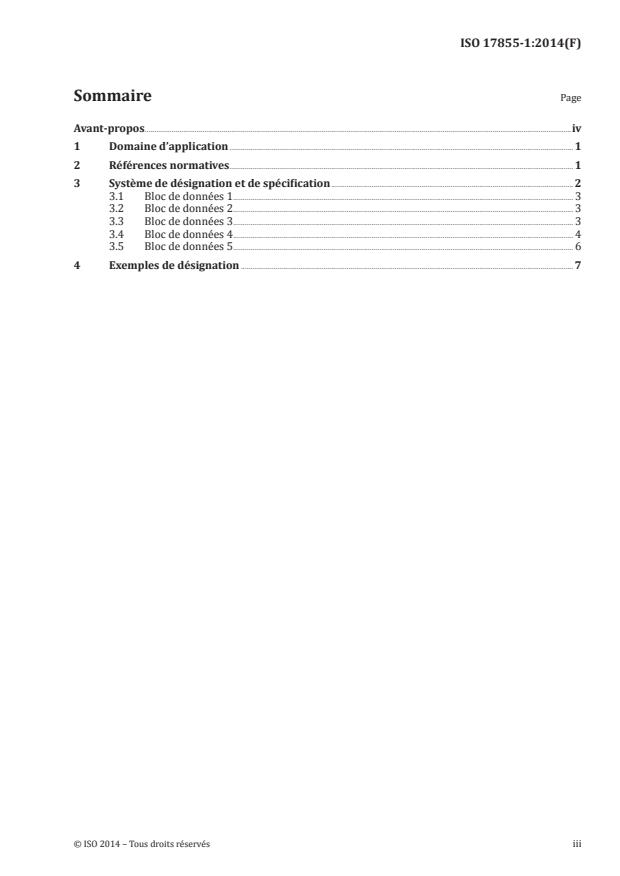
Sommaire Page
Avant-propos .iv
1 Domaine d’application . 1
2 Références normatives . 1
3 Système de désignation et de spécification . 2
3.1 Bloc de données 1 . 3
3.2 Bloc de données 2 . 3
3.3 Bloc de données 3 . 3
3.4 Bloc de données 4 . 4
3.5 Bloc de données 5 . 6
4 Exemples de désignation . 7
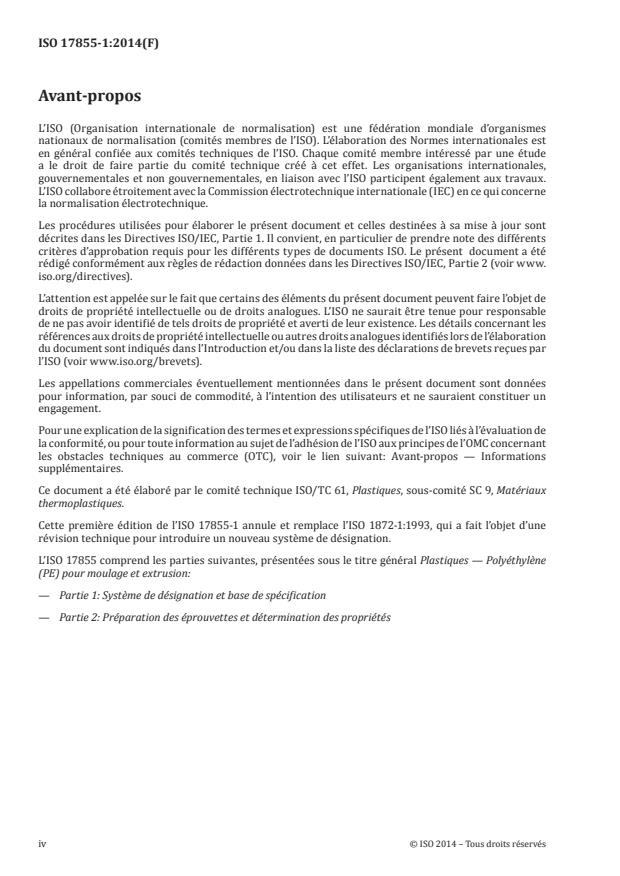
Avant-propos
L’ISO (Organisation internationale de normalisation) est une fédération mondiale d’organismes
nationaux de normalisation (comités membres de l’ISO). L’élaboration des Normes internationales est
en général confiée aux comités techniques de l’ISO. Chaque comité membre intéressé par une étude
a le droit de faire partie du comité technique créé à cet effet. Les organisations internationales,
gouvernementales et non gouvernementales, en liaison avec l’ISO participent également aux travaux.
L’ISO collabore étroitement avec la Commission électrotechnique internationale (IEC) en ce qui concerne
la normalisation électrotechnique.
Les procédures utilisées pour élaborer le présent document et celles destinées à sa mise à jour sont
décrites dans les Directives ISO/IEC, Partie 1. Il convient, en particulier de prendre note des différents
critères d’approbation requis pour les différents types de documents ISO. Le présent document a été
rédigé conformément aux règles de rédaction données dans les Directives ISO/IEC, Partie 2 (voir www.
iso.org/directives).
L’attention est appelée sur le fait que certains des éléments du présent document peuvent faire l’objet de
droits de propriété intellectuelle ou de droits analogues. L’ISO ne saurait être tenue pour responsable
de ne pas avoir identifié de tels droits de propriété et averti de leur existence. Les détails concernant les
références aux droits de propriété intellectuelle ou autres droits analogues identifiés lors de l’élaboration
du document sont indiqués dans l’Introduction et/ou dans la liste des déclarations de brevets reçues par
l’ISO (voir www.iso.org/brevets).
Les appellations commerciales éventuellement mentionnées dans le présent document sont données
pour information, par souci de commodité, à l’intention des utilisateurs et ne sauraient constituer un
engagement.
Pour une explication de la signification des termes et expressions spécifiques de l’ISO liés à l’évaluation de
la conformité, ou pour toute information au sujet de l’adhésion de l’ISO aux principes de l’OMC concernant
les obstacles techniques au commerce (OTC), voir le lien suivant: Avant-propos — Informations
supplémentaires.
Ce document a été élaboré par le comité technique ISO/TC 61, Plastiques, sous-comité SC 9, Matériaux
thermoplastiques.
Cette première édition de l’ISO 17855-1 annule et remplace l’ISO 1872-1:1993, qui a fait l’objet d’une
révision technique pour introduire un nouveau système de désignation.
L’ISO 17855 comprend les parties suivantes, présentées sous le titre général Plastiques — Polyéthylène
(PE) pour moulage et extrusion:
— Partie 1: Système de désignation et base de spécification
— Partie 2: Préparation des éprouvettes et détermination des propriétés
iv © ISO 2014 – Tous droits réservés
NORME INTERNATIONALE ISO 17855-1:2014(F)
Plastiques — Polyéthylène (PE) pour moulage et
extrusion —
Partie 1:
Système de désignation et base de spécification
1 Domaine d’application
1.1 La présente partie de l’ISO 17855 établit un système de désignation des matériaux thermoplastiques
polyéthylène qui peut être utilisé comme base pour les spécifications.
1.2 Les types de plastiques polyéthylène sont différenciés les uns des autres par un système de
classification basé sur des niveaux appropriés des propriétés de désignation
a) masse volumique
b) indice de fluidité à chaud en masse
et des informations concernant l’application prévue et/ou la méthode de mise en œuvre, les propriétés
importantes, les additifs, colorants, charges et matériaux de renfort.
1.3 La présente partie de l’ISO 17855 est applicable à tous les homopolymères polyéthylène et aux
copolymères de l’éthylène ayant une teneur en autres monomères 1-oléfiniques inférieure à 50 % (m/m)
et une teneur maximale de 3 % (m/m) en monomères non oléfiniques ayant des groupes fonctionnels.
Elle s’applique aux matériaux prêts à l’emploi sous forme de poudres, grains ou granulés, non modifiés
ou modifiés par des colorants, additifs, charges, etc.
La présente partie de l’ISO 17855 ne s’applique ni aux mélanges-maîtres, ni au caoutchouc EPM. Elle ne
s’applique pas non plus au PE-UHMW. Il convient de se référer à l’ISO 11542-1 pour le PE-UHMW.
1.4 Le fait que des matériaux aient la même désignation n’implique pas qu’ils présentent nécessairement
les mêmes performances. La présente partie de l’ISO 17855 ne comporte pas de données sur la conception,
la performance ou les conditions de mise en œuvre qui peuvent être exigées pour spécifier un matériau
pour une application et/ou une méthode de mise en œuvre particulière.
Si de telles caractéristiques supplémentaires sont nécessaires, elles doivent être déterminées
conformément aux méthodes d’essai spécifiées dans l’ISO 1872-2, le cas échéant.
1.5 Afin de prescrire un matériau thermoplastique pour une application particulière ou d’assurer une
méthode de mise en œuvre reproductible, des exigences additionnelles peuvent être codées dans le bloc
de données 5 (voir l’Article 3, alinéas d’introduction).
2 Références normatives
Les documents suivants, en tout ou partie, sont référencés de manière normative dans le présent
document et sont indispensables pour son application. Pour les références datées, seule l’édition citée
s’applique. Pour les références non datées, la dernière édition du document de référence s’applique (y
compris les éventuels amendements).
ISO 1043-1, Plastiques — Symboles et termes abrégés — Partie 1: polymères de base et leurs caractéristiques
spéciales
ISO 1133-1, Plastiques — Détermination de l’indice de fluidité à chaud des thermoplastiques, en masse
(MFR) et en volume (MVR) — Partie 1: méthode normale
ISO 1183-1, Plastiques — Méthodes de détermination de la masse volumique des plastiques non alvéolaires —
Partie 1: méthode par immersion, méthode du pycnomètre en milieu liquide et méthode par titrage
ISO 1183-2, Plastiques — Méthodes de détermination de la masse volumique des plastiques non alvéolaires —
Partie 2: méthode de la colonne à gradient de masse volumique
ISO 1183-3, Plastiques — Méthodes pour déterminer la masse volumique des plastiques non alvéolaires —
Partie 3: méthode utilisant un pycnomètre à gaz
ISO 1872-2, Plastiques — Polyéthylène (PE) pour moulage et extrusion — Partie 2: préparation des
éprouvettes et détermination des propriétés
ISO 11542-1, Plastiques — Matériaux à base de polyéthylène à très haute masse moléculaire (PE-UHMW)
pour moulage et extrusion — Partie 1: système de désignation et basse de spécifications
3 Système de désignation et de spécification
Le système de désignation et de spécification des thermoplastiques est basé sur le modèle normalisé
suivant:
Désignation
Bloc d’identification
Bloc descripteur Bloc «Objet particulier»
Bloc «numéro de
(facultatif)
Bloc de Bloc de Bloc de Bloc de Bloc de
Norme internationale»
données 1 données 2 données 3 données 4 données 5
La désignation consiste en un bloc descripteur facultatif, intitulé «thermoplastiques», un bloc
d’identification comprenant le numéro de la Norme internationale et un bloc «objet particulier». Pour une
désignation non ambiguë, le bloc «objet particulier» est subdivisé en cinq blocs de données, comprenant
les informations suivantes:
Bloc de données 1: Identification du plastique par son symbole PE-VLD, PE-LD, PE-LLD, PE-MD ou
PE-HD selon l’ISO 1043-1 (voir 3.1).
Bloc de données 2: Charges ou matériaux de renforcement et leur teneur nominale (voir 3.2).
Bloc de données 3: Position 1: Application prévue ou méthode de mise en œuvre (voir 3.3
...