

ISO 294-5:2026
(Main)Plastics — Injection moulding of test specimens of thermoplastic materials — Part 5: Preparation of standard specimens for investigating anisotropy
General Information
- Abstract
This document specifies a mould (designated the type F ISO mould) for the injection moulding of plates with a preferred size of 80 mm × 120 mm, and a preferred thickness of 2 mm for single-point and multi-point data acquisition. Suitable test specimens according to ISO 20753 type A22 or B3 are then machined or stamped from the plates and used to obtain information on the anisotropy. For the design of plastic parts, this will provide upper and lower bounds for the tensile properties. Investigation of the anisotropy of materials is a special procedure intended to provide guidance in the design of mouldings for end-use applications and is not intended as a quality control tool. In the injection moulding of thermoplastic materials, the flow of molten polymer can influence the orientation of fillers such as fibreglass or the orientation of polymer chains, resulting in anisotropic behaviour. For the purposes of this document, the flow direction is defined as the direction from the gate to the far end of the mould cavity and the cross direction as the direction perpendicular to the flow direction. The type F mould is not intended to replace the type D mould used to determine the moulding shrinkage of thermoplastics.
- Status
- Published
- Publication Date
- 18-Jan-2026
- Technical Committee
- ISO/TC 61/SC 9 - Thermoplastic materials
- Drafting Committee
- ISO/TC 61/SC 9 - Thermoplastic materials
- Current Stage
- 6060 - International Standard published
- Start Date
- 19-Jan-2026
- Due Date
- 19-Sep-2025
- Completion Date
- 19-Jan-2026
Buy Documents
ISO 294-5:2026 - Plastics — Injection moulding of test specimens of thermoplastic materials — Part 5: Preparation of standard specimens for investigating anisotropy Released:19. 01. 2026
ISO 294-5:2026 - Plastiques — Moulage par injection des éprouvettes de matériaux thermoplastiques — Partie 5: Préparation d'éprouvettes normalisées pour déterminer l'anisotropie Released:19. 01. 2026
Overview
ISO 294-5:2026 is an international standard developed by ISO for the plastics industry, focusing on the injection moulding of test specimens of thermoplastic materials. Part 5 of this series specifies the method for preparing standardized specimens used to investigate the anisotropy of these materials. Anisotropy, which refers to direction-dependent material properties, is a critical consideration for engineers and designers when developing plastic components for end-use applications. This document describes the use of the type F ISO mould to produce plate specimens with preferred dimensions and guides the extraction of specific test samples for the measurement and analysis of anisotropic properties.
Key Topics
- Type F ISO Mould: The standard defines a two-cavity injection mould designed to produce plates sized 120 mm x 80 mm, with a preferred thickness of 2 mm. These dimensions optimize fibre or polymer chain alignment during processing, yielding plates with pronounced anisotropy for reliable comparative data.
- Test Specimen Preparation: After moulding, test specimens aligned both in the flow and cross-flow directions are machined or stamped from the plates according to ISO 20753 (type A22 or B3). Accurate preparation is crucial for assessing anisotropic characteristics.
- Influence of Injection Parameters: The standard highlights the significant impact of injection velocity and plate thickness on fibre alignment and the resulting material properties. Slower injection rates and thinner plates tend to increase anisotropic behaviour.
- Purpose of Investigation: The procedures outlined are specifically meant to guide design decisions by providing upper and lower bounds for tensile properties in different directions. They are not intended for routine quality control of thermoplastics.
- Reporting Requirements: Complete documentation of moulding conditions, material details, and specimen preparation is mandated to ensure repeatability and transparency.
Applications
ISO 294-5:2026 is widely used in the plastics industry for:
- Material Characterization: Enabling accurate assessment of the directional dependence of mechanical properties, such as tensile strength and modulus, critical in applications where loading direction varies.
- Product Design Optimization: Providing essential data on how reinforcement fillers (e.g., glass fibers) and polymer chain orientation affect performance, informing engineers during the design of safety-critical or load-bearing plastic components.
- Research and Development: Supporting material selection, design simulations, and the development of new thermoplastic compounds by supplying consistent, industry-accepted preparation and testing methods.
- Comparative Testing: Allowing manufacturers and researchers to benchmark materials from different suppliers or formulations under standardized conditions.
Related Standards
ISO 294-5:2026 is part of a comprehensive framework of international standards for plastics testing. Key related standards include:
- ISO 294-1:2017 – Plastics - Injection moulding of test specimens of thermoplastic materials - Part 1: General principles and moulding of multipurpose and bar test specimens.
- ISO 20753 – Plastics - Test specimens, providing a range of standardized specimen geometries.
- ISO 2818 – Plastics - Preparation of test specimens by machining.
These documents, when used alongside ISO 294-5, enable a holistic and rigorous approach to plastic material testing and evaluation.
By adhering to ISO 294-5:2026, professionals in plastics engineering gain accurate insight into the anisotropic properties of thermoplastic materials, allowing for more reliable design and enhanced product performance across various industrial sectors.
Relations
- Effective Date
- 12-Feb-2026
- Consolidates
ISO 4134:2021 - Meat and meat products — Determination of L-(+)-glutamic acid content — Reference method - Effective Date
- 03-Dec-2022
- Effective Date
- 22-Oct-2022
Buy Documents
ISO 294-5:2026 - Plastics — Injection moulding of test specimens of thermoplastic materials — Part 5: Preparation of standard specimens for investigating anisotropy Released:19. 01. 2026
ISO 294-5:2026 - Plastiques — Moulage par injection des éprouvettes de matériaux thermoplastiques — Partie 5: Préparation d'éprouvettes normalisées pour déterminer l'anisotropie Released:19. 01. 2026
Get Certified
Connect with accredited certification bodies for this standard

DIN CERTCO
DIN Group product certification.

Smithers Quality Assessments
US management systems and product certification.
Sponsored listings
Frequently Asked Questions
ISO 294-5:2026 is a standard published by the International Organization for Standardization (ISO). Its full title is "Plastics — Injection moulding of test specimens of thermoplastic materials — Part 5: Preparation of standard specimens for investigating anisotropy". This standard covers: This document specifies a mould (designated the type F ISO mould) for the injection moulding of plates with a preferred size of 80 mm × 120 mm, and a preferred thickness of 2 mm for single-point and multi-point data acquisition. Suitable test specimens according to ISO 20753 type A22 or B3 are then machined or stamped from the plates and used to obtain information on the anisotropy. For the design of plastic parts, this will provide upper and lower bounds for the tensile properties. Investigation of the anisotropy of materials is a special procedure intended to provide guidance in the design of mouldings for end-use applications and is not intended as a quality control tool. In the injection moulding of thermoplastic materials, the flow of molten polymer can influence the orientation of fillers such as fibreglass or the orientation of polymer chains, resulting in anisotropic behaviour. For the purposes of this document, the flow direction is defined as the direction from the gate to the far end of the mould cavity and the cross direction as the direction perpendicular to the flow direction. The type F mould is not intended to replace the type D mould used to determine the moulding shrinkage of thermoplastics.
This document specifies a mould (designated the type F ISO mould) for the injection moulding of plates with a preferred size of 80 mm × 120 mm, and a preferred thickness of 2 mm for single-point and multi-point data acquisition. Suitable test specimens according to ISO 20753 type A22 or B3 are then machined or stamped from the plates and used to obtain information on the anisotropy. For the design of plastic parts, this will provide upper and lower bounds for the tensile properties. Investigation of the anisotropy of materials is a special procedure intended to provide guidance in the design of mouldings for end-use applications and is not intended as a quality control tool. In the injection moulding of thermoplastic materials, the flow of molten polymer can influence the orientation of fillers such as fibreglass or the orientation of polymer chains, resulting in anisotropic behaviour. For the purposes of this document, the flow direction is defined as the direction from the gate to the far end of the mould cavity and the cross direction as the direction perpendicular to the flow direction. The type F mould is not intended to replace the type D mould used to determine the moulding shrinkage of thermoplastics.
ISO 294-5:2026 is classified under the following ICS (International Classification for Standards) categories: 83.080.20 - Thermoplastic materials. The ICS classification helps identify the subject area and facilitates finding related standards.
ISO 294-5:2026 has the following relationships with other standards: It is inter standard links to EN ISO 294-5:2026, ISO 4134:2021, ISO 294-5:2017. Understanding these relationships helps ensure you are using the most current and applicable version of the standard.
ISO 294-5:2026 is available in PDF format for immediate download after purchase. The document can be added to your cart and obtained through the secure checkout process. Digital delivery ensures instant access to the complete standard document.
Standards Content (Sample)
International
Standard
ISO 294-5
Fourth edition
Plastics — Injection moulding of
2026-01
test specimens of thermoplastic
materials —
Part 5:
Preparation of standard specimens
for investigating anisotropy
Plastiques — Moulage par injection des éprouvettes de matériaux
thermoplastiques —
Partie 5: Préparation d'éprouvettes normalisées pour déterminer
l'anisotropie
Reference number
© ISO 2026
All rights reserved. Unless otherwise specified, or required in the context of its implementation, no part of this publication may
be reproduced or utilized otherwise in any form or by any means, electronic or mechanical, including photocopying, or posting on
the internet or an intranet, without prior written permission. Permission can be requested from either ISO at the address below
or ISO’s member body in the country of the requester.
ISO copyright office
CP 401 • Ch. de Blandonnet 8
CH-1214 Vernier, Geneva
Phone: +41 22 749 01 11
Email: copyright@iso.org
Website: www.iso.org
Published in Switzerland
ii
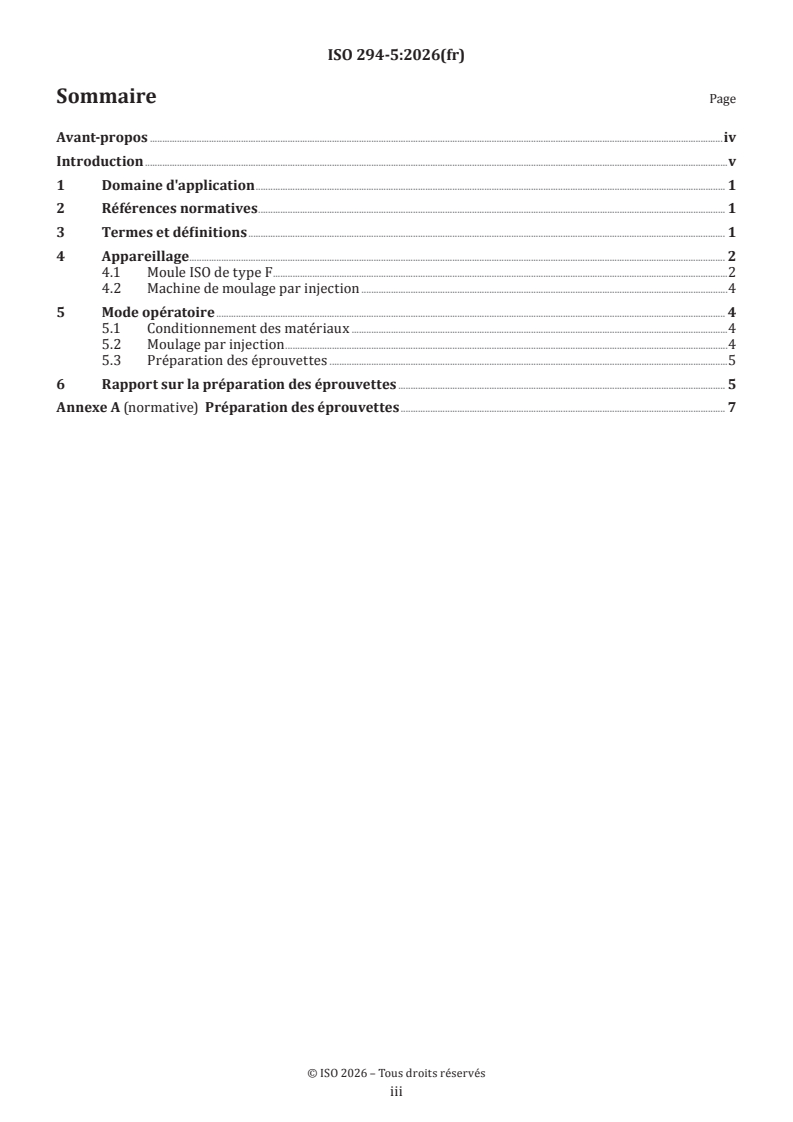
Contents Page
Foreword .iv
Introduction .v
1 Scope . 1
2 Normative references . 1
3 Terms and definitions . 1
4 Apparatus . 2
4.1 Type F ISO mould .2
4.2 Injection-moulding machine .4
5 Procedure . 4
5.1 Conditioning of material .4
5.2 Injection moulding .4
5.3 Preparation of test specimen . .5
6 Report on test specimen preparation . 5
Annex A (normative) Preparation of test specimens . 6
iii
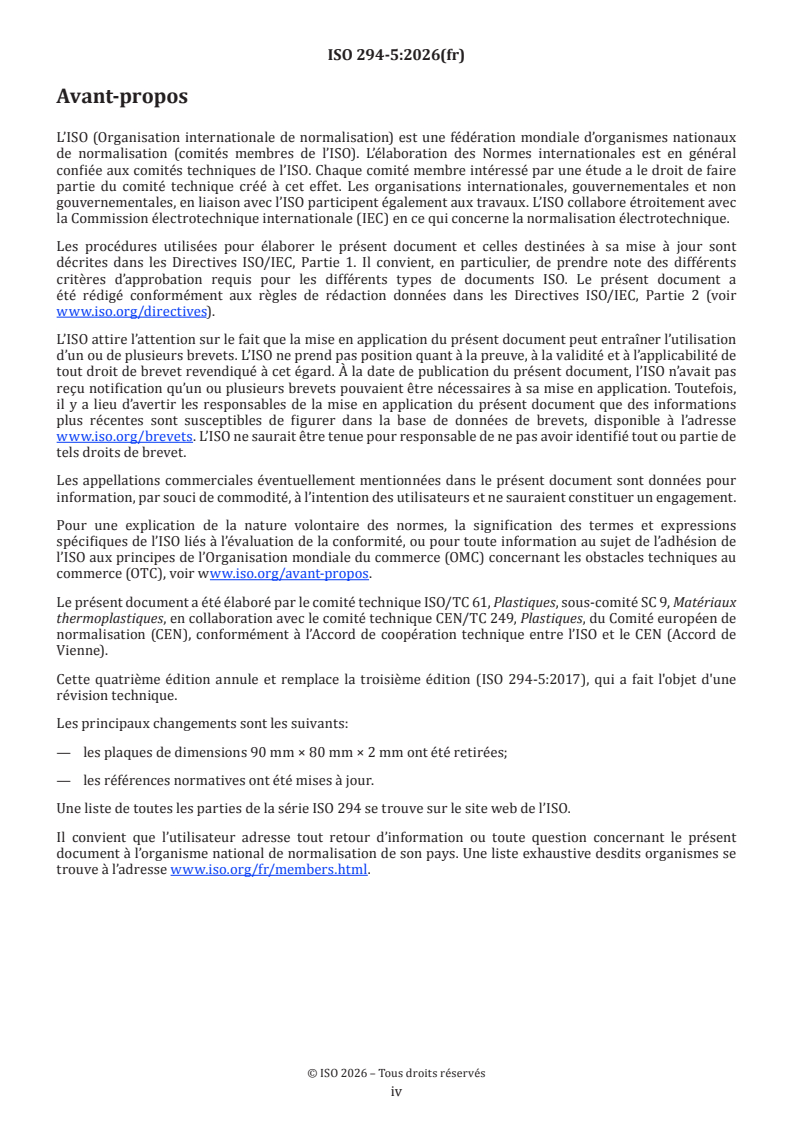
Foreword
ISO (the International Organization for Standardization) is a worldwide federation of national standards
bodies (ISO member bodies). The work of preparing International Standards is normally carried out through
ISO technical committees. Each member body interested in a subject for which a technical committee
has been established has the right to be represented on that committee. International organizations,
governmental and non-governmental, in liaison with ISO, also take part in the work. ISO collaborates closely
with the International Electrotechnical Commission (IEC) on all matters of electrotechnical standardization.
The procedures used to develop this document and those intended for its further maintenance are described
in the ISO/IEC Directives, Part 1. In particular, the different approval criteria needed for the different types
of ISO document should be noted. This document was drafted in accordance with the editorial rules of the
ISO/IEC Directives, Part 2 (see www.iso.org/directives).
ISO draws attention to the possibility that the implementation of this document may involve the use of (a)
patent(s). ISO takes no position concerning the evidence, validity or applicability of any claimed patent
rights in respect thereof. As of the date of publication of this document, ISO had not received notice of (a)
patent(s) which may be required to implement this document. However, implementers are cautioned that
this may not represent the latest information, which may be obtained from the patent database available at
www.iso.org/patents. ISO shall not be held responsible for identifying any or all such patent rights.
Any trade name used in this document is information given for the convenience of users and does not
constitute an endorsement.
For an explanation of the voluntary nature of standards, the meaning of ISO specific terms and expressions
related to conformity assessment, as well as information about ISO's adherence to the World Trade
Organization (WTO) principles in the Technical Barriers to Trade (TBT), see www.iso.org/iso/foreword.html.
This document was prepared by Technical Committee ISO/TC 61, Plastics, Subcommittee SC 9, Thermoplastic
materials, in collaboration with the European Committee for Standardization (CEN) Technical Committee
CEN/TC 249, Plastics, in accordance with the Agreement on technical cooperation between ISO and CEN
(Vienna Agreement).
This fourth edition cancels and replaces the third edition (ISO 294-5:2017), which has been technically
revised.
The main changes are as follows:
— size 90 mm × 80 mm × 2 mm plates have been removed;
— the normative references have been updated.
A list of all parts in the ISO 294 series can be found on the ISO website.
Any feedback or questions on this document should be directed to the user’s national standards body. A
complete listing of these bodies can be found at www.iso.org/members.html.
iv
Introduction
Reinforced and self-reinforcing injection-mouldable thermoplastics are used in a wide variety of applications,
some of which can be safety-related. During the injection-moulding process, reinforcement fibres can
preferentially align with the flow of the molten material and not across the flow direction. This preferential
alignment causes an imbalance in the properties of the moulded thermoplastic so that, in the flow direction,
the alignment of the reinforcing fibres causes a higher strength and stiffness than in the cross direction
with fewer aligned fibres. This difference in properties is termed anisotropy and it can result in an injection-
moulded component having less than the desired or designed strength. To aid designers in understanding
the potential strength of an injection-moulded component, it is desirable to know about the anisotropy of an
injection-moulded component.
During the development of this document, it was found that injection-moulded test specimens do not exhibit
the same fibre alignment across their thickness, but that the outer layers have fibres preferentially aligned
in the mould filling direction while the core has randomly oriented fibres (i.e. no preferential alignment).
The ratio of the cross-sectional area of aligned-fibre orientation (i.e. “skin” layer thickness) to that of
random-fibre orientation (i.e. “core” thickness) is affected by the specimen thickness and the mould filling
rate, i.e. the average injection velocity. Thicker specimens exhibit a lower proportion of aligned fibres than
do thinner specimens. Slower mould fill speeds lead to thicker “skin” layers with aligned fibres. As a result,
to obtain meaningful data on a particular design of moulding, an investigator should prepare specimens
with the maximum anisotropic properties, as this data will best represent the upper and lower bounds of a
composite structure. Since the specimen thickness and injection velocity have a significant influence on the
final anisotropy, this document should only be used for determining information that is useful in designing
mouldings and not as a quality control test for the plastic material itself.
A survey of more than 10 raw material suppliers worldwide carried out from 2010 to 2013 clearly indicated
that the preparation of plates which provide a suitable degree of anisotropy requires plates with non-square
shape to ensure a fibre orientation in flow direction. Under the conditions of this study, the highest degree of
anisotropy was obtained using a plate with dimensions 120 mm × 80 mm × 2 mm. It can be considered that
plates longer than 120 mm will show at least as good results. Square plates (e.g. 80 mm × 80 mm × 2 mm or
even 150 mm × 150 mm × 2 mm) resulted in problems sometimes independent of the size. Within this study,
the plate with size 90 mm × 80 mm × 2 mm as required in the previous edition of this document did not
perform well in any case and was removed from this document.
v
International Standard ISO 294-5:2026(en)
Plastics — Injection moulding of test specimens of
thermo
...
Norme
internationale
ISO 294-5
Quatrième édition
Plastiques — Moulage par injection
2026-01
des éprouvettes de matériaux
thermoplastiques —
Partie 5:
Préparation d'éprouvettes
normalisées pour déterminer
l'anisotropie
Plastics — Injection moulding of test specimens of thermoplastic
materials —
Part 5: Preparation of standard specimens for investigating
anisotropy
Numéro de référence
DOCUMENT PROTÉGÉ PAR COPYRIGHT
© ISO 2026
Tous droits réservés. Sauf prescription différente ou nécessité dans le contexte de sa mise en œuvre, aucune partie de cette
publication ne peut être reproduite ni utilisée sous quelque forme que ce soit et par aucun procédé, électronique ou mécanique,
y compris la photocopie, ou la diffusion sur l’internet ou sur un intranet, sans autorisation écrite préalable. Une autorisation peut
être demandée à l’ISO à l’adresse ci-après ou au comité membre de l’ISO dans le pays du demandeur.
ISO copyright office
Case postale 401 • Ch. de Blandonnet 8
CH-1214 Vernier, Genève
Tél.: +41 22 749 01 11
E-mail: copyright@iso.org
Web: www.iso.org
Publié en Suisse
ii
Sommaire Page
Avant-propos .iv
Introduction .v
1 Domaine d'application . 1
2 Références normatives . 1
3 Termes et définitions . 1
4 Appareillage . 2
4.1 Moule ISO de type F .2
4.2 Machine de moulage par injection .4
5 Mode opératoire . 4
5.1 Conditionnement des matériaux .4
5.2 Moulage par injection .4
5.3 Préparation des éprouvettes .5
6 Rapport sur la préparation des éprouvettes . 5
Annexe A (normative) Préparation des éprouvettes . 7
iii
Avant-propos
L’ISO (Organisation internationale de normalisation) est une fédération mondiale d’organismes nationaux
de normalisation (comités membres de l’ISO). L’élaboration des Normes internationales est en général
confiée aux comités techniques de l’ISO. Chaque comité membre intéressé par une étude a le droit de faire
partie du comité technique créé à cet effet. Les organisations internationales, gouvernementales et non
gouvernementales, en liaison avec l’ISO participent également aux travaux. L’ISO collabore étroitement avec
la Commission électrotechnique internationale (IEC) en ce qui concerne la normalisation électrotechnique.
Les procédures utilisées pour élaborer le présent document et celles destinées à sa mise à jour sont
décrites dans les Directives ISO/IEC, Partie 1. Il convient, en particulier, de prendre note des différents
critères d’approbation requis pour les différents types de documents ISO. Le présent document a
été rédigé conformément aux règles de rédaction données dans les Directives ISO/IEC, Partie 2 (voir
www.iso.org/directives).
L’ISO attire l’attention sur le fait que la mise en application du présent document peut entraîner l’utilisation
d’un ou de plusieurs brevets. L’ISO ne prend pas position quant à la preuve, à la validité et à l’applicabilité de
tout droit de brevet revendiqué à cet égard. À la date de publication du présent document, l’ISO n’avait pas
reçu notification qu’un ou plusieurs brevets pouvaient être nécessaires à sa mise en application. Toutefois,
il y a lieu d’avertir les responsables de la mise en application du présent document que des informations
plus récentes sont susceptibles de figurer dans la base de données de brevets, disponible à l’adresse
www.iso.org/brevets. L’ISO ne saurait être tenue pour responsable de ne pas avoir identifié tout ou partie de
tels droits de brevet.
Les appellations commerciales éventuellement mentionnées dans le présent document sont données pour
information, par souci de commodité, à l’intention des utilisateurs et ne sauraient constituer un engagement.
Pour une explication de la nature volontaire des normes, la signification des termes et expressions
spécifiques de l’ISO liés à l’évaluation de la conformité, ou pour toute information au sujet de l’adhésion de
l’ISO aux principes de l’Organisation mondiale du commerce (OMC) concernant les obstacles techniques au
commerce (OTC), voir www.iso.org/avant-propos.
Le présent document a été élaboré par le comité technique ISO/TC 61, Plastiques, sous-comité SC 9, Matériaux
thermoplastiques, en collaboration avec le comité technique CEN/TC 249, Plastiques, du Comité européen de
normalisation (CEN), conformément à l’Accord de coopération technique entre l’ISO et le CEN (Accord de
Vienne).
Cette quatrième édition annule et remplace la troisième édition (ISO 294-5:2017), qui a fait l'objet d'une
révision technique.
Les principaux changements sont les suivants:
— les plaques de dimensions 90 mm × 80 mm × 2 mm ont été retirées;
— les références normatives ont été mises à jour.
Une liste de toutes les parties de la série ISO 294 se trouve sur le site web de l’ISO.
Il convient que l’utilisateur adresse tout retour d’information ou toute question concernant le présent
document à l’organisme national de normalisation de son pays. Une liste exhaustive desdits organismes se
trouve à l’adresse www.iso.org/fr/members.html.
iv
Introduction
Les thermoplastiques renforcés et à auto-renforcement pouvant être moulés par injection sont utilisés
dans une grande variété d'applications dont certaines peuvent être liées à la sécurité. Pendant le processus
de moulage par injection, les fibres de renfort peuvent avoir tendance à s'aligner dans la direction du flux
de la matière fondue et non pas perpendiculairement à celui-ci. Cet alignement préférentiel engendre un
déséquilibre des propriétés du thermoplastique moulé de sorte que dans la direction du flux, l'alignement des
fibres de renfort entraîne une rigidité et une résistance supérieures à celles obtenues dans le sens transversal
avec des fibres disposées aléatoirement. Cette variation des propriétés est dénommée anisotropie. Ainsi, un
objet moulé par injection peut présenter une résistance inférieure à la résistance voulue ou conçue. Pour
aider les concepteurs à comprendre la résistance potentielle d'un objet moulé par injection, il est souhaitable
de connaître l'anisotropie d'un objet moulé par injection.
Au cours de l'élaboration du présent document, il a été établi que les éprouvettes moulées par injection ne
présentent pas le même alignement de fibres dans le sens de l'épaisseur de l'éprouvette, mais que les couches
extérieures présentent un alignement préférentiel des fibres dans la direction du flux, alors que le milieu
est constitué de fibres orientées aléatoirement (c'est-à-dire absence d'alignement préférentiel). Le rapport
de la quantité de fibres alignées (épaisseur de la peau) à celle des fibres alignées aléatoirement (épaisseur
au milieu) est influencé par l'épaisseur de l'éprouvette et la vitesse de remplissage du moule, c'est-à-dire la
vitesse moyenne d'injection. Les éprouvettes épaisses présentent un rapport de fibres alignées plus faible
que les éprouvettes minces. De faibles vitesses de remplissage du moule induisent de fortes couches de
peau à fibres alignées. En conséquence, pour obtenir des données significatives sur un procédé de moulage
particulier, il convient de préparer des éprouvettes possédant des propriétés anisotropes maximales, ces
données étant la meilleure représentation des limites inférieures et supérieures d'une structure composite.
Étant donné que l'épaisseur de l'éprouvette et la vitesse d'injection ont une influence significative sur
l'anisotropie finale, il convient de n'utiliser le présent document que pour déterminer des informations utiles
pour la conception des pièces moulées et non dans le cadre d'un essai de contrôle de la qualité des matériaux
plastiques.
Une étude au plan mondial de plus de dix fournisseurs de matériau effectuée entre 2010 et 2013 montre
clairement que la préparation des plaques avec un degré approprié d'anisotropie nécessite des plaques
de forme non carrée pour garantir une orientation des fibres dans la direction de l'écoulement. Selon les
conditions de cette étude, le degré d'anisotropie le plus élevé a été obtenu dans une plaque de dimensions
120 mm × 80 mm × 2 mm. Il peut être considéré que des plaques de longueur supérieure à 120 mm présenteront
au minimum des résultats équivalents. Des plaques carrées (par exemple 80 mm × 80 mm × 2 mm ou même
150 mm × 150 mm × 2 mm) ont occasionné parfois des problèmes indépendamment de leurs dimensions.
Selon cette étude, les plaques de dimensions 90 mm × 80 mm × 2 mm, comme exigé dans l'édition précédente
du présent document ne se sont pas bien comportés dans tous les cas et ont été retirées du présent document.
v
Norme internationale ISO 294-5:2026(fr)
Plastiques — Moulage par injection des éprouvettes de
matériaux thermoplastiques —
Partie 5:
Préparation d'éprouvettes normalisées pour déterminer
l'anisotropie
1 Domaine d'application
Le présent document spécifie un moule (appelé moule ISO de type F) pour le moulage par injection de
plaques avec des dimensions préférentielles de 80 mm × 120 mm ayant une épaisseur préférentielle de 2 mm
pour l'acquisition des caractéristiques intrinsèques en simples ou multipoints. Des éprouvettes conformes
à l’ISO 20753 de type A22 ou B3 sont ensuite usinées ou découpées à l’emporte-pièce à partir des plaques et
utilisées pour obtenir des information
...