

IEC TS 63222-3:2024
(Main)Power quality management - Part 3: User characteristics modelling
General Information
- Abstract
IEC TS 63222-3:2024 is intended to provide provisions regarding recognized engineering practices applicable to assess the user’s characteristics in power quality predicted assessment. It summarizes the best practice in non-linear, unbalanced, impact and fluctuating loads or generations modelling for power quality disturbance anticipation in public power systems at the planning stage.
This document focuses on frequency-domain modelling for AC power quality analysis in electric power networks, typically in the range up to the 50th harmonic (2,5 kHz in 50 Hz systems or 3 kHz in 60 Hz systems). Unbalance is analyzed in three-phase systems and only negative sequence component is considered. The approach and modelling guidelines provided are valid on the representation of user installations connected to power systems acting as sources of disturbance. Modelling of the network elements is out of the scope of the document.
These guidelines will be valuable in the definition of power quality performance specifications for user equipment. They will also assist users when modelling their installation to assess or demonstrate compliance with the emission limits provided by the system owner/operator and to investigate and specify mitigation measures.
- Status
- Published
- Publication Date
- 23-May-2024
- Technical Committee
- TC 8 - System aspects of electrical energy supply
- Drafting Committee
- WG 11 - TC 8/WG 11
- Current Stage
- PPUB - Publication issued
- Start Date
- 24-May-2024
- Completion Date
- 31-May-2024
Overview
IEC TS 63222-3:2024 is a technical specification from the International Electrotechnical Commission (IEC) focusing on power quality management, specifically user characteristics modelling. This standard provides recognized engineering practices for assessing the characteristics of user installations that may affect power quality in public power systems during the planning stage.
It summarizes best practices for modeling non-linear, unbalanced, impact, and fluctuating loads or generations that act as sources of disturbances, such as harmonics, flicker, or voltage unbalance. The main emphasis is on frequency-domain modelling for AC power quality analysis, with coverage up to the 50th harmonic (2.5 kHz for 50 Hz systems or 3 kHz for 60 Hz systems). The modelling guidelines presented serve as foundational resources for predicting power quality issues and ensuring compliance with emission limits as specified by system operators or grid owners.
Key Topics
- Frequency-domain modelling: Recommended for analyzing power quality disturbances, especially harmonics and unbalance, in AC power networks.
- User characteristics: Focus on modeling user installations known to be non-linear, unbalanced, or to have fluctuating/impact loads.
- Modelling methodology: Outlines the application of simplified and advanced calculation methods for various power quality indices (voltage deviation, flicker, harmonics, and voltage dips).
- Data requirements: Emphasizes the need for reliable measurement data, ideally with long-term and multi-phase monitoring, to achieve accurate modelling.
- Best practices: Summarizes approaches for representing user equipment impacting power quality through equivalent circuit models (Thevenin/Norton), and highlights how time-varying behavior can be reflected using time series or probabilistic distributions.
- Assessment support: Helps with the development of power quality performance specifications, compliance demonstrations, and identification of potential mitigation measures for user installations.
Applications
- Power system planning: Utilities, engineers, and system planners can use these modelling guidelines during the grid planning process to anticipate potential power quality disturbances arising from new or modified user installations.
- Equipment specification: Manufacturers and end-users can define technical performance requirements for electrical devices concerning power quality, supporting grid compatibility.
- Compliance assessment: User installations can be modelled to assess or demonstrate conformity with emission limits set by system operators, facilitating grid connection agreements and regulatory compliance.
- Mitigation strategy development: By understanding the disturbance characteristics of user loads, targeted mitigation measures (such as filters or compensators) can be specified and implemented to control power quality issues.
- Operational diagnostics: Distribution and transmission operators can use these modelling practices for post-event analysis and operational troubleshooting of disturbances attributed to specific user activities.
Related Standards
IEC TS 63222-3:2024 is closely related to several IEC standards and technical reports focusing on issues of power quality and electromagnetic compatibility in electrical networks:
- IEC TR 61000-3-6: Addresses assessment of emission limits for distorting installations connected to medium, high, and extra-high voltage power systems.
- IEC TR 61000-3-7: Provides guidelines for the assessment of fluctuating installational emissions.
- IEC TR 61000-3-13: Focuses on emission limit assessment for unbalanced installations.
- IEC 61000-4-30: Defines measurement methods and equipment requirements for power quality parameters.
- IEC 60050-614: Provides definitions and terminology related to power quality.
These related standards help form an integrated framework for power quality management, supporting users, utilities, and manufacturers in maintaining network reliability and compliance with international best practices.
Keywords: power quality management, user characteristics modelling, IEC power quality, frequency-domain modelling, harmonics, unbalance, flicker, voltage deviation, compliance assessment, AC power networks, IEC TS 63222-3, power quality standards.
Get Certified
Connect with accredited certification bodies for this standard

IMQ S.p.A. (Certification)
Italian electrical product certification.

SLG Prüf- und Zertifizierungs GmbH
German testing and certification body.

UL Solutions
Global safety science company with testing, inspection and certification.
Sponsored listings
Frequently Asked Questions
IEC TS 63222-3:2024 is a technical specification published by the International Electrotechnical Commission (IEC). Its full title is "Power quality management - Part 3: User characteristics modelling". This standard covers: IEC TS 63222-3:2024 is intended to provide provisions regarding recognized engineering practices applicable to assess the user’s characteristics in power quality predicted assessment. It summarizes the best practice in non-linear, unbalanced, impact and fluctuating loads or generations modelling for power quality disturbance anticipation in public power systems at the planning stage. This document focuses on frequency-domain modelling for AC power quality analysis in electric power networks, typically in the range up to the 50th harmonic (2,5 kHz in 50 Hz systems or 3 kHz in 60 Hz systems). Unbalance is analyzed in three-phase systems and only negative sequence component is considered. The approach and modelling guidelines provided are valid on the representation of user installations connected to power systems acting as sources of disturbance. Modelling of the network elements is out of the scope of the document. These guidelines will be valuable in the definition of power quality performance specifications for user equipment. They will also assist users when modelling their installation to assess or demonstrate compliance with the emission limits provided by the system owner/operator and to investigate and specify mitigation measures.
IEC TS 63222-3:2024 is intended to provide provisions regarding recognized engineering practices applicable to assess the user’s characteristics in power quality predicted assessment. It summarizes the best practice in non-linear, unbalanced, impact and fluctuating loads or generations modelling for power quality disturbance anticipation in public power systems at the planning stage. This document focuses on frequency-domain modelling for AC power quality analysis in electric power networks, typically in the range up to the 50th harmonic (2,5 kHz in 50 Hz systems or 3 kHz in 60 Hz systems). Unbalance is analyzed in three-phase systems and only negative sequence component is considered. The approach and modelling guidelines provided are valid on the representation of user installations connected to power systems acting as sources of disturbance. Modelling of the network elements is out of the scope of the document. These guidelines will be valuable in the definition of power quality performance specifications for user equipment. They will also assist users when modelling their installation to assess or demonstrate compliance with the emission limits provided by the system owner/operator and to investigate and specify mitigation measures.
IEC TS 63222-3:2024 is classified under the following ICS (International Classification for Standards) categories: 29.020 - Electrical engineering in general. The ICS classification helps identify the subject area and facilitates finding related standards.
IEC TS 63222-3:2024 is available in PDF format for immediate download after purchase. The document can be added to your cart and obtained through the secure checkout process. Digital delivery ensures instant access to the complete standard document.
Standards Content (Sample)
IEC TS 63222-3 ®
Edition 1.0 2024-05
TECHNICAL
SPECIFICATION
Power quality management –
Part 3: User characteristics modelling
All rights reserved. Unless otherwise specified, no part of this publication may be reproduced or utilized in any form
or by any means, electronic or mechanical, including photocopying and microfilm, without permission in writing from
either IEC or IEC's member National Committee in the country of the requester. If you have any questions about IEC
copyright or have an enquiry about obtaining additional rights to this publication, please contact the address below or
your local IEC member National Committee for further information.
IEC Secretariat Tel.: +41 22 919 02 11
3, rue de Varembé info@iec.ch
CH-1211 Geneva 20 www.iec.ch
Switzerland
About the IEC
The International Electrotechnical Commission (IEC) is the leading global organization that prepares and publishes
International Standards for all electrical, electronic and related technologies.
About IEC publications
The technical content of IEC publications is kept under constant review by the IEC. Please make sure that you have the
latest edition, a corrigendum or an amendment might have been published.
IEC publications search - webstore.iec.ch/advsearchform IEC Products & Services Portal - products.iec.ch
The advanced search enables to find IEC publications by a Discover our powerful search engine and read freely all the
variety of criteria (reference number, text, technical publications previews, graphical symbols and the glossary.
committee, …). It also gives information on projects, replaced With a subscription you will always have access to up to date
and withdrawn publications. content tailored to your needs.
IEC Just Published - webstore.iec.ch/justpublished
Electropedia - www.electropedia.org
Stay up to date on all new IEC publications. Just Published
The world's leading online dictionary on electrotechnology,
details all new publications released. Available online and once
containing more than 22 500 terminological entries in English
a month by email.
and French, with equivalent terms in 25 additional languages.
Also known as the International Electrotechnical Vocabulary
IEC Customer Service Centre - webstore.iec.ch/csc
(IEV) online.
If you wish to give us your feedback on this publication or need
further assistance, please contact the Customer Service
Centre: sales@iec.ch.
IEC TS 63222-3 ®
Edition 1.0 2024-05
TECHNICAL
SPECIFICATION
Power quality management –
Part 3: User characteristics modelling
INTERNATIONAL
ELECTROTECHNICAL
COMMISSION
ICS 29.020 ISBN 978-2-8322-8921-1
– 2 – IEC TS 63222-3:2024 © IEC 2024
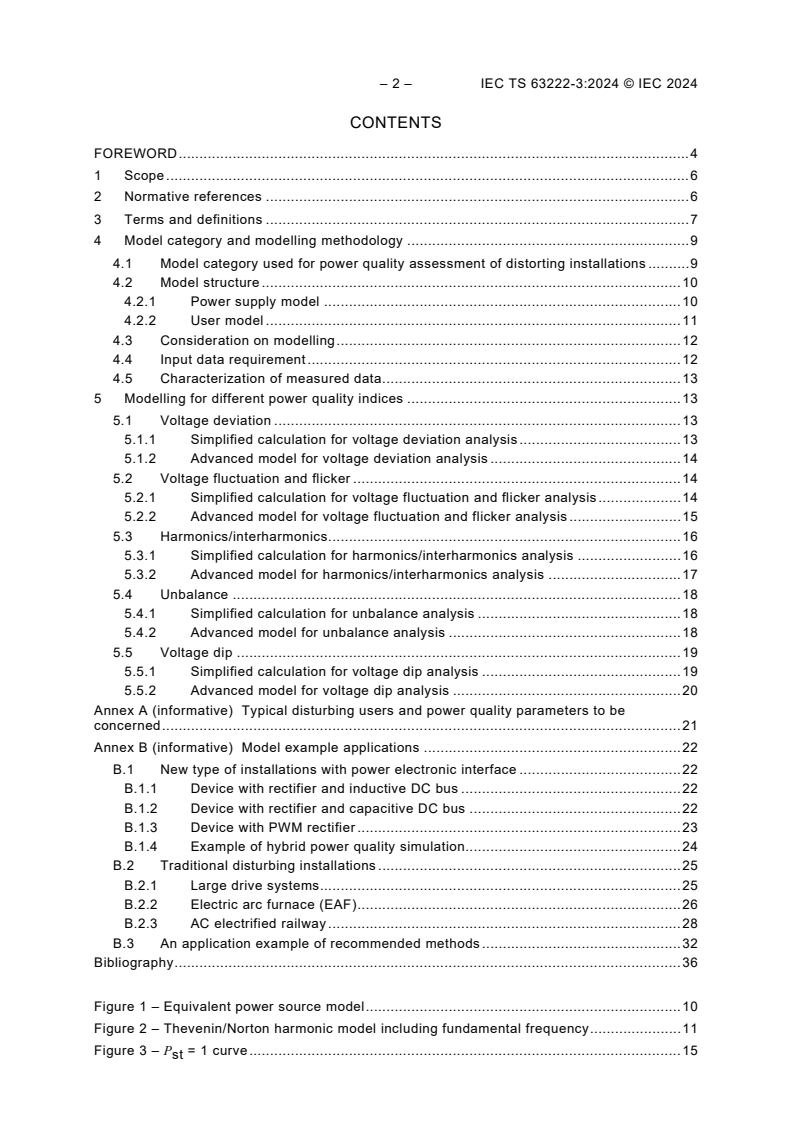
CONTENTS
FOREWORD . 4
1 Scope . 6
2 Normative references . 6
3 Terms and definitions . 7
4 Model category and modelling methodology . 9
4.1 Model category used for power quality assessment of distorting installations . 9
4.2 Model structure . 10
4.2.1 Power supply model . 10
4.2.2 User model . 11
4.3 Consideration on modelling . 12
4.4 Input data requirement . 12
4.5 Characterization of measured data. 13
5 Modelling for different power quality indices . 13
5.1 Voltage deviation . 13
5.1.1 Simplified calculation for voltage deviation analysis . 13
5.1.2 Advanced model for voltage deviation analysis . 14
5.2 Voltage fluctuation and flicker . 14
5.2.1 Simplified calculation for voltage fluctuation and flicker analysis . 14
5.2.2 Advanced model for voltage fluctuation and flicker analysis . 15
5.3 Harmonics/interharmonics . 16
5.3.1 Simplified calculation for harmonics/interharmonics analysis . 16
5.3.2 Advanced model for harmonics/interharmonics analysis . 17
5.4 Unbalance . 18
5.4.1 Simplified calculation for unbalance analysis . 18
5.4.2 Advanced model for unbalance analysis . 18
5.5 Voltage dip . 19
5.5.1 Simplified calculation for voltage dip analysis . 19
5.5.2 Advanced model for voltage dip analysis . 20
Annex A (informative) Typical disturbing users and power quality parameters to be
concerned . 21
Annex B (informative) Model example applications . 22
B.1 New type of installations with power electronic interface . 22
B.1.1 Device with rectifier and inductive DC bus . 22
B.1.2 Device with rectifier and capacitive DC bus . 22
B.1.3 Device with PWM rectifier . 23
B.1.4 Example of hybrid power quality simulation. 24
B.2 Traditional disturbing installations . 25
B.2.1 Large drive systems. 25
B.2.2 Electric arc furnace (EAF) . 26
B.2.3 AC electrified railway . 28
B.3 An application example of recommended methods . 32
Bibliography . 36
Figure 1 – Equivalent power source model . 10
Figure 2 – Thevenin/Norton harmonic model including fundamental frequency . 11
Figure 3 – P = 1 curve . 15
st
Figure 4 – Equivalent phasor model of induction motor . 19
Figure 5 – Unbalance modelling of induction motor based on negative impedance . 19
Figure 5 – Equivalent circuit for voltage dip due to induction motor starting . 19
Figure B.1 – Simplified harmonic models by small size simplified time domain
equivalent model . 23
Figure B.2 – Harmonic assessment results based on frequency domain and time
domain hybrid simulation . 25
Figure B.3 – Norton equivalent model . 26
Figure B.4 – EAF modelling by two chaotic functions per phase and simulated flicker
levels . 27
Figure B.5 – Principal arrangement of traction system . 28
Figure B.6 – High speed train traction system with PQ recorders and VSC compensator . 30
Figure B.7 – Recordings of voltage unbalances with and without VSC compensator . 30
Figure B.8 – On-site measurements with and without VSC compensator . 31
Figure B.9 – Simulation of unbalances and with VSC compensation . 31
Figure B.10 – Simulated harmonic distortions and VSC compensation currents . 32
Figure B.11 – Schematic diagram of a grid including nonlinear loads . 33
Figure B.12 – Starting curve of an induction motor and power curve of a controllable load . 34
Figure B.13 – Current wave forms and spectra of electric loads . 35
Table 1 – Example of representation/Template of the equivalent power source . 10
Table 2 – Example of representation/Template of the equivalent harmonic current
source . 11
Table 3 – Example of representation/template of the equivalent frequency impedance. 12
Table A.1 – Type of installation . 21
Table B.1 – Modelling methods of nonlinear electric loads . 33
– 4 – IEC TS 63222-3:2024 © IEC 2024
INTERNATIONAL ELECTROTECHNICAL COMMISSION
____________
POWER QUALITY MANAGEMENT –
Part 3: User characteristics modelling
FOREWORD
1) The International Electrotechnical Commission (IEC) is a worldwide organization for standardization comprising
all national electrotechnical committees (IEC National Committees). The object of IEC is to promote international
co-operation on all questions concerning standardization in the electrical and electronic fields. To this end and
in addition to other activities, IEC publishes International Standards, Technical Specifications, Technical Reports,
Publicly Available Specifications (PAS) and Guides (hereafter referred to as "IEC Publication(s)"). Their
preparation is entrusted to technical committees; any IEC National Committee interested in the subject dealt with
may participate in this preparatory work. International, governmental and non-governmental organizations liaising
with the IEC also participate in this preparation. IEC collaborates closely with the International Organization for
Standardization (ISO) in accordance with conditions determined by agreement between the two organizations.
2) The formal decisions or agreements of IEC on technical matters express, as nearly as possible, an international
consensus of opinion on the relevant subjects since each technical committee has representation from all
interested IEC National Committees.
3) IEC Publications have the form of recommendations for international use and are accepted by IEC National
Committees in that sense. While all reasonable efforts are made to ensure that the technical content of IEC
Publications is accurate, IEC cannot be held responsible for the way in which they are used or for any
misinterpretation by any end user.
4) In order to promote international uniformity, IEC National Committees undertake to apply IEC Publications
transparently to the maximum extent possible in their national and regional publications. Any divergence between
any IEC Publication and the corresponding national or regional publication shall be clearly indicated in the latter.
5) IEC itself does not provide any attestation of conformity. Independent certification bodies provide conformity
assessment services and, in some areas, access to IEC marks of conformity. IEC is not responsible for any
services carried out by independent certification bodies.
6) All users should ensure that they have the latest edition of this publication.
7) No liability shall attach to IEC or its directors, employees, servants or agents including individual experts and
members of its technical committees and IEC National Committees for any personal injury, property damage or
other damage of any nature whatsoever, whether direct or indirect, or for costs (including legal fees) and
expenses arising out of the publication, use of, or reliance upon, this IEC Publication or any other IEC
Publications.
8) Attention is drawn to the Normative references cited in this publication. Use of the referenced publications is
indispensable for the correct application of this publication.
9) IEC draws attention to the possibility that the implementation of this document may involve the use of (a)
patent(s). IEC takes no position concerning the evidence, validity or applicability of any claimed patent rights in
respect thereof. As of the date of publication of this document, IEC had not received notice of (a) patent(s), which
may be required to implement this document. However, implementers are cautioned that this may not represent
the latest information, which may be obtained from the patent database available at https://patents.iec.ch. IEC
shall not be held responsible for identifying any or all such patent rights.
IEC 63222-3 has been prepared by IEC technical committee 8: System aspects of electrical
energy supply. It is a Technical Specification.
The text of this Technical Specification is based on the following documents:
Draft Report on voting
8/1690/DTS 8/1702/RVDTS
Full information on the voting for its approval can be found in the report on voting indicated in
the above table.
The language used for the development of this Technical Specification is English.
This document was drafted in accordance with ISO/IEC Directives, Part 2, and developed in
accordance with ISO/IEC Directives, Part 1 and ISO/IEC Directives, IEC Supplement, available
at www.iec.ch/members_experts/refdocs. The main document types developed by IEC are
described in greater detail at http://www.iec.ch/standardsdev/publications.
A list of all parts in the IEC 63222 series, published under the general title Power quality
management, can be found on the IEC website.
The committee has decided that the contents of this document will remain unchanged until the
stability date indicated on the IEC website under webstore.iec.ch in the data related to the
specific document. At this date, the document will be
• reconfirmed,
• withdrawn, or
• revised.
IMPORTANT – The "colour inside" logo on the cover page of this document indicates
that it contains colours which are considered to be useful for the correct understanding
of its contents. Users should therefore print this document using a colour printer.
– 6 – IEC TS 63222-3:2024 © IEC 2024
POWER QUALITY MANAGEMENT –
Part 3: User characteristics modelling
1 Scope
This part of IEC 63222 is intended to provide provisions regarding recognized engineering
practices applicable to assess the user’s characteristics in power quality predicted assessment.
It summarizes the best practice in non-linear, unbalanced, impact and fluctuating loads or
generations modelling for power quality disturbance anticipation in public power systems at the
planning stage.
This document focuses on frequency-domain modelling for AC power quality analysis in electric
th
power networks, typically in the range up to the 50 harmonic (2,5 kHz in 50 Hz systems or
3 kHz in 60 Hz systems). Unbalance is analyzed in three-phase systems and only negative
sequence component is considered. The approach and modelling guidelines provided are valid
on the representation of user installations connected to power systems acting as sources of
disturbance. Modelling of the network elements is out of the scope of the document.
These guidelines will be valuable in the definition of power quality performance specifications
for user equipment. They will also assist users when modelling their installation to assess or
demonstrate compliance with the emission limits provided by the system owner/operator and to
investigate and specify mitigation measures.
2 Normative references
The following documents are referred to in the text in such a way that some or all of their content
constitutes requirements of this document. For dated references, only the edition cited applies.
For undated references, the latest edition of the referenced document (including any
amendments) applies.
IEC TR 61000-3-6, Electromagnetic compatibility (EMC) – Part 3-6: Limits – Assessment of
emission limits for the connection of distorting installations to MV, HV and EHV power systems
IEC TR 61000-3-7, Electromagnetic compatibility (EMC) – Part 3-7: Limits – Assessment of
emission limits for the connection of fluctuating installations to MV, HV and EHV power systems
IEC TR 61000-3-13, Electromagnetic compatibility (EMC) – Part 3-13: Limits – Assessment of
emission limits for the connection of unbalanced installations to MV, HV and EHV power
systems
IEC 61000-4-30, Electromagnetic compatibility (EMC) – Part 4-30: Testing and measurement
techniques – Power quality measurement methods
3 Terms and definitions
For the purposes of this document, the following terms and definitions apply.
ISO and IEC maintain terminology databases for use in standardization at the following
addresses:
• IEC Electropedia: available at https://www.electropedia.org/
• ISO Online browsing platform: available at https://www.iso.org/obp
3.1
power quality
characteristics of the electric current, voltage and frequency at a given point in an electric power
system, evaluated against a set of reference technical parameters
[SOURCE: IEC 60050-614:2016, 614-01-01 − The note to entry has been deleted.]
3.2
point of common coupling
PCC
point in an electric power system, electrically nearest to a particular load, at which other loads
are, or may be, connected
Note 1 to entry: These loads can be either devices, equipment or systems, or distinct network users' installations.
[SOURCE: IEC 60050-614:2016, 614-01-12]
3.3
point of connection
POC
reference point on the electric power system where the user’s electrical facility is connected
[SOURCE: IEC 60050-617: 2009, 617-04-01]
3.4
system impedance
impedance of the electric power system as viewed from a designated point (e.g. point of
common coupling or point of supply)
[SOURCE: IEC 60050-614:2016, 614-01-13]
3.5
short-circuit power
product of the current in the short circuit at a point of a system and a conventional voltage,
generally the operating voltage
[SOURCE: IEC 60050-601:1985, 601-01-14]
3.6
RMS value
root-mean-square value
effective value
for a time-dependent quantity, positive square root of the mean value of the square of the
quantity taken over a given time interval
[SOURCE: IEC 60050-103:2017, 103-02-03, modified – The notes to entry have been deleted.]
– 8 – IEC TS 63222-3:2024 © IEC 2024
3.7
voltage deviation
difference between the supply voltage at a given instant and the declared supply voltage
[SOURCE: IEC 60050-614:2016, 614-01-04]
3.8
voltage fluctuation
series of voltage changes or a continuous variation of the RMS or peak value of the voltage
Note 1 to entry: Whether the RMS or peak value is chosen depends upon the application, and which is used should
be specified.
[SOURCE: IEC 60050-161:1990, 161-08-05]
3.9
flicker
impression of unsteadiness of visual sensation induced by a light stimulus whose luminance or
spectral distribution fluctuates with time
[SOURCE: IEC 60050-614:2016, 614-01-28]
3.10
voltage unbalance
condition in a polyphase system in which the RMS values of the phase element voltages
(fundamental component), or the phase angles between consecutive phase element voltages,
are not all equal
[SOURCE: IEC 60050-614:2016, 614-01-32]
3.11
unbalance factor
in a three-phase system, degree of unbalance expressed by the ratio (in per cent) of the RMS
values of the negative sequence component (or the zero sequence component) to the positive
sequence component of the fundamental component of the voltage or the electric current
[SOURCE: IEC 60050-614:2016, 614-01-33]
3.12
harmonic order
harmonic number
the integral number given by the ratio of the frequency of a harmonic to the fundamental
frequency
[SOURCE: IEC 60050-161:1990, 161-02-19]
3.13
harmonic content
the quantity obtained by subtracting the fundamental component from an alternating quantity
[SOURCE: IEC 60050-161:1990, 161-02-21]
3.14
nth harmonic ratio
ratio of the RMS value of the nth harmonic to that of the fundamental component
[SOURCE: IEC 60050-161:1990, 161-02-20]
3.15
total harmonic ratio
THD
total harmonic distortion
ratio of the RMS value of the harmonic content to the RMS value of the fundamental component
or the reference fundamental component of an alternating quantity
Note 1 to entry: The total harmonic ratio depends on the choice of the fundamental component. If it is not clear
from the context which one is used an indication should be given.
Note 2 to entry: The total harmonic ratio can be restricted to a certain harmonic order. This is to be stated.
[SOURCE: IEC 60050-551:2001, 551-20-13, modified – In the term, "factor" has been changed
to "ratio", an equivalent term and an admitted term have been added; in the definition, "of an
alternating quantity" has been replaced by "value of the fundamental component or the
reference fundamental component of an alternating quantity" and note 2 to entry has been
added.]
3.16
interharmonic frequency
frequency which is a non-integer multiple of the reference fundamental frequency
[SOURCE: IEC 60050-551:2001, 551-20-06]
3.17
voltage dip
sudden voltage reduction at a point in an electric power system, followed by voltage recovery
after a short time interval, from a few periods of the sinusoidal wave of the voltage to a few
seconds
[SOURCE: IEC 60050-614:2016, 614-01-08]
4 Model category and modelling methodology
4.1 Model category used for power quality assessment of distorting installations
Power quality predictive evaluation procedure follows three stages (IEC TR 61000-3-6,
IEC TR 61000-3-7, IEC TR 61000-3-13). User characteristics modelling differs with three stages
of power quality assessment. For stage 1, no power quality evaluation or modelling is necessary.
For stage 2, the simplified calculation method is used to evaluate the impact of equipment. For
stage 3, assessment is generally carried out by power system simulation software. Three types
of modelling methods are involved in stage 3, including:
– frequency-domain modelling, with respect to simulations for analysis of harmonics,
interharmonics and unbalance.
– electromechanical time-domain modelling, with respect to electromechanical transient
simulations for analysis of voltage dip/surge, fast voltage variation and flicker.
– electromagnetic time-domain modelling of equipment such as power electronic converter,
with respect to electromagnetic transient (EMT) simulations for analysis of harmonics and
interharmonics.
NOTE power quality simulations can be carried out based on load flow results in two ways:
– "fast RMS time domain modelling method" for analysis of voltage dip/swell, fluctuation, flicker, etc.
– "frequency domain modelling method" for analysis of harmonics, interharmonics and disturbances > 2 kHz, where
all harmonic components are synchronized to fundamental voltages.
– 10 – IEC TS 63222-3:2024 © IEC 2024
4.2 Model structure
4.2.1 Power supply model
To analyze voltage deviation, voltage fluctuation, flicker, and voltage dip, an equivalent power
source model is recommended, as in Figure 1. The parameters in the equivalent Thevenin or
Norton source circuit is recommended in Table 1. This model can be used to represent
background voltage disturbances at point of common coupling (PCC) or point of connection
(POC).
Key
E equivalent open-circuit voltage source (case Thevenin)
oc
equivalent short-circuit current source (case Norton)
J
sc
Z , Z source impedance in complex values
r i
Figure 1 – Equivalent power source model
Table 1 – Example of representation/Template of the equivalent power source
Case Thevenin equivalent circuit:
Open circuit voltage Short-circuit impedance Short-circuit impedance
Phase
E real part Z image part Z
oc r i
V Ω Ω
A
B
C
Case Norton equivalent circuit:
Short-circuit current Source impedance real Source impedance image
Phase
J part Z part Z
sc r i
A Ω Ω
A
B
C
4.2.2 User model
For simulating harmonics and voltage variations caused by electric loads, a Thevenin/Norton
equivalent circuit of electric load is recommended, see Figure 2. The Thevenin/Norton
equivalent circuit is generally used and represented by means of an equivalent ideal current
source and equivalent impedance for each frequency of interest. The parameters involved are
shown in Table 2 and Table 3. In modelling of modern power electronic equipment such as
voltage source converter (VSC) or local generation unit, harmonic emission can be a type of
voltage source and should be modelled with Thevenin equivalent circuit. In both the two
equivalent circuits, I and E are mutually converted at each frequency versus source
n n
impedance. Regardless of the model used, the equivalent source and impedance should be
provided at the frequencies of interest for the intended application. Note that all three phases
and other conductors such as neutrals of a distribution feeder shall be represented explicitly.
For nonlinear load models, the source E and I are not zero.
n n
NOTE For convergence issue of the actual power grid simulation, loads are often modelled with impedances
calculated based on the P and Q at fundamental frequency (not with source E or I ).
n n
Figure 2 – Thevenin/Norton harmonic model including fundamental frequency
Table 2 – Example of representation/Template of
the equivalent harmonic current source
Current source I or voltage source E
Frequency
n n
Magnitude
Harmonic order A, V
Phase
Hz or
o
Ratio to fundamental
%
…
– 12 – IEC TS 63222-3:2024 © IEC 2024
Table 3 – Example of representation/template of the equivalent frequency impedance
Impedance Z
Frequency
n
Impedance real part Impedance imaginary part
Harmonic order
Hz
R X
Ω Ω
…
4.3 Consideration on modelling
To describe time-varying characteristics of users (see Annex A for typical disturbing users), the
proposed model structure allows for the implementation of representative time series or
probabilistic distribution to represent the impact or fluctuating behaviour. The fundamental
frequency current should be represented in the function of time or probability density function
(typically Gaussian distribution). For one instant of time or a sample, the corresponding
harmonic component can be obtained by Formula (1) and Formula (2).
Any power factor correction and harmonic filter capacitor banks associated with the device
should be modelled or included in the equivalent harmonic impedance.
4.4 Input data requirement
The data required for modelling can be obtained from the frequency-dependent model built by
the manufacturer of a device, or from measurement data provided by the operator. The
manufacturer should be able to provide the operational impedances of the device and the
injected current at each of the harmonic frequencies of interest at full load and at various
operating conditions. Next, the background power quality data should be measured, preferably
at various loading levels up to the full load so that the background power quality characteristics
can be estimated and taken into account as the second input data for the system modelling
requirement.
For the purpose of load modelling based on measurement data, class A measuring equipment
defined in IEC 61000-4-30 is required. The measurement methods, time aggregation, accuracy
and evaluation methods associated with the equipment are recommended in IEC 61000-4-30
to obtain reliable, repeatable and comparable results.
Measurements should be conducted as long as possible, ideally for not less than three months,
including measurements of all three phases and power quality parameters concerned. 1 min
aggregated value is recommended to record. In some cases, 3 s aggregated value or waveform
record are necessary. Half cycle value of reactive and active power should be simulated in
order to assess flicker level.
NOTE The aggregation method of phase angle can refer to IEC 61400-21-1 [7] .
___________
Numbers in square brackets refer to the Bibliography.
4.5 Characterization of measured data
When considering characteristics of disturbance varied with time, one often finds that the
disturbance contains a large number of irregularities which fail to conform to coherent patterns.
The variations generally have random characteristics and the behaviour can be described in
statistical terms which transform a large volume of data into compressed and interpretable
forms.
Numerical descriptive measures are the simplest form of representing a set of measurements.
These measures include minimum value, maximum value, average or root mean square value,
th th
95 or 99 percentile value, and standard deviation. Mathematically, let a set of n
measurements X , i = 1,…,n, with minimum value X , maximum value X .The average value
i min max
X and standard deviation σ are calculated by
avg x
n
X
∑ i
i=1
(1)
X =
avg
n
n
XX−
( )
∑ i avg
i=1 (2)
σ =
X
n−1
Because it is often difficult to determine a priori the best distribution to describe a set of
measurements, a more accurate method is a histogram which shows the portions of the total
set of measurements that fall in various intervals.
5 Modelling for different power quality indices
5.1 Voltage deviation
5.1.1 Simplified calculation for voltage deviation analysis
For a simplified calculation, the user installation should be represented as an equivalent power
model. The magnitude of the power source corresponds to the condition that the maximum
reactive power is drawn by the user. Voltage deviation is estimated as follows:
QX+ PR
δU ×100 %
(3)
U
N
where
δU
is the voltage deviation;
U is the nominal system voltage in kV;
N
Q is the maximum reactive power drawn by the user in MVar;
P is the corresponding real power in MW;
R is the resistance component of network equivalent impedance at the PCC in Ω;
X is the reactance component of system impedance at the PCC in Ω.
=
– 14 – IEC TS 63222-3:2024 © IEC 2024
5.1.2 Advanced model for voltage deviation analysis
To conduct a simulation analysis, the user installation can be modelled as an equivalent circuit
which comprises an equivalent power source and equivalent impedance at each frequency, as
shown in Figure 2. Interaction between the user facility and grid can be assessed with an
enhanced model (see 5.3.2). The power source and equivalent impedance in the model can be
represented as a function of time to simulate the time-varying characteristic, which can be
constructed based on 10 min aggregated values.
5.2 Voltage fluctuation and flicker
5.2.1 Simplified calculation for voltage fluctuation and flicker analysis
To analyse voltage fluctuation and flicker caused by impact or fluctuating loads (simplified to
rectangular variation form), the user installation should be represented as variable powers P
and Q model.
Steady state voltage change can be estimated as follows:
R×∆P+ X×∆Q
∆=U
(4)
ss
U
N
where
∆U is the steady state voltage change in kV;
ss
∆P and ∆Q is the change of active power in MW and reactive power in MVar, respectively;
U is the nominal system voltage in kV;
N
R is the resistance component of network equivalent impedance at the PCC in Ω;
X is the reactance component of system impedance at the PCC in Ω.
For a periodic and equally spaced rectangular wave (or step wave) load, the resultant flicker
can be estimated by relative voltage change d and voltage change frequency per minute r. d is
given by the following formula:
d=∆UU/ (5)
ss N
When d and r are known, the relative voltage changes d corresponding to short term flicker
lim
limit can be found from r using the P = 1 curve in Figure 3, and the short-term flicker value
st
can be calculated as follows:
d
P =
(6)
st
d
lim
Source: IEC 61000-3-3, 2013, Figure 2 [8].
Figure 3 – P = 1 curve
st
For non-periodic loads, the flicker can be estimated by the flicker coefficient according to the
load characteristics. For example, the flicker caused by the electric arc furnace can be
calculated according to Formula (7), and the maximum voltage change d caused by the
max
electric arc furnace at the PCC can be obtained by Formula (5).
P Kd× (7)
st lt max
where
K K = 0, 48
is device dependent. For AC electric arc furnace , for Consteel electric arc
lt lt
K = 0,25 K = 0,30
furnace , for DC electric arc furnace , for refining electric arc furnace
lt lt
K = 0,20 .
lt
5.2.2 Advanced model for voltage fluctuation and flicker analysis
For simulation analysis, user should be modelled as an equivalent power model of P and Q.
The time interval used in the equivalent voltage fluctuation and flicker modelling should be as
short as possible, at least one cycle of fundamental frequency. The main difference between
voltage fluctuation and voltage deviation lies in the time interval considered in voltage variations.
Representative load model time series can be identified from monitoring data covering all
process states of the user’s installation and should be capable of reflecting the impact and
fluctuating characteristics of the user. With the recent grid monitoring system, it is possible to
record RMS values every half cycle (equivalent 100 Hz in 50 Hz system), see Electric Arc
Furnaces (EAF) application case in B.2.2.
=
– 16 – IEC TS 63222-3:2024 © IEC 2024
It is possible to consider flicker attenuation phenomenon from higher voltage level to lower
voltage level through analytical, laboratory, and field measurement. Aggregated flicker model
is proposed for a number of distribution loads in order to assess flicker propagation effect, see
clause 4.3 in reference [9]. For a flicker source in the HV grid that produces some measurable
P value, the corresponding flicker level measured in a local MV area will likely be less than
st
that present in the HV supply. This attenuation is largely due to the load response to the voltage
fluctuations. It is certain that the load power is not constant under the conditions of fluctuating
voltages, but the manner in which the load changes dynamically remains the subject of research.
Variable P&Q load models with voltage sensitivity, variable load impedances, and complete time
domain simulations can all be used to capture the attenuation phenomenon (refer to Annex B
for application examples).
5.3 Harmonics/interharmonics
5.3.1 Simplified calculation for harmonics/interharmonics analysis
Non-linear users should be represented as an ideal current source for each frequency of interest.
The nth harmonic ratio of the resultant voltage U % at the PCC to which a nonlinear user is
n
connected can be estimated as follows:
3ZI
nn
U %=
(8)
n
10U
N
where
Z is the system harmonic impedance in Ω;
n
I is the RMS value of harmonic current injected by the user in A;
n
U is the nominal voltage at the PCC in kV.
N
Note that the background harmonic voltage is neglected in Formula (8).
As to the aggregation of harmonic sources which are assumed to be time independent, if the
phase angles are known, the resultant harmonic current can be calculated by Formula (9); if
the phase angles are unknown, the resultant harmonic current can be calculated by
Formula (10):
I= I+ I+ 2II cosθ (9)
nnn1 n2 nn12
where
I is the current magnitude at harmonic order n;
n
I is current magnitude of harmonic source 1 at harmonic order n;
n1
I is current magnitude of harmonic source 2 at harmonic order n;
n2
θ
is the phase difference between harmonic source 1 and 2 at harmonic order n.
n
α
α
II= (10)
n ∑ ni
i
where
I is the magnitude of the various emission levels at order n to be combined;
ni
is an exponent which mainly depends on the degree to which individual harmonic currents
α
vary randomly in terms of magnitude and phase.
5.3.2 Advanced model for harmonics/interharmonics analysis
As to thyristor or IGBT based loads, both harmonic emissions and harmonic impedance of the
device should be taken into consideration. The Thevenin/Norton equivalent circuit model should
be used to reflect the interactions between the harmonic sources and networks.
For non-linear time-varying installation, statistical techniques for harmonic analysis are more
I∠θ
suitable. A harmonic current phasor can be described by its magnitude and phase .
Typically, it can be assumed that its magnitude varies randomly with a uniform distribution
a a θ
between and , while its phase varies randomly with a uniform distribution between and
1 2 1
θ
.The joint probability density function of the sum of independent phasors can be obtained by
applying convolution of bivariate functions. Such integrations are complicated and one often
resorts to Monte Carlo simulation. If a relatively large number of phasors are to be added and
none of the phasors is dominant, then the central limit theorem can be applied.
With recent power electronic based loads, the disturbance behaviours are not always as current
source type (thyristor-based), i.e., the load current harmonic emission depends considerably
on grid impedance and grid background harmonics (magnitude and phase angle).
Five disturbance modelling approaches are studied in [10], in which at least 4 methods can be
used to make harmonic modelling. These approaches give different degrees of accuracy in
disturbance modelling.
1) Simplified constant passive model (for all frequencies);
2) RMS parameters variation for analysing interharmonics (f < 50/60 Hz);
3) Equivalent frequency domain source model (see 4.2.1, 4.2.2);
4) Local time domain model of nonlinear load (or other dynamic models such as
frequency-coupling matrix and artificial intelligence models) within hybrid simulation
platform (see B.1.4);
5) Model with built-in statistical functions.
Among above modelling methods, the local time domain model of the nonlinear load concerns
the simplified time domain model of a disturbance source, or the dynamic model (the rest of the
simulated grid is modelled in frequency domain or time-variable RMS model) which can take
into account the interactions between the grid (impedance and background disturbances) and
the load. Consequently, a time domain solver or EMT simulation tool is needed to simulate the
local time domain model and get steady state current spectra as output results. If many dynamic
models are used in the same network, iteration or hybrid simulations should be carried out in
order to guarantee the convergence.
NOTE Full time domain modelling and simulation can give precise results if all models are available. However, it is
not very easy in practice to get precise models of all power electronic structures and control algorithms.
– 18 – IEC TS 63222-3:2024 © IEC 2024
5.4 Unbalance
5.4.1 Simplified calculation for unbalance analysis
To analyse the impact of unbalance loads, the load should be represented as a negative
sequence current source. Assuming the positive sequence impedance at PCC is equal to the
negative sequence impedance, the negative sequence voltage unbalance factor can be
calculated as follows:
3IU
2L
ε = (11)
U2
S
SC
where
I is the negative sequence current;
U is the phase-to-phase voltage;
L
S is the short-circuit power at PCC.
SC
Considering the background voltage unbalance, the resultant unbalance factor can be
estimated as follows:
α α
α
ε εε+ (12)
UT UL UB
where
ε is the total negative sequence voltage unbalance factor;
UT
ε is the negative sequence voltage unbalance factor induced by the load;
UL
ε is the background voltage unbalance;
UB
α is the summation exponent whose value range is typically within [1,2].
For worst-case study, α shall be taken as 2, except for worse-case study.
The magnitude of the negative sequence current can be obtained by statistical analysis of
monitoring data considering different operating conditions of load.
5.4.2 Advanced model for unbalance analysis
For simulation study, full phase representation of a network and multiphase analysis is required.
Single-phase users connected in different phases of a system can only interact with each other
through the system. Each single-phase user should be modelled separately. A three-phase user
should be modelled as a multiphase model. To study the characteristics of variation, the model
should be represented in the function of time.
Unbalance behaviour of induction motors should be studied with a dedicated model. In fact, in
an industrial network, an induction motor has a special behaviour to unbalanced voltage. The
correct way is to model an induction motor with positive sequence impedance and negative
sequence impedance, see Figure 4. For a general induction motor, negative sequence
impedance is smaller compared to the positive one, while this is the key parameter to be
considered to access the overall grid unbalance.
=
Figure 4 – Equivalent phasor model of induction motor
Figure 5 shows the effect of negative sequence impedance of general induction motor
...