

IEC TR 63282-102:2025
(Main)LVDC systems - Part 102: Low-voltage DC electric island power supply systems
General Information
- Abstract
IEC TR 63282-102:2025 assesses the existing technical requirements (by TC 64, TC 82, SyC LVDC) and close any gaps related to electric island LVDC power supply systems in rural or remote areas without electricity up to a maximum of 1 500 V only. Additionally, it covers the case of LVDC auxiliary power supply systems for ships.
Specific technical items for electric island LVDC systems are explained in this document. Rationale for the proposed voltage level, topology, power quality, etc. are given.
This document gives inputs to several TCs in charge of the standardization of different issues and coordinated by SyC LVDC.
- Status
- Published
- Publication Date
- 25-Nov-2025
- Technical Committee
- TC 8 - System aspects of electrical energy supply
- Drafting Committee
- JWG 9 - TC 8/JWG 9
- Current Stage
- PPUB - Publication issued
- Start Date
- 26-Nov-2025
- Completion Date
- 28-Nov-2025
Overview
IEC TR 63282-102:2025 - "LVDC systems - Part 102: Low-voltage DC electric island power supply systems" is a technical report that evaluates existing technical requirements (prepared by IEC TCs 64, 82 and SyC LVDC) and identifies and closes gaps for standalone low-voltage DC (LVDC) electric island power supply systems. The scope covers rural or remote electrification and LVDC auxiliary power supply systems for ships up to a maximum of 1 500 V. The report provides rationale for recommended voltage levels, topologies, power quality expectations and control strategies and supplies inputs to multiple IEC technical committees.
Key topics and technical requirements
- System scope and characteristics: Definitions and specific considerations for electric island LVDC systems in rural/remote contexts and ship auxiliary systems.
- Voltage levels: Guidance to select appropriate LVDC voltage bands (up to 1 500 V) based on application, safety and interoperability.
- Topologies: Recommended architectures including household-level, county-level (nano-grid) and ship configurations; radial and ring distribution examples.
- Protection & earthing: Earthing configurations, protection device selection and operational protection schemes tailored to LVDC networks.
- Control & operation: Passive and active DC control modes, system operation, energy management and power flow control techniques for DC buses.
- Power quality: Criteria and examples for DC bus stability, voltage ripple, transient behavior and long-term voltage evolution in varying weather/load conditions.
- Components & installation: Annex material on power sources (PV, diesel, PMSG), storage systems and BMS, DC breakers/fuses, connectors, wiring, EMS and installation guidance.
- Application case studies: Real-world cases from Africa, China, Algeria, experimental platforms and recreational/utility ships illustrating design choices and performance data.
Practical applications and users
This TR is valuable for:
- LVDC system designers and electrical engineers deploying microgrids, nano-grids and off-grid electrification projects
- Ship designers and marine electrical engineers specifying LVDC auxiliary power systems
- Energy access and rural electrification program managers and NGOs
- Manufacturers of DC breakers, converters, batteries, connectors and energy management systems
- Standards committees and regulators using the TR as input for subsequent normative standards
Practical uses include system design guidance, safety and compatibility checks, selection of voltage and topology, protection strategy development, and performance benchmarking of PV+storage LVDC installations.
Related standards
- Inputs and coordination by SyC LVDC and IEC technical committees (TC 64, TC 82)
- References include IEC 60092-201 for marine voltage applications (as cited in the report)
Keywords: IEC TR 63282-102:2025, LVDC, electric island, low-voltage DC, rural electrification, LVDC ship auxiliary, microgrid, nano-grid, DC bus, energy management.
Get Certified
Connect with accredited certification bodies for this standard

IMQ S.p.A. (Certification)
Italian electrical product certification.

SLG Prüf- und Zertifizierungs GmbH
German testing and certification body.

UL Solutions
Global safety science company with testing, inspection and certification.
Sponsored listings
Frequently Asked Questions
IEC TR 63282-102:2025 is a technical report published by the International Electrotechnical Commission (IEC). Its full title is "LVDC systems - Part 102: Low-voltage DC electric island power supply systems". This standard covers: IEC TR 63282-102:2025 assesses the existing technical requirements (by TC 64, TC 82, SyC LVDC) and close any gaps related to electric island LVDC power supply systems in rural or remote areas without electricity up to a maximum of 1 500 V only. Additionally, it covers the case of LVDC auxiliary power supply systems for ships. Specific technical items for electric island LVDC systems are explained in this document. Rationale for the proposed voltage level, topology, power quality, etc. are given. This document gives inputs to several TCs in charge of the standardization of different issues and coordinated by SyC LVDC.
IEC TR 63282-102:2025 assesses the existing technical requirements (by TC 64, TC 82, SyC LVDC) and close any gaps related to electric island LVDC power supply systems in rural or remote areas without electricity up to a maximum of 1 500 V only. Additionally, it covers the case of LVDC auxiliary power supply systems for ships. Specific technical items for electric island LVDC systems are explained in this document. Rationale for the proposed voltage level, topology, power quality, etc. are given. This document gives inputs to several TCs in charge of the standardization of different issues and coordinated by SyC LVDC.
IEC TR 63282-102:2025 is classified under the following ICS (International Classification for Standards) categories: 29.020 - Electrical engineering in general; 29.240.01 - Power transmission and distribution networks in general. The ICS classification helps identify the subject area and facilitates finding related standards.
IEC TR 63282-102:2025 is available in PDF format for immediate download after purchase. The document can be added to your cart and obtained through the secure checkout process. Digital delivery ensures instant access to the complete standard document.
Standards Content (Sample)
IEC TR 63282-102 ®
Edition 1.0 2025-11
TECHNICAL
REPORT
LVDC systems -
Part 102: Low-voltage DC electric island power supply systems
ICS 29.020; 29.240.01 ISBN 978-2-8327-0805-7
All rights reserved. Unless otherwise specified, no part of this publication may be reproduced or utilized in any form or
by any means, electronic or mechanical, including photocopying and microfilm, without permission in writing from either
IEC or IEC's member National Committee in the country of the requester. If you have any questions about IEC copyright
or have an enquiry about obtaining additional rights to this publication, please contact the address below or your local
IEC member National Committee for further information.
IEC Secretariat Tel.: +41 22 919 02 11
3, rue de Varembé info@iec.ch
CH-1211 Geneva 20 www.iec.ch
Switzerland
About the IEC
The International Electrotechnical Commission (IEC) is the leading global organization that prepares and publishes
International Standards for all electrical, electronic and related technologies.
About IEC publications
The technical content of IEC publications is kept under constant review by the IEC. Please make sure that you have the
latest edition, a corrigendum or an amendment might have been published.
IEC publications search - IEC Products & Services Portal - products.iec.ch
webstore.iec.ch/advsearchform Discover our powerful search engine and read freely all the
The advanced search enables to find IEC publications by a
publications previews, graphical symbols and the glossary.
variety of criteria (reference number, text, technical With a subscription you will always have access to up to date
committee, …). It also gives information on projects, content tailored to your needs.
replaced and withdrawn publications.
Electropedia - www.electropedia.org
IEC Just Published - webstore.iec.ch/justpublished The world's leading online dictionary on electrotechnology,
Stay up to date on all new IEC publications. Just Published containing more than 22 500 terminological entries in English
details all new publications released. Available online and and French, with equivalent terms in 25 additional languages.
once a month by email. Also known as the International Electrotechnical Vocabulary
(IEV) online.
IEC Customer Service Centre - webstore.iec.ch/csc
If you wish to give us your feedback on this publication or
need further assistance, please contact the Customer
Service Centre: sales@iec.ch.
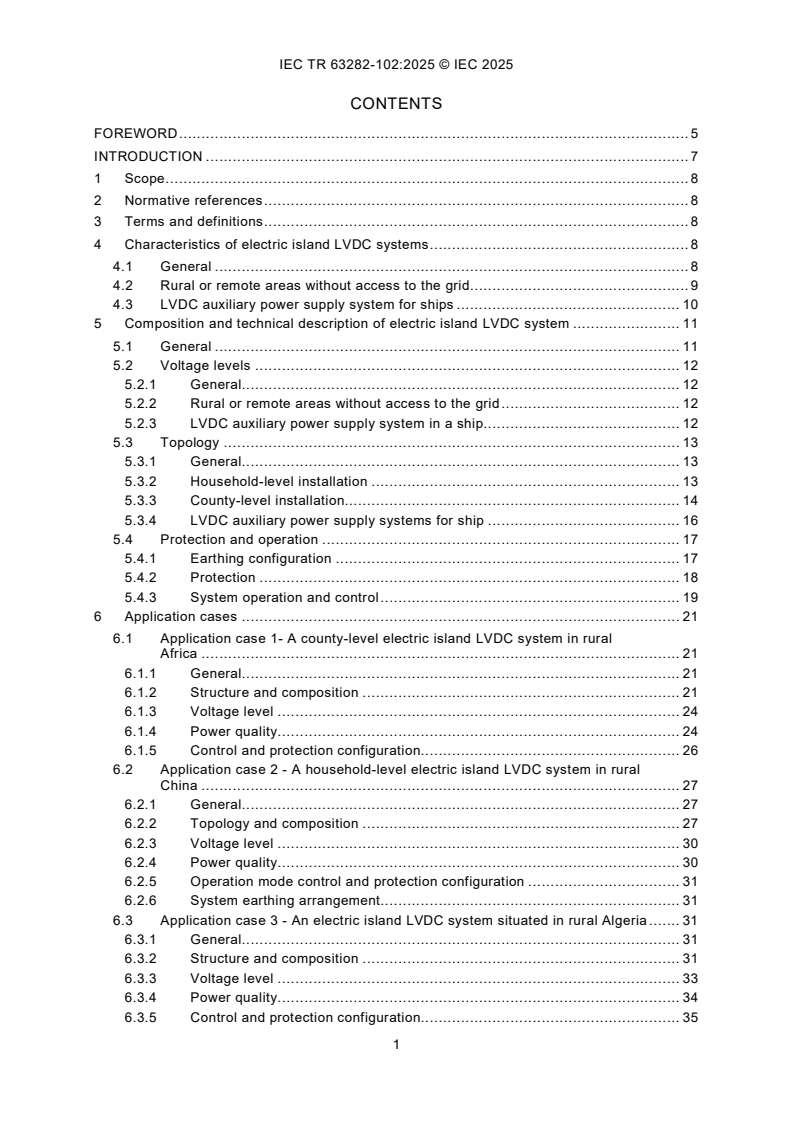
CONTENTS
FOREWORD . 5
INTRODUCTION . 7
1 Scope . 8
2 Normative references . 8
3 Terms and definitions . 8
4 Characteristics of electric island LVDC systems . 8
4.1 General . 8
4.2 Rural or remote areas without access to the grid . 9
4.3 LVDC auxiliary power supply system for ships . 10
5 Composition and technical description of electric island LVDC system . 11
5.1 General . 11
5.2 Voltage levels . 12
5.2.1 General. 12
5.2.2 Rural or remote areas without access to the grid . 12
5.2.3 LVDC auxiliary power supply system in a ship. 12
5.3 Topology . 13
5.3.1 General. 13
5.3.2 Household-level installation . 13
5.3.3 County-level installation. 14
5.3.4 LVDC auxiliary power supply systems for ship . 16
5.4 Protection and operation . 17
5.4.1 Earthing configuration . 17
5.4.2 Protection . 18
5.4.3 System operation and control . 19
6 Application cases . 21
6.1 Application case 1- A county-level electric island LVDC system in rural
Africa . 21
6.1.1 General. 21
6.1.2 Structure and composition . 21
6.1.3 Voltage level . 24
6.1.4 Power quality. 24
6.1.5 Control and protection configuration. 26
6.2 Application case 2 - A household-level electric island LVDC system in rural
China . 27
6.2.1 General. 27
6.2.2 Topology and composition . 27
6.2.3 Voltage level . 30
6.2.4 Power quality. 30
6.2.5 Operation mode control and protection configuration . 31
6.2.6 System earthing arrangement. 31
6.3 Application case 3 - An electric island LVDC system situated in rural Algeria . 31
6.3.1 General. 31
6.3.2 Structure and composition . 31
6.3.3 Voltage level . 33
6.3.4 Power quality. 34
6.3.5 Control and protection configuration. 35
6.4 Application case 4 - Experimental test platforms . 35
6.4.1 General. 35
6.4.2 Structure and composition . 35
6.4.3 Voltage level . 36
6.4.4 Power quality. 36
6.4.5 Control and protection configuration. 39
6.5 Application Case 5 - LVDC powered ship . 40
6.5.1 General. 40
6.5.2 Structure and composition . 40
6.5.3 Voltage level . 41
6.5.4 Power quality. 41
6.5.5 Control and Protection configuration . 42
6.6 Application Case 6 - A solar powered electrical recreational ship in
Indonesian waters. 42
6.6.1 General. 42
6.6.2 Structure and composition . 42
6.6.3 Voltage level . 45
6.6.4 Power quality. 45
6.6.5 Control and protection configuration. 45
Annex A (informative) System composition . 46
A.1 General . 46
A.2 Power sources . 46
A.2.1 General. 46
A.2.2 Types of sources . 46
A.2.3 Control modes . 47
A.3 Loads . 48
A.4 Storage system . 48
A.5 Wiring system . 50
A.6 DC breaker and fuses . 51
A.7 Connectors and socket . 52
A.8 Energy control and management system . 52
Annex B (informative) Design and configuration . 54
Annex C (informative) System installation . 57
C.1 General . 57
C.2 PV array mounting structures . 57
C.3 Battery installations . 57
C.4 Electrical cables and electrical connections . 58
Bibliography . 59
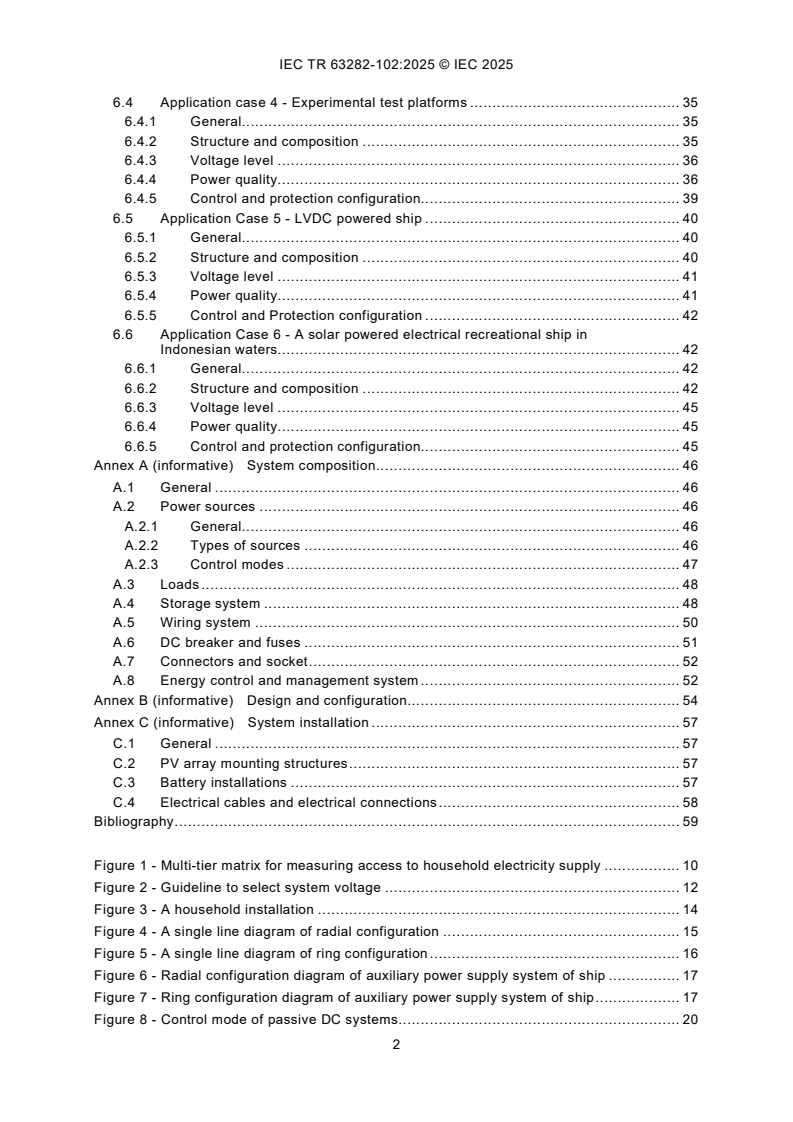
Figure 1 - Multi-tier matrix for measuring access to household electricity supply . 10
Figure 2 - Guideline to select system voltage . 12
Figure 3 - A household installation . 14
Figure 4 - A single line diagram of radial configuration . 15
Figure 5 - A single line diagram of ring configuration . 16
Figure 6 - Radial configuration diagram of auxiliary power supply system of ship . 17
Figure 7 - Ring configuration diagram of auxiliary power supply system of ship . 17
Figure 8 - Control mode of passive DC systems . 20
Figure 9 - Control mode of active DC systems . 20
Figure 10 - Schematic of a PV-based nano-grid installation . 21
Figure 11 - Geographical distribution of the nano-grids in Ambohimena . 22
Figure 12 - Schematic of the LVDC system installation . 23
Figure 13 - Configuration and structure of the LVDC system in Ambohimena . 23
Figure 14 - Voltage band when configured with DC/DC converters . 24
Figure 15 - Long-term exchanged currents on the LVDC system . 25
Figure 16 - Long-term evolution of the DC bus voltage . 25
Figure 17 - Exchanged currents during a rainy period . 26
Figure 18 - Evolution of the DC bus voltage during a rainy period . 26
Figure 19 - Initial inrush current (in green) and DC bus voltage (in pink) without and
with smooth start-up procedure . 27
Figure 20 - The topology of the LVDC power distribution system in Yuanqu Village . 28
Figure 21 - PV modules mounted on the roof and DC loads in the house . 28
Figure 22 - Schematic diagram and real photo of the energy router in household-level
installation . 29
Figure 23 - The variation of ripple coefficient of the peak-to-peak voltages . 31
Figure 24 - The topology scheme of the LVDC power distribution system . 32
Figure 25 - Voltage band when configured with household electrical devices . 34
Figure 26 - System topology of the experimental test platform . 36
Figure 27 - 36 V steady-state DC voltage waveforms . 36
Figure 28 - 36 V steady state DC voltage waveform expansion. 37
Figure 29 - 400 V steady state DC voltage waveforms . 37
Figure 30 - 650 V steady state DC voltage waveforms . 37
Figure 31 - Voltage ripple analysis with different time window . 38
Figure 32 - 36 V transient DC voltage waveforms. 38
Figure 33 - 400 V transient DC voltage waveforms . 39
Figure 34 - 650 V transient DC voltage waveforms . 39
Figure 35 - LVDC powered ship in the Alleppey backwaters . 40
Figure 36 - Electrical line diagram of LVDC powered ship hotel loads . 41
Figure 37 - A solar powered electrical recreational ship in indonesian water . 42
Figure 38 - Electrical line diagram of solar powered electrical recreational ship . 43
Figure 39 - Total loads in different conditions . 44
Figure A.1 - System composition . 46
Figure A.2 - Topology of Dual Active Bridge Converter . 47
Figure A.3 - Topology of PMSG connecting to DC grid through rectifier . 47
Figure A.4 - Discharge curves of different current rates of lithium cell . 49
Figure A.5 - Typical battery management system diagram of lithium battery and lead-
acid battery . 50
Figure A.6 - Centralized energy management system . 52
Figure A.7 - Examples of EMS functions and their relationships . 53
Figure B.1 - Design process . 54
Table 1 - Voltages for different applications (IEC 60092-201) . 13
Table 2 - Generic requirements for ESMAP tiers and attributes . 13
Table 3 - Daily load profile for single household in Yuanqu village . 29
Table 4 - Loads characteristics in the application case . 32
Table 5 - Photovoltaic module technical data sheet . 33
Table 6 - Lead acid battery specifications . 33
Table 7 - Generic requirements for voltage ripple/noise . 35
Table 8 - Common hotel loads of LVDC powered ship . 41
Table 9 - Loads of solar powered electrical recreational ship . 43
Table 10 - Daily power output on different weather conditions (kWh) . 44
Table 11 - Power system summary . 44
Table A.1 - Load level . 48
Table A.2 - Economic comparison of energy storage . 49
INTERNATIONAL ELECTROTECHNICAL COMMISSION
____________
LVDC systems -
Part 102: Low-voltage DC electric island power supply systems
FOREWORD
1) The International Electrotechnical Commission (IEC) is a worldwide organization for standardization comprising
all national electrotechnical committees (IEC National Committees). The object of IEC is to promote international
co-operation on all questions concerning standardization in the electrical and electronic fields. To this end and
in addition to other activities, IEC publishes International Standards, Technical Specifications, Technical Reports,
Publicly Available Specifications (PAS) and Guides (hereafter referred to as "IEC Publication(s)"). Their
preparation is entrusted to technical committees; any IEC National Committee interested in the subject dealt with
may participate in this preparatory work. International, governmental and non-governmental organizations liaising
with the IEC also participate in this preparation. IEC collaborates closely with the International Organization for
Standardization (ISO) in accordance with conditions determined by agreement between the two organizations.
2) The formal decisions or agreements of IEC on technical matters express, as nearly as possible, an international
consensus of opinion on the relevant subjects since each technical committee has representation from all
interested IEC National Committees.
3) IEC Publications have the form of recommendations for international use and are accepted by IEC National
Committees in that sense. While all reasonable efforts are made to ensure that the technical content of IEC
Publications is accurate, IEC cannot be held responsible for the way in which they are used or for any
misinterpretation by any end user.
4) In order to promote international uniformity, IEC National Committees undertake to apply IEC Publications
transparently to the maximum extent possible in their national and regional publications. Any divergence between
any IEC Publication and the corresponding national or regional publication shall be clearly indicated in the latter.
5) IEC itself does not provide any attestation of conformity. Independent certification bodies provide conformity
assessment services and, in some areas, access to IEC marks of conformity. IEC is not responsible for any
services carried out by independent certification bodies.
6) All users should ensure that they have the latest edition of this publication.
7) No liability shall attach to IEC or its directors, employees, servants or agents including individual experts and
members of its technical committees and IEC National Committees for any personal injury, property damage or
other damage of any nature whatsoever, whether direct or indirect, or for costs (including legal fees) and
expenses arising out of the publication, use of, or reliance upon, this IEC Publication or any other IEC
Publications.
8) Attention is drawn to the Normative references cited in this publication. Use of the referenced publications is
indispensable for the correct application of this publication.
9) IEC draws attention to the possibility that the implementation of this document may involve the use of (a)
patent(s). IEC takes no position concerning the evidence, validity or applicability of any claimed patent rights in
respect thereof. As of the date of publication of this document, IEC had not received notice of (a) patent(s), which
may be required to implement this document. However, implementers are cautioned that this may not represent
the latest information, which may be obtained from the patent database available at https://patents.iec.ch. IEC
shall not be held responsible for identifying any or all such patent rights.
IEC TR 63282-102 has been prepared by IEC technical committee 8: System aspects of
electrical energy supply. It is a Technical Report.
The text of this Technical Report is based on the following documents:
Draft Report on voting
8/1760/DTR 8/1784/RVDTR
Full information on the voting for its approval can be found in the report on voting indicated in
the above table.
This document is to be used in conjunction with and as a supplement to IEC TR 63282 up to
1 500 V DC.
The language used for the development of this Technical Report is English.
This document was drafted in accordance with ISO/IEC Directives, Part 2, and developed in
accordance with ISO/IEC Directives, Part 1 and ISO/IEC Directives, IEC Supplement, available
at www.iec.ch/members_experts/refdocs. The main document types developed by IEC are
described in greater detail at www.iec.ch/publications.
A list of all parts in the IEC 63282 series, published under the general title LVDC systems, can
be found on the IEC website.
The committee has decided that the contents of this document will remain unchanged until the
stability date indicated on the IEC website under webstore.iec.ch in the data related to the
specific document. At this date, the document will be
– reconfirmed,
– withdrawn, or
– revised.
INTRODUCTION
The vast majority of global population lives in the developing countries, and a significant portion
of the developing countries have no, or poor, access to electricity. According to the United
Nations Foundation, there are still around 1,2 billion people who do not have access to
electricity and around 1 billion more who depend on unreliable electric networks. Energy access
is a complex task in rural areas as most of the villages/hamlets are located at remote and/or
hilly terrain. Barriers to energy access include uneconomic grid expansion and high
transportation costs for fuel. However, these remote areas are rich in availability of locally
available resources such as waste from agricultural field, solar intensity, wind utilization, etc.,
so how to use local resources to provide electricity supply has become a challenge in remote
rural areas.
Electric island LVDC (Low voltage direct current) systems have recently been recognized by a
number of stakeholders as an alternative solution for energy access in rural area. Several
countries have already shown interest in the development of DC systems in order to improve
the quality of their inhabitants' life together with the development of the local economy.
This document defines electric island LVDC systems for rural or remote areas, and on ships
which normally operate with no connections to a national grid infrastructure. The purpose of
this document is to provide some effective technical information to support the construction of
electric island LVDC systems. It provides the unique characteristics of electric island power
supply system and the key elements such as optional voltage level, topology and operation
control, and provides some cases.
This document harmonizes with IEC TR 63282 for voltage level and power quality, and as a
supplement to IEC TR 63282, but the application scenarios are slightly different and the power
quality in this document are more prominent because there is no connection to a nation's
primary grid.
This document mainly consists of three parts. The first part (Clause 4) gives the characteristics
of the system, and describes the characteristics of the power source, load and the power quality
of the electric island LVDC systems. These characteristics are designed to inform a number of
stakeholders of the information to be aware of when building electric island LVDC systems. The
second part (Clause 5) gives the system composition and technical description, and describes
the load requirements, power source requirements, protection and operation of the electric
island LVDC systems. Finally, five typical cases are given (Clause 6).
1 Scope
The scope of this document is to assess the existing technical requirements (by TC 64, TC 82,
SyC LVDC) and close any gaps related to electric island LVDC power supply systems in rural
or remote areas without electricity up to a maximum of 1 500 V only. Additionally, it covers the
case of LVDC auxiliary power supply systems for ships.
Specific technical items for electric island LVDC systems are explained in this document.
Rationale for the proposed voltage level, topology, power quality, etc. are given.
This document gives inputs to several TCs in charge of the standardization of different issues
and coordinated by SyC LVDC.
2 Normative references
There are no normative references in this document.
3 Terms and definitions
For the purposes of this document, the following terms and definitions apply.
ISO and IEC maintain terminology databases for use in standardization at the following
addresses:
– IEC Electropedia: available at https://www.electropedia.org/
– ISO Online browsing platform: available at https://www.iso.org/obp
3.1
nominal system voltage
suitable approximate value of voltage used to designate or identify a system
[SOURCE: IEC 60050-601:1985, 601-01-21, modified - The original term "nominal voltage of a
system" has been replaced by "nominal system voltage".]
3.2
electric island power supply system
off-grid or isolated power system
system that provides electricity without relying on any utility power grid
Note 1 to entry: It is designed to generate and store electricity using renewable energy sources such as solar panels
and wind turbines, combined with energy storage systems like batteries, sometimes associated with a diesel
generator. Electric island power supply systems are usually designed for isolated islands or for rural electrification
in developing countries.
4 Characteristics of electric island LVDC systems
4.1 General
Power supply of electric island LVDC systems can be achieved with variable renewable sources
like photovoltaic (PV) arrays, wind turbines and energy storage units. Consumption of electric
island LVDC systems can be derived from a set of electrical equipment such as fans, lighting,
mobile phones, etc.
Electric island LVDC system represents a specific scenario within the field of LVDC systems.
The power quality phenomena described in IEC TR 63282 are applicable to electric island
LVDC power supply systems. Different scenarios and scales exhibit unique features, leading to
diverse requirements for power quality.
4.2 Rural or remote areas without access to the grid
Electrification of remote rural regions through national power grids is largely unviable due to
both the high infrastructure cost and the limited power generation capacity in many countries.
Generally, rural or remote areas have vast territories with low population density and relatively
modest electricity consumption, which are characterized by low energy density. An electric
island LVDC system that relies on one or more energy sources in conjunction with a battery
and power conversion equipment is a feasible solution.
In terms of power sources, rural or remote areas are basically characterized with abundant
renewable energy sources. Technologies such as wind turbines and PV arrays can be utilized
in electric island LVDC systems to economically satisfy local energy demands. Generally, the
solar power generation ramps up with the sunrise and wanes as the sun sets, while the wind
power generation usually peaks at night. Considering that variable renewable sources, like PV
arrays and wind turbines, provide intermittent supply, energy storage plays a crucial rule in
enhancing flexibility and reliability of the electric island supply systems. The commonly used
energy storage in power systems include pump hydro, compressed air, flywheel, as well as
lithium-ion batteries, supercapacitors, etc. However, these options are costly and typically
designed for large-scale scenarios. For electric island LVDC systems in rural or remote areas,
economically viable lead-acid batteries are generally employed as the energy storage
components.
In terms of loads, the electricity demand in these regions primarily caters to fundamental living
and production necessities. According to the report published by Energy Sector Management
Assistance Program (ESMAP), a multi-tier framework is defined for electricity consumption, as
shown in Figure 1. Load characteristics in rural or remote areas basically refer to the ESMAP
multi-tier framework, ranging from Tier 1 to Tier 3, which pertains to household electricity supply
requirements. Most load profiles exhibit morning and evening peaks while more affluent homes
also exhibit mid-day peaks. Daytime electricity consumption peaks in the morning, primarily
driven by lighting, radios, and other electrical appliances. Nighttime electricity consumption
mainly includes lighting, cooking and charger usage. Consequently, there are instances of
insufficient power supply and increased electricity demand, leading to potential deviations of
the system voltage from its normal operating range.
Electric island LVDC systems in rural or remote areas face limitations of village distribution and
topographical factors. The loads tend to be relatively decentralized, resulting in an excessively
large radius of electricity supply to cover all households. As the loads increase, low voltage
issues arise owing to larger line voltage drop. Phenomenon of voltage fluctuations and
deviations will be occasionally caused by the temporal and spatial disparities between the
power sources and the loads. A careful consideration on system voltage selection and
appropriate voltage level is paramount, which can significantly contribute to the mitigation of
such issues. Overall, in remote and rural areas without access to electricity, the primary power
quality concerns include voltage deviation, voltage fluctuation, power interruption, and ripple.
While prioritizing cost-effectiveness, it is appropriate to consider a reduction in power quality
indicators in these scenarios.
Figure 1 - Multi-tier matrix for measuring access to household electricity supply
4.3 LVDC auxiliary power supply system for ships
The auxiliary power supply system for ships is a typical LVDC, which is mainly responsible for
supplying power to auxiliary loads on the ship, such as hotel loads. This will be discussed in
this document. Noted that the primary power system of ships for the electrical propulsion is not
included.
In terms of power sources, a ship's electric power is supplied by generators, fuel cells, energy
storage systems, PV arrays and other energy sources having sufficient capacity to support
onboard services. The generator is the most commonly used power supply device of the DC
ship, and the number and capacity of the generators can be determined according to the hotel
load demand. Energy storage can store electric energy when the power consumption is low,
and provide power supply for the hotel load when the load demand is high. PV power generation
is a clean energy that can be used in combination with generator and energy storage to improve
power utilization. The ships can have both a main power supply and an emergency power supply
according to the demand of electricity. According to IEC 60092-201, the main electric power
supply ensures uninterrupted power to all essential electrical loads for maintaining the ship in
normal operational and habitable condition and preservation of the cargo, without relying on the
emergency power supply. The emergency power supply is capable of sustaining for a minimum
of 6 hours according to IEC 60092-507. The starting current, surge current and fault current are
restricted to a level that guarantees the effectiveness of the safety device and meets the voltage
drop limits specified by IEC 60092 (all parts).
The loads on a ship can be categorized into two main types: propulsion loads and hotel loads.
Hotel loads encompass various elements, including lighting, ventilation, accommodation
requirements, and auxiliary systems like small pumps and winches. Their contributions to the
overall load are dependent on the shipboard missions. For instance, passenger cruise carriers
and survey vessels have significant sensor and operational loads during missions, resulting in
a more significant impact from hotel loads on the total power demand. According to
IEC 60092-201, loads connected between lines and middle wire are balanced as far as possible
within 15 % of the respective loads. According to IEEE Std 45.1™, the capacity of energy
storage and on-line generators for redundancy are able to carry on-line uninterruptible and
short-term interruptible loads.
The battery can be installed either as a stand-alone unit or in combination with other energy
sources as the main electric power supply, while also serving as an emergency power source.
When the energy storage is used as an emergency power source, it is capable of carrying
emergency loads without charging, while maintaining the storage voltage within [−12 %, +5 %]
of its nominal voltage throughout the discharge period. According to IEC 60092-507, the
nominal DC voltage tolerance at the battery terminals, within which all the DC equipment is able
to operate, is set at ± 10 %. Besides, the important loads of the ships remain functional when
subjected to the minimum voltage at the battery terminals.
Overall, the power quality is pretty important to ensure the normal operation of DC ships.
IEEE Std 1709 gives certain provisions for medium-voltage DC power systems on ships, mainly
focusing on voltage ripple and noise, and according to it, the acceptable rms value of ripple
voltage and load induced noise does not exceed 5 % per unit, while further research is needed
for the power quality of ships with LVDC power supply.
5 Composition and technical description of electric island LVDC system
5.1 General
Understanding how to utilize an electric island LVDC system implies knowledge of its system
composition and technical information, including the power source requirements (refer to
Clause A.2 for detail information), load requirements (see Clause A.3), energy storage
requirements (see Clause A.4), wiring (see Clause A.5), connectors and sockets (see
Clause A.7), voltage level, topology, protection and operation (see Clause A.6 and Clause A.8),
design (see Annex B), system installation (see Annex C), etc.
The IEC 62257 series provides comprehensive guidelines for renewable energy and hybrid
systems for rural electrification. Some of them are applicable to both AC and DC systems.
Specifically:
– IEC TS 62257-4: offers recommendations for system selection and design;
– IEC TS 62257-5: covers protection against electrical hazards;
– IEC TS 62257-7: provides guidance on the use of generators;
– IEC TS 62257-9-4: focuses on integrated systems and user installation;
– IEC TS 62257-9-7: recommends criteria for the selection of inverters;
– IEC TS 62257-9-8: sets requirements for stand-alone renewable energy products with
power ratings less than or equal to 350 W.
5.2 Voltage levels
5.2.1 General
Nowadays, LVDC distribution projects covers a wide range of scenarios, such as residential
and office buildings, data centres, hospitals, retail establishments, transportation systems,
lighting networks, and applications in agriculture or fish farming. Voltage levels are influenced
by various factors such as topology, load distribution, supply capacity, insulation, wiring
features, control strategies, protection requirements and equipment characteristics. Different
commonly used voltage levels can be found in IEC 60038 and IEC TR 63282.
The selection of an appropriate DC bus voltage is made comprehensively, taking into account
various influencing factors related to safety, power efficiency, and cost-effectiveness.
5.2.2 Rural or remote areas without access to the grid
For power supply to the rural or remote areas, electric island LVDC systems consisting of PV
panels, batteries and loads present a promising solution by closing the access gap as well as
featuring lower costs. Typically, these systems are installed on rural housing and village houses,
where DC power directly feeds lighting and small DC appliances, or small AC appliances
powered by dedicated inverters operating on DC power. The capacity of solar panels ranges
from hundreds of Wps to thousands of Wps (Watts-peaks). The DC voltages provided to the
loads are generally 5 V USB, 5 V USB-PD to 20 V USB-PD (USB Power Delivery), 12 V, 24 V
and 48 V. The actual voltage is determined by the requirements of the system.
For example, if the batteries and the inverter are a long way from the PV array and use a
switching type solar controller, then a higher voltage can be required to offset the power lost in
the cables. In larger systems, 120 V DC or 240 V DC can be used, but these are not typical
household systems. Due to the potentially fatal voltages used, the complexity in electrical
designs would be increased, and the resulting system would be more expensive than for
systems using voltages below 60 V DC that are not so dangerous.
As a general guideline, the nominal system voltage tends to increase with the total daily energy
consumption. For smaller daily loads, a 12 V system voltage is commonly used, while
intermediate daily loads are typically accommodated with a 24 V system voltage. For more
substantial energy requirements, a 48 V system voltage is commonly used. The Sustainable
Energy Industry Association of the Pacific Islands (SEIAPI) suggests that a 24 V system voltage
is appropriate for systems with a maximum instantaneous power up to 4 kW, and for higher
values of maximum instantaneous power, a 48 V system is used, as shown in Figure 2. Specific
technical specifications can be found in IS 16711 and IEC 63318. Additionally, communication
cables can provide power up to 70 W (PoE, power over Ethernet).
As for larger scale scenarios, further technical specifications are outlined in
IEEE Std 2030.10™.
Figure 2 - Guideline to select system voltage
5.2.3 LVDC auxiliary power supply system in a ship
IEC 60092-201 gives typical values of nominal voltages and maximum voltages for common
applications of LVDC auxiliary power supply system in a ship, as shown in Table 1.
Table 1 - Voltages for different applications (IEC 60092-201)
Application Nominal voltages Maximum voltages
(V) (V)
Cooking, heating 110, 220 500
Lighting and socket outlets 24, 110, 220 500
Communication 6, 12, 24, 48, 110, 220 250
Supplies to lifeboats or similar craft 12, 24, 48 55
Instrumentation 24, 48, 110, 220 250
5.3 Topology
5.3.1 General
The electric island DC power supply systems can be applied to both remote areas and ship
power supply systems. In this document, the electric island DC power supply systems for remote
area are further categorized into two levels: household-level and county-level, based on power
capacity.
There is no unified standard for the system topology of DC distribution network. The selection
process requires a thorough evaluation of various factors, including the power supply range,
power supply capacity, the cost of the DC distribution network, and the choice of insulating
switch equipment. At present, there are two basic structures, namely ring topology and radial
topology. Different topologies are applied to different scenarios.
5.3.2 Household-level installation
A household installation is a small, interconnected, self-sustaining electrical system. For
household-level applications, the ESMAP multi-tier framework can be used as a reference,
including use cases from Tier 2 to Tier 5, as shown in Table 2.
Table 2 - Generic requirements for ESMAP tiers and attributes
Attribute Tier 2 Tier 3 Tier 4 Tier 5
Peak capacity Min 50 W Min 200 W Min 800 W Min 2 kW
(W or daily Wh) Min 200 Wh Min 1,0 kWh Min 3,4 kWh Min 8,2 kWh
Minimum 4 h per Minimum 8 h per Minimum 16 h per Minimum 23 h per
Availability day; Minimum 2 h in day; Minimum 3 h in day; Minimum 4 h in day; Minimum 4 h in
the evening the evening the evening the evening
Reliability Not mentioned Not mentioned Moderate impact little (or no) impact
Quality Not mentioned Not mentioned Moderate impact little (or no) impact
Configuration of such an individual installation is based on the scale of local loads, economic
conditions, environmental factors, etc. A household installation commonly includes loads (sorts
of household electric appliances), power sources (such as PV panels, wind turbines, DC
generating sets and storage units), and ancillary facilities (such as distribution boards, wiring
systems, socket-o
...