

IEC 63041-3:2026
(Main)Piezoelectric sensors - Part 3: Physical sensors
General Information
- Abstract
IEC 63041-3:2026 is available as IEC 63041-3:2026 RLV which contains the International Standard and its Redline version, showing all changes of the technical content compared to the previous edition.IEC 63041-3:2026 is applicable to piezoelectric physical sensors mainly used in the field of process control, wireless monitoring, dynamics, thermodynamics, vacuum engineering, and environmental sciences. This document provides users with technical guidelines as well as basic knowledge of common physical sensors. Piezoelectric sensors covered herein are those applied to the detection and measurement of physical quantities such as force, pressure, torque, viscosity, temperature, film thickness, acceleration, vibration, and tilt angle.
This edition includes the following significant technical changes with respect to the previous edition:
a) Some terms in Clause 3 have been updated to be consistent with IEC TS 61994-5:2023.
- Status
- Published
- Publication Date
- 24-Feb-2026
- Technical Committee
- TC 49 - Piezoelectric, dielectric and electrostatic devices and associated materials for frequency control, selection and detection
- Drafting Committee
- WG 13 - TC 49/WG 13
- Current Stage
- PPUB - Publication issued
- Start Date
- 25-Feb-2026
- Completion Date
- 27-Feb-2026
Buy Documents
IEC 63041-3:2026 - Piezoelectric sensors - Part 3: Physical sensors
REDLINE IEC 63041-3:2026 RLV - Piezoelectric sensors - Part 3: Physical sensors
IEC 63041-3:2026 - Capteurs piézoélectriques - Partie 3: Capteurs physiques
IEC 63041-3:2026 - Piezoelectric sensors - Part 3: Physical sensors
Overview
IEC 63041-3:2026 – Piezoelectric sensors – Part 3: Physical sensors is an internationally recognized standard published by the International Electrotechnical Commission (IEC). This document defines requirements and provides technical guidelines for piezoelectric physical sensors primarily employed in process control, wireless monitoring, dynamics, thermodynamics, vacuum engineering, and environmental sciences. The standard was developed by IEC Technical Committee 49, which focuses on piezoelectric, dielectric, and electrostatic devices.
IEC 63041-3:2026 details key terms, measurement methods, sensor types, and essential parameters for the detection and measurement of physical quantities such as force, pressure, torque, viscosity, temperature, film thickness, acceleration, vibration, and tilt angle. It also includes a redline version that highlights significant updates from the previous edition, such as the harmonization of terminology in accordance with IEC TS 61994-5:2023.
Key Topics
Sensor Definitions and Types
The standard defines several types of piezoelectric sensor elements, including:- Acceleration sensors
- Humidity sensors
- Tilt angle sensors
- Vibration sensors
- Dual mode, differential, and multi-measurand sensors
Operating Principles
Piezoelectric sensors use variations in resonance frequency, delay time, and electrical signals (charge/voltage) for accurate measurement of different physical properties.Sensor Configurations
The document introduces conceptual diagrams for:- Surface Acoustic Wave (SAW) single and differential resonator types
- SAW transmission (two-port) and reflective (one-port) delay-line types Reflective delay lines are notable for their ability to support unique sensor identification and enhanced sensitivity.
Technical Specification Requirements
Manufacturers and users must clarify:- Avoidance of unwanted vibration mode coupling
- Sensor detection direction
- Hysteresis
- Linearity in sensor response
- Overload characteristics
- Response time
Testing and Calibration
Calibration methods and test procedures are referenced, aiming to ensure the reliability and accuracy of physical sensor measurements. Relevant annexes elaborate on detection, measurement, and the application of typical formulae for quantifying physical properties.
Applications
Piezoelectric physical sensors standardized under IEC 63041-3:2026 are widely integrated in:
Process Control
For real-time monitoring of pressure, force, and vibration in industrial automation and manufacturing.Wireless Monitoring
Used in harsh or remote environments where real-time, contactless measurement (such as with SAW-based sensors) is essential, including environmental systems and facility management.Dynamics and Thermodynamics
For accurate monitoring of temperature fluctuations, dynamic pressure, and acceleration in scientific research and engineering applications.Vacuum Engineering
Ideal for controlling and monitoring sensitive processes in vacuum environments, where reliability and measurement precision are critical.Environmental Sciences
Applied for measuring environmental parameters such as humidity, tilt angle (for geotechnical monitoring), and film thickness in pollution control and resource management.
Related Standards
For a comprehensive approach to piezoelectric sensor technology, IEC 63041-3:2026 should be considered alongside the following standards:
- IEC 63041-1:2017 – Piezoelectric sensors – Part 1: Generic specifications
- IEC 63041-2 – Piezoelectric sensors – Part 2: Chemical and biochemical sensors
- IEC TS 61994-5:2023 – Glossary for piezoelectric, dielectric, and electrostatic devices
- IEC 60758:2016 – Synthetic quartz crystal – Specifications and guidelines for use
- IEC 60444 series – Measurement of quartz crystal unit parameters
- ISO/IEC 17025 – General requirements for the competence of testing and calibration laboratories
Consulting these related standards ensures full regulatory compliance, enhances technical compatibility, and supports the deployment of robust piezoelectric measurement systems across diverse application areas.
Keywords: IEC 63041-3, piezoelectric sensors, physical sensors, process control, SAW sensors, wireless monitoring, sensor calibration, sensor types, international standards, sensor measurement.
Relations
- Effective Date
- 25-Oct-2024
Buy Documents
IEC 63041-3:2026 - Piezoelectric sensors - Part 3: Physical sensors
REDLINE IEC 63041-3:2026 RLV - Piezoelectric sensors - Part 3: Physical sensors
IEC 63041-3:2026 - Capteurs piézoélectriques - Partie 3: Capteurs physiques
IEC 63041-3:2026 - Piezoelectric sensors - Part 3: Physical sensors
Frequently Asked Questions
IEC 63041-3:2026 is a standard published by the International Electrotechnical Commission (IEC). Its full title is "Piezoelectric sensors - Part 3: Physical sensors". This standard covers: IEC 63041-3:2026 is available as IEC 63041-3:2026 RLV which contains the International Standard and its Redline version, showing all changes of the technical content compared to the previous edition.IEC 63041-3:2026 is applicable to piezoelectric physical sensors mainly used in the field of process control, wireless monitoring, dynamics, thermodynamics, vacuum engineering, and environmental sciences. This document provides users with technical guidelines as well as basic knowledge of common physical sensors. Piezoelectric sensors covered herein are those applied to the detection and measurement of physical quantities such as force, pressure, torque, viscosity, temperature, film thickness, acceleration, vibration, and tilt angle. This edition includes the following significant technical changes with respect to the previous edition: a) Some terms in Clause 3 have been updated to be consistent with IEC TS 61994-5:2023.
IEC 63041-3:2026 is available as IEC 63041-3:2026 RLV which contains the International Standard and its Redline version, showing all changes of the technical content compared to the previous edition.IEC 63041-3:2026 is applicable to piezoelectric physical sensors mainly used in the field of process control, wireless monitoring, dynamics, thermodynamics, vacuum engineering, and environmental sciences. This document provides users with technical guidelines as well as basic knowledge of common physical sensors. Piezoelectric sensors covered herein are those applied to the detection and measurement of physical quantities such as force, pressure, torque, viscosity, temperature, film thickness, acceleration, vibration, and tilt angle. This edition includes the following significant technical changes with respect to the previous edition: a) Some terms in Clause 3 have been updated to be consistent with IEC TS 61994-5:2023.
IEC 63041-3:2026 is classified under the following ICS (International Classification for Standards) categories: 31.140 - Piezoelectric devices. The ICS classification helps identify the subject area and facilitates finding related standards.
IEC 63041-3:2026 has the following relationships with other standards: It is inter standard links to IEC 63041-3:2020. Understanding these relationships helps ensure you are using the most current and applicable version of the standard.
IEC 63041-3:2026 is available in PDF format for immediate download after purchase. The document can be added to your cart and obtained through the secure checkout process. Digital delivery ensures instant access to the complete standard document.
Standards Content (Sample)
IEC 63041-3 ®
Edition 2.0 2026-02
INTERNATIONAL
STANDARD
Piezoelectric sensors -
Part 3: Physical sensors
ICS 31.140 ISBN 978-2-8327-1033-3
All rights reserved. Unless otherwise specified, no part of this publication may be reproduced or utilized in any form or
by any means, electronic or mechanical, including photocopying and microfilm, without permission in writing from either
IEC or IEC's member National Committee in the country of the requester. If you have any questions about IEC copyright
or have an enquiry about obtaining additional rights to this publication, please contact the address below or your local
IEC member National Committee for further information.
IEC Secretariat Tel.: +41 22 919 02 11
3, rue de Varembé info@iec.ch
CH-1211 Geneva 20 www.iec.ch
Switzerland
About the IEC
The International Electrotechnical Commission (IEC) is the leading global organization that prepares and publishes
International Standards for all electrical, electronic and related technologies.
About IEC publications
The technical content of IEC publications is kept under constant review by the IEC. Please make sure that you have the
latest edition, a corrigendum or an amendment might have been published.
IEC publications search - IEC Products & Services Portal - products.iec.ch
webstore.iec.ch/advsearchform Discover our powerful search engine and read freely all the
The advanced search enables to find IEC publications by a publications previews, graphical symbols and the glossary.
variety of criteria (reference number, text, technical With a subscription you will always have access to up to date
committee, …). It also gives information on projects, content tailored to your needs.
replaced and withdrawn publications.
Electropedia - www.electropedia.org
The world's leading online dictionary on electrotechnology,
IEC Just Published - webstore.iec.ch/justpublished
Stay up to date on all new IEC publications. Just Published containing more than 22 500 terminological entries in English
details all new publications released. Available online and and French, with equivalent terms in 25 additional languages.
once a month by email. Also known as the International Electrotechnical Vocabulary
(IEV) online.
IEC Customer Service Centre - webstore.iec.ch/csc
If you wish to give us your feedback on this publication or
need further assistance, please contact the Customer
Service Centre: sales@iec.ch.
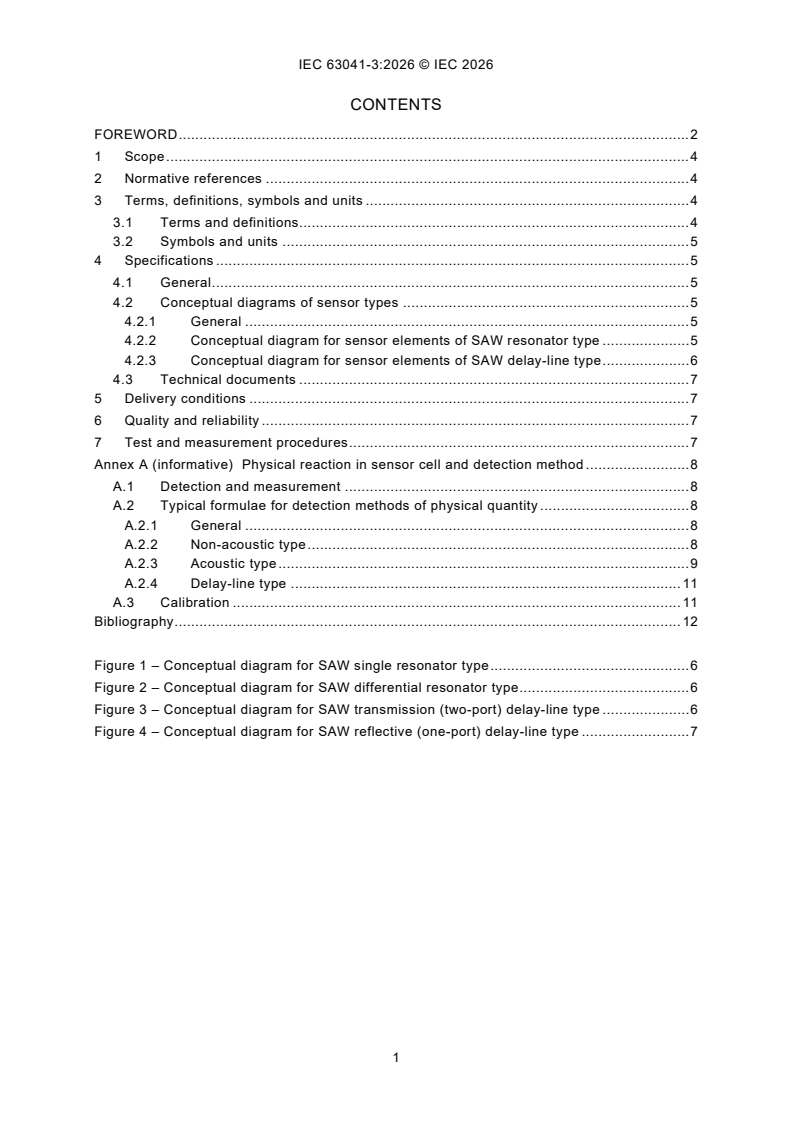
CONTENTS
FOREWORD . 2
1 Scope . 4
2 Normative references . 4
3 Terms, definitions, symbols and units . 4
3.1 Terms and definitions. 4
3.2 Symbols and units . 5
4 Specifications . 5
4.1 General . 5
4.2 Conceptual diagrams of sensor types . 5
4.2.1 General . 5
4.2.2 Conceptual diagram for sensor elements of SAW resonator type . 5
4.2.3 Conceptual diagram for sensor elements of SAW delay-line type . 6
4.3 Technical documents . 7
5 Delivery conditions . 7
6 Quality and reliability . 7
7 Test and measurement procedures . 7
Annex A (informative) Physical reaction in sensor cell and detection method . 8
A.1 Detection and measurement . 8
A.2 Typical formulae for detection methods of physical quantity . 8
A.2.1 General . 8
A.2.2 Non-acoustic type . 8
A.2.3 Acoustic type . 9
A.2.4 Delay-line type . 11
A.3 Calibration . 11
Bibliography . 12
Figure 1 – Conceptual diagram for SAW single resonator type . 6
Figure 2 – Conceptual diagram for SAW differential resonator type . 6
Figure 3 – Conceptual diagram for SAW transmission (two-port) delay-line type . 6
Figure 4 – Conceptual diagram for SAW reflective (one-port) delay-line type . 7
INTERNATIONAL ELECTROTECHNICAL COMMISSION
____________
Piezoelectric sensors -
Part 3: Physical sensors
FOREWORD
1) The International Electrotechnical Commission (IEC) is a worldwide organization for
standardization comprising all national electrotechnical committees (IEC National Committees).
The object of IEC is to promote international co-operation on all questions concerning
standardization in the electrical and electronic fields. To this end and in addition to other
activities, IEC publishes International Standards, Technical Specifications, Technical Reports,
Publicly Available Specifications (PAS) and Guides (hereafter referred to as “IEC
Publication(s)”). Their preparation is entrusted to technical committees; any IEC National
Committee interested in the subject dealt with may participate in this preparatory work.
International, governmental and non-governmental organizations liaising with the IEC also
participate in this preparation. IEC collaborates closely with the International Organization for
Standardization (ISO) in accordance with conditions determined by agreement between the
two organizations.
2) The formal decisions or agreements of IEC on technical matters express, as nearly as
possible, an international consensus of opinion on the relevant subjects since each technical
committee has representation from all interested IEC National Committees.
3) IEC Publications have the form of recommendations for international use and are accepted
by IEC National Committees in that sense. While all reasonable efforts are made to ensure that
the technical content of IEC Publications is accurate, IEC cannot be held responsible for the
way in which they are used or for any misinterpretation by any end user.
4) In order to promote international uniformity, IEC National Committees undertake to apply
IEC Publications transparently to the maximum extent possible in their national and regional
publications. Any divergence between any IEC Publication and the corresponding national or
regional publication shall be clearly indicated in the latter.
5) IEC itself does not provide any attestation of conformity. Independent certification bodies
provide conformity assessment services and, in some areas, access to IEC marks of conformity.
IEC is not responsible for any services carried out by independent certification bodies.
6) All users should ensure that they have the latest edition of this publication.
7) No liability shall attach to IEC or its directors, employees, servants or agents including
individual experts and members of its technical committees and IEC National Committees for
any personal injury, property damage or other damage of any nature whatsoever, whether direct
or indirect, or for costs (including legal fees) and expenses arising out of the publication, use
of, or reliance upon, this IEC Publication or any other IEC Publications.
8) Attention is drawn to the Normative references cited in this publication. Use of the referenced
publications is indispensable for the correct application of this publication.
9) IEC draws attention to the possibility that the implementation of this document may involve
the use of (a) patent(s). IEC takes no position concerning the evidence, validity or applicability
of any claimed patent rights in respect thereof. As of the date of publication of this document,
IEC had not received notice of (a) patent(s), which may be required to implement this document.
However, implementers are cautioned that this may not represent the latest information, which
may be obtained from the patent database available at https://patents.iec.ch. IEC shall not be
held responsible for identifying any or all such patent rights.
IEC 63041-3 has been prepared by IEC technical committee TC 49: Piezoelectric, dielectric and
electrostatic devices and associated materials for frequency control, selection and detection. It
is an International Standard.
This second edition cancels and replaces the first edition published in 2020. This edition
constitutes a technical revision.
This edition includes the following significant technical changes with respect to the previous
edition:
a) Some terms in Clause 3 have been updated to be consistent with IEC TS 61994-5:2023 [1].
The text of International Standard is based on the following documents:
Draft Report on voting
49/1526/FDIS 49/1530/RVD
Full information on the voting for its approval can be found in the report on voting indicated in
the above table.
The language used for the development of this International Standard is English .
This document was drafted in accordance with ISO/IEC Directives, Part 2, and developed in
accordance with ISO/IEC Directives, Part 1 and ISO/IEC Directives, IEC Supplement, available
at http://www.iec.ch/members_experts/refdocs. The main document types developed by IEC
are described in greater detail at http://www.iec.ch/publications.
A list of all parts in the IEC 63041 series, published under the general title Piezoelectric sensors,
can be found on the IEC website.
The committee has decided that the contents of this document will remain unchanged until the
stability date indicated on the IEC website under webstore.iec.ch in the data related to the
specific document. At this date, the document will be
– reconfirmed,
– withdrawn, or
– revised.
1 Scope
This part of IEC 63041 is applicable to piezoelectric physical sensors mainly used in the field
of process control, wireless monitoring, dynamics, thermodynamics, vacuum engineering, and
environmental sciences. This document provides users with technical guidelines as well as
basic knowledge of common physical sensors.
Piezoelectric sensors covered herein are those applied to the detection and measurement of
physical quantities such as force, pressure, torque, viscosity, temperature, film thickness,
acceleration, vibration, and tilt angle.
2 Normative references
The following documents are referred to in the text in such a way that some or all of their content
constitutes requirements of this document. For dated references, only the edition cited applies.
For undated references, the latest edition of the referenced document (including any
amendments) applies.
IEC 60027 (all parts), Letter symbols to be used in electrical technology
IEC 60050–561, International electrotechnical vocabulary – Part 561: Piezoelectric, dielectric
and electrostatic devices and associated materials for frequency control, selection and
detection
...
IEC 63041-3 ®
Edition 2.0 2026-02
INTERNATIONAL
STANDARD
REDLINE VERSION
Piezoelectric sensors -
Part 3: Physical sensors
ICS 31.140 ISBN 978-2-8327-1111-8
All rights reserved. Unless otherwise specified, no part of this publication may be reproduced or utilized in any form or
by any means, electronic or mechanical, including photocopying and microfilm, without permission in writing from either
IEC or IEC's member National Committee in the country of the requester. If you have any questions about IEC copyright
or have an enquiry about obtaining additional rights to this publication, please contact the address below or your local
IEC member National Committee for further information.
IEC Secretariat Tel.: +41 22 919 02 11
3, rue de Varembé info@iec.ch
CH-1211 Geneva 20 www.iec.ch
Switzerland
About the IEC
The International Electrotechnical Commission (IEC) is the leading global organization that prepares and publishes
International Standards for all electrical, electronic and related technologies.
About IEC publications
The technical content of IEC publications is kept under constant review by the IEC. Please make sure that you have the
latest edition, a corrigendum or an amendment might have been published.
IEC publications search - IEC Products & Services Portal - products.iec.ch
webstore.iec.ch/advsearchform Discover our powerful search engine and read freely all the
The advanced search enables to find IEC publications by a publications previews, graphical symbols and the glossary.
variety of criteria (reference number, text, technical With a subscription you will always have access to up to date
committee, …). It also gives information on projects, content tailored to your needs.
replaced and withdrawn publications.
Electropedia - www.electropedia.org
The world's leading online dictionary on electrotechnology,
IEC Just Published - webstore.iec.ch/justpublished
Stay up to date on all new IEC publications. Just Published containing more than 22 500 terminological entries in English
details all new publications released. Available online and and French, with equivalent terms in 25 additional languages.
once a month by email. Also known as the International Electrotechnical Vocabulary
(IEV) online.
IEC Customer Service Centre - webstore.iec.ch/csc
If you wish to give us your feedback on this publication or
need further assistance, please contact the Customer
Service Centre: sales@iec.ch.
CONTENTS
FOREWORD . 2
1 Scope . 4
2 Normative references . 4
3 Terms, definitions, symbols and units . 4
3.1 Terms and definitions. 4
3.2 Symbols and units . 5
4 Specifications . 5
4.1 General . 5
4.2 Conceptual diagrams of sensor types . 5
4.2.1 General . 5
4.2.2 Conceptual diagram for sensor elements of SAW resonator type . 6
4.2.3 Conceptual diagram for sensor elements of SAW delay-line type . 6
4.3 Technical documents . 7
5 Delivery conditions . 7
6 Quality and reliability . 7
7 Test and measurement procedures . 7
Annex A (informative) Physical reaction in sensor cell and detection method . 8
A.1 Detection and measurement . 8
A.2 Typical formulae for detection methods of physical quantity . 8
A.2.1 General . 8
A.2.2 Non-acoustic type . 8
A.2.3 Acoustic type . 9
A.2.4 Delay-line type . 11
A.3 Calibration . 11
Bibliography . 12
Figure 1 – Conceptual diagram for SAW single resonator type . 6
Figure 2 – Conceptual diagram for SAW differential resonator type . 6
Figure 3 – Conceptual diagram for SAW transmission (two-port) delay-line type . 6
Figure 4 – Conceptual diagram for SAW reflective (one-port) delay-line type . 7
INTERNATIONAL ELECTROTECHNICAL COMMISSION
____________
Piezoelectric sensors -
Part 3: Physical sensors
FOREWORD
1) The International Electrotechnical Commission (IEC) is a worldwide organization for
standardization comprising all national electrotechnical committees (IEC National Committees).
The object of IEC is to promote international co-operation on all questions concerning
standardization in the electrical and electronic fields. To this end and in addition to other
activities, IEC publishes International Standards, Technical Specifications, Technical Reports,
Publicly Available Specifications (PAS) and Guides (hereafter referred to as “IEC
Publication(s)”). Their preparation is entrusted to technical committees; any IEC National
Committee interested in the subject dealt with may participate in this preparatory work.
International, governmental and non-governmental organizations liaising with the IEC also
participate in this preparation. IEC collaborates closely with the International Organization for
Standardization (ISO) in accordance with conditions determined by agreement between the
two organizations.
2) The formal decisions or agreements of IEC on technical matters express, as nearly as
possible, an international consensus of opinion on the relevant subjects since each technical
committee has representation from all interested IEC National Committees.
3) IEC Publications have the form of recommendations for international use and are accepted
by IEC National Committees in that sense. While all reasonable efforts are made to ensure that
the technical content of IEC Publications is accurate, IEC cannot be held responsible for the
way in which they are used or for any misinterpretation by any end user.
4) In order to promote international uniformity, IEC National Committees undertake to apply
IEC Publications transparently to the maximum extent possible in their national and regional
publications. Any divergence between any IEC Publication and the corresponding national or
regional publication shall be clearly indicated in the latter.
5) IEC itself does not provide any attestation of conformity. Independent certification bodies
provide conformity assessment services and, in some areas, access to IEC marks of conformity.
IEC is not responsible for any services carried out by independent certification bodies.
6) All users should ensure that they have the latest edition of this publication.
7) No liability shall attach to IEC or its directors, employees, servants or agents including
individual experts and members of its technical committees and IEC National Committees for
any personal injury, property damage or other damage of any nature whatsoever, whether direct
or indirect, or for costs (including legal fees) and expenses arising out of the publication, use
of, or reliance upon, this IEC Publication or any other IEC Publications.
8) Attention is drawn to the Normative references cited in this publication. Use of the referenced
publications is indispensable for the correct application of this publication.
9) IEC draws attention to the possibility that the implementation of this document may involve
the use of (a) patent(s). IEC takes no position concerning the evidence, validity or applicability
of any claimed patent rights in respect thereof. As of the date of publication of this document,
IEC had not received notice of (a) patent(s), which may be required to implement this document.
However, implementers are cautioned that this may not represent the latest information, which
may be obtained from the patent database available at https://patents.iec.ch. IEC shall not be
held responsible for identifying any or all such patent rights.
This redline version of the official IEC Standard allows the user to identify the changes made
to the previous edition IEC 63041-3:2020. A vertical bar appears in the margin wherever a
change has been made. Additions are in green text, deletions are in strikethrough red text.
IEC 63041-3 has been prepared by IEC technical committee TC 49: Piezoelectric, dielectric and
electrostatic devices and associated materials for frequency control, selection and detection. It
is an International Standard.
This second edition cancels and replaces the first edition published in 2020. This edition
constitutes a technical revision.
This edition includes the following significant technical changes with respect to the previous
edition:
a) Some terms in Clause 3 have been updated to be consistent with IEC TS 61994-5:2023 [1].
The text of International Standard is based on the following documents:
Draft Report on voting
49/1526/FDIS 49/1530/RVD
Full information on the voting for its approval can be found in the report on voting indicated in
the above table.
The language used for the development of this International Standard is English .
This document was drafted in accordance with ISO/IEC Directives, Part 2, and developed in
accordance with ISO/IEC Directives, Part 1 and ISO/IEC Directives, IEC Supplement, available
at http://www.iec.ch/members_experts/refdocs. The main document types developed by IEC
are described in greater detail at http://www.iec.ch/publications.
A list of all parts in the IEC 63041 series, published under the general title Piezoelectric sensors,
can be found on the IEC website.
The committee has decided that the contents of this document will remain unchanged until the
stability date indicated on the IEC website under webstore.iec.ch in the data related to the
specific document. At this date, the document will be
– reconfirmed,
– withdrawn, or
– revised.
1 Scope
This part of IEC 63041 is applicable to piezoelectric physical sensors mainly used in the field
of process control, wireless monitoring, dynamics, thermodynamics, vacuum engineering, and
environmental sciences. This document provides users with technical guidelines as well as
basic knowledge of common physical sensors.
Piezoelectric sensors covered herein are those applied to the detection and measurement of
physical quantities such as force, pressure, torque, viscosity, temperature, film thickness,
acceleration, vibration, and tilt angle.
2 Normative references
The following documents are referred to in the text in such a way that some or all of their content
constitutes requirements of this document. For dated references, only the edition cited applies.
For undated references, the latest edition of the referenced document (including any
amendments) applies.
IEC 60027 (all parts), Letter symbols to be used in electrical technology
IEC 60050–561, International electrotechnical vocabulary – Part 561: Piezoelectric, dielectric
and electrostatic devices and associated materials for frequency control, selection and
detection
IEC 60617:2012, Graphical symbols for diagrams (database available at
http://std.iec.ch/iec60617)
IEC 63041-1:2017, Piezoelectric sensors - Part 1: Generic specifications
IEC 63041-2, Piezoelectric sensors - Part 2: Chemical and biochemical sensors
ISO 80000–1, Quantities and units – Part 1: General
3 Terms, definitions, symbols and units
3.1 Terms and definitions
For the purposes of this document, the terms and definitions given in IEC 60027 (all parts),
IEC 60050–561, IEC 60617:2012, IEC 63041-1, IEC 63041-2, and ISO 80000–1 and the
following apply.
ISO and IEC maintain terminological databases for use in standardization at the following
addresses:
– IEC Electropedia: available at http://www.electropedia.org/
– ISO Online browsing platform: available at http://www.iso.org/obp
3.1.1
piezoelectric acceleration sensor element
piezoelectric sensor component whose resonance frequency or delay time is used to measure
the change in velocity of an object with time
3.1.2
piezoelectric humidity sensor element
piezoelectric sensor component whose resonance frequency or delay time is used for dew point
and moisture detection
3.1.3
piezoelectric tilt angle sensor element
piezoelectric sensor component whose resonance frequency or delay time is used to measure
tilt angles, elevation, or depression of an object with respect to gravity's detection
3.1.4
piezoelectric vibration sensor element
piezoelectric sensor component whose resonance frequency or delay time is used for
measurement of vibration
3.1.5
dual mode sensor
piezoelectric sensor which is able to detect physical quantities from a change in resonance
frequencies of two independent modes on a single piezoelectric plate
Note 1 to entry: In order to achieve improved precision and/or to eliminate undesired influence factors, sensor
solutions are employed that utilize two or more modes. By evaluation of combinations of these modes’ sensitivities
to various ambient conditions, on the one hand, improved detection sensitivity can be achieved, while, on the other
hand, undesirable sensitivities can be reduced or eliminated.
3.1.6
differential sensor
piezoelectric sensor which is able to detect physical quantities from a change in resonance
frequencies or delays delay times of two independent and same micro-acoustic structures
assembled on the same or different piezoelectric plates
3.1.7
multi-measurand sensor
piezoelectric sensor element that is able to can detect two or more different physical quantities
from an analysis of different sensor responses
[SOURCE: IEC TS 61994-5:2023 [1], 3.6]
3.2 Symbols and units
The symbols and units given in IEC 63041-1 apply.
4 Specifications
4.1 General
Key points of the specification are identified in IEC 63041-1:2017, Clause 5.
4.2 Conceptual diagrams of sensor types
4.2.1 General
In addition to the sensor types listed in IEC 63041-1:2017, Clause 4, specific realizations are
common for surface acoustic wave (SAW) sensors.
In addition to the sensors defined in Clause 4 of IEC 63041-1, piezoelectric acceleration sensor
element, piezoelectric humidity sensor element, piezoelectric tilt angle sensor element and
piezoelectric vibration sensor element are also in practical use as physical sensors.
In addition, dual mode sensor, differential sensor and multi-measurand sensor are used as
sensor configuration.
4.2.2 Conceptual diagram for sensor elements of SAW resonator type
Figure 1 and Figure 2 show conceptual diagrams for resonator type SAW sensors. Figure 1
provides one resonance which is sensitive to undesirable influence factors such as frequency
pulling. In the case of Figure 2, comprising e.g. a parallel connection of two resonators at
different resonance frequencies, the sensor will be designed to have similar sensitivities of both
resonators to such undesired effects and is therefore suitable to achieve higher accuracy with
respect to the target measurand due to this compensation technique.
Figure 1 – Conceptual diagram for SAW single resonator type
Figure 2 – Conceptual diagram for SAW differential resonator type
4.2.3 Conceptual diagram for sensor elements of SAW delay-line type
Figure 3 shows a transmission type (two-port) and Figure 4 shows a reflective type (one-port).
Reflective delay lines use the SAW propagation path which is evaluated for delay and
attenuation changes twice for incident and reflected wave, and therefore can be designed as
smaller realizations. Reflective delay-line sensors can be designed to feature a unique sensor
identification, in combination with their sensor capabilities, by using several SAW reflector
structures resulting in a characteristic pattern of the reflected signal which can be distinguished
from other sensors using the same frequency range.
Figure 3 – Conceptual diagram for SAW transmission (two-port) delay-line type
Figure 4 – Conceptual diagram for SAW reflective (one-port) delay-line type
4.3 Technical documents
The physical reaction in sensor cell and detection methods are defined in Annex A.
The following 4.3, list item a) to 4.3, list item f) shall clearly be defined in the specifications to
be concluded between the manufacturer and customers:
a) avoidance of coupling of main and unwanted vibration modes;
b) detection direction of sensor element;
c) hysteresis of sensor elements;
d) linearity between sensor outputs and physical quantities to be detected;
e) overload characteristics by excessive physical quantities to be detected;
f) response time of sensor elements.
5 Delivery conditions
Clause 7 of IEC 63041-1:2017 applies.
6 Quality and reliability
Clause 8 of IEC 63041-1:2017 applies.
7 Test and measurement procedures
Annexes A and B of IEC 63041-1:2017 apply.
Annex A
(informative)
Physical reaction in sensor cell and detection method
A.1 Detection and measurement
Generally, detection and measurement items are Clause A.1, list item a) to Clause A.1,
list item d):
a) resonance frequency, delay time, and electrical charged and voltage covered herein are
applied to the detection and measurement of force, pressure, torque, vibration, acceleration,
etc.;
b) resonance frequency, delay time or insertion loss / gain covered herein are applied to the
detection and measurement of viscosity;
c) resonance frequency or delay time is applied to the detection and measurement of
temperature;
d) resonance frequency is applied to the detection and measurement of film thickness.
NOTE An electrical charged and voltage is measured by non-acoustic type piezoelectric ceramic and quartz crystal
sensors.
For these specifications, the manufacturer and customer shall have detailed discussions, the
discrepancies shall be eliminated, and the results shall clearly be described in the contract
clause, the requirements specifications of the customer, the delivery specifications thereof or
the like, and shall be settled as one of the contracts with the customer.
For Formula (A.1) to Formula (A.6), the manufacturer and customer can have discussions to
resolve discrepancies and note them in the relevant contract clause of the customer's
specifications
A.2 Typical formulae for detection methods of physical quantity
A.2.1 General
Formula (A.1) to Formula (A.6) presented as below are typical examples applied to physical
sensor elements and cells. For these formulae, the manufacturer and customer shall have
detailed discussions, the discrepancies shall be eliminated, and the results shall be described
clearly in the contract clause.
A.2.2 Non-acoustic type
A.2.2.1 Piezoelectric ceramics
When a sensor element is made of piezoelectric ceramics, and is working under g mode,
Formula (A.1) applies:
𝐹𝐹
𝑙𝑙 (A.1)
𝑉𝑉 =𝑔𝑔
𝑆𝑆
where
V is the voltage generated across the piezoelectric ceramic (V);
g is the piezoelectric voltage coefficient that quantifies the electric field generated per
unit of mechanical stress (V·m/N);
l is the length of the piezoelectric ceramics element and is the direction in which force
is applied to the one (mm);
F is the force applied to the piezoelectric ceramic element and cell (N);
S is the electrode area and is formed in a direction in which a force is applied to the
piezoelectric ceramic element and cell (m ).
A.2.2.2 X-cut quartz crystal
When sensor element is X-cut quartz crystal, Formula (A.2) applies:
𝐹𝐹
(A.2)
𝑉𝑉 =𝑔𝑔 𝑡𝑡
𝑆𝑆
where
g is the piezoelectric voltage coefficient (V·m/N);
t is the thickness of quartz crystal (mm).
A.2.3 Acoustic type
A.2.3.1 Resonator type
For resonator-type piezoelectric sensors, the change of one or more resonance frequencies
related to the effect of the measurand is interpreted to quantify the measurand. Typical
measuring range transform function is defined by polynomials as
N
i
y= g(∆f)= a f
∑
r i r
i=0
𝑁𝑁
𝑖𝑖
𝑦𝑦 =𝑔𝑔(Δ𝑓𝑓 ) =� 𝑎𝑎𝑓𝑓 (A.3)
𝑟𝑟 𝑖𝑖 𝑟𝑟
𝑖𝑖=0
where
y is the measurand (e.g. temperature, pressure, film thickness, etc.);
Δf is the change of resonance frequency under the influence of the measurand (Hz);
r
a are transform coefficients, determined by design and material system.
i
The unit used to measure "y" varies depending on the object being measured, for example,
temperature is measured in kelvins (K), pressure in pascals (Pa)", Δf in hertz (Hz). a is an
r i
arbitrary unit which changes depending on the input amount. For example, in the case of
measuring temperature, the unit of a is K/Hz.
i
A biunique transform function is generally desirable. Hence, the order of the polynomial should
will be kept low, ideally N = 1.
A.2.3.2 Differential resonator type
For differential resonator type sensors, it is common to evaluate two resonances with different
sensitivities to the measurand in order to eliminate undesired frequency pulling effects (e.g.
from load pulling effects in wireless piezoelectric sensor systems), such as
i
N
y= g(∆f −∆f )= b(∆f −∆f )
r1 r2 ∑ i r1 r2
i=0
𝑁𝑁
𝑖𝑖
𝑦𝑦 =𝑔𝑔(Δ𝑓𝑓 −Δ𝑓𝑓 ) =� 𝑏𝑏 (Δ𝑓𝑓 −Δ𝑓𝑓 ) (A.4)
𝑟𝑟1 𝑟𝑟2 𝑖𝑖 𝑟𝑟1 𝑟𝑟2
𝑖𝑖=0
where
Δf , are resonance frequencies of two resonators or resonant modes with different
r1
sensitivities with respect to the measurand, but preferably similar sensitivities with
Δf
r2
respect to undesired influence actors (Hz);
b are transform coefficients, determined by design and material system.
i
A.2.3.3 Multi-measurand resonator type
Evaluation of two or more resonators and their resonance frequencies, having arbitrary
sensitivities with respect to the measurands to be quantified, can be transformed by
𝑦𝑦 𝑎𝑎 𝑎𝑎 · · · 𝑎𝑎
1 1,0 1,1 1,𝑁𝑁 ⎡ ⎤
∆𝑓𝑓
⎡ ⎤ ⎡ ⎤ 1
𝑎𝑎 𝑎𝑎 · · · ·
𝑦𝑦
2,0 2,1 ⎢ ⎥
∆𝑓𝑓
⎢ ⎥ ⎢ ⎥
· · · · · · ·
⎢ ⎥
⎢ ⎥ ⎢ ⎥
= · (A.5)
⎢ ⎥
· · · · · · ·
⎢ ⎥ ⎢ ⎥
·
⎢ ⎥
· · · · · ·
·
⎢ ⎥ ⎢ ⎥
·
⎢ ⎥
𝑎𝑎 𝑎𝑎 · · · 𝑎𝑎
⎣𝑦𝑦 ⎦ ⎣ ⎦
𝐾𝐾,0 𝐾𝐾,0 𝐾𝐾,𝑁𝑁
𝐾𝐾
⎣∆𝑓𝑓⎦
𝑁𝑁
where
y are a range of measurands, and the units used to measure them vary depending
1 . . .
on the measurement object. For example, the unit for temperature is K and the
y
K
unit for pressure is Pa;
a is the coefficient of the transformation matrix, and its units are determined by the
K,N
relationship between 𝑦𝑦and ∆𝑓𝑓. For example, if 'y' represents temperature, the unit
of 𝑎𝑎 is K/Hz;
Δf . . are the changes in resonance frequencies obtained for N resonators of the
piezoelectric sensor (Hz);
. Δf
N
K < N to allow for determination of multiple measurands and compensation for undesired
effects are dimensionless constants;
j, n are the exponents of higher order polynomial transform functions and should be
are kept minimum, e.g. j, n ≤ 2.
𝑗𝑗
𝑛𝑛
or higher-order polynomials of Δ𝑓𝑓 ⋅Δ𝑓𝑓 (𝑖𝑖,𝑚𝑚∈ [1.𝑁𝑁]).
𝑚𝑚
𝑖𝑖
A.2.4 Delay-line type
For delay-line type piezoelectric sensors, the change of the delay of the transmitted or reflected
impulses related to the effect of the measurand is interpreted to quantify the measurand.
Typically the transform function is defined by polynomials:
N
i
y= g(∆τ)= c∆τ
∑ i
i=0
y is the measurand (e.g. temperature, pressure, etc.);
Δτ is the change of the delay of the transmitted or reflected signal under the influence of the
measurand;
c are transform coefficients, determined by design and material system.
i
𝑁𝑁
𝑖𝑖
( )
𝑦𝑦 =𝑔𝑔(∆𝜏𝜏) =� 𝑐𝑐 ∆𝜏𝜏 (A.6)
𝑖𝑖
𝑖𝑖=0
where
y is the measurand (e.g. temperature, pressure, film thickness, etc.). It varies
depending on the object being measured, for example, units of temperature is K,
and pressure is Pa;
𝑔𝑔(∆𝜏𝜏) is the change of resonance frequency under the influence of the measurand;
∆𝜏𝜏 is the change of the delay of the transmitted or reflected signal under the influence
of the measurand in delay (s);
𝑐𝑐 is transform coefficients, determined by design and material system. It has an
𝑖𝑖
arbitrary unit which changes depending on the input amount. For example, in the
case of measuring temperature, its unit is K/Hz.
For reflective delay lines of Figure 4, realization and evaluation of multiple reflected signals are
common to enhance sensitivity and/or to enable unique sensor identification, e.g. allowing for
use of multiple sensors within the same frequency range in wireless sensor systems.
A.3 Calibration
The calibration method should be is specified in the detailed specification and/or contract.
Bibliography
IEC 60068 (all parts), Environmental testing
IEC 60122-1, Quartz crystal units of assessed quality – Part 1: Generic specification
IEC 60122-2-1, Quartz crystal units for frequency control and selection – Part 2: Guide to the
use of quartz crystal units for frequency control and selection – Section one: Quartz crystal
units for microprocessor clock supply
IEC 60444-1, Measurement of quartz crystal unit parameters by zero phase technique in a pi-
network – Part 1: Basic method for the measurement of resonance frequency and resonance
resistance of quartz crystal units by zero phase technique in a pi-network
IEC 60444-5, Measurement of quartz crystal unit parameters – Part 5: Methods for the
determination of equivalent electrical parameters using automatic network analyzer techniques
and error correction
IEC 60444-9, Measurement of quartz crystal unit parameters – Part 9: Measurement of spurious
resonances of piezoelectric crystal units
IEC 60642, Piezoelectric ceramic resonators and resonator units for frequency control and
selection – Chapter I: Standard values and conditions – Chapter II: Measuring and test
conditions
IEC 60679 (all parts), Piezoelectric, dielectric and electrostatic oscillators of assessed quality
IEC 60758:2016, Synthetic quartz crystal – Specifications and guidelines for use
IEC 60862-1, Surface acoustic wave (SAW) filters of assessed quality – Part 1: Generic
specification
IEC 61019-1, Surface acoustic wave (SAW) resonators – Part 1: Generic specification
IEC 61240:2016, Piezoelectric devices – Preparation of outline drawings of surface-mounted
devices (SMD) for frequency control and selection – General rules
IEC 61760 (all parts), Surface mounting technology
IEC 61837 (all parts), Surface mounted piezoelectric devices for frequency control and
selection – Standard outlines and terminal lead connections
IEC TS 61994 (all parts), Piezoelectric, dielectric and electrostatic devices and associated
materials for frequency control, selection and detection – Glossary
IEC 62276:2016, Single crystal wafers for surface acoustic wave (SAW) device applications –
Specifications and measuring methods
ISO 2859-1:1999, Sampling procedures for inspection by attributes – Part 1: Sampling schemes
indexed by acceptance quality limit (AQL) for lot-by-lot inspection
ISO 11843-1: 1997, Capability of detection – Part 1: Terms and definitions
ISO 11843-2: 2000, Capability of detection – Part 2: Methodology in the linear calibration case
ISO/IEC Guide 99:2007, International vocabulary of metrology – Basic and general concepts
and associated terms (VIM)
ISO/IEC 17025, General requirements for the competence of testing and calibration laboratories
E. P. EerNisse, R. W. Ward and R. B. Wiggins, "Survey of Quartz Bulk Resonator Sensor
Technologies," IEEE Transactions on Ultrasonics, Ferroelectrics, and Frequency Control, Vol.
35, No. 3, pp. 323-330, May 1988.
G. G. Guilbault and J. M. Jordan, "Analytical Uses of Piezoelectric Crystals: A Review," CRC
Critical Reviews in Analytical Chemistry, Vol. 19, Issue 1, pp. 1-28, 1988.
J. J. McCallum, "Piezoelectric Devices for Mass and Chemical Measurements," Analyst, Vol.
114, pp. 1173-1189, Oct. 1989.
R. J. Besson, J. J. Boy, B. Glotin, Y. Jinzaki, B. Sinha, and M. Valdois, “A dual-mode thickness-
shear quartz pressure sensor,” IEEE Trans. Ultrason. Ferroelect. Freq. Contr., Vol. 40, pp. 584-
591, 1993.
D. S. Ballantine, Jr., et. al, Acoustic Wave Sensors - Theory, Design, and Physico-Chemical
Applications, Academic Press, 1997.
Special Issue on Sensors and Actuators, IEEE Trans. on Ultrasonics, Ferroelectrics, and
Frequency Control, vol. 45, September 1998.
J. R. Vig, “Dual-mode Oscillators for Clocks and Sensors,” Proc. 1999 IEEE International
Ultrasonics Symposium
N. Matsumoto, Y. Sudo, B. Sinha and M. Niwa, “Long-term stability and performance
characteristics of crystal gauge at high pressures and temperatures,” Proc. 1999 IEEE
International Frequency Control Symposium
Shigeyoshi GOKA, Kiwamu OKABE, Yasuaki WATANABE and Hitoshi SEKIMOTO, “Multimode
Quartz Crystal Microbalance,” Jpn. J. Appl. Phys. Vol. 39 (2000) pp. 3073–3075.
X. Q. Bao, W. Burkhard, V. V. Varadan and V. K. Varadan, “SAW temperature sensor and
remote reading system,” Proc. 1987 IEEE International Ultrasonics Symposium
W. Buff, M. Rusko, T. Vandahl, M. Goroll and F. Möller, “A differential measurement SAW device
for passive remote sensoring,” Proc. 1996 IEEE International Ultrasonics Symposium
A. Pohl and F. Seifert, “Wirelessly interrogable Surface Acoustic Wave sensors for vehicular
applications,“ IEEE Transactions on Instrumentation and Measurement, Vol. 46, pp. 1031-1038,
L. M. Reindl, A. Pohl, G. Scholl and R. Weigel, “SAW-based radio sensor systems,” IEEE
Sensors Journal, Vol. 1, pp. 69-78, 2001
D. Puccio, D. C. Malocha, D. Gallagher and J. Hines, “SAW Sensors Using Orthogonal
Frequency Coding,” Proceedings of the 2004 IEEE International Frequency Control Symposium
and Exposition
[1] IEC TS 61994-5:2023, Piezoelectric, dielectric and electrostatic devices and associated
materials for frequency control, selection and detection - Glossary - Part 5: Piezoelectric
sensors
___________
IEC 63041-3 ®
Edition 2.0 2026-02
INTERNATIONAL
STANDARD
NORME
INTERNATIONALE
Piezoelectric sensors -
Part 3: Physical sensors
Capteurs piézoélectriques -
Partie 3: Capteurs physiques
ICS 31.140 ISBN 978-2-8327-1033-3
CONTENTS
FOREWORD . 2
1 Scope . 4
2 Normative references . 4
3 Terms, definitions, symbols and units . 4
3.1 Terms and definitions. 4
3.2 Symbols and units . 5
4 Specifications . 5
4.1 General . 5
4.2 Conceptual diagrams of sensor types . 5
4.2.1 General . 5
4.2.2 Conceptual diagram for sensor elements of SAW resonator type . 5
4.2.3 Conceptual diagram for sensor elements of SAW delay-line type . 6
4.3 Technical documents . 7
5 Delivery conditions . 7
6 Quality and reliability . 7
7 Test and measurement procedures . 7
Annex A (informative) Physical reaction in sensor cell and detection method . 8
A.1 Detection and measurement . 8
A.2 Typical formulae for detection methods of physical quantity . 8
A.2.1 General . 8
A.2.2 Non-acoustic type . 8
A.2.3 Acoustic type . 9
A.2.4 Delay-line type . 11
A.3 Calibration . 11
Bibliography . 12
Figure 1 – Conceptual diagram for SAW single resonator type . 6
Figure 2 – Conceptual diagram for SAW differential resonator type . 6
Figure 3 – Conceptual diagram for SAW transmission (two-port) delay-line type . 6
Figure 4 – Conceptual diagram for SAW reflective (one-port) delay-line type . 7
INTERNATIONAL ELECTROTECHNICAL COMMISSION
____________
Piezoelectric sensors -
Part 3: Physical sensors
FOREWORD
1) The International Electrotechnical Commission (IEC) is a worldwide organization for
standardization comprising all national electrotechnical committees (IEC National Committees).
The object of IEC is to promote international co-operation on all questions concerning
standardization in the electrical and electronic fields. To this end and in addition to other
activities, IEC publishes International Standards, Technical Specifications, Technical Reports,
Publicly Available Specifications (PAS) and Guides (hereafter referred to as “IEC
Publication(s)”). Their preparation is entrusted to technical committees; any IEC National
Committee interested in the subject dealt with may participate in this preparatory work.
International, governmental and non-governmental organizations liaising with the IEC also
participate in this preparation. IEC collaborates closely with the International Organization for
Standardization (ISO) in accordance with conditions determined by agreement between the
two organizations.
2) The formal decisions or agreements of IEC on technical matters express, as nearly as
possible, an international consensus of opinion on the relevant subjects since each technical
committee has representation from all interested IEC National Committees.
3) IEC Publications have the form of recommendations for international use and are accepted
by IEC National Committees in that sense. While all reasonable efforts are made to ensure that
the technical content of IEC Publications is accurate, IEC cannot be held responsible for the
way in which they are used or for any misinterpretation by any end user.
4) In order to promote international uniformity, IEC National Committees undertake to apply
IEC Publications transparently to the maximum extent possible in their national and regional
publications. Any divergence between any IEC Publication and the corresponding national or
regional publication shall be clearly indicated in the latter.
5) IEC itself does not provide any attestation of conformity. Independent certification bodies
provide conformity assessment services and, in some areas, access to IEC marks of conformity.
IEC is not responsible for any services carried out by independent certification bodies.
6) All users should ensure that they have the latest edition of this publication.
7) No liability shall attach to IEC or its directors, employees, servants or agents including
individual experts and members of its technical committees and IEC National Committees for
any personal injury, property damage or other damage of any nature whatsoever, whether direct
or indirect, or for costs (including legal fees) and expenses arising out of the publication, use
of, or reliance upon, this IEC Publication or any other IEC Publications.
8) Attention is drawn to the Normative references cited in this publication. Use of the referenced
publications is indispensable for the correct application of this publication.
9) IEC draws attention to the possibility that the implementation of this document may involve
the use of (a) patent(s). IEC takes no position concerning the evidence, validity or applicability
of any claimed patent rights in respect thereof. As of the date of publication of this document,
IEC had not received notice of (a) patent(s), which may be required to implement this document.
However, implementers are cautioned that this may not represent the latest information, which
may be obtained from the patent database available at https://patents.iec.ch. IEC shall not be
held responsible for identifying any or all such patent rights.
IEC 63041-3 has been prepared by IEC technical committee TC 49: Piezoelectric, dielectric and
electrostatic devices and associated materials for frequency control, selection and detection. It
is an International Standard.
This second edition cancels and replaces the first edition published in 2020. This edition
constitutes a technical revision.
This edition includes the following significant technical changes with respect to the previous
edition:
a) Some terms in Clause 3 have been updated to be consistent with IEC TS 61994-5:2023 [1].
The text of International Standard is based on the following documents:
Draft Report on voting
49/1526/FDIS 49/1530/RVD
Full information on the voting for its approval can be found in the report on voting indicated in
the above table.
The language used for the development of this International Standard is English .
This document was drafted in accordance with ISO/IEC Directives, Part 2, and developed in
accordance with ISO/IEC Directives, Part 1 and ISO/IEC Directives, IEC Supplement, available
at http://www.iec.ch/members_experts/refdocs. The main document types developed by IEC
are described in greater detail at http://www.iec.ch/publications.
A list of all parts in the IEC 63041 series, published under the general title Piezoelectric sensors,
can be found on the IEC website.
The committee has decided that the contents of this document will remain unchanged until the
stability date indicated on the IEC website under webstore.iec.ch in the data related to the
specific document. At this date, the document will be
– reconfirmed,
– withdrawn, or
– revised.
1 Scope
This part of IEC 63041 is applicable to piezoelectric physical sensors mainly used in the field
of process control, wireless monitoring, dynamics, thermodynamics, vacuum engineering, and
environmental sciences. This document provides users with technical guidelines as well as
basic knowledge of common physical sensors.
Piezoelectric sensors covered herein are those applied to the detection and measurement of
physical quantities such as force, pressure, torque, viscosity, temperature, film thickness,
acceleration, vibration, and tilt angle.
2 Normative references
The following documents are referred to in the text in such a way that some or all of their content
constitutes requirements of this document. For dated references, only the edition cited applies.
For undated references, the latest edition of the referenced document (including any
amendments) applies.
IEC 60027 (all parts), Letter symbols to be used in electrical technology
IEC 60050–561, International electrotechnical vocabulary – Part 561: Piezoelectric, dielectric
and electrostatic devices and associated materials for frequency control, selection and
detection
IEC 60617:2012, Graphical symbols for diagrams
IEC 63041-1, Piezoelectric sensors - Part 1: Generic specifications
IEC 63041-2, Piezoelectric sensors - Part 2: Chemical and biochemical sensors
ISO 80000–1, Quantities and units – Part 1: General
3 Terms, definitions, symbols and units
3.1 Terms and definitions
For the purposes of this document, the terms and definitions given in IEC 60027 (all parts),
IEC 60050–561, IEC 60617:2012, IEC 63041-1, IEC 63041-2, and ISO 80000–1 and the
following apply.
ISO and IEC maintain terminological databases for use in standardization at the following
addresses:
– IEC Electropedia: available at http://www.electropedia.org/
– ISO Online browsing platform: available at http://www.iso.org/obp
3.1.1
piezoelectric acceleration sensor element
piezoelectric sensor component whose resonance frequency or delay time is used to measure
the change in velocity of an object with time
3.1.2
piezoelectric humidity sensor element
piezoelectric sensor component whose resonance frequency or delay time is used for dew point
and moisture detection
3.1.3
piezoelectric tilt angle sensor element
piezoelectric sensor component whose res
...
IEC 63041-3 ®
Edition 2.0 2026-02
NORME
INTERNATIONALE
Capteurs piézoélectriques -
Partie 3: Capteurs physiques
ICS 31.140 ISBN 978-2-8327-1033-3
Droits de reproduction réservés. Sauf indication contraire, aucune partie de cette publication ne peut être reproduite ni
utilisée sous quelque forme que ce soit et par aucun procédé, électronique ou mécanique, y compris la photocopie et
les microfilms, sans l'accord écrit de l'IEC ou du Comité national de l'IEC du pays du demandeur. Si vous avez des
questions sur le copyright de l'IEC ou si vous désirez obtenir des droits supplémentaires sur cette publication, utilisez
les coordonnées ci-après ou contactez le Comité national de l'IEC de votre pays de résidence.
IEC Secretariat Tel.: +41 22 919 02 11
3, rue de Varembé info@iec.ch
CH-1211 Geneva 20 www.iec.ch
Switzerland
A propos de l'IEC
La Commission Electrotechnique Internationale (IEC) est la première organisation mondiale qui élabore et publie des
Normes internationales pour tout ce qui a trait à l'électricité, à l'électronique et aux technologies apparentées.
A propos des publications IEC
Le contenu technique des publications IEC est constamment revu. Veuillez vous assurer que vous possédez l’édition la
plus récente, un corrigendum ou amendement peut avoir été publié.
Recherche de publications IEC - IEC Products & Services Portal - products.iec.ch
webstore.iec.ch/advsearchform Découvrez notre puissant moteur de recherche et consultez
La recherche avancée permet de trouver des publications gratuitement tous les aperçus des publications, symboles
IEC en utilisant différents critères (numéro de référence, graphiques et le glossaire. Avec un abonnement, vous aurez
texte, comité d’études, …). Elle donne aussi des toujours accès à un contenu à jour adapté à vos besoins.
informations sur les projets et les publications remplacées
ou retirées. Electropedia - www.electropedia.org
Le premier dictionnaire d'électrotechnologie en ligne au
IEC Just Published - webstore.iec.ch/justpublished monde, avec plus de 22 500 articles terminologiques en
Restez informé sur les nouvelles publications IEC. Just anglais et en français, ainsi que les termes équivalents
dans 25 langues additionnelles. Egalement appelé
Published détaille les nouvelles publications parues.
Disponible en ligne et une fois par mois par email. Vocabulaire Electrotechnique International (IEV) en ligne.
Service Clients - webstore.iec.ch/csc
Si vous désirez nous donner des commentaires sur cette
publication ou si vous avez des questions contactez-
nous: sales@iec.ch.
SOMMAIRE
AVANT-PROPOS . 2
1 Domaine d’application . 4
2 Références normatives . 4
3 Termes, définitions, symboles et unités . 4
3.1 Termes et définitions . 4
3.2 Symboles et unités . 5
4 Spécifications . 5
4.1 Généralités . 5
4.2 Diagrammes conceptuels des types de capteurs . 5
4.2.1 Généralités . 5
4.2.2 Schéma conceptuel des éléments de capteur de type résonateur SAW . 6
4.2.3 Schéma conceptuel des éléments de détection de type ligne à retard
SAW . 6
4.3 Documents techniques . 7
5 Conditions de livraison . 7
6 Qualité et fiabilité . 7
7 Procédures d'essai et de mesure . 7
Annexe A (informative) Réaction physique dans la cellule de détection et méthode de
détection . 8
A.1 Détection et mesure . 8
A.2 Formules typiques pour les méthodes de détection des quantités physiques . 8
A.2.1 Généralités . 8
A.2.2 Type non acoustique . 8
A.2.3 Type acoustique . 9
A.2.4 Type de ligne à retard . 11
A.3 Calibrage . 11
Bibliographie . 12
Figure 1 – Schéma conceptuel d'un résonateur unique SAW . 6
Figure 2 – Schéma conceptuel d'un résonateur différentiel SAW . 6
Figure 3 – Schéma conceptuel d'une transmission SAW (à deux ports) de type ligne à
retard . 7
Figure 4 – Schéma conceptuel d'une ligne à retard réfléchissante SAW (à un port) . 7
COMMISSION ÉLECTROTECHNIQUE INTERNATIONALE
____________
Capteurs piézoélectriques -
Partie 3: Capteurs physiques
AVANT-PROPOS
1) La Commission Électrotechnique Internationale (IEC) est une organisation mondiale de
normalisation composée de tous les comités électrotechniques nationaux (Comités nationaux
de l'IEC). L’IEC a pour objet de favoriser la coopération internationale pour toutes les questions
de normalisation dans les domaines de l’électricité et de l’électronique. À cet effet, l’IEC – entre
autres activités – publie des Normes internationales, des Spécifications techniques, des
Rapports techniques, des Spécifications accessibles au public (PAS) et des Guides (ci-après
dénommés "Publication(s) de l’IEC"). Leur élaboration est confiée à des comités d’études, aux
travaux desquels tout Comité national intéressé par le sujet traité peut participer. Les
organisations internationales, gouvernementales et non gouvernementales, en liaison avec
l’IEC, participent également aux travaux. L’IEC collabore étroitement avec l’Organisation
Internationale de Normalisation (ISO), selon des conditions fixées par accord entre les deux
organisations.
2) Les décisions ou accords officiels de l’IEC relatifs aux questions techniques représentent,
dans la mesure du possible, un consensus international sur les sujets étudiés, étant donné que
tous les Comités nationaux de l’IEC intéressés sont représentés dans chaque comité d’études.
3) Les Publications de l'IEC se présentent sous la forme de recommandations internationales
et sont acceptées en ce sens par les Comités nationaux de l'IEC. Tous les efforts raisonnables
sont entrepris afin que l’IEC s’assure de l’exactitude du contenu technique de ses publications;
l’IEC ne peut pas être tenue responsable de l’éventuelle mauvaise utilisation ou interprétation
qui en est faite par un quelconque utilisateur final.
4) Afin de promouvoir l'uniformité internationale, les Comités nationaux de l’IEC s'engagent,
dans toute la mesure possible, à appliquer les Publications de l’IEC de manière transparente
dans leurs publications nationales et régionales. Toutes divergences entre toutes Publications
de l’IEC et toutes publications nationales ou régionales correspondantes doivent être indiquées
en termes clairs dans ces dernières.
5) L'IEC elle-même ne fournit aucune attestation de conformité. Des organismes de
certification indépendants fournissent des services d’évaluation de conformité et, dans certains
secteurs, accèdent aux marques de conformité de l’IEC. L’IEC n’est responsable d’aucun des
services effectués par les organismes de certification indépendants.
6) Il convient que tous les utilisateurs s'assurent qu'ils sont en possession de la dernière édition
de cette publication.
7) Aucune responsabilité ne doit être imputée à l'IEC, à ses administrateurs, employés,
auxiliaires ou mandataires, y compris ses experts particuliers et les membres de ses comités
d"études et des Comités nationaux de l'IEC, pour tout préjudice causé en cas de dommages
corporels et matériels ou de tout autre dommage de quelque nature que ce soit, directe ou
indirecte, ou pour supporter les coûts (y compris les frais de justice) et les dépenses découlant
de la publication ou de l'utilisation de cette Publication de l'IEC ou de toute autre Publication
de l'IEC, ou au crédit qui lui est accordé.
8) L'attention est attirée sur les références normatives citées dans la présente publication.
L’utilisation de publications référencées est obligatoire pour une application correcte de la
présente publication.
9) L'IEC attire l'attention sur le fait que la mise en œuvre du présent document peut impliquer
l'utilisation de brevet(s). L’IEC ne prend pas position quant à la preuve, à la validité et à
l’applicabilité de tout droit de brevet revendiqué à cet égard. À la date de publication du présent
document, l’IEC n'avait pas reçu de notification de brevet(s) pouvant être exigé(s) pour la mise
en œuvre du présent document. Toutefois, il y a lieu d’avertir les responsables de la mise en
application du présent document que des informations plus récentes sont susceptibles de
figurer dans la base de données de brevets, disponible à l’adresse https://patents.iec.ch. L’IEC
ne saurait être tenue pour responsable de ne pas avoir identifié de tels droits de propriété et
averti de leur existence.
L'IEC 63041‑3 a été établie par le comité d’études 49 de l'IEC: Dispositifs piézoélectriques,
diélectriques et électrostatiques et matériaux associés pour le contrôle, la sélection et la
détection des fréquences. Il s’agit d’une norme internationale.
Cette deuxième édition annule et remplace la première édition publiée en 2020. Cette édition
constitue une révision technique.
Cette édition inclut les modifications techniques majeures suivantes par rapport à l’édition
précédente:
a) Certains termes de l'Article 3 ont été mis à jour pour être cohérents avec
l'IEC TS 61994-5:2023 [1].
Le texte de la norme internationale est basé sur les documents suivants :
Projet Rapport de vote
49/1526/FDIS 49/1530/RVD
Le rapport de vote indiqué dans le tableau ci-dessus donne toute information sur le vote ayant
abouti à son approbation.
La langue employée pour l’élaboration de cette Norme internationale est l’anglais.
Ce document a été rédigé conformément aux Directives ISO/IEC, Partie 2, et développé
conformément aux Directives ISO/IEC, Partie 1 et aux Directives ISO/IEC, Supplément IEC,
disponibles à l'adresse http://www.iec.ch/members_experts/refdocs. Les principaux types de
documents élaborés par l’IEC sont décrits plus en détail à l'adresse
http://www.iec.ch/publications.
Une liste de toutes les parties de la série IEC 63041, publiée sous le titre général Piezoelectric
sensors, peut être consultée sur le site web de l’IEC.
Le comité a décidé que le contenu de ce document ne sera pas modifié avant la date de stabilité
indiquée sur le site web de l'IEC sous webstore.iec.ch dans les données relatives au document
spécifique. À cette date, le document sera
– reconduit,
– supprimé, ou
– révisé.
1 Domaine d’application
La présente partie de l’IEC 63041 s'applique aux capteurs physiques piézoélectriques
principalement utilisés dans le domaine du contrôle des processus, de la surveillance sans fil,
de la dynamique, de la thermodynamique, de l'ingénierie du vide et des sciences de
l'environnement. Ce document fournit aux utilisateurs des lignes directrices techniques ainsi
que des connaissances de base sur les capteurs physiques courants.
Les capteurs piézoélectriques dont il est question ici sont ceux qui sont appliqués à la détection
et à la mesure de grandeurs physiques telles que la force, la pression, le couple, la viscosité,
la température, l'épaisseur du film, l'accélération, la vibration et l'angle d'inclinaison.
2 Références normatives
Les documents suivants sont cités dans le texte de sorte qu’ils constituent, pour tout ou partie
de leur contenu, des exigences du présent document. Pour les références datées, seule
l’édition citée s’applique. Pour les références non datées, la dernière édition du document de
référence s’applique (y compris les éventuels amendements).
IEC 60027 (toutes les parties), Lettres symboles à utiliser en électrotechnique
IEC 60050-561, Vocabulaire électrotechnique international - Partie 561 : Dispositifs
piézoélectriques, diélectriques et électrostatiques et matériaux associés pour le contrôle, la
sélection et la détection de la fréquence
IEC 60617:2012, Symboles graphiques pour les diagrammes
IEC 63041-1, Capteurs piézoélectriques - Partie 1: Spécifications génériques
IEC 63041-2, Capteurs piézoélectriques - Partie 2: Détecteurs chimiques et biochimiques
I
...
IEC 63041-3 ®
Edition 2.0 2026-02
INTERNATIONAL
STANDARD
NORME
INTERNATIONALE
Piezoelectric sensors -
Part 3: Physical sensors
Capteurs piézoélectriques -
Partie 3: Capteurs physiques
ICS 31.140 ISBN 978-2-8327-1033-3
All rights reserved. Unless otherwise specified, no part of this publication may be reproduced or utilized in any form or
by any means, electronic or mechanical, including photocopying and microfilm, without permission in writing from either
IEC or IEC's member National Committee in the country of the requester. If you have any questions about IEC copyright
or have an enquiry about obtaining additional rights to this publication, please contact the address below or your local
IEC member National Committee for further information.
Droits de reproduction réservés. Sauf indication contraire, aucune partie de cette publication ne peut être reproduite ni
utilisée sous quelque forme que ce soit et par aucun procédé, électronique ou mécanique, y compris la photocopie et
les microfilms, sans l'accord écrit de l'IEC ou du Comité national de l'IEC du pays du demandeur. Si vous avez des
questions sur le copyright de l'IEC ou si vous désirez obtenir des droits supplémentaires sur cette publication, utilisez
les coordonnées ci-après ou contactez le Comité national de l'IEC de votre pays de résidence.
IEC Secretariat Tel.: +41 22 919 02 11
3, rue de Varembé info@iec.ch
CH-1211 Geneva 20 www.iec.ch
Switzerland
About the IEC
The International Electrotechnical Commission (IEC) is the leading global organization that prepares and publishes
International Standards for all electrical, electronic and related technologies.
About IEC publications
The technical content of IEC publications is kept under constant review by the IEC. Please make sure that you have the
latest edition, a corrigendum or an amendment might have been published.
IEC publications search - IEC Products & Services Portal - products.iec.ch
webstore.iec.ch/advsearchform Discover our powerful search engine and read freely all the
The advanced search enables to find IEC publications by a publications previews, graphical symbols and the glossary.
variety of criteria (reference number, text, technical With a subscription you will always have access to up to date
committee, …). It also gives information on projects, content tailored to your needs.
replaced and withdrawn publications.
Electropedia - www.electropedia.org
IEC Just Published - webstore.iec.ch/justpublished The world's leading online dictionary on electrotechnology,
Stay up to date on all new IEC publications. Just Published containing more than 22 500 terminological entries in English
details all new publications released. Available online and and French, with equivalent terms in 25 additional languages.
once a month by email. Also known as the International Electrotechnical Vocabulary
(IEV) online.
IEC Customer Service Centre - webstore.iec.ch/csc
If you wish to give us your feedback on this publication or
need further assistance, please contact the Customer
Service Centre: sales@iec.ch.
A propos de l'IEC
La Commission Electrotechnique Internationale (IEC) est la première organisation mondiale qui élabore et publie des
Normes internationales pour tout ce qui a trait à l'électricité, à l'électronique et aux technologies apparentées.
A propos des publications IEC
Le contenu technique des publications IEC est constamment revu. Veuillez vous assurer que vous possédez l’édition la
plus récente, un corrigendum ou amendement peut avoir été publié.
Recherche de publications IEC - IEC Products & Services Portal - products.iec.ch
webstore.iec.ch/advsearchform Découvrez notre puissant moteur de recherche et consultez
La recherche avancée permet de trouver des publications gratuitement tous les aperçus des publications, symboles
IEC en utilisant différents critères (numéro de référence, graphiques et le glossaire. Avec un abonnement, vous aurez
texte, comité d’études, …). Elle donne aussi des toujours accès à un contenu à jour adapté à vos besoins.
informations sur les projets et les publications remplacées
ou retirées. Electropedia - www.electropedia.org
Le premier dictionnaire d'électrotechnologie en ligne au
IEC Just Published - webstore.iec.ch/justpublished monde, avec plus de 22 500 articles terminologiques en
Restez informé sur les nouvelles publications IEC. Just anglais et en français, ainsi que les termes équivalents
Published détaille les nouvelles publications parues. dans 25 langues additionnelles. Egalement appelé
Disponible en ligne et une fois par mois par email. Vocabulaire Electrotechnique International (IEV) en ligne.
Service Clients - webstore.iec.ch/csc
Si vous désirez nous donner des commentaires sur cette
publication ou si vous avez des questions contactez-
nous: sales@iec.ch.
CONTENTS
FOREWORD . 2
1 Scope . 4
2 Normative references . 4
3 Terms, definitions, symbols and units . 4
3.1 Terms and definitions. 4
3.2 Symbols and units . 5
4 Specifications . 5
4.1 General . 5
4.2 Conceptual diagrams of sensor types . 5
4.2.1 General . 5
4.2.2 Conceptual diagram for sensor elements of SAW resonator type . 5
4.2.3 Conceptual diagram for sensor elements of SAW delay-line type . 6
4.3 Technical documents . 7
5 Delivery conditions . 7
6 Quality and reliability . 7
7 Test and measurement procedures . 7
Annex A (informative) Physical reaction in sensor cell and detection method . 8
A.1 Detection and measurement . 8
A.2 Typical formulae for detection methods of physical quantity . 8
A.2.1 General . 8
A.2.2 Non-acoustic type . 8
A.2.3 Acoustic type . 9
A.2.4 Delay-line type . 11
A.3 Calibration . 11
Bibliography . 12
Figure 1 – Conceptual diagram for SAW single resonator type . 6
Figure 2 – Conceptual diagram for SAW differential resonator type . 6
Figure 3 – Conceptual diagram for SAW transmission (two-port) delay-line type . 6
Figure 4 – Conceptual diagram for SAW reflective (one-port) delay-line type . 7
INTERNATIONAL ELECTROTECHNICAL COMMISSION
____________
Piezoelectric sensors -
Part 3: Physical sensors
FOREWORD
1) The International Electrotechnical Commission (IEC) is a worldwide organization for
standardization comprising all national electrotechnical committees (IEC National Committees).
The object of IEC is to promote international co-operation on all questions concerning
standardization in the electrical and electronic fields. To this end and in addition to other
activities, IEC publishes International Standards, Technical Specifications, Technical Reports,
Publicly Available Specifications (PAS) and Guides (hereafter referred to as “IEC
Publication(s)”). Their preparation is entrusted to technical committees; any IEC National
Committee interested in the subject dealt with may participate in this preparatory work.
International, governmental and non-governmental organizations liaising with the IEC also
participate in this preparation. IEC collaborates closely with the International Organization for
Standardization (ISO) in accordance with conditions determined by agreement between the
two organizations.
2) The formal decisions or agreements of IEC on technical matters express, as nearly as
possible, an international consensus of opinion on the relevant subjects since each technical
committee has representation from all interested IEC National Committees.
3) IEC Publications have the form of recommendations for international use and are accepted
by IEC National Committees in that sense. While all reasonable efforts are made to ensure that
the technical content of IEC Publications is accurate, IEC cannot be held responsible for the
way in which they are used or for any misinterpretation by any end user.
4) In order to promote international uniformity, IEC National Committees undertake to apply
IEC Publications transparently to the maximum extent possible in their national and regional
publications. Any divergence between any IEC Publication and the corresponding national or
regional publication shall be clearly indicated in the latter.
5) IEC itself does not provide any attestation of conformity. Independent certification bodies
provide conformity assessment services and, in some areas, access to IEC marks of conformity.
IEC is not responsible for any services carried out by independent certification bodies.
6) All users should ensure that they have the latest edition of this publication.
7) No liability shall attach to IEC or its directors, employees, servants or agents including
individual experts and members of its technical committees and IEC National Committees for
any personal injury, property damage or other damage of any nature whatsoever, whether direct
or indirect, or for costs (including legal fees) and expenses arising out of the publication, use
of, or reliance upon, this IEC Publication or any other IEC Publications.
8) Attention is drawn to the Normative references cited in this publication. Use of the referenced
publications is indispensable for the correct application of this publication.
9) IEC draws attention to the possibility that the implementation of this document may involve
the use of (a) patent(s). IEC takes no position concerning the evidence, validity or applicability
of any claimed patent rights in respect thereof. As of the date of publication of this document,
IEC had not received notice of (a) patent(s), which may be required to implement this document.
However, implementers are cautioned that this may not represent the latest information, which
may be obtained from the patent database available at https://patents.iec.ch. IEC shall not be
held responsible for identifying any or all such patent rights.
IEC 63041-3 has been prepared by IEC technical committee TC 49: Piezoelectric, dielectric and
electrostatic devices and associated materials for frequency control, selection and detection. It
is an International Standard.
This second edition cancels and replaces the first edition published in 2020. This edition
constitutes a technical revision.
This edition includes the following significant technical changes with respect to the previous
edition:
a) Some terms in Clause 3 have been updated to be consistent with IEC TS 61994-5:2023 [1].
The text of International Standard is based on the following documents:
Draft Report on voting
49/1526/FDIS 49/1530/RVD
Full information on the voting for its approval can be found in the report on voting indicated in
the above table.
The language used for the development of this International Standard is English .
This document was drafted in accordance with ISO/IEC Directives, Part 2, and developed in
accordance with ISO/IEC Directives, Part 1 and ISO/IEC Directives, IEC Supplement, available
at http://www.iec.ch/members_experts/refdocs. The main document types developed by IEC
are described in greater detail at http://www.iec.ch/publications.
A list of all parts in the IEC 63041 series, published under the general title Piezoelectric sensors,
can be found on the IEC website.
The committee has decided that the contents of this document will remain unchanged until the
stability date indicated on the IEC website under webstore.iec.ch in the data related to the
specific document. At this date, the document will be
– reconfirmed,
– withdrawn, or
– revised.
1 Scope
This part of IEC 63041 is applicable to piezoelectric physical sensors mainly used in the field
of process control, wireless monitoring, dynamics, thermodynamics, vacuum engineering, and
environmental sciences. This document provides users with technical guidelines as well as
basic knowledge of common physical sensors.
Piezoelectric sensors covered herein are those applied to the detection and measurement of
physical quantities such as force, pressure, torque, viscosity, temperature, film thickness,
acceleration, vibration, and tilt angle.
2 Normative references
The following documents are referred to in the text in such a way that some or all of their content
constitutes requirements of this document. For dated references, only the edition cited applies.
For undated references, the latest edition of the referenced document (including any
amendments) applies.
IEC 60027 (all parts), Letter symbols to be used in electrical technology
IEC 60050–561, International electrotechnical vocabulary – Part 561: Piezoelectric, dielectric
and electrostatic devices and associated materials for frequency control, selection and
detection
IEC 60617:2012, Graphical symbols for diagrams
IEC 63041-1, Piezoelectric sensors - Part 1: Generic specifications
IEC 63041-2, Piezoelectric sensors - Part 2: Chemical and biochemical sensors
ISO 80000–1, Quantities and units – Part 1: General
3 Terms, definitions, symbols and units
3.1 Terms and definitions
For the purposes of this document, the terms and definitions given in IEC 60027 (all parts),
IEC 60050–561, IEC 60617:2012, IEC 63041-1, IEC 63041-2, and ISO 80000–1 and the
following apply.
ISO and IEC maintain terminological databases for use in standardization at the following
addresses:
– IEC Electropedia: available at http://www.electropedia.org/
– ISO Online browsing platform: available at http://www.iso.org/obp
3.1.1
piezoelectric acceleration sensor element
piezoelectric sensor component whose resonance frequency or delay time is used to measure
the change in velocity of an object with time
3.1.2
piezoelectric humidity sensor element
piezoelectric sensor component whose resonance frequency or delay time is used for dew point
and moisture detection
3.1.3
piezoelectric tilt angle sensor element
piezoelectric sensor component whose resonance frequency or delay time is used to measure
tilt angles, elevation, or depression of an object with respect to gravity's detection
3.1.4
piezoelectric vibration sensor element
piezoelectric sensor component whose resonance frequency or delay time is used for
measurement of vibration
3.1.5
dual mode sensor
piezoelectric sensor which is able to detect physical quantities from a change in resonance
frequencies of two independent modes on a single piezoelectric plate
Note 1 to entry: In order to achieve improved precision and/or to eliminate undesired influence factors, sensor
solutions are employed that utilize two or more modes. By evaluation of combinations of these modes’ sensitivities
to various ambient conditions, on the one hand, improved detection sensitivity can be achieved, while, on the other
hand, undesirable sensitivities can be reduced or eliminated.
3.1.6
differential sensor
piezoelectric sensor which is able to detect physical quantities from a change in resonance
frequencies or delay times of two independent and same micro-acoustic structures assembled
on the same or different piezoelectric plates
3.1.7
multi-measurand sensor
piezoelectric sensor element that can detect two or more different physical quantities from an
analysis of different sensor responses
[SOURCE: IEC TS 61994-5:2023 [1], 3.6]
3.2 Symbols and units
The symbols and units given in IEC 63041-1 apply.
4 Specifications
4.1 General
Key points of the specification are identified in IEC 63041-1, Clause 5.
4.2 Conceptual diagrams of sensor types
4.2.1 General
In addition to the sensors defined in Clause 4 of IEC 63041-1, piezoelectric acceleration sensor
element, piezoelectric humidity sensor element, piezoelectric tilt angle sensor element and
piezoelectric vibration sensor element are also in practical use as physical sensors.
In addition, dual mode sensor, differential sensor and multi-measurand sensor are used as
sensor configuration.
4.2.2 Conceptual diagram for sensor elements of SAW resonator type
Figure 1 and Figure 2 show conceptual diagrams for resonator type SAW sensors. Figure 1
provides one resonance which is sensitive to undesirable influence factors such as frequency
pulling. In the case of Figure 2, comprising e.g. a parallel connection of two resonators at
different resonance frequencies, the sensor will be designed to have similar sensitivities of both
resonators to such undesired effects and is therefore suitable to achieve higher accuracy with
respect to the target measurand due to this compensation technique.
Figure 1 – Conceptual diagram for SAW single resonator type
Figure 2 – Conceptual diagram for SAW differential resonator type
4.2.3 Conceptual diagram for sensor elements of SAW delay-line type
Figure 3 shows a transmission type (two-port) and Figure 4 shows a reflective type (one-port).
Reflective delay lines use the SAW propagation path which is evaluated for delay and
attenuation changes twice for incident and reflected wave, and therefore can be designed as
smaller realizations. Reflective delay-line sensors can be designed to feature a unique sensor
identification, in combination with their sensor capabilities, by using several SAW reflector
structures resulting in a characteristic pattern of the reflected signal which can be distinguished
from other sensors using the same frequency range.
Figure 3 – Conceptual diagram for SAW transmission (two-port) delay-line type
Figure 4 – Conceptual diagram for SAW reflective (one-port) delay-line type
4.3 Technical documents
The physical reaction in sensor cell and detection methods are defined in Annex A.
The following 4.3, list item a) to 4.3, list item f) shall clearly be defined in the specifications to
be concluded between the manufacturer and customers:
a) avoidance of coupling of main and unwanted vibration modes;
b) detection direction of sensor element;
c) hysteresis of sensor elements;
d) linearity between sensor outputs and physical quantities to be detected;
e) overload characteristics by excessive physical quantities to be detected;
f) response time of sensor elements.
5 Delivery conditions
Clause 7 of IEC 63041-1 applies.
6 Quality and reliability
Clause 8 of IEC 63041-1 applies.
7 Test and measurement procedures
Annexes A and B of IEC 63041-1 apply.
Annex A
(informative)
Physical reaction in sensor cell and detection method
A.1 Detection and measurement
Generally, detection and measurement items are Clause A.1, list item a) to Clause A.1,
list item d):
a) resonance frequency, delay time, and electrical charged and voltage covered herein are
applied to the detection and measurement of force, pressure, torque, vibration, acceleration,
etc.;
b) resonance frequency, delay time or insertion loss / gain covered herein are applied to the
detection and measurement of viscosity;
c) resonance frequency or delay time is applied to the detection and measurement of
temperature;
d) resonance frequency is applied to the detection and measurement of film thickness.
NOTE An electrical charged and voltage is measured by non-acoustic type piezoelectric ceramic and quartz crystal
sensors.
For Formula (A.1) to Formula (A.6), the manufacturer and customer can have discussions to
resolve discrepancies and note them in the relevant contract clause of the customer's
specifications
A.2 Typical formulae for detection methods of physical quantity
A.2.1 General
Formula (A.1) to Formula (A.6) presented as below are typical examples applied to physical
sensor elements and cells.
A.2.2 Non-acoustic type
A.2.2.1 Piezoelectric ceramics
When a sensor element is made of piezoelectric ceramics, and is working under g mode,
Formula (A.1) applies:
𝐹𝐹
𝑙𝑙 (A.1)
𝑉𝑉 =𝑔𝑔
𝑆𝑆
where
V is the voltage generated across the piezoelectric ceramic (V);
g is the piezoelectric voltage coefficient that quantifies the electric field generated per
unit of mechanical stress (V·m/N);
l is the length of the piezoelectric ceramics element and is the direction in which force
is applied to the one (mm);
F is the force applied to the piezoelectric ceramic element and cell (N);
S is the electrode area and is formed in a direction in which a force is applied to the
piezoelectric ceramic element and cell (m ).
A.2.2.2 X-cut quartz crystal
When sensor element is X-cut quartz crystal, Formula (A.2) applies:
𝐹𝐹
(A.2)
𝑉𝑉 =𝑔𝑔 𝑡𝑡
𝑆𝑆
where
g is the piezoelectric voltage coefficient (V·m/N);
t is the thickness of quartz crystal (mm).
A.2.3 Acoustic type
A.2.3.1 Resonator type
For resonator-type piezoelectric sensors, the change of one or more resonance frequencies
related to the effect of the measurand is interpreted to quantify the measurand. Typical
measuring range transform function is defined by polynomials as
𝑁𝑁
𝑖𝑖
𝑦𝑦 =𝑔𝑔(Δ𝑓𝑓 ) =� 𝑎𝑎𝑓𝑓 (A.3)
𝑟𝑟 𝑖𝑖 𝑟𝑟
𝑖𝑖=0
where
y is the measurand (e.g. temperature, pressure, film thickness, etc.);
is the change of resonance frequency under the influence of the measurand (Hz);
Δf
r
a are transform coefficients, determined by design and material system.
i
The unit used to measure "y" varies depending on the object being measured, for example,
temperature is measured in kelvins (K), pressure in pascals (Pa)", Δf in hertz (Hz). a is an
r i
arbitrary unit which changes depending on the input amount. For example, in the case of
measuring temperature, the unit of a is K/Hz.
i
A biunique transform function is generally desirable. Hence, the order of the polynomial will be
kept low, ideally N = 1.
A.2.3.2 Differential resonator type
For differential resonator type sensors, it is common to evaluate two resonances with different
sensitivities to the measurand in order to eliminate undesired frequency pulling effects (e.g.
from load pulling effects in wireless piezoelectric sensor systems), such as
𝑁𝑁
𝑖𝑖
𝑦𝑦 =𝑔𝑔(Δ𝑓𝑓 −Δ𝑓𝑓 ) =� 𝑏𝑏 (Δ𝑓𝑓 −Δ𝑓𝑓 ) (A.4)
𝑟𝑟1 𝑟𝑟2 𝑖𝑖 𝑟𝑟1 𝑟𝑟2
𝑖𝑖=0
where
Δf , are resonance frequencies of two resonators or resonant modes with different
r1
sensitivities with respect to the measurand, but preferably similar sensitivities with
Δf
r2
respect to undesired influence actors (Hz);
b are transform coefficients, determined by design and material system.
i
A.2.3.3 Multi-measurand resonator type
Evaluation of two or more resonators and their resonance frequencies, having arbitrary
sensitivities with respect to the measurands to be quantified, can be transformed by
𝑦𝑦 𝑎𝑎 𝑎𝑎 · · · 𝑎𝑎
1 1,0 1,1 1,𝑁𝑁 ⎡ ⎤
∆𝑓𝑓
⎡ ⎤ 1
⎡ ⎤
𝑎𝑎 𝑎𝑎 · · · ·
𝑦𝑦
2,0 2,1
2 ⎢ ⎥
∆𝑓𝑓
⎢ ⎥ ⎢ ⎥
· · · · · ·
· ⎢ ⎥
⎢ ⎥ ⎢ ⎥
= · (A.5)
⎢ ⎥
· · · · · · ·
⎢ ⎥ ⎢ ⎥
·
⎢ ⎥
· · · · · · ·
⎢ ⎥
⎢ ⎥
·
⎢ ⎥
𝑎𝑎 𝑎𝑎 · · · 𝑎𝑎
⎣𝑦𝑦 ⎦ ⎣ ⎦
𝐾𝐾,0 𝐾𝐾,0 𝐾𝐾,𝑁𝑁
𝐾𝐾
⎣∆𝑓𝑓⎦
𝑁𝑁
where
y are a range of measurands, and the units used to measure them vary depending
1 . . .
on the measurement object. For example, the unit for temperature is K and the
y
K
unit for pressure is Pa;
a is the coefficient of the transformation matrix, and its units are determined by the
K,N
relationship between 𝑦𝑦and ∆𝑓𝑓. For example, if 'y' represents temperature, the unit
of 𝑎𝑎 is K/Hz;
Δf . . are the changes in resonance frequencies obtained for N resonators of the
piezoelectric sensor (Hz);
. Δf
N
K < N are dimensionless constants;
j, n are the exponents of higher order polynomial transform functions and are kept
minimum, e.g. j, n ≤ 2.
𝑗𝑗
𝑛𝑛
or higher-order polynomials of Δ𝑓𝑓 ⋅Δ𝑓𝑓 (𝑖𝑖,𝑚𝑚∈ [1.𝑁𝑁]).
𝑚𝑚
𝑖𝑖
A.2.4 Delay-line type
For delay-line type piezoelectric sensors, the change of the delay of the transmitted or reflected
impulses related to the effect of the measurand is interpreted to quantify the measurand.
Typically the transform function is defined by polynomials:
𝑁𝑁
𝑖𝑖
𝑦𝑦 =𝑔𝑔(∆𝜏𝜏) =� 𝑐𝑐 (∆𝜏𝜏) (A.6)
𝑖𝑖
𝑖𝑖=0
where
y is the measurand (e.g. temperature, pressure, film thickness, etc.). It varies
depending on the object being measured, for example, units of temperature is K,
and pressure is Pa;
𝑔𝑔(∆𝜏𝜏) is the change of resonance frequency under the influence of the measurand;
∆𝜏𝜏 is the change in delay (s);
𝑐𝑐 is transform coef
...